Dodgers Make Yankees Blush, Sign Zach Greinke
Zach Greinke has a 6 year, $147 million deal with the Dodgers pending a physical. This deal shouldn’t be much of a surprise to anyone, especially anyone who read my post about Greinke last month. The Dodgers needed pitching and had money. They existed in the center of the Venn Diagram of “need pitching” and “have money” in which Zach Greinke would no doubt sign.
You can read my previous post to give you an idea of what I think about Greinke, but the contract is new, so let’s talk about that.
$24.5 million a season for six seasons, totaling $147 million. Not a bad gig if you can get it. I like this for the Dodgers, however, even if a lot of people will write that it is an overpay. Greinke is 29. This contract will take him into his decline years, but not that far into it. He’s easily capable of putting up a couple 4-5 win seasons during the span and those seasons will pay for themselves. There might be some lost value on the back end where he’s worth a few million less than the contract if inflation doesn’t catch up and make it a wash.
The point I’m trying to make is that if this is an overpay, it’s a small one. Over six years, it’s hard not to imagine Greinke putting up at least 3 WAR a season. That’s $90 million with no inflation and nothing better than 3 wins a season. With all the money flying around the Dodgers front office right now, whatever part of that $50 million excess cost doesn’t get picked up by inflation and better than 3 win performances, I’m sure they will be able to cover it. They have a lot of dollars, so giving a lot to Zach Greinke should be okay.
It should also help to move to a nice pitcher’s park like Dodger Stadium. And putting him next to Clayton Kershaw should be pretty awesome. Two Cy Young contenders on one club.
Money isn’t an object for the Dodgers and they needed pitching. Zach Greinke likes money and is good at pitching. This is a pretty good match. Grade: A-
2012 Season in Review: Miami Marlins
69-93, 5th in the NL East
Man, it was a bad year to be a Marlins fan. Your ownership and front office lay out a bunch of cash to sign big free agents and your city builds you a new stadium, but then, everything collapses underneath you like the trap door in front of Mr. Burns’ desk at the Springfield Nuclear Power Plant.

Ozzie Guillen said he respected Fidel Castro. The stadium has the ugliest centerfield statue that anyone could imagine. (Read: I literally couldn’t come up with a bigger eyesore if it was my job to design it) The team played bad. The owners traded everyone who made any sort of money for a less than inspiring haul and Giancarlo Stanton has no one to play catch with this year.
Stanton had a great year (5.8 WAR, .290/.361/.608, good defense), and a couple other guys contributed nicely led by Jose Reyes (4.5 WAR and now a Blue Jay), Justin Ruggiano (2.8 WAR, still a Marlin!), and Omar Infante (2.4 WAR, now a Tiger). Everyone else either got traded before they could cross the 2.0 threshold or didn’t produce that much.
Hanley Ramirez, Mark Buehrle, Josh Joshson, Emilio Bonifacio, Infante, Reyes, Heath Bell, Anibal Sanchez, Gaby Sanchez. These were all members of the Marlins core on Opening Day who have been traded since.
A lot of people liked the Marlins to be a contender this year. I didn’t because I saw the Nationals, Braves, and Phillies being too good to overcome, but I didn’t expect the Marlins to only win 69 games. That’s fewer games than the Mets. The Mets!
Josh Johnson had a good year (3.8). Ricky Nolasco (2.7) and Mark Buehrle (2.1) were respectable. Anibal Sanchez (2.3 before the trade) was also very good. The staff was probably good enough. The bullpen probably wasn’t.
The team was just bad. The owners were worse. The fans are the victims. A team on the way up sputtered and the pilots hit the eject button. The 2013 Marlins will be Giancarlo Stanton and a lot of people you’ve never heard of. The statue will still be there.
But there’s no Ozzie, so that’s something.
2012 Grade: What’s worse than an F?
Early 2013 Projection: 66-96
Josh Hamilton and the White Sox Get Closer to Finding Each Other
A few weeks ago I wrote about the strange free agent situation surrounding Josh Hamilton. You can read the post here, but let’s consider where we are right now.
The Rangers will not sign Hamilton if they sign Greinke, which looks pretty likely. If they sign Greinke, they will trade for Upton and Hamilton will not have the Rangers as an option. The two clubs with the most buzz for Hamilton other than the Rangers are the Mariners and the Red Sox.
In the post linked above, I told you the White Sox were the real team to watch. I said they would trade Viciedo or De Aza and would add a lefty power bat. Hamilton would fit perfectly. Here’s a post on MLB Trade Rumors yesterday:

It’s happening. Hamilton will sign with the White Sox for 5/110. I can’t guarantee I’ll be right, but I feel better about this prediction than when I made it.
Tigers Quiet at the Winter Meetings…For a Reason
The Winter Meetings are over, but winter isn’t. We’re 77 days from Spring Training in Lakeland and 115 days from Opening Day in Minnesota. There’s still time for the Tigers to tweak the roster, but here’s the rundown of the 2013 Tigers:
C: Avila
1B: Fielder
2B: Infante
SS: Peralta
3B: Cabrera
LF: Dirks
CF: Jackson
RF: Hunter
DH: Martinez
Bench: Holaday, Santiago/Worth, outfielder, utility player
SP: Verlander, Fister, Scherzer, Porcello, Smyly
RP: Benoit, Coke, Alburquerque, Dotel, three other guys
The Tigers have a clear need over the next two months: depth.
The starting lineup is strong, but the bench is up in the air. They need a righthanded outfielder who can platoon or backup Dirks. They need some positional flexibility and might have gotten it by trading in a Don Kelly for another (Jeff Kobernus).
The starting rotation is also among the best in baseball and some of the bullpen slots are locked up. They need to choose another lefty and two righties, one of whom should probably be a long man.
None of these spots are premium spots. The Tigers don’t need impact players, they need role players. This is a star heavy team that needs some solid bench pieces to make it back to the postseason. The Tigers have been quiet this week for a reason.
They’re pretty much set for 2013.
Plate Discipline and the Case Against Simplification
I’m not alone in viewing plate discipline as one of the most important skills a major league hitter can have. Picking the right pitches to swing at and the right pitches to take is extremely critical in providing offensive value, so it’s not surprising that plate discipline is a skill we like to chase when building a team. We also find that plate discipline is a skill that tends to be predictive and sustainable, which is another way of saying plate discipline isn’t as noisy as some other stats.
But how do we measure plate discipline? Walk rate (BB%) or OBP in relation to AVG are the standard ways of looking at discipline. If guys walk, they’re likely pretty good at deciding which pitches at which they shouldn’t swing. But that doesn’t really tell the whole story. There is still a lot of noise in walk rates and strikeout rates.
Consider some of the factors included in those stats. You can’t walk if pitchers don’t throw you pitches outside of the zone. You shouldn’t walk if you get good pitches to hit. Context matters too because you might be trying to hit for extra bases in some cases and singles in others, which would tend to change how you swing and what pitches you select. Power hitters will walk more because the risk of pitching to them is higher, even if their actual ability to recognize pitches is worse than that of a speedster.
A good number to look at is O-Swing% which tells us how often someone swings at pitches outside of the strike zone. Z-Swing% tells us how often someone swings at a pitch in the zone. But these numbers vary some by what pitches you’re getting. If you swing at 25% of the pitches outside the strike zone, but see a lot of pitches outside the zone, how does that compare to someone pitches outside the strike zone, but see a lot of pitches outside teh someone swings at awho swings at 40% of pitches outside the zone, but doesn’t see all that many out there?
There’s a lot of variation in all of these stats based on the context in which we observe them. Generally speaking, we want players to not swing at pitches outside the strike zone, so we want that O-Swing% to be low. But do we want hitters swinging at all of the pitches in the zone? Probably not. Not all strikes are created equally.
We also want the count and the situation to matter. A 3-0 pitch just outside and you should take. A 1-2 pitch just outside and you better swing. With all of the new Pitch F/X data, we probably aren’t that far away from being able to call up a players discipline graph so we can see which pitches each guy swings at in which counts against which pitchers and which type of pitch, but that information isn’t quite out there yet.
The lesson here is that while we usually try to boil things down to single numbers and easy to process information, the best strategy is almost always to look at lots of data. Batting average, for example, in a vacuum is a useless stat. Almost anything in a vacuum is useless.
I spent some time this afternoon working on crafting a formula that would best reflect plate discipline in one single number. I couldn’t do it. I kept trying to isolate the signal in the midst of noise, but couldn’t find a way to do it that was less complex that than status quo: Look at more than one piece of information.
We have a tendency to look for models or numbers that give us everything we need to know. We look for things that tell us how to interpret information instead of giving us the information that we interpret ourselves.
When we talk about Wins Above Replacement (WAR), we tend to do this. WAR sums it all together and tells us who the most valuable player is. This is good in broad strokes. I can easily see that Mike Trout outperformed Curtis Granderson with this protocol, but when we need to handle finer distinctions, we should be unpacking the data and looking at all of it.
Trout’s WAR exceeded Miguel Cabrera’s, but we’re better off if we take a look at each individual piece of information that goes into WAR because it gives you a richer picture of who is better. OBP, SLG, defense, speed, etc are all hidden inside WAR. WAR is shorthand. Which particular skills are does Trout beat Cabrera at and visa versa? We ask lots of question about who is the best player, but shouldn’t we ask who is the best at this particular thing? And the particular components of each of those things.
I tend to believe that more information is always better than less. When I want to think about who the most disciplined hitters are, I want to think about a lot of factors and weigh how much each matters in my head. I want to look at unfiltered information.
Let’s try this with the 2012 Tigers (min. 300 ABs):
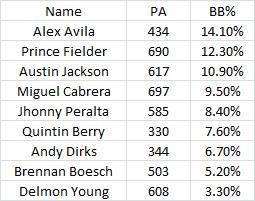
By walk rate (BB%), this is how the Tigers look.
By O-Swing% (swing percentage on pitches outside the zone):

By Z-Swing% (swing percentage on pitches in the strike zone):
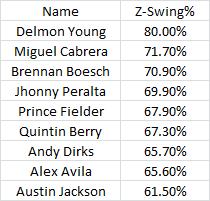
The information varies in each of these lists. There’s some correlation, but it’s not perfect. Taking pitches outside the zone makes it more likely that you walk, but lots of other things go into it. Cabrera swings at lots of pitches inside the zone, close to Delmon Young’s number, but walks a lot more than he does.
There’s so much that goes into each outcome that it’s easy to misinterpret the information. I’m pretty confident after looking at this information that Alex Avila is the more disciplined Tigers hitter, but there’s a case to be made for a couple guys for second place. And we haven’t even talked about what our eyes tell us.
When asking tough questions, instead of looking for the best number, let’s look for all the numbers. We’ll be better off.
Twins Trade Their Remaining Centerfielder
Last week the Twins traded Denard Span to the Nationals because they had Ben Revere to play centerfield. Today, they traded Ben Revere to the Phillies for Vance Worley and a pitching prospect because they had, um, Aaron Hicks to play centerfield?
They went from a team with many centerfielders to a team with less than one centerfielder. I can’t really fault the strategy given that they are probably a few years away from contention and that they wanted to maximize the return for guys who they don’t expect to be pieces of that success.
But I do have to wonder about the timing. Why wouldn’t they wait for Bourn, Hamilton, and Swisher to clear the market? Maybe that takes certain teams out of play for their guys, but wouldn’t it make the remaining teams more desperate? The Twins didn’t have to move Span and Revere for cost reasons or time horizons, so they could easily have waited this one out.
I also have to say the returns haven’t been spectacular either. Meyer, Worley, and Trevor May. I’m not sure those three guys dramatically improve their future success. In a best case scenario based on the scouting I’ve read on the two prospects, we’re looking at two #2s and a #3/4 guy with solid club control. That’s a good return, but that’s the ceiling. Prospect evaluation is full of uncertainty and those #2s could easily turn into bullpen pieces, swingmen, or nothing.
The Twins had a plethora of centerfielders and traded them all to bulk up their pitching depth. I think it needs to be said that two major league centerfielders are probably more valuable than one proven mid to lower rotation guy and two respectable ceiling prospects given that the centerfielders were on team friendly deals.
Hard to like this for the Twins in my book, which means as a Tigers fan, I love it. Grade: C
Tigers Decide Andy Oliver’s Time Has Come…To Go
It wasn’t that long ago that Andy Oliver was a top prospect in the Tigers farm system. But things change, and now Andy Oliver is a Pittsburgh Pirate and Ramon Cabrera is a Detroit Tiger.
The trade happened earlier today as the Tigers decided a change of scenery would be good for Oliver and got back a catcher who will start the season in Toledo. I don’t know much about Cabrera but the scouting report I received on him from Mark Anderson says that he has “an average glove overall” and “some modest hitting ability.”
It appears that Cabrera will be a useful depth guy for the Tigers behind the plate and can fill in on the big league roster if Avila or Holaday get hurt. The real story here is Oliver.
Just a couple years ago, he looked like someone who had a shot to really contribute to a big league rotation. But that hope faded. Slowly he started to look like a reliever. Then maybe nothing at all.
Oliver’s problem was that he lost command and then he lost his slider. A lefty who can throw mid 90s with a solider breaking ball is a big league starter. A lefty who can’t find the zone and only has a fastball is probably a LOOGY. That’s where Oliver is right now.
This is a story of the Tigers not cashing in on Oliver when his value was higher. I thought they should have traded him two offseasons ago. It’s easy to look back now and say that I’m right given that we know he hasn’t lived up to the potential. The Tigers wanted him to live up to it so they held on.
Today they let go.
Andy Oliver is the story of a prospect not panning out. It happens all the time. A great GM can see it coming and flip them for value before their stock tanks. That’s a very tough thing to perfect. Dombrowski did it perfectly with Andrew Miller. He didn’t do it with Andy Oliver. y with Andrew Miller. He didn’It happens all the time. A great GM can see it coming and flip them for Such is life.
Oliver has the raw ability to pitch, but doesn’t have the fine-tuned skill. I watch him a lot in Toledo and in his few stints in Detroit. The velocity from the left side is valuable, so he won’t have trouble finding someone to give him a chance, but I’m not convinced it’s ever going to happen for him.
That’s okay though. He’s still getting paid to play baseball for a living, even if he’s never going to be on top.
Tigers Bench Gene Lamont
Just in case Tigers fans felt left out after lots of baseball news over the last few days that didn’t involve their favorite team, things changed in a big way tonight. That’s right, the huge move you’ve all been waiting for has finally happened: Gene Lamont is out as the Tigers 3B coach.
Tom Brookens will move from 1B to 3B and Rafael Belliard will take over at 1B. Lamont will stay on staff but will become the Tigers bench coach, a position that wasn’t technically filled in the last seven seasons, but he essentially occupied for that entire time.
Throngs of Tigers fans who booed, stomped, and tweeted for Lamont to go have finally gotten their wish.
I’ve always wondered how much a 3B coach impacts the game. We can easily point to Lamont making bad calls over the last several years there, but how much better off would the club be with the best 3B coach in the league manning that spot?
I don’t have an answer and I’ve always wanted to know. I don’t watch enough games of any one other team besides the Tigers to even know how bad Lamont was in relation to his colleagues. I can’t think of other base coaches who made as many bonehead calls as Lamont over the last decade, but that’s probably just an observation problem because the raw number isn’t that high.
Is Lamont even the worst? Who is if he isn’t? If there are fans of other teams reading this, let me know how much you love or hate your third base coach!
It’s hard for me to imagine the Tigers won’t be better off with Brookens at 3B, but exactly how much better will be tough to determine. Please let me know if you have an idea about how to even figure this out. For some reason, this question captivates me.
The Red Sox might be signing players, the Nationals got Haren, and Greinke should sign soon, too. But the big newsmakers today were the Tigers as they benched Gene Lamont for good.
Red Sox Sign Victorino
The Red Sox continue to remake their team this winter and signed OF Shane Victorino to a 3 year deal worth $37.5-$39 million depending on who you ask. The Sox needed OF help and Victorino has been worth 3 plus wins in each of the last six seasons. He’s probably never going to make another run at 5.0 WAR, but he should be a useful outfielder for the Sox over the next couple seasons.
He’s not a great player on offense anymore but he doesn’t strike out and has a solid glove that should play up in a corner outfield spot. This isn’t a great player, but $12-13 million a season doesn’t buy what it used to. It’s a very interesting market for outfielders with a lot of very different players with very different skill sets. Bourn, Swisher, and Hamilton are left and the Red Sox are no longer in the market for them, so we should be getting closer to a resolution.
Grady Sizemore and What Could Have Been
It wasn’t that long ago that Grady Sizemore was a premier player. Really it wasn’t. Just four years ago he was worth 7.4 wins above replacement. Over a four year stretch from 2005-2008, Sizemore was a bona fide star on his way to a great career.
But brilliance can be fleeting for athletes and Sizemore ran into injury after injury. He’s played 212 games since and hasn’t hit above .250. He was a great player on the brink and then everything was gone.
He’s hurt again and his 2013 season will be on hold for a while. The 30 year old outfielder could have been one of the game’s top players, but instead may never play another meaningful game. That’s how quickly things can turn.
Take a look at his Fangraphs dashboard:
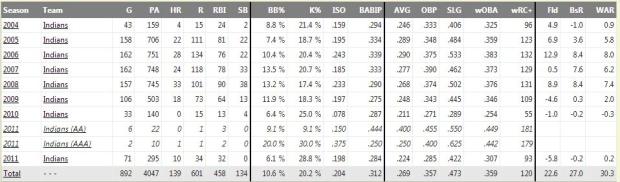
Four straight seasons of 157+ games, 20+HR, 20+SB, awesome walk rates, high average, and good power. He played solid to great defense and did so at a premium position on the field. Grady Sizemore was awesome.
And then Grady Sizemore was nothing. Only Albert Pujols had a higher positions player WAR in 2006. Pujols. That was it. From 2005-2008, Pujols, Alex Rodriguez, and Chase Utley were the only players to post higher WARs.
He was awesome to watch too. I didn’t really like doing it because he played against my favorite team, but he was spectacular. Power, speed, and highlight reel plays. Sizemore did it all and then he did nothing.
It’s a somber reminder for us that players who look invincible can vanish very quickly. Teams are backing up the money truck to free agents right now and one of them could be the next Sizemore. Cut down in his prime by a body that’s failing him.
So while he’ll work hard to get back and other players make the big dollars he was destined for, take a look at those stat lines again and think about Grady Sizemore and what could have been.
 New English D