A Plan For The 2016 Tigers

So, hey, remember the Tigers? I know they haven’t played baseball in a month, but free agency gets started this week and the club is going to have to do some work under new general manager Al Avila if they want to compete in 2016. And to some extent, that is a question they do have to ponder. Do the Tigers want to go for it in 2016 or do they want to take a step back and rebuild?
I think there’s a decent case to be made for sitting 2016 out, but it also seems pretty clear that the Tigers plan to compete. They have Cabrera, both Martinezes, Verlander, Kinsler, and Sanchez. That core isn’t getting on in years and so is the owner. And while Avila decides who, what, and where, Ilitch decides when. I could offer a rebuilding plan, but that would be more of a campaign manifesto than a governing document.
Earlier in the offseason, I suggested that based on the current roster, the Tigers need a center fielder, corner outfielder, backup catcher, bench stuff, a really good starter, and lots of relief pitching. Ideally, one of those outfielders would be close to a star level player. I’m working under the assumption that the team intends to ride it out with Nick Castellanos, but I wouldn’t be opposed to buying some third base insurance either.
Let’s take this position by position.
Corner Outfielder and Center Fielder
If you’re looking at the free agent market, there are plenty of excellent corner outfielders out there. It seems easy enough to pick one of them. There’s Cespedes, Alex Gordon, Ben Zobrist, Justin Upton, and Jason Heyward. The worst of the group is probably a 3 WAR player and the best could be in the 6-7 WAR range for 2016. All of these guys are very good, with plenty of potential for greatness. Of course, you’re going to pay for that kind of production, but it’s out there for the taking and it’s only money.
The other free agent options are guys like Chris Young, Gerardo Parra, Dexter Fowler, Denard Span, and Colby Rasmus. That’s not as impressive of a list, but they are guys you can add without giving up anything but cash (and maybe a second round pick).
But keep in mind that trades are also possible. You don’t have to find your new players on the free agent market. A name you might hear is Yasiel Puig. Carlos Gonzalez could be on the block. Ryan Braun might be on the move given the Brewers interest in rebuilding. In other words, there are a lot of very good outfielders available to the Tigers. Importantly, very few of the difference makers can play center field with regularity. You can find someone to play center, but there aren’t borderline starts in center to be had.
So that should lead the Tigers to look for a big upgrade in left (or right, JD can shift back) and add a less flashy option in center. I know the Tigers coaches and front office have had nice things to say about Gose, but he doesn’t look like a a starter on a competitive team. He’s a below average hitter, and despite his good speed, hasn’t played well defensively. Could they correct the defensive flaws, perhaps? Could the bat tick up, sure. But counting on him to take a real step forward is foolish if you’re really committed to winning in 2016.
I don’t think there’s any question that Heyward is the best player of the free agent group, but that also comes with a massive price tag considering his youth. He’s going to command more than $150 million and $200 million seems entirely within his grasp. It’s not a terrible bet given that you’re buying his late twenties rather than trading exclusively in his thirties, but it’s probably not a move the club can realistically afford. In the short term, his salary is manageable, but it might not be the right fit given the available options.
Upton and Cespedes are similar, with a nod to Cespedes for the better defense and a nod to Upton for the youth and OBP. I think Cespedes is a better player at the moment, but Upton might provide more total value over his entire contract. It’s a small consideration, but Upton will cost a second round pick and Cespedes won’t, plus the Tigers are comfortable with Cespedes while Upton would be new. So Cespedes is probably the better choice. Yet he will cost the team between $120 million and $150 million to reacquire. A step down from Heyward, but expensive.
Which brings us into the Gordon and Zobrist former-Royal pairing. Gordon will be 32 next season and has been one of the better players in baseball for the last five years. Zobrist will be 35 next season and has been one of the better players in baseball for the last five seasons. Gordon probably gets six years and $110 million to $120 million, a bit cheaper than Cespedes. He’s a good hitter, probably starting the deal in the 120 wRC+ range with elite corner defense. That’s a great player and one the Tigers really need. And he provides left-handed on-base skills that do not really exist outside of a healthy V-Mart.
Zobrist is older but he will cost much less as a result. I’d expect him to get something just north of the Martinez/Cruz contracts from last year, coming in around 4/$80 million. Zobrist’s bat has been aging very well, and while his defensive metrics weren’t good in 2015, he has been very good defensively at multiple positions in every year prior. Zobrist adds the the switch hitting element and gives the Tigers defensive insurance in the infield as well.
So if you’re picking from the group of very good corner outfielders, there are four options depending on the amount of risk to which you want to expose yourself. Heyward is young and amazing, but pricey. Cespedes is a known quantity, but his lack of discipline at the plate could leave him open to a steeper decline phase. Gordon and Zobrist are older and closer to the ends of their careers, but they are cheaper.
I’m not sure you can go wrong. I’d be happy with any of the options, but for me it’s Gordon or Zobrist with a tip toward Zobrist because he can play 2B/SS/3B in addition to corner outfield. Now, you are probably thinking that Kinsler and Iglesias have two of those spots locked down. While that’s true, Iglesias seems to be slightly injury prone and having Zobrist on the roster means you can free up a bench spot because you don’t need a second backup infielder. And if Castellanos can’t get it together, you have Zobrist to slide to third and you can replace Nick with an outfielder. That gives the team an ability to carry a bench player who is more useful as a PH than you would otherwise expect if you needed someone who could handle the dirt.
So I’ll recommend Zobrist at about 4/$80M. There’s no draft pick cost, he’s versatile, and he’s a tremendous player for two thirds of the cost of Gordon. That comes with age-based risk, but the Tigers are already carrying that in spades. What’s one more?
So now that we’ve pegged Zobrist for one of the slots, our attention turns to center field. You wouldn’t mind grabbing a really solid player, but you have to pay attention to the payroll. Factoring in commitments ($110M), expected arbitration salaries ($12M), and Zobrist ($20M), the Tigers are already at $142 million for 2016. I’m assuming $180ish million is the target.
So we have to leave room for relievers and a starter, so we can’t really commit a huge amount to a center fielder. One option would be to go to someone like Peter Bourjos, who could be had in a trade cheaply, who could mix with Gose as a below average hitter and great defender in center. It’s a good fallback option, but for it to work well, you’re counting on a bit of an offensive upside and he hasn’t had regular at bats in a while. To go the other way, you could try someone like Chris Young on a 1-year deal. He’s going to provide a bit more offense and he was a good defender in his younger days. He’d be cheap and hits right handed. Denard Span is interesting, but his health is probably a big obstacle.
And then there’s a possible reunion with Austin Jackson, who will probably be looking for a 1-year deal to build up some free agent value. Perhaps he’ll draw more interest than I think, but if you can snag him for a year, it might make sense.
So let’s split the difference. The Tigers should add one of the Bourjos-Young-Jackson contingent to provide support for Gose in center. None will cost much and all have decide upside. Call it $8 million, which brings us to $150 million.
Backup Catcher and Bench
So if the Tigers follow my lead, they would currently have three bench spots available. One of the four goes to one of the center fielders, so we have to allocate a spot for a middle infielder and backup catcher, and then someone else. The middle infielder can be Andrew Romine or Dixon Machado. Both play quality defense and it’s hard to find a good hitting option for that role. You might find a better hitter if you worked at it, but the cost seems unneeded.
So that leaves backup catcher. Bryan Holaday is an option, but he’s a very replaceable player. I would be all over Avila as a backup, but that sounds unlikely. The free agent ranks are thin and trading for a solid catcher is tough. McCann figures to get most of the reps, but someone like Dioner Navarro should be on the radar depending on how much Marco Estrada really needs him. The Tigers could probably find a team willing to trade a good catcher (Lucroy?) but a solid backup would be tough to snag. Maybe Holaday is the right choice. It would be very bad if McCann went down with a serious injury, but unless the Tigers wanted to downgrade McCann to a backup role, the options are limited because other than Avila, there isn’t an obvious solution. Put a pin in this.
So that leaves one bench spot left. Collins, Moya, and company will try to earn it. But that gives me a bit of an idea. John Jaso.
I know it’s not a sexy name, but he can mash RHP and while he’s not a good defensive catcher (and given concussion history, probably not a permanent one) he could absolutely provide the Tigers with a bench bat who also serves as a backup catching option. This gives the Tigers the ability to go north with Holaday if they want, but if Collins or Moya force their way onto the roster, you can take Holaday’s spot if you need to. Jaso can probably be had for a 1-2 year deal, let’s say for $7 million a season? Brings us to $157 million with a bench of Gose/other CF, Romine/Machado, Jaso, Collins/Moya/Holaday.
Now for the pitching.
Starting Pitcher
So the Tigers have two very obvious rotation pieces in place. Justin Verlander and Anibal Sanchez will be in the rotation unless they wind up hurt, and as they currently stand, they are probably #2-#3 starters. So the Tigers need an ace, at least.
They also have Daniel Norris. While his prognosis is good, you also don’t want to invest too much in the idea that he’ll be in top form from Opening Day. Even if everything is great and he’s cancer free, it seems probable that his offseason regiment will be affected. There’s also Matt Boyd, Michael Fulmer, and Shane Greene. Ideally, this calls for a veteran innings eater and a frontline ace. What are the options?
Among the aces on the free agent market are Johnny Cueto, Zack Greinke, David Price, and Jordan Zimmermann. And behind them there is plenty of mid-level and back end pitching. It’s a good year to need pitching, if there ever is such a thing. So let’s start with the ace. Those are four expensive pitchers, with Cueto, Zimmermann, and Greinke probably in the $150 million range and Price in the $200 million range. If you sign one of these guys, you’re at your limit for 2016 and you’ve committed to another 30-something pitcher who might explode because pitchers are flammable.
It’s tricky to know who will be on the block and what the Tigers could afford to trade. The Indians are likely to make one of their starters available, but the Tigers don’t really have an obvious young hitter to swap. Sonny Gray plays in Oakland, so he might move, but Billy Beane isn’t going to want to have a Donaldson repeat, so the price tag will be justifiably high. Which brings me back to a pretty interesting name: Tyson Ross.
Ross has two seasons of team control left, but he’s a super two player who will probably wind up making $10 million in 2016 and maybe $13-$15 million in 2017. While that’s still a bargain for the Padres, the Padres need to try to undo some one the damage of last year’s spending spree. The Tigers could go a couple of ways. They could could dangle someone like Iglesias, something like Machado and Hill, or maybe even one of the young arms they acquired last July. It will depends on how things shake out, but Ross is a worthwhile target. Heck, maybe Castellanos is Preller’s kind of player given his desire to add every right handed hitter who can’t play defense to his roster. Ross is a bit below “ace” territory, but he’s very good and would be the right kind of investment for a team that still has work to do.
Let’s assume they fork over talent, which means they need to add another one of the free agent pitcher for depth. An interesting option would be Mat Latos on a 1-year deal. Latos was cruising toward a nice contract but his ERA was awful and he bounced around a lot in 2015. The underlying numbers aren’t too bad and he seems like a good bet to want to rebuild his value before trying for a big deal next winter.
The same could be said for old friend Doug Fister. Fister was great from 2011-2013, was okay in 2014, and then really struggled in 2015. He’s not the borderline ace we used to know, but he would make an interesting buy-low option who could wind up being a fun righty reliever if things went south. There are other options, but you’re probably looking at multi-year commitments, and while that’s not out of the question, it would set the Tigers up for issues if the young arms started to emerge.
Let’s trade for Tyson Ross and sign Latos/Fister. Let’s call it $15 million total (with incentives), moving us to $172 million.
Relief Pitching
Uh oh! We’re down to $8 million, so we’re going to be pushing our budget. Although it probably wouldn’t be hard to backload the Zobrist deal, so we can go over by a bit without much worry.
The Tigers have Alex Wilson and Blaine Hardy in hand as two of their seven relievers. There are also some other guys like Rondon and Alburquerque who might be good enough to play a role. Then you have VerHagen, Farmer, Lobstein, Ryan, and whichever guys don’t make the rotation. That could be Greene and Fulmer, or Latos and Boyd, it doesn’t matter. Let’s say the Tigers can fill two spots with the other in house options, leaving three open slots to fill.
Realistically, that means you probably want to acquire five new relievers to make sure three make it through the line, but I’m going to figure the current Tigers have the insurance covered. That was always Dombrowski’s big weakness. He planned for everyone in the bullpen to pitch well and stay healthy, which doesn’t happen. I’ve listed more than seven pitchers already, but the key is to make sure you start with more than seven because some of them won’t work out. I’ve listed 12 names so far and one will make the rotation, so that’s 11 guys for 7 spots. I would like three more.
So we need a real lefty and two righties in addition to what’s already in front of us.
Target one, if you can believe it, is Joe Blanton. He dropped his arm slot and became a slider happy reliever in Pittsburgh last year. Next up is Darren O’Day, who is very good but he’s 33 and doesn’t throw hard, so people will shy away from big money. You get him with a nice AAV, but mostly by going longer than anyone else. Throw in Oliver Perez, who has been consistently solid as a lefty out of the pen over the last four seasons.
I recognize this is a weird collection of arms and that it’s a little less open and shut than my plan for 2015, but I actually think it’s a good direction. O’Day-Wilson-Blanton-Rondon-VerHagen from the right side and Hardy-Perez from the left side with some other current Tigers filling in around them. It’s not the Royals bullpen, but you can’t just pull the Royals pen out of nowhere. I like VerHagen’s potential out of the pen, and Farmer/Ryan/Lobstein should probably turn into one good reliever. Maybe you get lucky and Greene or Fulmer plays up in the pen for part of the year. The idea with these signings is to create depth. The stupid thing would be to acquire one elite reliever and assume you can fill the rest of the slots internally. You need to add quantity more than top end quality.
It’s much smarter to acquire 150 good innings than 65 great innings, especially when you don’t have a lot of good relievers already in palce.
Let’s say O’Day, Blanton, and Perez run the Tigers $11 million in 2016. We’re at $183 million or so, and probably have to add a few more in minimum salaries. So that’s somewhere in the $180M-$190M range for 2016.
In doing so, the Tigers added Zobrist, a platoon CF, Jaso, Ross, Latos/Fister, and three quality relievers. It was expensive and tricky, but it got the job done. That’s a mid to upper 80s win team in my estimation. If things break well enough, they win the division and play in the LDS. If things break wrong, they can offload whichever pitchers are useful.
Granted, I don’t think this makes them a dominant force with which to be reckoned. A Ross-Verlander-Sanchez-Norris-someone else rotation is good. A bullpen with O’Day-Wilson-Blanton-VerHagen-Hardy-Perez is okay. An offense that swaps out Cespedes for Zobrist and counts on something from VMart is solid. This isn’t the 2013 team, but it’s a team that is competitive without investing too much money and tying the team’s hands. Zobrist is the only new player that drags on the payroll into the future.
I’ll leave it here, and will revisit some of the individual aspects in future posts because somehow I’ve held your attention for 3,000 words and I don’t want to get greedy.
Should The Tigers Extend JD Martinez?
While eight other fan bases are still enjoying themselves, the Tigers are planning for 2016 and beyond. They have a lot of work to do if they are planning to contend next year, but it’s not an insurmountable task. One of the issues the Tigers will confront this winter that is a little less urgent is the matter of JD Martinez’s contract situation.
Martinez has two years of team control remaining, both of which are currently slated for arbitration. He will likely earn about $8 million in 2016 and something like $12-14 million in 2017. For ease of presentation, let’s say the Tigers will be able to keep Martinez for the next two seasons for $20 million. That’s Martinez’s age 28 and 29 season for $20 million, with him set for free agency at 30. Should the Tigers look to buy out any of those free agent seasons this winter?
The first thing we need to do is estimate what it would take to extend Martinez. We’ll start with the 2/$20M we know he has coming. Only very young or extremely good players get deals longer than 7 years, so let’s say the Martinez deal would max out at 7 years, or 5 free agent years. For argument’s sake, call it 3-5 free agent seasons depending on the average annual value of the deal.
Martinez has been worth 4 WAR and 5 WAR in his two seasons with the Tigers, and it’s probably safe to say he’s had his best seasons. That’s not to say he’s going to get a lot worse over the next couple seasons, but it’s not likely he’s going to get better. Let’s presume his true talent is a 4 WAR player for 2016. If that’s the case, and we factor in the way players normally age, something like 17.5 WAR would be expected over his next seven seasons. On the free agent market, you’d probably expect to pay $140 million for that kind of player.
But of course the Tigers have some leverage, in the sense that Martinez is locked up for the next two years. So what we really care about is what we expect in years 3-7, which might be something like 10 WAR. So that would be about $80 million if you were buying that level of player on the free agent market. Keep in mind we are talking about 2018-2022. Martinez is a better player than that right now, but you don’t sign players for long term deals based on their current quality.
So if you add 2/$20M and 5/$80, you wind up with a 7 year, $100 million extension for Martinez. If you only want to go the 5 year route, you can probably get away with a 5 year, $80 million deal. In my head, I was kind of expecting 5/$75M, so I’m happy to see the math worked out so nicely.
I would argue that Martinez is probably an easier player to sign than most players of his quality because his success is rather new and that will lead him to be risk averse. I don’t know that for a fact, it’s just an inference. Martinez has only made about $5 million in his career and even after this year’s arbitration award, he hasn’t made the kind of money that sets up one’s grandchildren for life. Given how close he was to never getting the big paycheck, it seems reasonable that he would be more risk averse.
So let’s focus on the 5/$80M version of the offer. Presumably 7-year version wouldn’t be that much more interesting to either side because it’s not a lot more money for Martinez and it’s very far in the future, so the Tigers won’t really care a lot. It’s easier to analyze a single scenario, so let’s call it 5/$80M (but keep the 7/$100M in your mind).
Given that we have some framework for what the deal would be, the question we need to ask now is if the Tigers should do it?
Can the Tigers expected to get $60 million of value from Martinez’s age 30-32 seasons? On the face of it, that seems like an obvious proposition given the season he just had, but players age. If you could guarantee a repeat of 2015 for the next five years, life would be very different indeed.
I would argue that while Martinez’s lack of success prior to 2014 is a bit of concern, watching two years of Martinez as a bona fide slugger has been enough to assure me it wasn’t a fluke. It’s very possible that he ages poorly, but I’m beyond the point of worrying his success has been a mirage.
So let’s try to figure out how Martinez will age. To do so, let’s look at the players who were somewhat similar to him during their age 26-27 seasons from 2000-2010. There were 134 qualifying 26-27 seasons during that window. Martinez had a 144 wRC+ during his two seasons, so let’s look only at hitters who were between 135 and 155. That leaves us with 12 players. That’s a good number for this analysis, but it’s also worth cutting out one additional player – Alex Rodriguez – who played premium defense during those years. Even if you like JD’s glove in RF (I do), a solid corner man is not the same as a very good shortstop.
So that leaves us with 11 players who had their ages 26-27 seasons between 2000 and 2010. None of them are perfect comparisons for JD, but they are the guys who hit about as well as he did for those seasons and did so without being a great glove man as well. How did the same group do in their ages 28-29 seasons and then 30-32 seasons?

There’s plenty happening in this table, but allow me to summarize. The group averages about 10 WAR during ages 26-27 with the range being 6.6 to 12.7. JD sits around 9 WAR and has a wRC+ in the middle at 144. The same group averages 7.2 WAR from ages 28-29 with a range of 0.9 WAR to 11.3 WAR. On average, the bats decline by about 8-10 points of wRC+.
Then in the 30-32 window, we find an average WAR of 9.1, ranging from 1.6 to 16.6. Again the average wRC+ declines, but only about 5-7 points from this step down. In other words, it would be a reasonable expectation to say that Martinez will be worth around 9 wins from age 30 to 32. And given that we’re only looking for about 7.5 WAR of value for those seasons, this seems like a solid bet.
But it is a little more complicated. First, you might wind up with Nick Johnson or Ryan Howard. You can’t simply look at the mean and median, you want to look at the range of possible outcomes. If Martinez were to hit the low value, you’re down about $50 million. If he hits the high mark you’re up about $70 million. The degree to which you like those odds depends entirely on your risk aversion.
There’s one more factor that I always implore teams to consider. It’s why I advocated strongly against the Cabrera extension. It’s not about whether it’s a good deal today, it’s about whether you could get a better deal later. The thing you really want to consider is how much Martinez would cost you if he has the best case scenario over the next two years.
So let’s play that out. The highwater mark is about 11 WAR, and that makes sense. It’s basically back to back 5.5 WAR years. If Martinez does this, the Tigers will be super happy because they’re going to get about $90 million in value for $20 million, but it will also add to his price come free agency. Let’s say he does that and is coming off four very good seasons and hits the market at age 30. For argument’s sake, let’s call it a 5-year deal. That’s probably going to cost you $160 million plus inflation.
So you have three options. First, you can do nothing and not re-sign him. you pay $20 million for two years and walk away with plenty of bang for your buck. Second, you extend him now for 5/$80M or 7/$100M. Third, you pay $20 million and then sign him as a free agent for 5/$160M (i.e. 7/$180M). This is all assuming JD hits his best case scenario. If he hits that scenario, you’re risking something like $80M to $100M. That’s a lot!
But what if you sign the deal and he hits the worst case scenario? What if he’s only worth 2 WAR and you’ve paid him $60M or $80M? That’s a loss of $50M to $70M.
Your decision to offer an extension to Martinez comes down to a very simple thing; how good do you think JD will be over the next two seasons? If you think he’s a 5 WAR player in each of the next two years, you definitely want to sign him not. If you think he’s crashing and burning, obviously you don’t. So what’s the breakeven point? That is the single most important piece of information.
In essence, what performance over the next two years would yield a 5/$80M deal from 2018 forward? Essentially, you have to think he’s going to be a 3.5 WAR guy over each of the next couple of years. The odds say that is pretty likely. There’s a good chance that Martinez will be good enough for the next two years to warrant a contract that will exceed what you could get him for this winter.
But I’m not sure it’s a slam dunk case. If JD Martinez came to the Tigers and said he’d sign a 5/$80M or 7/$100M extension, I would still balk. I think that’s the highest I want to go. Martinez is a very good player but they already have two seasons of team control in hand and players can change a lot over the next two seasons. And they can especially change a lot over five and seven seasons. Personally, I would rather risk him getting even more expensive in two years than commit to a huge extension right now.
Miguel Cabrera is locked up long term, which means there is no DH spot to transition to if JD loses a step in the outfield, and his high strikeout rate and unimpressive walk rate suggest that if he loses a bit of bat speed, he could really crater. I’m not suggesting he’s due for a collapse, but I’m not so sure he’s a safe bet to keep being great for this long. I have a hard time believing that Martinez is going to put together two more huge seasons. A couple of 3 win seasons seem more likely, and then you can make the decision with more information without any of the risk in two years.
Again, this is a risk aversion question. I’m very risk averse so it informs my thinking here. I think signing Martinez to an extension will probably be fine. Even if he ages a little worse than average, you’re not going to lose much money. But I also don’t think there’s a ton of savings coming if you sign the deal today and it comes with plenty of risk.
I’m thrilled to see Martinez on the Tigers for the next two seasons, but the way I read the market, the deal he would accept today is not team friendly enough to warrant the risk for the club. So I would recommend against it, but this is a 60/40 kind of thing. I’m not strongly against it, but the last two mega-deals the Tigers signed have been mistakes. Not because Verlander and Cabrera are useless, but because the Tigers could have signed them for less if they had waited. It’s rare for players of this age and caliber to get better, and if you wait for them to have a slightly worse year, you can save some cash and you still haven’t lost them for good. You also retain the option of trading the player for prospects if you’re terrible.
So I’ll come down against a contract extension and recommend they spend their time and resources on improving the club with outside players. They have two great years of Martinez for next to nothing. The Tigers should benefit from those and revisit the relationship when Martinez is reaching free agency.
The 2016 Tigers, As They Stand Now
The 2015 Tigers officially ended their campaign on Sunday. The season was over long ago, but it didn’t go in the books until around 6pm last night. It’s over and done. They can’t hurt you anymore.
For the first time since 2010, the Tigers don’t have any games after #162 so we can get to work early on planning for next season. There is plenty up in the air and plenty that will be decided based on the actions of the other 29 teams, 10 of whom are still focusing on 2015. For our sake, let’s spend this post looking internally. Who are the current Tigers who will serve on the 2016 roster and what will their roles be?
The Sure Things
Only injuries or massive shakeups can prevent the following players for having a big role on the 2016 team:
- Miguel Cabrera (1B)
- JD Martinez (COF)
- Victor Martinez (DH)
- Ian Kinsler (2B)
- Justin Verlander (SP)
- Anibal Sanchez (SP)
Will Make Team
These guys will make the MLB roster unless they are hurt or traded, it’s just a question of how they’re used.
- Daniel Norris (SP)
- James McCann (C)
- Nick Castellanos (3B)
- Jose Iglesias (SS)
A Role
These guys will be contributors in some form or fashion, but have less job security than those above.
- Alex Wilson (RP)
- Blaine Hardy (RP)
- Tyler Collins (COF)
- Anthony Gose (OF)
- Andrew Romine (INF)
- Matt Boyd (SP)
Other Guys
There are certainly other players in the organization who have and will see MLB time in 2016. The relief corps, Bryan Holaday, Dixon Machado, and Steven Moya, in particular. Expect to see Michael Fulmer as well.
*****
So how does this shake out? Where does that leave the 2016 Tigers before making offseason moves? Here’s my general expectation.
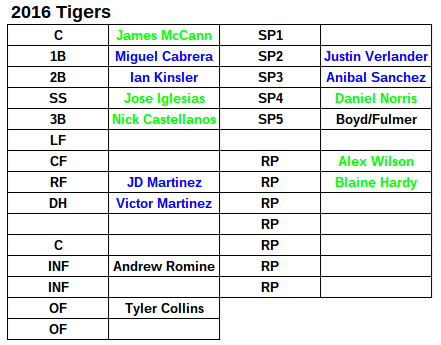
This isn’t exactly what I would do if I was in charge or exactly how I think the roster will look, but it’s a general guide based on both. I expect McCann has established himself to the point where the club won’t look for a primary catcher during the offseason. Cabrera, Kinsler, JD, and Victor are safe, with the possibility that JD might wind up in left. Verlander and Sanchez have rotation spots if healthy.
Iglesias will play short, but I hesitate only because it is possible they wind up trading him to fill a need elsewhere given Dixon Machado’s defensive ability. Nick Castellanos probably isn’t as good as the team wants him to be, but his offense in the second half is enough for me to think the team won’t move on this offseason.
Norris has probably locked up a spot in the rotation, and I expect either Boyd or Fulmer will win another. The bullpen will be a big question mark, but Wilson and Hardy have done enough. As for the bench, a lot depends on how the starting spots shake out, but Romine and Collins seem like safe bets for two of those spots.
That means, the Tigers have the following shopping list:
- Center Fielder
- Corner Outfielder
- Backup Catcher
- Various Bench
- Front Line Starter
- LOTS OF RELIEF PITCHERS
- EVEN MORE RELIEF PITCHERS
This is a long list, but there are only two or three critical needs. The Tigers absolutely need a top tier starter. Maybe not Price or Greinke, but they need a very good starting pitcher. Someone who can be in the 4-6 WAR range.
They also need one of their new outfielders to be a top tier player. Cespedes would fit, but so would Heyward or Gordon. Or someone on the trading block come December. They will also need another outfielder, and even if they want to give Gose another shot, having no real alternative is a bad idea. Gose is likely a backup at the MLB level and the Tigers shouldn’t plan to have the job be his to lose.
They need a catcher and some bench stuff, but those are easily attainable. The key is actually caring about the spots, which Dombrowski often didn’t.
Finally, the bullpen. We’ll see what Avila’s philosophy is, but Dombrowski would famously sign one Proven Closer and then magically assume all of the in house options would hit their best possible outcomes. How many times can you really believe Alburquerque is going to be a shut down reliever? The Tigers realistically, and I’m not kidding, need to sign about six legitimate relievers this winter. One or two should be very good.
So that’s it. Really good outfielder and pitcher, decent outfielder, bench help, and relievers. It’s a long list but a doable one if they are trying to contend in 2016. I’ll have follow up posts advocating for particular targets, but now we have a sense what they need to find once the hot stove heats up.
The End Of The 2015 Tigers
The first post on this website came prior to Game 3 of the 2012 ALCS. The Tigers were about to win two at home against the Yankees before being roasted in the World Series by the Giants. That’s a slightly elongated way of saying that this is fourth time I’ve written a eulogy for a baseball team.
In each of the three prior cases, there was no guarantee the season would end on any particular day. The 2012 Tigers could have won Game 4 and played on. The 2013 Tigers could have won Game 6 and played on. The 2014 Tigers could have won Game 3 and played on. The 2015 Tigers have no such option. They were officially eliminated last week and effectively eliminated in July. This is the first time since I began writing about the team in 2012 that the end came with no possible hope.
There are good and bad aspects to that. The miserable baseball we watched this season was trying, but there was something peaceful about not playing any games during the final two months of the season that dialed up your blood pressure. I wouldn’t recommend that the Tigers try to lose every year, but if they were going to miss the playoffs decisively, I’m happy they lost in July rather than on September 15th, if only for our health.
It was a weird and depressing season. They started 6-0 and 11-2. They went 65-83 the rest of the way and gave up runs like it was going out of style. The final record belies the quality of the team they started the season with, however, as they dealt David Price and Yoenis Cespedes, both of whom had tremendous seasons before and after the trades. The Tigers also lost two and half months of Verlander and had some combination of broken/missing Anibal Sanchez.
Dave Dombrowski built a better team than the one that Al Avila will finish with, but it was never a team that could rival the great 2011-2013 squads. The starting pitching was worse off even when Price was still on the team. Calling the bullpen a dumpster fire would be an insult to dumpster fires. And while the offense was solid and the defense was better, there were still weak points around the diamond, primarily in center field, third base, and (sadly) designated hitter. And that’s before acknowledging the six weeks Miguel Cabrera missed during a crucial juncture of the season.
In part, this was a failed design and dumb luck. These Tigers weren’t build to steamroll the American League and they really weren’t build to overcome adversity, but losing Cabrera, Verlander, and Sanchez for big chunks of time while also getting nothing from a recovering Victor Martinez was always going to be too much to overcome.
Even with a tremendous follow-up campaign from JD Martinez and four great months from Price and Cespedes, this just wan’t going to work. James McCann was a revelation against the running game, but his bat slowed as the year wore on. Jose Iglesias made dazzling plays and definitely hit at or above his projections, but he botched more routine plays than you’d like and wound up missing time with various injuries.
Nick Castellanos played better defense than he did a year ago, but it was still extremely poor. His bat definitely picked up after a few days off in June, but his second half performance is the minimum he has to do in order to make his defense tenable at the hot corner.
Ian Kinsler was great again, highlighting one of Dombrowski’s great moves. Miguel Cabrera was terrific when healthy until the final month of the season, when he was unable to really drive the ball. A long offseason should help there. Anthony Gose showed some raw ability, but did nothing to make a claim on a 2016 starting job. Rajai Davis had a nice season, as did Andrew Romine’s glove. Alex Avila remained an on-base machine, but a complete lack of extra base power is going to force him to find employment as something lesser than a front-line catcher.
On the pitching side, Verlander’s late season resurgence will be the story. You shouldn’t let it blind you to the coming effects of aging, but getting healthy and having success will bode will for the near term. Blaine Hardy and Alex Wilson had solid seasons in the bullpen, but everyone else who touched the mound basically turned to mush. Time will tell whether Sanchez can be Sanchez when he’s healthy, and fully rested and acclimated versions of Daniel Norris and Matt Boyd are compelling, but if the Tigers are going to be great again, they need a lot of new relievers and at least one starter.
The story of this season will, however, always be what happened in the first days of August. After a disappointing season, the Tigers were sellers for the first time since 2010 and despite a universally lauded deadline, owner Mike Ilitch showed Dave Dombrowski the door in favor of Al Avila. I wrote extensively about the move and what it means, but the biggest head-scratcher is that Dombrowski was the only casualty of the failure. The rest of the front office survived, as did Brad Ausmus and the entire coaching staff. The blame fell at the feet of one man. A man who happened to do more to revive the franchise in the preceding week than anyone really thought possible.
The Tigers farm system is in much better shape going into 2016, and they’ll have a protected first round pick next June as well. Yet despite all the success and the firm footing for the future, the architect was relieved of command.
Avila is well-prepared for the task ahead after a lifetime of experience, but the mind-boggling decision to retain Ausmus and his staff rings as a very bad omen for what’s to come. We don’t really know what Avila will do now that he’s the guy but his history of finding good talent to sign is at least somewhat shadowed by his inability to see the colossal embarrassment his own manager has been.
This was a transition year for the Tigers. A transition that started back in November of 2013, I suppose. There’s plenty of blame to go around for the club’s failure to win a title over the last five years and their inability to make the postseason this year. It was a shaky roster, managed poorly, and oft injured. It was what it was.
Yet there’s a very odd feeling I have at the end. Objectively and subjectively, this was the hardest Tigers team to watch since the Renaissance. They wound up finishing about on par with the 2008 club, but the horrible fundamentals and inept leadership made it much less fun. But the feeling I have transcends that a bit.
This was the worst Tigers team since the turnaround, yet the day after the official surrender was the most optimistic I’ve been about their long term future in quite some time. Adding Norris, Boyd, Fulmer, et al to the stable made the organization look healthy. And then three days later Dombrowski was gone. At first, it seemed mutual but it slowly turned into a clear dismissal with an unclear origin. Dombrowski was not perfect in that chair, but a split had clearly occurred at the highest levels, and the person I trusted most of the group was the one that wound up elsewhere.
Ilitch and Avila are both good overall, so the future still looked bright, even if it wasn’t quite as rosy a transition as you’d like. And then it happened last week. Avila made the determination that Ausmus was coming back, and all of the signals he was sending about modernizing the organization started to look like cheap talk. Avila spoke about elevating analytics in their decision making, but outside of the bullpen, Dombrowski rarely seemed to make decisions that flew in the face of analytics. The Tigers could certainly modernize a bit, but the first and only real decision we have to evaluate Avila was retaining a horrible manager with no idea about how the game is played. It does make you worry.
There will be an entire offseason to evaluate what happens next, but the seeds were planted in the ashes of the 2015 club. There were injuries of concern and some very good seasons to appreciate. The overall on field product was rough, but all of the flaws there are correctable. Replacing the bad starters is within their grasp. If they learn their lessons, the bullpen is fixable. Patching the position player side is manageable.
It is very easy to imagine the 2016 team being a real contender. It’s not a particularly tall task to get them there, in fact. The question is the overall direction. We don’t have much data on Avila as the leader, but the one data point we have is bad. We used to think of Ilitch as the ideal owner, but that image has fractured as well.
There were things to like about this team, but after those early days, it was not a team that was easy to love. The roster isn’t a disaster zone and things could be great in one year’s time. The problem, as we arrive at the end of this version of the franchise, is not that they were bad this year, it’s that we don’t know if their next step is going to be in the right direction.
The Year The Tigers Stopped Pitching
I put it out on Twitter last night that the Tigers pitchers have combined for 7.8 fWAR in 2015. That’s not good, and what’s worse is that 6.2 of that mark belongs to David Price and Justin Verlander. That’s 80% of their WAR coming from 20% of their innings. As a club, they’re one of the three worst run prevention teams this season.
This is particularly devastating to watch because pitching was the club’s strength for the last few years. We knew Verlander was a question mark and that failure would mean a Price deal, but the big blows were losing Scherzer and Porcello while dealing with an injured and homer-happy Sanchez. We were optimistic about Greene, but having Greene and Simon in place of Scherzer and Porcello is a downgrade, clearly. So we expected worse and it turned out to be awful.
It happened by trading away the last two months of Price, having a broken or missing Sanchez, and counting on Greene and Simon at all. Turns out, once Verlander got healthy he was good, so that was nice of him. Matt Boyd and Daniel Norris are promising, but they haven’t lit the world on fire post deadline and guys like Farmer, Ryan, and Lobstein have occupied a number of innings. And we won’t even talk about the bullpen because this is a family website.
But let’s put the year in context a bit. The story of the 2015 Tigers pitchers in four graphs:

2008 was the last bad year, and the Tigers have been average (100) or much better (lower) as a staff every year since. This year, not so much. You can explain the faltering quite easily. Fewer strikeouts, more fly balls, and more dingers.

Keep in mind that strikeout rate is going up across the league, so the Tigers decline over the last two seasons is actually even more pronounced than it looks. And fewer punch outs means for balls in play, which in conjunction with graph number three, means lots more fly balls. And in conjunction with graph four, way more dingers.

Miss you, Rick.

It’s not really very complicated. This isn’t some horrible failure of coaching or game-calling, the Tigers just used worse pitchers. Only Sanchez did something really outrageous, and now it seems like that may have been linked to a shoulder injury he says he felt for a “couple of months.” Price was great, Verlander was better than expected, Sanchez was hurt/something’d, and everyone else hit at or below their expectations in a very normal way.
The Tigers were one of the best pitching staffs of all time in 2013, regressed to the mean a bit in 2014, and then became very bad in 2015. It was a steep fall, but not one that was unexpected. With a new GM in place, it’s not clear what the Tigers intend to emphasize in 2016, but they will need to acquire at least one top flight arm in order to urn their pitching into a strength.
Sanchez should be more useful if healthy, Verlander should be useful if healthy. Some combination of Norris, Boyd, and Fulmer should offer two quality backend arms. That leaves one big void, with some interesting enough depth options in Greene, Ryan, and Lobstein to fill in for injuries. And there are options if the Tigers want to go out and acquire that ace. It was a bad year, but try to let it ruin your winter [note: New English D does not expect you to live up to that].
Al Avila Fails His First Test
I want to share a secret about writing. Sometimes, I prepare things in advance and wait for the news to break. For example, I wrote last year’s post about the division clincher two days ahead of time and then added in the specific details the day it happened. So…here’s a paragraph I drafted literally yesterday, prepared for two weeks from Monday:
Today, the Tigers fired manager Brad Ausmus two years into the three year deal he signed prior to the 2014 season. This firing was expected. Ausmus’ poor performance as a manager made his situation tenuous as the team faltered in June and July, but when Dave Dombrowski was fired and Al Avila took over in August, it was clear that Ausmus’ days were numbered. That was readily apparent when Avila decline to give Ausmus a vote of confidence, saying simply that he would remain the manager through the end of the year. Not a ringing endorsement when your contract extends through 2016.
I don’t think I need to tell you how surprised I was by today’s news that Brad Ausmus and his entire staff will be back for 2016. I am shocked. I’m floored. I can’t believe it. If you had to pick characteristics of manager firings, new GM/underperforming team/being unpopular with the media is the trifecta. Ausmus has been a dead man walking for two months. And the governor called at the eleventh hour. What in the world?
Regular readers or “people within earshot of me during Tigers games” know that I’ve been clamoring for the end of the Ausmus Era since late in the 2014 season. While his initial performance with the media after being hired, in conjunction with the hiring of Matt Martin and retention of Jeff Jones gave me a lot of hope for the direction Ausmus would take as manager, that eroded over the course of 2014.
Last April, he looked good because the team was rolling and he wasn’t calling bunts or doing anything particularly meddlesome. The clubhouse was relaxed and things were fine. I didn’t argue that he had shown himself to be a good manager, but he had not done anything to worry me and that’s all you can ask in month number one.
But when the Tigers ran into problems scoring runs last year at times, he started mashing all of the buttons on his keyboard like a child who doesn’t know how to ask for help. I won’t take the time to run down examples of each grievance, and I’ll get to the broad complaints momentarily, but the moment he really lost me was a late summer night in Cleveland when he used Ezequiel Carrera as a pinch hitter over Moya and Collins because “If Carrera gets on he can steal a base.” I don’t need to tell you why that’s stupid, but I will anyway. Carrera is a very bad hitter. The odds of him reaching base are lower than anyone on the team. Setting aside the fact that a stolen base was not totally necessary at the time, the logical approach would be to use a good (better) hitter to get on base and then utilize Carrera as a pinch runner.
It’s possible that Ausmus didn’t actually believe what he was saying, but given that it was entirely nonsense, it’s hard to imagine how saying that would be a good public relations move after a mind boggling failure. And Ausmus never won me back.
He is deeply flawed as a manager for many reasons, which I’ll summarize here.
He had no idea how to manage a bullpen. This manifested itself in two ways. First, he has no understanding of leverage and when it is appropriate to use his best relievers. He wanted to get pitchers into roles, rather than using pitchers when they are needed most. Now of course, many managers fail to do this to my liking, but Ausmus is particularly flawed and it showed up big time considering that he had a lot of bad relievers to work around. If you’re given bad ingredients, you have to be very talented to make them work. Ausmus is not.
Second, he didn’t really have a good understanding of which relievers were good at which things. He never wanted to use Soria (even before Soria struggled) and he insisted on Joba and Nathan even when both were pitching very poorly.
He preached/allowed horrible base running. When Ausmus first got to Detroit, there was a sense he was going to make the club more aggressive on the bases. Some of that was roster-based, but a lot of it was his tendency to push the envelope. That’s acceptable to a point, but the Tigers were really bad at it. Horrible, even. They made bone-headed play after bone-headed play, costing themselves countless outs (you could count them, actually, I was just too lazy to actually do it when writing that sentence and now I’ve taken longer to write this explanation that it would have taken me to look it up).
Now, Ausmus can’t use mind control and prevent his players from making bad decisions all the time. But at a certain point, it was his job to tell them to knock it off. Fewer steal signs? More red lights? Coaching about when to run? All of the above were needed, even if we don’t know how much was active mistakes by Ausmus or mere negligence.
He didn’t know his players. There’s really no greater flaw than putting your players in position to fail. Ausmus did this all the time. The Carrera example stands out, but he ran multiple relievers out to face bad matchups. He used Gose at leadoff constantly. He asked Alex Avila to bunt!
More concretely, he often made comments that reflected this ignorance. I understand his motivation to protect certain guys, but his descriptions of Nick Castellanos’ defensive struggles in 2014 were incorrect. He somehow thought Carrera was a good defender. He frequently spoke of a pitcher having “good stuff” on a day in which he didn’t. He brought up batter-pitcher matchup stats that were based on useless data.
I don’t require a manager to be painfully honest, but I prefer the lies, if they are lies, to show some recognition that the manager actually knows the truth.
He refused to learn and he never planned ahead properly. My biggest complaint about Ausmus over the last two years is that he doesn’t change his mind when his decisions predictably fail. He would make stupid moves, get criticized for them, and then he would defend himself by walking the media through his thought process. That’s all well and good, but he wound up giving the same explanations about the same mistakes over and over. He didn’t appear to ever stop and think that his views on the strategies could be flawed.
I get that it’s human nature to avoid acknowledging when you were wrong about something. I don’t need Ausmus to apologize for being stupid three months ago, but I would like some indication that he has internally reflected and changed his internal decision making. That never happened. He dug in his heels and kept doing it his way. Contrast that with Ned Yost’s evolution over the last year, or Clint Hurdle’s over the last five.
Which leads me to the meta-criticism of Ausmus that really should have become his downfall. He is horrible at planning ahead and it caused him to fail spectacularly. The basic flaw in everything Ausmus does is that he manages the game based on how he expects the game to play out, not based on how the events actually unfold. He gets to the 7th inning and gets Alburquerque, for example, warming in the pen because the other team had three righties due up.
The problem, however, is that if Alburquerque doesn’t get the first two guys out, it would be clear that two lefties would be up in the inning. By the time Ausmus realized it, there wouldn’t be time to get Hardy or someone loose to face them. He doesn’t plan for his first move to go wrong and so he has no backup plan.
This happens with pinch hitters too, as he holds a guy back from a good spot because it was too early in the game and he didn’t want to be without a pinch hitter for a spot he envisioned later.
The flaw here is that he traded away the present for the future. That can often make sense, but he fails to factor in the fact that the event in front of you is definitely happening and the event in the future is probabilistic. He is horrible at understanding the odds in front of him. He often thinks a player is better than they are because of some meaningless data point and he then applies that data point to a situation erroneously.
And this is particularly scary because Ausmus is a well spoken and intellectual person. And by that I mean that he has the tools of intelligence (pun accidental). He does think things through and he does explain them in clear terms. The problem is that the things he believes are incorrect. He’s a smart person with bad ideas. That’s dangerous because it prevents him from seeing the error of his ways.
And this all resulted in terrible managing. I don’t think the Tigers would have gone farther in 2014 with an average manager, and I don’t think they would have made the playoffs this year with one, but that isn’t a defense of Ausmus as the manager. He is, unequivocally, terrible at managing a major league baseball team.
People who wish to defend Ausmus will point to the flawed teams he received as explanation for his failure, and will then suggest he will succeed when given a better team in the future. Do not believe it. My opinion of Ausmus has nothing to do with the win/loss columns and everything to do with watching him manage every day for two years. Maybe he will learn to get better, but at the present moment is he very bad and the Tigers should have fired him.
It is an incorrect defense to suggest that the team would have failed no matter who was in charge. That isn’t the point at all. Ausmus should be judged based on his actions, independent of the roster he received. I don’t fault him, for example, for the poor starting pitching he had this year. He doesn’t make the roster. He used the guys he had. A great manager probably wouldn’t have gotten much from them. But the fact that someone else wouldn’t have won 90 games does not mean that Ausmus’ performance was somehow not flawed. It was.
I won’t put too fine a point on things, but would feel confident saying he is one of the worst 5 in-game managers in the league in 2015. You could argue for 6th or whatever, but he is very bad. And he hasn’t show signs of growth or any other qualities you desire in a manager, like Leyland did with his ability to make players feel comfortable.
The idea of Ausmus was probably a wrong one, but I don’t begrudge the Tigers for trying it in the first place. People thought of him as smart and progressive, and he was known for his leadership as a player. Obviously, those things were proven wrong or failed to translate to this context. It’s hard to judge someone’s managerial skills without ever seeing them manage. But I was fooled at the time. I will fully admit that. Ausmus seemed like a positive departure from the old guard, but turned out to be its greatest advocate.
Ausmus has been a terrible manager in his two years in Detroit. Does that mean he will never have success? Of course not. But does it mean that the Tigers should have gone in another direction? Absolutely. Al Avila had his first big chance to chart his own course, and he botched it big time.
Granted, a bad manager can’t ruin a good team. If you have a 95 win team, it’s hard to manage them into the ground. But most clubs find themselves near the bubble and every single win is extremely valuable. Having a bad manager just because you value continuity or don’t want to remove him is nonsense. If an outfielder is making $1 million and isn’t performing well, you don’t just keep playing him because he’s on the roster. The same should be true for the manager.
This Avila quote is one that’s very troubling. If Avila has spent time evaluating the team and thinks he can’t find a better manager than Ausmus, I am very concerned about his judgement. Now, if Avila disagrees with my view of Ausmus as one of the five worst managers in the game, it’s entirely possible that he knows things about the team and Ausmus that I don’t. But the idea that Avila could think Ausmus is the best guy he can find to run this clubhouse is scary.
Does it mean Avila isn’t a good evaluator of his employees and has a hard time seeing Ausmus’ flaws? Does it mean he doesn’t understand the game? Does it mean Ausmus is really good at advocating for his job behind closed doors?
This line is also scary, because the Tigers absolutely fell apart when the shit hit the fan this year. Don’t get me wrong, the lack of talent was the problem, but they phoned in plenty of baseball and Ausmus was extremely testy when the media pushed him prior to the out and out collapse.
I don’t get the desire to bring Ausmus back, and I really don’t understand Avila’s argument for keeping him. Now perhaps Avila has other motivations and he’s just taking nonsense as a cover. That’s possible, so I will give Avila the benefit of the doubt and will not write him off immediately. You are the sum of your actions, not any single one.
But I’m worried. I was worried when Ilitch acted out of character in August and I’m worried now that the Tigers are talking like the only problem was Dombrowski. I absolutely do not blame Ausmus for missing the playoffs, but I do absolutely think he has cost the Tigers plenty of games this year. The Tigers are going to lose the division by 20 and they’ll miss the Wild Card by about 10. I don’t think Ausmus cost the team 20 games this year, but if he cost them six games (and I think that’s a reasonable estimate), that’s a huge negative.
If you brought in an average manager who could get those six wins back, that’s the equivalent of adding a superstar player to your roster. And you could do this for single-digit millions of dollars instead of hundreds of millions.
I don’t want to give the impression that the manager is the only problem or that most of our focus should be on the manager, but Brad Ausmus has been a bad manager for two years and Avila had a great chance to improve the team by replacing him. He decided not to, leaving me to wonder about the competency of the new GM. I don’t know what’s happening on the inside and won’t pretend to, but based on what we can observe, I’m very much starting to worry about the direction of the franchise.
There is a long way to go before grading Avila, but he had his first test and failed. Could he wind up proving me wrong? Of course. But as someone who desperately wants the Tigers to win a championship, I’m not hopeful about the future.
Can you overcome Ausmus? Yes. Should Avila be asking the 2016 Tigers to overcome Ausmus after what we’ve seen for the last two years? No way.
Verlander’s Last Ten Starts And Hoping Against History
There have been no shortage of Justin Verlander Opinions over the last three seasons. From 2009 to 2012, he was probably the best pitcher in the game. Then, in 2013, a rocky summer surrounded a good spring and fall, leaving some to panic and some to hold firm. If you looked at his fielding independent numbers in 2013, the lows weren’t nearly so bad and most of the struggles could be attributed to a bit of mechanical funk. He wasn’t JUSTIN VERLANDER, but he was perfectly fine.
Then came 2014. It wasn’t as bad as it looked if you’re an ERA kind of person, but it wasn’t good. It was a bad year and it wasn’t encouraging that it happened after offseason surgery and his first missed start, due to shoulder inflammation. There were concerns! There was panic. And then more offseason injuries and such and about two and a half months on the DL. Then he came out of the gate struggling. And the panic set in big. The end was basically here, just two seasons into a seven year contract that would pay him $180 million. Uh oh.
Of course you’re aware that Verlander has righted the ship and now has a 2.3 fWAR in 114.1 innings in 2015. Over his last ten outings, he’s tossed 72.1 innings with a 2.24 ERA and 2.48 FIP. The full season numbers are not Cy Young stuff, but it’s borderline All-Star level at age 32. If you didn’t know anything about Verlander in 2013 or 2014, looking at him in 2012 and 2015 would look exactly right.
As I wrote at TigsTown earlier this year, the concern with stud pitchers isn’t so much that they randomly become terrible, it’s that their durability vanishes. As I’ve said all along, I’ve never discounted Verlander’s ability to have a series of good outings, but as he wears down, the odds that he stays healthy and productive for entire seasons dwindles.
Clearly, he wasn’t going to throw 99 mph with three great secondary pitchers forever. The stuff was always going to fade, but we assumed he’d be able to adjust and maintain his inning for inning ability in the context of fewer innings per year. At least that was always my take. He would age gracefully, but we would see less of him.
Yet the story of the last three years, this boom and bust Verlander, has been a little odd. I think the convenient explanation was health. Verlander just hasn’t been fully healthy since 2012 and now that he has himself in order, he’s pitching well once again.
Although there’s another explanation, one that nearly drove me to violence when I heard it. Over the last few weeks, Verlander has been quoted saying that he’s finally getting into scouting reports and pre-game preparation.
I’ve been beating this drum for two years. As his stuff declines, he has to learn to pitch differently. Being naive, I assumed he was working on that from the time of his earliest struggles. Apparently, he wasn’t. Apparently, Verlander stubbornly tried to be the old version of himself for two years while he gave up homers and couldn’t get punch outs.
Bless him for finally adapting, eventually.
But has he truly turned a corner? Can we believe that this Verlander is going to be the Verlander of the future? Is what we’ve seen for the last few weeks the truth or a mirage?
To some extent, we can’t answer that. The odds are simply against Verlander from a health standpoint. Let’s say he’s finally healthy and capable for the first time in more than two years. Even if that’s true and it explains his success, 32 year olds with his career workload are near locks to break down. Even if he’s made adjustments, the odds of another 180 inning season, much less a 220 inning season are low. It’s the reality of aging.
But let’s set that aside and assume we can distinguish between a healthy Verlander and an injured one. Is the healthy Verlander the Verlander we’ve been seeking? From a results standpoint, he’s certainly pitched like himself over the last few weeks and has been decidedly above average overall this year. His strikeout rate isn’t Cy Young caliber for the full season, but over his last ten games it’s looking like the Verlander of old. And that was missing last year. It’s hard to fake a good strikeout rate for the many innings.
Take a look at his rolling strikeout and walk rates over his career. This is every 10-game stretch of his career, labeled based on the last game of the streak. So the last data point represents his last ten games. Start 100 represents starts 91-100, etc.

How badly do you want to believe in this? His walk rate over the last ten is almost the best 10-game walk rate of his career. The strikeout rate isn’t on par with his best but it’s in the neighborhood of all of those other good seasons. You can see the ugly stretch in 2013 and horrible 2014 and then you can see it rising from the ashes now. (FYI: Playoffs excluded)
We all want to believe that Verlander can be great again. True, sustained greatness is probably out of reach. He’s not going to be a 7-8 win pitcher again. That’s just not likely at his age. It’s not impossible, but so much would have to go right.
But can he be a 3-4 win pitcher for the next few years? That’s not at all out of the question if he has truly come around to pitching to his current skill set rather than the one he had when he was a younger man. He can touch 96, but he doesn’t sit there. He doesn’t have 101 when there are two on and one out. But his arsenal is still very good and if he has finally learned how to get outs with lesser stuff, he should remain effective.
When he was struggling in 2013 and 2014, I remained optimistic that his days of usefulness were not over. And today, as the entire world gets back on the Verlander train, I want to exercise some caution. Clearly, he’s not the disaster he was at times in 2014, but even a revived Verlander is still 32 years old coming off two injury plagued seasons.
There will be plenty of good nights for Verlander, but it would be foolish to think they’re all going to be like this or that there won’t be more DL trips and missed starts.
There is plenty about which to be hopeful, but there is also a reality to accept. This is what Verlander can be when he is healthy and in sync, but pitchers fall apart. There’s virtually nothing more certain than that. Counting on him to be the dominant workhouse for the next few seasons is asking too much.
A version of Verlander is back. That’s worth celebrating, but it’s also worth acknowledging that he can’t escape injuries and the effects of trying to pitch through them. The last few weeks have been encouraging, but they don’t erase what’s coming. They merely remind us that it’s not over.
Ian Kinsler, The Dave Dombrowski Gift That Keeps On Giving
Two offseasons ago, the Tigers put together a pair of blockbluster deals. One of them sent Doug Fister to Washington for a package of unhappy baseball fans, but the other was considered one of the Dave Dombrowski’s finest, swapping Prince Fielder for Ian Kinsler.
The particulars were this: four years of Ian Kinsler at $62M for seven years of Prince Fielder priced at $168M. To balance out the costs, the Tigers also chipped in $30M. So the Tigers got four years of Kinsler and $76M for seven years of Prince Fielder. At the time, my only concern was making sure the Tigers invested that savings in other players rather than the Ilitch family trust, but from a tactical standpoint it was a really nice deal.
Here’s the thing, going into 2014, Kinsler was coming off one of his worst seasons in which he hit 104 wRC+ and put together 2.6 fWAR. Prince had a similarly rough 2013, registering a 126 wRC+ and 2.3 fWAR. It was a challenge trade. Kinsler is two years older and under contract for a shorter period of time, and his value was tied up in defense and base running. Everyone knew Prince was a bat-only player, but he had already bottomed out in terms of non-hitting value, meaning that if he could continue to hit, his value wouldn’t decline. Kinsler, on the other hand, didn’t have the bat anymore, we thought, to protect against any athletic declines.
Surprise! Kinsler went back to being great and Fielder dealt with injuries and mediocre performance. Put another way, over the first two years of the post-deal era, the Tigers have gotten 9.2 fWAR from Kinsler and Fielder has accumulated 1.4. That’s a difference of 7.8 WAR.
In order for this deal, roughly speaking, to wind up as a negative for the Tigers (using the price points from November 2013), Fielder would have to out-WAR Kinsler over the remainder of each contract by, and I’m not kidding, about 19 wins. So if Kinsler doesn’t play a game for the Tigers for the next two years, Fielder would still have to average 3.7 WAR per season for the rest of his deal. Fielder only averaged 3.4 WAR between his peak 2007 to 2013 seasons.
In other words, there is almost no way in which the Tigers lose this trade. This isn’t news, but it’s fun to put some numbers on it. Fielder would have to play like a borderline All-Star through age 38 without Kinsler ever playing again in order for this deal to break even. That’s pretty great.
Obviously, we probably couldn’t have predicted Fielder’s neck injury, but in non-Dombrowski fashion, the erstwhile GM bet on a good all-around player over a slugger and it’s been fantastic. But it’s worth wondering at this juncture: how did Kinsler maintain his value into his thirties? We all kind of figured he’d be good enough for the deal to make sense, but I don’t think any of us really banked on a couple of 5 win seasons.
Last year, his bat fell in line with his 2012-13 numbers, but excellent defense and base running lifted him into the 5 win neighborhood. This year, his glove has been good, but maybe not quite as good, and he’s been a better hitter thanks more walks and a higher BABIP. His power remains average or a touch under, but his walk rate bounced back (2014 was probably unusually low). Interestingly, this is Kinsler’s best BABIP since 2008, and he’s typically been a low BABIP guy.
This year, he’s getting a lot of extra value from that .326 BABIP. Often, we chalk BABIP spikes up to randomness. That’s usually the safe assumptions, but it’s always fun to poke around and look for signals that there is an underlying change. For example, he’s hitting more line drives, which isn’t a super sticky stat, but you know what?
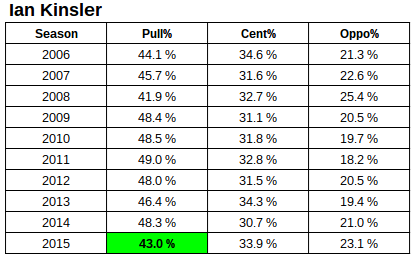
Kinsler is having a nice offensive season in conjunction with hitting more balls up the middle and to right field. Can we say this is definitely connected? Maybe not, but this could be a good way to neutralize the shift.
An average hitting second baseman who plays good defense is a good player, and if Kinsler can be anything more at the plate he’s going to keep paying dividends for the club. It will be curious to see how Kinsler’s bat carries into next season, but it’s not unprecedented for an older player to start going the other way a little more to the benefit of their BABIP. In fact, that’s exactly what helped Torii Hunter extend his career over the last several seasons.
Will he be great for years to come? Perhaps not, but at least the Tigers won the trade.
It’s Time To See What Steven Moya Is
Now that the AAA season is over, Steven Moya will likely be called up by the Tigers on Tuesday. He’s on the 40-man roster so there’s no harm in bringing him to Detroit, and the Tigers have reached a decision point with the impressively large outfielder.
Moya has just 8 major league plate appearances, but with a few weeks to go in the 2015 season and nothing to play for except a protected draft pick, the Tigers have reached an opportunity to find out if Steven Moya is a long term asset. There was a time not that long ago that Moya was one of the best prospects in the Tigers’ system. But a lack of forward movement in 2015 and an influx of new talent has pushed Moya down the list. If you’re a Moya devotee, he’s in the middle of your Tigers top 10 and if you’re not, he’s struggling to cling to the 10-15 range. Personally, rankings aren’t very useful in my opinion because it doesn’t matter who is the #4 prospect and who is #6. They aren’t in competition with each other. But leaving that aside, the Tigers are in a position to see what Moya can be.
Now let’s start with a couple of important points. The first point is that with 25 games left, you’re only going to be able to find 80-100 PA for Moya down the stretch and that alone isn’t enough to make a complete judgement of him as a player. The point isn’t that Moya in September will be Moya forever, the point is that the Tigers should take this opportunity to get an extended look at him as a player. That means letting him face all of the righties and most of the lefties. That means giving him left field on most nights. It’s time to see who Steven Moya can be.
As a player, his profile is pretty easy to define. He has tremendous power with a rough approach. He doesn’t walk much, he strikes out a ton, but when he connects he can really drive the ball. He hit 35 HR with a .280 ISO in AA in 2014 and hit 20 in 2015 with a .180 ISO in AAA. It was definitely a lesser year, but the question isn’t the ability to smack the ball, it’s making contact at all. He’s been a 30 K% guy his entire career and his 5.1 BB% in AAA this year was among his best marks as a pro.
He has the arm and the mobility to work well enough in the outfield, certainly to the point at which he could play out there without embarrassing himself. And there’s a decent chance that he’ll be better than that. It all comes down to the strike zone. Or more accurately, Moya’s ability to make contact and recognize pitches.
I’m not really telling you anything you don’t know if you’re a moderately interested watcher of the Tigers’ minor league system (which is a thing that exists now!). This is all prelude to the broader argument: Moya needs to start basically every day for the rest of the year.
The Tigers have JD Martinez holding down a spot in the outfield next year. As long as he is healthy, he’ll control one of the corners, and unless they pick up an elite right fielder (looks longingly at Jason Heyward), right field will belong to Martinez. That leaves LF and CF wide open for anyone to claim. Anthony Gose was given the starting CF job this year, but he’s been somewhere between “not very good” and “terrible” in 2015. He’s a potentially useful MLB player, but he’s not someone you build into your roster. He has not shown himself to be an MLB starter, for sure.
Rajai Davis isn’t under contract and Tyler Collins, while potentially useful, also hasn’t claimed a spot for himself in the starting lineup. He could have a role, but again, if you’re contending, you’re looking for two outfielders. And the Tigers need to use the rest of 2015 to figure out the odds of Moya being one of those guys.
Going into the exercise, I would bet against it. Moya isn’t the kind of player on whose behalf I typically advocate. He has raw tools and no strike zone discipline. But the kind of power than Moya has in his bat is unusual. You might call it “70 grade” if you like scouting scales. If you can make enough contact with his ability to not suck in the field, that power will put you in a starting lineup.
To give you an idea, you want a corner outfielder to be in the 120 wRC+ neighborhood or better. Moya doesn’t have to produce that right away, but that’s kind of what you’re trying to get to if you’re playing in a corner and want to start on a good team. So that’s about a .350 wOBA. I worked out a simple stat line assuming 650 PA (full season). If you figure a 5 BB% and 30 K%, add in an optimistic 30 HR, and then give him a .320 BABIP with 95 singles and 40 doubles, you get to about .340 wOBA. As a slash line, it’s .269/.307/.480. And this is optimistic all the way around.
You could imagine a .270/.310/.480 line from Moya. But in AAA this year it was .240/.280/.420. In AA in 2014, it was about .280/.310/.550. In other words, for Moya to work as a starter in the show, you need him to hit a lot like his AA line. And that’s the best we’ve seen from him and it was a year ago against weaker competition.
Now, Moya is more experienced and presumably better coached. He’ll have access to better scouting reports, better lights, better nutrition, and a better nights sleep. There are all kinds of reasons why he might flourish again in the show. But the odds are against him.
The Tigers are going to have to make some decisions this offseason regarding their outfield. They will have to find two quality starters and one of them probably needs to be pushing All-Star levels. The Tigers have seen plenty of Gose, but they have just 8 MLB PA of Moya. They have lots of minor league data and scouting reports, but when you have a free month to mess around, using that month to see how Moya looks against good pitching is going to be valuable. Bringing him up for get 15-25 PA doesn’t help his development or allow the Tigers to learn very much. But if you give him 100 PA, you might get a chance to learn something about his abilities.
Granted, the raw stat line won’t tell you much, but the stats and your observations in conjunction with what you already know about him will help you determine the odds he can help in 2015. And you need to make that call by November so you know exactly who you want to sign.
My prior expectations are the on the table. I doubt Moya will ever become an above average MLB player. Or maybe more accurately, I don’t think he will become one unless he makes dramatic adjustments to his game. Those are always possible. But I’m also a huge believer in letting players prove you wrong. Moya hasn’t excelled in AAA, but he’s 24, on the 40-man, and the team needs outfielders. It’s worth seeing what happens. If he’s way over-matched, you’ll see that in no time. If he shows you something, then you know.
Too often, teams get into the business of confirmation bias. They have an opinion about a player (often a correct one), but they don’t push that opinion to see if they can be proven wrong. Jordan Lennerton is a perfect example of this problem. He got to A-ball at 23, but he hit well at every level. He had a great eye and played well at 1B. Supposedly, the knock on him was a serious lack of bat speed. And he sat in the minors for six years until the Tigers cut him loose in July. He never got a single MLB plate appearance.
Now I’m not saying Lennerton would have been a good major leaguer. I’m saying the Tigers had him in their system and never found out. It’s one thing to look at a guy struggling in AA and giving up, but it’s another to graduate a guy through the system and wind up never getting a clean look at him in the show. Maybe he proves you right, but at least give him a chance to prove you wrong.
I don’t necessarily think Moya will have a strong MLB career, but the best time to find out what a player is capable of is when there is nothing to lose. If the Tigers were in a pennant chase, I wouldn’t advocate for a risky player. But with the season over, the Tigers have a chance to let Moya get some reps and they absolutely must do it.
They are clearly preparing to give him some playing time, with the recent shift to LF in AAA, but last year Moya came up and was used very sparingly. The same was true with James McCann. Maybe that was about the playoffs. But this can’t be a month of easing the kids in.
The Tigers need outfielders in 2016 and they have a chance to preview what Moya can do in the show. They should take it.
Cabrera Makes Friends With Right Field
Miguel Cabrera is an amazing hitter, and that makes him an awesome baseball player. He’s hitting .358/.460/.589 in 404 PA this year, which is good for a 186 wRC+. Per plate appearance this is the second best offensive season of his career, second only to 2013. This isn’t his best year when it comes to extra base hits, but he’s getting on base more often than he ever has. Some of that is his 15.6% walk rate, which is narrowly the second best mark of his career, and some of it is his .408 BABIP, which is the highest BABIP he’s registered to date.
Cabrera is a high BABIP guy. You generally expect a .350 or so BABIP based on his talent level and over 400 PA it’s not crazy to see a number 60 points higher than expected. It’s not common or likely to continue at quite this rate, but it’s not like he’s going to crash back to Earth when his BABIP “luck” runs out. He’s having a great year at the plate and it’s skewing a little more toward singles and walks than doubles and homers, but it’s great all around.
The thing about Cabrera is that when it comes to hitting, he’s great at everything. He’s not an effective base runner because he’s slow and he’s not a great fielder, also because he’s slow, but in the batter’s box he is one of the five best hitters in the game and heading toward a late July speech in upstate New York. He’s incredible.
Due to that dominance, it can sometimes be hard to find interesting things to say about him. He is good and consistently so. Writing about him too often is akin to Homer’s everything’s okay alarm.

But given that there’s a lot of depressing baseball going around, we do have to circle back on the things that are going well from time to time. Cabrera is one of those things. We know about his great season overall. He’s missing some plate appearances due to the calf injury, but that 186 wRC+ is impressive.
One thing that’s worth pointing out is that Cabrera’s batted ball distribution is taken a bit of an interesting turn this year.

Cabrera is hitting the ball the other way much more this year than he has in recent seasons. It’s the highest number of his career and his first time over 30% since 2010. He’s consistently been hitting 25-28% of his batted balls to right field during his career with a couple of years in the 30-31% range. This year, it’s 33.5%.
I think a lot of people think of Cabrera as being an “opposite field hitter,” but he actually hasn’t been a big outlier in his career. the Average hitter is around 40-35-25 and his typical season is 40-32-28. The real reason you believe Cabrera is an a guy who hits to all fields is that he absolutely crushes the ball the other way and most hitters don’t. Here’s his career directional splits compared to 2015 league average.

Take these with a grain of salt. It’s been a long career and there are no controls for handedness of pitcher, etc. But you’ll notice that Cabrera has generally stood out more to the pull field than the other way. He’s one of the best handful of opposite field hitters when it comes to damage done, but he’s actually been better compared to average when pulling the ball.
So what does this mean, exactly? Cabrera is hitting the ball the other way more often – a lot more often – this year. Is that a good thing or a bad thing? If you use his career directional splits as a proxy for the better directions, you’d want to avoid adding extra batted balls the other way, even if he’s still very good in that direction. This year he’s 216-287-189, FYI.
BABIP-wise, he’s killing it to center and right (120 and 80 points above career norms) and is right around his career average to the pull field. Keep in mind this doesn’t count home runs. His ISO to the pull and opposite fields are normal-ish and it’s way up to center. Package it all together and you have a pretty normal set of batted balls to left, more average and power to center, and more average to right.
Generally, over 400 PA I would say this doesn’t mean a whole lot. My theory is that there was a certain population of pitches that he’s decided to push the other way instead of trying to pull them. That’s probably an obvious statement, but if you read into it a bit more closely it makes some sense. Cabrera has the ability to crush baseballs, but going to the pull power swing has its tradeoffs. You run the risk of whiffing or being out in front and generating weak contact. If Cabrera is waiting back a little more often, he’s going to set himself up for more hits the other way, but they will be a little less forceful overall. Theoretically, if you take his worst swings to center away and give them to right field, it has the effect, potentially, of increasing production in both directions.
Each hitter has a perfect balance of power/contact for their own skill set which will maximize their offensive value. A guy with already low contact ability might want to really sell out so that he can get a couple extra homers or a high contact guy might want to avoid too many big swings because his best contact is warning track power.
Cabrera, being an elite hitter, has a tougher decision and he has to react to the new ways pitchers try to pitch him. That’s why it’s kind of hard to know for sure. Is Cabrera hitting the other way more often because he’s being forced to or because he wants to? The pitch locations don’t look much different, but he’s generally being more selection this year as well.
It’s hard not to notice how often he’s gone the other way this year, and it’s helped him a put together a great season. Is this happening because he feels like he doesn’t quite have the power he once did and is adapting, or is he simply making the most out of the pitches he’s received?
Sorry I don’t have a definitive answer to the question. I really just wanted to point it out and call attention to where he stands as an opposite field hitter. He’s one of the best there is from a value standpoint, but until this year, he wasn’t a particularly likely candidate to hit a ball to right field relative to league average. But this is a thing he’s doing more this year and it’s working so far. The main takeaway, I think, is that this is a roadmap for an aging Cabrera.
At some point, he won’t be able to deliver the consistent bat speed needed to be an elite hitter. It’s coming. Probably not next year, but he’s under contract until his 107th birthday, so it will happen eventually. His ability to go the other way more and more often might allow him to offset some of that loss. This might be practice. Albert Pujols went with the all dingers-no OBP model of aging, but Cabrera might be able to implement an all hits-fewer dingers model that will serve him well.
I’d treat this opposite field thing as a beta test. Cabrera is flashing a tool he generally hasn’t flashed. He hits well the other way, but now he’s doing it more often without hurting his results. It could always be randomness and pitcher fluctuation, but it could be a trial run for a smooth landing into old age.
 New English D