2012 Season in Review: Colorado Rockies
64-98, 5th in the NL West
The Rockies were really bad in 2012. Usually I make an attempt at wit in the opening lines of a recap, but that’s all there is to be said. The Rockies were bad.
Their best hitter, Dexter Fowler, posted a 2.9 WAR and Carlos Gonzalez (2.7) and Tyler Colvin (2.7) are the only others above the 2.0 threshold. Granted their best player, Troy Tulowitzki, only played 47 games, so he likely would have made a run at something like a good season. The Rockies get help at home to make their traditional offensive numbers look good, but their batting average dropped from first in baseball at home to 26th in baseball when they went on the road.
Their staff as a whole was 23rd in baseball by WAR, but they were first in embarrassing attempts to limit pitch counts and use an ill-advised four man rotation! Let’s put it this way, their best pitcher by WAR in 2012 was a reliever. Matt Belisle, who was actually good, made 80 relief appearances on his way to a 2.1 WAR. None of their starters topped 1.8.
Yes, it was that bad. They went with a 75 pitch limit for starters no matter what and down to four starters to adjust for how bad they were and of course that made it worse.
Health will improve the Rockies going forward but the team isn’t built very well. With full seasons from their stars, I think the offense is good enough to contend in the NL West, but the pitching is simply too terrible for it to even matter.
It is very hard to get free agent pitchers to go to Colorado and drafting pitching is difficult as well. It only takes a few good luck seasons to get back into contention, but right now, this is easily the worst team in a division that includes the Padres.
It was a dark 2012 for the Rockies and 2013 doesn’t look a lot better. Tulo should be back and I don’t imagine the pitching can get worse, but their also up against some teams on the rise out west who will counteract those gains.
2012 Grade: F
Early 2013 Projection: 64-98
Lineup Protection: Fact or Fiction?
Among members of the traditional baseball community, lineup protection is a well-accepted truth. Among many members of the sabermetric community, lineup protection is a myth. Both can’t be right, but I’m sure not sure we know which side is.
First off, let’s define the term. Lineup protection is the idea that the hitter who hits behind you impacts how you perform based on a pitcher’s willingness to attack the zone against you versus pitching around you to face the next hitter. Let’s go a little further.
1) Protection assumes that it is better for Hitter 1 to see pitches in the strikezone because those pitches are easier to hit, therefore, protection increases your offensive numbers that do not include walks.
2) Protection assumes that a pitcher has some ability to control whether or not they throw you strikes versus balls in an at bat.
3) If you are “protected” you will see fewer pitches outside the strikezone, thus giving you a better chance to produce offensive numbers.
Now the sabermetric community points to evidence that says protection is myth because it hasn’t been shown to matter in any of the cases in which it could be tested. But a reasonable person would point out that to conduct a valid test, we would have to control for factors that we cannot control for in real life. We can’t randomly assign pitchers. We can’t hold the quality of the Hitter 1 constant. Even if you try to do that in a statistical sense, the sample size gets too small to have findings of any real significance.
The sabr crowd will tell you that the absence of evidence for protection means the burden of proof is place on those supporting it, and that’s a fine request in the abstract, but my aim isn’t to litigate an argument, it’s to see if protection is a thing or not.
More specifically, I want to see if protection should exist. In other words, should the hitter behind you impact how you get pitched?
I argue that it should and I’ll lay out my reasoning here. I can’t present an argument that protection does happen because it would be impossible to show that it does while maintaining a valid design, but I can present the argument that protection should exist using the 2012 Detroit Tigers.
Our Hitter 1 in this design is Miguel Cabrera. In 2012, Prince Fielder hit behind him and “protected” him. I will use their 2012 stats to craft their abilities, but these numbers could be adjusted if you prefer to track likelihoods by career numbers, monthly numbers, etc. Does Fielder’s presence behind Cabrera change the way a pitcher should attack Cabrera? I argue that it should.
Let’s look at this in the simplest terms possible. No one on, no one out. Cabrera leads off the inning, Fielder due up second.
In this scenario, Miguel Cabrera will get a base hit 33% of the time if the pitcher does not walk him (assuming Cabrera doesn’t know the pitcher will choose not to walk him). Fielder will get a base hit 31.3% of the time under the same conditions.
But not all base hits are the same. A walk and a single in this scenario have the same outcome for Cabrera, but doubles, triples, and homeruns are more damaging. Here, the pitcher would choose to walk Cabrera in all cases in which he would get a hit that wasn’t a single.
.33(batting average)*.41(% of hits that are for extra bases) = .1353
Regardless of who hits behind Cabrera, 13.5% of the time it is a better choice to walk Cabrera instead of pitching to him. If you don’t walk Cabrera, he will get an extra base hit 13.5% of the time, so you should walk him in those cases, but the other 86.5% of the time he will make an out (better) or single (equal).
So now let’s introduce his protector. Fielder gets a hit 31.3% of the time and 35% of his hits are for extra bases. This is important here because if Fielder gets an extra base hit, it is irrelevant what Cabrera did. If Cabrera gets a hit and then Fielder doubles, triples, or homers, Cabrera will score regardless of what base he occupied.
What we care about is how often Cabrera will get an extra base hit minus how often Fielder gets an extra base hit. We want to know how often we should walk Cabrera, so we need to see how often a Cabrera extra base hit will be followed by a Fielder single or out because a Fielder extra base hit would score a Cabrera walk.
Piece this all together and we discover that with none on and none out with Cabrera leading off and inning with Prince protecting him, walking Cabrera is the preferred choice 2.5% of the time.
This tells us that when Cabrera leads off an inning, 97.5% of the time, pitching to Cabrera will be the same or better than walking him with Fielder behind him. Obviously you can’t predict which 2.5% it will be, so you play the odds and always pitch to him when he leads off an inning.
How does this help us solve the problem? Should lineup protection matter?
It helps because if we insert the 2012 version of Delmon Young into this methodology, we should walk Cabrera 5.5% of the time. This still doesn’t tell us to walk Cabrera when he leads off an inning, but it tells us that we should walk him more to lead off an inning with Young behind him than if Fielder is.
This tells us that protection should matter. The hitter who bats behind you should impact the pitches you see. In practice, the likelihood of a walk being a smarter play with Young behind Cabrera means a pitcher should be more willing to pitch around Cabrera than if Fielder was behind him.
This becomes more evident when you add in baserunners and outs. I’m not going to walk through all the math in each of the 24 possible arrangements except to say that the more baserunners there are, the more valuable a walk can be over a hit. If a runner is on 2nd base, a walk is better than a single in the pitcher’s eyes, so the percentages slide in favor of a walk. However, you’re making a trade off because you are saying you like a 31.3% chance of a hit to a 33% of a hit when it comes to scoring the runner from second, but you are risking the chance that Fielder drives in Cabrera too.
The point of this entire piece is that the hitter behind Cabrera should matter. A pitcher should be more willing to pitch around Cabrera based on who hits behind him. That is hard to ignore, even if the percentages favor pitching to him in all scenarios. The important take away, however, is that it should also be a matter of degree.
Fielder and Young are dramatically different hitters. A very good hitter like Fielder matters over someone like Young, but would Fielder matter of Victor Martinez? Glad you asked.
Victor behind Cabrera means you should walk Cabrera 3.9% of the time in our scenario. So Prince is a better protector because he hits for extra bases more than Martinez does. But the difference is smaller than when Young is involved.
So, protection should matter, it’s a question of how much. A better hitter should protect you more than a lesser one and one who hits for more power should protect you more than one who hits more singles. It’s a sliding scale, so an overall difference would not be that evident unless the two potential protectors are significantly different both in reality and in the minds of the pitchers.
So while I cannot prove that protection exists, it absolutely should exists and should favor hitters with higher averages who get a lot of extra base hits. Additionally, since most baseball people believe it exists, that should reinforce its effect.
It should have a larger effect when pitchers and managers believe it exists. If they change their approach based on who hits behind someone because they believe it matters, then it will matter. Since it also should matter in a formal, logical sense as shown above, there is no other belief except to posit that lineup protection is a real thing, even if we can’t prove it.
The sabermetric response to this finding would likely be that even if it varies based on who hits behind you, the percentages always favor pitching to Cabrera over walking him. In other words, we never break 50.0%. This is true, but it misses something important. If 95% of the time you should pitch to Cabrera (and this is the extreme end), 1 out of 20 times, you should have walked him. This should impact you approach as a pitcher or you are being irrational. You should be more willing to walk Cabrera with Young behind him than Fielder even if your preference is to never walk him.
Protection should and probably does exist, even if the results are relatively small. Cabrera will not have a dramatically different season with Fielder or Young behind him, but we should observe differences, which means protection is likely a real phenomenon.
Alan Trammell and What We Want the Hall of Fame to Look Like
I was six when Alan Trammell played his final game. I can’t say I remember seeing much of him with my own eyes. But I come from a family of Tigers fans, so much so that my parents had a dog before I was born named, you guessed it, Trammell.
So the issue of Alan Trammell’s Hall of Fame candidacy is of some importance to me, my family, and the majority of the state of Michigan. Trammell is a beloved figure from the ’84 World Series team and a less beloved figure from a less than perfect managerial stint prior to Jim Leyland’s (he’s found a better home as Kirk Gibson’s bench coach in Arizona).
But is he a Hall of Famer? He’s a great Tiger, but does he make the cut for baseball’s highest honor?
First, I guess I should make clear that the Hall of Fame voting and the BBWAA in general are a joke. Stubborn, self-righteous writers won’t vote for suspected steroid users despite no proof and some refuse to vote for anyone on the first ballot simply because Babe Ruth didn’t make it in unanimously on the first ballot, so no one should. Lots of things about the voting are silly, but let’s leave that aside and ask if Trammell should be in the Hall of Fame assuming the Hall of Fame is actually a good measure of real baseball value.
For a long time, I thought no. And so have most of the voters. 36.8% of the 2012 voters put Trammell on their ballots, which is a far cry from the necessary 75% needed for induction. But in recent years I’ve become a more sophisticated fan, especially in the area of comparing eras and positions.
Trammell doesn’t have any universally accepted counting stat thresholds like 3000 hits or 500 homeruns to rest his candidacy upon, but those marks aren’t necessary for induction, they are merely sufficient. Let’s examine Trammell’s candidacy.
Over 20 big league seasons, he played 2293 games, hit 185 homeruns, drove in 1003, scored 1231, and stole 236 bases. He hit .285/.352/.415, good for a .343 wOBA and 111 wRC+. With good defense, Fangraphs puts his WAR at a healthy 69.5 (Baseball Reference says 67.1).
I’m not going to go through the arguments for or against Trammell made by others, but rather I’m going to construct a case based solely on the evidence.
Let’s start my putting Trammell in the context of major league shortstops. In the simplest terms, Trammell in 16th in career WAR for a shortstop. Every retired player on the list ahead of him is in the Hall. Some behind him are in. Based on the players already in the Hall at short, it seems like Trammell has a strong case. But past decisions aren’t necessarily right, so we can’t just say Trammell should make it because other undeserving players have made it.
By all of the main counting stats, Trammell is somewhere between 14th and 21st all time for shortstops with no controls for era. He’s outside the top 30 in all of the rate stats, however. Again, we’re not controlling for era here. This is the crux of the problem with Trammell’s candidacy. If you look at his numbers, it looks like he played for 20 years and accumulated a lot of counting stats without ever rising to the to the rate levels of the other past greats.
But like I said, this ignores context. Offense shot up right as Trammell’s career was ending and only in the last few years has it headed back down. Let’s look at Trammell’s contemporaries. Shortstops who played from 1970 to 2000 (adding five years on each end). These are arbitrary end points, but during that 30 year span, only Cal Ripkin, Ozzie Smith, and Robin Yount have higher WARs.
Trammell’s case rests on being a very good shortstop at a time of lower offense. He wasn’t the best of his era and he isn’t the best at anything. He played well over a long career and had a peak that looked like a Hall of Fame peak. Trammell’s best seasons are Hall of Fame worthy, but some of his worst seasons drag down the overall resume. Trammell is a good study in what you think the Hall of Fame should be.
I’ve always been a “story of the game” guy. The Hall of Fame to me is a museum to the game’s history and it should include the players who are vital to understanding the game. For this reason, I’m for admitting the suspected steroid users. But where does that leave Trammell?
By counting stats, he should be in. By rate stats, he’s probably not good enough. But that’s before you factor in the context of his position and his era. If the threshold for induction is that you have to be better than the worst player who is in, Trammell makes the cut. If there is a more ideal definition I think his case is less clear.
Trammell is vital to the story of the Tigers, but I don’t know how much he matters to the game as a whole. The fourth best shortstop of his era and a top 20 or 30 shortstop all time. If you like a big Hall of Fame, there is room for him. If you’re an exclusivity fan, he’s probably on the outside looking in.
Despite the quirks of voting, the Hall is still sacred ground. It does matter who gets in and who doesn’t. I’m left wavering on Trammell because I’m a story of the game guy and an exclusivity hawk. I want to induct players who were great and players that mattered. Greg Maddux is going in the Hall soon because he was great (and mattered), but I’m also more favorable toward Jack Morris because of his role in one of the great pitching classics of all time (Game 7, 1991 World Series) even if his raw numbers don’t warrant an inclusion in my book.
By my own standards, if I was redrawing the Hall of Fame, I think I would leave Trammell out. He doesn’t meet my own internal standards for the Hall, but he does mean the standards of the Hall as it currently stands.
Like I said, the Hall is a quirky place. Tim Raines isn’t in, but Jim Rice is. That doesn’t really add up. Hell, Pete Rose isn’t in the Hall. Voters have a lot of weird traditions and unwritten rules that don’t make sense. Certain voters see themselves as privileged gatekeepers to the point of ridiculousness. Bonds won’t make it because maybe he used steroids, but racists and wife beaters are just fine with them. The voters are the morality police without the moral compass.
As a Tigers fan, I want Trammell to get in. If I was designing my own Hall of Fame, I’d probably leave him out. But he belongs in this one. He has four years left of eligibility and he might get lost in the other battles raging over the Hall.
Given the criteria and the boundaries drawn by voters past and present, Alan Trammell belongs in the Hall of Fame.
Indians Get Swisher, Laugh Like Mr. Burns
Nick Swisher is underrated and Nick Swisher is now a Cleveland Indian. He’ll likely replace Shin Shoo Choo in right field, but can play left, first base, or DH over the course of his four year, $56 million deal (vesting option could take it to 5/70).
Most people figured Josh Hamilton would get more than Swisher on the free agent market, and we now know they are right. Hamilton got 5/125, which is more than 4/56. But that’s because Hamilton is overvalued and Swisher is undervalued. This is a great deal for the Indians. A great one.
Swisher is a young 32 and this deal will cover his age 32-35. Those are past his peak years, but not way into Alex Rodriguez territory. Swisher played his first full season in 2005 and was a full time player from 2006-2012. Over the last seven seasons, Swisher has never played fewer than 148 games. He’s never hit fewer than 22 homeruns. He’s had a walk rate under 12.3% once. He’s had an OBP under .355 once. He’s been an above average hitter and an average or better defender.
He’s been worth less than 3.0 WAR once in that span. All of these “onces” came during his worst season in 2008 where he was still an okay player.
Even if you figure he’ll decline into this thirties, he’s been a model player. Consistent power and patience mixed with solid defense. You can write him down for a 3 win season. He’s getting paid to be worth 2-3 wins over the next four season each, so if there is no salary inflation, he should be worth it. But there will be inflation, so he’s a steal.
Also, at $14 million a season, the risk isn’t so high that he’ll fall off the table and drag the team with him because he doesn’t have that $25 million price tag of Hamilton.
Swisher is essentially provides consistent, reliable production at the level that Hamilton averages out to. He’s a 3-4 win player with power. That’s what Hamilton is, but Hamilton has the amazing ceiling and flashes of brilliance mixed with the terrible lows.
With no inflation, Swisher needs to accumulate 11-12 wins to earn his deal. Hamilton needs to accumulate 25 wins. I’d much rather take the Swisher contract with a lower ceiling than the Hamilton contract with the bottomless-pit-like floor.
The Indians are a small market club and have a lot of work to do to build a winner. But in the weak AL Central, contention is probably not too far off. They have a solid young infield and catcher and an outfield that is serviceable. One more good bat and some rotation upgrades could get the Tribe near the top. Swisher is a good step in the right direction.
It will take some luck for the Indians to play with the Tigers in 2013, but anything can happen. Nick Swisher is a reliable player at a good price and he’s a fun loving guy who went to school at Ohio State. He seems like a natural fit for the Indians. He’d have a been a great fit for a lot of teams. It’s a little surprising a bigger market club didn’t offer more money, but fans in northeast Ohio will be glad they didn’t.
Grade: A
Does Bonderman Have Something Left?
Jeremy Bonderman hasn’t thrown a pitch in professional baseball since 2010 and it looked like he was hanging up his cleats for good. He saved his money wisely and seemed ready for a backwoods retirement in obscurity.
But he couldn’t quite close off that part of his life. The former Tiger hurler who spent eight seasons in the major leagues is trying to make a comeback, and yesterday, his hometown Mariners made that comeback a possibility by signing him to a minor league contract. Jeremy Bonderman might not be done after all.
Bonderman went 67-77 with a 4.89 ERA in 207 games with the Tigers from 2003-2010, including some durable and effective seasons from 2003-2007. In 2006, he posted a 3.29 FIP and 6.1 WAR, which were both career bests. He was by no means a great starting pitcher in the mold of Johan Santana or Roy Halladay, but he was the Tigers workhouse until Verlander took over that role.
The whole of his career is respectable and unimpressive. He made it to the big leagues early because the Tigers were terrible and needed pitchers and because he left high school a year early and got his GED so he could enter the draft at 17. He’s also famous for causing Billy Beane to throw a chair through a wall. Yes, that’s a real thing.
But that 2006 campaign was great. Only Johan Santana and Brandon Webb had better FIPs and WARs. Aren’t those a couple of names from a time long since passed?
The potential was always there for Bonderman, who had a solid fastball and an excellent slider. He worked year after year on a changeup, but it never materialized and injuries soon caught up with him. He had four above average major league seasons, one of them great, before his 26th birthday. Most pitches don’t hit their peak until ages 26-30. Bonderman’s came long before.
Bonderman will spend the entire 2013 being 30 years old. He’s missed two years being semi-retired, and he’s still thirty.
If the arm speed is still there and the fastball and slider can still work, he could be a good piece out of the bullpen. I always thought he could thrive in the pen. When the injuries came, I thought they should have moved him to the back end of the ‘pen, but alas, it never happened and he walked away from the game.
Until now. Now, Jeremy Bonderman is making a comeback. I’m not sure if there’s a more romantic quest in sports than the grizzly veteran seeing if he has something left. Think The Rookie or Bull Durham. Think about the awesome Sports Night episode, “The Sword of Orion,” in which part of the story centers around Dan’s desire to watch a washed up starting pitcher start a comeback in an exhibition game with the Baltimore Orioles.
Something about a comeback speaks to us at a very emotional level. The idea of thinking something is over, only to find out that there is still time, is a powerful feeling. So we love when athletes try to conquer father time and mother nature and play beyond when we thought they could.
I’m dying to see Bonderman make this comeback. I’ll be waiting up for West Coast games, just hoping he’ll get the call. I want to see what he has left. The look in a man’s eye when he realizes there’s a little bit left in the tank that no one thought he had, that’s the look we live for.
The idea of a peak is everywhere in life. Some people peak in high school when they’re named prom king. Some in college. Baseball players in their late 20s. Others in their 40s. Whatever and whoever it is, we all peak. But what comes after the peak is still meaningful. There’s still something there. The party isn’t over.
The best days of Bonderman’s career may be over, but there may yet be days ahead. He might have another pitch, another game, another season, or another five seasons. He might have nothing left. But Bonderman was a big piece of some of my earliest baseball memories and I’ll be cheering like crazy for him. I love comebacks and I’m dying to see what Bondo has left, even if it’s just one more pitch.
Catching Up on All the Moves in Baseball
Last weekend, I had the nerve to go on my honeymoon and missed writing about a lot of baseball trades and signings. To atone for such indiscretions, here’s a post about everything I missed while I was following my wife around the Wizarding World of Harry Potter.
Blue Jays acquire R.A. Dickey from the Mets, Sign Him to an Extension
This deal also included Josh Thole and Mike Nickeas in exchange for John Buck, Travis d’Arnaud, Noah Syndergaard, and Wuilmer Becerra. The Dickey extension is for two additional seasons and $25 million with a club option for 2016.
This is a very solid deal for the Mets in my book as they deal one year of Dickey plus two less than glamorous pieces for some prospects with really high upsides. d’Arnaud isn’t a sure thing, but he’s a top 10 prospect in baseball who can provide legitimate offense from behind the plate, and the other prospects are also potential contributors in the future. I’m not going to break down each of these guys at length, but the value is good for the Mets.
The Jays gave up a lot, but they also got a lot in return. Thole and Nickeas will be useful, but Dickey could be a difference maker. Over the last three seasons he’s been a great starter and capped it off with a Cy Young this season. He’s old and a knuckleballer, but he’s very effective. He’ll make just $5 million in 2013, so he’s a steal. If he maintains similar levels over the course of the extension, the $12 million per season price tag is a steal. If you buy him as someone who can maintain this level of performance, his 4+ WAR levels are worth about twice what he’ll make over the course of this deal.
The Blue Jays paid a premium for his services via trade, but they are right on the cusp of contention. With the addition of Melky Cabrera, Maizer Iztruis, and most of the Miami Marlins, the Blue Jays are easily within a couple wins of a division title and Dickey could make that difference. We’re not great at predicting baseball down to the precise win totals of a team, but we do have a good idea of about where the Blue Jays will fall in 2013 and we think that will be near a spot in the standings where a couple wins could make a big difference.
Grade (Mets): B+, Grade (Jays): B+
Astros Sign Carlos Pena, 1 year, $2.9 million plus incentives
Pena hits for a low average. He walks and hits homeruns. He’s solid on defense at first. While that makes him a below average player, it makes him like the second best Astro. Houston moves to the AL this season so Pena will largely play the role of DH at Minute Maid Park and should see some time at first.
In context this is a great move, even if it isn’t much of anything on a large scale. Pena should provide some offense for a bad team and they’ll get that offense at likely below market value because he has such a low batting average. Any true contender would have trouble selling a .190 hitter to their fan base, but the Astros don’t have that problem. This should pay off, even if it’s the difference between 67 wins and 69.
Grade: B
Cubs Sign Edwin Jackson, 4 years, $52 million
Edwin Jackson is 29 years old. He has made 31 or more starts in seven straight seasons. In the last six seasons, he’s thrown 183 innings or more each year with an ERA at 4.42 or below. Decent strikeout numbers, a few too many walks.
He’s not great, but he’s been close to a 4 WAR pitcher three of the last four seasons and close to a 3 WAR pitcher in the other. He’s pretty good. If you want him to be your ace, that’s a problem. But he’s better than average. If we figure over the next four seasons that he’ll be somewhere between 2 and 4 WAR, we’d offer him $10-$25 million per season depending on inflationary projections.
Obviously the $25 million is at the very high end and you don’t offer contracts with inflation built in. The Cubs have him for $13 million a year. At that rate, he needs to be worth 2 to 3 wins if there is no inflation (and there will be). He’s hasn’t been worth less than 2 WAR since 2008.
This is a good deal for the Cubs because most people seem to undervalue Jackson because he performs worse than we think he should given the quality of his raw stuff. He feels like he should be a #2, but he’s really been more of a #3 type guy and his ERA tends to look a little bloated at times. If you check the FIP, he looks better.
If he’s the same guy over the next four seasons minus a little aging as he has been for the last four, this deal will work out for the Cubs.
Grade: B
Rangers Sign A.J. Pierzynski, 1 year, $7.5 million
The Rangers lost out on Greinke, Hamilton, Upton, and pretty much everyone else they’ve wanted in the last twelve months. But gosh darn it, they got A.J.
Former White Sox, jerkish personality aside, this should be a good fit for the Rangers. He’s a durable lefthanded hitting catcher who hits for power. That’s not an easy thing to find. He doesn’t walk, but he rarely strikesout. The defense is suspect at times, but he’s usually commended for his ability to lead staffs.
He’s going to be somewhere between 1 and 3 WAR, just like he has been his whole career, in 2013. If he hits for a lot of power, look toward the high end. If he doesn’t, expect the low end. He’s durable and respectable at the plate. For $7.5 million, you’re only asking him to be better than 1 WAR for it to payoff and he should be able to handle that.
Grade: B+
Brief Thoughts on Minor Moves
Phillies sign Mike Adams: Too long for a reliever, but should help.
Red Sox sign Stephen Drew: One year deals are low risk. Should be a good stop gap with some upside and they have the money to spend.
Rays sign the pitcher formerly known as Fausto Carmona: No bad one year deals and the Rays are good at turning these guys into valuable pieces. Can’t hate it.
Marlins sign Placido Polanco: Past his prime and injury prone. In his heyday, he was a master. Now, he might be more of a bench player than a starter. But the Marlins are terrible, so it’s a decent move.
Pirates sign Francisco Liriano: At 2 years and $14 million, there is some risk he’s terrible and they’re out a non-trivial amount of money. But the Pirates need to thicken up their rotation and he could be useful in the pen if it comes to that. I wouldn’t love this deal, but the dollar value is low enough that it could really be a steal if he finds his form for just one of the seasons.
That should get you caught up on the happenings around the league and I have no plans to walk around theme parks for quite some time. We’re less than two months from pitchers and catchers and we’ll have coverage of everything that happens.
Thinking About the Strasburg Shutdown
One of the biggest stories in baseball this season was the Nationals shutting down Stephen Strasburg. I liked it. Lots of people didn’t.
The argument against the shutdown was that they had a shot at a title and he would help them get there. We also don’t know enough about Tommy John recovery to know if he needed to be shut down.
But I think they had to do it. He wasn’t just a year and a half removed from Tommy John surgery, he had never thrown more than about 120 innings in a season before. How would his arm respond to a bigger workload after the surgery?
They didn’t need him to make the playoffs. That much is clear. Could he have made a difference in the playoffs? Sure, but he also could have pitched terribly, we’re just guessing. Gonzalez was lights out in the regular season and laid an egg in the NLDS.
I’m a big believer in building innings slowly. He already threw 40 more innings than he had ever thrown. I would be weary of going much higher than he did if he hadn’t had surgery, but the surgery sealed it for me. Strasburg is the future of that team, you can’t risk a second surgery because second Tommy John’s lead to careers in the bullpen.
We don’t know a lot about what causes injuries to pitchers, but what we do know is that pitching tired is a factor. Strasburg had never thrown this many innings and had missed an entire season. This sounds like a recipe for fatigue. He would tell you he isn’t tired because he wants to be a team guy, but I would wager he was tired.
It’s one thing to wear him out and make him tired going into next season, but it’s another to risk another injury. If he was my investment, I would shut him down. They had a good team and made it to the playoffs anyway. I would bet they’ll be back.
He’ll have something to say about that.
2012 Season in Review: National League East
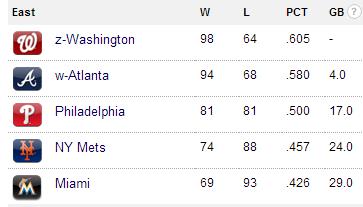
It was a big season for the NL East. The Marlins spent big. The Mets had R.A. Dickey. The Phillies underperformed. The Braves bounced back. The Nationals rose to the occasion.
I predicted the big year from the Nats and the poor showing by the Marlins. I thought too highly of the Phillies and sold the Braves a little short. For a breakdown of how I viewed each team’s 2012, I wrote full pieces on each club.
Here’s how 2012 shook out:
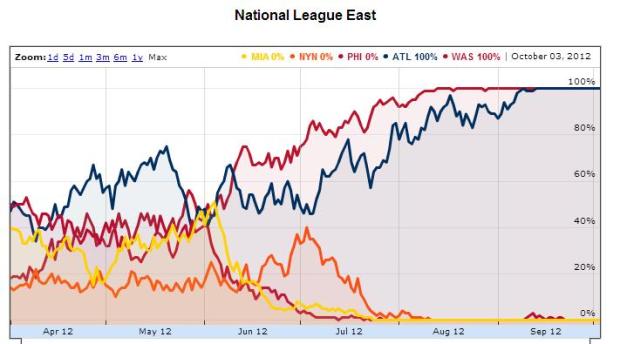
And here are the playoff odds across time:
This is how I see the division next season:

And a final look at my 2012 grades:

The National League East was one of the better divisions in baseball in 2012 and there’s a lot of talent for next season. I like the Nationals to repeat in 2013, but there are a lot of interesting teams…except the Marlins. They will be terrible.
NL East Cy Young: R.A. Dickey
NL East MVP: David Wright
2012 Season in Review: Washington Nationals
98-64, 1st in the NL East
Lost in the NLDS to the Cardinals
The Washington Nationals were my team to watch in 2012. I said on The Guy Show in March that they would win the East and go to the World Series. While the second part of the prediction didn’t come through, it was way closer than what most people thought. The Nationals were baseball’s best regular season team and came within an out of the NLCS.
The offense doesn’t jump off the page, but they played well together. Ian Desmond (5.4), Bryce Harper (4.9), and Ryan Zimmerman (4.5) all had great years. Danny Espinosa (3.8) and Adam LaRoche (3.8) were also very good.
The starting pitching was extraordinary as well. Gio Gonzalez (5.4), Stephen Strasburg (4.3), Jordan Zimmermann (3.5), Edwin Jackson (2.7), and Ross Detwiler (1.8) made all but 11 of the teams 162 starts. They also got a lot of great innings out of their bullpen.
The Nationals were in command of Game 5 of the NLCS until they weren’t in the final innings and lost to a little of that Cardinals magic.
But two big stories dominated the Nationals season. First, the Nationals are contenders now. They played well and didn’t go away. Most people will agree that they’re the favorites in the National League again in 2013.
The other story was the Strasburg shutdown, which was a huge controversy all season. I’m on board with the shutdown, but a lot of people thought it cost them. (Look for a post on this next week!)
As the offseason has gone on, the Nats have added Denard Span and Dan Haren, so they should be set to contend again in 2013, but it’s hard not to look back at 2012 and enjoy it. The Nationals brought winning baseball back to DC for the first time in decades, and there’s no sign of slowing down.
2012 Grade: A
Early 2013 Projection: 94-68
2012 Season in Review: Atlanta Braves
94-68, 2nd in the NL East, 1st Wild Card
Lost in the Play-In Game
The Braves had a great season after a disappointing end to 2011, and in any other season, would have made the playoffs. Unfortunately, the new rules sent them into a one game playoff against the Cardinals to earn a spot in the postseason. In this game, a very questionable infield fly was called, and their last shot at a rally was killed.
But losing a coin-flip game shouldn’t dampen the success of the 2012 Braves. The Braves outfield of Heyward (6.6), Bourn (6.4), and Prado (5.9) was all-world in WAR and played superb defense. Uggla (3.5), Jones (3.0), Simmons (2.2),Jones (3.0), and played superb defense. Prado at a rally was killed.
a spot in the postseason. In this game, a v McCann (2.0), and Freeman (2.0) showed what a complimentary starting lineup looks like. Every single Braves position player hit the 2.0 starter threshold, and some did so in less than a full season.
The pitching was strong too led by a bonkers-good Kris Medlen (3.9) in the second half. Hudson (2.6), Minor (1.4), and Hanson (1.0) made a full season of starts to varying success, but found good outings from the rest of the piecemeal rotation in Beachy (1.5), Maholm (1.0), and Delgado (1.0).
The bullpen was taking names in 2012 as well. Kimbrel’s 3.6 WAR was an incredible mark for a reliever and the rest of the group posted solid numbers.
In sum, this was a very good club. The offense was great and the starters were solid. The bullpen was lights out. The Braves ran into the poor fortune of having a good season in the first year of a silly new playoff format. They were six games better than the Cardinals during the season but were thrown into a coin flip game to generate fake drama and it cost them. Who knows what would have happened if they had earned a real playoff spot under the old system.
But 2012 was Chipper’s farewell season and most Braves fans will remember that as well. They’ve parted with Bourn and added BJ Upton, so the 2013 Braves should be equally as competitive.
2012 Grade: B
Early 2013 Projection: 91-71
 New English D