Josh Hamilton and the White Sox Get Closer to Finding Each Other
A few weeks ago I wrote about the strange free agent situation surrounding Josh Hamilton. You can read the post here, but let’s consider where we are right now.
The Rangers will not sign Hamilton if they sign Greinke, which looks pretty likely. If they sign Greinke, they will trade for Upton and Hamilton will not have the Rangers as an option. The two clubs with the most buzz for Hamilton other than the Rangers are the Mariners and the Red Sox.
In the post linked above, I told you the White Sox were the real team to watch. I said they would trade Viciedo or De Aza and would add a lefty power bat. Hamilton would fit perfectly. Here’s a post on MLB Trade Rumors yesterday:

It’s happening. Hamilton will sign with the White Sox for 5/110. I can’t guarantee I’ll be right, but I feel better about this prediction than when I made it.
Plate Discipline and the Case Against Simplification
I’m not alone in viewing plate discipline as one of the most important skills a major league hitter can have. Picking the right pitches to swing at and the right pitches to take is extremely critical in providing offensive value, so it’s not surprising that plate discipline is a skill we like to chase when building a team. We also find that plate discipline is a skill that tends to be predictive and sustainable, which is another way of saying plate discipline isn’t as noisy as some other stats.
But how do we measure plate discipline? Walk rate (BB%) or OBP in relation to AVG are the standard ways of looking at discipline. If guys walk, they’re likely pretty good at deciding which pitches at which they shouldn’t swing. But that doesn’t really tell the whole story. There is still a lot of noise in walk rates and strikeout rates.
Consider some of the factors included in those stats. You can’t walk if pitchers don’t throw you pitches outside of the zone. You shouldn’t walk if you get good pitches to hit. Context matters too because you might be trying to hit for extra bases in some cases and singles in others, which would tend to change how you swing and what pitches you select. Power hitters will walk more because the risk of pitching to them is higher, even if their actual ability to recognize pitches is worse than that of a speedster.
A good number to look at is O-Swing% which tells us how often someone swings at pitches outside of the strike zone. Z-Swing% tells us how often someone swings at a pitch in the zone. But these numbers vary some by what pitches you’re getting. If you swing at 25% of the pitches outside the strike zone, but see a lot of pitches outside the zone, how does that compare to someone pitches outside the strike zone, but see a lot of pitches outside teh someone swings at awho swings at 40% of pitches outside the zone, but doesn’t see all that many out there?
There’s a lot of variation in all of these stats based on the context in which we observe them. Generally speaking, we want players to not swing at pitches outside the strike zone, so we want that O-Swing% to be low. But do we want hitters swinging at all of the pitches in the zone? Probably not. Not all strikes are created equally.
We also want the count and the situation to matter. A 3-0 pitch just outside and you should take. A 1-2 pitch just outside and you better swing. With all of the new Pitch F/X data, we probably aren’t that far away from being able to call up a players discipline graph so we can see which pitches each guy swings at in which counts against which pitchers and which type of pitch, but that information isn’t quite out there yet.
The lesson here is that while we usually try to boil things down to single numbers and easy to process information, the best strategy is almost always to look at lots of data. Batting average, for example, in a vacuum is a useless stat. Almost anything in a vacuum is useless.
I spent some time this afternoon working on crafting a formula that would best reflect plate discipline in one single number. I couldn’t do it. I kept trying to isolate the signal in the midst of noise, but couldn’t find a way to do it that was less complex that than status quo: Look at more than one piece of information.
We have a tendency to look for models or numbers that give us everything we need to know. We look for things that tell us how to interpret information instead of giving us the information that we interpret ourselves.
When we talk about Wins Above Replacement (WAR), we tend to do this. WAR sums it all together and tells us who the most valuable player is. This is good in broad strokes. I can easily see that Mike Trout outperformed Curtis Granderson with this protocol, but when we need to handle finer distinctions, we should be unpacking the data and looking at all of it.
Trout’s WAR exceeded Miguel Cabrera’s, but we’re better off if we take a look at each individual piece of information that goes into WAR because it gives you a richer picture of who is better. OBP, SLG, defense, speed, etc are all hidden inside WAR. WAR is shorthand. Which particular skills are does Trout beat Cabrera at and visa versa? We ask lots of question about who is the best player, but shouldn’t we ask who is the best at this particular thing? And the particular components of each of those things.
I tend to believe that more information is always better than less. When I want to think about who the most disciplined hitters are, I want to think about a lot of factors and weigh how much each matters in my head. I want to look at unfiltered information.
Let’s try this with the 2012 Tigers (min. 300 ABs):
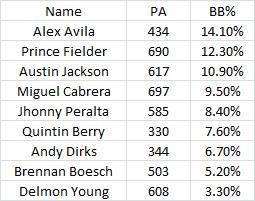
By walk rate (BB%), this is how the Tigers look.
By O-Swing% (swing percentage on pitches outside the zone):

By Z-Swing% (swing percentage on pitches in the strike zone):
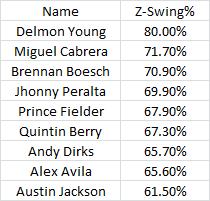
The information varies in each of these lists. There’s some correlation, but it’s not perfect. Taking pitches outside the zone makes it more likely that you walk, but lots of other things go into it. Cabrera swings at lots of pitches inside the zone, close to Delmon Young’s number, but walks a lot more than he does.
There’s so much that goes into each outcome that it’s easy to misinterpret the information. I’m pretty confident after looking at this information that Alex Avila is the more disciplined Tigers hitter, but there’s a case to be made for a couple guys for second place. And we haven’t even talked about what our eyes tell us.
When asking tough questions, instead of looking for the best number, let’s look for all the numbers. We’ll be better off.
Twins Trade Their Remaining Centerfielder
Last week the Twins traded Denard Span to the Nationals because they had Ben Revere to play centerfield. Today, they traded Ben Revere to the Phillies for Vance Worley and a pitching prospect because they had, um, Aaron Hicks to play centerfield?
They went from a team with many centerfielders to a team with less than one centerfielder. I can’t really fault the strategy given that they are probably a few years away from contention and that they wanted to maximize the return for guys who they don’t expect to be pieces of that success.
But I do have to wonder about the timing. Why wouldn’t they wait for Bourn, Hamilton, and Swisher to clear the market? Maybe that takes certain teams out of play for their guys, but wouldn’t it make the remaining teams more desperate? The Twins didn’t have to move Span and Revere for cost reasons or time horizons, so they could easily have waited this one out.
I also have to say the returns haven’t been spectacular either. Meyer, Worley, and Trevor May. I’m not sure those three guys dramatically improve their future success. In a best case scenario based on the scouting I’ve read on the two prospects, we’re looking at two #2s and a #3/4 guy with solid club control. That’s a good return, but that’s the ceiling. Prospect evaluation is full of uncertainty and those #2s could easily turn into bullpen pieces, swingmen, or nothing.
The Twins had a plethora of centerfielders and traded them all to bulk up their pitching depth. I think it needs to be said that two major league centerfielders are probably more valuable than one proven mid to lower rotation guy and two respectable ceiling prospects given that the centerfielders were on team friendly deals.
Hard to like this for the Twins in my book, which means as a Tigers fan, I love it. Grade: C
Red Sox Sign Victorino
The Red Sox continue to remake their team this winter and signed OF Shane Victorino to a 3 year deal worth $37.5-$39 million depending on who you ask. The Sox needed OF help and Victorino has been worth 3 plus wins in each of the last six seasons. He’s probably never going to make another run at 5.0 WAR, but he should be a useful outfielder for the Sox over the next couple seasons.
He’s not a great player on offense anymore but he doesn’t strike out and has a solid glove that should play up in a corner outfield spot. This isn’t a great player, but $12-13 million a season doesn’t buy what it used to. It’s a very interesting market for outfielders with a lot of very different players with very different skill sets. Bourn, Swisher, and Hamilton are left and the Red Sox are no longer in the market for them, so we should be getting closer to a resolution.
Grady Sizemore and What Could Have Been
It wasn’t that long ago that Grady Sizemore was a premier player. Really it wasn’t. Just four years ago he was worth 7.4 wins above replacement. Over a four year stretch from 2005-2008, Sizemore was a bona fide star on his way to a great career.
But brilliance can be fleeting for athletes and Sizemore ran into injury after injury. He’s played 212 games since and hasn’t hit above .250. He was a great player on the brink and then everything was gone.
He’s hurt again and his 2013 season will be on hold for a while. The 30 year old outfielder could have been one of the game’s top players, but instead may never play another meaningful game. That’s how quickly things can turn.
Take a look at his Fangraphs dashboard:
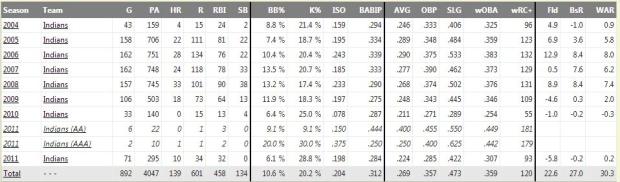
Four straight seasons of 157+ games, 20+HR, 20+SB, awesome walk rates, high average, and good power. He played solid to great defense and did so at a premium position on the field. Grady Sizemore was awesome.
And then Grady Sizemore was nothing. Only Albert Pujols had a higher positions player WAR in 2006. Pujols. That was it. From 2005-2008, Pujols, Alex Rodriguez, and Chase Utley were the only players to post higher WARs.
He was awesome to watch too. I didn’t really like doing it because he played against my favorite team, but he was spectacular. Power, speed, and highlight reel plays. Sizemore did it all and then he did nothing.
It’s a somber reminder for us that players who look invincible can vanish very quickly. Teams are backing up the money truck to free agents right now and one of them could be the next Sizemore. Cut down in his prime by a body that’s failing him.
So while he’ll work hard to get back and other players make the big dollars he was destined for, take a look at those stat lines again and think about Grady Sizemore and what could have been.
Nationals Add Haren, Improve on Team that Won Many Games
Updated 5:20pm: Great move for the Nationals who now have Haren behind Strasburg, Zimmerman, and Gonzalez. That’s a pretty good rotation and they were top five last year with Edwin Jackson instead of Haren. All one year deals are good risks and even if Haren’s medicals are in question, this deal should pay off.
1:48pm:The Nationals have signed Dan Haren to a 1 year, $13 million deal pending a physical. More to come.
Giants sign Pagan to Four Year Deal
Updated (5:24pm): I like the annual value of the contract for the Giants as Pagan has produced two 4+ win seasons in the last 3 seasons and three 2,9+ win seasons in the last four. He’s a good bet to be worth $10 million next season, so the only concern for me is if he’s going to be that guy four years from now. He’s only 31, so I don’t think he’ll drop off in a big way, but it’s hard to say for sure.
The Giants have money to spend after two World Series runs in the last three seasons and this isn’t a bad way to spend it. The commitment is a little long, but that’s the cost of doing business in today’s game. B.J. Upton got 5/75 to only be a little better and a little younger.
4:46pm: The Giants have signed OF Angel Pagan to a 4 year, $40 million deal.
News from Nashville: Winter Meetings Buzz (Monday)
The news of the day from Nashville comes in many parts, but these are the three that caught my eye.
Red Sox sign C/1B/DH Mike Napoli, 3 years, $39 million
The Sox needed someone to play first base and hit for power after they traded away most of their team to the Dodgers in August and Napoli qualifies. I think a lot of this deal comes from his awesome but lucky 2011 rather than his pretty good 2012. Napoli can certainly be a useful hitter in 2013 and beyond but there’s no way he can provide a lot of value on defense.
He’s a DH who won’t embarrass himself at 1B and can catch on occasion. The Sox already have David Ortiz at DH and have a lot of options at catcher, so Napoli figures to be the starting first baseman. They probably should have gone with LaRoche here, but the deal isn’t too big to turn me off. Grade: B-
Anibal Sanchez is asking for 6 years and $90 million
A couple of things to note here. First, a rumor went around that the Tigers offered 4/48 and Sanchez was insulted. Jason Beck of MLB.com says that the rumor is inaccurate, so maybe this isn’t a thing.
The other thing to note here is that a former The Guy Show personality and I had this exchange over the Sanchez news (edited for emphasis):
Him: No way I’m paying Sanchez $90m and no way I give anyone six years!
Me: If you don’t want to sign six year deals, you will never sign big time free agents.
Him: For that money I would want Greinke.
Me: Greinke will sign for many millions more than that.
Him: I would do 6/110.
Me: Then he will sign with the Dodgers and not you.
What we can learn from this exchange is twofold. One, the Tigers won’t sign Sanchez because he wants #2 starter money. The Tigers have two #2 starters already and don’t need a third. Other teams need #2 starters a lot more, and will in turn, pay more for them. Two, Sanchez is not asking for too much. Six years is always risky, but $15 million a season is a fair price if you’re confident in his ability to stay healthy relative to other pitchers.
Salaries are bigger now than they used to be. Teams are paying $5 million per WAR right now and the new TV money is going to bump that up to closer to $7 million per WAR in the near future. Sanchez is worth 3.0 WAR, so this is not an overpay.
R.A. Dickey Trade Talk
Lots of buzz around the Mets dealing Dickey and the Royals and Rangers seem interested. Hard to tell how much of this is media driven speculation and how much is actually happening.
I’m undecided about this move because I think the Mets aren’t that far away and could contend by 2014 if they play things right. Dickey seems willing to sign and extension if it’s a fair deal and knuckleballers age well. If they buy his ability to actually replicate the last two seasons, they should keep him. If they think he’s a flash in the pan, they should move him.
Also! Big news! A-Rod needs surgery and will be out until May or June. I’m sure you are very surprised because none of the national media is covering this story!
Previewing the Winter Meetings
Baseball’s Winter Meetings kick off this week in the annual “Now is About the Time We Start Doing Things” portion of most GMs’ job. As the week goes on, we should start to get a sense of where the bigger free agents might end up and we might see a trade or two as well.
Here are five things to watch at this year’s meetings:
1) Centerfield
Josh Hamilton, Michael Bourn, Angel Pagan, Shane Victorino. Four centerfielders last season who are looking for new teams and somewhere between 2 and 4 of them will get jobs as centerfielders. Bourn and Pagan certainly, with Hamilton and Victorino potentially moving to a corner.
The market here is interesting because the players are all looking for very different contracts and are very different style players, but they are actually probably all worth about the same on the field. Hamilton provides power, Bourn provides speed on offense and defense, Pagan plays good defense and gets on base, and Victorino does everything kind of well.
It will be very interesting to see who takes the plunge on Hamilton, how much Bourn gets, who sees Pagan as the safe bet, and who thinks Victorino will bounce back. This part of the market is deep in a strange way.
2) Zach Greinke
Greinke is easily the top free agent on the market in my book and he should become a very rich man in the next couple weeks if he doesn’t fall down a flight of stairs while simultaneously tearing his UCL.
Earlier this offseason I wrote that the Dodgers and the Angels were the most likely suitors for Greinke, but there is some talk that the Angels might not be as in control of this as we thought a month ago.
The Dodgers can give Greinke the team credit card and he could really shine in the big park, light hitting NL West. Yet the Angels need him desperately and currently have a pitching staff that more closely resembles the Cubs than the Phillies. Last year, a lot of mystery teams jumped in on big rf mystery teams tly have a pitching staff that more closely resembles the Cubs than the Phillies. Yet the Angefree agents, so keep an eye out for that again.
We’re watching Greinke because of his value, but also because everyone will wait for him to sign to go forward with starting pitching plans. His market will set the market for other pitcher and teams that needed Greinke will turn up the heat on other options.
3) Relievers
I won’t say much here other than that Brandon League and Jonathan Broxton got three year deals in excess of $20 million to pitch 60 innings a season. The relief market is off the rails and we’ll see where it goes from here. How much does Soriano want if this is what his inferior competition is making?
Fans and teams dramatically overvalue individual relievers and I’ll be watching how this plays out in Nashville this week.
4) Good Players that Don’t Fit
There are a few players on the free agent market who might be in odd situations because their current club doesn’t really have a place for them anymore. Adam LaRoche might have just been pushed out in Washington with Span coming over. The Tigers can’t afford Anibal Sanchez. The Yankees don’t want Nick Swisher. There’s no room at the inn in LA for Victorino.
It will be interesting to watch how this market plays out given that a lot of very useful players won’t be able to turn around and resign with their previous clubs. They might be undervalued, but they could still get overpaid. It’s really hard to tell how all of the new money will change the game and how a weak top of the market plays with a deep middle of the market.
5) TRADES?
Everyone seems to love trades and trade scenarios. Justin Upton? Giancarlo Stanton? Wil Myers? R.A. Dickey? Could these guys be traded?!
The Winter Meetings will give teams a chance to really gauge both the free agent and trade markets as they look to improve their clubs for 2013. If another big trade is going to happen this offseason, it’ll come in the next few days.
There’s a lot to watch next week as the offseason gets into full swing, so check with STT every day for complete coverage.
Lots of Baseball Happens: Signings, Extensions, and Trades
In the most cliché move yet this offseason, the hot stove is heating up as baseball’s GMs decided to start making moves in the week before the Winter Meetings in Nashville. Because my day job doesn’t allow me to spend the 12 hours a day I would like to writing about baseball, I’m going to have to get you caught up at lightning speed.
Here are the big moves from this week and my brief take on each:
Angels sign RP Ryan Madson, 1 year, $6 million plus incentives
Excellent move by the Angels who followed up by dumping Jordon Walden on the Braves for Tommy Hanson. Madson was a solid reliever for the Phillies for several years before signing a 1 year deal with the Reds last season. He got injured before the season and never threw a pitch, so it’s hard to judge exactly how healthy he may be. The Angels took that risk and added Madson to their bullpen on a one year deal during and offseason that has seen two meh relievers (League and Broxton) get three year contracts. Grade: A
Braves sign OF BJ Upton , 5 years, $75 million
The Braves needed to resign or replace Michael Bourn and this will do the trick. I have my doubts about Upton going forward and think he’s a guy who peaked early and will never live up to his skills. That said, he’s been a useful big leaguer with flashes of star power in the past and the Braves are only signing him through his age 32 season. I don’t love this deal, but it’s not a huge risk given how big contracts are getting. I think Upton has a couple more $15 million seasons in him, I’m just not sure how many and when they’ll come. I’m glad my team isn’t taking this risk, but I’m guessing the Braves won’t regret this and if they do, it won’t be a huge regret. Grade: B-
Nationals acquire Denard Span from the Twins for P Alex Meyer
The Tigers fan in me is thrilled Span is leaving the AL Central. The analyst in me thinks the Nationals made a shrewd move here. A cost controlled Span for three more seasons will do wonders between Harper and Werth and can provide a nice boost at the top of the order in a much cheaper way than the free agent options. Meyer is an interesting prospect, but most of the people I’ve talked to or read seem to think he’s a risky-high upside type. Span fills a hole in the Nats outfield and they traded from pitching depth, and they have a lot of that. The Twins have Ben Revere to fill the Span void and they do need a lot of pitching. I like this deal for them except that I think they probably could have gotten more in a deal for Span. Grade (Nats): A, Grade (Twins): C+
Pirates sign Russell Martin, 2 years, $17 million
The Pirates got something they needed. Offense. Martin hits for power and walks at a decent rate while provide some value on defense through solid pitching framing and debatable throwing skills. He’s a good fit for the Pirates and it’s hard to call $8.5 million for a free agent who can easily get to 2.0 WAR an overpay. Can’t complain if I’m a Bucs fan, but I really just want to point out that the Pirates outbid the Yankees for a player. The Pirates…outbid…the Yankees. With money. Grade: B
Mets extend David Wright, 7 years, $122 million
This extension starts after 2013 and carries Wright into his age 37 season. I was preparing a “What Should the Mets Pay Wright” piece when the news broke of this extension and I have to say, the Mets are getting a really solid yearly price for the cost of guaranteeing a lot of years. This is similar to the Longoria deal in a lot of ways except Longoria signed his four years ahead of free agency and Wright signed his one year ahead. Wright proved, through signing this deal, that he is committed to winning in New York and he’ll likely be a Met for life. Assuming he stays healthy, it’s hard for me to see a way in which this deal becomes a mess. It might not payoff, but it should mostly pay off. Grade: B+
The Winter Meetings are coming next week and a lot more action should be coming. Check back with STT for complete coverage.
122 days until Opening Day.
 New English D