2012 Season in Review: NL Central
Over the last couple weeks, you’ve seen the STT Seasons in Review for each of the six NL Central teams that gave brief overviews of each team’s biggest contributors and how their seasons went. I gave each club a letter grade for 2012 and a rough projection of how I see them stacking up in 2013.
Today, I want to review the division as a whole and paint a broad picture about what it looks like going forward (See you never, Astros!).
This is how things went in 2012:

And here’s how the Baseball Prospectus Playoff Odds looked from April to October.
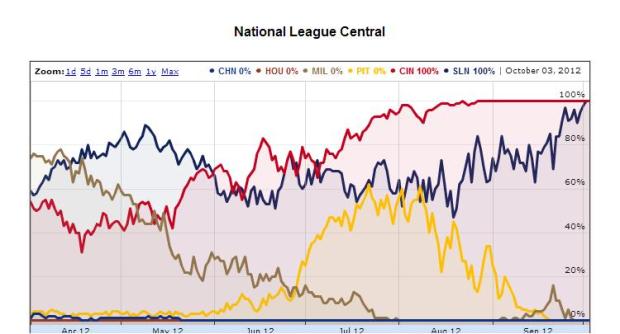
The Reds took over by July and the Cardinals pretty much stayed in Wild Card position for most of the season. Each of the Brewers and Pirates made a run at it at different points, but neither could really close the deal. Needless to say, the Cubs and Astros did not really factor into the race.
The NL Central is one of the lesser divisions in the game, but the offense from the Reds, Cards, and Brewers was pretty good. Match that with a Pirates club on the rise and some good pitching from a couple of these teams, and what we really have is a division dragged down by the bottom feeders.
The Reds and Cardinals are good teams. The Brewers are talented but have damaging holes. The Pirates are becoming competitive, but still haven’t become a threat. The Cubs and Astros are a mess. One of these teams is leaving next year, so the division as a whole might get a little better by subtraction.
My bet is that the division will look pretty similar in 2013 when it’s all said and done. Here is my early projection, which is subject to change throughout the offseason:
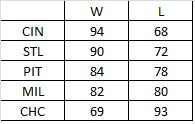
The key variable here is that these teams have to pick up some wins that normally came at the expense of the Astros in order to keep these win totals up. I guess I’ll have to look at this more closely as I fill in the sheet with the rest of the divisions.
The NL Central MVP goes to Ryan Braun over Yadier Molina and the Cy Young belongs to Johnny Cueto.
Here’s a final summary of the NL Central 2012 Grades and Win totals:

All and all, another fine year in the pitcher-bats-9th Midwestern United States led by the Reds and Cardinals.
2012 Season in Review: Cincinnati Reds
97-65, 1st in the NL Central, Division Champion
Lost in the NLDS to the Giants
It’s hard not to be happy with 97 wins. That’s a lot of wins. The Reds were a great team in 2012 and should be really happy about everything they did except for those last three playoff games where they let the Giants embarrass them.
Joey Votto played 70 percent of the year and posted a 5.9 WAR. His slash line (.337/474/.567) was something out of a video game. Brandon Phillips, Ryan Hanigan, Todd Frazier, Ryan Ludwick, Zack Cozart, and Jay Bruce all posted starter or better WARs while contributing to baseball’s 10th best cohort of position players.
It’s hard to argue with a top five pitching staff either. The original rotation, led by Johnny Cueto, made 161 starts, yielding only a single game to Todd Redmond at the very end of the season. Mat Latos, Bronson Arroyo, Mike Leake, and Homer Bailey joined Cueto in the original five to form one of the better rotations in the game.
But the bullpen was the story. They posted the second best K/9 rate and the third best FIP in 2012 on the back of fireballer Aroldis Chapman.
The Reds hit well, fielded well enough, and pitched great. That’s a really good formula if you’re trying to win baseball games.
The Reds were a complete team and commanded the soft NL Central for the entire season. They fought off challenges from the Pirates and Cardinals and coasted their way into the postseason. After a strong start on the road in San Francisco, the Reds lost all three home games and called it a season after Game 5 of the NLDS.
It’s hard not to favor the Reds again in 2013 as they return most of their key pieces and look to be moving Chapman to the rotation where he belongs. The Cardinals will have something to say about the Reds’ chance at a repeat division crown, but the Great American Ballpark faithful should clear their schedules for next fall.
2012 Grade: A
Early 2013 Projection: 94-68
Steroid Users and the Hall of Fame: The Time Has Come to Decide
The 2013 MLB Hall of Fame ballot is out, and it’s time to start yelling and screaming. Why you ask? Well because we’re welcoming a wave of suspected steroid users into the conversation and people seem to have strong opinions about that.
Here is the official ballot, and you can see a lot of first timers are controversial like Barry Bonds, Sammy Sosa, and Roger Clemens along with previous question marks like Mark McGwire and Jeff Bagwell. Curt Schilling, Mike Piazza, and Craig Biggio are others of note joining the party for the first time.
I’m not going to assess each candidacy individually, but I will say that there are some players who clearly belong in the Hall based on their numbers, but might have a tough time getting in because of their conduct. Presumably, in a world in which we could know with certainty that Barry Bonds never used steroids, he would be a first ballot Hall of Famer easily. Same goes for Sosa and Clemens. No question.
The rest of the players I’ve named are all Hall-worthy, but some of them are under suspicion to varying degrees. Let’s ask the more important question here. Should steroid use matter in Hall of Fame voting?
We can never know who used and who didn’t, so all of this is based on suspicion because none of these guys ever failed a test (although McGwire has admitted to using). Let’s assume for a moment that all of these players would make the Hall of Fame if there was no suspicious on steroid use and that higher suspicion decreases an individual’s likelihood of election.
There are different scenarios for how to address this.
1) Suspicion versus Evidence?
Should we keep players out of the Hall because we think they used? This is an important question. Manny Ramirez, who won’t be eligible for four more years, failed two tests. We know he used banned substances. Bonds never failed a test; we just think he used banned substances. Should we vote based on a feeling, in the absence of true evidence? I would argue that we probably shouldn’t.
We think certain players used, but we don’t actually know. A lot of players used steroids and we’ll never know exactly who did. That includes the players who competed against each of these stars. That doesn’t make their choices to use morally okay, but it does make me think that we can’t just decide certain players don’t belong in the Hall because we think they may have done something wrong. We don’t have evidence. We want to punish users because they corrupted the sport, but we can’t just keep people out of the Hall of Fame because we think they did something wrong.
A jury shouldn’t convict someone just because they look like a murderer if there is no evidence they murdered someone. Certainly, the stakes are different, but the logic is the same.
If we don’t have proof, can we really say who is clean and who isn’t?
2) Is excluding suspected users immoral?
This is an interesting perspective. If we exclude users, are we punishing them or are we trying to hide from a black mark on the game’s record. Wouldn’t we be pretty upset if Germany just stopped putting Nazis in history books because they were bad people? Isn’t the Hall of Fame a museum to baseball? Shouldn’t it include the good and the bad?
I could understand not wanting to celebrate Bonds, but his absence from the Hall would just be strange. He’s the all-time HR leader and one of the best players of all time. He may have cheated to get that far, but we can’t just say he never happened, can we?
If we hide from what brings us shame, we’re trying to pretend it never happened.
3) The Story of the Game
How can we exclude steroid users when they were such a big part of baseball? How can I take my kids to a Cooperstown that doesn’t include the best players of my childhood? They might not be the heroes we want them to be, but they were the best.
We don’t just ignore Nixon because he broke the law. He’s a critical character in American history for that very reason. Bonds can be a villain, but all great stories need villains. These guys were bad guys, we can say, but they are part of our history and we were really happy when clean players broke their records and stole their limelight.
4) What about the Type II Error?
This is a problem in the same vein as #1. What if we exclude a player who earned his way into the Hall cleanly because we thought he used. What if Bonds was totally clean? Wouldn’t we rather have a few bad apples in the Hall if it means all of the innocent people made it in for sure instead of keeping innocent people out in order to make sure none of the guilty get in?
This is a serious dilemma for the voters. Which is better? I’d feel a lot worse if a clean player was left out that if a steroid user got in.
All said, what should we do about the steroid era and the Hall of Fame? I’ve waivered about this for a while, but now that the day has come, it’s time to decide. How do we handle such a complex problem?
I think we have to let them in.
It’s wrong to punish someone on suspicion alone and we shouldn’t try to whitewash over a black period of history. We need to tell the whole story and I don’t want anyone punished for something they didn’t do.
It’s our responsibility as fans to teach our kids about the game in the most honest way possible. When the time comes, my kids will know I think Barry Bonds cheated, but they’ll also know that I can’t prove it. I’ll tell him he was a force to be reckoned with in the box, but I don’t know if he or anyone else was using something they shouldn’t have.
I’ll tell him he’s in the Hall because the Hall is a museum to the game, not a reward for the best behaved.
Most importantly, I teach my kids the important lesson of Bonds and Clemens and Sosa. I’ll teach them that cheating might be a good short term answer, but it’s never the right choice in the long run. I’ll tell them about how I sat up at night watching Barry Bonds break the homerun record in a quiet house. I’ll tell them that no one celebrated outside of San Francisco.
I’ll tell them how everyone said Bonds’ name with disgust, disappointment, or indifference.
He broke the most hallowed record in sports and almost no one really cared. Compare that with the excitement of Aaron passing Ruth and you’ll learn the valuable lesson. Cheating might earn you some hardware. It might make you some money. You might even make it into the Hall of Fame.
But it won’t earn you respect and it won’t make you happy.
We should let the suspected users into the Hall because if they cheated, they’ll be the ones living with the lie, not us.
2012 Season in Review: St. Louis Cardinals
88-74, 2nd in the NL Central, 2nd Wild Card
Lost in the NLCS to the Giants
After winning the 2011 World Series in dramatic fashion the Cardinals came within one win of making it back to rekindle the 2006 series against the Tigers. But falling short can hardly be called a failure in a game filled with parity. The Cardinals had an amazing season that was capped off by one of the more amazing wins in recent memory.
They lost Albert Pujols to free agency and Tony LaRussa and Dave Duncan to retirement after 2011, but the Cardinals didn’t panic and had a solid season. They won the inaugural NL Coin Flip game against the Braves with a little help from a bad call and came back to stun the Nationals in Game 5 of the NLDS. They took a 3-1 lead on the Giants in the NLCS, but couldn’t close the deal and went home one win shy of the Fall Classic.
The offense led the way as we all thought it would. Yadier Molina (6.5), Matt Holliday (5.1), David Freese (4.1), Jon Jay (4.1), Carlos Beltran (3.6), and Allen Craig (3.1) all racked up solid to great WARs and role players like Matt Carpenter and Pete Kozma delivered when they needed them to do so.
All told, they were baseball’s second best offense and third best group of position players when you factor in defense. As expected, they Cardinals bats delivered.
But the league’s 9th best pitching staff also called Busch Stadium home in 2012. Adam Wainwright led the staff (4.4 WAR) and had a great #2 in the form of Kyle Lohse’s breakout year (3.6). Lance Lynn and Jamie Garcia also contributed along with a respectable year from Jake Westbrook. Joe Kelly picked up the slack and filled in when those five couldn’t go, allowing Chris Carpenter to rest up for the very late stretch run.
The bullpen was middle of the roadish, but they certainly didn’t cost them enough games to make it hurt.
Mike Matheny’s first season as a manager went well for the club, even if he does think bunting is compulsory.
It was a very strong year from one of baseball’s strongest franchises. The Cardinals locked up the newly minted 2nd Wild Card and carried that good fortune deep into October. They didn’t miss Pujols and managed without Carpenter.
With some exciting young arms coming to a Busch Stadium mound near you, it’s hard not to be bullish on the 2013 Cardinals while commending them on a fine 2012.
2012 Grade: A
Early 2013 Projection: 90-72
2012 Season in Review: Milwaukee Brewers
83-79, 3rd in the NL Central
The Brewers came close to following up their run to the 2011 NLCS with another playoff appearance, but ended up just short and finished 5 games behind WC2 St. Louis. This might feel like a respectable season given the loss of Prince Fielder to the big spending Tigers and Zach Greinke to the Angels via trade, but it’s hard not to look at 2012 as a missed opportunity if you’re a Brewers fan.
The reason I say this is because the Brewers could have made the playoffs if their bullpen didn’t implode time after time during the first half. They played well down the stretch and certainly could have won five more games with two more months of Greinke mixed with a not-terrible bullpen in May and June.
Ryan Braun had a near MVP season (7.9 WAR) and Aramis Ramirez filled in admirably in place of Fielder (6.5 WAR) behind him. Jonathan Lucroy posted a spectacular 3.9 WAR in 96 games behind the plate and Carlos Gomez (3.5), Nori Aoki (2.9), and Corey Hart (2.9) all had solid seasons at the plate.
Collectively, Brewers position players accumulated 33.6 WAR on offense and defense, good for second in all of baseball. They didn’t miss Fielder that much. They got elite production from their stars, solid contributions from regulars, and didn’t have anyone who dragged them down with a lot of at bats of negative value.
On the hill, the story is a bit different. Greinke gave them two great months (3.8 WAR) and Mike Fiers (3.0), Marco Estrada (2.7), and Yovani Gallardo (2.7) all had solid seasons. Wolf and Marcum also made quite a few starts of mediocre value, but the key deficiency of the rotation was that only Gallardo make more than 24 starts. By WAR, they had the 9th best rotation in baseball.
The bullpen, however, was 25th in baseball and posted a 4.11 BB/9 rate. Only the Cubs and Dodgers were as bad or worse in 2012. Only the Mets had a worse Left on Base rate. Only the Astros and Rockies gave up more hits. We should cut them some slack because they pitch in a hitter friendly park, but not this much. And we should also remember they stunk in the first half and did get a little better.
But the story here is that bullpens performing very badly over a short period can cost you a good deal of games with a small raw amount of terrible performance. I don’t like Saves as a stat for many reasons, but when you blow 30 of them as a team in one season, you’re doing something wrong.
So the story of the 2012 Brewers is a story about a good offense, respectable starting pitching, and a rough bullpen. They were good enough to make the Play-in Game except for a ton of blown games late. It’s hard not to let that eat at you over the course of an offseason.
The loss of Greinke going forward will cost them without an obvious replacement, but they should be able to recreate him with a couple of solid arms who can replace all of the starts they gave to AAAA type players.
The Reds and Cardinals aren’t going anywhere and the Pirates look serious. The Brewers need to beef up their bullpen and solidify their rotation if they want to give their offense a shot at carrying them back to the postseason.
2012 Grade: C
Early 2013 Projection: 82-80
Rays Extend Best Contract in Baseball, Evan Longoria is now Rich, Awesome, and Loyal
Baseball’s most team friendly deal just got longer. It didn’t get better, but that would have been impossible.
This morning, the Tampa Bay Rays signed Evan Longoria to a 6 year, $100 million extension that tacks on to the end of their current accord.
Let’s summarize Longoria’s salary progression:
2008: $500,000
2009: $550,000
2010: $950,000
2011: $2,000,000
2012: $4,500,000
2013: $6,000,000
2014: $7,500,000
2015: $11,000,000
2016: $11,500,000
2017-2022: $16,667,000 (average, breakdown unknown at time of publishing)
2023: (undisclosed option at time of publishing)
Basically, Longoria’s first three seasons brought him standard pre-arbitration payment with a touch of sweetener. In what would have been his arbitration seasons, he will make $12.5 million. That’s about what Hunter Pence will earn in arbitration next year alone.
Needless to say, the Rays made a good investment with the first contract that guaranteed money through in 2013. Longoria ended up earning a lot less than he could of, but he opted for certainty over potential.
The new deal exercises the options from the first deal (14-16) and adds 6-7 more seasons. Longoria’s going to average $14.4 million over the life of this deal (not counting the 2023 option). He’s basically going to be paid to average 2-3 WAR over the next ten seasons after averaging 6 WAR through his first five seasons that included three seasons of less than 140 games.
His average WAR is 6 despite only playing two full seasons, two majority seasons, and one half season. That’s pretty awesome given that he is entering his prime according to our conception of aging in MLB. According to Fangraphs’ Salary numbers, Longoria has already been worth $128 million in his career. To earn the rest of his contract, he essentially only has to match his value over the next ten years with the last five.
This is a great deal for the club given the kind of money flying around to players these days. 10 year, $200 plus million deals are everywhere. Pujols, Fielder, and Votto all got that in the last 12 months.
Certainly Longoria could have earned more on the open market, but he’s also going to have more money than any reasonable person can spend for the rest of his life. He’s tied to one city and one team. He’ll easily earn 10 and 5 rights if the deal doesn’t include its own no-trade clause. He’s basically mapped out his professional career at 27 years old.
He’s an elite third baseman now, but he can move to 1B and then DH as he ages if need be. The Rays only need him to be pretty good to earn his contract and he’s set for life on a team he loves either way. Longoria can basically guarantee he’ll retire as the greatest Ray of all time and he’ll be a very rich man.
So while the Longoria contract is no longer a giant steal, it’s still a steal. It’s probably no longer the best contract in baseball because he’s making more than $500,000, but it’s still amazing.
Everyone wins, especially baseball fans in Tampa Bay. If any ex-Marlins fans are looking for a new team to follow, the guys in St. Pete are actually building a winner in a small market, and their poster-boy is now a Ray for life.
Where to Sit When You Head to the Ballpark
One of the more important decisions to make as a baseball fan is where to sit when you attend a game in person. This is a critical decision as you plan to maximize your enjoyment, even if the worst seat in the house is still better than every other geographic location on Planet Earth.
With that said, it will always come down to a matter of opinion (and also cost), but there are advantages and disadvantage to each vantage point. I’ve included a seating chart of Comerica Park for reference, but recognize that all stadiums are different. Later in the offseason, I’ll run a series ranking the MLB parks I’ve been to, so I can give you specific advice at that point, but this is a general overview.
Let’s assume that funds aren’t an issue here, but if they are, just eliminate any options that are out of your price range, and voila, this will still work for you!
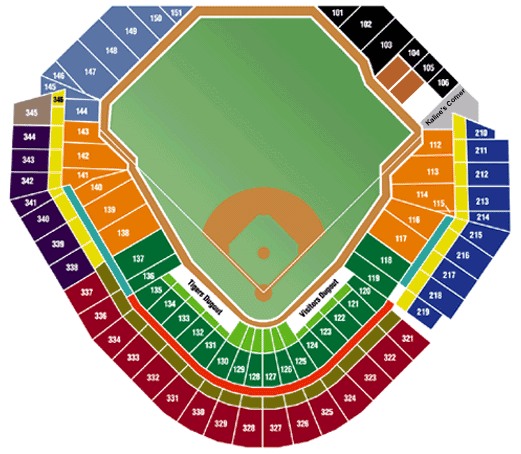
Most people assume close proximity to the playing field is the most desirable aspect of your seating choice, but this is a fallacy. You actually don’t want to be too close because it will throw off your perspective. While sitting directly behind home plate in the first row seems cool, it’s actually not a great view unless you like nodding approvingly at the player near the on-deck circle.
In this instance, however, the umpire obstructs your view of balls and strikes, you have a bad angle on plays at first and third and won’t be able to judge the distance of fly balls. If you want to sit near the plate, you want to sit many rows back. This will give you a better view of the strikezone and will improve your ability to judge batted balls. Your views of the bases are still not ideal, but they are better.
A much better choice if you like to sit facing the field in a similar way is the first row of the upper deck. Here, you’ve improved your view of the strikezone, you’re in a better position to judge batted balls, and the bases are less obstructed. It’s still not an ideal seat because of the angle, but if you like the view from behind the field of play, this is my recommendation.
If you’re looking to improve on your view, the best thing you can do is move down the line. You don’t want to go too far and lose your view of the zone, but swinging around to first or third base will really help you judge batted balls. You’ll still be close enough to see the zone, but you will give up some of your inside-outside judgment.
Here, you’re also going to give yourself a good angle on most of the bases too. If you move toward first, you will have a good view of forces at first (important), tags at third, and tags at home while losing tags at first (coming back to the bag), and tags at second. Forces at second will vary. If you slide toward third, you can see tags at first, everything at second and everything at home. You surrender a lot of action at third and forces at first. If I have to choose, the profile of sitting on first base is a little better.
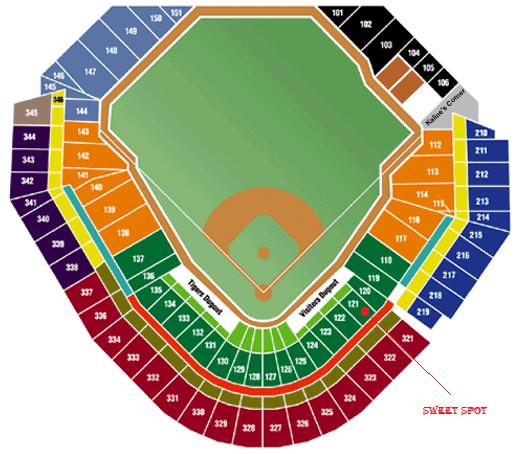
So far, we want to sit on the first base side, but not too close to the action. We also don’t want to sit so far that we can’t see either. The sweetspot, as indicated in this diagram, is probably about even with first base and above two thirds of the way up the section. This will give you optimum viewing and will put you in foul ball range. This is where I’d tell you to sit.
But there are advantages to other spots. It’s always nice to be in the first row under an overhang because it protects you from the elements during April and October (and also rain delays in the summer). The first few rows of the outfield seats can be fun too, if you like watching the game unfold from a player’s point of view.
If you’re cost conscious, another smart move is to sit on the infield side of the first section after a price change (117, 138). This offers a more expensive view at a lower price.
Another trick is to sit with the nearest aisle to you on the outfield side of you. In other words, be far away from the nearest aisle that might block your view of the plate.
If you’re still deciding between or among some choices, think about the geography of the stadium. Are there particular areas you like to see when looking around? Do you want to be close to a particular concession stand, bathroom, or apparel shop?
You could also choose to sit close to your favorite player. I knew a girl in high school who always sat near Inge because she loves him and I have a feeling a former co-host of mine likes standing in right center field so he can get a nice view of Josh Hamilton when he comes to town. In my case, I’m not sure if they’ll let me sit in the dugout, as my favorite players are usually utility guys.
So while it’s a matter of opinion, there is a right method for picking your seats. Some people value different things at a ballpark, but you should know what you’re choosing when you make the call. Don’t worry though, if you screw it up, you’ll still be spending three hours watching baseball.
2012 Season in Review: Pittsburgh Pirates
79-83, 4th in the NL Central
They almost ended the torture that is baseball’s longest losing season streak. Almost. After pulling even with .500 on May 30th, they held at or above .500 until September 20th.
For some of the season, they were sitting in a playoff position. The Pirates were a relevant baseball team in 2012 even if they faded down the stretch and ended up posting another losing season.
The story of the Pirates’ strength was pitching and Andrew McCutchen, but only one of those held up down the stretch. McCutchen’s 7.4 WAR and 158 wRC+ were the best numbers from a Pirates positions player since Barry Bonds in the early 1990s.
Problem was, he didn’t get much help. Neil Walker (3.3) and Pedro Alvarez (2.9) were the only position players to post starter level WARs this season, and the club as a whole was 10% below average offensively and didn’t make up for it on defense.
After a strong start, the pitching faded too. A.J. Burnett had a fine year (3.4 WAR, 3.51 ERA), but James MacDonald was the only other starter to combine innings with any kind of effectiveness. Burnett was the only Pirates arm to top 1.7 WAR. That’s not a good formula.
But the Pirates shouldn’t fear because they have a lot to look forward too. They have one of the best stadiums in the game in a great part of the city and they also have some exciting young arms coming up through the system. With McCutchen locked up and some interesting complimentary pieces in-house, the Pirates might not be that far away from being true contenders.
I wouldn’t start buying 2013 playoff tickets just yet, but I would plan to have a “We’re Over .500” party next September.
2012 Grade: C
Early 2013 Projection: 84-78
2012 Season in Review: Chicago Cubs
61-101, 5th in the NL Central
The best thing you can say about the 2012 Chicago Cubs is that they weren’t the 2012 Houston Astros. It was a rough season for the North Siders as they lost over 100 games for just the third time in franchise history. Given the bad news bears-ish-ness of the Cubs over the years, that’s actually kind of surprising.
The Cubs had a few solid position player contributors, but those contributions dropped off well before you got down the lineup and onto the bench. Alfonso Soriano (4.0), Starlin Castro (3.3), Darwin Barney (2.5), and Anthony Rizzo (1.8 in half a season) all posted starter worthy WARs, but no one else made the cut. On top of that, a lot of Soriano and Barney’s value came on defense, which is somewhat questionable given the Cubs level of shifting.
The long and short of it is they weren’t good enough on offense. Only the Mariners got on base less in 2012 than the Cubs. That’s just not a winning formula.
On defense, they were a respectable 9th in the league according to UZR, but they were still a step or two behind the truly elite clubs.
As a staff, they were 27th in baseball with a 7.7 WAR, but 9.9 WAR came from the starters. That is not a mistake. Their relievers were the worst in baseball at -1.5 WAR (cumulative difference varies because of innings).
Jeff Samardjiza had a strong year (3.3) and Dempster (2.1) and Maholm (1.4) each did well in their partial seasons with the club and Garza (1.2) was good enough in his 18 starts.
Collectively, this just wasn’t a good team. They can’t hit, they can’t pitch, and their fielding wasn’t good enough to overcome those two problems. Their total WAR actually over estimates their 2012 win total, but you would expect it to given how bad the bullpen was.
The immediate future doesn’t look too bright, but Jed Hoyer and Theo Epstein are at the helm now, so the long term prospects are much brighter. With the fan base and the resources of the Cubs, those two guys should be able to turn things around if they’re given time.
The 2012 Cubs were one of the worst teams in the league and they look to stay there in 2013. Anybody can have a bad year, and as Cubs fans like to say, anybody can have a bad century too.
2012 Grade: F
Early 2013 Projection: 69-93
Blue Jays Take a Smart Risk, Sign Melky Cabrera
For most of the day I stewed over Mitch Albom’s silly defense of Cabrera as MVP and wanted to write about how ridiculous it was, but then lots of other smart people rushed in to fill that void. I decided to let it go and get back to legitimate baseball discussion, and once again, the Toronto Blue Jays are driving the day’s story.
News broke this afternoon that the Jays and GM Alex Anthopolous had inked Melky Cabrera to a 2 year, $16 million deal. To be clear, this is the switch hitting steroid suspended OF, not the other M. Cabrera that is getting all the attention today.
To me, this is a great sign by one of the game’s better front offices. They bought low on an undervalued player.
But the Melky saga is quite complex. He’s had three bad seasons, two solid seasons, and two great seasons. The two great seasons have been the last two, but the most recent one ended with a 50 game suspension for testing positive for steroids (which he admitted to).
How should we value a player like this? What is he worth and what is the risk?
First, it should be noted that he’s only 28, which means his two great seasons came between ages 26-28, which is exactly when you would expect a player to peak. In other words, there is a very logical explanation for his breakout other than steroids.
We also can’t assume he was using prior to this season, because we would expect that he would have taken 1-3 tests during 2011 as well. None of this is perfectly certain, but it is fair to say that Melky is probably better than the very bad seasons and not quite as good as the very good seasons.
It’s very possible that steroids aided his improvement, but there is still a lot of scientific debate about how steroids help baseball players. Some say power, some say endurance, some say there is no real effect.
So assuming he doesn’t get suspended again and is on the field for the next two years, let’s evaluate this for the Jays.
The Free Agent market is set somewhere around 1.0 WAR per $5-6 million. This is an average, but over two seasons, for Melky to earn $16 million he needs to be worth somewhere between 3.0 and 4.0 WAR in my book if we want to account for a range given imperfect modeling.
Over the last two seasons, 34 MLB hitters fell between 3.0 and 4.0 WAR regardless of how many plate appearance they had. In other words, these are the hitters who ended up being worth about what Melky is going to make regardless of how they were used.
I averaged their production and then divided it into two seasons to get an idea of what Melky needs to look like in order to be worth this deal. I should note this is all hitters, not just OF and there is plenty of variation.
Per Season Stat Line:
113 G, 436 PA, 101 H, 11 HR, 49 R, 46 RBI, 8 SB
.260/.329/.414
8% BB, 19% K
(League average defense and baserunning)
That looks extremely doable for Melky in the next two seasons. He needs to hit .260, walk at a league average rate and hit 11 HR per season to earn this contract. He doesn’t need to be the player he was last year, he needs to be respectable.
To give you a sense of this, let’s consider the players in 2012 who hit between .250 and .270 and slugged between .400 and .420.
A.J. Ellis, Coco Crisp, David DeJesus, and Delmon Young. Those players aren’t good defense comparisons to the player Melky needs to be, but he can certainly hit like those guys and be average in the other aspects of baseball if he stays reasonably healthy.
The Blue Jays were willing to bet on Melky not using PEDs again and certainly willing to pay $8 million a season for a player who could easily be worth close to $12 or $15 million if he’s really who he’s been the last two seasons.
This is a solid deal for the Blue Jays and good chance for Melky to repair his image and still have some good years left when he’s ready to hit the market again after the 2014 season.
 New English D