Mike Aviles Goes For AL Central Bingo

The Tigers signed Mike Aviles to a one year deal worth $2 million on Friday. Because it’s the offseason, we’ll talk about it, but in reality it’s a very minor move. Aviles is a career .265/.297/.385 hitter while playing something around average defense with okay base running. Aviles has primarily played the infield during his career but does have around 500 innings of outfield work to his name as well.
In one sense, signing Aviles is basically a no-risk move. $2 million is nothing. It’s a drop in the bucket for a team that will spend $170 million or more in 2016 and it isn’t a big enough commitment to tie the club to him if he struggles. It’s the kind of move that doesn’t preclude the team for going in another direction. On the other hand, signing Aviles led the Tigers to bounce Kyle Lobstein from the 40-man roster. Perhaps Lobstein isn’t healthy and this won’t matter at all, but if the Tigers lose a healthy Lobstein to squeeze Aviles onto the roster this move is kind of a head scratcher. I don’t see any reason why he’s more useful than Romine or Machado.
The thing about Aviles is that he isn’t any good. He’s had good offensive seasons in his career twice, way back in 2008 and 2010. Since 2011, his wRC+ have been 85, 75, 77, 72, and 65. If you can play decent infield defense with an 85 wRC+ that’s a fine guy to have on the roster but Aviles has been more in the 75 wRC+ range with okay defense for the last four seasons. He doesn’t walk, strikeout, or hit for much power. You’re going to get balls in play with Aviles but you won’t get much damage.
To be valuable with his offensive profile, you need to be a really strong defender, and while Aviles isn’t a liability in the field, it’s been a while since he’s put up high quality defensive numbers. The best case scenario is he’s worth maybe 0.5 WAR, but it’s very plausible that he’s a replacement level player.
Now this isn’t a big deal because you have to pay everyone at least $500,000, so you’re basically risking $1.5 million on the chance that he adds a little positive value and some good influence in the clubhouse. He’s versatile on defense, which always helps, but he’s a 25th man in every sense of the word.
The only potential risk with Aviles is that you might lose Lobstein who can serve as a good depth piece on the pitching side. Otherwise, it’s very little money and the club can still bring someone in to take his roster spot if they find the money for a good player. There’s nothing wrong with this move, but don’t expect him to be a meaningful contributor on the field.
And Justin Wilson Makes Three
The Tigers went into the offseason needing to revamp their bullpen. They traded for K-Rod, signed Mark Lowe, and, today, picked up lefty flamethrower Justin Wilson from the Yankees. Going the other way were Luis Cessa and Chad Green, both minor league relievers. The 28-year old has 199.1 career major league innings in relief with an 82 ERA- and 85 FIP-. He’s also coming off his best season.
Wilson is basically all fastballs and cutters, but he sits 95 from the left side and has enough command to for the stuff to work. Additionally, while 200 innings worth of data isn’t enough of a sample to be sure, he’s displayed no serious platoon split in his time in the show, meaning he’s probably capable of getting big outs against righties late in games.
Wilson is arbitration eligible for the first time this winter, so that means the Tigers will have him for three pretty reasonably priced years. Cessa and Green are both good enough to make the majors, but they’re probably third-tier relievers or worse in most scenarios. The Tigers gave up two guys who might be solid arms in two or three years for a guy who should be very good for the next couple of years.
There’s not a lot to say about the deal other than that it looks like a good one. I’ll dive in on Wilson as a pitcher later in the offseason, as I did with Zimmermann, but from a transaction standpoint, Avila had a good night.
Take a step back and appreciate what Avila has done. They traded Betancourt, Cessa, and Green and spent less than $40 million over three years to acquire two years of K-Rod, two years of Lowe, and three years of Wilson. None of those guys are the best in the business at their respective reliever tier, but that’s a very impressive haul for the price. The club added three really solid relief pitchers without subtracting any 2016 talent or important future pieces, and it only increased payroll by like $12 million a year on average.
Avila got his front-end arm, his back end starter, three relievers, a backup catcher, and a 3/4 OF. They could use a good bench bat in addition to a top flight outfielder, but the key is that they’ve made all these additions without depleting the farm or signing any crazy contracts. They’re prepared to compete in 2016 without hurting themselves in any future years.
Avila hasn’t quite made the Tigers the 2016 AL Central front runners, but he’s certainly had himself a nice opening month in his first offseason at the helm.
Tigers Sign Mark Lowe
Today, the Tigers are continuing to revamp their team, this time signing free agent reliever Mark Lowe to a two-year deal worth $11 million. Lowe is coming off the best season his career and the Tigers will get the right-hander’s age 33 and 34 seasons.
The simplest way to put it is that Lowe looked cooked entering 2015. He threw 18 terrible innings from 2013-2014 and had only been a mediocre reliever in 2011-2012. His only good season came all the way back in 2009, when he threw 80 innings of 76 ERA-/83 FIP- baseball in Seattle. The M’s re-signed him in 2015 as a reclamation project. He was reclaimed.
A couple of key things happened. First, Lowe began relying on his slider more often. Try to ignore 2013 and 2014 in this graph because he hardly threw any innings, but if you track pre-2013 with 2015, the spike is clear.

He also found the velocity he didn’t have during the last few seasons:

Granted, Lowe threw hard for his entire career before 2012, so it’s not like the velocity is solely responsible for his big year. You’ll also notice that he’s lowered his release point:

Essentially, Lowe stayed off the plate away against righties and lefties in 2015 more than he had in he past. And interestingly, he threw a lot of sliders to lefties and righties, when the typical RHP would typically use his slider more against right-handed batters.
Lowe isn’t a sure thing by any means, but it’s fair to say that by throwing harder than he has in years and by mixing in more sliders with better command, his 2015 wasn’t a statistical fluke. He didn’t succeed in 2015 because he got lucky on balls in play or something like that. He pitched well, but when you’re talking about a guy with a long history of not pitching well, you always have to be cautious. Relievers are relievers.
The Tigers paid him $11 million over two years, so it’s not like they
are betting on another elite season or anything. He’s getting paid like a second tier reliever in a year where lots of those guys are likely to get three years worth. Lowe is a nice guy to add to the bullpen along with K-Rod, but there’s still plenty of room for other arms if the Tigers can locate the money.
Jarrod Saltalamacchia Becomes A Tiger
The Tigers, after losing Alex Avila to the White Sox, were in the market for some catching insurance. The club is committed to James McCann but there’s a whole other roster spot reserved for a catcher and the only internal option is a very replacement level Bryan Holaday. Enter Jarrod Saltalamacchia.
On Sunday, the Tigers signed him to a one-year deal for the league minimum (~$550K) and he will compete for a spot in Spring Training. Salty is still drawing a paycheck from the Marlins, who cut him last April, so the Tigers get to have him for basically no money. And anything that doesn’t take money away from another place is worth trying. No need to discuss the merits of the deal because there’s no downside. Salty doesn’t block a surprise prospect, he doesn’t steal time from McCann if McCann is playing well, and he doesn’t even stand in the way if the Tigers stumbled their way into a trade for a better player.
If you’re looking for a rundown of the newest Tiger, it’s pretty simple. Salty is a switch-hitting catcher who was a highly touted young prospect. Nine MLB seasons later, he’s had one good season (2013). He’s pretty regularly been in the 95-100 wRC+ range, which is above average for a catcher, but he’s somewhere between not very good and pretty darn bad behind the plate. He’s a poor framer, an average blocker at best, and doesn’t command the running game. He’s a bat first guy without much bat.
He had a good 46 PA against lefties in 2015, but has been absolutely awful from the right side of the plate in his previous work. Against righties, however, he’s a decent enough hitter who can provide some power (.195 career ISO). He’s a three true outcomes type who is only useful as a bat-only catcher versus RHP, but while that’s not an exciting player, it’s a player that’s cool if he’s free.
If things go well, he can provide some power off the bench and on days when McCann needs a break. He could provide half a win and be an improvement over Holaday and there is some upside if he runs into enough fastballs from righties. This isn’t a major move, and anything above replacement level is a net positive for the club. If things go poorly, the Tigers release him at virtually no cost.
We’re also probably in for some good “salt” related puns, so that makes the move worth it no matter way.
Getting To Know Jordan Zimmermann, Offseason Centerpiece
The Tigers have already checked quite a few of their offseason boxes as the Winter Meetings begin in Nashville. They acquired Francisco Rodriguez and Cameron Maybin in trades and signed Jordan Zimmermann and Mike Pelfrey as free agents. The club has about $160 million committed for 2016, leaving them with $10-$20 million left to spend before they exceed their 2015 payroll allocations. But that’s hot stove talk. We talk about dollars and cents to evaluate the quality of a signing, as I did when the Tigers inked Zimmermann last week. But things get to be more fun when you go beyond “good contract/bad contract” and talk about the players as players. So let’s get to know Jordan Zimmermann, New Tigers Pitcher.
First, the absolute basics. Zimmermann is a right-handed starter who will turn 30 in May. He’s pitched in parts of seven seasons with the Nationals and has tallied 1094 major league innings. That spans 178 starts and he’s recorded an 86 ERA- and 88 FIP- in his career. In laymen’s terms, Zimmermann is a guy who typically tosses about 200 innings and comes in about 10-15% better than the league average pitcher. Essentially, he’s been a 3-4 WAR pitcher for most of his career.
Let’s compare him, in an overall sense, to all pitchers since 2009 with 300 innings pitched (only counting statistics as starters). That’s 225 starting pitchers. Of the group, he has the 28th best park-adjusted ERA, near guys like Scherzer, Cole, Bumgarner, and Kluber. He’s 37th using FIP, near guys like Cobb, Gray, and Latos. But that’s his career, and while we care a little bit about him in 2010, that was also a very long time ago. Let’s look only at 2012-2015, same parameters otherwise. Since 2012, he’s 17th in ERA- (82) near guys like Arrieta, Hamels, and Strasburg. He’s 32nd in FIP- (88).
In other words, by performance, Zimmermann has been somewhere between the 15th and 35th best starting pitcher in baseball during his career. I typically think of #1/aces as being top 15 starters, so that puts Zimmermann somewhere in the very good #3 to solid #2 range. He’ll get points for durability over the last five seasons, as some of the guys ahead of him have either burned out or are yet to show their ability to handle a heavy workload. It would be difficult to paint Zimmermann as any sort of ace, but he’s performed like a decidedly above average starter. I don’t really care about rankings, so that’s good enough for me.
Now that we have a sense of Zimmermann’s overall performance, let’s dive into what kind of pitcher he is. What do we know about the new Tiger?
He Throws Strikes
One of Zimmermann’s calling cards is his command of the zone. One thing to keep in mind is that all strikes are not created equally and being a strike-thrower isn’t universally good or bad. That said, PITCHf/x says he’s thrown 55% of his pitches inside the zone over his career. League average is about 48-50% depending on the year. He’s thrown about 67% first pitch strikes while the average pitcher typically sits around 60%. In other words, Zimmermann comes at you in the strike zone and does so early in counts.
This translates to a very low walk rate. He’s walked 4.9% of the batters he’s faced in his career while league average has been about 7-8% during that span. To give you an idea, if we say that a pitcher faces 25 batters per start, the difference between Zimmermann’s walk rate and the average pitcher amounts to 0.5 to 0.75 walks per game or maybe 16-24 walks per year. Roughly speaking, that’s 5-8 runs per year he doesn’t allow compared to an otherwise identical pitcher with a league average walk rate. That’s maybe 0.20 to 0.30 runs shaved off his RA9/ERA/FIP/whatever based on not walking guys. That’s a pretty cool trick.
He Might Be Good At Keeping The Ball In The Park
The tenants of good pitching are strikeouts, walks, and home runs. If you get strikeouts, don’t issue free passes, and don’t allow dingers, you’re going to be a very good pitcher. We already know Zimmermann is one of the best at avoiding walks, but since 2012 he has a 9.0% HR/FB rate. That’s not an incredible mark, but it’s 28th among starters with 300+ innings in that span and it’s helped him run a better than average HR/9 throughout his career.
However, home run rates are among the more sensitive stats when it comes to sample size. From 2011-2014, Zimmermann was very good at preventing home runs and home runs per fly ball, but in 2015, he gave up 1.07 HR/9 on a 10.9 HR/FB%. Those marks are just fine, but they are much worse than he was for most of his career.
If you take his last four seasons and shake up the order, you would think that Zimmermann is a home run-prevention guy who had one fluky year. But any time the most recent season is the worst, you are always a little more cautious. The odds are the Zimmermann is a little better at preventing home runs than his peers, but it’s such a tricky skill to have and maintain that I wouldn’t put a ton of stock in it because…
Zimmermann Throws Hard, But He Might Be Losing It
This is something you’ve probably read about a lot already so I’ll cut to it:

2011 was still post-Tommy John, so you can understand the build up was still underway. For the next three seasons, his average fourseam fastball was quite consistent, until it wasn’t. We’re talking about a one-year, full mile per hour drop in velocity. Zimmermann passed his physical, says he feels great, and didn’t even know his velocity was down that much in 2015.
You expect guys to lose heat as they age, but a steep drop like this in one season is troubling. Could this explain why it was easier for guys to hit home runs against him in 2015? If it is, and the velocity is a permanent loss, you’re less optimistic about how good Zimmermann can be for the Tigers.
On the other hand, we basically suck at predicting injuries and atypical declines, so it’s a like a flashing ‘don’t walk’ sign; you can probably cross the street without incident, but you know there’s some risk.
Different Strokes For Different Folks
Zimmermann is a three-pitch guy. He relies a lot on his fastball (~62% of his pitchers in 2015) and then brings in his slider and a curve to go along with it. You’ll see a changeup every once in a while, but it hasn’t been a major part of his arsenal. As noted, the fastball has good velocity with some sink. The slider is hard without a ton of movement and breaking ball is mostly a 12-6 type pitch.
Zimmermann seems to attack righties and lefties differently. He typically works up and away for lefties and down and away to righties. Here he is in 2015:

Also, as you would expect, he is slider happy versus righties and relies on the curve against lefties:

It’s actually a really simple philosophy. When he faces a RHH, he goes with a fastball up and a slider low and away. Against a lefty, fastball up and away, curveball low.

The upshot of having great command is that you can be both predictable and good at the same time.
***
Zimmermann is a good pitcher. He’s not an ace level starter like Greinke or Price, but he’s definitely in the upper-third of starting pitchers. Given that he’ll be with the Tigers from age 30-34, you’re not going to get his best years, but they should get enough good years to be happy enough with the deal. Of course, if he needs a second Tommy John early in the deal, that goes out the window.
Look for Zimmermann to work fast, be in and around the zone, and follow a pretty predictable method depending on he handedness of the batter. He’s a nice addition to the club, but keep in mind that $22 million doesn’t buy what it used to. Zimmermann, as you’ve seen here, is very capable, but he’s a non-elite starter entering his thirties. He’ll be fun to watch, but he doesn’t live up to the 2009-2015 Verlander-Scherzer-Price insanity we’ve been treated to over the last few years.
Signing Mike Pelfrey and Resource Allocation
The Tigers are signing Mike Pelfrey to a 2 year, $16 million deal. If you’re not keen on division, that means he’ll be making $8 million a year to pitch for the club. Which kind of feels like a lot of money for Pelfrey, but the reality is that he’s getting paid for exactly what we should think he is. Pelfrey is a 1-2 win starter when healthy, and the going price for a free agent of that caliber is $8 million or so a season.
So we don’t have to spend a lot of time deciding if Pelfrey is worth his deal in the aggregate. FanGraphs readers predicted he would get a 2/$16M deal. He’s not a great pitcher, but he keeps his walks and homers low enough that his awful strikeout rate isn’t a death sentence. If you have an objection to someone paying Pelfrey $8 million a year, it’s because you’re understanding of the economics of the game are outdated.
But the Tigers are an individual team and we can discuss whether it was right for them to sign him to this deal. For this, I’m going to assume the Tigers don’t intend to significantly increase payroll over 2015, meaning they have about $10 million left in the bank after this deal gets done. If Ilitch is willing to spend $200 million this year, then I have no objection to the deal at all. It’s his money, so I only care if the amount given to Al Avila is spent inefficiently. If there’s no cap, you can buy whatever you want.
The concern is that the Tigers could have used this $8 million more effectively. If they hadn’t signed Pelfrey, they could have gone to 2016 with a 5th starter from Greene, Boyd, Fulmer, Lobstein, et al. I’m not so sure that Pelfrey is much better. He had a 3 WAR season back in 2008 and has topped out in the 2-2.5 WAR range since, with lots of lean years too. In other words, if things break right, he’s a 2 WAR pitcher for $8 million. That’s a fine signing, but there isn’t much upside. If you gave a full season to any of those other guys, they probably wind up in the same range of outcomes, or better because they have some upside.
Instead, the Tigers could have used the $8 million to sign a couple of higher risk, higher reward types. Heck, Rich Hill signed for 1/$6M this year, and he was cheaper last year! The other option is that this $8 million could buy two solid relievers or one Darren O’Day. O’Day would be an obvious choice, but we do have to acknowledge he’ll get a 4 year deal so the risk is much higher.
Any of those options sound more interesting to me. A higher risk starter might be injured and terrible, but if you get 100-120 innings from them it’s likely to be better than Pelfrey. If you go with the reliever route, you might not find guys who are clearly more valuable than Pelfrey in a vacuum, but replacing the Tigers bad relief options will solid ones strikes me as a better net increase than adding Pelfrey into the 5th starter soup. The same logic applies to O’Day, as he would slide everyone down a peg in the bullpen.
In the grand scheme of things, this is actually a pretty minor signing. Two years and $16 million just isn’t a lot of money in today’s game. Pelfrey is the kind of guy who deserves that contract, but if the Tigers are running low on payroll space, he’s not the guy I’d have given it to. If they are going to go into the $185-190M range, then this is a perfectly fine depth play. You can evaluate trades based on who got what for who, but you can’t evaluate signings until you know how much the team had to spend. That is the case here.
Jordan Zimmermann Joins The Rotation
In a move that will frustrate copy editors across Michigan, the Tigers have reportedly agreed to terms with starting pitcher Jordan Zimmermann. The deal isn’t yet official, but assuming the i’s are dotted and the t’s are crossed, the Tigers will spend $110 million over the next five seasons to bring the righty to Detroit.
To catch you up on Zimmermann, he’s entering his age 30 season and is coming off five straights seasons of 3 fWAR or better. He’s made 32+ starts and has thrown 195+ innings in each of the last four years. Zimmermann is a reliable and talented right-hander who will immediately improve the Tigers rotation. But any analysis requires more interesting questions. It’s inarguable that Zimmermann has been a good pitcher over the last five seasons, but we don’t really care about that directly. We only care about how well Zimmermann is likely to pitch over the next five years and if that justifies the investment the Tigers are about to make.
Let’s start with the first question. How good is Zimmermann going to be in 2016 and beyond? To answer that, we need to start with how good we think he is right now and then apply some type of basic aging expectation. From 2011-2015, Zimmermann has generally been in the above average but not great class of pitchers. The exception was his great 2014 campaign in which he had a 72 ERA- and 73 FIP- in 199.2 innings. But overall since 2011, his first full year back from Tommy John, Zimmermann has thrown 971.2 innings with an 82 ERA- and 87 FIP-.
He’s a low walk, average strikeout guy who pounds the zone. He seems to have a bit of a home run suppression skill, but nothing so extreme that you’d hang your hat on it with nothing else. This is basically the player we saw in 2015, although the home runs were higher and looked more like league average. The earliest projection from Steamer expects another 3 WAR type year in 2016 with the same basic shape. If you’re using his past history to look forward, you would expect something like one or two more 3 win seasons, a couple 2 win seasons, and a 1.5 win season over the five years in the deal. That’s about 11 wins, which using some rough math is worth about $90 million on the free agent market.
By that accounting, the deal for Zimmermann looks to be a little more than he’s worth, but not egregiously so. If there’s more inflation this winter than we expect it might look just fine. So essentially, you have to ask yourself if you’re bullish on Zimmermann aging well or not. Aging curves are averages of all players, so some guys are like Bonds and some guys are like Griffey.
There are reasons to like Zimmermann and reasons to be concerned. On the positive side, Zimmermann has exceptional command and should be the kind of pitcher who can continue to get hitters out even as his stuff fades. 90 mph on the corner is worse than 93 on the corner, but 90 mph on the corner is better than 90 mph over the plate. A guy whose success is built more heavily on command than stuff should survive aging better than a guy who leans more on stufff. It’s not an exact science, but it’s a positive.
On the other hand, Zimmermann lost about a full mile per hour off his fastball in 2015 compared to 2012-14. Granted, he was sitting 94 and now sits 93, but any sudden drop like that is a red flag. You expect pitchers to lose velocity as they get older, but you want to see a steady and gradual decline rather than a steep fall. He can certainly be effective at 93, but it’s a question of the velocity drop being a precursor to injury.
Which brings us to the other major problem. Zimmermann is about six years removed from Tommy John surgery and while he’s certainly past the first danger zone that occurs during the initial rehab, we’re into the window where it wouldn’t be surprising to see another TJS for Zimmermann. There’s a lot we don’t know about pitcher injuries, but coming back from the second TJS is a bigger challenge than coming back from the first. If he hadn’t had the surgery, you would feel confident than a UCL tear would keep him out for one year, but a second tear could be career threatening, and if it happens early in the deal the Tigers are out of luck.
Zimmermann is a good, consistent pitcher who fills up the zone and has stayed healthy and on the mound over the last several seasons. The Tigers are buying his ages 30-34 seasons for $110 million. If he ages normally or better, it’s a good investment. If he ages poorly, there will be a loss for the club. That’s all pretty boring and easy to understand. In the aggregate, the Tigers paid a fine price for former Nationals’ righty.
So now let’s put him into the Tigers’ context. The club absolutely needed a quality starting pitcher if they wanted to contend in 2016. Going into the year with Verlander, Sanchez, and the kids wouldn’t get them anywhere close to a competitive rotation. Verlander had a great second half of 2015 but has struggled with injuries for several years and pitchers don’t often get healthier with age. Sanchez was great in his first few years with the team but struggled mightily with injuries and poor performance in 2015.
Even if you buy the bounceback, the Tigers would be lucky to have a pair of 3-4 win arms and then a parade of rookies and sophomores still in need of seasoning. Adding Zimmermann helps out on the front end. The Tigers probably could have gone with a true ace, or with a solid starter and then an innings eater. Zimmermann takes them on the latter path in an effective way. He’s not Price or Greinke, but he’s good enough to make a real difference.
The larger question is how his $22 million salary affects the overall ability to spend. With Zimmermann they’re probably up to $160M for 2016 and they still need another starter, an outfielder, and couple of relievers. If they don’t have a mandate to increase the payroll, that’s going to be tough to achieve.
In a vacuum, paying Zimmermann $110 million over 5 years seems like a solid bet given the price of free agent pitching these days. There are some reasons to worry the deal could go south, but that’s why the Tigers only had to give him five years instead of a six or seven. The risk is already priced in and Zimmermann figures to be a solid enough return on investment. A team that needed a starter should be happy with signing Zimmermann to this deal.
But we have to judge the Tigers moves in the context of their overall strategy. So far, they’ve added a good reliever, outfield depth, and a #2 starter in a series of perfectly acceptable moves. From a baseball standpoint, each one looks wise. Bu also from a baseball standpoint, the Tigers have a lot more work to do and have talked like they don’t have a ton more money to spend to do it. If that’s the case, Zimmermann is a more difficult signing to understand. You shouldn’t make a $110 million investment in a pitcher like Zimmermann if 2016 is more of a holding pattern year.
Ultimately, like the moves before it, this is a good one if they made it with the idea that they’re really going for it. Maxing out the payroll to build an 80-win team isn’t a good long terms strategy because it’s wasteful and creates risk before risk is needed. If the club, however, intends to really invest in the pieces they need to be an 87-90 win team, getting Zimmermann is a nice move.
Cameron Maybin Comes Home
Last night, Al Avila pulled the trigger on trade number two, sending Ian Krol and Gabe Speier to Atlanta for Cameron Maybin and a couple million dollars. You might remember Maybin as a former Tigers prospect who was involved in the Cabrera trade in late 2007.
Maybin is a right handed outfielder with one year left on his contract plus a team option for 2017. He had one big season back in 2011 and a solid one in 2012. In his younger days he was an elite base runner, but while he stole 23 bags in 2015, his ability to take the extra base isn’t what it once was.
He’s been up and down defensively if you believe the metrics, but a roughly average career center fielder is a perfectly fine addition if you want someone who can handle center while spending time in left. The real issue will be his bat.
Maybin has had one above average offensive season and has hovered below average for the remaining seasons. Maybin strikes out less than average and takes his walks, but his failing as a hitter is the lack of pop. From 2009-2011, Maybin was a perfectly fine .130ish ISO guy, but he’s been below .110 ISO since. Of course some of that is Petco and Turner, but you can’t be a below average on-base and power guy unless you stand out on defense. While Maybin isn’t horrible with the glove, he hasn’t been a star.
So don’t get the wrong idea about Maybin. He’s a fourth outfielder by history while some upside due to his tools. He could absolutely hit his 90% outcome and be a 3-4 win player, but odds are he’s a 400 PA, 1 WAR guy.
And that’s perfectly fine! Maybin will cost the Tigers about $5.5M in 2016 and Ian Krol and Gabe Speier. Monetarily, $5.5M for one year buys you a well below average player, especially if you want a 29-year old version. Ian Krol is not only a bad and replaceable reliever, taking him off the roster also takes him away from Ausmus who seemed to think he was cut out for leverage roles because he throws hard. Addition by subtraction.
Speier was part of the Porcello deal and is a much more interesting piece. I got to see him once last year and the general reports have been good. He’s an intriguing arm but he’s probably two years away and relievers are relievers. It’s a cost, but it’s a small one.
All told, the Tigers got a nice depth piece for a very low cost. The trade was a good one, but again the question is how much the Tigers think he figures into the plans for 2016. If they understand that he is a supplemental piece and not a major outfield upgrade, great! End of article.
If the Tigers think Maybin-Gose-Martinez is a winning outfield, they are taking a giant leap of faith. They still need another bat, but Maybin does fill a role they needed to fill. Now to reunite him with Andrew Miller…
Tigers Get Guy With Saves, But Pay Reasonable Price
The Al Avila era is very much picking up where his predecessor left off. The Tigers went into the offseason with a bad bullpen and the first move they made was to acquire someone with a long history of earning “saves.” Granted, getting a guy who’s been a successful closer isn’t inherently a bad thing – it’s just a sign that the Tigers might be the same as they ever were, in more ways than one.
The particulars are this: the Tigers sent infield prospect Javier Betancourt and a PTBNL to the Brewers for Francisco Rodriguez (aka K-Rod) and a PTBNL. K-Rod will enter his age 34 season with one year and an option left on his current deal. He’ll get paid $5.5 million in 2016 with $2 million deferred and has a $6 million option/$2 million buyout waiting for 2017. It’s unclear exactly how that will all shake out and if any money is changing hands. Betancourt will be 21 in 2016 and had 531 PA in High-A in 2015. We’ll assume the PTBNLs aren’t substantial names.
Really, the move comes down to how much you think K-Rod has left. Presumably, the Tigers are counting on paying him about $13 million over two seasons, which is probably a bit less than someone like him would make on the free agent market this winter. In other words, the Tigers will save a couple million at the expense of losing Betancourt. Your opinion of Betancourt depends on your opinion of his future offensive profile. He grades out as a solid but unspectacular defender at second base, so if you buy him as someone who can hang in a major league lineup, he has a nifty future. If you think of him as someone who is probably not going to provide slightly below average offense or better, he’s probably nothing more than a fungible utility guy.
In assessing this particular exchange, you have to also consider the time horizons. Betancourt likely won’t be sniffing the big leagues until at least late 2017 and even if he winds up being a worthwhile contributor, that’s probably not until 2018-2019. This requires that you discount his potential value because the future matters less than the present, and as a result, it doesn’t require much more than a “meh” view of his bat to lead you to be comfortable with this deal.
Realistically, while Betancourt might someday be a useful big league infielder, combining the odds of that with how far away that day would be makes it a pretty low cost move. Remember of course that acquiring K-Rod improves the team, but you aren’t comparing him to the current relievers, you’re comparing him to what you could have bought this winter with the money that’s now been allocated to his salary. So this trade saves the Tigers a few million and costs them a prospect who might be a fringe-average player in three years. A fine swap if you’re into grading the exchange.
But more broadly, we should now consider exactly whom the Tigers acquired. We’ve agreed that the cost is fine, but how did picking up K-Rod move the needle for the 2016 team?
There was a time when he was among the best relievers in baseball. From 2004-2007, he was outstanding. He was very good in 2008, meh in 2009, very good again in 2010 and 2011, meh in 2012, and then pretty good in 2013. He was solid enough in 2014 and then good again in 2015. In other words, he has a track record of success with some off years mixed in. But seasons eight and ten years ago mean very little in the life of a reliever. We only care about K-Rod today.
He still gets lots of strikeouts, but while his walk rate has improved in recent years, he’s also become more vulnerable to the long ball. He still limits contact and he’s had better control as of late. In other words, he’s not the star he once was, but still pitches like the kind of guy you’d want in your bullpen. He’s still a good reliever. He doesn’t throw mid-90s anymore, but shifting from a fastball dominant approach to a changeup heavy offering in 2015 is interesting:
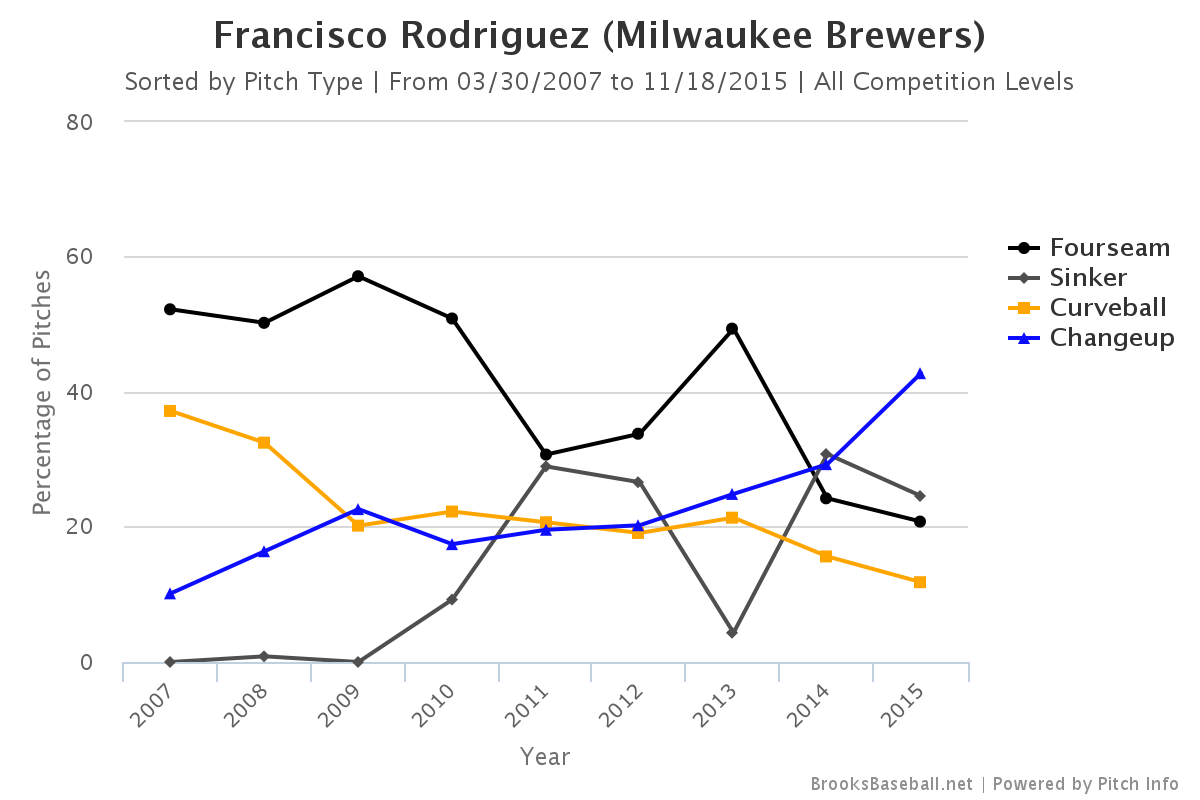
K-Rod was very good in his younger days and has maintained a solid level of performance as he’s transitioned to a guy with a low 90s fastball. As long as he’s healthy, and his track record on that is good, he should be a nice addition to the bullpen.
So in summation: cost fine, addition good. But there is the 800 Tiger-shaped elephant in the room.
This. Can’t. Be. All.
The Tigers have historically been obsessed with acquiring single, elite relievers who can solidify their entire bullpen. Yes, K-Rod is a nice addition, and yes, he has 386 career “saves,” but neither of those facts mean that one quality reliever is a game changer. The Tigers need to do more, either in free agency or on the trade market. Having a good reliever pitch the 9th inning when the lead is three runs or fewer doesn’t make other relievers pitch better, it just bumps the worst guy from the bullpen and moves everyone down a slot. The Tigers needed to add three pretty good relievers when the winter began, now that number is down to two. The fact that he has been a “closer” in his career does not change that calculation.
The cost was fair and the player was needed. As long as the front office is clear on the degree to which Rodriguez can impact the team, the baseball side of this is good.
Of course, there is another dimension to Rodriguez. He’s known for being a bit of a hot-head and has had run-ins with teammates over the years. Those are the kinds of things you can brush aside in most cases, but he’s also been arrested for assaulting the father of his girlfriend and charged in a separate incident for assaulting the mother of his child. Those are not the kind of issues you want to brush aside. The details of the second incident are somewhat limited and it is possible that Rodriguez has made efforts to change over the last few years. It should not immediately disqualify him from employment with the team to have had these incidents in his past, but you don’t feel good about it either.
The Tigers are no strangers to putting allegedly violent and dangerous people in uniform, including Miguel Cabrera, Evan Reed, and Alfredo Simon in recent years. The reports about Rodriguez sound less egregious than those the Tigers have already embraced, but that doesn’t mean Rodriguez doesn’t have a shameful past which the Tigers should be worried about. At the very least, it won’t be easy to cheer for his personal success. Most of the world doesn’t care about athletes who get into fights and beat women. If you’re a good athlete, people will make excuses for your behavior because they care about winning more than they care about what is morally right. I’m not interested in doing that, but I understand that many of your are.
I wouldn’t have traded for K-Rod without evidence that he’s sought counseling for his personal flaws, shown remorse, and changed his ways. But in a baseball only vacuum, the trade does help the team.
The Tigers Need A Good Outfielder, Not A Complementary One
Last week I published my yearly offseason plan for the Tigers and, among other things, I called for the Tigers to sign Ben Zobrist and acquire one of Chris Young/Austin Jackson/Peter Bourjos. The idea was to install Zobrist (or a player of similar quality) in a corner opposite JD Martinez and use the right-handed hitter to compliment Anthony Gose. I haven’ been secretive about viewing Gose as more of a bench player, but the Tigers seem to like him so I didn’t go as far as to totally discount him.
Yet something Al Avila said recently concerned me a little bit. Now of course, Avila might just be saying words to reporters that don’t mean anything. His predecessor did that pretty often and it’s totally reasonable that Avila doesn’t believe what he said. Here’s a quote from a Jason Beck summary of Avila’s comments:
The Tigers also are looking at the outfield market, Avila confirmed, either for a full-time left fielder or a right-handed hitter to platoon. How the search for pitching goes is likely to affect how they approach that.
I’ll call your attention to the “or” in that statement. The Tigers want to get a full time left fielder or a right-handed hitter to platoon. The assumption here is that the Tigers are going with Martinez-Gose-UNDECIDED for the outfield. That undecided spot either belongs to a full time guy or a guy who they can platoon with Tyler Collins, or perhaps Steven Moya.
If Avila’s comments can be taken at face value we should be a touch worried. Of course, wins are fungible. If you have five Clayton Kershaws, you don’t need much of an offense and if you are world beaters at the plate, you don’t need great pitching, but we have a strong sense of what the Tigers roster will look like. Given what we know about their 2016 roster already, it concerns me that the Tigers think they could go to battle with a Collins/some guy platoon while also having Gose as a full-time player.
All of this is predicated on the team not making some insane trade to upgrade their infield dramatically, but if we assume they go out and get a good starter and an okay starter to supplement the rotation and some relief help (not as much as I suggested though), then we can expect the team to sit in he low to mid 80s in terms of expected wins. It’s a fine club, but there is a significant gap between that and a playoff team.
If the Tigers go out and sign a legitimate outfielder like Zobrist (or Gordon, Heyward, Cespedes, Upton, etc), then they are in a much better position certainly. If the outfield is Zobrist-Gose-Martinez, it’s a very different thing that Collins/platoon-Gose-Martinez. That’s kind of self-evident, but that’s the line Avila is walking in that comment. Either they get a left fielder, or they’re going to platoon Collins with a low-key righty. That’s a huge difference.
If you pile that onto his comments about being more restrictive about free agent spending than in the past, you have to assume the Tigers aren’t going to add significant payroll. They were at $170M or so last year, and maybe you can imagine $180M or so, but if the world according to Avila is true, it starts to look difficult for the Tigers to build a winner.
It sounds like, at least, that the Tigers are either going to sign a good starter or a good outfielder, and they’ll go fringy with whichever doesn’t shake out. I have no problem investing in one part of the roster over the other. Wins are wins. But if you break down the comments, it sounds like the Tigers are limited financially and there’s a chance they won’t acquire a quality bat for the outfield and might enter the season relying on Gose for a full time spot and a weak platoon in left. And that’s just not going to get the job done.
You can support one kind of iffy outfield spot, but supporting two iffy spots when you’re already unsure about the bats at third base and catcher (not to mention the health of your DH), means that you’re counting on your team to prevent runs very well. That would be fine except for the fact that requires adding at least a really good starter and an okay one in addition to like three relievers just to get yourself into the conversation.
Hopefully, this is just Avila keeping things noncommittal. You can get by with signing a high quality outfielder and ignoring a platoon mate for Gose, but you can’t get buy with only finding a platoon partner for Collins. That leaves the offense too weak and very exposed to injuries. And that’s to say nothing of the only left handed bats being Collins, Gose, and VMart. If the Tigers don’t acquire a quality bat in the outfield, they better intend to invest heavily in pitching. And this isn’t a Iwakuma and Latos kind of investment, but a Price/Iwakuma kind of investment.
It’s okay to go with pitching or offense, but if the Tigers take the low offense play, they need to understand how much pitching it would truly require to make them competitive. And they also need to keep in mind that next year’s free agent class is very thin, so a two-year shopping effort isn’t really a wise move.
You can’t put too much stock into a few GM comments, but if the Tigers are going to compete, they need to add two really good players, three okay players, and to bolster the bullpen. They can choose to do that in many different ways, but if they think they can ignore the outfield and get away with acquiring only one top level pitcher, it’s going to be another October of watching other teams spray champagne.
 New English D