How Was The Game? (June 18, 2014)

Stop asking, geez!
Royals 2, Tigers 1
Drew Smyly (11 GS, 67.1 IP, 3.48 ERA 4.35 FIP, 0.6 fWAR) gave the Tigers a strong pitching performance, giving up two runs in 7+ innings after allowing a run in the first thanks to the actual second base bag and a solo shot from old friend Omar Infante. Other than that, Smyly stayed out of trouble and offered the offense a chance to rally. Martinez, he of the JD variety, put the Tigers on the board with a solo HR that wrapped just inside the left field foul pole, but the Tigers were unable to complete the rally despite a leadoff single from Cabrera to start the 9th inning. That makes it three straight losses to the Royals and probably a lot of losses in the last 30 games, but it’s getting to depressing to count. At least we get to watch Anibal Sanchez (11 GS, 62.2 IP, 2.44 ERA, 2.32 FIP, 2.0 fWAR) on Thursday.
The Moment: JD Martinez homers in the 7th.
How Was The Game? (June 17, 2014)
Lalalala can’t hear you.
Royals 11, Tigers 4
Losing to Yordano Venture isn’t bad. But Max Scherzer (15 GS, 98.1 IP, 3.84 ERA, 3.26 FIP, 2.1 fWAR) allowing 10 runs, well that’s downright depressing. Max struck out five and walked one in four innings, but he surrendered two home runs and ten hits in the effort that included a 51 pitch second inning. The Tigers put together a few runs over the course of the game, which is nice, but there’s only so much you can do when your pitching staff hangs 11. I would recommend that you don’t look at the standings page after this one and I’ll spare you the details. Not a whole lot to like in a month of things not to like. It’ll be Drew Smyly (10 GS, 60.1 IP, 3.58 ERA, 4.48 FIP, 0.4 fWAR) on the mound Wednesday afternoon.
The Moment: Eugenio Suarez makes a dandy snag on a liner.
The Justin Verlander Hypothesis
Justin Verlander isn’t pitching well. No one thinks the results are any good. They’re not. But while his ERA is close to 5.00 and his FIP is above 4.00, it’s not as if he’s throwing 89mph with no life on his breaking balls. The stuff might be diminished, but if you looked at his stuff in a vacuum, you wouldn’t be worried. A couple of weeks back, I wrote about the need to accept that Verlander is going to have more rough starts as he ages and that his days as a superstar were behind him. That’s still true. I’m not worried about Verlander in the long run because he still has above average stuff and should be a perfectly fine starter for several more years. I am, however, worried about his current troubles and how quickly he might turn them around.
With that in mind, let’s dig into things and evaluate the various theories about what’s wrong with Verlander and how he can make it back.
Kate Upton
This is the least interesting one, but I didn’t want to ignore it. Verlander isn’t struggling because of the woman he’s dating. Verlander was seeing Upton in 2012 when he was awesome and it’s not like his previous love interests weren’t attractive women. Sure she’s famous, but he’s pretty famous too. He owns fancy cars and expensive watches. This isn’t a matter of Verlander becoming an uninterested playboy, no matter how many times my mother tells me she thinks Ms. Upton is distracting him.
The Injury
Verlander had core surgery during the offseason which 1) delayed his offseason routine and 2) probably affected his ability to throw a baseball. He claims that he’s 100% healthy, so #2 is out the window. It’s possible, however, that the injury threw off Verlander’s preparations and that he’s trying to accomplish things during the year which he normally does in the Spring. Except Verlander was nails during Spring Training. I know the stats don’t mean anything, but everyone seemed to agree he was on track and healthy. He had a good first month in terms of run prevention, but the strikeout and walk numbers were equally worrisome. If we think about it, it’s possible that Verlander is struggling because the injury has in some way affected his nature range of motion in a way that doesn’t hurt, but limits his ability to find the proper release point and delivery.
Age
Verlander is 31. That’s far from dead for a pitcher, but it’s also around the time when a pitcher starts to fade. It’s perfectly reasonable to expect Verlander to lose something from his 2009-2012 peak. His fastball velocity has been good over the last few starts, but it was lower early in the season, which could simply be a sign of aging. His other pitches have all looked very good at times, but they haven’t been consistently good. It’s perfectly plausible that the shine is simply off the apple. But the problem with this explanation is that Verlander pitched out of his mind last September and October and he’s only a little bit older. Age hurts you, but it doesn’t all of a sudden crush you.
Approach
This is a bit of a catch all category, but it’s possible that Verlander is just making bad pitches and poor choices. The stuff isn’t 2011 stuff, but it’s more than good enough to get hitters out. The location is off at times. He says he’s tinkering. Trying to find the mechanical tweak that will right the ship, but maybe it’s as simple as feeling the effects of age and injury recovery and not accounting for that in the game plan.
Verlander’s stuff is still good, that’s why this is so weird. Maybe that’s exactly the point. Verlander sees good stuff and thinks, “Hm, I still have it, there must be some problem.” But his stuff isn’t as good as it was three or four years ago. Maybe Verlander doesn’t realize he needs to make a strategic adjustment rather than a physical one. He’s pitching like he has the best stuff in the league and it’s leading to some damage. If he started pitching like he had just plain old good stuff, maybe it would do the trick.
I’ve been watching Verlander for almost a decade and I can’t remember a time when hitters looked so comfortable. This isn’t because he’s not pitching inside or something, but it’s because they don’t have to deal with 100 mph and three amazing secondary pitches at once. The big breaking ball still freezes hitters, but without the ability to hit 101, it freezes them a little less. This isn’t one thing, it’s a tiny little problem in a 100 different places.
Let’s consider a bit of evidence. In 2011, he averaged about 95 on the fastball but averaged 97 with two strikes (via Brooks). This year, he’s averaging 94 and hitting 95 with two strikes. If we use Baseball Savant data (which doesn’t make the same alterations as Brooks, so the numbers won’t match perfectly) Verlander averaged 95.04 mph in 2011 and 93.4 this year on the fastball. With men in scoring position, it’s 97 mph in 2011 and 94.5 mph in 2014.
Verlander isn’t dialing it up to generate strikeouts like he used to with the fastball. He still throws hard, but the velocity loss in “strikeout situations” is greater than overall. It’s not about average velocity, it’s about peak velocity. We can pick out all of these little problems with Verlander. His breaking ball has less lateral movement than it used to, also, but I think it’s ultimately about trying to pitch like he used to. He doesn’t need to make drastic changes, he just needs to not throw 95 up in the zone when he used to throw 101. That’s no longer the right pitch.
It’s almost like a curse. Verlander’s stuff is good enough that he doesn’t realize he needs to change. Take a look at his contact percentage with two strikes in 2011-12 and in 2014.
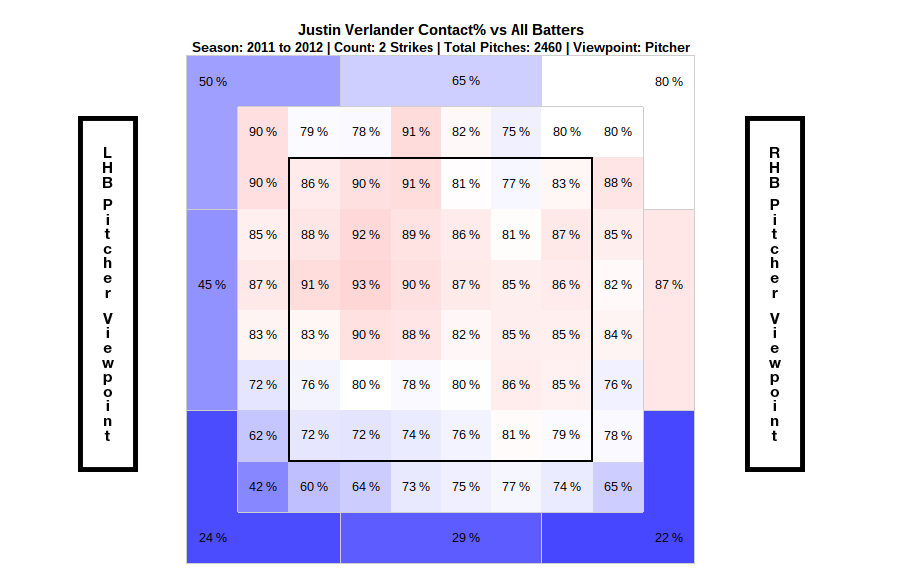
Verlander’s not getting into as many two strike counts as he used to, but when he does, he’s really not putting hitters away like he should. His strikeout rate when he gets two strikes on a batters used to be in the 40-45% range (even last year) but it’s in the 32% range this year. By my estimate, that’s a difference of 16 strikeouts already this year, not to mention the cascading effect of allowing fewer baserunners and extending fewer innings.
It’s not just one thing, but Verlander isn’t adjusting his two strike approach to account for his different quality arsenal. Throw in 16 more strikeouts and cut back the two strike home runs and his FIP sits at about 3.46. You can’t just say if this had happened then this would have certainly happened, but you can easily see how much of an effect this could have.
Long term, Verlander will be fine. In the short term, it’s time to start thinking about how he approaches hitters. He’s right that the stuff is good, but he’s wrong that he can pitch like he did as a 28 year old forever. The problem, perhaps, is that Verlander isn’t broken so he can’t accept that a change is needed.
How Was The Game? (June 16, 2014)
[averts eyes, peaks through fingers].
Royals 11, Tigers 8
I’m going to be honest with you all, this didn’t go well. Justin Verlander (15 GS, 97.2 IP, 4.98 ERA, 4.09 FIP, 1.4 fWAR) looked fine for the first few innings and then the 5th and 6th innings came along and ruined all of that. When all was said and done, Verlander had gone six innings after allowing seven runs with two walks and two strikeouts against a mediocre offense at best. Verlander showed some signs of life in his last few starts, but it’s hard to find positives in this one. The bats got a couple of early runs, but Verlander’s seven and the bullpen’s four runs were way too many to overcome. Blaine Hardy got a chance to make his MLB debut and struck out the first two batters he faced, which was a nice moment in the midst of a disaster. Then, of course, the Tigers scored 6 runs in the 9th inning to make it look a lot more interesting than it was and put the fear or God into the Royals. Max Scherzer (14 GS, 94.1 IP, 3.05 ERA, 3.03 FIP, 2.2 fWAR) goes Tuesday.
The Moment: Blaine Hardy punches out the first two batters of his MLB career.
How Was The Game? (June 15, 2014)
On the right side of things, at least.
Tigers 4, Twins 3
In theory, this was a good game. In theory. Rick Porcello (13 GS, 82.2 IP, 4.03 ERA, 3.98 FIP, 1.2 fWAR) was good, except for five batter stretch in the six inning that should have ended a run earlier if not for a poor connection from JDM to Avila when they had Morales out at home by 25 feet. He went seven innings, gave up three runs, and generated a lot of easy outs, but left the game with the score tied. The Tigers grabbed a pair early and tied it shortly after the Twins took the lead on a Castellanos RBI double. Joba held serve in the 8th, despite a bit of trouble, and Nathan did the same, despite a bit more. Torii led off the 9th with a single and VMart reach on complete whiff on the warning track. JDM came up and hit a shallow fly ball, but with the help of a poor throw it was enough to score Hunter for the walk off win. It didn’t feel like a winning series, but the Tigers sent the Twins packing after taking two of three. Justin Verlander (14 GS, 91.2 IP, 4.61 ERA, 3.96 FIP, 1.5 fWAR) will get the ball on Monday when the Royals come to town.
The Moment: JD Martinez hits a shallow, but game winning sac fly.
How Was The Game? (June 14, 2014)
Closer than it should have been.
Tigers 12, Twins 9
Let me put it this way, this one started out well. Anibal Sanchez (11 GS, 72.2 IP, 2.44 ERA, 2.32 FIP, 2.0 fWAR) was dominant until his final inning in which the Twins picked up a couple of add on runs as he tired, but the lead was already so large that it’s hard to sweat it. The offense absolutely unloaded, however, starting in the third inning with seven runs on many hits. Suarez and Martinez both homered and came one leg shy of a cycle each. Kinsler reached base four times, so did Avila and Suarez. It was an all out assault that was a long time coming for the Tigers offense that had been awfully quiet as of late. Of course, the day ended in “y,” so the bullpen melted down and ended up allowing six extra runs to force Joba to warm up in a game m that was, at one point, 11-1. The team will look to take the series on Sunday with Rick Porcello (12 GS, 75.2 IP, 4.04 ERA, 4.05 FIP, 1.0 fWAR) getting the nod.
The Moment: Tigers load up with a seven run 3rd inning.
How Was The Game? (June 13, 2014)
Uninspired.
Twins 2, Tigers 0
Drew Smyly (10 GS, 60.1 IP, 3.58 ERA, 4.47 FIP, 0.4 fWAR) didn’t look like he was going to have a great night early on, but he managed to hold the Twins to one run in six innings of work, giving the Tigers a very good opportunity to win the opener. Unfortunately, the Tigers were unable to generate any offense on Friday night. They had a couple of threats, but could not deliver especially in the 5th inning when Ausmus took the bat out of Kinsler’s hands and watched a budding rally crumble during the next two at bats. It was a poor choice, but failing to score at all against Kyle Gibson isn’t solely on the manager. Joe Nathan came in for the 9th to get some work and it wasn’t exactly an impressive tune-up, as he loaded the bases and walked in a run before getting yanked for Phil Coke who escaped the jam. The Tigers could not come back against Perkins despite a Castellanos double and fell to 34-29 on the season. It’ll be Anibal Sanchez (10 GS, 56.1 IP, 2.24 ERA, 2.34 FIP, 1.8 fWAR) tomorrow afternoon.
The Moment: Phil Coke keeps things from getting worse in the 9th.
Why The Kinsler Bunt Was Wrong
In the 5th inning of Friday night’s game against the Twins, Brad Ausmus called for two bunts. Avila led off with a single (Down 1-0) and Romine laid down a bunt which the Twins misplayed, allowing Romine to reach base. The Romine bunt was fine because Romine is an extremely poor hitter and the Tigers were bringing up a much better hitter in Ian Kinsler. I might not have bunted with Romine in a 4-0 game or in the first inning, but down one in the 5th it was fine.
Then Ausmus gave Kinsler the sacrifice sign.
There are a few problems with this bunt. On average, it costs you .16 runs. We’ll start there. You’re giving away runs with this play on average, but those numbers are player agnostic. Kinsler is “slumping,” which is why a number of people liked the bunt, but Kinsler is also projected to have something like a .330 wOBA for the rest of the year. And that .330 wOBA is a much better prediction of his next at bat than his previous 67 PA. Unless he’s hurt, he’s one of your best hitters.
Let’s walk through this. Kinsler could have (run values relative to successful sac):
- Walked/HBP (+1 runs)
- Singled (+1 runs if Avila doesn’t score)
- Doubled/Tripled (+1.8 to 2.0 runs)
- Homered (+2.2 runs)
- Grounded out (both runners move up) (push)
- Fielder’s choice (runner out at 3rd) (-0.4 runs)
- Fielder’s choice (runner out at 2nd) (-0.1 runs)
- Fly out/strikeout (-0.4 runs)
- Double play (Grounder or line out) (-1 run or so)
- Bunted (push, which equals -.16 runs from previous state)
Options 1-5 would have been better than or equal to the bunt. Options 6-9 would have been worse. You’re going to get 1-5 at least 35% of the time, perhaps more. Of course, there is some chance Kinsler makes two outs and you want to avoid that, but the odds are stacked heavily against that. You’re wagering that second and third with one out is the better outcome than letting Ian bat. That’s wrong. I don’t have a super detailed projection of Kinsler’s probability of each of those out types on hand, but the expected value of the bunt is worse than not bunting.
The problem is also that you have Jackson (pretty good hitter) and Cabrera (awesome hitter) coming up. Cabrera, the guy this was supposed to set up, doesn’t need you to advance runners for him. Cabrera can drive Romine in from first better than almost anyone in baseball. You avoided a double play with the bunt. You made sure Cabrera came to the plate. That seems like a good thing but it’s not. The odds of a double play by Kinsler or Jackson aren’t very high and having the extra out is valuable.
It’s entirely possible that letting Kinsler swing away wouldn’t have helped, but on average, it’s the better outcome.
How Was The Game? (June 12, 2014)
Complete.
Tigers 4, White Sox 0
On most nights, I set you up with the pitching line, how the runs were scored, and any interesting plays. This one is easy. Max Scherzer (14 GS, 94.1 IP, 3.05 ERA, 3.03 FIP, 2.3 fWAR) went the distance for the first time in his career, delivering a three hit shutout with 3 walks and 8 strikeouts. It wasn’t the best stuff we’ve ever seen from Max, but after 178 starts and no complete games (an MLB record), he finally finished what he started. Victor Martinez went yard early. Chris Sale was awesome and his team gave him nothing in the way of support. After Sale left the game, it was pretty uneventful. You know, just your average Miguel Cabrera two run infield single to add a pair of insurance runs. The night belonged to Max, as he helped the Tigers escape the sweep and the team will head home to face the Twins with Anibal Sanchez (10 GS, 56.1 IP, 2.24 ERA, 2.34 FIP, 1.8 fWAR) grabbing the ball in game one.
The Moment: Max Scherzer gets out the first and last out of a game for the first time in his career.
How Was The Game? (June 11, 2014)
[rolls eyes].
White Sox 8, Tigers 2
Well, shoot. This looked so promising during the first five innings. The Sox got their only run off Justin Verlander (14 GS, 91.2 IP, 4.61 ERA, 3.95 FIP, 1.5 fWAR) on a Jose Abreau homer and the Tigers pushed one across courtesy of Miguel Cabrera’s baserunning and this one was hurdling toward a duel. Verlander’s stuff was better than we’ve seen this year with plenty of velocity and swinging strikes, but things unraveled in the 6th when he gave up some not-terribly well hit balls for hits and Ausmus left him in at least one batter too long, if not two batters too long because he failed to properly prepare the bullpen. Verlander lost it a little, but it wasn’t nearly as bad as 7 runs in 5.2 innings appears. This felt like a turning point and then it didn’t. Alas. They’ll try to save one behind Max Scherzer (13 GS, 85.1 IP, 3.38 ERA, 3.10 FIP, 1.9 fWAR) against Chris Sale on Thursday.
The Moment: Castellanos guns down Eaton at the plate in the 5th.
 New English D