2016 Bellwethers, #3: Nick Castellanos

In an effort to find to bring a new angle to the routine nature of season previews, this year New English D will be running a season preview series based on the team’s nine most pivotal players. We’ll be calling the series “2016 Bellwethers,” and will break down the players currently on the roster whose 2016 direction will indicate where the Tigers are heading this year. Keep in mind this is not a series about the most important Tigers, but rather the Tigers with the widest range of possible outcomes. You won’t see Miguel Cabrera featured, for example, because of his steady dominance of the league. Enjoy. #9: Daniel Norris | #8: Justin Wilson | #7: Mark Lowe |#6: Jose Iglesias | #5: Francisco Rodriguez | #4: James McCann
It feels like he’s been around forever, but Nick Castellanos is just 24 years old. He was the 44th overall pick in the 2010 draft and essentially from the time he was drafted until he lost his rookie eligibility, he personified the Tigers future. Fans wanted to rush him to the majors to fill a void at second base. They demanded his presence in the OF when the team needed an OF. He was an actual prospect in a system rarely known for having actual prospects!
But after two years as a full-time player, the shine is completely off the apple. He’s been a below average hitter in the majors and has been arguably one of the worst defenders in the game since his arrival. He’s still young, but baseball fans are unforgiving and youth is only an excuse to them when you lack experience. After two years of experience, Castellanos now faces his make or break season.
The ship has sailed on Castellanos as a good defender, not that such a thing was ever likely, but he did go from disastrous to bad from 2014 to 2015, so if he can take a small step forward by eliminating mistakes on easier plays, he should be able to hold on to third base for another year or two. He’s seemed to be a -10 or -15 true talent third basemen based on the numbers and my own observations. If he could arrive somewhere between -5 and -10, we will all consider it a victory.
The question for Castellanos this year will be his bat. His glove just has to be not-embarrassing and we’ll make do. But he was supposed to hit and needs to hit or his place on the roster as someone who will get 600 PA will come into dispute quickly.
If you compare his 2014 and 2015 seasons, they are nearly identical offensively except that the more recent Castellanos hit for more power. Walks, strikeouts, and BABIP were all about the same, but his ISO rose from .135 to .164. Keep in mind that offense went up across the leauge however, so his slight spike in wOBA translated into no movement in his wRC+.
But that is not the point. The point is the turning point. In late June, Ausmus sat Castellanos down for a couple of days and unless Ausmus learns to manage at some point in the future, it will go down as his crowning achievement. From June 23 forward, Castellanos hit .283/.329/.487 (121 wRC+) in 340 PA. For his career prior, those numbers were .247/.293/.372 (83 wRC+) in 852 PA. The difference is an 80 point jump in ISO and a 60 point jump in BABIP.
Was that a smaller sample size aberration? We’ll soon find out. The power absolutely looked real to the naked eye, as Castellanos drove the ball with much more authority when he squared up a pitch, but the BABIP remains to be seen. His style of hitting lends itself to a higher than average BABIP, but there’s a big gulf between a .315 BABIP and a .340 BABIP that we’ll need to litigate over time.
Castellanos has a swing you can dream on and he definitely bulked up between 2014 and 2015. His approach leaves something to be desired but it really might be as simple as learning to lay off the breaking ball low and away. He can’t hit that pitch and once he stopped trying, his numbers perked up. There’s loads of offensive potential in his bat, he just needs to hone his approach now that he’s added enough strength to hit for power.
A 120 wRC+ Castellanos is a totally plausible thing. And if he hits like that with a below average, but not embarrassing glove, the team has themselves a quality big leaguer.
When we were naive and hopeful back in 2013, Castellanos seemed like a good bet to be an average player with an occasional All-Star year. After two rough years, the odds of that player arriving are lower, but they aren’t gone. Castellanos got full-time major league work very early, and he might simply have been a player who didn’t face enough good stuff in the minors to learn how to handle it.
If the June 23+ Castellanos comes back in 2016, the Tigers are going to be in a much better position to win the Central than if the pre-June 23 Castellanos returns. It’s hard to be a real contender when getting replacement level performance from an everyday player, but if Castellanos is ready to make the leap, the Tigers might just get to play beyond Game 162.
2016 Bellwethers, #4: James McCann
In an effort to find to bring a new angle to the routine nature of season previews, this year New English D will be running a season preview series based on the team’s nine most pivotal players. We’ll be calling the series “2016 Bellwethers,” and will break down the players currently on the roster whose 2016 direction will indicate where the Tigers are heading this year. Keep in mind this is not a series about the most important Tigers, but rather the Tigers with the widest range of possible outcomes. You won’t see Miguel Cabrera featured, for example, because of his steady dominance of the league. Enjoy. #9: Daniel Norris | #8: Justin Wilson | #7: Mark Lowe |#6: Jose Iglesias | #5: Francisco Rodriguez
James McCann is one of the more pivotal members of the 2016 Tigers because we’ve seen flashes of an above average major leaguer within him but the sum total of his contributions so far have been below average. You shouldn’t write off a promising young player because of mediocre performance in his first 500 PA, but those first 500 PA offer a window into the questions we’ve had about McCann all along. Is he built to be a full-time major league catcher or does his future hold years as a backup or the weak side of a platoon?
McCann had an 85 wRC+ in 2015, which puts him 17th among catchers who had a total of 300 or more PA last year. Catchers on average hit around 85-86 wRC+ last year, so his bat is firmly in the average tier. He’s not a front line offensive catcher, but no one expected him to give Buster Posey a run for his money.
McCann walked less than 4% of the time and struck out around 21% of the time, below average and around average respectively. His .122 ISO and .325 BABIP are numbers you’d be happy to see again, but ideally with a little more in terms of on-base ability. A larger red flag was his 149 wRC+ to 64 wRC+ platoon split, especially when he faced righties about three times as often as lefties last year.
No one should argue that a 400 PA sample is enough to demonstrate one’s true platoon split, but it’s not a good sign that he was so vulnerable to right-handed pitching. The split will likely regress in the future, but it’s not terribly common to see someone display a platoon split of this nature over the course of a season without having a bit of a deficiency against same side pitchers, even if the deficiency is less severe than it appeared.
Another big concern is that McCann hit much worse as the season wore on (104 wRC+ to 67 wRC+ from the first half to the second half) and his monthly wRC+ marks were 88-98-80-152-36-76. Again, it’s a small sample, but after the break he was much less effective than he was before the break.
All of these offensive issues circle back to a single question. Is McCann’s 2015 a reflection of his ability going forward or was his offense hampered by the herculean task of learning to be a full-time, everyday catcher in the majors? It’s a tricky thing to parse because if you told me two years ago that McCann was going to settle in as an 85-90 wRC+ guy, that wouldn’t have been a shock. But we saw flashes of something more early last year. Was that slightly better performance a sign of things to come and he simply wore down as the year went on…or did he regress toward his mean as the year went on and the league learned his weaknesses?
This is the central question for McCann’s bat in 2016. Is he an unimpressive hitting catcher with a vulnerability to righties or did he just appear that way last season because the weight of his first season as a major league catcher simply took its toll late in the season? Time will tell.
But there’s another really important aspect to the McCann bellwether, and that’s his framing. If you recall, McCann rated as one of the worse framing catchers in 2015, costing the team somewhere between one and two wins of value with his inability to get borderline strike calls.
As I wrote last year, I’m not terribly concerned about one season of bad framing metrics for a rookie catcher, but it is something you have to monitor. McCann didn’t have a reputation as a poor framer in the minors, although he wasn’t known for being great either. The data supports that idea, but minor league data is also more limiting. If you look at it from a “did-he-get-calls” perspective without knowing exactly where the pitchers were located, McCann appeared to be an adequate receiver in the minors, but when he graduated to the show and we put him under the PITCHf/x microscope, he started to look quite bad.
Mark Simon tweeted this handy graphic just the other day:
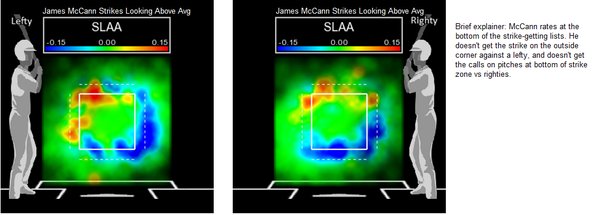
McCann seems capable of keeping high strikes in the zone and balls that come to his right, but pitches to his left (i.e., inside to righties and outside to lefties) seem to give him trouble along with low pitches in general. As I noted in the piece last summer, there are plenty of reasons a young catcher might struggle with framing without being a bad framer, but it would be hard to argue he didn’t struggle.
So another huge question for McCann this year will be if he can improve his receiving. We know he’s got a strong throwing arm and can manage the running game, but getting strikes for the pitching staff is his most important job and failing to come through in this department will wash away his positive contributions elsewhere.
Fortunately, while Brad Ausmus often causes more problems than he solves, this one is right up his alley. In fact, Ausmus was probably one of the better pitch framers in baseball history. If the front office was able to communicate to Ausmus that McCann needed help and Ausmus is an able teacher, there’s reason to be hopeful. We’ve seen in other cases that framing is a teachable skill.
McCann has Saltalamacchia to watch his back this year, but while Salty can bail him out against tough right-handed pitchers, he can’t do anything to help defensively. The Tigers can cover McCann if his offensive questions turn out to be more systemic than they are growing pains, but the defense is a very big deal. I’m nowhere near ready to give up on the 25-year-old backstop, but the Tigers are going to be in a very close race in the Central and every run they give away is going to matter.
McCann gave away 15 to 20 runs with his framing last year, according to the models. If he can get that number into the -5 to -10 range, it will go a long way toward helping the team compete. They can live with the 2015 version of his bat, but they can’t live with the 2015 version of his bat if they also get the 2015 version of his glove.
2016 Bellwethers, #5: Francisco Rodriguez
In an effort to find to bring a new angle to the routine nature of season previews, this year New English D will be running a season preview series based on the team’s nine most pivotal players. We’ll be calling the series “2016 Bellwethers,” and will break down the players currently on the roster whose 2016 direction will indicate where the Tigers are heading this year. Keep in mind this is not a series about the most important Tigers, but rather the Tigers with the widest range of possible outcomes. You won’t see Miguel Cabrera featured, for example, because of his steady dominance of the league. Enjoy. #9: Daniel Norris | #8: Justin Wilson | #7: Mark Lowe |#6 Jose Iglesias
Rather than paraphrasing what I wrote to introduce the Justin Wilson and Mark Lowe posts, I’ll pull the quote from both about why the new Tigers relievers matter:
Everyone knows the Tigers bullpen was a weak point during the Dombrowski era and Al Avila went into the offseason with only two real locks for the 2016 pen: Alex Wilson and Blaine Hardy. While Wilson and Hardy were good in 2015, they aren’t exactly guys you want to point to as your best two arms. Sure the Tigers had some interesting potential like Bruce Rondon, Drew VerHagen, etc, but they needed relief help this winter, and relief help is something they got.
We’ve already covered the importance of Justin Wilson and Mark Lowe in reshaping the bullpen, but Francisco Rodriguez is slated to be the team’s relief ace and will dictate how the best laid plans of Al Avila will unfold. The 34 year old Rodriguez is no longer the superstar reliever he was during his youth, but he doesn’t have to be the 2004-2007 version of himself to help the Tigers win another AL Central crown.
While Rodriguez has had his share of mediocre seasons, he’s been reasonably effective and durable into his thirties. He’s developed more command as he’s aged and while he’s not the strikeout force he was during his peak, he’s still more than capable of recording punch outs. The major question mark as of late has been a propensity to allow the long ball, 35 over his last 243.2 innings (roughly 1.3 HR/9 over his last four seasons). He’s moving back to the American League, but away from a very hitter friendly park into a pretty balanced home yard.
Perhaps Rodriguez’s most interesting transformation is his growing reliance on the changeup:
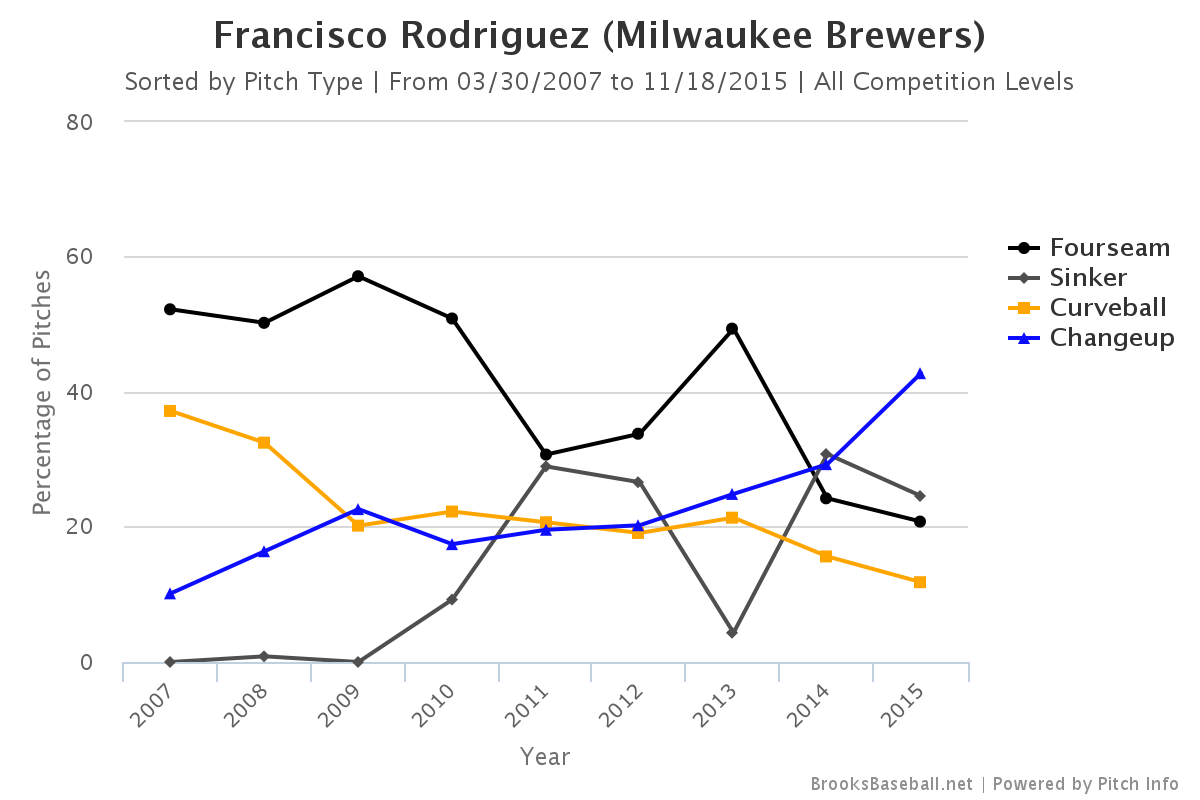
This is the kind of thing you like to see from aging pitchers: a willingness to adapt as their physical skills wane.
There’s isn’t one particular thing Rodriguez needs to keep doing, as we’ve noted with some other players during this series, it’s really just that he needs to hold off that inevitable decline a little bit longer. The Tigers overhauled the back of their bullpen this winter, but even if you do everything right, relievers are still relievers. If Wilson-Lowe-Rodriguez generally resemble the 2015 versions of themselves in 2016, the Tigers will have a quality LHP1, RHP1, and Relief Ace capable of holding leads and allowing the offense to get them back to the promise land.
I ranked Rodriguez higher on this list because he’s the anchor. If he fails, more will be asked of every lesser arm in the Tigers bullpen. Each cog in the new bullpen has to play it’s role for the revamp to work, but if you had to pick a most important one, it’s the one who will be asked to get the most outs.
From 2012-2014, the starting rotation and offense were good enough to survive the bullpen, but as the other parts of the roster show their age a bit, the bullpen has to step up and carry it’s weight. A successful year from K-Rod will go a long way toward that aim.
2016 Bellwethers, #6: Jose Iglesias
In an effort to find to bring a new angle to the routine nature of season previews, this year New English D will be running a season preview series based on the team’s nine most pivotal players. We’ll be calling the series “2016 Bellwethers,” and will break down the players currently on the roster whose 2016 direction will indicate where the Tigers are heading this year. Keep in mind this is not a series about the most important Tigers, but rather the Tigers with the widest range of possible outcomes. You won’t see Miguel Cabrera featured, for example, because of his steady dominance of the league. Enjoy. #9: Daniel Norris | #8: Justin Wilson | #7: Mark Lowe
The 26-year-old Tigers shortstop, Jose Iglesias, is one of the most mesmerizing players in the game. He certainly lacks the preternatural gifts of guys like Mike Trout and Miguel Cabrera, but Iglesias provides some of the game’s most jaw-dropping, unable-to-find-words moments of any player in the game. No one disputes this. Remember the running catch in 2013 ALDS? That was preposterous. Remember that weird, sprawling thing he did against the White Sox that year? He’s flashy, and as Nick Castellanos said, he’s probably a good dancer.
From a raw ability standpoint, there aren’t many infielders better than Iglesias. Andrelton Simmons comes to mind, but Iglesias would be right there in the non-Simmons tier when it comes to talent. However, his defensive metrics have been a little uninspired. If you like UZR, he’s been solidly above average for his career, but not in any sort of extraordinary way. And last year, he was only a couple runs better than average for the position. DRS has been even less kind, suggesting that he’s only been slightly better than average for his career and was worse than average in 2015.
While I would absolutely caution you not to put too much weight on 1,800 innings of the metrics, I wrote last year that there is some evidence that Iglesias hasn’t been the vacuum cleaner we seem to think he is. That said, Iglesias’ flaws are fixable. He has tremendous ability (range, hands, and arm) and the runs he gives away are on plays that require a little more focus and execution. If you can make great plays, you can learn to fix the problems you have on easier ones.
So part of Iglesias’ 2016 will be about avoiding miscues on those easier and mid-range plays. He’s going to blow you away with some great defense, but saving a run by making a great play only goes so far if you boot a routine play the next day. Few are better than Iglesias from a talent perspective, but he need to take a step forward defensively so that the Tigers can get the most out of that ability. He’s probably played like a +5 shortstop recently, even though he has +10 to +15 talent. Getting those extra five or ten runs is going to be huge for the Tigers as they chase Cleveland and Kansas City.
Another thing that popped up last year was bad base running numbers. Part of it was stolen base related (he got caught way too much) and part happened while the ball was in play. I think most of that is structural and the Tigers need to address it as a whole, so I won’t focus too much on it here. The only thing I’ll say is that letting Iglesias get caught 8 times in 19 attempts last year indicates a team with a bad base running approach. Based on what I saw from the entire club, I don’t think it reflects the player in question today and will expect to get better now that the team hopefully understands how many runs they gave away being “aggressive.”
I think the real question for Iglesias, and through him the Tigers, is whether he’s really going to be a league average hitter. In 2013 he had a 103 wRC+ and in 2015 it was 97. The statistical models aren’t buying a repeat because Iglesias wasn’t a great hitter in the minors and has succeeded in the show with high BABIPs. Steamer, ZiPS, etc are expecting something in the 85-90 wRC+ range for 2016.
The average shortstop had an 87 wRC+ in 2015, so the difference here is the projection systems seeing him as an average hitter for the position with a slightly above average glove. Roughly speaking, that’s a 2 WAR player. Two win players are great, and Iglesias is cost-controlled, but if the Tigers are going to be Contenders with a capital C, they need more from Iggy.
FanGraphs also host a projection system called “Fans” which is based on fan estimates of player performance. As I’m writing this, 21 people have voted and they expect something like a 99 wRC+ and solidly above average defense, good for 3.5 WAR over a full season. The defensive difference is easy to understand as the models only know Iglesias’ performance, they can’t watch him do things to base runners that should probably be against the Geneva Convention. The offensive side of the difference is mostly BABIP. The computers and the fans see similar profiles, but the fans add about 20 points of BABIP and an extra 1% to his walk rate.
I obviously don’t know who’s right, but the fans do have a pretty strong case given that Iglesias’ career BABIP is .328 when the projection systems are forecasting it to be around .310. He’s a ground ball/ line drive hitter who gets plenty of infield hits, so a BABIP above .300 is to be expected, it’s just a question of how much higher it will be.
But that’s the question. Iglesias is going to hit a couple dingers, knock 20 doubles, and have a low walk rate. That’s his game. But last year he cut down on his strikeouts by a lot (under 10% after being in the 15-20% range for his career) and has always put up a quality BABIP. If he can rack up plenty of singles, he can be an average MLB hitter.
Just for reference, let’s say he gets 500 PA in 2016. Cut out 30 for walks and HBP, another 50 for strikeouts, and you’re left with about 420 balls in play expected. The difference between a .300 BABIP and .325 BABIP is about 11 hits. Let’s assume the difference is all singles, even if that’s not a sure thing. Trading 11 outs for 11 singles is worth about 80% of a win. Of course you already knew that given the difference in the projections we discussed earlier.
The key here is that it doesn’t take much, roughly two hits a month, to make the difference between an average hitting shortstop and a well-above average hitting shortstop. If Iglesias can continue to hit like the latter and play up to his potential on defense, he could net the Tigers an additional two wins or so for 2016.
Given how close the race figure to be, an Iglesias that plays to his potential would go a long way toward getting the team back to meaningful October baseball.
2016 Bellwethers, #7 Mark Lowe
In an effort to find to bring a new angle to the routine nature of season previews, this year New English D will be running a season preview series based on the team’s nine most pivotal players. We’ll be calling the series “2016 Bellwethers,” and will break down the players currently on the roster whose 2016 direction will indicate where the Tigers are heading this year. Keep in mind this is not a series about the most important Tigers, but rather the Tigers with the widest range of possible outcomes. You won’t see Miguel Cabrera featured, for example, because of his steady dominance of the league. Enjoy. #9: Daniel Norris | #8: Justin Wilson
Rather than paraphrasing what I wrote last week to introduce the Justin Wilson post, I’ll pull a quote about why the new Tigers relievers matter:
Everyone knows the Tigers bullpen was a weak point during the Dombrowski era and Al Avila went into the offseason with only two real locks for the 2016 pen: Alex Wilson and Blaine Hardy. While Wilson and Hardy were good in 2015, they aren’t exactly guys you want to point to as your best two arms. Sure the Tigers had some interesting potential like Bruce Rondon, Drew VerHagen, etc, but they needed relief help this winter, and relief help is something they got.
In order to compete in a tight AL Central, the Tigers need to pitch better at the end of games. We’ve already talked about Justin Wilson, and we’ll get to K-Rod, but the Tigers new RHP1 is going to be a critical piece of the 2016 re-tool. If Mark Lowe really has remade himself and the 2015 version is the version he truly is, the Tigers are going to be in a much better position in the 7th and 8th innings than in recent seasons.
There are two key things we should monitor when it comes to Lowe. First, he found his early career velocity again in 2015. Keep in mind that in 2013 and 2014 (and 2010) he didn’t throw many innings.

Career relievers don’t often magically learn to throw harder at 32, but if all we’re looking at it a guy who finally got healthy, this could be a very real difference that allowed him to pitch much better. He also lowered his arm slot a touch as well.
The big difference for Lowe was that he started using his slider a lot more to lefties and righties in 2015. Same 2010/2013/2014 sample size applies, watch 2008-2009-2011-2012-2015 for the best idea.

The 2014 spike is 7 innings, so you can see how it became a much larger part of his arsenal in 2015 compared to years past. More strikeouts, fewer walks, fewer dingers, fewer runs. He was the whole package.
It’s likely that health is a key factor for Lowe, but even in the seasons in which he seemed to be healthy, he was never as good as he was in 2015. Last year was clearly his best year, and how the Tigers perform in 2016 will be partially dependent on how much of that was a real shift toward greatness and how much was a blip.
Is Mark Lowe really a great reliever, or is he simply a solid arm who had a good year? Even if he’s just a solid bullpen piece, but stays healthy, he’ll make the team better. But the team was awful in 2015, so a little better isn’t a terribly exciting move. If his slider-heavy approach and high velocity fastball are here to stay, the Tigers have themselves a late-inning reliever who can prevent leads from slipping away. If he can’t stay healthy or his 2015 success was mostly noise, it will be much harder for the team to keep up with Kansas City, Cleveland, and perhaps Chicago.
2016 Bellwethers, #8: Justin Wilson
In an effort to find to bring a new angle to the routine nature of season previews, this year New English D will be running a season preview series based on the team’s nine most pivotal players. We’ll be calling the series “2016 Bellwethers,” and will break down the players currently on the roster whose 2016 direction will indicate where the Tigers are heading this year. Keep in mind this is not a series about the most important Tigers, but rather the Tigers with the widest range of possible outcomes. You won’t see Miguel Cabrera featured, for example, because of his steady dominance of the league. Enjoy. #9: Daniel Norris.
Given the success the Tigers have had with pitchers named Justin and Wilson separately, it made all the sense in the world that they would go for the gold by acquiring a pitcher named Justin Wilson. Presumably they put a little more thought into the deal that sent Chad Green and Luis Cessa to the Yankees in exchange for the left-handed reliever, but I like to think it was as simple as a lazy deployment of the transitive property.
Everyone knows the Tigers bullpen was a weak point during the Dombrowski era and Al Avila went into the offseason with only two real locks for the 2016 pen: Alex Wilson and Blaine Hardy. While Wilson and Hardy were good in 2015, they aren’t exactly guys you want to point to as your best two arms. Sure the Tigers had some interesting potential like Bruce Rondon, Drew VerHagen, etc, but they needed relief help this winter, and relief help is something they got. You won’t have to wait long to see the other two new relievers, but today we’ll turn our attention to Justin Wilson.
Wilson pitched his third full season in 2015, delivering 61 innings across 74 appearances to go with a 76 ERA- and 64 FIP-. Last season was clearly his best using fielding independent numbers, although his ERA was better in 2013 thanks to a crazy low BABIP. Given that we’re talking about fewer than 200 career innings, I’m going to keep my focus on the components rather than the results, but at least you have some idea where he stood.
Wilson has always been a low homer guy, giving up between 0.4 and 0.6 HR/9 in each of his three seasons, but the big difference in 2015 was his increase in strikeouts. He punched out 27% of the batters he faced in 2015 compared to about 20% in 2013 and 24% in 2014. On top of that, he walked 8.2% of batters in 2015 after walking 9.5% and 11.7% during his previous seasons.
From that perspective, it’s not surprising that Wilson had such a good season. If you don’t allow dingers, get guys to strike out, and keep the free passes around league average, you’re going to have a solid season. Also, while Wilson might strike you as a LOOGY because of his 61 IP to 74 G ratio, he’s actually faced plenty of righties and has a slight reverse platoon split for his career.
Granted, I would never suggest 200 innings across three seasons is enough data to suggest he is actually a reverse platoon guy, but the fact that he hasn’t displayed a normal split over 200 innings does indicate to me that he’s probably not someone who is going to have a major platoon split.
Wilson is primarily going to throw a fastball around 95-96 and a cutter around 91-92, while also mixing in a few sinkers. You might even see 98-99 when he really needs it. That kind of power from the left side is pretty rare and he’s used it well. One thing you’ll notice is that in 2015, compared to 2014, Wilson kept the ball down and away when facing lefties.
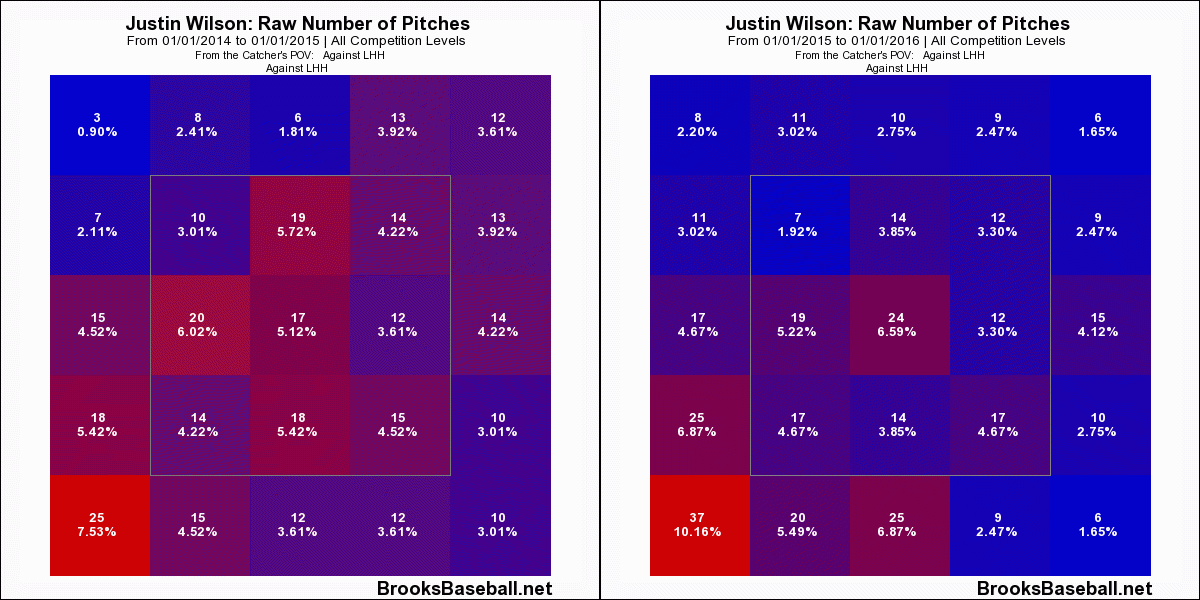
Now that did cost him in the walk department, going from a 8.1% to 12.1% walk rate against lefties, but it also helped in the power department, dropping their ISO from .114 to .056. Small samples all around (86 and 83 PA), but you only have so much information when you’re talking about relievers.
While Wilson kept the strikeouts steady, increased the walks, and cut the power versus lefties, he increased strikeouts, cut walks, and kept the power about even versus righties.
It’s no secret that the Tigers need better innings from their bullpen if they want to compete and Wilson is going to be an important piece of that puzzle. He’s probably not 30-40% better than league average when it comes to ERA or FIP, but if he’s good enough to be in the 20-30% better than average window, that’s a big step forward for the Tigers. If Wilson can put together a 25 K%, 8 BB%, 0.50 HR/9 kind of season, all of which are very much in line with his 2015 season plus a little negative regression, the Tigers will have a really good LHP1 that will allow them to move Blaine Hardy into a LHP2.
The Tigers need the new relief corps to pitch well, but they’ve shown an ability to do so in recent years. The question, as it always is with relievers, is if they can continue to get batters out before they flame out. There are many dominant relievers in baseball, but dominant relief pitching year in and year out is a difficult thing to maintain. If Wilson can keep it going for another year, the Tigers bullpen will be on its way to one of its best seasons in years.
2016 Bellwethers, #9: Daniel Norris
In an effort to find to bring a new angle to the routine nature of season previews, this year New English D will be running a season preview series based on the team’s nine most pivotal players. We’ll be calling the series “2016 Bellwethers,” and will break down the players currently on the roster whose 2016 direction will indicate where the Tigers are heading this year. Keep in mind this is not a series about the most important Tigers, but rather the Tigers with the widest range of possible outcomes. You won’t see Miguel Cabrera featured, for example, because of his steady dominance of the league. Enjoy.
2015 was a big year for Tigers left-hander Daniel Norris. His professional life changed dramatically when he found himself serving as the July 30th centerpiece of a trade that delivered superstar David Price to the Toronto Blue Jays. For most people, switching employers, cities, and countries would probably register as the biggest event of the year, but the introspective hurler found himself face to face with cancer last April, pitched the entire season, and then had surgery to remove a malignant tumor in October. Norris behaves like someone you might find musing near Walden Pond, but pitches like someone who earned $2 million signing bonus out of high school. He starts our list of 2016 Bellwethers.
Norris will turn 23 years old during the first month of the 2016 campaign and despite losing his rookie/prospect status in 2015, he is essentially the Tigers brightest “prospect” if you’ll allow me to use the term non-technically. Michael Fulmer is the club’s consensus number one (official) prospect but the promising right-handed is actually older than Norris despite his lack of major league experience. Nick Castellanos, Jose Iglesias, and James McCann are also older than Norris and possess lower ceilings.
Twenty-three is young in pitcher-years. While the sport is skewing younger, pitching requires seasoning and experience. Justin Verlander wasn’t Justin Verlander until he was 26. Max Scherzer was 27 before he turned himself into a star. It’s extremely rare for pitchers to arrive on the scene fully formed and how long it takes Norris to develop will be a key determinant of the club’s success going forward.
During the 2015 season, Norris logged 150.2 professional innings, 60 at the MLB level. The year before he had tossed roughly 130 innings and given that his offseason was likely disrupted by his recovery, it’s unlikely that we’ll see more than 180 innings from Norris in 2016. There isn’t a formula for assessing pitcher risk, but teams typically avoid big year-to-year innings jumps for young pitchers and Norris will likely be no exception. With that in mind, there is an artificial ceiling on what Norris can do for the Tigers, but there’s also a big difference between 180 above average innings and the kind of season that gets him sent to Toledo for some extra development time.
We can all see Norris’ potential. He’s a lefty who sits 92 with his fastballs and touches 95-96 with some regularity. He is also comfortable throwing his curve, slider, and change with significant frequency. The pitches aren’t all fully formed and reliable, but the fact that they are as advanced as they are is a promising sign. The question for Norris in the long run will be his ability to command as many of them as possible.
During his 60 brief innings last year Norris posted a 94 ERA- and 114 FIP-. Neither number is particularly meaningful in such a small sample of innings spread across a full season in conjunction with an oblique strain. He struck out batters at a below average clip and walked about an average number for a guy who threw just 60 innings. Given that command is the area of his game which needs work, the latter is a promising note. But in order for Norris to be successful he will need to find himself more strikeouts. Those were there in 2014, but were lacking in 2015. There’s no way to know if his health issues were to blame, if it was a matter of better competition, or if something else was the cause.
That’s essentially the question we’ll be looking to answer in 2016. Can Daniel Norris strike out more hitters without sacrificing command? He’s a fly ball pitcher with a solid enough group of outfielders and has a pair of great defenders up the middle in the field. Norris was victimized surprisingly by lefties in 2015, who hit for a ton of power (.293 ISO in 64 PA), but that probably won’t continue once he gets a chance to pitch a full season.
In 2015, hitters were very patient against Norris, which is something he’ll need to combat with a higher number of first pitch strikes. He needs to get ahead early and let his arsenal of secondary pitches force hitters to chase for swinging strikes and weak contact. This is all very much within his grasp given the tools at his disposal. He’s physically gifted, intellectually capable, and works hard.
Norris has the potential to become a #2 starter someday, but it’s probably not a good bet to predict he reaches that zenith in his first full season in the majors. More likely, Norris will have his ups and downs, getting hit hard from time to time before making adjustments to get back in control. Realistically, a 90 ERA-/FIP- is probably the best case scenario, which would make him about a 3 WAR pitcher over 180 innings. That’s better than he was in 2015, but it’s not all the way to his ceiling.
But it’s also not out of the question to imagine Norris struggles with his command in April and the club decides he isn’t quite ready for prime time, especially because they need to watch his innings anyway. In this scenario, maybe he’s in the 110 ERA-/FIP- range, or worse, and the Tigers have to rely on Boyd, Fulmer, etc before they are fully ready. Given that the club doesn’t have a ton of depth, Norris is a crucial component of a successful season. There are always ways for teams to surprise you, but it seems relatively unlikely that the Tigers will win the division without a productive Daniel Norris.
Norris seems like a good bet to be a productive member of the organization over the next six years, but the question the club will face in 2016 is if he’s ready to be a mid rotation starter right now. That’s going to depend on his ability to get ahead of hitters with strikes and finish them off when he does.
If Norris has good strikeout numbers and doesn’t increase his walk rate too much in 2016, he’ll have done his part and the Tigers will be on track for meaningful September baseball.
Acquainting Ourselves With The New Left Fielder
About two weeks ago, the Tigers completed their major offseason to-do list by signing outfielder Justin Upton to a six-year deal worth $132 million. The club might still make some changes around the edges of the roster by finding a reliever or a bench bat, but signing Upton effectively ended the roster construction portion of the winter. This is good news because 1) it means that the Tigers have made themselves a lot better and 2) it means we can all start focusing on the 2016 season which is a mere 65 days away.
On the day Upton signed, we discussed the merits of the deal from a contractual standpoint. Did the Tigers get a good value? How much does the opt-out hurt them? Did the club use their resources wisely? The early calculus makes it look like a very smart move for the team, but we can put that angle aside and focus more on the upcoming season. What did the Tigers get in Justin Upton?
Upton has played in nine major league season dating back to 2007, including seven full seasons since 2009. If you’re doing some quick math in your head, the part of your brain that makes inferences is now estimating that he’s about 32 years old. Your brain is wrong, Upton is actually only entering his age 28 season. He was a top draft choice out of high school (1-1 in the stacked 2005 draft) and got to the majors very quickly.
As I frequently say in these pages, age matters a lot when you’re looking forward in baseball. There’s no one, single, perfect aging curve, but players of similar types typically age in consistent patterns, so you always want to try to assess where a player stands on his personal aging curve. The fact that Upton is 28 (albeit an old MLB 28) means that he’s probably not likely to experience any significant aging for at least a couple more seasons. That’s not a guarantee, but all of our analysis is about playing the odds. For the layman, this simply means that he’s not likely to get much worse from 2015 to 2016 because of declining skills. He might play worse or get hurt or something, but he hasn’t quite reach the point at which we think he’s on the decline in a predictable way.
I’m going to focus mostly on Upton’s upcoming two seasons because it seems pretty likely that he will opt-out of the contract after 2017. Maybe the new collective bargaining agreement that will govern the next two offseason’s will change his mindset, but it’s hard to imagine that a 30 year old Upton won’t want to test the market again. So for our purposes, what do we expect from the 28 and 29 year old Upton.
Let’s get a baseline. For his career, Upton was been worth 26.5 fWAR over 4934 PA. He’s hit .271/.352/.473, good for a 121 wRC+. On average, he’s been a hair above league average defensively in a corner outfield role and has graded out as a solidly above average base runner (~ +3 BsR/600 PA). Essentially, Upton is a solidly above average hitter and runner with an average glove at a non-premium position. However, keep in mind that we’re talking about a relatively long career. The 2008 version of Upton isn’t totally irrelevant, but it’s not a super important data point.
Let’s try his last three seasons. He’s hit .262/.344/.470 (127 wRC+) with 10.6 fWAR in 1904 PA. His base running numbers look equally good, but his defense has been a little less clear. He had a rough 2013 by both DRS and UZR, looked average by both in 2014, and was somewhere between solid and really good in 2015 depending on the stat in question. The last three years of defensive data don’t tell a clear story, but they do seem to point to a slight drop off in his abilities compared to his earlier self.
Collectively, Upton’s bat has gotten a little better over the course of his career (even though his best year was 2011), his base running has been consistent, and his glove is probably declining a little. He’s essentially a 3-4 WAR player with a good bat, solid running, and acceptable or better defense for a corner outfielder. That’s a really nice player to have alongside great hitters like Cabrera and Martinez (Martinezes?).
Upton does strike out 25-26% of the time, but he’s got an above average walk rate and well above average power. You’d prefer he put some of those strikeouts in play, but doing so would probably hamper his power, and given that he has a solid ability to draw walks, we know it’s probably more about swinging through pitches rather than chasing awful ones. That’s a tradeoff worth making.
If you look to his projections, they fall right in line with the last three years of his career: 127 wRC+, 3-4 WAR. That’s Upton in a nutshell. He pulled the ball a little more in 2015 than he had in the previous couple of seasons, but any number from 2015 that you try to apply a trend line too is probably just normal fluctuation. Upton’s career is a perfect encapsulation of a consistent player who gets slightly varying results.
Upton’s story is an interesting one because he is simultaneously a very good player and a player who feels disappointing. By most measures, Upton is probably somewhere between the 20th and 25th best outfielder in baseball. It depends how you want to measure it and the timeline you want to use to draw your conclusions, but that’s kind of the range he’s been in over his career. He’s nowhere near Trout, McCutchen, Haper, Heyward, or Bautista, but beyond the super elite players, there’s a pretty similar group of two dozen options that you could see being better or worse than each other during a given year.
For almost anyone, a top 20 outfielder ranking would be terrific, but Upton had so much hype coming out of high school that being a borderline All-Star feels like a let down. The top of the 2005 draft included Alex Gordon, Ryan Zimmerman, Ryan Braun, Troy Tulowitzki, and Andrew McCutchen — all of whom were drafted after Upton. There are also some hilariously sad names like Jeff Clement. You might argue that Gordon and Zimmerman are in Upton’s tier, but Braun, Tulo, and McCutch have been much better players since getting drafted, and Upton was supposed to be the best of them all.
Expectations are a dangerous thing, not because it’s bad to dream, but because you anchor your future understanding in something that isn’t really all that tangible. Upton was supposed to be a great player but has never really reached that level. He came close in 2011 but that looks more and more like a career year than a real, repeatable output. But the silly thing is that those expectations for Upton were just the opinions of some scouts who watched these guys take 40-50 at bats when they were still basically children.
We do our best, but even the best scout isn’t all that great at watching an 18 year old and telling you what he’s going to be. Sure, people saw elite talent in Upton, but baseball is incredibly hard and it’s probably pretty easy to mistake “really good potential” with “elite potential” when you’re assessing someone’s career ten years into the future.
Justin Upton has been a well above average hitter, a good base runner, and a solid corner defender across his career and he probably has a few more really good years left in him before aging takes its toll. Just because he isn’t an MVP doesn’t mean he isn’t a terrific player. There are roughly 400 “full-time” roster spots in the majors each year (probably fewer would get that label) and only two players win an MVP. We can probably assume that top five MVP finishers are MVP-type players, meaning that there are basically ten slots a year for MVP level performance each year. That’s a really high bar to cross for anyone and Upton has kind of flown under the radar because he has sailed below those high expectations.
That’s to the Tigers’ benefit, however, as they signed him for a good price partially because Upton seems less remarkable than he should due to his high expectations. Upton is not a Cabrera level player, nor is he a Martinez level hitter, but he is an all around very good player who should help the team tremendously.
Justin Upton Completes The Offseason
It was a tumultuous season for the Tigers, but in the first offseason of the Avila era, the Tigers have checked every box on their winter to-do list. They signed Zimmermann and Pelfrey, acquired Rodriguez, Lowe, and Wilson, and added Saltalamacchia and Aviles. Now Justin Upton. If you go back and read our offseason plan, it called for two starters, three relievers, a premier outfielder, and some bench stuff. While they went a little light on the bench and could have been more imaginative with the second starting pitcher, the Tigers have done everything they needed to do. The players they chose aren’t the players I recommended, but they substituted players of equivalent merit.
Granted, a World Series favorite this does not make. The Tigers will still have stiff competition in the Central and the juggernauts of the National League, but the Tigers now have a team within striking distance of the title that has eluded them for 32 years.
Upton will be a Tiger for 6 years at the price of $132.75M million, with an opt-out after 2017. The deal makes plenty of sense for the Tigers because not only did they need an outfielder, they needed these extra wins to push them from being an okay team to a good one. In more sophisticated parlance, the Tigers are at a place on the win curve where every win they add to their 2016 total increases their odds of October baseball significantly. And the Tigers have already decided that they’re not rebuilding, so it makes all the sense in the world to go for broke this year. Verlander, Cabrera, Sanchez, and Kinsler won’t be impact players that much longer.
The Tigers also added an outfielder without trading away any of their young starting pitchers, which might serve to soften the blow of 2019 and 2020. Norris, Boyd, Fulmer, and Burrows all remain in the fold and ready to contribute in the future. Signing Upton will also cost the club a 3rd round draft choice.
So all told, the Tigers will spend $132 million, plus the million or two in value they will lose with the draft pick, plus some amount of value lost by offering the opt out. Maybe that makes the deal worth $140 million. Maybe it’s $150 million. It doesn’t really matter. Justin Upton has averaged just north of 3 WAR per 600 plate appearances in his career, including his shaky 2007-2008 debut seasons. If you wipe those out, you’re talking about an average of 3.5 WAR with definite upside potential.
He’s been a consistent, above average corner outfielder with star potential. If he continues on that path, the Tigers will probably wind up getting $110-120 million of context neutral value out of this deal. And that’s if he doesn’t have any star level seasons and stays around for the length of the deal. That doesn’t factor in the fact that the Tigers should be heavily discounting future costs given the nature of their roster. Upton makes them significantly better in 2016 and 2017 and the long term downside is relatively minimal.
Any player can suffer a total collapse, but there is no reason to think Upton is more likely than anyone to suffer such a fate. Outside of that, the downside is that Upton is an average player and is worth $80-90 million over the life of the deal. If everything goes right, he’ll help them make the playoffs and will decide to opt out. Maybe he ages poorly and the Tigers regret this, but the size of the downside relative to the potential upside makes this a pretty smart move for the team.
The Tigers need Upton for the next couple of seasons and the risk they absorbed for that benefit is not unreasonable. He gets on base and hits for power, he plays a solid corner, and still runs the bases quite well. He’s a very good player and he’s still only 28.
The worst thing you can say about this deal is that might be for slightly more money that Upton is likely to be worth over the next six seasons. But the Tigers are absolutely a team that should prioritize short term returns and that wipes away any concerns you should have about the potential cost down the line. Signing free agents is not a good way to spend efficiently, but you can’t find and develop a 20 year old star overnight.
The Tigers took 600 PA from a combination of Gose, Maybin, and Collins and gave them to Upton. That’s a 2 WAR upgrade on the low end, but might be closer to 3 WAR. Given where this team is at this moment in time, that’s absolutely an upgrade worth paying for, even if it ends up being a little pricier than fair market value when all is said and done after 2021. I mean, honestly, think of how far away that is? Mike Ilitch might not be alive. I will probably have children and a house. As I’m fond of saying, an old, expensive roster in 2020 is Future Neil’s problem.
I’ll have more to say about Upton as a player as we get out of the offseason and into preseason mode, but for now I’ll say this. The Tigers needed to fill a lot of holes this winter. They needed starting pitching, relief help, a good outfielder, and some bench pieces. They got it all. Is Justin Upton the outfielder I wanted most? No. Was K-Rod my ideal relief ace? No. But the Tigers got the pieces they needed even if they weren’t the exact pieces I had in mind.
Reasonable people will disagree over which corner outfielder made the most sense and which back end starter was most likely to have a good 2016, but everyone should have been able to see what the Tigers needed to acquire in order to matter in 2016. They had a long shopping list.
Al Avila had me worried when he decided to retain Ausmus, but Avila and his lieutenants have done a great job assembling the 2016 Tigers. There are no guarantees in baseball, but with the roster they inherited and the money they had to spend, this was roughly the best for which we could have hoped.
Go Tigers.
Getting To Know Mike Pelfrey, New Back End Starter
The Tigers are essentially done with the offseason revamp. Maybe we’ll be lucky and they’ll sign a talented left-fielder, but most of the boxes on the club’s offseason wish list have been checked. They added two starting pitchers, three relievers, a depth outfielder, a backup catcher, and a versatile bench player. We’ve covered each acquisition from a value standpoint, but now we can continue our look at the players themselves. We started with Jordan Zimmermann. Today, we’re moving on to Mike Pelfrey. What do the Tigers have in their new back end starter?
The particulars first. Pelfrey is about to turn 32 years old and will be a Tiger for the next two seasons at $8 million a piece. As discussed when they signed him, 2/$16M is the market price for a player of his caliber. It wasn’t a sexy signing, but pitching is expensive and the Tigers needed some pitching. Pelfrey was the 9th overall pick in 2005, was with the Mets until 2012, and spent the last three seasons with the Twins. He pitched full seasons in 2008, 2009, 2010, 2011, 2013, and 2015. Pelfrey missed most of 2012 and 2014 with Tommy John Surgery and a separate elbow surgery. So how did he pitch in those six seasons?
Let’s use fWAR as a basic guide. Rattling off his full seasons gets you 3.2, 1.7, 2.6, 0.9, 2.0, and 2.0. If you flip over to RA9-WAR which uses runs allowed instead of FIP as its base you wind up with 3.8, -0.1, 3.3, -0.3, 0.1, and 1.5. In other words, Pelfrey is a guy whose fielding independent numbers look better than his runs allowed numbers. That stands to reason, as his career ERA- is 114 and his career FIP- is 104.
He’s either an average-ish starter with an injury history or a below average starter with an injury history. In recent years he hasn’t pitched deep into games, going just 152.2 and 164.2 innings in 2013 and 2015. He fills up the zone, pitches to contact, and doesn’t get hitters to swing much outside the zone. He’s a classic Twins pitcher. I’m surprised they didn’t sign him to a lifetime contract!
You can expect a strikeout in about 13% of his plate appearances, which is very low. He allows a lot of balls to be put in play and has allowed a BABIP higher than average in recent seasons. He doesn’t walk a ton of guys but he also isn’t a low-walk guy. His real skill seems to be his ability to prevent home runs. He’s allowed 0.72 HR/9 in his career and only has one full season in which that number was above 0.88 HR/9. And that’s not because of a consistently elite ground ball or strikeout rate or anything. When Pelfrey gives up a fly ball, it doesn’t leave the yard as often as you might expect for a normal pitcher. Pitching in New York and Minnesota helps prevent those dingers, but over an entire career, there does seem to be some signal. He has a platoon split, but it’s not an unusual one.
It’s hard to judge his velocity changes precisely given some difficulty distinguishing his four-seam and sinker in previous years, but we can say that he still throws with good velocity, averaging 94 mph with his sinker in 2015. He’s mostly sinker/splitter with a touch of slider/curve when he needs to these days. Obviously righties see more of his slider and lefties see more of his splitter, but the latter is getting more screen time against righties lately. All in all, though, you’re going to see a sinker in most situations.
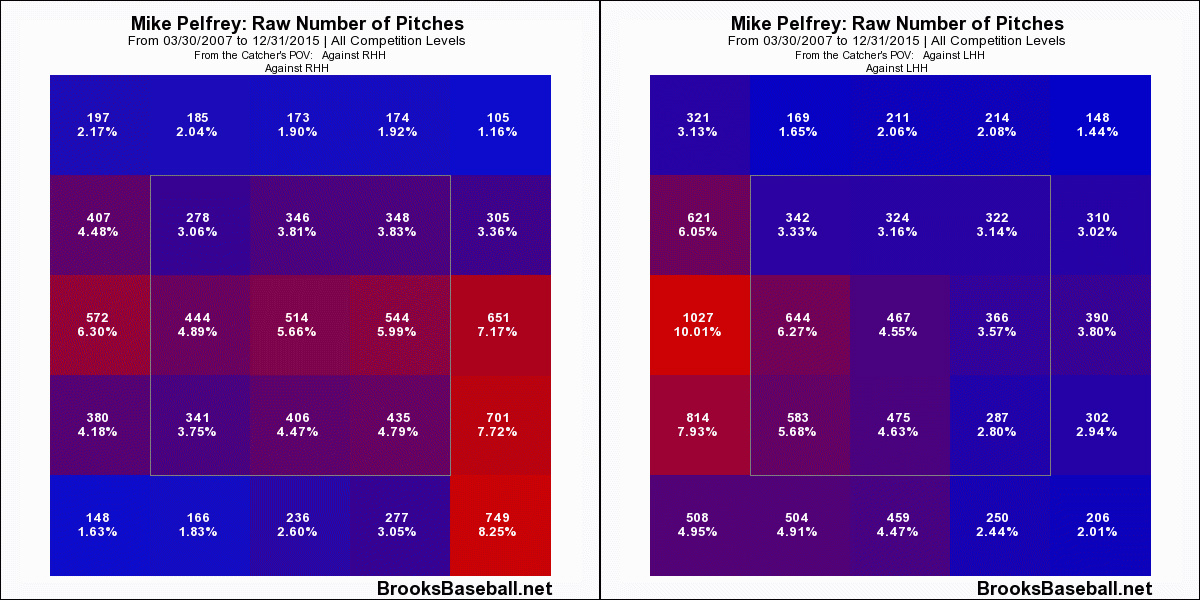
He throws his sinker and typically works away. He’s a man of simple tastes. Sinkers away with the occasional splitter or slider depending on handedness. He’s probably going to keep the ball in the yard but the ball will be in play and the hits will fall.
There’s plenty of risk when it comes to his right elbow and there’s virtually no upside. If things go well Pelfrey will be an average starter over 160 innings per year. He’s not an exciting player but there’s a decent probability that he’s a useful starter. Having a good defense on the field behind him matters, so the Tigers should be sure to play there best fielders during most of his starts, but if his arm stays in tact there’s a good shot that he’ll be a solid arm at the back end of the rotation.
If the Tigers find a better option, he should be able to float into the bullpen just fine and if he blows out, $8 million doesn’t kill them. He probably won’t be the most exciting guy to watch, but Pelfrey is a nice insurance policy to give the kids more time to develop.
 New English D