Andy Dirks’ Inverted Value: Trading Offense for Defense
Andy Dirks has been slumping with the bat lately. A lot of Tigers fans are unhappy with his performance lately and want to see more from the now-injured Tuiasosopo, Garcia, and Castellanos. I get that, I understand. The offensive numbers are down. You can see it in his rate stats from last year to this season:

He’s 100 PA shy of where he was last season (344 to 244), so the counting stats are going to be harder to compare, but something is incredibly interesting about Dirks this season. Last year, he was worth 1.6 WAR in 344 PA. This year he’s at 1.4 WAR in 244 PA. So he’s actually a little ahead of last year’s overall value despite being 100 PA behind and being a worse player across the board offensively.
Andy Dirks went from an above average hitter and below average defender last season to an elite fielder and below average hitter this season. Now, it could be a sample size issue. Certainly it could. But the change is pretty dramatic and pretty interesting in terms of where his value is coming from, so let’s just take a look with the caveat that this might not keep up.
If we take a look at this advanced defensive numbers, multiple measures line up. Defensive Runs Saved (DRS) and Ultimate Zone Rating (UZR) agree that Dirks was slightly below average/right around average in 2012 and way above average in 2013.

So Dirks’ bat is down and his defense is way up. If we look at where he is contributing runs to his team it has completely shifted (keep in mind replacement level and positional adjustments change a little year to year) from the bat to the glove (10 runs equals 1 WAR). Batting runs, fielding runs, and total runs above replacement look like this:
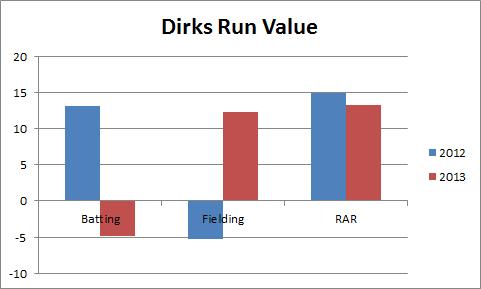
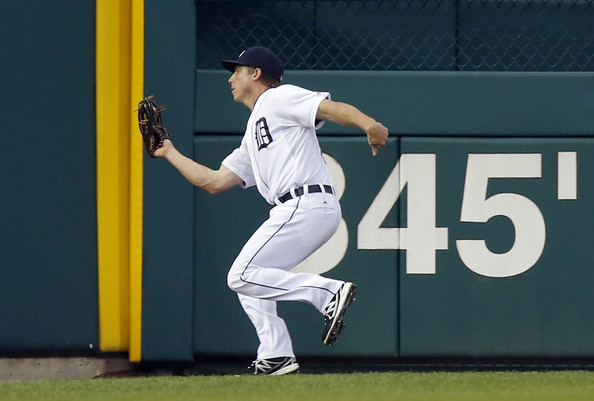
Basically, the takeaway point here is that while Dirks is struggling at the plate this season, he has made up for it with huge defensive value. I’ve watched almost every inning of Tigers baseball this year and I’m comfortable with the directional change, even if you want to quibble over his precise defensive numbers. Dirks has been great on defense especially compared to most guys who play left field.
Consider this, by UZR/150 which is essentially how many runs a player saves on defense per 150 games, Andy Dirks in LF is baseball’s best qualifying defender. His UZR/150 this year is 34.9. That’s like being a 3.5 WAR player just on defense. Granted, he’ll regress a little over time, but that is an elite level to this point. He’s the best defensive player in baseball by this measure! He’s 2nd in UZR (which isn’t scaled to a full season) and 8th in DRS. (These are all broken down by position and player so guys who play many different positions are unfairly knocked down)
So while I understand that fans are concerned about Dirks’ offensive performance you have to consider his defense as part of his overall value. That’s why Wins Above Replacement (WAR) is such a useful tool. It places a run value on everything and converts those runs into wins. I don’t care how a player adds value, I care if they add value. Dirks is adding value on defense instead of at the plate, and we can’t just ignore that.
Half of a player’s job is playing defense, even if it isn’t as sexy. And Andy Dirks is playing great defense.
Does Andy Dirks Need a Platoon Partner?
What often happens when a team has relatively few holes to address during an offseason is a lot of attention gets placed on minor needs. One of these needs in Detroit, has been a right handed hitting outfielder to match with Andy Dirks in a platoon situation.
The feeling among many is that this is one way the Tigers could improve their club heading into 2013, and it is also a way to improve the club that most perceive as possible. Finding a right handed hitter to man the weak side of a platoon is easier, for example, than finding a shortstop that is both available and an upgrade over Peralta.
So we’ve spent a good bit of the winter wondering who the Tigers could target to compliment Dirks. Scott Hairston was a logical fit, but he ended up signing with the Cubs for two years because they could offer him more in terms of playing time than the Tigers could.
But I think we’ve gotten a little too caught up in finding a dance partner for Dirks that we’ve overlooked the fact that he probably doesn’t need one. We’ve been looking for a match for him because there’s nothing else we even remotely need on offense, but we actually probably don’t need this either. The only place the Tigers really have room to upgrade is the bullpen and that only relates to Dirks in that he will be standing in front of it when he man’s left field.
Why is it that I say we don’t need a platoon partner for Dirks? Well, it’s because he can hit lefties just fine. Let’s explore the numbers.
Dirks has played 166 games in his career spawning 579 plate appearances. We’re working with about a full season of information that has covered parts of three seasons. Unfortunately, I can’t get splits data from his minor league career, just total numbers, so that can’t be included right now.
But let’s look at his big league breakdown:

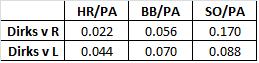
So if we look at that, Dirks is pretty much just as good against righties and lefties. He gets on base a little more versus lefties and hits with a little more extra base power against righties. But he hits more homeruns on average against lefties, walks more against lefties, and strikes out less against lefties.
According to Baseball-Reference’s tOPS which weighs each side, he scores 100 against righties and 99 against lefties, meaning that he is a one percent better hitter against righties. That doesn’t sound like a big platoon split to me. In fact, one would hardly consider that a platoon split at all. What are the odds both sides are perfectly identical.
From both sides, Dirks appears to be a capable major leaguer. But even if you don’t buy into Dirks yet and worry about the sample size, that should affect your opinion of him against all pitchers, not just one side of them. Dirks shows no discernible platoon split during his big league career.
So while we’re dying to find Dirks a buddy to play with out in left field, he doesn’t need one. Dirks can handle that position all on his own.
I generally think we overvalue platoon advantages. Don’t get me wrong, a lot of hitters weight to one side or the other, but I don’t think we should accept it as a given that hitters hit worse against their same side pitcher. I think that hitters who aren’t top flight prospects are often pigeonholed into a role that assumes they can’t hit one side before they actually display evidence of this shortcoming, and that pigeonholing puts them in a position in which they get fewer at bats against their “weaker” side, which means they actually develop a weakness because of a belief that may have not been true.
I’m not sure how to demonstrate evidence of this, but I think it’s happening. At any rate, I can and did show evidence that Dirks does not appear to be weaker against lefties. So in this case, at least, Dirks doesn’t need a dance partner and the Tigers can stop looking.
The Book on Andy Dirks
What People Think:
Andy Dirks is the subject of some debate among people familiar with the Tigers. Some think he can stick as an everyday outfielder and some think he’s destined to be a solid fourth outfielder and left-handed bat off the bench.
Jim Leyland likes to say he’s “just a ballplayer” and that’s not a bad description, even if it’s a massive cliché. He’s got all five tools, but none of them are flashy or elite level. Dombrowski said after the 2012 season that Dirks may or not be an everyday outfielder, which just about sums up the line Andy Dirks walks.
What the Numbers Say:
Over the course of two major league seasons, Dirks has registered about one full season of plate appearances. His career line is .293/.340/.454, which is absolutely everyday player worthy. He has 14 HR, 10 SB, and only strikes out 14.6% of the time. The metrics don’t love his defense, but the sample size isn’t big enough to really buy into those numbers just yet.
The minor league numbers seem to indicate that these big league numbers are replicable and the soon to be 27 year old Dirks can contribute for the Tigers for years to come.
What My Eyes Tell Me:
I’m a big believer in Dirks. I think he does the little things very well like playing the ball off the wall in the outfield and making good decisions on the basepaths. He has a solid OBP and puts the ball in play.
Most of that value at the plate comes from his willingness not to over-swing in search of homerun glory. Dirks benefits from hitting line drives toward the gaps and runs well enough to extract a little bit of value on the bases.
On defense, like I said earlier, I think Dirks does a lot of little things well. He has enough speed and arm strength to be a solid corner outfielder and his ability to be in the right place at the right time makes him good enough to stick. He’s probably an above average left fielder and an average right fielder long term.
Dirks hits well enough and plays defense well enough in my book to make him a big league regular and I could easily see a full season of at bats and good health resulting in 3.0 WAR next season if the Tigers give him that shot.
The Dotted Line:
Dirks has less than two seasons of big league services so he won’t even be arbitration eligible until after the 2014 season. It’s way too early to worry about Dirks’ contract status and he should make his role more clear by the time it’s time to talk turkey.
Fantasy-Land:
Fantasy baseball players should be wary of Dirks because he may end up as a platoon or bench guy, so he won’t get enough ABs to help you. Additionally, if he does get a lot of starts this year, it will be near the bottom of the lineup, so runs might be harder to come by. He’ll help you in AVG, but HR, R, RBI, and SB will really depend on how much he plays. Even if he does get a full season of ABs, he still won’t wow you in a lot of categories.
The Lead:
Dirks is a really useful player. At worst, he’s a really solid fourth outfielder and at best he’s a solid MLB regular. Dirks can put up a really good slash line and solid defensive work and should be helpful to the Tigers in some capacity.
He’ll head into 2013 with a big league roster spot locked up and will have a shot to earn a spot in the starting lineup with a good spring.
 New English D