Jhonny Peralta and a Lesson in Context
A decent number of Detroit sports personalities hate Jhonny Peralta. They think he’s a bad defender and unimpressive hitter. But they’re wrong and they’re wrong for an important reason. Position matters.
Peralta has been as durable as they come and hasn’t been on the DL in his entire career. He’s a lock for 145+ games and he’ll hit .250, walk a little less than average, and hit for average power. He’s not rangey, but he’s reliable on defense. He’s consistent. He’s shown the ability to hit .300 with a lot of power, but even if you don’t buy that ceiling, the floor is pretty stable and safe.
So if you look at a .264/.327/.422 hitter, you’re not thinking about a great player. But that actually depends. If that guy is hitting third and playing first base for you, you’re in trouble. But if he hits eighth and plays shortstop, you’re thrilled. This is a lesson in context.
In 2012, by WAR, Peralta was the 14th best shortstop in baseball with 2.6 (probably 13th if we don’t count Ben Zobrist who wasn’t a full time shortstop). Fourteenth is dead on average. In order to improve at shortstop, the Tigers would need to find a way to get a player who’s ahead of him on this list:
Alcides Escobar, Zack Cozart, J.J. Hardy, Asdrubal Cabrera, Hanley Ramirez, Derek Jeter, Starlin Castro, Erick Aybar, Elvis Adrus, Jose Reyes, Jimmy Rollins, Ian Desmond, and Ben Zobrist.
Those are the shortstops who were more valuable in 2012 than Peralta. Those are all big league starters and their teams aren’t giving them away. Those guys were better than Peralta in a down year for Peralta. In 2011, Peralta was third among MLB shortstops in WAR with 5.2, trailing only Reyes and Troy Tulowitzki.
From 2006-2012, Peralta was the 12th best shortstop in baseball. This, remember, is a lesson in context.
The context is the position you play. Peralta is not a great hitter. His .324 wOBA since 2006 is very average. But shortstops are lesser hitters as a group. Peralta’s average-ness is actually quite valuable from the shortstop position. You can’t compare him to everyone, just the players who play his position, and against them, he stacks up well.
He’s an average to slightly above average shortstop. You can’t replace him with Danny Worth or Ramon Santiago and get better. 15-20 teams would be very happy to take Jhonny Peralta from the Tigers and improve their middle infield.
You might think Peralta is lackluster on offense, but you have to realize the bar is lower for shortstops than it is for players on the corners.
His defense is also hotly debated. A lot of people think he’s terrible. The advanced metrics actually seem to love him. He’s posted a 9.9 UZR each of the last two seasons (meaning he’s been a win better than average at short each year). A lot of his critics read these numbers and scoff and say he benefits from good positioning by the coaching staff.
But you can’t deny what UZR is telling you. It might not mean Peralta is great on defense, but it does mean that he is getting to enough balls to be worth a win a season on defense. He might be getting aid from his coaches, but it is happening. Brendan Ryan would outperform him in the same context, but Peralta is performing well, even if someone else could take the Tigers’ coaches and use them even better.
I’ve read other metrics and watched with my own eyes and I think it’s fair to say Peralta is good going to his left and a little less rangey going to his right. He has good hands and generally makes accurate throws. With the help of good positioning, he’s helped the Tigers win on defense. He might not be miraculous himself, but remember, this is a lesson in context. In the situation he plays in, he is doing well.
So while a lot of people complain about Peralta, he’s clearly an average or better shortstop and is very durable. He’s also cheap at $6.5 million a season. Excellent shortstops are rare and expensive. Peralta is cheap, durable, and pretty good. I don’t see anything wrong with that.
The Tigers are a good team with a lot of star power. Peralta is a good compliment. He’s a good, cheap player at a position with few true stars. The people who want to get rid of Peralta need to take a long hard look at the rest of the league.
The league average production at shortstop in 2012 was .256/.310/.375. That looks an awful lot like the Peralta floor. You can’t compare him to Prince Fielder. Fielder plays first base and the league average first baseman in 2012 hit .257/.330/436. Way more walks, way more power. It’s a different position, so it’s a different set of expectations.
Jhonny Peralta is a guy you want to hang on to if you’re the Tigers, not a guy you need to replace.
Fantasy Baseball Strategy Session
Over the course of this offseason, particularly after the first of the year when more free agents have signed, I’ll be writing fantasy baseball rankings and predictions to help you win your league. But today, I’d like to offer a strategy primer. This isn’t what players to draft; it is how to draft, period.
I’ll assume most people don’t play in a league that doesn’t utilize an auction and most of your leagues are standard 5×5 with traditional categories.
A lot of strategy will depend on where you pick in the draft when we’re talking about early picks, but once we get 10 plus rounds into it, that distinction melts away. I’ll offer some broad rules below, but first, I want to make a couple points in general. First, use sabermetrics to prepare. Fantasy baseball might glorify more tradition statistics, but sabermetrics will help you judge over and under performers. High and low BABIP can tell you something. Dramatically different walk or strikeout rates might explain something else. Use these things to determine if you should buy low or sell high.
Second, don’t draft names, draft performance. Don’t get caught up in someone’s history, go for what you think will happen in the year for which you’re drafting. Draft Adam LaRoche if you think he’ll outperform Pujols next season.
Draft Reliability
Early on it your draft, don’t get cute. Don’t go for the person you think might have a breakout season, draft safe players. Ryan Braun, Miguel Cabrera, etc. In the early rounds, get someone you can count on. There’s nothing worse than playing a hunch and drafting someone who bombs out instead of drafting someone you can count on even if they don’t have the best numbers from the year before.
Position Matters
A lot of people will tell you take the best player available, but I don’t recommend it. You should draft the best players at the worst position. There are a lot of good first basemen and outfielders, but very few good second basemen. Robinson Cano and Dustin Pedroia aren’t as good as Joey Votto, but you might think about drafting them higher because the difference between Cano and Marco Scutaro is much larger than the one between Votto and, let’s say, Freddie Freeman. Votto is the better player, but you have to get a second basemen eventually, so make sure you think about position depth when drafting.
Draft Elite Pitchers Too Early
Another typical piece of fantasy advice is not to draft top starters too early, but you should. Grab Verlander and Kershaw or Felix Hernandez a round early. You’re going to want a couple elite arms and this is the best way to handle it. Get them early and pay for it by losing out on a position player. You’re taking on some injury risk, but the reward will be worth it.
Draft Too Many Closers
One of the easiest things to do in April is to find saves. Closers and relievers are volatile. Teams will switch closers a lot during the season and you can draft proven saves-getters and trade them early. Get Papelbon and trade him for something you need. Closers are a great trade asset and you can outsmart the field and pick up saves on the waiver wire.
Add Pitchers Early
Draft lots of position players and drop them for pitchers in early April. You can only play so many position players every day, but you can rotate your pitchers in and out of the lineup throughout the week. Drop your ineffective subs and pick up pitchers on hot streaks.
There’s no secret to winning your fantasy league other than being smart and lucky, but these are some good tips. Draft reliability, think about position, draft great pitchers early, draft too many closers and trade them, and add hot starters in April. Do this, and you’ll be on your way.
2012 Season in Review: New York Mets
74-88, 4th in the NL East
The 2012 version of the Metropolitans was very compelling and super exciting into the early summer, but bottomed out as the dog days arrived. They were led by an MVP contender and the NL Cy Young, but the supporting cast wasn’t enough to make the Mets a player in one of the tougher divisions in the sport.
The afore-alluded to Wright (7.8) was worth more WAR than the next four position players combined. Only Ruben Tejada (2.1) and Scott Hairston (2.0) hit the 2.0 starter threshold. Ike Davis gets honorable mention for doing everything right except getting hits. Great power, good patience, but the .227 batting average dragged the whole thing down. He should be better in 2013.
R.A. Dickey had an RA-diculous season and was my (and the BBWAA) pick for Cy Young. Jonathan Niese also had a fine season, but no other pitcher made more than 21 starts. Johan Santana was good, but got hurt. Dillon Gee too. Chris Young was meh, but not bad for a 5th starter. Matt Harvey was eye-popping good, but only made 10 starts after his callup.
The bullpen was, let’s be generous, a weakness.
The Mets had some bright moments this year, especially the first no-hitter in franchise history, courtesy of Mr. Santana, and a wonderful string of dominance by Dickey. Wright signed an extension and Matt Harvey stepped into the spotlight.
The 2012 season shot some life into Mets fans for the first few months and faded down the stretch. I think they’re on their way up. The starting pitching is there.
A Dickey, Niese, Santana, Harvey, and Gee rotation is very good. If Zach Wheeler is ready to be the 1/2 a lot of us think he can be, they Mets could easily have a top five rotation.
They need offense. Wright is a good centerpiece and they have a handful of guys who can really fill out the bottom of a lineup. They need one or two more formidable bats to surround Wright near the top and they could be good to go.
It wasn’t a great year for the Mets, but the future looks bright.
2012 Grade: D
Early 2013 Projection: 80-82
The Dodgers Have Money, But That Doesn’t Mean They’ll Win
It should come as a surprise to no one that the Dodgers, buoyed by a new ownership group and TV deal, have a very large sum of money to pay for baseball players. Their 2013 payroll is likely to be near $250 million, or about $60 million above the luxury tax threshold, meaning they’ll pay a tax that will increase their effective payroll toward $300 million.
They took on a bunch of bad contracts in trades in 2012 and have signed expensive players in the offseason that has followed. At least in the short run, we have to assume that the Dodgers payroll constraints are such that we could not reasonably expect them to be met.
Jeff Sullivan, the best of the best at Fangraphs, wrote a piece the other day thinking about what a team of the highest paid players would look like and came to the conclusion that such a team would be a contender, but not a juggernaut. You can read the piece here.
Sullivan’s main argument is that the most expensive player is not the necessarily the best player. On that, we can all agree. What the Dodgers have the ability to do, given their vast financial resources, is outbid everyone for the best players. Put another way, in a world in which we could perfectly predict future performance, they Dodgers would have the best team.
But teams still need to predict future performance to get this right. Most MLB teams think Zach Greinke will be a better pitcher over the next five to six seasons than Anibal Sanchez, so Greinke will earn more money in free agency. But there is a decent chance we’re wrong about this prediction and Sanchez will be better.
If this occurs, Sanchez is the better player and the better investment. He will be worth more and earn less. If Greinke is the better player, Sanchez could still be the better investment because he will earn fewer dollars.
Think of it like this. A player’s value to his team is his WAR. A player’s value as an investment is his $/WAR. If Greinke is worth a healthy 30 WAR over this deal, he will help his team win 30 games, but those 30 wins will cost $4.9 million each.
If Sanchez adds 20 WAR over a five year deal but only makes $75 million, his team will only pay $3.75 million each. Greinke adds more value in the standings, but Sanchez adds more value per dollar.
The Dodgers have only conquered half of this equation. They can pay more per win than any team because they have the most money, but they still need to find the wins. If it turns out that Greinke is worth 25 wins and Sanchez is worth 30 wins over the same period, they should have signed Sanchez.
The Dodgers’ riches don’t make them better at making smart baseball moves, it means they can afford to spend more per win. They can pay Greinke more than any team, but that money will only work if they spend it on the best players. The Dodgers don’t care about the value of their investments, but they do care that their players are the best players.
They can pay $17 million to Josh Beckett to be a fifth starter when most teams would spend $7 million for that level of performance. They can pay Greinke $24 million to be a $19 million arm, but they can’t pay to make Greinke better.
This is the trap of being the Dodgers. The Dodgers are forking over a ton of cash to these players on long term deals because these big deals make sure the Dodgers get the free agent players (and trades/extensions) they wish. But if they choose the wrong players, they are stuck.
While they can buy more players if the current ones don’t perform, can they really afford to spend money to replace a big contract? Greinke makes $24.5 million a season now. If he flames out in two seasons, can the Dodgers replace him? Can they put a $25 million arm in the bullpen or on the waiver wire? Do they really have that much money?
The conflict they face is roster size and future commitment. If Carl Crawford turns out to be terrible for the Dodgers, can they just eat his contract, cut him loose and buy the next big free agent to replace him in LF? Do they have that much money? I don’t know.
The Dodgers can outbid you for the best players and spend more per win than any team in baseball, but can they spend their way out from under these contracts if they go bad?
They can afford at $250 million payroll. Can they afford to pay $250 million to an average team? What happens when they need to get better?
The flip side of this is a team like the Rays who constantly keep their costs down and derives value from young, pre-free agency players. It keeps them from having a high payroll, but it also provides something the Dodgers no longer have; flexibility.
This huge payroll limits the Dodgers flexibility. It creates a logjam. They can’t just go sign Hamilton to replace Crawford. With a $20 million guy at all 8 positions and 5 starter spots, they would pay $260 million plus the bullpen and bench. That’s workable for them I think, but only if those guys perform. What happens if one or more aren’t good enough and need to be replaced? Can they pay $40 million per position? $20 million for the new guy and $20 million for their new benchwarmer. Could they pay $60 million?
The Rays can easily jettison a $1.5 million outfielder and replace him with another, but I’m not sure you can do the same when the player you want to get rid of has four years left on his deal and is making $25 million annually.
The Dodgers can outspend everyone, but that doesn’t mean they’ll be a juggernaut and a force to be reckoned with. They still have to make the right choices. They still have to pick the best 25 players to put on their club. They’ll sign pretty much any player they want, but they have to want the right guys. If they make a mistake, I’m not so sure they can just replace them with a better player during the next offseason.
The Dodgers can outbid you, but they can’t necessarily outsmart you. If Anibal Sanchez is worth more wins than Greinke over the next few years, it will be proof of that.
Dodgers Make Yankees Blush, Sign Zach Greinke
Zach Greinke has a 6 year, $147 million deal with the Dodgers pending a physical. This deal shouldn’t be much of a surprise to anyone, especially anyone who read my post about Greinke last month. The Dodgers needed pitching and had money. They existed in the center of the Venn Diagram of “need pitching” and “have money” in which Zach Greinke would no doubt sign.
You can read my previous post to give you an idea of what I think about Greinke, but the contract is new, so let’s talk about that.
$24.5 million a season for six seasons, totaling $147 million. Not a bad gig if you can get it. I like this for the Dodgers, however, even if a lot of people will write that it is an overpay. Greinke is 29. This contract will take him into his decline years, but not that far into it. He’s easily capable of putting up a couple 4-5 win seasons during the span and those seasons will pay for themselves. There might be some lost value on the back end where he’s worth a few million less than the contract if inflation doesn’t catch up and make it a wash.
The point I’m trying to make is that if this is an overpay, it’s a small one. Over six years, it’s hard not to imagine Greinke putting up at least 3 WAR a season. That’s $90 million with no inflation and nothing better than 3 wins a season. With all the money flying around the Dodgers front office right now, whatever part of that $50 million excess cost doesn’t get picked up by inflation and better than 3 win performances, I’m sure they will be able to cover it. They have a lot of dollars, so giving a lot to Zach Greinke should be okay.
It should also help to move to a nice pitcher’s park like Dodger Stadium. And putting him next to Clayton Kershaw should be pretty awesome. Two Cy Young contenders on one club.
Money isn’t an object for the Dodgers and they needed pitching. Zach Greinke likes money and is good at pitching. This is a pretty good match. Grade: A-
Previewing the Winter Meetings
Baseball’s Winter Meetings kick off this week in the annual “Now is About the Time We Start Doing Things” portion of most GMs’ job. As the week goes on, we should start to get a sense of where the bigger free agents might end up and we might see a trade or two as well.
Here are five things to watch at this year’s meetings:
1) Centerfield
Josh Hamilton, Michael Bourn, Angel Pagan, Shane Victorino. Four centerfielders last season who are looking for new teams and somewhere between 2 and 4 of them will get jobs as centerfielders. Bourn and Pagan certainly, with Hamilton and Victorino potentially moving to a corner.
The market here is interesting because the players are all looking for very different contracts and are very different style players, but they are actually probably all worth about the same on the field. Hamilton provides power, Bourn provides speed on offense and defense, Pagan plays good defense and gets on base, and Victorino does everything kind of well.
It will be very interesting to see who takes the plunge on Hamilton, how much Bourn gets, who sees Pagan as the safe bet, and who thinks Victorino will bounce back. This part of the market is deep in a strange way.
2) Zach Greinke
Greinke is easily the top free agent on the market in my book and he should become a very rich man in the next couple weeks if he doesn’t fall down a flight of stairs while simultaneously tearing his UCL.
Earlier this offseason I wrote that the Dodgers and the Angels were the most likely suitors for Greinke, but there is some talk that the Angels might not be as in control of this as we thought a month ago.
The Dodgers can give Greinke the team credit card and he could really shine in the big park, light hitting NL West. Yet the Angels need him desperately and currently have a pitching staff that more closely resembles the Cubs than the Phillies. Last year, a lot of mystery teams jumped in on big rf mystery teams tly have a pitching staff that more closely resembles the Cubs than the Phillies. Yet the Angefree agents, so keep an eye out for that again.
We’re watching Greinke because of his value, but also because everyone will wait for him to sign to go forward with starting pitching plans. His market will set the market for other pitcher and teams that needed Greinke will turn up the heat on other options.
3) Relievers
I won’t say much here other than that Brandon League and Jonathan Broxton got three year deals in excess of $20 million to pitch 60 innings a season. The relief market is off the rails and we’ll see where it goes from here. How much does Soriano want if this is what his inferior competition is making?
Fans and teams dramatically overvalue individual relievers and I’ll be watching how this plays out in Nashville this week.
4) Good Players that Don’t Fit
There are a few players on the free agent market who might be in odd situations because their current club doesn’t really have a place for them anymore. Adam LaRoche might have just been pushed out in Washington with Span coming over. The Tigers can’t afford Anibal Sanchez. The Yankees don’t want Nick Swisher. There’s no room at the inn in LA for Victorino.
It will be interesting to watch how this market plays out given that a lot of very useful players won’t be able to turn around and resign with their previous clubs. They might be undervalued, but they could still get overpaid. It’s really hard to tell how all of the new money will change the game and how a weak top of the market plays with a deep middle of the market.
5) TRADES?
Everyone seems to love trades and trade scenarios. Justin Upton? Giancarlo Stanton? Wil Myers? R.A. Dickey? Could these guys be traded?!
The Winter Meetings will give teams a chance to really gauge both the free agent and trade markets as they look to improve their clubs for 2013. If another big trade is going to happen this offseason, it’ll come in the next few days.
There’s a lot to watch next week as the offseason gets into full swing, so check with STT every day for complete coverage.
Lots of Baseball Happens: Signings, Extensions, and Trades
In the most cliché move yet this offseason, the hot stove is heating up as baseball’s GMs decided to start making moves in the week before the Winter Meetings in Nashville. Because my day job doesn’t allow me to spend the 12 hours a day I would like to writing about baseball, I’m going to have to get you caught up at lightning speed.
Here are the big moves from this week and my brief take on each:
Angels sign RP Ryan Madson, 1 year, $6 million plus incentives
Excellent move by the Angels who followed up by dumping Jordon Walden on the Braves for Tommy Hanson. Madson was a solid reliever for the Phillies for several years before signing a 1 year deal with the Reds last season. He got injured before the season and never threw a pitch, so it’s hard to judge exactly how healthy he may be. The Angels took that risk and added Madson to their bullpen on a one year deal during and offseason that has seen two meh relievers (League and Broxton) get three year contracts. Grade: A
Braves sign OF BJ Upton , 5 years, $75 million
The Braves needed to resign or replace Michael Bourn and this will do the trick. I have my doubts about Upton going forward and think he’s a guy who peaked early and will never live up to his skills. That said, he’s been a useful big leaguer with flashes of star power in the past and the Braves are only signing him through his age 32 season. I don’t love this deal, but it’s not a huge risk given how big contracts are getting. I think Upton has a couple more $15 million seasons in him, I’m just not sure how many and when they’ll come. I’m glad my team isn’t taking this risk, but I’m guessing the Braves won’t regret this and if they do, it won’t be a huge regret. Grade: B-
Nationals acquire Denard Span from the Twins for P Alex Meyer
The Tigers fan in me is thrilled Span is leaving the AL Central. The analyst in me thinks the Nationals made a shrewd move here. A cost controlled Span for three more seasons will do wonders between Harper and Werth and can provide a nice boost at the top of the order in a much cheaper way than the free agent options. Meyer is an interesting prospect, but most of the people I’ve talked to or read seem to think he’s a risky-high upside type. Span fills a hole in the Nats outfield and they traded from pitching depth, and they have a lot of that. The Twins have Ben Revere to fill the Span void and they do need a lot of pitching. I like this deal for them except that I think they probably could have gotten more in a deal for Span. Grade (Nats): A, Grade (Twins): C+
Pirates sign Russell Martin, 2 years, $17 million
The Pirates got something they needed. Offense. Martin hits for power and walks at a decent rate while provide some value on defense through solid pitching framing and debatable throwing skills. He’s a good fit for the Pirates and it’s hard to call $8.5 million for a free agent who can easily get to 2.0 WAR an overpay. Can’t complain if I’m a Bucs fan, but I really just want to point out that the Pirates outbid the Yankees for a player. The Pirates…outbid…the Yankees. With money. Grade: B
Mets extend David Wright, 7 years, $122 million
This extension starts after 2013 and carries Wright into his age 37 season. I was preparing a “What Should the Mets Pay Wright” piece when the news broke of this extension and I have to say, the Mets are getting a really solid yearly price for the cost of guaranteeing a lot of years. This is similar to the Longoria deal in a lot of ways except Longoria signed his four years ahead of free agency and Wright signed his one year ahead. Wright proved, through signing this deal, that he is committed to winning in New York and he’ll likely be a Met for life. Assuming he stays healthy, it’s hard for me to see a way in which this deal becomes a mess. It might not payoff, but it should mostly pay off. Grade: B+
The Winter Meetings are coming next week and a lot more action should be coming. Check back with STT for complete coverage.
122 days until Opening Day.
2012 Season in Review: Cincinnati Reds
97-65, 1st in the NL Central, Division Champion
Lost in the NLDS to the Giants
It’s hard not to be happy with 97 wins. That’s a lot of wins. The Reds were a great team in 2012 and should be really happy about everything they did except for those last three playoff games where they let the Giants embarrass them.
Joey Votto played 70 percent of the year and posted a 5.9 WAR. His slash line (.337/474/.567) was something out of a video game. Brandon Phillips, Ryan Hanigan, Todd Frazier, Ryan Ludwick, Zack Cozart, and Jay Bruce all posted starter or better WARs while contributing to baseball’s 10th best cohort of position players.
It’s hard to argue with a top five pitching staff either. The original rotation, led by Johnny Cueto, made 161 starts, yielding only a single game to Todd Redmond at the very end of the season. Mat Latos, Bronson Arroyo, Mike Leake, and Homer Bailey joined Cueto in the original five to form one of the better rotations in the game.
But the bullpen was the story. They posted the second best K/9 rate and the third best FIP in 2012 on the back of fireballer Aroldis Chapman.
The Reds hit well, fielded well enough, and pitched great. That’s a really good formula if you’re trying to win baseball games.
The Reds were a complete team and commanded the soft NL Central for the entire season. They fought off challenges from the Pirates and Cardinals and coasted their way into the postseason. After a strong start on the road in San Francisco, the Reds lost all three home games and called it a season after Game 5 of the NLDS.
It’s hard not to favor the Reds again in 2013 as they return most of their key pieces and look to be moving Chapman to the rotation where he belongs. The Cardinals will have something to say about the Reds’ chance at a repeat division crown, but the Great American Ballpark faithful should clear their schedules for next fall.
2012 Grade: A
Early 2013 Projection: 94-68
2012 Season in Review: Milwaukee Brewers
83-79, 3rd in the NL Central
The Brewers came close to following up their run to the 2011 NLCS with another playoff appearance, but ended up just short and finished 5 games behind WC2 St. Louis. This might feel like a respectable season given the loss of Prince Fielder to the big spending Tigers and Zach Greinke to the Angels via trade, but it’s hard not to look at 2012 as a missed opportunity if you’re a Brewers fan.
The reason I say this is because the Brewers could have made the playoffs if their bullpen didn’t implode time after time during the first half. They played well down the stretch and certainly could have won five more games with two more months of Greinke mixed with a not-terrible bullpen in May and June.
Ryan Braun had a near MVP season (7.9 WAR) and Aramis Ramirez filled in admirably in place of Fielder (6.5 WAR) behind him. Jonathan Lucroy posted a spectacular 3.9 WAR in 96 games behind the plate and Carlos Gomez (3.5), Nori Aoki (2.9), and Corey Hart (2.9) all had solid seasons at the plate.
Collectively, Brewers position players accumulated 33.6 WAR on offense and defense, good for second in all of baseball. They didn’t miss Fielder that much. They got elite production from their stars, solid contributions from regulars, and didn’t have anyone who dragged them down with a lot of at bats of negative value.
On the hill, the story is a bit different. Greinke gave them two great months (3.8 WAR) and Mike Fiers (3.0), Marco Estrada (2.7), and Yovani Gallardo (2.7) all had solid seasons. Wolf and Marcum also made quite a few starts of mediocre value, but the key deficiency of the rotation was that only Gallardo make more than 24 starts. By WAR, they had the 9th best rotation in baseball.
The bullpen, however, was 25th in baseball and posted a 4.11 BB/9 rate. Only the Cubs and Dodgers were as bad or worse in 2012. Only the Mets had a worse Left on Base rate. Only the Astros and Rockies gave up more hits. We should cut them some slack because they pitch in a hitter friendly park, but not this much. And we should also remember they stunk in the first half and did get a little better.
But the story here is that bullpens performing very badly over a short period can cost you a good deal of games with a small raw amount of terrible performance. I don’t like Saves as a stat for many reasons, but when you blow 30 of them as a team in one season, you’re doing something wrong.
So the story of the 2012 Brewers is a story about a good offense, respectable starting pitching, and a rough bullpen. They were good enough to make the Play-in Game except for a ton of blown games late. It’s hard not to let that eat at you over the course of an offseason.
The loss of Greinke going forward will cost them without an obvious replacement, but they should be able to recreate him with a couple of solid arms who can replace all of the starts they gave to AAAA type players.
The Reds and Cardinals aren’t going anywhere and the Pirates look serious. The Brewers need to beef up their bullpen and solidify their rotation if they want to give their offense a shot at carrying them back to the postseason.
2012 Grade: C
Early 2013 Projection: 82-80
Where to Sit When You Head to the Ballpark
One of the more important decisions to make as a baseball fan is where to sit when you attend a game in person. This is a critical decision as you plan to maximize your enjoyment, even if the worst seat in the house is still better than every other geographic location on Planet Earth.
With that said, it will always come down to a matter of opinion (and also cost), but there are advantages and disadvantage to each vantage point. I’ve included a seating chart of Comerica Park for reference, but recognize that all stadiums are different. Later in the offseason, I’ll run a series ranking the MLB parks I’ve been to, so I can give you specific advice at that point, but this is a general overview.
Let’s assume that funds aren’t an issue here, but if they are, just eliminate any options that are out of your price range, and voila, this will still work for you!
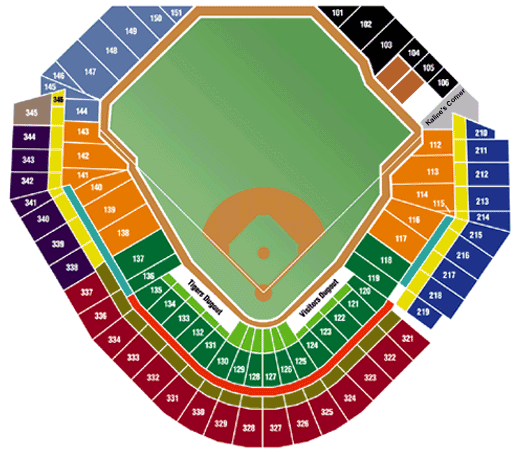
Most people assume close proximity to the playing field is the most desirable aspect of your seating choice, but this is a fallacy. You actually don’t want to be too close because it will throw off your perspective. While sitting directly behind home plate in the first row seems cool, it’s actually not a great view unless you like nodding approvingly at the player near the on-deck circle.
In this instance, however, the umpire obstructs your view of balls and strikes, you have a bad angle on plays at first and third and won’t be able to judge the distance of fly balls. If you want to sit near the plate, you want to sit many rows back. This will give you a better view of the strikezone and will improve your ability to judge batted balls. Your views of the bases are still not ideal, but they are better.
A much better choice if you like to sit facing the field in a similar way is the first row of the upper deck. Here, you’ve improved your view of the strikezone, you’re in a better position to judge batted balls, and the bases are less obstructed. It’s still not an ideal seat because of the angle, but if you like the view from behind the field of play, this is my recommendation.
If you’re looking to improve on your view, the best thing you can do is move down the line. You don’t want to go too far and lose your view of the zone, but swinging around to first or third base will really help you judge batted balls. You’ll still be close enough to see the zone, but you will give up some of your inside-outside judgment.
Here, you’re also going to give yourself a good angle on most of the bases too. If you move toward first, you will have a good view of forces at first (important), tags at third, and tags at home while losing tags at first (coming back to the bag), and tags at second. Forces at second will vary. If you slide toward third, you can see tags at first, everything at second and everything at home. You surrender a lot of action at third and forces at first. If I have to choose, the profile of sitting on first base is a little better.
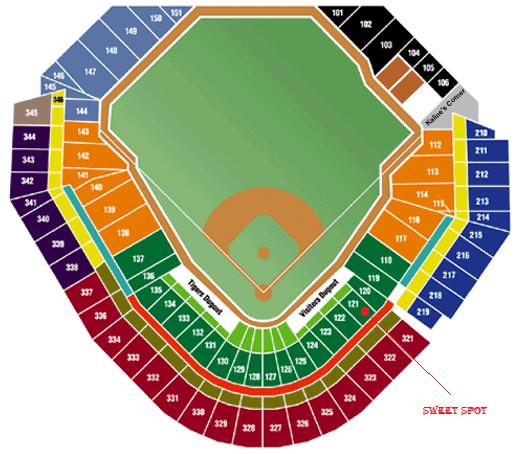
So far, we want to sit on the first base side, but not too close to the action. We also don’t want to sit so far that we can’t see either. The sweetspot, as indicated in this diagram, is probably about even with first base and above two thirds of the way up the section. This will give you optimum viewing and will put you in foul ball range. This is where I’d tell you to sit.
But there are advantages to other spots. It’s always nice to be in the first row under an overhang because it protects you from the elements during April and October (and also rain delays in the summer). The first few rows of the outfield seats can be fun too, if you like watching the game unfold from a player’s point of view.
If you’re cost conscious, another smart move is to sit on the infield side of the first section after a price change (117, 138). This offers a more expensive view at a lower price.
Another trick is to sit with the nearest aisle to you on the outfield side of you. In other words, be far away from the nearest aisle that might block your view of the plate.
If you’re still deciding between or among some choices, think about the geography of the stadium. Are there particular areas you like to see when looking around? Do you want to be close to a particular concession stand, bathroom, or apparel shop?
You could also choose to sit close to your favorite player. I knew a girl in high school who always sat near Inge because she loves him and I have a feeling a former co-host of mine likes standing in right center field so he can get a nice view of Josh Hamilton when he comes to town. In my case, I’m not sure if they’ll let me sit in the dugout, as my favorite players are usually utility guys.
So while it’s a matter of opinion, there is a right method for picking your seats. Some people value different things at a ballpark, but you should know what you’re choosing when you make the call. Don’t worry though, if you screw it up, you’ll still be spending three hours watching baseball.
 New English D