Don Kelly and Athletes You Can Feel Good About
Don Kelly is coming back!
That was my reaction to the news today that the Tigers had signed Kelly to a minor league deal with an invitation to Spring Training and a shot to make the club as the 25th man once again.
Let’s be clear upfront, I love Don Kelly. He became my favorite Tiger once the Tigers released Inge last year and I’m very excited about the prospect of him returning to the club. I’m not overly optimistic that it will happen, but I’m happy that he’ll get a shot at it.
You see, Don Kelly is everything that is great about baseball. That may seem odd to you considering that Kelly is a bench player and certainly won’t ever be anything more than that.
But what matters here is how much Kelly loves playing baseball and what a nice guy he is. I would never advocate for Kelly to start in centerfield and hit third for my team, but that’s okay, because only one guy can play centerfield and only one guy can hit third. You need 25 guys on a team, and Kelly fills a very valuable role. He plays every position, has a disciplined approach at the plate, and can get the occasional extra base hit.
He runs pretty well and can fill in as the emergency everything. I’ve personally seen him pitch and catch live and he’s the only active player to have played all nine positions in the majors. He’s played 8 of 9 for the Tigers plus a few games at short for the Pirates.
I love versatility. My favorite players are utility players. Maybe that makes me unusual, but I don’t particularly care. Don Kelly can play anywhere. He rides the bench with great enjoyment and is revered by everyone who knows him as, like, the nicest dude on the planet.
When he got sent down last year, the reporters were tearing up. He told them it wasn’t a funeral, and it wasn’t. He had a game winning sac fly in the ALDS and got to be the hero.
He’s the most polite athlete I’ve ever seen and his love for the game and his teammates is obvious. I love Don Kelly and I’m glad he’s getting another shot.
I’m fully aware that a list of the best 25 players in the Tigers organization probably doesn’t include Kelly, but he’s my favorite one to cheer for. The best 24 and Kelly might win one fewer game than the best 25, and I’m okay with that because sports are better when you can put your faith in someone who won’t let you down.
With all the cheating and lying and general unsavoriness going on with Bonds, Clemens, baseball writers, and Lance Armstrong, I’m more excited than ever to support players who are a little less talented if it means they are a lot better people. Don Kelly is one of those guys.
Don Kelly is easy to root for, so I’m hoping I get more chances to do so.
Lineup Protection: Fact or Fiction?
Among members of the traditional baseball community, lineup protection is a well-accepted truth. Among many members of the sabermetric community, lineup protection is a myth. Both can’t be right, but I’m sure not sure we know which side is.
First off, let’s define the term. Lineup protection is the idea that the hitter who hits behind you impacts how you perform based on a pitcher’s willingness to attack the zone against you versus pitching around you to face the next hitter. Let’s go a little further.
1) Protection assumes that it is better for Hitter 1 to see pitches in the strikezone because those pitches are easier to hit, therefore, protection increases your offensive numbers that do not include walks.
2) Protection assumes that a pitcher has some ability to control whether or not they throw you strikes versus balls in an at bat.
3) If you are “protected” you will see fewer pitches outside the strikezone, thus giving you a better chance to produce offensive numbers.
Now the sabermetric community points to evidence that says protection is myth because it hasn’t been shown to matter in any of the cases in which it could be tested. But a reasonable person would point out that to conduct a valid test, we would have to control for factors that we cannot control for in real life. We can’t randomly assign pitchers. We can’t hold the quality of the Hitter 1 constant. Even if you try to do that in a statistical sense, the sample size gets too small to have findings of any real significance.
The sabr crowd will tell you that the absence of evidence for protection means the burden of proof is place on those supporting it, and that’s a fine request in the abstract, but my aim isn’t to litigate an argument, it’s to see if protection is a thing or not.
More specifically, I want to see if protection should exist. In other words, should the hitter behind you impact how you get pitched?
I argue that it should and I’ll lay out my reasoning here. I can’t present an argument that protection does happen because it would be impossible to show that it does while maintaining a valid design, but I can present the argument that protection should exist using the 2012 Detroit Tigers.
Our Hitter 1 in this design is Miguel Cabrera. In 2012, Prince Fielder hit behind him and “protected” him. I will use their 2012 stats to craft their abilities, but these numbers could be adjusted if you prefer to track likelihoods by career numbers, monthly numbers, etc. Does Fielder’s presence behind Cabrera change the way a pitcher should attack Cabrera? I argue that it should.
Let’s look at this in the simplest terms possible. No one on, no one out. Cabrera leads off the inning, Fielder due up second.
In this scenario, Miguel Cabrera will get a base hit 33% of the time if the pitcher does not walk him (assuming Cabrera doesn’t know the pitcher will choose not to walk him). Fielder will get a base hit 31.3% of the time under the same conditions.
But not all base hits are the same. A walk and a single in this scenario have the same outcome for Cabrera, but doubles, triples, and homeruns are more damaging. Here, the pitcher would choose to walk Cabrera in all cases in which he would get a hit that wasn’t a single.
.33(batting average)*.41(% of hits that are for extra bases) = .1353
Regardless of who hits behind Cabrera, 13.5% of the time it is a better choice to walk Cabrera instead of pitching to him. If you don’t walk Cabrera, he will get an extra base hit 13.5% of the time, so you should walk him in those cases, but the other 86.5% of the time he will make an out (better) or single (equal).
So now let’s introduce his protector. Fielder gets a hit 31.3% of the time and 35% of his hits are for extra bases. This is important here because if Fielder gets an extra base hit, it is irrelevant what Cabrera did. If Cabrera gets a hit and then Fielder doubles, triples, or homers, Cabrera will score regardless of what base he occupied.
What we care about is how often Cabrera will get an extra base hit minus how often Fielder gets an extra base hit. We want to know how often we should walk Cabrera, so we need to see how often a Cabrera extra base hit will be followed by a Fielder single or out because a Fielder extra base hit would score a Cabrera walk.
Piece this all together and we discover that with none on and none out with Cabrera leading off and inning with Prince protecting him, walking Cabrera is the preferred choice 2.5% of the time.
This tells us that when Cabrera leads off an inning, 97.5% of the time, pitching to Cabrera will be the same or better than walking him with Fielder behind him. Obviously you can’t predict which 2.5% it will be, so you play the odds and always pitch to him when he leads off an inning.
How does this help us solve the problem? Should lineup protection matter?
It helps because if we insert the 2012 version of Delmon Young into this methodology, we should walk Cabrera 5.5% of the time. This still doesn’t tell us to walk Cabrera when he leads off an inning, but it tells us that we should walk him more to lead off an inning with Young behind him than if Fielder is.
This tells us that protection should matter. The hitter who bats behind you should impact the pitches you see. In practice, the likelihood of a walk being a smarter play with Young behind Cabrera means a pitcher should be more willing to pitch around Cabrera than if Fielder was behind him.
This becomes more evident when you add in baserunners and outs. I’m not going to walk through all the math in each of the 24 possible arrangements except to say that the more baserunners there are, the more valuable a walk can be over a hit. If a runner is on 2nd base, a walk is better than a single in the pitcher’s eyes, so the percentages slide in favor of a walk. However, you’re making a trade off because you are saying you like a 31.3% chance of a hit to a 33% of a hit when it comes to scoring the runner from second, but you are risking the chance that Fielder drives in Cabrera too.
The point of this entire piece is that the hitter behind Cabrera should matter. A pitcher should be more willing to pitch around Cabrera based on who hits behind him. That is hard to ignore, even if the percentages favor pitching to him in all scenarios. The important take away, however, is that it should also be a matter of degree.
Fielder and Young are dramatically different hitters. A very good hitter like Fielder matters over someone like Young, but would Fielder matter of Victor Martinez? Glad you asked.
Victor behind Cabrera means you should walk Cabrera 3.9% of the time in our scenario. So Prince is a better protector because he hits for extra bases more than Martinez does. But the difference is smaller than when Young is involved.
So, protection should matter, it’s a question of how much. A better hitter should protect you more than a lesser one and one who hits for more power should protect you more than one who hits more singles. It’s a sliding scale, so an overall difference would not be that evident unless the two potential protectors are significantly different both in reality and in the minds of the pitchers.
So while I cannot prove that protection exists, it absolutely should exists and should favor hitters with higher averages who get a lot of extra base hits. Additionally, since most baseball people believe it exists, that should reinforce its effect.
It should have a larger effect when pitchers and managers believe it exists. If they change their approach based on who hits behind someone because they believe it matters, then it will matter. Since it also should matter in a formal, logical sense as shown above, there is no other belief except to posit that lineup protection is a real thing, even if we can’t prove it.
The sabermetric response to this finding would likely be that even if it varies based on who hits behind you, the percentages always favor pitching to Cabrera over walking him. In other words, we never break 50.0%. This is true, but it misses something important. If 95% of the time you should pitch to Cabrera (and this is the extreme end), 1 out of 20 times, you should have walked him. This should impact you approach as a pitcher or you are being irrational. You should be more willing to walk Cabrera with Young behind him than Fielder even if your preference is to never walk him.
Protection should and probably does exist, even if the results are relatively small. Cabrera will not have a dramatically different season with Fielder or Young behind him, but we should observe differences, which means protection is likely a real phenomenon.
Alan Trammell and What We Want the Hall of Fame to Look Like
I was six when Alan Trammell played his final game. I can’t say I remember seeing much of him with my own eyes. But I come from a family of Tigers fans, so much so that my parents had a dog before I was born named, you guessed it, Trammell.
So the issue of Alan Trammell’s Hall of Fame candidacy is of some importance to me, my family, and the majority of the state of Michigan. Trammell is a beloved figure from the ’84 World Series team and a less beloved figure from a less than perfect managerial stint prior to Jim Leyland’s (he’s found a better home as Kirk Gibson’s bench coach in Arizona).
But is he a Hall of Famer? He’s a great Tiger, but does he make the cut for baseball’s highest honor?
First, I guess I should make clear that the Hall of Fame voting and the BBWAA in general are a joke. Stubborn, self-righteous writers won’t vote for suspected steroid users despite no proof and some refuse to vote for anyone on the first ballot simply because Babe Ruth didn’t make it in unanimously on the first ballot, so no one should. Lots of things about the voting are silly, but let’s leave that aside and ask if Trammell should be in the Hall of Fame assuming the Hall of Fame is actually a good measure of real baseball value.
For a long time, I thought no. And so have most of the voters. 36.8% of the 2012 voters put Trammell on their ballots, which is a far cry from the necessary 75% needed for induction. But in recent years I’ve become a more sophisticated fan, especially in the area of comparing eras and positions.
Trammell doesn’t have any universally accepted counting stat thresholds like 3000 hits or 500 homeruns to rest his candidacy upon, but those marks aren’t necessary for induction, they are merely sufficient. Let’s examine Trammell’s candidacy.
Over 20 big league seasons, he played 2293 games, hit 185 homeruns, drove in 1003, scored 1231, and stole 236 bases. He hit .285/.352/.415, good for a .343 wOBA and 111 wRC+. With good defense, Fangraphs puts his WAR at a healthy 69.5 (Baseball Reference says 67.1).
I’m not going to go through the arguments for or against Trammell made by others, but rather I’m going to construct a case based solely on the evidence.
Let’s start my putting Trammell in the context of major league shortstops. In the simplest terms, Trammell in 16th in career WAR for a shortstop. Every retired player on the list ahead of him is in the Hall. Some behind him are in. Based on the players already in the Hall at short, it seems like Trammell has a strong case. But past decisions aren’t necessarily right, so we can’t just say Trammell should make it because other undeserving players have made it.
By all of the main counting stats, Trammell is somewhere between 14th and 21st all time for shortstops with no controls for era. He’s outside the top 30 in all of the rate stats, however. Again, we’re not controlling for era here. This is the crux of the problem with Trammell’s candidacy. If you look at his numbers, it looks like he played for 20 years and accumulated a lot of counting stats without ever rising to the to the rate levels of the other past greats.
But like I said, this ignores context. Offense shot up right as Trammell’s career was ending and only in the last few years has it headed back down. Let’s look at Trammell’s contemporaries. Shortstops who played from 1970 to 2000 (adding five years on each end). These are arbitrary end points, but during that 30 year span, only Cal Ripkin, Ozzie Smith, and Robin Yount have higher WARs.
Trammell’s case rests on being a very good shortstop at a time of lower offense. He wasn’t the best of his era and he isn’t the best at anything. He played well over a long career and had a peak that looked like a Hall of Fame peak. Trammell’s best seasons are Hall of Fame worthy, but some of his worst seasons drag down the overall resume. Trammell is a good study in what you think the Hall of Fame should be.
I’ve always been a “story of the game” guy. The Hall of Fame to me is a museum to the game’s history and it should include the players who are vital to understanding the game. For this reason, I’m for admitting the suspected steroid users. But where does that leave Trammell?
By counting stats, he should be in. By rate stats, he’s probably not good enough. But that’s before you factor in the context of his position and his era. If the threshold for induction is that you have to be better than the worst player who is in, Trammell makes the cut. If there is a more ideal definition I think his case is less clear.
Trammell is vital to the story of the Tigers, but I don’t know how much he matters to the game as a whole. The fourth best shortstop of his era and a top 20 or 30 shortstop all time. If you like a big Hall of Fame, there is room for him. If you’re an exclusivity fan, he’s probably on the outside looking in.
Despite the quirks of voting, the Hall is still sacred ground. It does matter who gets in and who doesn’t. I’m left wavering on Trammell because I’m a story of the game guy and an exclusivity hawk. I want to induct players who were great and players that mattered. Greg Maddux is going in the Hall soon because he was great (and mattered), but I’m also more favorable toward Jack Morris because of his role in one of the great pitching classics of all time (Game 7, 1991 World Series) even if his raw numbers don’t warrant an inclusion in my book.
By my own standards, if I was redrawing the Hall of Fame, I think I would leave Trammell out. He doesn’t meet my own internal standards for the Hall, but he does mean the standards of the Hall as it currently stands.
Like I said, the Hall is a quirky place. Tim Raines isn’t in, but Jim Rice is. That doesn’t really add up. Hell, Pete Rose isn’t in the Hall. Voters have a lot of weird traditions and unwritten rules that don’t make sense. Certain voters see themselves as privileged gatekeepers to the point of ridiculousness. Bonds won’t make it because maybe he used steroids, but racists and wife beaters are just fine with them. The voters are the morality police without the moral compass.
As a Tigers fan, I want Trammell to get in. If I was designing my own Hall of Fame, I’d probably leave him out. But he belongs in this one. He has four years left of eligibility and he might get lost in the other battles raging over the Hall.
Given the criteria and the boundaries drawn by voters past and present, Alan Trammell belongs in the Hall of Fame.
Jhonny Peralta and a Lesson in Context
A decent number of Detroit sports personalities hate Jhonny Peralta. They think he’s a bad defender and unimpressive hitter. But they’re wrong and they’re wrong for an important reason. Position matters.
Peralta has been as durable as they come and hasn’t been on the DL in his entire career. He’s a lock for 145+ games and he’ll hit .250, walk a little less than average, and hit for average power. He’s not rangey, but he’s reliable on defense. He’s consistent. He’s shown the ability to hit .300 with a lot of power, but even if you don’t buy that ceiling, the floor is pretty stable and safe.
So if you look at a .264/.327/.422 hitter, you’re not thinking about a great player. But that actually depends. If that guy is hitting third and playing first base for you, you’re in trouble. But if he hits eighth and plays shortstop, you’re thrilled. This is a lesson in context.
In 2012, by WAR, Peralta was the 14th best shortstop in baseball with 2.6 (probably 13th if we don’t count Ben Zobrist who wasn’t a full time shortstop). Fourteenth is dead on average. In order to improve at shortstop, the Tigers would need to find a way to get a player who’s ahead of him on this list:
Alcides Escobar, Zack Cozart, J.J. Hardy, Asdrubal Cabrera, Hanley Ramirez, Derek Jeter, Starlin Castro, Erick Aybar, Elvis Adrus, Jose Reyes, Jimmy Rollins, Ian Desmond, and Ben Zobrist.
Those are the shortstops who were more valuable in 2012 than Peralta. Those are all big league starters and their teams aren’t giving them away. Those guys were better than Peralta in a down year for Peralta. In 2011, Peralta was third among MLB shortstops in WAR with 5.2, trailing only Reyes and Troy Tulowitzki.
From 2006-2012, Peralta was the 12th best shortstop in baseball. This, remember, is a lesson in context.
The context is the position you play. Peralta is not a great hitter. His .324 wOBA since 2006 is very average. But shortstops are lesser hitters as a group. Peralta’s average-ness is actually quite valuable from the shortstop position. You can’t compare him to everyone, just the players who play his position, and against them, he stacks up well.
He’s an average to slightly above average shortstop. You can’t replace him with Danny Worth or Ramon Santiago and get better. 15-20 teams would be very happy to take Jhonny Peralta from the Tigers and improve their middle infield.
You might think Peralta is lackluster on offense, but you have to realize the bar is lower for shortstops than it is for players on the corners.
His defense is also hotly debated. A lot of people think he’s terrible. The advanced metrics actually seem to love him. He’s posted a 9.9 UZR each of the last two seasons (meaning he’s been a win better than average at short each year). A lot of his critics read these numbers and scoff and say he benefits from good positioning by the coaching staff.
But you can’t deny what UZR is telling you. It might not mean Peralta is great on defense, but it does mean that he is getting to enough balls to be worth a win a season on defense. He might be getting aid from his coaches, but it is happening. Brendan Ryan would outperform him in the same context, but Peralta is performing well, even if someone else could take the Tigers’ coaches and use them even better.
I’ve read other metrics and watched with my own eyes and I think it’s fair to say Peralta is good going to his left and a little less rangey going to his right. He has good hands and generally makes accurate throws. With the help of good positioning, he’s helped the Tigers win on defense. He might not be miraculous himself, but remember, this is a lesson in context. In the situation he plays in, he is doing well.
So while a lot of people complain about Peralta, he’s clearly an average or better shortstop and is very durable. He’s also cheap at $6.5 million a season. Excellent shortstops are rare and expensive. Peralta is cheap, durable, and pretty good. I don’t see anything wrong with that.
The Tigers are a good team with a lot of star power. Peralta is a good compliment. He’s a good, cheap player at a position with few true stars. The people who want to get rid of Peralta need to take a long hard look at the rest of the league.
The league average production at shortstop in 2012 was .256/.310/.375. That looks an awful lot like the Peralta floor. You can’t compare him to Prince Fielder. Fielder plays first base and the league average first baseman in 2012 hit .257/.330/436. Way more walks, way more power. It’s a different position, so it’s a different set of expectations.
Jhonny Peralta is a guy you want to hang on to if you’re the Tigers, not a guy you need to replace.
Does Bonderman Have Something Left?
Jeremy Bonderman hasn’t thrown a pitch in professional baseball since 2010 and it looked like he was hanging up his cleats for good. He saved his money wisely and seemed ready for a backwoods retirement in obscurity.
But he couldn’t quite close off that part of his life. The former Tiger hurler who spent eight seasons in the major leagues is trying to make a comeback, and yesterday, his hometown Mariners made that comeback a possibility by signing him to a minor league contract. Jeremy Bonderman might not be done after all.
Bonderman went 67-77 with a 4.89 ERA in 207 games with the Tigers from 2003-2010, including some durable and effective seasons from 2003-2007. In 2006, he posted a 3.29 FIP and 6.1 WAR, which were both career bests. He was by no means a great starting pitcher in the mold of Johan Santana or Roy Halladay, but he was the Tigers workhouse until Verlander took over that role.
The whole of his career is respectable and unimpressive. He made it to the big leagues early because the Tigers were terrible and needed pitchers and because he left high school a year early and got his GED so he could enter the draft at 17. He’s also famous for causing Billy Beane to throw a chair through a wall. Yes, that’s a real thing.
But that 2006 campaign was great. Only Johan Santana and Brandon Webb had better FIPs and WARs. Aren’t those a couple of names from a time long since passed?
The potential was always there for Bonderman, who had a solid fastball and an excellent slider. He worked year after year on a changeup, but it never materialized and injuries soon caught up with him. He had four above average major league seasons, one of them great, before his 26th birthday. Most pitches don’t hit their peak until ages 26-30. Bonderman’s came long before.
Bonderman will spend the entire 2013 being 30 years old. He’s missed two years being semi-retired, and he’s still thirty.
If the arm speed is still there and the fastball and slider can still work, he could be a good piece out of the bullpen. I always thought he could thrive in the pen. When the injuries came, I thought they should have moved him to the back end of the ‘pen, but alas, it never happened and he walked away from the game.
Until now. Now, Jeremy Bonderman is making a comeback. I’m not sure if there’s a more romantic quest in sports than the grizzly veteran seeing if he has something left. Think The Rookie or Bull Durham. Think about the awesome Sports Night episode, “The Sword of Orion,” in which part of the story centers around Dan’s desire to watch a washed up starting pitcher start a comeback in an exhibition game with the Baltimore Orioles.
Something about a comeback speaks to us at a very emotional level. The idea of thinking something is over, only to find out that there is still time, is a powerful feeling. So we love when athletes try to conquer father time and mother nature and play beyond when we thought they could.
I’m dying to see Bonderman make this comeback. I’ll be waiting up for West Coast games, just hoping he’ll get the call. I want to see what he has left. The look in a man’s eye when he realizes there’s a little bit left in the tank that no one thought he had, that’s the look we live for.
The idea of a peak is everywhere in life. Some people peak in high school when they’re named prom king. Some in college. Baseball players in their late 20s. Others in their 40s. Whatever and whoever it is, we all peak. But what comes after the peak is still meaningful. There’s still something there. The party isn’t over.
The best days of Bonderman’s career may be over, but there may yet be days ahead. He might have another pitch, another game, another season, or another five seasons. He might have nothing left. But Bonderman was a big piece of some of my earliest baseball memories and I’ll be cheering like crazy for him. I love comebacks and I’m dying to see what Bondo has left, even if it’s just one more pitch.
Tigers Re-Sign Sanchez, Not Worried About the Cost
After it looked like he was heading to the Cubs last night, Anibal Sanchez gave the Tigers one last shot and they took it. Today, they signed him to a 5 year, $80 million contract.
The Tigers, very much in a win now mode, opened up the bank vault and got their man. The Tigers also have six starting pitchers now. After a strong performance down the stretch and in the playoffs, the Tigers made Sanchez a key target and they decided to pay.
In three full seasons of starts, Sanchez has been worth 3.8 WAR or higher. That’s worth $17 million a year on the free agent market, so this contract looks dead on. We should also factor in inflation, so the contract is probably worth it assuming he can maintain a similar level of performance. He won’t turn 29 until February, so while he isn’t especially young, he isn’t old either.
Sanchez has made a full season of starts in each of the last three years as well, so while some people think he’s an injury risk, I wouldn’t say he is any more so than any other pitcher. All in all, this is a fair deal for Sanchez. The question is if this is a good deal for the Tigers, specifically.
The Tigers had five starters going into the offseason; Verlander, Fister, Scherzer, Porcello, and Smyly. The first three are locks if they’re healthy. Porcello is only 23 and has four solid MLB seasons behind him and Smyly showed great, but slightly fragile potential in 2012. Sanchez is an upgrade over both of the backend guys, but he is more expensive.
The Tigers didn’t need to upgrade a rotation that was essentially baseball’s best in 2012, but they did. If Illitch doesn’t mind forking over more cash, why not go for Sanchez? They can trade Porcello or Smyly, they can send Smyly down, or move one to the bullpen.
Sanchez should no doubt be worth the deal in 2013, so the risk comes later. He isn’t taking cash away from anyone else, because the Tigers don’t have anywhere else to spend. The only needs are in the bullpen and bench, which aren’t places where you can spend a lot of dough.
I wouldn’t recommend this deal to a financially strapped team in the middle of rebuilding. I wouldn’t really recommend it for the Tigers. This was a deal for the Angels or Rangers or Red Sox to make. The Tigers need Sanchez less than other teams do, but they’re still better with him than without him.
If Illitch is really committed to winning at title at all costs, this is a good move because he’s the best pitcher left and those marginal wins are worth a lot to the Tigers right now. As long as this doesn’t hamstring them down the line in extension discussions with Verlander, Cabrera, Jackson, Fister, and Scherzer, this is a good deal. If the Tigers have decided they can afford all of these guys, I like it.
But they shouldn’t trade Porcello or Smyly. You need one and the other is great insurance. Unless they can add something really valuable for one of these guys they should hold on to both.
Sanchez will make the Tigers better in 2013. He will cost them $16 million to do so while the Porcello/Smyly tandem will cost closer to $5 million. They’re paying for the privilege to be a little better. That’s okay, it’s not my money. But it is my favorite team. If they win a title because of this move, I’m all for it.
Grade: B
Tigers Sign Brayan Pena Because, “Hey, Who Doesn’t Need Another Backup Catcher?”
Apparently, the new market inefficiency is backup catchers. The Tigers got another one today when they signed Brayan Pena to a one year deal to backup Alex Avila.
Prior to this deal the Tigers were short on backup catchers. They only had Holaday, Cabrera, and McCann. Everyone needs four backup catchers.
I kid. This deal costs them nothing, so it’s not a bad move. But like, man, how many backups do we need?
Here are Pena’s numbers for his career:
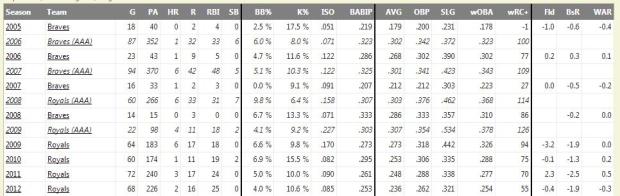
Nothing much to look at here. Not a hitter. Not a fielder. He’s a backup catcher and not a great one. But good backup catchers are getting two years deals this season (Laird and Ross). I’d have gone with Holaday from the start, but there’s no harm in this move.
Tigers Quiet at the Winter Meetings…For a Reason
The Winter Meetings are over, but winter isn’t. We’re 77 days from Spring Training in Lakeland and 115 days from Opening Day in Minnesota. There’s still time for the Tigers to tweak the roster, but here’s the rundown of the 2013 Tigers:
C: Avila
1B: Fielder
2B: Infante
SS: Peralta
3B: Cabrera
LF: Dirks
CF: Jackson
RF: Hunter
DH: Martinez
Bench: Holaday, Santiago/Worth, outfielder, utility player
SP: Verlander, Fister, Scherzer, Porcello, Smyly
RP: Benoit, Coke, Alburquerque, Dotel, three other guys
The Tigers have a clear need over the next two months: depth.
The starting lineup is strong, but the bench is up in the air. They need a righthanded outfielder who can platoon or backup Dirks. They need some positional flexibility and might have gotten it by trading in a Don Kelly for another (Jeff Kobernus).
The starting rotation is also among the best in baseball and some of the bullpen slots are locked up. They need to choose another lefty and two righties, one of whom should probably be a long man.
None of these spots are premium spots. The Tigers don’t need impact players, they need role players. This is a star heavy team that needs some solid bench pieces to make it back to the postseason. The Tigers have been quiet this week for a reason.
They’re pretty much set for 2013.
Plate Discipline and the Case Against Simplification
I’m not alone in viewing plate discipline as one of the most important skills a major league hitter can have. Picking the right pitches to swing at and the right pitches to take is extremely critical in providing offensive value, so it’s not surprising that plate discipline is a skill we like to chase when building a team. We also find that plate discipline is a skill that tends to be predictive and sustainable, which is another way of saying plate discipline isn’t as noisy as some other stats.
But how do we measure plate discipline? Walk rate (BB%) or OBP in relation to AVG are the standard ways of looking at discipline. If guys walk, they’re likely pretty good at deciding which pitches at which they shouldn’t swing. But that doesn’t really tell the whole story. There is still a lot of noise in walk rates and strikeout rates.
Consider some of the factors included in those stats. You can’t walk if pitchers don’t throw you pitches outside of the zone. You shouldn’t walk if you get good pitches to hit. Context matters too because you might be trying to hit for extra bases in some cases and singles in others, which would tend to change how you swing and what pitches you select. Power hitters will walk more because the risk of pitching to them is higher, even if their actual ability to recognize pitches is worse than that of a speedster.
A good number to look at is O-Swing% which tells us how often someone swings at pitches outside of the strike zone. Z-Swing% tells us how often someone swings at a pitch in the zone. But these numbers vary some by what pitches you’re getting. If you swing at 25% of the pitches outside the strike zone, but see a lot of pitches outside the zone, how does that compare to someone pitches outside the strike zone, but see a lot of pitches outside teh someone swings at awho swings at 40% of pitches outside the zone, but doesn’t see all that many out there?
There’s a lot of variation in all of these stats based on the context in which we observe them. Generally speaking, we want players to not swing at pitches outside the strike zone, so we want that O-Swing% to be low. But do we want hitters swinging at all of the pitches in the zone? Probably not. Not all strikes are created equally.
We also want the count and the situation to matter. A 3-0 pitch just outside and you should take. A 1-2 pitch just outside and you better swing. With all of the new Pitch F/X data, we probably aren’t that far away from being able to call up a players discipline graph so we can see which pitches each guy swings at in which counts against which pitchers and which type of pitch, but that information isn’t quite out there yet.
The lesson here is that while we usually try to boil things down to single numbers and easy to process information, the best strategy is almost always to look at lots of data. Batting average, for example, in a vacuum is a useless stat. Almost anything in a vacuum is useless.
I spent some time this afternoon working on crafting a formula that would best reflect plate discipline in one single number. I couldn’t do it. I kept trying to isolate the signal in the midst of noise, but couldn’t find a way to do it that was less complex that than status quo: Look at more than one piece of information.
We have a tendency to look for models or numbers that give us everything we need to know. We look for things that tell us how to interpret information instead of giving us the information that we interpret ourselves.
When we talk about Wins Above Replacement (WAR), we tend to do this. WAR sums it all together and tells us who the most valuable player is. This is good in broad strokes. I can easily see that Mike Trout outperformed Curtis Granderson with this protocol, but when we need to handle finer distinctions, we should be unpacking the data and looking at all of it.
Trout’s WAR exceeded Miguel Cabrera’s, but we’re better off if we take a look at each individual piece of information that goes into WAR because it gives you a richer picture of who is better. OBP, SLG, defense, speed, etc are all hidden inside WAR. WAR is shorthand. Which particular skills are does Trout beat Cabrera at and visa versa? We ask lots of question about who is the best player, but shouldn’t we ask who is the best at this particular thing? And the particular components of each of those things.
I tend to believe that more information is always better than less. When I want to think about who the most disciplined hitters are, I want to think about a lot of factors and weigh how much each matters in my head. I want to look at unfiltered information.
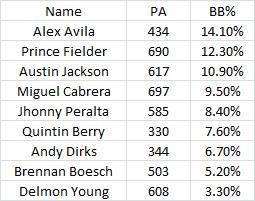
Let’s try this with the 2012 Tigers (min. 300 ABs):
By walk rate (BB%), this is how the Tigers look.
By O-Swing% (swing percentage on pitches outside the zone):

By Z-Swing% (swing percentage on pitches in the strike zone):
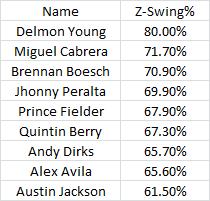
The information varies in each of these lists. There’s some correlation, but it’s not perfect. Taking pitches outside the zone makes it more likely that you walk, but lots of other things go into it. Cabrera swings at lots of pitches inside the zone, close to Delmon Young’s number, but walks a lot more than he does.
There’s so much that goes into each outcome that it’s easy to misinterpret the information. I’m pretty confident after looking at this information that Alex Avila is the more disciplined Tigers hitter, but there’s a case to be made for a couple guys for second place. And we haven’t even talked about what our eyes tell us.
When asking tough questions, instead of looking for the best number, let’s look for all the numbers. We’ll be better off.
Tigers Decide Andy Oliver’s Time Has Come…To Go
It wasn’t that long ago that Andy Oliver was a top prospect in the Tigers farm system. But things change, and now Andy Oliver is a Pittsburgh Pirate and Ramon Cabrera is a Detroit Tiger.
The trade happened earlier today as the Tigers decided a change of scenery would be good for Oliver and got back a catcher who will start the season in Toledo. I don’t know much about Cabrera but the scouting report I received on him from Mark Anderson says that he has “an average glove overall” and “some modest hitting ability.”
It appears that Cabrera will be a useful depth guy for the Tigers behind the plate and can fill in on the big league roster if Avila or Holaday get hurt. The real story here is Oliver.
Just a couple years ago, he looked like someone who had a shot to really contribute to a big league rotation. But that hope faded. Slowly he started to look like a reliever. Then maybe nothing at all.
Oliver’s problem was that he lost command and then he lost his slider. A lefty who can throw mid 90s with a solider breaking ball is a big league starter. A lefty who can’t find the zone and only has a fastball is probably a LOOGY. That’s where Oliver is right now.
This is a story of the Tigers not cashing in on Oliver when his value was higher. I thought they should have traded him two offseasons ago. It’s easy to look back now and say that I’m right given that we know he hasn’t lived up to the potential. The Tigers wanted him to live up to it so they held on.
Today they let go.
Andy Oliver is the story of a prospect not panning out. It happens all the time. A great GM can see it coming and flip them for value before their stock tanks. That’s a very tough thing to perfect. Dombrowski did it perfectly with Andrew Miller. He didn’t do it with Andy Oliver. y with Andrew Miller. He didn’It happens all the time. A great GM can see it coming and flip them for Such is life.
Oliver has the raw ability to pitch, but doesn’t have the fine-tuned skill. I watch him a lot in Toledo and in his few stints in Detroit. The velocity from the left side is valuable, so he won’t have trouble finding someone to give him a chance, but I’m not convinced it’s ever going to happen for him.
That’s okay though. He’s still getting paid to play baseball for a living, even if he’s never going to be on top.
 New English D