Tigers Get Player They Need…At A Price

Joakim Soria is absolutely one of the players the Tigers needed. No doubt about it. They need at least two really good relievers and maybe a third in order to field a competitive postseason team. Soria fits the mold. He’s having a great year. He has a great track record. The projections love him. He seems to be back and healthy and has a $7 million team option. It’s a great pickup.
But the Tigers paid a very steep price to make this upgrade. They traded Corey Knebel and Jake Thompson to get him and while Knebel’s a reliever through and through, Jake Thompson is a very real pitching prospect. A lot of people peg him as a back end guy, but I know multiple rival sources who have seen him this year and thing a lot more of him. The Tigers gave away a future quality reliever and a future potential mid-rotation starter for a year and a half of a very good reliever.
That’s a high price. It’s not insane. It’s not crazy. But it’s a lot. I’d trade Knebel for Soria easily and I’d throw in more but I wouldn’t want to add Thompson. I get why the Tigers did it. They need a reliever badly. It makes sense and it could be a big upgrade.
But there’s a problem. They don’t just need one reliever. They need two or three relievers. In order to win this year, they need another great reliever and they fired off two of their best bullets. They’ve taken two important prospects and sent them away. Which is fine in principle, but if you’re making this trade, you have to make more. This trade only makes sense if you’re really going to go all in.
Joakim Soria doesn’t make this a World Series winner. You need two Sorias, at least. So if you’re giving up Thompson and Knebel for Soria, you have to give up Ray for someone else. Or Crawford. Or Moya. Whatever it is. If you’re doing this, you’re going for it.
That’s fine, but you can’t do it halfway. Soria’s going to make this team better, but he makes the 2016-17 Tigers worse. That’s a worthwhile tradeoff, but only if it really makes the 2014 Tigers better.
This is the window, so don’t let it close without adding more.
How Was The Game? (July 23, 2014)
Diverse.
Tigers 11, Dbacks 5
This game was essentially a three act play. The first act featured a good Anibal Sanchez (18 GS, 107 IP, 3.45 ERA, 2.95 FIP, 2.7 fWAR) and very potent Tigers bats. Before you knew it, the Tigers were in control of a 7-0 game, largely thanks to basically everyone in the lineup. Act two featured Anibal Sanchez allowing baserunners and runs, to the tune of 11 hits and a walk, totaling five runs of damage across 6.1 innings. Job came in to bail him out, which was great, but then Ausmus didn’t utilize the double switch, meaning that he had to hit for himself in the 8th inning. Fortunately, the Tigers added on four runs anyway, largely on a Cabrera home run, and Joba became superfluous in Act Three. So while Tuesday night was very disappointing, Wednesday was very appointing(?). The team will head further west to face the Angels and Mike Trout on Thursday with Max Scherzer (20 GS, 132 IP, 3.34 ERA, 3.20 FIP, 2.8 fWAR) taking the ball in game one.
The Moment: Joba Chamberlain batted.
How Was The Game? (July 22, 2014)
A giveaway.
Dbacks 5, Tigers 4
Rick Porcello (19 GS, 126.1 IP, 3.42 ERA, 3.93 FIP, 1.8 fWAR) gave up three runs on Tuesday night, but they were isolated events. For most of his seven innings, he was in complete control, allowing just five hits and no walks while striking out five. The Tigers got a run in the first and a run in the third to set up the 8th inning of joy and doom. The Tigers teed off on the Dbacks bullpen, culminating in a bases loaded single by Torii Hunter that gave the Tigers a 4-3 lead. Ausmus wanted to add on and he pulled Porcello for a pinch hitter with two outs and the bases loaded (at 77 pitches and a tired Joba). On average, the value of pinch hitting is something like 0.15 runs or a touch more, but the drop off to the Tigers terrible bullpen is likely more significant. Naturally, Coke walked two lefties, Alburquerque walked another, and then Krol allowed a single to give the Dbacks the lead and the win. Once again, the Tigers were thwarted by having bad relievers and a manager who isn’t a great tactician. They’ll try to take the series anyway on Wednesday behind Anibal Sanchez (17 GS, 100.2 IP, 3.22 ERA, 2.87 FIP, 2.6 fWAR).
The Moment: Torii Hunter singles up the middle to plate the tying and go-ahead run in the 8th.
Are The Tigers Better or Worse Than Last Year?
This question came up on Twitter the other day and I think it’s instructive. A follower asked something to the effect of “do you really think last year’s team was better than this year’s team?” Based on the context of the conversation, he clearly though the 2014 version of the team was better than the 2013 version. My answer was the exact opposite. The 2013 Tigers were better. I’m almost positive of this fact.
Which brings us to a sticking point. How should we judge the quality of a team? Simple wins and losses are a reflection of how well a team performed in a set of 162 individual contests, but there are all sorts of things that can happen over 162 games that can muddy the waters. Yes, you would rather win 95 games with a team that’s supposed to win 86 than win 90 games with a team that’s supposed to win 100, but that’s not an interesting question. The interesting question is which team was better. One team won more games, but that doesn’t tell the whole story. I’d rather have a team with the best offensive and starting pitching in the league by a lot that loses close games because they have a bad closer than a team that is middle of the road in offense and pitching but never blows a save.
Let’s look at some numbers!
Winning Percentage
2013: .610
2014: .573 (through 96 games)
Right off the bat, the 2013 Tigers were more successful! So even if you disagree with me about the value of actual wins and losses in a talent evaluation capacity, 2013 was better.
Runs Per Game
2013: 4.9 R/G, 3.8 RA/G
2014: 4.7 R/G, 4.3 RA/G
2013 Tigers way ahead.
Position Players:
2013: 113 wRC+, 26.2 WAR
2014: 111 wRC+, 14.4 WAR (24.3 WAR pro-rate)
Starting Pitching
2013: 3.44 ERA, 3.12 FIP, 25.4 WAR
2014: 3.84 ERA, 3.74 FIP, 9.9 WAR (16.7 WAR pro-rate)
Bullpen:
2013: 4.01 ERA, 3.61 FIP, 4.1 WAR
2014: 4.36 ERA, 3.93 FIP, 1.0 WAR (1.7 WAR pro-rate)
Projected Record:
91-71 via FanGraphs with both FanGraphs and Baseball Prospectus suggesting they’ve actually over-performed in the W/L column to date. Last year, Baseball Prospectus’ models suggested the Tigers actually played like a 104 win team, despite winning only 93. In other words, last year they under-performed and had a better record than we expect an over-performing 2014 team to achieve.
I don’t at all mean to single out Eric. I mean this as a demonstration of principles. The 2013 Tigers were a better team in pretty much every way (maybe a wash defensively?) we measure performance and likely too in the W/L column. This wasn’t difficult to see coming. They made moves that made them worse. Some were out of necessity, some were out of foolishness, some were gambles. They hit on Joba, JD Martinez, and Kinsler. They whiffed on Fister, Nathan, and kind of Davis.
I’ll be perfectly honest and remind you what I said at the time. Joba was a fine risk, but not one that I thought would be a difference maker. Wrong. I don’t think I wrote about JD, but a minor league deal is never a mistake. Loved the Kinsler trade, but did not expect it to work out this well. No one did. Hated the Fister deal, was confused why you would sign Nathan but didn’t think it would be horrible, and felt like the Davis move was a fine gamble but also slightly strange in context.
Essentially, the Tigers got worse. Some of it was unavoidable. Verlander, Sanchez, and Scherzer simply weren’t going to repeat their performances. Iglesias got hurt. Hunter is aging. The Tigers were going to be worse if they kept the same roster together, but they didn’t just do that. Some moves worked, but on balance it was a downgrade. It’s probably not going to cost a playoff trip, but it might cost them in October. Thankfully, Dombrowski has a week or so to plug the holes. And it’s time to to empty the chamber because they’re never going to have a better chance with this core.
How Was The Game? (July 21, 2014)
Late, but successful.
Tigers 4, Dbacks 3
Justin Verlander (21 GS, 135.2 IP, 4.84 ERA, 4.07 FIP, 1.9 fWAR) came out of the gate looking much better than he did during the first half of the season, but even good Verlander allows three runs and nine baserunners across 6.2 innings in 2014. It wasn’t vintage Verlander, but it was plenty good enough Verlander. The Tigers got their runs on a two run blast from Hunter in the 2nd and a solo shot from Jackson in the third, but after the Dbacks rallied back it was Miguel Cabrera who singled off the wall in center to plate another, even though he was thrown out on what should have been a sure double. Alburquerque escaped the 7th, Joba handled the 8th, and Joe Nathan pitched a reasonably uneventful inning, by his standards, to nail it down. Rick Porcello (18 GS, 119.1 IP, 3.39 ERA, 3.95 FIP, 1.7 fWAR) will get the ball for game two.
The Moment: Holaday picks off Inciarte in the 7th.
How Was The Game? (July 20, 2014)
All Smyles.
Tigers 5, Indians 1
Drew Smyly (16 GS, 94.2 IP, 3.80 ERA, 4.43 FIP, 0.8 fWAR) hadn’t exactly been cruising through recent starts, but he definitely found a groove today, twirling seven innings of one run baseball, allowing six runners and striking out six with the only run coming on a solo shot. The breaking ball was as good as it’s been in some time and his offense backed him with four reasonably early runs and one late courtesy of leadoff hits by Jackson and Kinsler paired with two fly outs and then a two runs shot from Hunter in the 4th. Castellanos scored Hunter in the 8th with a double way up the RCF gap to make it a 5-1 game. Nathan came on in the 9th and didn’t even allow a baserunner! The Tigers will head west having salvaged one with Justin Verlander (20 GS, 129 IP, 4.88 ERA, 4.02 FIP, 1.8 fWAR) meeting the Dbacks on Monday.
The Moment: Hunter gives the Tigers some insurance with a two run blast.
How Was The Game? (July 19, 2014 – Game 2)
Predictable.
Indians 5, Tigers 2
Max Scherzer (20 GS, 132 IP, 3.34 ERA, 3.20 FIP, 2.9 fWAR) was supposed to calm things down, save the bullpen, and get the Tigers back on track in the nightcap, and he only sort of did that. Max managed to allow just two runs (both solo HR to Chris Dickerson, what?!), but he walked four and only struck out four and labored through 5.2 innings in almost 120 pitches. The offense was good enough to even the score, capped off by a huge triple from Jackson in the 7th, but the Tigers gave Joe Nathan a tie game and you can’t give Joe Nathan anything resembling a close game at this point. He allowed two runners and was asked to IBB Brantley before allowing a bases clearing ball up the gap from Santana to make it 5-2. Torii ripped a double in the 9th, but the Tigers were unable to rally back as they lost the DH, the first three in the series and their fourth in a row. They will try to salvage one with Drew Smyly (15 GS, 87.2 IP, 4.00 ERA, 4.46 FIP, 0.7 fWAR) going Sunday.
The Moment: Jackson swats a game-tying triple in the 7th.
How Was The Game? (July 19, 2014 – Game 1)
A nice moment, even if it didn’t end well.
Indians 6, Tigers 2
Drew VerHagen (1 GS, 5 IP, 5.40 ERA, 3.34 FIP, 0.1 fWAR) kicked off his MLB debut in style with a pair of strikeouts and four to his first six batters, and he was in great shape through four. The Indians got to him a little in the 5th, picking up three runs before pulling him in favor of the pen for the final four innings. The Tigers grabbed a run of their own in the 5th but the bullpen gave a run back in the 7th and two more in the 9th to set up a 9th inning confrontation with Corey Kluber looking for a complete game. The Tigers grabbed a run off Kluber and chased him when Castellanos doubled but the Tigers could not complete the rally. Luckily, the Tigers will get a chance to turn things around quickly with Max Scherzer (19 GS, 126.1 IP, 3.35 ERA, 2.96 FIP, 3.1 fWAR) on the hill in the nightcap.
The Moment: VerHagen fans the first two hitters he faces in his MLB career.
How Was The Game? (July 18, 2014)
Two-thirds great.
Indians 9, Tigers 3
After a few weird outings, Anibal Sanchez (17 GS, 100.2 IP, 3.22 ERA, 2.86 FIP, 2.7 fWAR) looked much more like himself during the first game from the All-Star break, unfortunately the Indians attack came all at once. Sanchez cruised through the first six innings and even after allowing three singles and a walk without registering an out in the 7th, he still finished the day with seven strikeouts, one walk, and six hits to go with his four runs. The strikeouts were an excellent sign and the only thing that hurt him was that four of the seven baserunners clustered together and then, you know, the bullpen opened the door for the remaining runners. The Tigers threatened heavily in the 3rd but scored only one run and grabbed two in the 4th, but didn’t add on or rally back to mitigate the Indians 7 run 7th. The Tigers won’t have long to stew over this one, as they’ll play two on Saturday with Drew VerHagen (MLB Debut) making his MLB debut in Game 1.
The Moment: Jackson makes a tremendous running catch over his shoulder in left center.
Where Have Miguel Cabrera’s Home Runs Gone?
I know there’s great irony in posting such a story the day after Miguel Cabrera hit a home run in the All-Star Game against Adam Wainwright in a very difficult park in which to hit home runs, but it’s a necessary post and I’m sure glad I didn’t run it on Tuesday right before Cabrera launched the ball deep to left field.
So far this season, Miguel Cabrera has hit 14 HR in 387 PA. For most human beings, that’s a very nice first half and puts him on pace for close to 30 over a full season. But Miguel Cabrera is Miguel Cabrera. He’s only hit 30 or fewer bombs in a season twice. Don’t get me wrong, he’s still on pace for an excellent season, but the absence of home runs is interesting, even if it isn’t concerning. Right now, he’s hitting a home run in about 3.4% of his trips to the plate, which is the lowest mark since his half season callup in 2003. And plate appearances probably isn’t the right denominator here because we’re not really concerned about all of his trips to the plate, just the ones in which he puts the ball in play. His strikeouts are fine and his walks, while down compared to last year, are still within his career norms. Let’s look at home runs on contact:
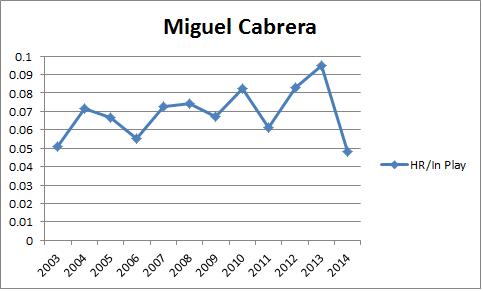
When Cabrera puts the ball in play, he’s hitting a home run about 5% of the time this year, compared to numbers that typically sit between 7 and 10 percent. His batted ball profile doesn’t seem to be much different and the actual frequency of hard contact remains pretty consistent. Although, there is some indication that the quality of contact on fly balls has diminished a bit this season, if you look at indicators like fly ball distance and other, less public, data.
So we can chalk most of this problem up to a much lower HR/FB%. And it is much lower this year than in the past:

Now what we want to know is if this low HR/FB% is a weird blip or something of an actual trend. It wouldn’t be shocking if Cabrera hit for a little bit less power this year while recovering from offseason surgery. We know he started slow, either because of the injury or because he needed extra time to get his swing back after it, but even since April 22, his HR/FB% is still just 14%, even though he has a 159 wRC+ in that time span.
Cabrera’s saving grace is that those home runs aren’t turning into outs, they’re turning into doubles. He’s on pace for more than 60 doubles and the projection systems think 57 is more reasonable. Either way, that’s a career high by a substantial margin. We often say that young hitters will see their doubles turn into home runs, well the opposite is true for Cabrera right now.
It’s always smart to bet on regression to the mean and that means Cabrera will be fine. Maybe he’s still healing, but those reports are kind of mixed. I don’t think there’s an obvious answer to this question. He’s not enough different to be worried but things are different enough to take notice. Let’s peer into his ISO, and specifically notice the way inside pitch.
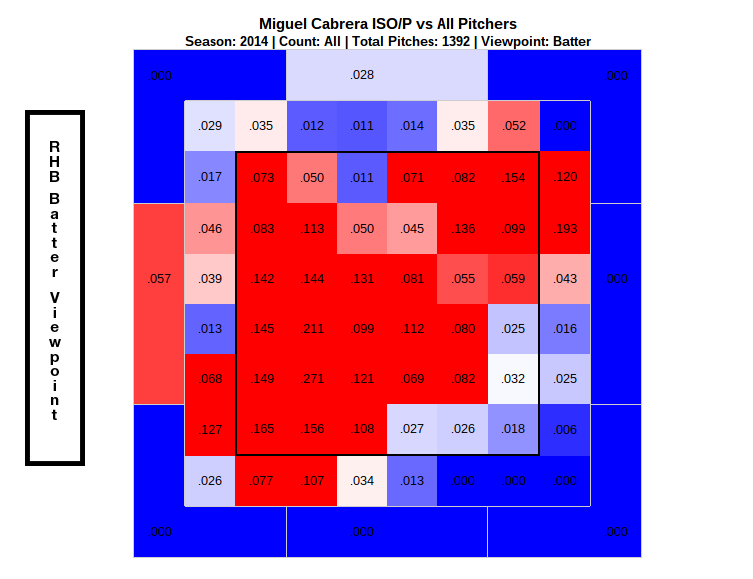
He’s not hitting for as much power on pitches just off the plate inside and that used to be his calling card. That might be a sign of aging, a sign of the injury, or random noise. It’s too early to say, but let’s keep an eye on it and see if pitches attempt to exploit it…and if he makes them pay.
 New English D