Where Miguel Cabrera Stands On The Eve of 400

I was born one day before Miguel Cabrera turned 7 years old. Maybe his parents could tell by that age what their son would grow to become, but his superhuman talent probably wasn’t evident by mid-April 1990. On that day, 22 men could claim to have hit 400 home runs in the major leagues. The list started with Aaron and ended with Snider. Tiger great Al Kaline was one dinger behind, at 399. A lot has changed since then.

Last night, Adrian Beltre became the 52nd player homer 400 times. Sometime in the next few days, Miguel Cabrera will become number 53.
In the last 25 years, the tools of baseball analysis have improved dramatically. Home runs are still the best thing a hitter can do in the box, but we have a much better understanding of how to best evaluate performance beyond homers, RBI, and batting average. And we’ve also lost a little love for home runs and round numbers in general in the aftermath of the steroid era. The 400 HR club is 241% as large as it was the day I was born. Whatever the cause, whoever is to blame, hitting 400 HR isn’t a particularly awe-inspiring feat anymore. It’s a milestone en route to bigger ones.
Miguel Cabrera’s been a great player virtually since the moment he arrived in the majors. He walked off in game one and won a World Series before he played on Opening Day. In his second full season, he was a star. He’s fallen short of 5 fWAR just twice in his career. In both of those seasons, he was still 30% better than the average hitter.
We all know about Cabrera’s defensive limitations. At his size, it’s quite difficult to be a great defensive player, and that’s going to keep him from winding up as one of he best players ever. He’s ranged from average to awful in the field, and he’s probably going to be a designated hitter by the end of the decade. But these are reasons that Cabrera falls short of Bonds and Mays and Rodriguez. He’s not Babe Ruth or Ted Williams, but he’s been among the best players of his era entirely on what he can do at the plate.
There are actually a lot more players (30-40) who have hit better than Cabrera through age 32, where he sits at this moment. He has a 152 wRC+, which is an era and park adjusted batting statistic. That’s among the best marks ever, but guys like Piazza, Ramirez, Bonds, Bagwell, Votto, Pujols, Thomas, and Trout (still 23) have been better with the bat through 32.
Cabrera is known for his mix of hit and power tool, but if you look only at the dingers through age 32 (Cabrera has five months left at 32), he’s already 15th on the list and should finish 2015 at 9th.
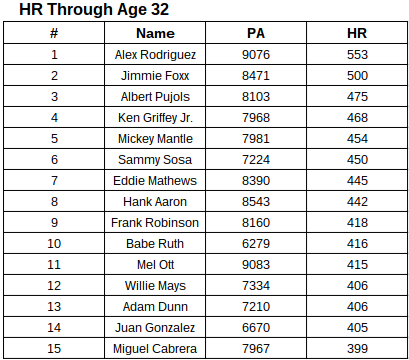
Cabrera’s been injured a lot over the last few seasons and while he hasn’t spent time on the DL, his body has been breaking down and limiting his power for periods of time. Since 2010, he leads the league in fWAR and is 6% better than the second best hitter in the league with a 171 wRC+ entering Saturday. There’s no question that Trout has become the player of the 2010s and that Pujols was the player of the 2000s, but Cabrera’s carved himself a section of the game spanning both reigns despite playing on one leg for months at a time.
I think Cabrera, as a player, is both vastly overrated and vastly underrated, depending on the day. Rod Allen talks about Cabrera as one of the best right handed hitters of all time. He’s not even the best right handed hitting first baseman to debut since 2000. People talk about him like he’s the best player in the game, but Trout and McCutchen and company are probably better right now. Cabrera’s body of work is impressive, but despite his excellent ability, the gap between Cabrera and Trout simply as hitters is virtually non-existent already.
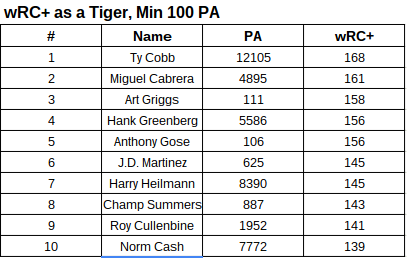
But on the other side of this, the fact that we’ve watched Cabrera for seven plus years now on a regular basis has also led to us to a state of complacency. Sure, Cabrera isn’t the best player to ever play the game but 60 WAR and a 152 wRC+ in about 8,000 PA is incredible. The years in Florida limit is raw Tigers value, but he’s 12th among Tigers position players in career WAR as Tigers. And maybe most importantly, in a Tigers uniform, only Ty Cobb has been a better hitter per PA among batters with 100 PA.
There are all kinds of reasons not to care about HR number 400. It’s only important because it’s a round number, and the home run list is diluted by a massive increase in the number of home run hitters in the last twenty years. There’s more to hitting than home runs and there’s more to baseball than hitting. Cabrera is simultaneously great and ordinary.
We’re used to him. I don’t even blink when he hits a pitch nine inches off the inside corner for a home run, even though no one else does that with the frequency he does. His ability to make adjustments against a pitcher within a game and hit the ball hard no matter where it’s pitched is nearly unrivaled.
Cabrera is obviously the best Tiger of my lifetime and he’s going to be the first I watched to go into the Hall of Fame (shakes fist at voters for Tram and Lou). Yet there’s something so ordinary and expected about his greatness that tempers it. People will get used to anything, I suppose. Just like how I see Giants fans complaining about their team on Twitter as if they haven’t won three championships since 2010.
We’ll probably have a better appreciation of Cabrera long after he’s gone. Ironically, given his huge contract that extends into era of flying cars, we’re going to watch him decline and as he starts to fail, sometime in the next decade, we’ll call back to the days when he dominated pitchers so effortlessly.
To say Cabrera’s erred off the diamond would be an understatement. Sports teams and cities tend to rally around their athletes even when the athletes are at fault. They’ll boo the crap out of a guy who strikeouts too much, but domestic altercations and drunk driving are struggles to overcome rather than crimes for which to atone. Six years ago, the gifted slugger found himself drunk and fighting with his wife during the final week of a playoff run. A year and a half later, he was getting pulled over with a blood alcohol level as high as his isolated power.
He’s largely gotten a pass on both incidents, at least publicly. The media and the fans forgave him or didn’t care. The organization has always played the card that Cabrera had problems and they were going to help. Whether he would say so or not, he had a problem with alcohol abuse and it led him to make bad, criminal choices. It took two rock bottom moments, but he started looking up and made changes.
As a baseball player, Cabrera’s the best Tiger of the era. He’s probably given too much credit for his geniality in light of what he’s done outside the chalk, but there’s also something to be said for actually turning your life around rather than paying lip service to it until everyone forgets.
Cabrera’s 400th home run will be a brief moment of celebration on the path to 500, and probably 600. He’s going to play for about ten more years and hitting another 200 HR is only going to require 20 a year the rest of the way. We won’t look at 600 the same way when Cabrera gets there as we did when Bonds crashed the club, but it’s still an impressive accomplishment.
The legacy of Cabrera is probably already cemented. His early 2010s are going to be the years we remember when it comes time to eulogize his career, but the back end of greatness is often the difference between ordinary and remarkable. The all-time greats are that way because they didn’t bend to father time. Cabrera’s going to hit number 400 shortly as the capstone of his peak, but how you climb down the mountain matters too.
How Was The Game? (May 15, 2015)
Impressive.
Tigers 10, Cardinals 4
As far as opponents go, they don’t get much tougher than the Cardinals. On Friday night, the Tigers didn’t seem to notice. A Cespedes home run was the difference early and Shane Greene (8 GS, 47 IP, 4.21 ERA, 3.52 FIP) gave the Tigers five solid innings, but the lion’s share of the action came after he left the ball game with some elbow pain. They grabbed an extra run in the 5th and then the offense unloaded in the 7th inning with dingers from Cabrera and Martinez. They added a run in the 8th but two 8th inning runs from the Cards brought it within two. The bats responded again with five hits and four runs in the 9th to make a clear impression on the remaining fans in St. Louis. The Tigers will spend the evening fretting about Greene’s health, but there’s no fretting about the way the club has played over the last couple of days. David Price (7 GS, 46.1 IP, 3.30 ERA, 3.27 FIP) will look to keep it going on Saturday.
The Moment: Cabrera and Martinez go back to back.
How Was The Game? (May 14, 2015)
A response.
Tigers 13, Twins 1
The Tigers got a very nice outing from Anibal Sanchez (8 GS, 51 IP, 4.76 ERA, 3.69 FIP) on Thursday, but they didn’t need it. Not even a little bit. Huge days from Gose, Cabrera, Castellanos, and Holaday supplemented contributions from Kinsler and Martinez to basically dominate the Twins on getaway day. They scored in 6 of their 8 innings, include three 3 run innings to lift them to a series victory. The bats shined, Iglesias made a crazy play, and Sanchez cruised. All was right in the world. Shane Greene (7 GS, 42 IP, 4.71 ERA, 3.48 FIP) goes Friday in St. Louis.
The Moment: Cabrera caps a 2-homer day.
How Was The Game? (May 13, 2015)
Uninspired.
Twins 6, Tigers 2
On Wednesday night, the Tigers offense continued their sputtering streak and the pitching simply wasn’t able to offset the lack of run scoring. Kyle Lobstein (6 GS, 35.1 IP, 4.33 ERA, 3.64 FIP) gave up a 1st inning dinger to Torii Hunter and then got tagged for five runs on five hits and a walk in the 3rd before giving way to the bullpen, who actually managed to shut the door the rest of the way. While the pen gave them a chance to hang in there, the Tigers only cashed in on a pair of runs in the 6th and failed to keep it going in the 7th, allowing the Twins to even the series. The rubber match will be Thursday, with Anibal Sanchez (7 GS, 43 IP, 5.44 ERA, 4.16 FIP) toeing the rubber.
The Moment: Cespedes guns down Dozier in the first.
How Was The Game? (May 12, 2015)
Closer than it needed to be.
Tigers 2, Twins 1
The Tigers will say after this one that they struggled to get things going offensively against a pitcher they should have been able to get after. They had some good contact but they strung nothing together against Gibson, scoring only on a JD Martinez homer to right in the 4th. Alfredo Simon (7 GS, 44.1 IP, 3.05 ERA, 3.53 FIP) got an introduction to facing the Twins, pitching into the 8th inning while allowing just one run. He had some stressful innings, but dispatched the problems without incident. It took an extra inning of baseball, but Anthony Gose doubled and Ian Kinsler singled to continue their dominance of the Twins in 2015. They’ll go for another series win with Kyle Lobstein (5 GS, 33 IP, 3.00 ERA, 3.24 FIP) on the hill Wednesday.
The Moment: Ian Kinslers pokes one into right center to end the game.
How Was The Game? (May 10, 2015)
A letdown.
Tigers 1, Royals 2
After splitting the first two games in the series, the Royals and Tigers decided to split the first eight innings of this one as well. The Royals got their run on two doubles to open the 2nd inning, but then Shane Greene (7 GS, 42 IP, 4.71 ERA, 3.50 FIP) didn’t allow a base runner until the 7th inning and looked a lot more like the early season Greene than the last couple of starts-Greene. The Tigers got their run in the 3rd on a single by Gose and a hilarious error by Infante followed by a single from Kinsler to plate the runner. It was all pitching and no hitting the rest of the way, all the way to a rain delay in the 9th. The Tigers loaded the bases in the bottom half but couldn’t score and surrendered a run in the 10th. In the home half, Romine singled and Gose and Kinsler walked trying to sacrifice before a double play, walk, and strikeout ended it. Alfredo Simon (6 GS, 36.2 IP, 3.44 ERA, 3.88 FIP) on Tuesday.
The Moment: Gose and Kinsler both walk trying to bunt.
What Happened To David Price’s Strikeouts?
Make no mistake, David Price hasn’t had a bad start to the season. As we speak, he has an 80 ERA- and 82 FIP-, both of which are well above average despite that nasty hiccup against the Yankees on April 22nd. Price isn’t walking many hitters, he’s not giving up dingers, and his .297 BABIP is just fine. His .291 wOBA allowed is right in line with his career numbers and what he did last year. The results aren’t a problem for Price, but one thing is: what happened to his strikeouts?
Now of course, he’s only about 20-25% of the way into his season and things can certainly change as the season wears on. Right now, Price has a 16.9% strikeout rate, which is 10% down from his career high a year ago and about 5% below his career average. We also know that it doesn’t take that long for strikeout rate to settle in during a season, so the fact that he’s only punched out 17% of the batters he has faced is a little bit of a concern. No one is panicking, but it’s worth exploring a bit.
If you assume last year was a bit of an aberration and that he’s a true talent 22% strikeout guy, he’s 10 strikeouts behind where he should be. If you believe in the 27% rate, he’s more like 20 strikeouts off the pace. Either way, it’s a non-trivial amount, but it’s not so big that you’re automatically assuming it’s a permanent problem.
Hitters are making a little more contact overall, but the key is that batters are swinging more at pitches in the zone and less often at pitches outside the zone. In other words, batters are making better decisions about when to swing against Price. He’s typically been around average when it comes to swinging strikes, although those ticked up a bit last year, but he’s also been quite good in his career when it’s come to called strike rate. No one got more called strikes than Price last year and among qualified starters, only Bartolo Colon had a higher percentage of his taken pitches go for strikes. This year, that rate has Price around 37th in the league instead of second, which backs up our O-swing/Z-swing observation.
Particularly, with two strikes, he’s getting 10% fewer called strikes with about the same swing rate. In other words, they’re laying off the two strike pitches outside the zone and swinging at the ones inside the zone. What’s going on here?
From Brooks Baseball, here’s his pitch usage:
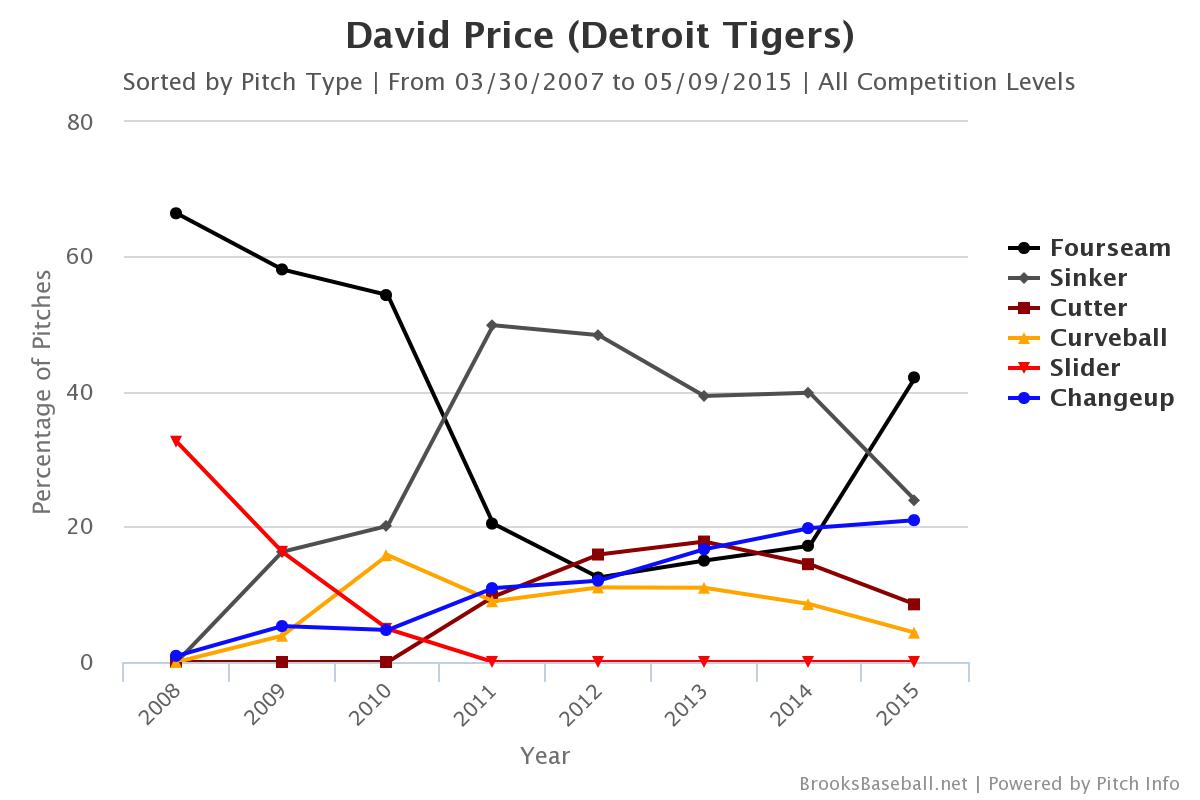
He’s always been a fastball/changeup guy who threw occasional breaking pitches, but this year, he’s relied much more on his four-seam fastball compared to his two seam and cutter. And if you’re wondering about classification, Brooks does hand tag all of the raw data, so it’s not like PITCHf/x is just confused.
If Price is going to the four seam more often, it wouldn’t shock me that batters are making better swing decisions because the pitch moves less and is less likely to slide in or out of the strike zone. If you look at the raw data, they are distinct pitches, especially the cutter. There’s no mistaking a Price cutter for a four seam fastball, and even the two seamer has a good bit more movement.
Again, the results have been fine for Price, so it’s not as if he should be looking to make lots of adjustments, but it is odd how much he’s using the four-seam fastball this year compared to the last four seasons of his career.
My first hunch was that the Tigers changed his approach, but their big thing has always been the changeup and they had him throwing a bunch of those last year. In August and September of 2014, he was throwing his two-seamer and cutter like normal. And then 2015 came and he stopped. In fact, it’s gotten more pronounced as the year has gone forward.
Without being in Price’s head, we can’t really know for sure why he’s started favoring one of his fastballs more than the other, but it’s seemed to track with a decrease in strikeouts through fewer called strikes. It doesn’t necessarily portend a problem for Price, but it is a noteworthy change in his game plan without an obvious explanation.
I could speculate about what I think is going on, but it would all be guess work and that’s not really my cup of tea. I do think it’s interesting that Price went from a guy who threw mostly two-seamers and cutters to a guy who throws a ton of four-seamers coming off his best season as a professional. So far it hasn’t hurt him, but if batters get wise, a four-seamer is usually easier to square up.
This offseason, I came down in favor of a Price extension, in part because I believed in the strikeouts. Now that he’s lost them and is pitching differently, I’m a little spooked. It’s not so much that he’s doing something different, it’s that it’s hard to figure out what led him to make that choice. As with anything, more data will help clear things up, but it’s definitely something to watch as the season wears on.
How Was The Game? (May 9, 2015)
Deflating.
Royals 6, Tigers 2
After walking off on Friday, the Tigers got off to a rocky start from which they could not recover on Satuday. Anibal Sanchez (7 GS, 43 IP, 5.44 ERA, 4.15 FIP) gave up a home run on the first pitch of the game and then another run two batters later. The 2nd inning wasn’t any better, as the Tigers found themselves down 4-0 before they batted a second time. Each team added two runs after that, and the Tigers saw some signs of life from Victor Martinez, but they couldn’t get to Guthrie the way they should have and Sanchez couldn’t hold the Royals off the board. We got to see a great throw from Cespedes and Alburquerque only allowed one base runner, if you’re looking for the positives. It’ll be Shane Greene (6 GS, 34 IP, 5.56 ERA, 3.74 FIP) Sunday to win the series.
The Moment: Castellanos triples to right center.
How Was The Game? (May 8, 2015)
Backwards.
Tigers 6, Royals 5
After splitting a four game set last week, the Tigers kicked off the homestand by surviving the Royals on Friday night. David Price (7 GS, 46.1 IP, 3.30 ERA, 3.29 FIP) got hit around a bit and then left the game in the 7th after stepping on a bat while backing up the plate. The Tigers got most their runs in a big second innings which featured five hits and a walk and gave all four of those back in the 4th inning. The Royals took the lead in the 7th and the Tigers tied it up in the bottom half, making it a bullpen game against a team whose bullpen you don’t want to test. Fortunately, Gose led off the 9th with a double and Kinsler dropped down a bunt that wound up in right field, propelling the W. In addition to the back and forth, the Tigers got two of their four 2nd inning runs thanks to some sloppy plays at the plate from Sal Perez and some fine slides from Castellanos and Romine. The club will look to take the series tomorrow with Anibal Sanchez (6 GS, 37 IP, 5.11 ERA, 3.75 FIP) taking the ball.
The Moment: Gose rips a double to set up the walk off bunt-error chaos.
How Was The Game? (May 7, 2015)
A sign of progress.
Tigers 4, White Sox 1
Now a simple 4-1 win on getaway day might not get anyone that excited, especially after such an ugly loss on Wednesday, but there was one big thing that happened on Thursday that you can’ ignore. Granted, Kyle Lobstein (5 GS, 33 IP, 3.00 ERA, 3.23 FIP) had a terrific day and the bats tacked some runs on against the Sox, but the story of this game was Brad Ausmus learning his lesson and going to his best reliever with four outs left in the game. Ausmus is a huge fan of the three inning save, but the Tigers don’t have a lot of good relievers and four outs is not really much harder than getting three. The best part is that Soria struck out every batter he faced, providing Ausmus with some much needed positive reinforcement. Hopefully, this will become a trend. Although if David Price (6 GS, 40 IP, 2.93 ERA, 3.01 FIP) has anything to say about it, Soria won’t be needed Friday against the Royals.
The Moment: Joakim Soria struts in to get the final four outs.
 New English D