Talking Tigers on Clubhouse Confidential

If you didn’t get a chance to see it, I joined Brian Kenny on Clubhouse Confidential to talk about the Fielder-Kinsler deal on Friday. Here’s a link to the conversation. If you’re looking for my initial take from the night of the deal, you can find that here, along with some thoughts about what this might mean about big contracts going forward.
We should also have some follow up analysis on Kinsler coming this afternoon or this evening.
Tigers Swap Fielder For Kinsler
That escalated quickly. Heading into the offseason the Tigers were expected to look to move Prince Fielder’s 7/$168M contract, but it didn’t look like there were going to be any takers. Fielder, even if he aged extremely well and bounced back to his pre-2013 levels, was barely going to be worth the contract. If he ages at a pretty normal clip and never goes back to his 5 win ways, we were looking at something like $70M in dead money. Maybe not anymore.
News broke on Wednesday night that the Tigers and Rangers agreed to a one for one swap of Prince Fielder and Ian Kinsler that gives the Rangers their power bat and frees up a spot for Jurickson Profar while the Tigers get salary flexibility and a new second baseman. The deal is amazing because if you squint really hard, it looks really good and really bad for both sides. It’s a challenge trade, but it’s also about position.
The Tigers had three guys who should be playing 1B and DH and now they have two. The Rangers had three middle infielders and now they have two. Kinsler will cost 4/$57M with a $10M/$5M buyout for year number five, plus something like $30M in cash. The Tigers are saving some cash in this deal that could prove to be extremely valuable when it comes time to extend Max Scherzer or Miguel Cabrera, but they’re also probably straightening out their defensive situation. Cabrera can go back to first where he belongs and Nick Castellanos can get into the lineup a little easier. Maybe Peralta gets back on the radar. It’s too soon to tell.
Kinsler had an insane 7 win peak in 2011, but looks a lot more like a 2-3 win player going forward. He’s a league average or slightly better bat with a history of running the bases well. The defense is a bit unclear because DRS loves him and UZR thinks he’s meh. Either way, you’re looking at solid player who is probably just a bit overpaid at $16M per season, plus however you want to allocate the $30 million
This trade has moving parts. If Kinsler is a 2 win player at 2B, Cabrera moves to first and is league average at the position defensively, and then the Tigers use Castellanos at 3B for about 2 wins, you’re looking at something like 11 wins for something like $40-44M. Re-signing Infante for $10M would put them somewhere around 12-13 wins for $54M. That’s a small improvement financially especially if it softens the risk later on in the deal.
I think this trade makes the Tigers worse in 2014, but it also gives them more financial resources to get better. They’ll save a few extra million that they can spend on a LF/RP/3B and they’re much better off in later years of the deal. Kinsler doesn’t look like a great player, but he’s good enough to probably make this work.
What we don’t know is how much of this momentum towards a deal came from the comments Fielder made after the season and his performance in the postseason. If the Tigers traded him because there were hard feelings, this is silly. If they traded him to save a little extra money that could be better allocated, it looks a lot better.
To be perfectly honest, I don’t have a strong opinion about this move. I think it makes a lot of sense for Texas and it’s a giant freaking question mark for the Tigers. Fielder probably bounces back in 2014 and beyond, but the trade saves them more money than it is likely to cost them in overall on field value. It’s a smart long term deal that might bite them in short run. Which means we really can’t judge this deal until we know how Dombrowski is going to spend the savings. That’s the key. Saving money is good, but you save that money so that you can spend it elsewhere.
I enjoyed rooting for Fielder and watching him slide, and had absolutely zero problem to his comments after the postseason ended. I’m sorry to see him go, but happy to welcome Kinsler. It’s hard to tell if this is an overreaction or a smart calculation, which is what makes it so interesting. Sorry to leave you hanging, but I don’t know what this one’s going to end. This won’t be the last thing I write about it, but my initial take is that this is probably going to work out for the best.
Brad Aumus’ Abraham Lincoln Impression
Stay with me here. This is going to be short and to the point. Brad Ausmus is pulling an Abraham Lincoln move right now and it’s worth noting. I’m not comparing the two, I’m saying Ausmus is borrowing a leadership tactic at which Lincoln was very skilled. This week, after hiring Matt Martin to be his defensive coordinator, Brad Ausmus told the Free Press that Martin is “a baseball guy” and “not a number cruncher” and “not a sabermetrician.” The manager doth protest too much.
There are two obvious points here, ones that Ben Lindbergh and Sam Miller argued on today’s Effectively Wild Podcast. First, Ausmus is going out of his way to sell Martin as “one of the guys.” This is Ausmus wrapping serious changes in a conservative cloth. This is Ausmus channeling Lincoln.
The key is that Martin’s job is weird and new and baseball players as a group tend to be slow to adapt. Columnists and writers tend to be slow to adapt. The Detroit media environment as a whole has been slow to adapt. If you start seeing the Tigers shake up defensive positioning – as Martin is likely to do – then Ausmus has already set the table to answer the questions. Martin isn’t some nerd who looks at spreadsheets, he’s a baseball guy with lots of “real” credibility. Lincoln was a master at this. Instituting massive change and convincing people it wasn’t massive change. That’s what this is. This position didn’t exist as a coaching position until three weeks ago when the Nationals created it. Now the Tigers and Angels have one too. More are likely coming.
What’s so great about the sales job is that it’s so obviously a deke. I doubt that Martin is programming is own algorithms, but he’s obviously going to be looking at the sabermetric data we’ve all been talking about for a while now. There simply isn’t another way to do that job. You can’t watch the last 100 at bats of every player on the opposing team and eye-ball the shift you need to employ. This requires batted ball data – the kind of data that sabermetricians use all the time.
I don’t know if Martin knows how to run and interpret regression analysis, but I’m fairly confident he knows how to employ the information readily available to all major league front offices. You don’t have to crunch the numbers to use the numbers, but you do have to get the players and local media to go along with it. That’s Ausmus’ job. Ausmus is selling the idea and Martin is implementing it.
They’re wrapping a newfangled position with fancy numbers in the cloth of an old set “of baseball eyes,” as Ausmus put it. The Tigers didn’t have this position a few days ago and no one had one in 2013. To suggest this isn’t a analytic innovation is silly, but that’s exactly how you have to sell it to get most people to buy in. That’s how you effectively institute change – by convincing people it isn’t really change at all. The hiring of Brad Ausmus looks better and better every day.
The Modernization Of The Detroit Tigers
It was pretty exciting to hear that the Tigers hired Omar Vizquel to be their first base coach and infield instructor given his reputation for strong defense and good instructional ability. With all due respect to Vizquel, his hiring was completely overshadowed when we learned today that the Tigers also hired Matt Martin to be their, I’m not making this title up, “defensive coordinator.” Oh boy.
The idea behind the position is pretty simple. Martin will be in charge of shifting and positioning the infield against specific hitters and will work with the advanced scouting group to prepare for this kind of decision-making. He’ll be joining with Vizquel to form a super-infield-defense-academy. In other words, the Tigers are about to get shifty.
This is big news for a couple of reasons. First, it’s one of the biggest leaps into the future that the Tigers have taken, at least in public, in many years. This is a big jump forward into analytics for the Tigers who have leaned much less on their statistical analysis team than many others in the industry. It also tells us that Ausmus is a believer as well because they wouldn’t bring someone like this in if the manager wasn’t on board. Leyland didn’t have a DC on staff, Ausmus does. This supports the idea I floated when Ausmus was hired that he’s going to be very receptive to analytic information when it comes to macrolevel decisions about his team.
But this hiring also tells us something else; it tells us the Tigers are going to get better. Well, it doesn’t really guarantee that, but if the Tigers are really going to go all-in here they stand to benefit more than almost any other club in the league. They have serious range issues in the infield and shifting is going to tighten up some of those holes. There’s no perfect answer, but if you look at the massive shifting integration the Pirates employed in 2013, it’s hard not to get excited. The Tigers probably won’t move that far, but we’ve seen the potential for BABIP payoff if a team is willing to make the move.
Finally, the specific hire looks extremely promising. I love the position in general, but Gabe Kapler, former Tiger and friend of the movement, speaks extremely highly of Martin.
Kapler also followed up with a link to something he wrote for Baseball Prospectus in August about Martin and coaching in general which lays the praise on pretty thick.
A couple of coaching hires doesn’t change a whole lot about the Tigers chances in 2014, but they send very positive signals about the future of the organization that seems to be growing more comfortable with modern thinking by the day. It’s too soon to tell what kind of impact these moves will have on the team, but they’re moves in the right direction. The Tigers have clearly had success without a lot of love for sabermetrics; imagine what they could do with even better information.
We’re about to find out.
Brief Thoughts On Being A Tigers Fan And Sabermetrician Today
I’ll keep this relatively short because I’m of the mind that these awards don’t really matter that much. They are a fun intellectual exercise and often an occasion for comedy, but they are of little real value beyond that. It’s nice to honor individual achievement with a plaque, but the fact that one player wins and one doesn’t changes nothing about the seasons or the players. It’s just a thing that an exclusive group of writers says.
But I also find myself in an interesting place because the player on my favorite team was the player who won the award that, in my mind, was handed out to the wrong guy. I’m thrilled for Miguel Cabrera personally and I’m really glad he had a great year. I’m thrilled for Scherzer, whom I didn’t vote for but considered a much better Cy Young candidate than Cabrera an MVP candidate. But on the other side, I’m a fan of smart, rational decision-making and good analysis and the MVP voting that helped Cabrera was lacking in that department. I have yet to see a rational case for why Cabrera was the AL’s best player. Or most valuable, if for some reason you think those two words mean different things. If you have a rational case for Cabrera, I want to hear it. Post it in the comments section or e-mail me at NewEnglishD@gmail.com. Maybe I’ll even publish it.
I’ve written about this race at Beyond The Box Score and I wrote about the same battle a year ago in these pages. I don’t have a lot else to say on the subject. Trout was better. The award should go to the best player. Therefore, Trout should win the award. Those three statements are important for this discussion. Let’s consider them briefly to illustrate a point.
Trout was better.
I touched on this above and in the first link, so I’ll keep this short. Mike Trout was the better baseball player in 2013. He had more plate appearances and was Cabrera’s equal when you combine baserunning and hitting and was much better on defense. A lot of the people who voted for Cabrera even admitted to this point. Okay, good.
The award should go to the best player.
This was the talking point this season. Lots of writers argued that in order to be valuable, your team has to be good because there’s no difference between the 70 games the Angels would have won without Trout and the 80 games they did win with him. That’s a silly thing to give out an individual award for, however. What is the value of handing out an award to the best player on a good team? Forget for a moment that the description explicitly says that the winner doesn’t have to come from a playoff team and just ask yourself this. Why would we want to give an award to the best player on a good team? What is that proving? That suggests that an individual award is contingent on the performance of one’s teammates, which means it isn’t an individual award at all.
Therefore, Trout should win the award.
If Trout is better and the award should go to the best player, then Trout should have won. That’s a little obvious, but also important to say. If we aren’t going to give the awards to the player who deserves to win, what’s the point of even giving out the award or caring about it at all?
—
So here’s the punch line. And this is going to sound strange. The fact that Cabrera won each of the last two MVP awards actually diminishes his accomplishments. I’m a Tigers fan before I’m a baseball writer and I’m actually more upset about this part of it than anything. The MVP has become a bit of a joke, so it’s less meaningful to me that he won it this year. It cheapens Verlander’s award, which I think was more justified. It’s a less prestigious award because of this process. I would be prouder of Cabrera finishing second in an award that matter than finishing first in one that doesn’t.
Several people have mentioned to me that I’m one of the few Tigers writers who sees this thing objectively. I appreciate that, but it also speaks to another important issue. Beat writers, many of whom are great and smart, don’t watch enough baseball to really provide a good vote. The Tigers guys know the Tigers, but they don’t stay up late watching the west coast games because they’re still busy covering the Tigers and going to bed so that they can cover them again. Part of the problem is that some writers are hopelessly lost, but a lot of them just don’t have the exposure to enough players because they don’t have the time. I think that’s another flaw in the system that isn’t any of the voters’ fault.
The rational analyst in me is unhappy with the result, but so is the Tigers fan. Cabrera didn’t deserve the award and the fact that he won anyway makes it less special as an institution. I’m not losing sleep, but I do wish we did a better job on things like this. I mean, we have to do something until they start playing again.
Sizing Up The Tigers Second Base Options
One of the strengths of the 2014 Tigers is that most of the 2013 version is locked up through at least the upcoming season. Seven of the nine starting position players and all five starting pitchers are under contract going into next season so the main focus will be on the bullpen and the bench. The two starting spots to consider are second base and left field. We covered left field a few days ago which means it’s now time to turn our attention to the keystone.
IN HOUSE CANDIDATES
The Tigers aren’t blessed with a lot of big league ready talent up the middle, so the two leading candidates are Danny Worth and Hernan Perez. I think both are perfectly capable of keeping their heads above replacement level thanks to solid to above average defense and good baserunning, but neither provides much of a boost offensively. Perez was seriously over-matched during his time at the plate in 2013 and gave us one of the most incredibly terrible swings of the year:
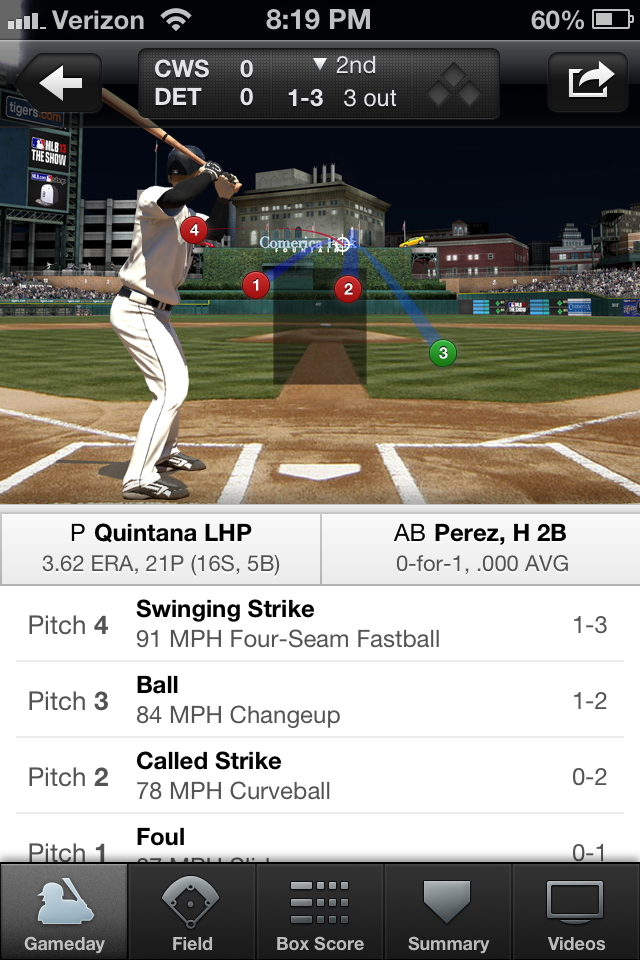
Needless to say, Perez might need some work. We know what Worth brings and I suspect he could offer 0.5-1.0 WAR if given the job. Not great options, but options that are good enough to keep you from doing something stupid.*
*Maybe not!
THE FREE AGENTS
So obviously, Omar Infante is the guy the Tigers are after. He’s coming off four straight seasons of 2.0+ WAR and just completed his career year entering his age 32 season. Something in the 2/20 to 3/30 range makes sense for both sides and the Tigers are likely to snatch him up if big spenders don’t drive up the price.
Only three other free agents make any kind of sense for the Tigers. First, is Brian Roberts – who doesn’t really make sense either. Roberts was great about four or five years ago and has struggled to stay healthy, but if you can get him for next to nothing, I’d be interested in the upside play.
Robinson Cano is the prize of the class and is likely to command something in the 8/200 range. He’s a 5-6 win player in the near future and a 3-4 win player a few years beyond that, so he’s a legitimate upgrade over Infante and the rest of their in house options. The price is quite high given the amount of money they have to allocate to Verlander, Fielder, Sanchez, and whomever they want to extend. There’s a way in which they can make Cano work financially, but it’s a Hail Mary. You’re talking about adding $20 million to the payroll over last year in addition to the arbitration raises and keeping that on the books long-term. I think it works if you’re willing to let Cabrera walk after 2015 or if you can find someone take the Fielder deal off your hands. The second option is tricky because you’d have to eat some money, which means it would be about $30 million per year for Cano compared to $20 million for Fielder. I’m not sure Cano is $10 million better than Fielder, but I’d consider going down that road if another team would let you.
The final free agent is Mark Ellis, who strikes me as the ideal Plan B if Infante walks. He’ll be cheap on a 1-2 year deal and can be counted on for 1-2 WAR with some nice defense in an infield that needs it. Not a sexy option, but one that will work.
TRADES
The only second baseman that’s an upgrade and could be on the market is Howie Kendrick. He’d work for me, but the prospect cost and salary seem high enough that Infante would be cheaper. I mean, if you can pry Matt Carpenter from St. Louis….hey wait this isn’t talk radio.
THE RECOMMENDATION
I thought about this a lot and there are four realistic scenarios. The first is to go in-house for free and punt on 2B offense. You have good glove men and the money can be spent elsewhere. Option two is re-signing Infante for $10-$12 million a year so you can keep the band together. Option three is to take a mild hit and go for Ellis at $6-$7M on a one year deal.
Option four is the big one, and I guess it’s not quite as crazy as it sounds. You have to ask yourself how much Mike Illitch is willing to pay to bring a title to Detroit. Cano doesn’t guarantee it, but it’s big deal. It’s three wins on top of Infante’s peak for $20 million extra. The math works out if the payroll does. It’s a big upgrade for a reasonable price relative to the cost of a win. You’re in at $25 million but out at $30-35 million. The question is what that means in the long-run. I don’t think they can keep Cabrera, Fielder, and Cano into their late 30s, but I think it can work in the short-run. Maybe it’s time to throw caution to the wind and think about winning now. If it sinks the 2018 Tigers, so be it.
If you could move Fielder at a financial loss, you can put Cabrera back at first, move Castellanos to third, and bring Cano in to play second. That works on a lot of levels because it improves the defense and doesn’t hurt the offense. You’re paying a premium to do it, but that could work too. I can envision a world in which the Tigers grab Cano. It would have to come from Mr. I because it’s expensive however you go about it. I wouldn’t recommend it, but I think you could talk me into it. It’s not likely, but it’s not crazy on the face of it.
Infante is the right choice. He’s still pretty young and has really improved his overall game in the last few years. A 2 win second baseman is hard to find hanging around the market and it won’t preclude other moves. Ellis is a nice backup plan, but re-signing Infante is way to go. That is, unless the owner wants to invest his children’s inheritance on one more crazy idea.
Sizing Up The Tigers Left Field Options
One of the strengths of the 2014 Tigers is that most of the 2013 version is locked up through at least the upcoming season. Seven of the nine starting position players and all five starting pitchers are under contract going into next season so the main focus will be on the bullpen and the bench. The two starting spots to consider are second base and left field. Second base looks like it will be Infante if the price is right and a future post if the price is too high. Left field remains a more interesting question.
THE IN-HOUSE CANDIDATES
The Tigers ran through the 2013 season predominantly using an Andy Dirks and Matt Tuiasosopo platoon who combined for 2.5 WAR across close to 700 total PA (some at DH and RF). All told, the Tigers LF hit .259/.325/.383 in 2013 and the league average LF hit .259/.323/.412. Not quite as much power as the average left fielder but essentially identical when it comes to AVG and OBP. The Tigers had more or less average offensive production from their left fielders when their left fielders were Dirks and Tuiasosopo.
Ultimate Zone Rating loves Dirks in LF, ranking him 3rd in baseball last season at 9.4 (DRS had him 6th). Tuiasosopo isn’t around anymore, so his average-ish ratings aren’t too relevant. In general, the Tigers worked a couple of wins out of left field with average offense and solid defense for next to nothing. They have that option again.
Dirks will be back with the team in some capacity and they have the option of handing him the job again in 2014. Dirks has about 1000 career PA and ranks just above average offensively (103 wRC+) with a .276/.332/.413 line. In 2011 and 2013 he was in the 85 wRC+ neighborhood with his 2012 season much higher at 132. It’s unclear exactly how good he would be over a full season, but it’s safe to say he’s somewhere in that range. An average OBP for a LF with a little less pop and a lot more glove is a pretty reasonable bet. If healthy, that’s about a 2 win player.
The Tigers could also hand the job to top prospect Nick Castellanos. Castellanos has 18 big league PA so we’re going to have to judge him based on his minor league numbers and scouting reports. He tore up AAA as one of the youngest players at the level in 2013 (.276/.343/.450) after crushing at three of five stops along the way from 2010 to 2012. Scouts love his bat and think the power will come with age. No one loves his feet or his defense, but plenty think he can be good enough not to warrant a DH spot. I’ve heard some scout/writers like Keith Law hang “future all-star” on him. Maybe the Tigers give the job to Nick and see if he’s ready.
It’s also possible, maybe even likely, that they use some sort of job share between the two. They won’t make Castellanos the weak half of a platoon, but they may find a way to use him for 110-120 games as they ease him in against big league pitching and full contact defense. If the Tigers want to stick with their in house options, it’s very likely they can match the production they received this season, which was plenty considering the talent they have elsewhere – even after a down year at times from Fielder, Jackson, Martinez, and Avila.
THE FREE AGENTS
FanGraphs has a leaderboard that includes 32 free agent outfielders that’s worth examining. Let’s limit our search to players who have some chance of being worth two wins in 2013 and don’t have a giant red flag (Franklin Gutierrez) or a huge price tag (Jacoby Ellsbury).
I have six names.
Granderson, Beltran, Choo, Chris Young, Marlon Byrd, and David Murphy.
You can click the link and view their statistics and you’ll notice that none of these players are ideal fits. Granderson makes a good deal of sense but the Tigers will need to commit to more than the $14 million qualifying offer waiting in his inbox and then subsequently more than the Yankees are willing to offer in addition to the loss of a draft pick. Granderson has had five seasons of 3.5 WAR or better in his career, but on the wrong side of 30 and coming off two down years (injuries included), I’m not sure he’s worth the money and the draft pick compared to what the Tigers have in house.
Beltran remains a great hitter but is approaching DH status, comes with the QO, and is even older than Granderson. This would be like signing another Torii Hunter if Hunter was better. Beltran is still a great hitter but his diminished defense isn’t really something the Tigers can absorb given the price he’s likely to command.
Choo would be a strong fit entering his age 32 season considering the fact that he’s among the best dozen or so offensive players in the sport and that his defense would look much better in a corner than it does in CF. The key variable with Choo is cost. He doesn’t come with the risks that Grandy and Beltran do, but that will also make his price tag harder to handle. The floor of a Choo deal is 4/60 and the final number will probably be higher. The Tigers aren’t likely to add that kind of money to their payroll given the coming raises, but if they do have the cash, he makes the most sense.
Young and Murphy are the wild cards because they are coming off down years and might be available for cheap. Young is a great defender with power and Murphy until recently was an excellent hitter against righties with some nice balance mixed in. Neither are great, but both are interesting if their market disintegrates. Byrd would never have been on my radar if he hadn’t just had a four win season. I don’t think it happens again, but for the right price, you talk.
TRADES
Only two names jump out as legitimate upgrades that wouldn’t cost an arm and a leg that could be on the market this offseason. The Padres’ Chris Denorfia and the Rockies’ Michael Cuddyer. Denorfia is on a cheap deal and will be a free agent after 2014, so if the Padres admit they aren’t going to catch the Dodgers, they may be willing to part with their underrated outfielder. He’s routinely been an average to above average hitter across varying playing time and showed promise defensively last year. He’s not an automatic upgrade over Dirks/Castellanos, but he might provide some depth and stability at the position without mortgaging the future.
Cuddyer has the potential to be an impact bat at a cool $10.5 million if the Rockies are will to part with him. The prospect cost might be a touch higher, but Cuddyer is coming off his best season at the plate with a career 113 wRC+. The high BABIP and resulting stats are partly Coors aided but Cuddyer was no slouch on the road last year either. He’s not the kind of upgrade that you’re really going to notice, but he’s probably a safer bet to produce than Dirks and Castellanos.
THE RECOMMENDATION
Given a sparse market and a weak trade crop, it’s hard to suggest the Tigers do anything but play the hand they were dealt. Test out Castellanos and have Dirks there to back him up. It would be a great idea to sign a right-handed bench bat like Reed Johnson or something to fill in if Castellanos needs some time in AAA, but there really isn’t a better option that wouldn’t be pretty expensive. Granderson, Beltran, and Choo are reasonable upgrades but they come at a cost. Dirks and Castellanos are going to cost the Tigers next to nothing and those players would also add $10 to $18 million to the yearly payroll. That might be worth it in a vacuum, but considering the other needs that money is better spent keeping Infante and stocking the bullpen.
The Tigers have to figure out how to make the money work going forward with Verlander, Fielder, Sanchez and whomever they wish to extend into the future. It’s hard to see how paying more than ten million dollars right now on a LF who might improve the team by 2 wins is truly worth it. If there was a great option out there, they should go for it, but there doesn’t appear to be anything worth doing. Dirks is underrated and Castellanos could be a star. This is the year to find out what those two can do.
Tigers Keep Jeff Jones, Everyone Looks Good
News broke today that Brad Ausmus and the Tigers will be keeping pitching coach Jeff Jones on board for the 2014 season. This wasn’t surprising and it was an easy decision, but it’s still reflects well on everyone involved.
I spent a lot of the 2013 season chronicling different improvements among the Tigers starting rotation – a rotation that rivaled the best couple of rotations in baseball history using Fielding Independent Pitching (FIP). You can read all of those different posts by clicking the “Tigers Breakdown” tab above but I want to call your attention to a post I wrote early last summer about the Tigers’ use of the changeup. In this post, I pointed out that all of the Tigers starters were throwing more changeups than they had ever thrown before. I didn’t know the cause, but I knew that one of the possible explanations was Jeff Jones.
During the 2013 season we saw three of the Tigers pitchers have career years, while Fister and Verlander only finished 7th and 12th in baseball in WAR. The rotation collectively posted a FIP- that was second best all time and they struck out something like 97% of batters they faced in the postseason (exaggeration added). There are a variety of possible explanations. This could be organizational and coming from the front office. It could be the pitchers figuring it out on their own. It could be Alex Avila. It could be Jeff Jones.
In reality, it’s probably a mix of all four. I assume that the Front Office provides Jones with information that he uses in conjunction with Avila and the starter to formulate a gameplan. Whatever the process is, it’s working. The Tigers starting pitchers ran away and hid.
I’m not going to take the time right now to recap the specific changes each pitcher made this year (I’ll do that throughout the offseason), but I will point out that Porcello took another big step forward with his strikeout rate. Fister added more ground balls. Scherzer did everything. Sanchez added strikeouts and cut homeruns. Verlander had issues, but Verlander also fixed those issues and was amazing over his last nine starts.
Without being in the pitchers’ meetings, I can’t guarantee that Jones is responsible, but when five pitchers on the same team all appear to have gotten better at the same time despite completely different styles and a bad defense, you tend to look for a connection. Some is Avila and some is Jones, why risk losing that?
So take a step back and think about what this says. First, it suggests that the organization values Jones as they should. Check. It shows that Gene Lamont values Jones. Check. It says that Brad Ausmus, who doesn’t know Jones as well as everyone else both listened to the right people and saw the value Jones brings when he talked with him. It means he read his players correctly, who love Jones. Check.
The Tigers don’t always make great decisions, but they do a decent job most of the time. Bringing Jones on as the pitching coach from the bullpen in 2011 was a smashing success and recognizing his value enough to keep him around in a new regime reflects well on everyone.
They need a new hitting coach and have to decide how they want to handle first base and infield coaching duties, but by having Ausmus in place and Jones in his old seat, they’re ready to figure out how to piece together the players that will finally help them win the last game of the season.
Brad Ausmus Meets The Press
Last night, news broke that Brad Ausmus would be the Tigers’ next manager and Dombrowski and Ausmus met the media to announce the 3 year deal this afternoon. My general thoughts can be found here and the basic takeaway is that it looks like a good move, but there is so much we don’t know about how he will fill the role.
In answering questions, Ausmus made a few comments that really encouraged me. When asked about sabermetrics, he discussed the need to take that information and boil it down into something he can give to players who are resistant to a lot of information. This is a really good mindset in that Ausmus knows it’s his job to pay attention to the advanced numbers and use that to craft his instruction and decision making. It doesn’t matter if Miguel Cabrera knows what his wOBA is, but it does matter that Ausmus knows why wOBA is something to focus on instead of batting average. I think that he does.
Ausmus also talked about leaning on Alex Avila and Gene Lamont during the transition which is a sign of wisdom. Ausmus doesn’t have all the answers, but he knows what he doesn’t know and knows who in the organization can help him. Lamont has been at the wheel before and Avila has marshaled this pitching staff for several years. I study political leadership and decision making in my other life and one characteristic that stands out is knowing who to rely on for assistance.
That said, he hasn’t made up his mind about the rest of the staff. The only thing that matters is Jeff Jones and he said Jeff Jones is a candidate for the job. Hopefully when he takes the time to sit down with Jones and talk with Avila and Lamont about a pitching coach, he’ll see the value Jones brings.
Finally, Ausmus spoke about thinking ahead and communicating, especially as it relates to taking pitchers out and having the bullpen ready. I’m not sure how far down the road he wants to take this, but it sure sounds like he’s going to use his communication skills to deploy a more flexible bullpen strategy. I don’t know if he’ll totally reinvent the wheel, but I would bet he won’t be afraid to use his set up men in much less rigid roles than his predecessor. It’s hard to say how the whole closer thing will go until we actually know who he’ll have in his bullpen, but it sounds like the Tigers are moving in the right direction.
As I said yesterday, we won’t know how Ausmus will do until we see him take the reins but the signs are pointing in the right direction. He gave good answers, even if the press asked predominantly routine questions. Ausmus seems to be a mix of good old boy credibility with some modern sensibilities. That’s the kind of change the Tigers needed. Now the only question is if the perception we have of Ausmus today will match the reality we find in April.
Tigers Hire Brad Ausmus
We’ll know more in the days and weeks to follow, but news broke late Saturday that the Tigers will finalize a deal with former catcher Brad Ausmus that will make him their next manager. I normally don’t give a lot of credit to people who “break news” like this in sports, but I will tonight because ESPN annoyingly referred to him as a “media report.”
On the face of it, I really like the move. I loved Brad Ausmus as a player and always thought highly of his baseball IQ. That said, he’s never managed at this level before and we just don’t know anything about his philosophical leanings or his ability to lead from the manager’s office. I’m not saying you have to hire a tried and true skipper, but I’m saying the untested are difficult to judge. Newsflash, I know.
Mike Matheny comes from the Ausmus tradition in that they’re about the same age and both filled similar roles in the big leagues before becoming first time managers. I don’t think that highly of Matheny as an on field manager, but that also tells me nothing about what Ausmus will do.
This is going to get repetitive quickly, but I just don’t know. Anyone who thinks they know is lying unless they’re Brad Ausmus or Dave Dombrowski. I’ll analyze his every move for you, but I won’t speculate. That’s not what we do here. I liked Ausmus as a player and think highly of him. For now, that’s all I’ll say. When he starts saying and doing things, I’ll write more about him.
I’ll leave you with a final thought. The best thing Ausmus can do at the beginning of this is to keep Jeff Jones. Jeff Jones makes a difference and knowing your personnel and how to get them to perform their best is critical. I normally harp on tactical stuff because that’s the stuff we can see, but when it comes down to it, making sure Anibal Sanchez and Rick Porcello maintain their improvements is way more important than calling on the right middle reliever at the right time.
And just in case you forgot, Brad Ausmus made the All-Star Game as a Tiger in 1999 courtesy of a .365 OBP and the team being awful. Even if Ausmus doesn’t work out as a manager, you’ve got to appreciate how much nicer it is to be a Tigers fan this time around.
 New English D