Catching Up on All the Moves in Baseball
Last weekend, I had the nerve to go on my honeymoon and missed writing about a lot of baseball trades and signings. To atone for such indiscretions, here’s a post about everything I missed while I was following my wife around the Wizarding World of Harry Potter.
Blue Jays acquire R.A. Dickey from the Mets, Sign Him to an Extension
This deal also included Josh Thole and Mike Nickeas in exchange for John Buck, Travis d’Arnaud, Noah Syndergaard, and Wuilmer Becerra. The Dickey extension is for two additional seasons and $25 million with a club option for 2016.
This is a very solid deal for the Mets in my book as they deal one year of Dickey plus two less than glamorous pieces for some prospects with really high upsides. d’Arnaud isn’t a sure thing, but he’s a top 10 prospect in baseball who can provide legitimate offense from behind the plate, and the other prospects are also potential contributors in the future. I’m not going to break down each of these guys at length, but the value is good for the Mets.
The Jays gave up a lot, but they also got a lot in return. Thole and Nickeas will be useful, but Dickey could be a difference maker. Over the last three seasons he’s been a great starter and capped it off with a Cy Young this season. He’s old and a knuckleballer, but he’s very effective. He’ll make just $5 million in 2013, so he’s a steal. If he maintains similar levels over the course of the extension, the $12 million per season price tag is a steal. If you buy him as someone who can maintain this level of performance, his 4+ WAR levels are worth about twice what he’ll make over the course of this deal.
The Blue Jays paid a premium for his services via trade, but they are right on the cusp of contention. With the addition of Melky Cabrera, Maizer Iztruis, and most of the Miami Marlins, the Blue Jays are easily within a couple wins of a division title and Dickey could make that difference. We’re not great at predicting baseball down to the precise win totals of a team, but we do have a good idea of about where the Blue Jays will fall in 2013 and we think that will be near a spot in the standings where a couple wins could make a big difference.
Grade (Mets): B+, Grade (Jays): B+
Astros Sign Carlos Pena, 1 year, $2.9 million plus incentives
Pena hits for a low average. He walks and hits homeruns. He’s solid on defense at first. While that makes him a below average player, it makes him like the second best Astro. Houston moves to the AL this season so Pena will largely play the role of DH at Minute Maid Park and should see some time at first.
In context this is a great move, even if it isn’t much of anything on a large scale. Pena should provide some offense for a bad team and they’ll get that offense at likely below market value because he has such a low batting average. Any true contender would have trouble selling a .190 hitter to their fan base, but the Astros don’t have that problem. This should pay off, even if it’s the difference between 67 wins and 69.
Grade: B
Cubs Sign Edwin Jackson, 4 years, $52 million
Edwin Jackson is 29 years old. He has made 31 or more starts in seven straight seasons. In the last six seasons, he’s thrown 183 innings or more each year with an ERA at 4.42 or below. Decent strikeout numbers, a few too many walks.
He’s not great, but he’s been close to a 4 WAR pitcher three of the last four seasons and close to a 3 WAR pitcher in the other. He’s pretty good. If you want him to be your ace, that’s a problem. But he’s better than average. If we figure over the next four seasons that he’ll be somewhere between 2 and 4 WAR, we’d offer him $10-$25 million per season depending on inflationary projections.
Obviously the $25 million is at the very high end and you don’t offer contracts with inflation built in. The Cubs have him for $13 million a year. At that rate, he needs to be worth 2 to 3 wins if there is no inflation (and there will be). He’s hasn’t been worth less than 2 WAR since 2008.
This is a good deal for the Cubs because most people seem to undervalue Jackson because he performs worse than we think he should given the quality of his raw stuff. He feels like he should be a #2, but he’s really been more of a #3 type guy and his ERA tends to look a little bloated at times. If you check the FIP, he looks better.
If he’s the same guy over the next four seasons minus a little aging as he has been for the last four, this deal will work out for the Cubs.
Grade: B
Rangers Sign A.J. Pierzynski, 1 year, $7.5 million
The Rangers lost out on Greinke, Hamilton, Upton, and pretty much everyone else they’ve wanted in the last twelve months. But gosh darn it, they got A.J.
Former White Sox, jerkish personality aside, this should be a good fit for the Rangers. He’s a durable lefthanded hitting catcher who hits for power. That’s not an easy thing to find. He doesn’t walk, but he rarely strikesout. The defense is suspect at times, but he’s usually commended for his ability to lead staffs.
He’s going to be somewhere between 1 and 3 WAR, just like he has been his whole career, in 2013. If he hits for a lot of power, look toward the high end. If he doesn’t, expect the low end. He’s durable and respectable at the plate. For $7.5 million, you’re only asking him to be better than 1 WAR for it to payoff and he should be able to handle that.
Grade: B+
Brief Thoughts on Minor Moves
Phillies sign Mike Adams: Too long for a reliever, but should help.
Red Sox sign Stephen Drew: One year deals are low risk. Should be a good stop gap with some upside and they have the money to spend.
Rays sign the pitcher formerly known as Fausto Carmona: No bad one year deals and the Rays are good at turning these guys into valuable pieces. Can’t hate it.
Marlins sign Placido Polanco: Past his prime and injury prone. In his heyday, he was a master. Now, he might be more of a bench player than a starter. But the Marlins are terrible, so it’s a decent move.
Pirates sign Francisco Liriano: At 2 years and $14 million, there is some risk he’s terrible and they’re out a non-trivial amount of money. But the Pirates need to thicken up their rotation and he could be useful in the pen if it comes to that. I wouldn’t love this deal, but the dollar value is low enough that it could really be a steal if he finds his form for just one of the seasons.
That should get you caught up on the happenings around the league and I have no plans to walk around theme parks for quite some time. We’re less than two months from pitchers and catchers and we’ll have coverage of everything that happens.
While We’ve Been Gone
I’ve been in Florida on my honeymoon for the last few days, so we haven’t been running any fresh content, just review pieces for the NL East. If you’re looking for coverage of the big moves, especially the Dickey trade, fear not! Fresh content will be coming in the next few days and throughout the holiday season.
Thinking About the Strasburg Shutdown
One of the biggest stories in baseball this season was the Nationals shutting down Stephen Strasburg. I liked it. Lots of people didn’t.
The argument against the shutdown was that they had a shot at a title and he would help them get there. We also don’t know enough about Tommy John recovery to know if he needed to be shut down.
But I think they had to do it. He wasn’t just a year and a half removed from Tommy John surgery, he had never thrown more than about 120 innings in a season before. How would his arm respond to a bigger workload after the surgery?
They didn’t need him to make the playoffs. That much is clear. Could he have made a difference in the playoffs? Sure, but he also could have pitched terribly, we’re just guessing. Gonzalez was lights out in the regular season and laid an egg in the NLDS.
I’m a big believer in building innings slowly. He already threw 40 more innings than he had ever thrown. I would be weary of going much higher than he did if he hadn’t had surgery, but the surgery sealed it for me. Strasburg is the future of that team, you can’t risk a second surgery because second Tommy John’s lead to careers in the bullpen.
We don’t know a lot about what causes injuries to pitchers, but what we do know is that pitching tired is a factor. Strasburg had never thrown this many innings and had missed an entire season. This sounds like a recipe for fatigue. He would tell you he isn’t tired because he wants to be a team guy, but I would wager he was tired.
It’s one thing to wear him out and make him tired going into next season, but it’s another to risk another injury. If he was my investment, I would shut him down. They had a good team and made it to the playoffs anyway. I would bet they’ll be back.
He’ll have something to say about that.
2012 Season in Review: National League East
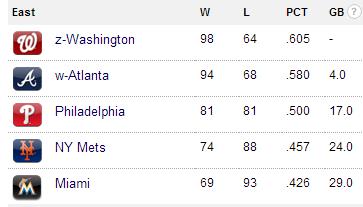
It was a big season for the NL East. The Marlins spent big. The Mets had R.A. Dickey. The Phillies underperformed. The Braves bounced back. The Nationals rose to the occasion.
I predicted the big year from the Nats and the poor showing by the Marlins. I thought too highly of the Phillies and sold the Braves a little short. For a breakdown of how I viewed each team’s 2012, I wrote full pieces on each club.
Here’s how 2012 shook out:
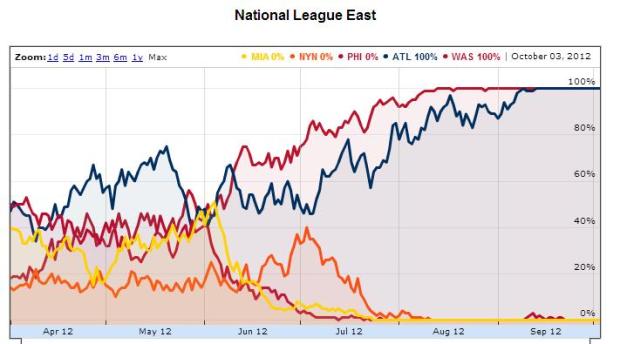
And here are the playoff odds across time:
This is how I see the division next season:

And a final look at my 2012 grades:

The National League East was one of the better divisions in baseball in 2012 and there’s a lot of talent for next season. I like the Nationals to repeat in 2013, but there are a lot of interesting teams…except the Marlins. They will be terrible.
NL East Cy Young: R.A. Dickey
NL East MVP: David Wright
2012 Season in Review: Washington Nationals
98-64, 1st in the NL East
Lost in the NLDS to the Cardinals
The Washington Nationals were my team to watch in 2012. I said on The Guy Show in March that they would win the East and go to the World Series. While the second part of the prediction didn’t come through, it was way closer than what most people thought. The Nationals were baseball’s best regular season team and came within an out of the NLCS.
The offense doesn’t jump off the page, but they played well together. Ian Desmond (5.4), Bryce Harper (4.9), and Ryan Zimmerman (4.5) all had great years. Danny Espinosa (3.8) and Adam LaRoche (3.8) were also very good.
The starting pitching was extraordinary as well. Gio Gonzalez (5.4), Stephen Strasburg (4.3), Jordan Zimmermann (3.5), Edwin Jackson (2.7), and Ross Detwiler (1.8) made all but 11 of the teams 162 starts. They also got a lot of great innings out of their bullpen.
The Nationals were in command of Game 5 of the NLCS until they weren’t in the final innings and lost to a little of that Cardinals magic.
But two big stories dominated the Nationals season. First, the Nationals are contenders now. They played well and didn’t go away. Most people will agree that they’re the favorites in the National League again in 2013.
The other story was the Strasburg shutdown, which was a huge controversy all season. I’m on board with the shutdown, but a lot of people thought it cost them. (Look for a post on this next week!)
As the offseason has gone on, the Nats have added Denard Span and Dan Haren, so they should be set to contend again in 2013, but it’s hard not to look back at 2012 and enjoy it. The Nationals brought winning baseball back to DC for the first time in decades, and there’s no sign of slowing down.
2012 Grade: A
Early 2013 Projection: 94-68
2012 Season in Review: Atlanta Braves
94-68, 2nd in the NL East, 1st Wild Card
Lost in the Play-In Game
The Braves had a great season after a disappointing end to 2011, and in any other season, would have made the playoffs. Unfortunately, the new rules sent them into a one game playoff against the Cardinals to earn a spot in the postseason. In this game, a very questionable infield fly was called, and their last shot at a rally was killed.
But losing a coin-flip game shouldn’t dampen the success of the 2012 Braves. The Braves outfield of Heyward (6.6), Bourn (6.4), and Prado (5.9) was all-world in WAR and played superb defense. Uggla (3.5), Jones (3.0), Simmons (2.2),Jones (3.0), and played superb defense. Prado at a rally was killed.
a spot in the postseason. In this game, a v McCann (2.0), and Freeman (2.0) showed what a complimentary starting lineup looks like. Every single Braves position player hit the 2.0 starter threshold, and some did so in less than a full season.
The pitching was strong too led by a bonkers-good Kris Medlen (3.9) in the second half. Hudson (2.6), Minor (1.4), and Hanson (1.0) made a full season of starts to varying success, but found good outings from the rest of the piecemeal rotation in Beachy (1.5), Maholm (1.0), and Delgado (1.0).
The bullpen was taking names in 2012 as well. Kimbrel’s 3.6 WAR was an incredible mark for a reliever and the rest of the group posted solid numbers.
In sum, this was a very good club. The offense was great and the starters were solid. The bullpen was lights out. The Braves ran into the poor fortune of having a good season in the first year of a silly new playoff format. They were six games better than the Cardinals during the season but were thrown into a coin flip game to generate fake drama and it cost them. Who knows what would have happened if they had earned a real playoff spot under the old system.
But 2012 was Chipper’s farewell season and most Braves fans will remember that as well. They’ve parted with Bourn and added BJ Upton, so the 2013 Braves should be equally as competitive.
2012 Grade: B
Early 2013 Projection: 91-71
Tigers Re-Sign Sanchez, Not Worried About the Cost
After it looked like he was heading to the Cubs last night, Anibal Sanchez gave the Tigers one last shot and they took it. Today, they signed him to a 5 year, $80 million contract.
The Tigers, very much in a win now mode, opened up the bank vault and got their man. The Tigers also have six starting pitchers now. After a strong performance down the stretch and in the playoffs, the Tigers made Sanchez a key target and they decided to pay.
In three full seasons of starts, Sanchez has been worth 3.8 WAR or higher. That’s worth $17 million a year on the free agent market, so this contract looks dead on. We should also factor in inflation, so the contract is probably worth it assuming he can maintain a similar level of performance. He won’t turn 29 until February, so while he isn’t especially young, he isn’t old either.
Sanchez has made a full season of starts in each of the last three years as well, so while some people think he’s an injury risk, I wouldn’t say he is any more so than any other pitcher. All in all, this is a fair deal for Sanchez. The question is if this is a good deal for the Tigers, specifically.
The Tigers had five starters going into the offseason; Verlander, Fister, Scherzer, Porcello, and Smyly. The first three are locks if they’re healthy. Porcello is only 23 and has four solid MLB seasons behind him and Smyly showed great, but slightly fragile potential in 2012. Sanchez is an upgrade over both of the backend guys, but he is more expensive.
The Tigers didn’t need to upgrade a rotation that was essentially baseball’s best in 2012, but they did. If Illitch doesn’t mind forking over more cash, why not go for Sanchez? They can trade Porcello or Smyly, they can send Smyly down, or move one to the bullpen.
Sanchez should no doubt be worth the deal in 2013, so the risk comes later. He isn’t taking cash away from anyone else, because the Tigers don’t have anywhere else to spend. The only needs are in the bullpen and bench, which aren’t places where you can spend a lot of dough.
I wouldn’t recommend this deal to a financially strapped team in the middle of rebuilding. I wouldn’t really recommend it for the Tigers. This was a deal for the Angels or Rangers or Red Sox to make. The Tigers need Sanchez less than other teams do, but they’re still better with him than without him.
If Illitch is really committed to winning at title at all costs, this is a good move because he’s the best pitcher left and those marginal wins are worth a lot to the Tigers right now. As long as this doesn’t hamstring them down the line in extension discussions with Verlander, Cabrera, Jackson, Fister, and Scherzer, this is a good deal. If the Tigers have decided they can afford all of these guys, I like it.
But they shouldn’t trade Porcello or Smyly. You need one and the other is great insurance. Unless they can add something really valuable for one of these guys they should hold on to both.
Sanchez will make the Tigers better in 2013. He will cost them $16 million to do so while the Porcello/Smyly tandem will cost closer to $5 million. They’re paying for the privilege to be a little better. That’s okay, it’s not my money. But it is my favorite team. If they win a title because of this move, I’m all for it.
Grade: B
Angels Take the Plunge and Sign Hamilton, Make Very Big Mistake
The Angels signed Josh Hamilton to a 5 year, $125 million deal today with a physical coming Friday. I wrote extensively about Hamilton last month and you can read what I think about him here.
The Angels, who had four outfielders before this deal, now have five. They also have Kendrys Morales as their DH who is blocked at 1B by a guy named Pujols. They have to trade at least one of these players. That’s fine. No big deal.
Trout in center. Hamilton in left. Trumbo in right. Or Bourjos? Or the $21 million Vernon Wells? I’m not sure what their plan is, but it’s a bad one no matter what.
The Angels didn’t need an outfielder. In fact, that was the thing they needed the least. They didn’t even need a bat. They needed starting pitching badly and still do. They lost out on Greinke because he was too expensive (but then signed a riskier player for the same AAV). They released Dan Haren. They traded Ervin Santana.
The Angels rotation is Jered Weaver, CJ Wilson, Tommy Hanson, Joe Blanton, and some other guy. I’m only convinced one of those guys is better than league average. Anibal Sanchez would have only cost them $15 million per season, which leaves another $10 million to spend on other upgrades.
I’m also not convinced the Angels get much better with Hamilton. He and Torii Hunter were probably equally as valuable this year, and the Angels said they didn’t want him. They were going to play Bourjos. Bourjos is an incredible, better than Mike Trout defender. He’s probably a 2-3 win player. Hamilton is only a 4-5 win guy. They’re spending $25 million to win two or three more games at the expense of the pitching staff that they could actually have upgraded.
Now maybe this is a prelude to a big deal for a pitcher on the trade market, but I’m skeptical. This feels like an f-you Rangers and Dodgers move. The Angels felt like they weren’t getting enough attention and they wanted a date to the dance. I can see Arte Moreno and Jerry Dipoto adding entries to the Mean Girls scrapbook right now.
The Angels don’t need Hamilton. They certainly don’t need Hamilton at $125 million. If his market collapsed, you might go for it, but he has to average 4-5 wins every season for this to payoff. I don’t think he can do that. Even if he does, the Angels have lots of outfielders who could put together seasons almost as good.
What they don’t have is a #2 or #3 starting pitcher. They spend $125 million on Josh Hamilton when they should have spent $90 million on Sanchez. I don’t think anyone should have paid Hamilton this much, but I really don’t think it should have been the Angels.
They either dramatically misunderstand Hamilton as a player or they think they needed to do something to keep up with the Jones’. Why offer him this deal? It doesn’t even look like anyone else was willing to go this high. The Angels paid market price or higher for a luxury player and it’s likely going to cost them a shot to improve their rotation.
I grade every trade and signing I write about, and I’m trying to decide how this ranks. Hamilton is a good player. But he is also an unusually risky player. He is old, injury prone, and has a history of substance abuse. He also has poor plate discipline, so when his bat slows down, he could really crumble. I think anyone who pays 5/125 for Hamilton is paying too much, but when you give him that deal and you don’t need him that seems like a big mistake.
At this point in time, given the context, and before we hear about a follow up move, I have to really nail the Angels here. This deal is that bad.
Grade: F
Fantasy Baseball Strategy Session
Over the course of this offseason, particularly after the first of the year when more free agents have signed, I’ll be writing fantasy baseball rankings and predictions to help you win your league. But today, I’d like to offer a strategy primer. This isn’t what players to draft; it is how to draft, period.
I’ll assume most people don’t play in a league that doesn’t utilize an auction and most of your leagues are standard 5×5 with traditional categories.
A lot of strategy will depend on where you pick in the draft when we’re talking about early picks, but once we get 10 plus rounds into it, that distinction melts away. I’ll offer some broad rules below, but first, I want to make a couple points in general. First, use sabermetrics to prepare. Fantasy baseball might glorify more tradition statistics, but sabermetrics will help you judge over and under performers. High and low BABIP can tell you something. Dramatically different walk or strikeout rates might explain something else. Use these things to determine if you should buy low or sell high.
Second, don’t draft names, draft performance. Don’t get caught up in someone’s history, go for what you think will happen in the year for which you’re drafting. Draft Adam LaRoche if you think he’ll outperform Pujols next season.
Draft Reliability
Early on it your draft, don’t get cute. Don’t go for the person you think might have a breakout season, draft safe players. Ryan Braun, Miguel Cabrera, etc. In the early rounds, get someone you can count on. There’s nothing worse than playing a hunch and drafting someone who bombs out instead of drafting someone you can count on even if they don’t have the best numbers from the year before.
Position Matters
A lot of people will tell you take the best player available, but I don’t recommend it. You should draft the best players at the worst position. There are a lot of good first basemen and outfielders, but very few good second basemen. Robinson Cano and Dustin Pedroia aren’t as good as Joey Votto, but you might think about drafting them higher because the difference between Cano and Marco Scutaro is much larger than the one between Votto and, let’s say, Freddie Freeman. Votto is the better player, but you have to get a second basemen eventually, so make sure you think about position depth when drafting.
Draft Elite Pitchers Too Early
Another typical piece of fantasy advice is not to draft top starters too early, but you should. Grab Verlander and Kershaw or Felix Hernandez a round early. You’re going to want a couple elite arms and this is the best way to handle it. Get them early and pay for it by losing out on a position player. You’re taking on some injury risk, but the reward will be worth it.
Draft Too Many Closers
One of the easiest things to do in April is to find saves. Closers and relievers are volatile. Teams will switch closers a lot during the season and you can draft proven saves-getters and trade them early. Get Papelbon and trade him for something you need. Closers are a great trade asset and you can outsmart the field and pick up saves on the waiver wire.
Add Pitchers Early
Draft lots of position players and drop them for pitchers in early April. You can only play so many position players every day, but you can rotate your pitchers in and out of the lineup throughout the week. Drop your ineffective subs and pick up pitchers on hot streaks.
There’s no secret to winning your fantasy league other than being smart and lucky, but these are some good tips. Draft reliability, think about position, draft great pitchers early, draft too many closers and trade them, and add hot starters in April. Do this, and you’ll be on your way.
2012 Season in Review: Philadelphia Phillies
81-81, 3rd in the NL East
After years atop the NL East, the Phillies stubbed their toe in 2012. Picked by many to head back to the playoffs, they finished the season .500 and failed to make the playoffs for the first time in six seasons.
The disappointment comes in two phases. The offense problems were predictable. Carlos Ruiz (5.5 WAR) had a very strong season behind the plate before his offseason suspension and Jimmy Rollins (4.4) provided a lot of value at short. Chase Utley (3.2) was very good, but only played half a season. Shane Victorino’s 2.2 WAR in 101 games was also a good showing, even if he isn’t the player he used to be.
Other than that, the Phillies didn’t get a lot of great offensive contributions and were very average as a team.
Cliff Lee and Cole Hamels had down-ballot Cy Young Type seasons, but Roy Halladay had an injury plagued campaign. Halladay was a solid starter in 2012, but that’s a far cry from his “best in the game” credentials. Vance Worley, Kyle Kendrick, and Joe Blanton combined to fill out the remaining rotation spots and did a respectable job doing so.
Jonathan Papelbon had a good season in the first year of his too-big contract, but the rest of the bullpen struggled. The rotation was top ten, but the bullpen was mediocre.
Collectively, the Phillies were just an average team in a tough division. They played better later on in the season and got some top flight performances from their stars, but not enough to live up to their high expectations.
The rotation is still great heading into 2013 and Ben Revere in center and the-maybe-upgrade of Michael Young at third should give them a boost. Ryan Howard is still a serious problem at first. The corner outfield is still up in the air.
The Phillies should be better in 2013, but they played below their potential in 2012.
2012 Grade: C
Early 2013 Projection: 85-77
 New English D