Reds Go For Choo, Get at Least Half of What They Need
After a few big trades this offseason, the Indians, Reds, and Diamondbacks felt left out and got involved in one of their own last night.
The three team deal sends SS Didi Gregorius, LHP Tony Sipp, and 1B Lars Anderson to Arizona, OF Drew Stubbs, RHP Trevor Bauer, RHP Matt Albers, and RHP Bryan Shaw to Cleveland, and OF Shin-Soo Choo and INF Jason Donald to the Reds.
The Reds needed a leadoff man and a centerfielder. They definitely got the leadoff man. Choo’s on base skills are top flight, but his ability to play centerfield is in question. If he can handle it, the Reds come out pretty well in the deal. They’re a team on the brink of a title and a few more marginal wins could easily be the difference and they made this addition without losing anyone from the big league roster.
The Diamondbacks needed a shortstop and a left handed reliever, and they got them. But they gave up an awful lot in terms of prospect value for an equally unproven return. Giving up on Bauer after a year and a half seems like a foolish move given that they made him the #3 pick two summers ago. They have young pitching depth, but this doesn’t seem like the upgrade they needed.
The Indians made out very well in this deal as they gave up one season of Choo, a utility infielder, and a respectable reliever for some really solid prospects and a useful OF. They weren’t ready to contend in 2013 so they traded Choo for a nice bundle of future talent. Hard not to like it.
The deal makes tons of sense for the tribe and little sense for Arizona. The Reds are the wild card. Choo is exactly what they need on offense and a very big question mark on defense. How Choo plays in centerfield at Great American Ballpark will determine how this trade is ultimately viewed.
Grade (Indians): A-, Grade (Diamondbacks): C-, Grade (Reds):B
2012 Season in Review: New York Mets
74-88, 4th in the NL East
The 2012 version of the Metropolitans was very compelling and super exciting into the early summer, but bottomed out as the dog days arrived. They were led by an MVP contender and the NL Cy Young, but the supporting cast wasn’t enough to make the Mets a player in one of the tougher divisions in the sport.
The afore-alluded to Wright (7.8) was worth more WAR than the next four position players combined. Only Ruben Tejada (2.1) and Scott Hairston (2.0) hit the 2.0 starter threshold. Ike Davis gets honorable mention for doing everything right except getting hits. Great power, good patience, but the .227 batting average dragged the whole thing down. He should be better in 2013.
R.A. Dickey had an RA-diculous season and was my (and the BBWAA) pick for Cy Young. Jonathan Niese also had a fine season, but no other pitcher made more than 21 starts. Johan Santana was good, but got hurt. Dillon Gee too. Chris Young was meh, but not bad for a 5th starter. Matt Harvey was eye-popping good, but only made 10 starts after his callup.
The bullpen was, let’s be generous, a weakness.
The Mets had some bright moments this year, especially the first no-hitter in franchise history, courtesy of Mr. Santana, and a wonderful string of dominance by Dickey. Wright signed an extension and Matt Harvey stepped into the spotlight.
The 2012 season shot some life into Mets fans for the first few months and faded down the stretch. I think they’re on their way up. The starting pitching is there.
A Dickey, Niese, Santana, Harvey, and Gee rotation is very good. If Zach Wheeler is ready to be the 1/2 a lot of us think he can be, they Mets could easily have a top five rotation.
They need offense. Wright is a good centerpiece and they have a handful of guys who can really fill out the bottom of a lineup. They need one or two more formidable bats to surround Wright near the top and they could be good to go.
It wasn’t a great year for the Mets, but the future looks bright.
2012 Grade: D
Early 2013 Projection: 80-82
The Dodgers Have Money, But That Doesn’t Mean They’ll Win
It should come as a surprise to no one that the Dodgers, buoyed by a new ownership group and TV deal, have a very large sum of money to pay for baseball players. Their 2013 payroll is likely to be near $250 million, or about $60 million above the luxury tax threshold, meaning they’ll pay a tax that will increase their effective payroll toward $300 million.
They took on a bunch of bad contracts in trades in 2012 and have signed expensive players in the offseason that has followed. At least in the short run, we have to assume that the Dodgers payroll constraints are such that we could not reasonably expect them to be met.
Jeff Sullivan, the best of the best at Fangraphs, wrote a piece the other day thinking about what a team of the highest paid players would look like and came to the conclusion that such a team would be a contender, but not a juggernaut. You can read the piece here.
Sullivan’s main argument is that the most expensive player is not the necessarily the best player. On that, we can all agree. What the Dodgers have the ability to do, given their vast financial resources, is outbid everyone for the best players. Put another way, in a world in which we could perfectly predict future performance, they Dodgers would have the best team.
But teams still need to predict future performance to get this right. Most MLB teams think Zach Greinke will be a better pitcher over the next five to six seasons than Anibal Sanchez, so Greinke will earn more money in free agency. But there is a decent chance we’re wrong about this prediction and Sanchez will be better.
If this occurs, Sanchez is the better player and the better investment. He will be worth more and earn less. If Greinke is the better player, Sanchez could still be the better investment because he will earn fewer dollars.
Think of it like this. A player’s value to his team is his WAR. A player’s value as an investment is his $/WAR. If Greinke is worth a healthy 30 WAR over this deal, he will help his team win 30 games, but those 30 wins will cost $4.9 million each.
If Sanchez adds 20 WAR over a five year deal but only makes $75 million, his team will only pay $3.75 million each. Greinke adds more value in the standings, but Sanchez adds more value per dollar.
The Dodgers have only conquered half of this equation. They can pay more per win than any team because they have the most money, but they still need to find the wins. If it turns out that Greinke is worth 25 wins and Sanchez is worth 30 wins over the same period, they should have signed Sanchez.
The Dodgers’ riches don’t make them better at making smart baseball moves, it means they can afford to spend more per win. They can pay Greinke more than any team, but that money will only work if they spend it on the best players. The Dodgers don’t care about the value of their investments, but they do care that their players are the best players.
They can pay $17 million to Josh Beckett to be a fifth starter when most teams would spend $7 million for that level of performance. They can pay Greinke $24 million to be a $19 million arm, but they can’t pay to make Greinke better.
This is the trap of being the Dodgers. The Dodgers are forking over a ton of cash to these players on long term deals because these big deals make sure the Dodgers get the free agent players (and trades/extensions) they wish. But if they choose the wrong players, they are stuck.
While they can buy more players if the current ones don’t perform, can they really afford to spend money to replace a big contract? Greinke makes $24.5 million a season now. If he flames out in two seasons, can the Dodgers replace him? Can they put a $25 million arm in the bullpen or on the waiver wire? Do they really have that much money?
The conflict they face is roster size and future commitment. If Carl Crawford turns out to be terrible for the Dodgers, can they just eat his contract, cut him loose and buy the next big free agent to replace him in LF? Do they have that much money? I don’t know.
The Dodgers can outbid you for the best players and spend more per win than any team in baseball, but can they spend their way out from under these contracts if they go bad?
They can afford at $250 million payroll. Can they afford to pay $250 million to an average team? What happens when they need to get better?
The flip side of this is a team like the Rays who constantly keep their costs down and derives value from young, pre-free agency players. It keeps them from having a high payroll, but it also provides something the Dodgers no longer have; flexibility.
This huge payroll limits the Dodgers flexibility. It creates a logjam. They can’t just go sign Hamilton to replace Crawford. With a $20 million guy at all 8 positions and 5 starter spots, they would pay $260 million plus the bullpen and bench. That’s workable for them I think, but only if those guys perform. What happens if one or more aren’t good enough and need to be replaced? Can they pay $40 million per position? $20 million for the new guy and $20 million for their new benchwarmer. Could they pay $60 million?
The Rays can easily jettison a $1.5 million outfielder and replace him with another, but I’m not sure you can do the same when the player you want to get rid of has four years left on his deal and is making $25 million annually.
The Dodgers can outspend everyone, but that doesn’t mean they’ll be a juggernaut and a force to be reckoned with. They still have to make the right choices. They still have to pick the best 25 players to put on their club. They’ll sign pretty much any player they want, but they have to want the right guys. If they make a mistake, I’m not so sure they can just replace them with a better player during the next offseason.
The Dodgers can outbid you, but they can’t necessarily outsmart you. If Anibal Sanchez is worth more wins than Greinke over the next few years, it will be proof of that.
Tigers Sign Brayan Pena Because, “Hey, Who Doesn’t Need Another Backup Catcher?”
Apparently, the new market inefficiency is backup catchers. The Tigers got another one today when they signed Brayan Pena to a one year deal to backup Alex Avila.
Prior to this deal the Tigers were short on backup catchers. They only had Holaday, Cabrera, and McCann. Everyone needs four backup catchers.
I kid. This deal costs them nothing, so it’s not a bad move. But like, man, how many backups do we need?
Here are Pena’s numbers for his career:
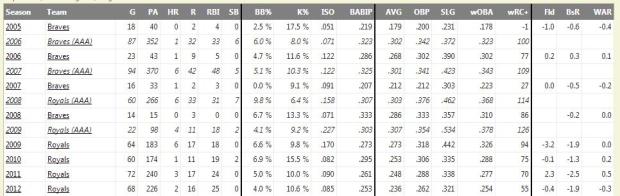
Nothing much to look at here. Not a hitter. Not a fielder. He’s a backup catcher and not a great one. But good backup catchers are getting two years deals this season (Laird and Ross). I’d have gone with Holaday from the start, but there’s no harm in this move.
Royals Talk Themselves Into Something, Rays Take Advantage
On Sunday night, the Royals went for it and Tampa Bay just let them do it. The Royals traded top prospect OF Wil Myers, RHP Jake Odorizzi, LHP Mike Montgomery, and 3B Patrick Leonard to the Rays for James Shields and Wade Davis.
This trade is rich with analytical possibilities, so bear with me here. From an actual value standpoint, it’s hard not to think the Rays robbed the Royals like they hadn’t eaten in weeks. Two years of James Shields at $9 million plus matched with a couple cheap years of Wade Davis followed by some more expensive years of Wade Davis for six years of all of those prospects who will earn the league minimum for the first three years.
Myers is perhaps the best hitting prospect in baseball. Odorizzi is a top arm. Montgomery is risky, but has a high ceiling. Leonard has power.
We know Shields is a great pitcher and Davis is at worst a great reliever and at best a solid starter.
The Rays got more total value, but if the Royals are truly trying to win in 2013, they are taking a risk that they believe will pay off. The Royals will be better in 2013 because of this deal, but they will be worse in the future because of it. That’s a generous way to put it.
But should the Royals have made this choice? They added a very good starting pitcher and a potentially solid starter, but as a result, they will keep the much worse Jeff Francouer in RF instead of Wil Myers. How many wins will that net them? I’ll be generous and call that 4 to 5 wins. That’s certainly not enough to win the division in 2013. And we’ve already decided that after the two years of Shields are over, this deal slants heavily in favor of the Rays.
So why did the Royals do it? Simple, I think. The Royals owners told GM Dayton Moore to win in 2013 or he’d be fired. Therefore, Dayton Moore traded away the future to improve his 2013 chances. All he cares about is 2013. This is a net gain in 2013 and a net loss everywhere else. Moore doesn’t care about that because he has to save his job. That’s the only explanation.
From the Rays side, this is another awesome Rays move. They traded Shields and Davis, but they have a ton of pitching depth and they got two more back. Myers slots into RF this year and the team is better off and cheaper because they can replace Shields in-house in a way that no other team could.
The Rays got four good to great players who cost nothing in exchange for two more expensive pitchers and one is a free agent after 2014.
Bu this deal is also a proven player versus prospect story. Lots of old school people are talking about Shields as a lot more valuable than Myers because he’s a proven guy. But the reality here is much different. Myers may turn out to be a bust, but he’s one of the safest bets as far as prospects go. He’s a young, good position player who hit well in the minors. His bust chances are low relative to other prospects.
Shields has shown he can play in majors for years, but if he blows out his elbow in April, this trade is a disaster. The Royals didn’t take on much less risk. Veterans are risky too. Everything is risky.
This is a bad deal for the Royals. They gave up some of their best prospects including one of the best in the game for a shot at winning in 2013 and 2014, but they didn’t get much better and aren’t close enough to contending for that to even matter. This was a desperate trade by a GM who is on the hot seat.
This is a great deal for the Rays because they can replace Shields and Davis, they saved money, and they get a great young outfielder.
This is all coming from a place in which I love James Shields. I think Shields is one of the most underrated players in the game. Innings eating pitchers with great changeups are my favorite. The Royals got a good one, they just paid way too much after they tricked themselves into thinking that they could contend this season.
Grade (Royals): D, Grade (Rays): A
Baseball and Culture: The Nine Best Baseball Books
I can’t pretend to have read everything ever written about baseball, but I wish that I could. I love baseball and I love reading. As you might expect given that information, I also love books about baseball. Here are some of my favorites and no fan’s library is complete without them. Feel free to recommend more in the comments section.
[Editor’s Note: You can find a crowd-sourced list of favorite baseball books here]
9. Men at Work by George Will (Amazon)
Will’s book tells the story of the game through discussions of specific players and managers. It’s the ultimate case study of the thinking baseball man. It’s about two decades old at this point, but it’s just as easy to pick up now and feel smell the fresh cut grass in every page.
8. Fantasyland by Sam Walker (Amazon)
This may be the only book about fantasy baseball on this list, but that doesn’t make the story any less real. Walker, a WSJ writer, spent a year chronicling his participation in one of the oldest and most competitive fantasy baseball leagues. It’s a great read and it’s about seven years old at this point, so it’s a quaint version of fantasy sports that doesn’t include Twitter.
7. Now I Can Die in Peace by Bill Simmons (Amazon)
Simmons is famous for his work as the Sports Guy and as editor of Grantland, but way back when, he was actually a fan of baseball and his hometown Red Sox. This book is a compilation of columns he wrote about the Sox leading up to their improbable 2004 World Series run. The title says it all, but it’s still a fun read even though the Red Sox have now become as annoying to all baseball fans as the Yankees.
6. 3 Nights in August by Buzz Bissinger (Amazon)
Bissinger, of Friday Night Lights fame, spend three nights in August trailing around Cardinals’ manager Tony LaRussa in 2003. I honestly haven’t picked this one up in a long time, but I remember finding it to be a great love letter to baseball.
5. Perfect by James Buckley (Amazon)
This book is great for a couple reasons. First, it’s the story of every perfect game in baseball history, which should be enough for you to buy it immediately. But it’s also the story of every perfect game that almost was. There’s an entire chapter devoted to pitchers who made it 8 2/3 innings before giving up a hit or a walk to the final batter. The other great thing about this book is that I read it a couple years (2008?) after Randy Johnson’s perfect game in 2004. Within the following four years, there would be like six more perfect games. I read this entire book and now it’s 33% longer!
Editor’s Note: Wait to buy this one until the three(!) 2012 perfect games are included.
4. Moneyball by Michael Lewis (Amazon)
This is probably the most famous book on the list. It’s become a target in the last few years, especially after the Hollywood adaptation. But the book itself is brilliant and wildly misunderstood by people who obviously didn’t read it. Moneyball is about the cash strapped A’s and their quest to exploit market inefficiency in order to win an unfair game. A lot of people turned this into a stats v. scouts book, and it absolutely wasn’t. This was a book about a team that folded statistical analysis into their player evaluation model because scouts were missing something. Scouts don’t miss these things as much anymore. The A’s spend more on their scouts than they did when the book was written because they do value that perspective. They just needed to find out what everyone else was undervaluing so that they could win without big dollar sign
3. 56 by Kostya Kennedy (Amazon)
56 is a really simple concept. It’s the story of the greatest athletic achievement in sports history. It’s the story of Joe DiMaggio’s 56 game hit streak in 1941. The book is a lot of fun and folds in a lot of great baseball history and its connection to the history of the nation. Kennedy also does a great job interspersing short analysis and commentary between chapters of the narrative to help you think about the streak from a modern point of view.
2. Heart of the Game by S.L. Price (Amazon)
This is the heartbreaking story of Mike Coolbaugh and the line drive that ended his life. He was coaching first base at a minor league game when a foul ball caught him in the neck and the book tells his story and the story of the man who hit the baseball. It’s a story about trying to make it in a tough game and also about coping with tragedy and loss. It’s a heavy read, but it’s as brilliant as it is sad.
1. The Art of Fielding by Chad Harbach (Amazon)
Fielding is the only work of fiction on this list, but it has a well-earned spot at the top of this list. Harbach’s first novel is a bit soapy at times, but that doesn’t detract from its wonderful treatment of a college baseball team at a small liberal arts school in Wisconsin. The story itself is great, but the way Harbach handles baseball tells you he’s not only a fantastic writer, but a true fan. The occasional uncomfortable sex scene is not nearly enough to make you want to put down one of the most compelling arrangements of sentences and paragraphs I’ve ever read.
Dodgers Make Yankees Blush, Sign Zach Greinke
Zach Greinke has a 6 year, $147 million deal with the Dodgers pending a physical. This deal shouldn’t be much of a surprise to anyone, especially anyone who read my post about Greinke last month. The Dodgers needed pitching and had money. They existed in the center of the Venn Diagram of “need pitching” and “have money” in which Zach Greinke would no doubt sign.
You can read my previous post to give you an idea of what I think about Greinke, but the contract is new, so let’s talk about that.
$24.5 million a season for six seasons, totaling $147 million. Not a bad gig if you can get it. I like this for the Dodgers, however, even if a lot of people will write that it is an overpay. Greinke is 29. This contract will take him into his decline years, but not that far into it. He’s easily capable of putting up a couple 4-5 win seasons during the span and those seasons will pay for themselves. There might be some lost value on the back end where he’s worth a few million less than the contract if inflation doesn’t catch up and make it a wash.
The point I’m trying to make is that if this is an overpay, it’s a small one. Over six years, it’s hard not to imagine Greinke putting up at least 3 WAR a season. That’s $90 million with no inflation and nothing better than 3 wins a season. With all the money flying around the Dodgers front office right now, whatever part of that $50 million excess cost doesn’t get picked up by inflation and better than 3 win performances, I’m sure they will be able to cover it. They have a lot of dollars, so giving a lot to Zach Greinke should be okay.
It should also help to move to a nice pitcher’s park like Dodger Stadium. And putting him next to Clayton Kershaw should be pretty awesome. Two Cy Young contenders on one club.
Money isn’t an object for the Dodgers and they needed pitching. Zach Greinke likes money and is good at pitching. This is a pretty good match. Grade: A-
2012 Season in Review: Miami Marlins
69-93, 5th in the NL East
Man, it was a bad year to be a Marlins fan. Your ownership and front office lay out a bunch of cash to sign big free agents and your city builds you a new stadium, but then, everything collapses underneath you like the trap door in front of Mr. Burns’ desk at the Springfield Nuclear Power Plant.

Ozzie Guillen said he respected Fidel Castro. The stadium has the ugliest centerfield statue that anyone could imagine. (Read: I literally couldn’t come up with a bigger eyesore if it was my job to design it) The team played bad. The owners traded everyone who made any sort of money for a less than inspiring haul and Giancarlo Stanton has no one to play catch with this year.
Stanton had a great year (5.8 WAR, .290/.361/.608, good defense), and a couple other guys contributed nicely led by Jose Reyes (4.5 WAR and now a Blue Jay), Justin Ruggiano (2.8 WAR, still a Marlin!), and Omar Infante (2.4 WAR, now a Tiger). Everyone else either got traded before they could cross the 2.0 threshold or didn’t produce that much.
Hanley Ramirez, Mark Buehrle, Josh Joshson, Emilio Bonifacio, Infante, Reyes, Heath Bell, Anibal Sanchez, Gaby Sanchez. These were all members of the Marlins core on Opening Day who have been traded since.
A lot of people liked the Marlins to be a contender this year. I didn’t because I saw the Nationals, Braves, and Phillies being too good to overcome, but I didn’t expect the Marlins to only win 69 games. That’s fewer games than the Mets. The Mets!
Josh Johnson had a good year (3.8). Ricky Nolasco (2.7) and Mark Buehrle (2.1) were respectable. Anibal Sanchez (2.3 before the trade) was also very good. The staff was probably good enough. The bullpen probably wasn’t.
The team was just bad. The owners were worse. The fans are the victims. A team on the way up sputtered and the pilots hit the eject button. The 2013 Marlins will be Giancarlo Stanton and a lot of people you’ve never heard of. The statue will still be there.
But there’s no Ozzie, so that’s something.
2012 Grade: What’s worse than an F?
Early 2013 Projection: 66-96
Josh Hamilton and the White Sox Get Closer to Finding Each Other
A few weeks ago I wrote about the strange free agent situation surrounding Josh Hamilton. You can read the post here, but let’s consider where we are right now.
The Rangers will not sign Hamilton if they sign Greinke, which looks pretty likely. If they sign Greinke, they will trade for Upton and Hamilton will not have the Rangers as an option. The two clubs with the most buzz for Hamilton other than the Rangers are the Mariners and the Red Sox.
In the post linked above, I told you the White Sox were the real team to watch. I said they would trade Viciedo or De Aza and would add a lefty power bat. Hamilton would fit perfectly. Here’s a post on MLB Trade Rumors yesterday:

It’s happening. Hamilton will sign with the White Sox for 5/110. I can’t guarantee I’ll be right, but I feel better about this prediction than when I made it.
Tigers Quiet at the Winter Meetings…For a Reason
The Winter Meetings are over, but winter isn’t. We’re 77 days from Spring Training in Lakeland and 115 days from Opening Day in Minnesota. There’s still time for the Tigers to tweak the roster, but here’s the rundown of the 2013 Tigers:
C: Avila
1B: Fielder
2B: Infante
SS: Peralta
3B: Cabrera
LF: Dirks
CF: Jackson
RF: Hunter
DH: Martinez
Bench: Holaday, Santiago/Worth, outfielder, utility player
SP: Verlander, Fister, Scherzer, Porcello, Smyly
RP: Benoit, Coke, Alburquerque, Dotel, three other guys
The Tigers have a clear need over the next two months: depth.
The starting lineup is strong, but the bench is up in the air. They need a righthanded outfielder who can platoon or backup Dirks. They need some positional flexibility and might have gotten it by trading in a Don Kelly for another (Jeff Kobernus).
The starting rotation is also among the best in baseball and some of the bullpen slots are locked up. They need to choose another lefty and two righties, one of whom should probably be a long man.
None of these spots are premium spots. The Tigers don’t need impact players, they need role players. This is a star heavy team that needs some solid bench pieces to make it back to the postseason. The Tigers have been quiet this week for a reason.
They’re pretty much set for 2013.
 New English D