The Nine Most Average Hitters of the Last Decade

Have you ever sat back and thought about being typical? Average? Middle of the road? Chances are you haven’t, but don’t worry, that’s where I come in. I answer questions you never knew you had and I’m about to do it again.
Have you ever wondered who the most average players are? We talk a lot about league average when we talk about statistics, but we don’t often provide illustrative examples. So let’s do that.
Below are a list of the most average MLB players over the last decade (2004-present) as defined by wRC+. There were 10-20 players who have posted a 100 wRC+ during that time period, so to make The Nine list, you have to have a 100 wRC+ since 2004 and then you have to have the most plate appearances doing so (as of 5/3/2013).
9. Ian Desmond (1964 PA)
8. Mike Jacobs (2140)
7. Marcus Giles (2190)
6. Brad Wilkerson (2412)
5. Xavier Nady (2794)
4. Mark Loretta (2885)
3. Coco Crisp (4397)
2. Aaron Hill (4494)
1. Alex Rios (5449)
Normally I write a blurb about each of the items on our The Nine lists, but I’d like to consider this one as a group because it’s more interesting to me. Notice the groupings. Players ranked 5-9 all have between 3 and 5 seasons of plate appearances during this window. They were league average over a span of 3-5 years during a sample of about 10. Crisp and Hill have 7 seasons. Rios has 9. So while these guys are all average by our best single offensive metric, Alex Rios is super average in that he produced average offense over a really long period of time. Let’s look at his career a little bit.

While Rios has been average on average, he has actually never been average in any one season. His most average season was 2008 in which he posted a 108 wRC+. What is kind of amazing is that none of the other guys on this list display a pattern much different from Rios. They vary in the degree to which they deviate from the 100 wRC+ line, but they all deviate a great deal. I haven’t taken the time to go searching for baseball’s most consistently average player, but I will someday. For now, Rios gets the title of baseball’s most average hitter over the last decade, but man, he’s done it in atypical fashion.
The Nine Best Aprils of the Last 10 Years
With April 2013 winding down and players such as Adam Wainwright and Justin Upton producing at very high levels, I thought it might be fun to revisit some of the best Aprils in recent memory. A few notes to start. First, March numbers are included for the few years that included 1-2 games in March because it’s simply too difficult to separate out that data and let’s face it, it’s pretty much the same thing. Second, I’ve determined these ranks by Wins Above Replacement (WAR) because it’s the easiest way to boil players down to one number who play different positions during different seasons. One shouldn’t treat this as a precise measure, but it’s the best we can do without inundating ourselves with information. Third, I haven’t included 2013 because it isn’t over yet and this is meant for you to compare this year’s performers with those performances past. For the years 2003-2012, The Nine Best Aprils follow.
9. Ryan Braun, 2011 (2.0 WAR)
Braun opened his MVP campaign in style with 26 games in April 2011. He hit 10 HR and posted a .367/.457/.724 line, good for a .496 wOBA and 220 wRC+. He would wind up hitting 33 HR over the course of the season with a 173 wRC+ and 7.3 WAR.
8. Alex Rodriguez, 2007 (2.1 WAR)
A-Rod, too, won the MVP in 2007 after a great April. He hit 14 HR and hit .355/.415/.882 to go with his .521 wOBA and 226 wRC+ during the first month and ended the year with 54 HR, a wRC+ of 175 and 9.6 WAR.
7. Alex Rodriguez, 2003 (2.1 WAR)
No this isn’t a typo and yes, Alex Rodriguez posted two separate 2.1 WAR in April in two separate MVP seasons in the last ten seasons. In this particular season, he hit 9 HR and posted a .355/.444/.673 slash line which produced a .472 wOBA and 188 wRC+. His season totals for 2003 were also impressive, with 47 HR, a .298/.396/.600 line, a 151 wRC+, and 9.1 WAR.
6. Matt Kemp, 2012 (2.2 WAR)
Just last year, Matt Kemp turned in an elite opening month by hitting 12 HR and delivering a .417/.490/.893 slash line to go with his .566 wOBA and 270 wRC+. Unfortunately for Kemp, injuries would shorten his season to 106 games and while he hit 23 HR and posted a .303/.367/.538 line, it would only be good for 3.2 WAR due to limited playing time.
5. Brian Roberts, 2005 (2.3 WAR)
Once upon a time, Roberts played an entire month of baseball without getting hurt. In April 2005, he hit 8 HR and stole 10 bases while posting a .379/.459/.726 line and a .496 wOBA and 214 wRC+. Roberts played well the rest of the season, and hit 18 HR and stole 27 bases to go with 140 wRC+ and a 9.4 UZR, but his 6.6 WAR wouldn’t be good enough to get him the MVP award that others on this list had coming.
4. Jose Bautista, 2011 (2.3 WAR)
2011 wouldn’t be an MVP year for Joey Bats, but his 9 HR in April and .366/.532/.780 line, wOBA of .541, and wRC+ of 249 would be good enough to put him on the path to a third place finish behind Justin Verlander and Jacoby Ellsbury. Bautista would finish the year with 43 HR, 182 wRC+, and 7.8 WAR. Nothing at which to sneeze.
3. Albert Pujols, 2006 (2.4 WAR)
Pujols delivered a superb April in 2006 enroute to a World Series win and 2nd place MVP finish. He hit 14 HR and .346/.509/.914 with a .548 wOBA and 240 wRC+. He’d finish the year with 8.2 WAR, 49 HR and a wRC+ of 174, but the voters wouldn’t ignore Ryan Howard’s 58 bombs.
2. Chase Utley, 2008 (2.5 WAR)
Howard’s teammate comes next on the list as Chase Utley posted great April 2008. His 11 HR, .360/.430/.766 line look awesome night to his .491 wOBA and 202 wRC+. He’d finish with 33 HR, 134 wRC+, and a 19.5 UZR, good for 8.0 WAR, but Pujols (who had a nice April 2008) beat him out for MVP. That doesn’t bother me much, as Pujols had a slightly better season. What does bother me, however, is that Utley somehow finished 14th despite having the second highest WAR.
1. Barry Bonds, 2004 (2.8 WAR)
Well you knew this was coming. 2004 would be Bonds’ final MVP season and he (and maybe some chemicals) certainly earned it. In April he hit 10 HR and posted an insane .472/.696/1.132 line to go with an otherworldly .673 wOBA and 322 wRC+. No one else is even the same conversation. He would conclude that season with 43 HR and a 233 wRC+ and 11.6 WAR.
—
It’s probably worth noting that the only one on this list who didn’t have a fantastic season was Matt Kemp, who simply got hurt. So if you have a 2.0 WAR type April, you’re probably in line for an awesome season. You have a great shot at an MVP award, too. Mr. Upton and Mr. Wainwright, things look good.
The Nine Most Exciting Plays in Baseball
This week, inspired by a fan poll question on FSDetroit on Friday, New English D provides you with The Nine Most Exciting plays in baseball. Each of these are general in that they do not refer to a play that has occurred such as Gibson’s 1988 walk off, but rather plays such as “the inning ending double play.”
Only one of them features a specific game situation (#4), but each play is amplified by the situation. Consider them ranked based on how exciting they would, all else equal. A double play may be more exciting than a diving catch if the double play comes in the bottom of the 9th and the catch comes in the 3rd, but here we consider them context neutral with one obvious exception that will be clear when you read the list.
9. Inside the Park Homerun
Now this one is pretty low on my list compared to what most people tend to believe, but there is a very simple explanation. Almost every inside the park homerun is the result of a defensive misplay. Either a fielder overruns a ball or it takes a weird hop they weren’t anticipating. Rarely is it a feat of speed and guts. In a big park with a fast runner, it can be exciting, but you almost never see one that isn’t dumb luck.
8. Triple Play
My thoughts here are similar; most triple plays are just dumb luck. Usually they happen when the runners are trying to steal but the batter hits a line drive. That’s not really exciting, it’s more just interesting for its rarity. A true triple play is almost impossible and usually just a function of random happenstance. Triple plays are fun, but rarely very exciting because they aren’t terribly dramatic.
7. The Diving Catch
This is a pretty wide category, but diving catches are great because they build to a crescendo. There is the moment the ball is hit, then you think it’s going to be a hit, then you see the fielder closing fast, then you see him decide to dive, then there is a heart stopping moment in which you aren’t sure if he caught it. It’s a thrilling novel spread across less than five seconds.
6. The Do or Die Groundball
I like this one because it functions exactly like the diving catch, except it happens even faster and you have the added element of the bang-bang play at first. Not only do we suddenly realize the fielder might make a play, but we also have to see if the runner can beat the throw. Take the diving catch, narrow the time frame, and given the batter some agency and you’ve got the do or die.
5. Suicide Squeeze
If you aren’t familiar with the terminology, this is when the runner on third takes off for home on the pitch and the batter lays down a bunt to ensure the catcher doesn’t receive the baseball and tag him out. It sounds exciting enough, but the great part is that first second when you see the runner take off and immediately think, “Oh my goodness, what the heck is he doing?” You’re prefrontal cortex takes over after a second, but at the beginning of it, your brain just can’t process what’s happening. It’s pretty cool.
4. Walk-Off Homerun
Everything is better in walk off fashion because it decides the game, but the walk-off homerun gets special mention due to its utter decisiveness. It’s just a great moment.
3. Robbing a Homerun
Take the excitement of the homerun and then add in the excitement of the diving catch. You think it’s going to be a homerun and then all of a sudden it’s taken away. It’s difficult and rare, but its key feature is it takes you from high to low or low to high reaction in a matter of seconds.
2. Stealing Home
This has all the excitement of the suicide squeeze, but with none of the wimpy “bunting.” The baserunner literally thinks he can get to home before the catcher can receive the ball and tag him. All of the “what the heck?” moments from the squeeze apply, but we also get to factor in the chutzpah this requires.
1. Play at the Plate
The play at the plate is the most exciting play in baseball because it has everything. It includes risk by the baserunner, defensive skill by the outfielder, usually a bang-bang call, and it is punctuated by the fact that it can only result in an out or a run. You can see it developing a mile away, but you also hold your breath because you have no idea how it’s going to turn out. A lot of moving parts have to work and then you have to wait that half beat to see what the umpire calls. Just think about how exciting this would be if it came with two outs in the 9th inning of a tie game.
The Nine Signs You’re a Die Hard Baseball Fan
This week on The Nine we’re providing a public service announcement about a serious affliction that affects so many of us. Learn the signs of being a Die Hard Baseball fan. They are as follows:
9. You decorate your home with no regard for aesthetics but rather care about how much team paraphernalia you can place on your walls.
This is a classic sign. There is such a thing as taste in that too much team gear can be obnoxious, as if you’re in a TGI Fridays. However, if you’re a die-hard fan, you don’t care. You place it everywhere it will fit because you love your team.
8. You consider your MLB.TV/Extra Innings subscription to be a non-discretionary expense.
This one is simple, you would sooner give up gasoline than you would access to baseball.
7. Your friends have stopped asking you to hang out during games.
They know that you’ll always choose watching baseball over spending time with other people, unless their desired activity is also watching baseball.
6. You plan procreation around important times of the season.
One would never want to be in the position to miss a playoff game or Opening Day while your wife/you go into labor. This means absolutely no hanky panky during February or July.
5. You spend the offseason in a state of depression despite normally fun events such as Thanksgiving, Christmas, etc.
It’s unavoidable, November to April is just the worst.
4. Your entire schedule centers around game times including doctor’s appointments, classes, meetings, etc.
When someone asks you to schedule something, you don’t check your schedule, you check the team’s schedule.
3. You can only communicate with others if they understand baseball analogies.
“So you’re saying your oldest kid is more of the Avila of the family?”
2. Summer travel is restricted to cities with MLB teams and hotels with MLB Network.
“A free trip to Paris in June? Are you crazy? We have have a nine game homestand starting that week.”
1. You develop hatred toward other people and even other entire states because they cheer for your team’s rival.
For example, you avoid the entire state of Minnesota because it’s terrible.
Do you suffer from these symptoms? If so, don’t call a doctor, you’re fine. If you don’t do these things, call a doctor because you don’t like baseball the right amount.
The Nine Best Ballpark Foods
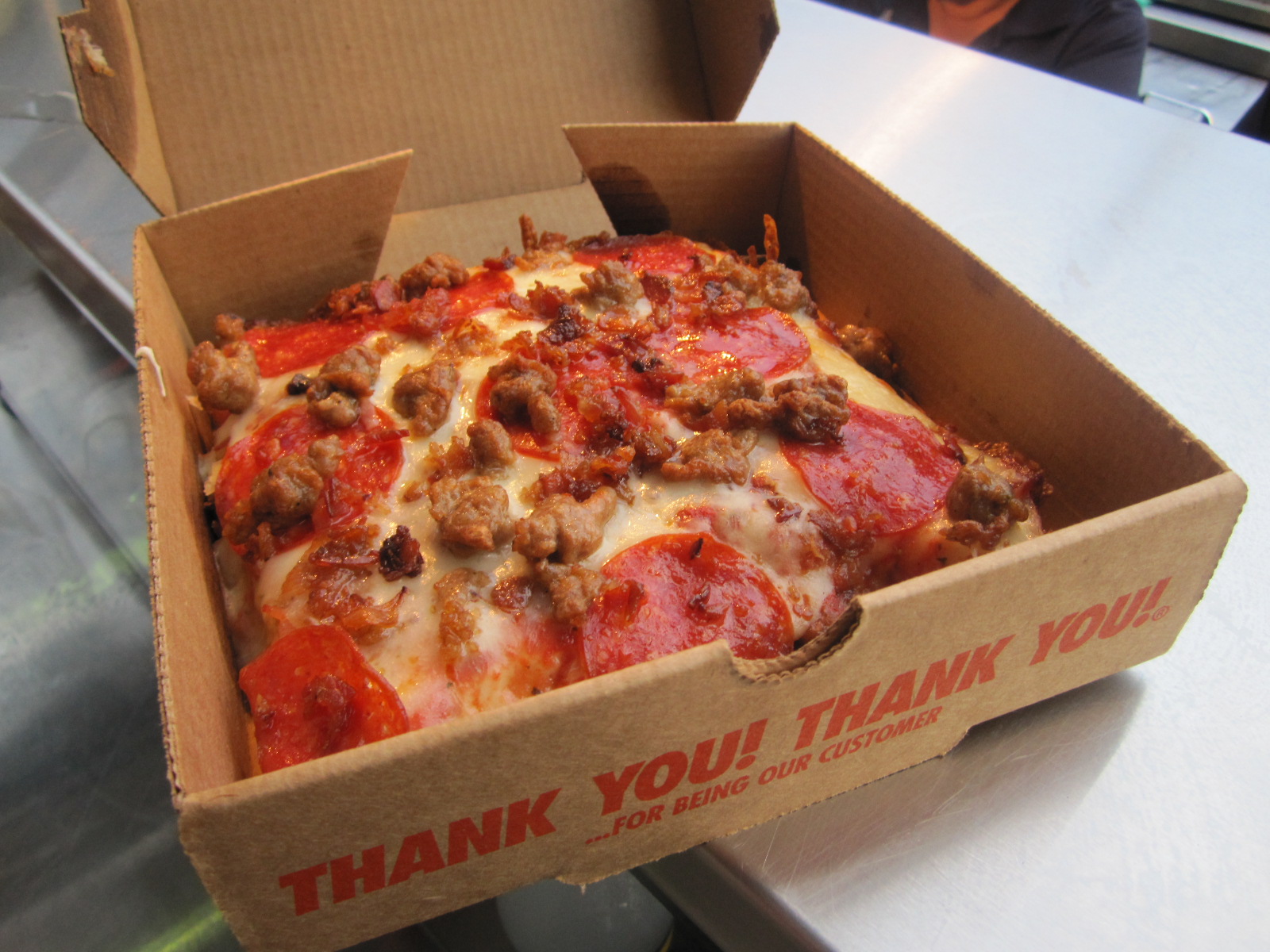
Two things should be made clear from the beginning. First, this post is about ballpark fare generally and not about The Nine best particular ballpark treats. Second, I am a man of simple tastes and should likely admit to being a picky eater. Therefore, certain items will miss this list that will seem implausible to some of you. For that, I merely offer to you that this list is obviously meant to be fun and not to be taken particularly seriously. Should you choose to take it seriously, I am prepared to follow up with a 1,200 word post about why I find nacho cheese to be gross.
Among those items that miss my list are: Peanuts, Cracker Jacks, Roasted Almonds, Brats, Burgers, Cotton Candy, and Nachos. Go ahead, sue me.
9. Popcorn
Many of the prototypical ballpark snacks are members of the salt family and popcorn is my pick of the litter. It doesn’t live up to the artery clogging euphoria that is movie theater popcorn, but if you’re in the mood to munch on something for a few innings, popcorn is the choice. Peanuts are messy and obnoxious for people sitting around you and lack butter, which is an important component of any guilty pleasure.
Downside: Getting a kernel stuck in your teeth for 6 innings and the drive home.
8. Ice Cream
Perhaps you don’t think about ice cream when you think about stadium food, but it’s a nice cool treat to enjoy during a season that takes place mostly during the summer. The quality of the product varies a great deal across the 30 major league parks, so it’s important to only go for it if you’re not getting melty slop. When it’s good, not much refreshes like two scoops.
Downside: It requires a spoon or a cone, which is either too civilized for the park or too messy.
7. Chicken Fingers
Chicken Fingers are the food of the Gods.
Downside: Requires two hands to eat or one hand and a balancing act on your lap. Potential for spills and drops.
6. French Fries
Fries are a solid gameday food because they are easily to eat and often fit in a cup holder. Also, given that fries are generally considered a side rather than a main dish, it’s a lot easier to justify eating more of them. Plus, anything that brings ketchup to the discussion is a winner.
Downside: Some stadiums skimp on quality and serve freezer aisle fries.
5. Snow Cones
First of all, if you aren’t mixing red and blue in your snow cone to make an awesome purple hybrid, you are not living, my friend. Nothing refreshes like sugar water over ice and it’s super fun to eat. It just takes you back to being a kid and the sweetness gives you that much needed boost for extra innings.
Downside: Snow Cones are becoming rarer and have often been replaced by Lemon Chills.
4. The Local Fare
Most ballparks have an option that is generally unique to its local. AT&T Park has garlic fries, Fenway has seafood. I imagine Target Field serves some sort of mind altering cocktail that keeps people cheering for the Twins. In general, you need to go for this option when you’re visiting. While I’m not a big advocate for trying new things, you can get most of these items anywhere and should consider the unique options when you travel.
Downside: Some of it is icky.
3. Pretzels
The soft pretzel a perfect snack. It’s easily to eat, results in no mess, and is surprisingly filling and satisfying. It’s somewhat customizable with various mustards, cheeses, and degrees of salt.
Downside: There really isn’t one other than that you can get a quality pretzel a lot of places, so you might not want to waste your appetite on one at the park. That’s crazy. Go get a pretzel, I’ll wait.
2. Pizza
I’m confident in telling you that pizza is my favorite food. Pizza is awesome. The only thing keeping it out of the number 1 spot is tradition and the fact that it is a little less manageable than the item above it. But seriously, it’s hard to go wrong with a slice of pizza at any reasonably competent park.
Downside: Occasionally messy depending on style.
1. Hot Dog
Of course. The hot dog is the ballparkiest of the ballpark foods. Easy to eat, fun to top, generally delicious even if it is subpar.
Downside: If you eat three or more, you will wake up that night with a stomach ache. It’s science. Two hot dogs, no problem. Three hot dogs? Near death experience.
What are you favorites at the park? What about favorite specific foods at specific parks? Let us know in the comments.
The Nine People Who Make Baseball Fun
Now this cannot be thought of as an exhaustive list or a list that perfectly ranks the quality it seeks to. Rather, this is a list of Nine people who make baseball fun, without a particular guarantee about who is left off and who is ahead of who.
However, let’s also think of this list as one that doesn’t include baseball players. This is about people outside of the clubhouses and front offices. In some cases, like in most good stories, they are composite characters. What follows, is The Nine People Who Make Baseball fun.
Because, after all, that’s what baseball is. Fun.
9. Eric Karabell (ESPN Fantasy Writer, former Baseball Today podcast host)
Here’s what I like about Karabell: He’s not reactive and he loves baseball. So many people who follow and cover sports react to everything as if it dramatically reshapes the landscape of the entire sports world. Karabell says not so fast. He doesn’t accept that one bad game or outing changes a season. He makes for good listening and following because he can walk you down off the edge when things are looking bad and keep you from getting your hopes up when things are great. But on the other side of it, he is such a fan. He openly professes to watching his team when they stink and enjoys going to Fall League games and minor league parks, and once confessed to being disappointed during the postseason because he couldn’t watch ten games at once.
8. The Fan Who Isn’t Quite Up to Date
You all know this guy. The one who still sees baseball through the prism of 2008. Like all of the players he thinks are good are getting old and he’s never heard of anyone under 25. He thinks $10 million is a big salary and can’t fathom why anyone would offer a ten year contract. This person makes baseball fun because you can exploit their ignorance for entertainment. Hey guy, who is better, Jason Heyward or Jason Werth?
7. The Person Who Asks Sportswriters Stupid Questions
I’m not talking about people asking Buster Olney if he thinks the Yankees will trade A-Rod. That’s stupid, but it’s not what I mean. People, mostly on Twitter, routinely ask “experts” to answer factually based questions like “Who is starting tonight?” and “What time does the game start?” Have these people mastered Twitter, but have no concept of Google or MLB.com? How is tweeting at a sportswriter the most effective way to gather that information? These people make baseball fun because they are funny in a sad sort of way.
6. Your Mom
Hear me out. Your mom, while she doesn’t know much about baseball, tries to portray herself as someone who knows things about baseball, leading to endless enjoyment. Specifically, moms can never pronounce/remember players’ names. It has something to do with them only have a little spare time in which to pay attention and their lack of interest in most cases. This is not a comment about women in general or middle-aged women, this is about the stereotypical mom. Below are actual names my mother calls players:
Placido Polanco: “Poblano.” This is a type of chili pepper.
Rick Porcello: “Portabello.” Notice, this isn’t just here replacing a food name for a player name, this is a hybrid of the two.
Al Alburquerque: “New Mexico.”
5. Vin Scully (Dodgers Announcer)
Scully’s pipes are incredible and he’s been working the same glamorous gig for more than a half century. Hiss soothing voice and mix of baseball acumen and catalog of great stories makes him the best announcer who doesn’t work for your team. I love Mario and Rod, but Scully is the best of the best when I take my blinders off. I can’t tell you how often, after a Tigers game ends, I flip on the Dodgers feed to listen to Scully call a Clayton Kershaw start. He’s baseball’s answer to easy listening.
4. The Nine Year Old Kid in All of Us
This is a tweet from WSJ’s Jason Gay, who sums it up nicely:
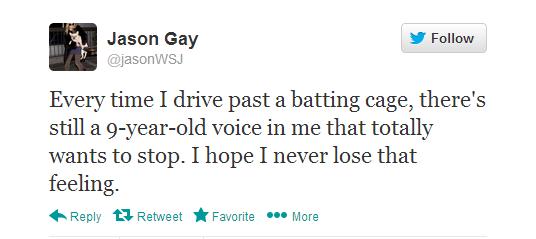
The kid in all of us makes baseball fun because they enjoy the game with such incredible optimism that can’t be match today, despite my optimistic leanings. I mean seriously, tell nine year old Neil the Tigers are terrible and can’t play worth a damn and he’ll tell you a million reasons why baseball is awesome and he can’t wait to go watch and play. (Full Disclosure: After writing that sentence, it’s entirely possible I am still nine years old. But most of you aren’t.)
3. Brian Kenny and Harold Reynolds (MLB Network)
Brian Kenny is MLB Network’s sabermetric mouthpiece and Reynolds is as old school as they come, once saying that the Triple Crown “is the [MVP] trump card.” Kenny draws on analytic thinking and research while Reynolds goes with his gut. If you know something about this site, you might think I’d prefer Kenny (and I do), but they are awesome together. Really awesome. Reynolds has great charisma and knows how to push Kenny’s buttons. At one point during an MLB Tonight episode last season, I literally rolled on the floor (read: couch) laughing at this exchange.
(Slight paraphrase)
HR: (jokes about Kenny’s use of The Shredder to analyze players)
Kenny: I’ll shred you!
HR: Yeah, yeah whatever, real baseball people don’t care about that stuff.
Kenny: They do, come to the SABR conference with me and see managers and GMs there.
HR: Do you wear your Star Wars costume to the convention?
This would be funnier if I had a clip, but trust me, it was hilarious.
2. The Person Who Runs @CantPredictBall
This and its counterpart @CanPredictBall are must follows on Twitter for their awesome and poignant baseball commentary. The premise for the account is that they post things that happen in baseball that are uncommon and strange. What’s even better is their awareness of strangeness which allows them to almost parody themselves by tweeting about things that are unpredictable in a predictable way. Here is an example of their standard tweeting:

And here is that self-awareness (from the World Series this year):

CanPredictBall does the same thing from the opposite perspective. Awesome stuff.
1. Jeff Sullivan (Fangraphs)
A few weeks ago, Sullivan retired from the Mariners blog Lookout Landing, which he created about ten years ago in favor of spending more time working for Fangraphs and working on other things. At that time, I posted his final column and remarked that if I had been born in the American northwest, I would have liked to have been Jeff Sullivan. He is quite simply, the best. The voice he achieves in his writing is among the best I’ve ever read (not just among sportswriters) and he picks up on the best things about baseball. He writes a lot of posts on pitch framing and pace and weird things that happen like Jesus Montero throwing out Mike Trout attempting to steal. If I write anymore, I think my wife will get jealous, but sufficed to say, Sullivan makes baseball fun.
Who makes baseball fun for you? Can your mom pronounce baseball names?
The Nine Best National League Starting Pitchers for 2013

Over the last nine weeks, we’ve chronicled the best players at each field position and the best starters the AL has to offer. Here, we’ll wrap up this particular run with the National League’s best starters.
I’ve often commented on the level of difficulty each list gave me during its construction, and this one, like the AL list, gave me trouble because there were a good number of candidates for the back half of the list. I feel strongly about the top five, but I think 6-15 could go in a lot of directions.
I hope you’ve enjoyed these rankings as a topic of debate and a way to preview the 2013 season. We’ll pick up next Saturday with other types The Nine lists, but we’ll revisit these lists throughout the season to see how well they prepared us for the future.
9. Johnny Cueto (Reds)
Cueto has pretty consistently outperformed his peripherals in the past and finally had a top shelf season this year in Cincinnati. Cueto remains in his prime and pitches in front of a pretty complete team. I thought about some other guys for this spot, and it killed me to leave Halladay off this list, but this one feels right.
8. Zach Greinke (Dodgers)
Greinke is now a very wealthy man and has a friendly home ballpark. He’s got great stuff but is susceptible to blow up innings. If there wasn’t a bit of a question about his elbow for the start of the season, he’d be a bit higher. Greinke is as talented as almost anyone on the list, but he tends to underperform his peripherals and his health is a bit uncertain.
7. Matt Cain (Giants)
Cain is an absolute workhouse with great control whose WAR undervalues him because it doesn’t appreciate his apparent ability to limit BABIP. He’s never missed a start in seven seasons, clearly has no-hit stuff and is very reliable. The ace of the world champs belongs on any list of this kind, and his contract looks incredible compared to some of the big signings of late.
6. Gio Gonzalez (Nationals)
Gio is a bit wild, but the strikeout rate and the walk rate are trending in the right direction. I’m not his biggest fan and there will certainly be steroid talk this season, but the numbers are telling me he’s a top six starter for next season. I’d rather have Cain or Greinke on my club, but if we’re going to try to be objective about next year, we probably have to give the edge to Gio.
5. Adam Wainwright (Cardinals)
Wainwright had two Cy Young type seasons in 2009 and 2010 before missing all of 2011 after having Tommy John’s Surgery. It took him a few months to return to form, and looks locked in and ready to go. He’s one of the best pitchers in the game when he’s healthy and all signs point to a big season from the 31 year old ace of the Cardinals.
4. Cliff Lee (Phillies)
Lee is coming off five excellent seasons in which he threw 211 innings or more. He has amazing control and a fine strikeout rate. He only has one Cy Young on his shelf, but this lefty ace could easily have a couple more. He is, without a doubt, owner of the best 6-9 season in baseball history and shows no sign of slowing down.
3. Cole Hamels (Phillies)
Everything about Cole Hamels’ game is awesome. Strikeouts, few walks, durability. He doesn’t quite have the ceiling of the others, but he’s consistency keeps him at the top of this list. The changeup is one of the best in the game and he remains the youngest of the Phillies aces heading into 2013.
2. Clayton Kershaw (Dodgers)
Kershaw is awesome. I don’t think I have to say anything else. He’s 25, has a Cy Young and a couple of near misses. He’s the best left handed pitcher in the game and should be for years to come. The only question about Kershaw is if he or Verlander will break the $200 million barrier for starters.
1. Stephen Strasburg (Nationals)
Last season was all about the innings limit. When he’s allowed to pitch, he is off the charts incredible. His career strikeout rate is 11.21 with a 2.71 BB/9. If he can hold up and stay healthy, he’s the best pitcher in the league. His stuff is amazing to watch. Is he Justin Verlander? Maybe not. Is he as close as any right hander in the game, you bet. Stephen Strasburg is the real deal.
What do you think? Kershaw or Strasburg? Or, someone else?
The Nine Best American League Starting Pitchers for 2013
The previous eight weekends have featured lists of The Nine best players at each of the main field positions for the 2013 MLB season. You can access these lists here all season long and I will provide status reports of these lists as we proceed through 2013.
There will be no list for relief pitchers because there are so many of them and their range of performance is so small that making a list isn’t very interesting. There will also be no DH list because there just aren’t enough full time DHs to make it worthwhile. Only 15 teams can have a DH and some of them employ platoons. Picking 9 DHs out of like 13 guys seems silly.
But starting pitching is a place of great interest and I struggled to decide how to break it down. With more than 150 players receiving starts in a given season on the hill versus a number closer to 30 for the field positions, I’ve decided to break it in half. I thought about lefties and righties, but decided American League and National League would be more fun.
Here, without more nonsense, are The Nine best American League starting pitchers for 2013 according to SABR Toothed Tigers. The list is difficult to make because there are many excellent candidates, so as always, don’t get too worked up about it.
9. Max Scherzer (Tigers)
Scherzer will turn 29 during the upcoming season, which will be the fifth full one of his career. The strikeouts shot up last season and he kept his walk rate below 3.00 per 9 for a second straight season. He had some arm issues late in the season, but pitched well enough in the playoffs to make us think the winter off was enough to reset his aching body. He’s a flyball and strikeout pitcher, which will work well with the Tigers defense and last season was his most complete effort in the sense that he didn’t go through long stretches of poor performance. I still wonder if he can repeat his delivery and keep his awkward mechanics in line, but if he can continue on the path he started last year, he has a shot to be a force in the AL.
8. R.A. Dickey (Blue Jays)
Dickey is coming off two and a half very good seasons and an NL Cy Young. We can’t worry too much about his age given his knuckleballing ways, but we should worry that he’s moving to a less pitchers’ friendly Rogers Centre and slightly better AL East. Dickey won’t do quite as well under those conditions, but we can control for those context type factors. I don’t think he’ll be a Cy Young again, but his ability to make the ball dance should be enough to keep him on this list for another season.
7. C.C. Sabathia (Yankees)
Sabathia showed signs of aging in 2012 for the first time after 11 above average to great seasons leading up to it. He’s still a workhorse with great control and hasn’t had an ERA above 3.38 since 2005, with much of that time spend in the tough AL East. CC is probably making his final appearance on this list for his career, but he will remain one of the best pitchers in the AL for 2013.
6. Doug Fister (Tigers)
Fister had a higher WAR than all but 12 AL pitchers last season, despite only making 26 starts due to a nagging oblique injury during the first half of the season. Had he pitched at the same rate over 34 starts as he did over 26, he would have easily been a top nine pitcher last season. There is no reason to think anything but injuries would stand in his way. The strikeout rate is on the way up and his control has been excellent in a Tigers uniform. He’s only 29 and could easily be poised for another fine season. He also happens to be my favorite pitcher to watch. His mix of modesty and control with great fastball movement makes for excellent viewing. He’s also super tall. That’s fun too.
5. David Price (Rays)
The reigning Cy Young winner in the AL is fifth on this list, not because I don’t like him, but because I like his opponents more. Price has three straight 4.0+WAR seasons and is right in the middle of his prime. All signs point to another great year from Price, but I think he’ll be just shy of Cy Young conversation in 2013.
4. Matt Moore (Rays)
So when I previewed the AL East, I said Moore would be the Cy Young of the division. In doing so, I also decided he would be a better pitcher than his teammate David Price. Perhaps that was foolish, but I’m bullish on Moore and think people overlook him. He was a top three prospect entering last season and had made an excellent late season cameo in 2011. A year of control issues later, and everyone seems to be looking past him. I’m not. Moore is not yet 24 and has a lot of developing left to do. He throws gas from the left side with two solid offspeed pitches. He was a solid #3 starter in his first big league season. I don’t see any reason to think he can’t make the leap to #1 a year after he was the best prospect in the league.
3. Yu Darvish (Rangers)
Darvish tied Price last season for third in the AL in WAR and should still be on his way up. The strikeout rate was superb and if he can limit the walks at all, he’ll be an elite starter. After a year in the states, he should be poised for a better season because he won’t be adjusting to life in America and can focus solely on pitching. The stuff is great and his first year of results matched that.
2. Felix Hernandez (Mariners)
Felix is about to turn 27 and already has 38.3 career WAR and four straight 230 IP + seasons. The velocity ticking down is the only thing to worry about with the game’s richest pitcher, but he’s shown the ability to be effective at all speeds and is coming off one of his best seasons as a pro. He’s an ace and a stud and any word you can think of to describe a top pitcher. The only thing he isn’t is number one on this list.

A photo from directly above the author’s desk.
1. Justin Verlander (Tigers)
I’m not sure what needs to be said about Verlander. His first three seasons were very good and his last four have been phenomenal. He has a ROY, Cy Young, MVP, and has never missed a start in seven seasons. He’s entering his age thirty season as the game’s best and more reliable starting pitching. With four above average to elite pitches, the two time no-hitter thrower is every hitter’s worst nightmare.
How would you rank the AL’s arms? Sound off. Check back next weekend for the NL list.
The Nine Best Right Fielders for 2013
When I started this series eight weeks ago, I didn’t immediately think that right field was obviously the deepest position in baseball, but after working to rank The Nine best players at each position it is extremely obvious. The top seven players on this list have MVP potential and I left guys off this list who are really good players.
I wasn’t picking between a bunch of question marks for #9, I was choosing among guys who I think are all very talented and who will have good seasons. Again, this list is of players projected to play right field for 2013, so position changes are taken into account. You’ll find Ben Zobrist and Josh Hamilton among this class of players settling into right this year.
My apologies to newly minted Indian Nick Swisher who was an outfielder when I wrote the first basemen list and a first basemen when I wrote the right field list. If Swisher has a big season, this is why he’s not on either list. If he has a bad season, I totally saw it coming.
9. Ichiro (Yankees)
Ichiro, despite his age, still plays great defense in right field, hits for high average, and runs the bases well. He should also see an uptick in power with a friendlier ballpark and should get a little help from a slightly better lineup around him. It would have been a lot better, but all of the Yankees are hurt. He’s not the MVP he once was, but I’m buying a very solid season from Ichiro in the Bronx.
8. Torii Hunter (Tigers)
Hunter had a huge season hitting between Mike Trout and Albert Pujols in 2012, so in choosing his next destination, he searched for a similarly cushy gig. And found it. He’ll hit between Austin Jackson (STT #1 CF) and Miguel Cabrera (STT #1 3B) and will play next to slight Trout downgrade Jackson in the outfield. Hunter had a big season last year, and while he’s not likely to match it, modest regression still earns him a place on this list with his mix of moderate power, speed, and defense.
7. Josh Hamilton (Angels)
Hamilton is baseball’s fragile giant. He’s shown, at times, flashes of historic talent and, at other times, flashes of unparalleled failure. He has impressive power and great raw skills, but has some of the worst plate discipline in a sport that includes Delmon Young. He has health issues and a history of off the field issues (i.e. drugs, alcohol, vision issues, energy drink addition). For my money, he has the widest possible range of outcomes of any player in the league. Hamilton hitting 50 HR seems equally as likely to me as him hitting .210. The upside is there, but age and fragility work against him. Plus there is an effort issue, as showcased by his utter lack of interest in playing baseball last September. Man, I just don’t know.
6. Carlos Beltran (Cardinals)
Beltran is not the defensive and baserunning star he once was, but he is still an extremely talented player when healthy. In seasons in which he has player 100 or more games, he has always posted a 3 WAR or better and has at times, approached 8 WAR. He’s on the downswing of a great career (Tell that to Mets fans!) and should be good for another great year if he remains healthy.
5. Jay Bruce (Reds)
Bruce hits for power and he walks. Those are two valuable qualities in a player, even if he is closer to .250 than .300 most seasons. The defensive numbers are a little all over the place, but he has 134 HR before his 26th birthday. That’s a good recipe for success and he should have it hitting behind the great Joey Votto.
4. Jose Bautista (Blue Jays)
If Joey Bats hadn’t missed half of 2012 with a wrist injury, an injury that is somewhat correlated with a loss in power, he’d probably be at the top of this list. The fact that he is fourth tells you just how good right field is right now. A healthy Bautista is a 40-50 HR guy with the ability to walk at a Bondsian rate while avoiding gaudy Dunnian strikeout numbers. He’s nothing special on defense or on the bases, but he is versatile and an absolute monster at the plate.
3. Giancarlo Stanton (Marlins)
Stanton has as much raw power as anyone in the game and puts in on display regularly between the lines. He’s a very good defender and he takes his walks at the plate. He’s a great young player, with an emphasis on both great and young separately. That is to say, he’s still very young. But he strikes out a ton and doesn’t do much for me on the bases. That doesn’t make him a bad player, it just keeps him from the top of the list. I’m also a believer in lineup protection more than most saber-guys and think it is especially real at the extremes. There is nobody even closer to Stanton’s level on the Marlins and he will be pitched around a lot. That doesn’t exactly hurt his rate stats, but it will drop the raw production and the frustration with his situation might have a slightly negative effect on his overall performance in 2013 before he gets traded in November.
2. Ben Zobrist (Rays)
The only reason Zobrist is likely no longer baseball’s most underrated player (Alex Gordon?) is because people like me have been talking him up long enough that it has finally caught on. He’s a great defender, a good baserunner, and a very good hitter. The plate discipline is excellent and his versatility makes me blush. He is an above average player at six or seven positions and hasn’t player fewer than 151 games since becoming a regular four years ago. He’s durable, he’s versatile, and he knows the strike zone. If you know anything about the type of players I most like to cheer for, you would rightly suspect that I would lose my mind if the Tigers found a way to acquire him.
1. Jason Heyward (Braves)
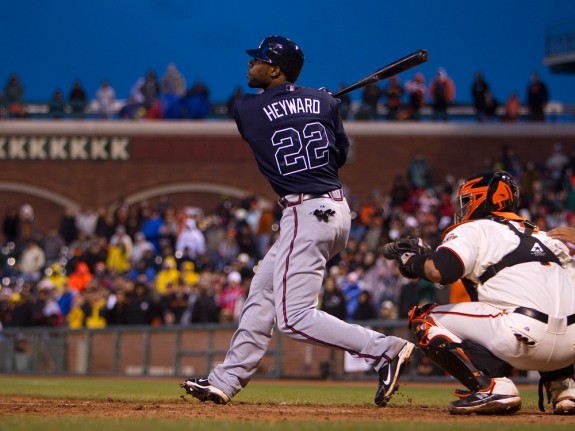
I’ll confess that I wasn’t a Heyward believer after his breakout 2010 season and felt super proud of myself for calling his 2011 regression. Didn’t I look silly in 2012? Heyward has a few trouble spots in that his plate discipline is actually getting worse each season, but he hits for power, plays elite defense, and runs the bases extremely well. On offense alone, he’s in the middle of this list, but he’s so good in the field and on the bases that he vaults himself up to the top. He’s also only 23 and has three seasons under his belt. He’s poised to lead the Braves back to the fake playoffs or better in 2013 with the Upton brothers to his right, and looks to be baseball’s best right fielder in the process.
What do you think? How does your top four look? Sound off in the comments section.
The Nine Best Center Fielders for 2013
As we do every week here at STT, we present lists of things ordered by the nines and on this Saturday, it’s a list of The Nine Best Center Fielders for 2013.
On this list, you’ll find a couple of center fielders have gone missing as they no longer play the position. If you’re looking for Mike Trout and Bryce Harper, for example, try the left field list. Beyond that, I found this list to be a bit convoluted and had a difficult time doing the rankings. A lot of players are left off who could easily be in the 7-9 range and lots of players who are on the list could easily end up somewhere else on the board.
Apologies to: Justin Ruggiano, Dexter Fowler, Brett Gardner, Jacoby Ellsbury.
9. Adam Jones (Orioles)
Jones hits for power and average and has decent speed, but his plate discipline is suspect. He’s also less than stellar on defense according to the metrics, but coaches seem to like him as they gave him a gold glove last year over the great Mike Trout. He’s a good player, but he’s not a complete player.
8. John Jay (Cardinals)
You could probably attack this choice more any other because Jay doesn’t hit for power and doesn’t have one eye popping skill. But Jay hits for average, runs the bases pretty well, and plays solid defense. It’s more of gut feeling here than anything, but I like Jay to break out this year. Entering his prime years on a great team, I’m buying.
7. B.J. Upton (Braves)
Upton will play between his brother and Jason Heyward on a good all-around team. He’s a solid defender who hits for power and runs well to mix with a good approach at the plate. He has a swing and miss problem and a lowish batting average, but he’s a good bet for 3 to 5 WAR.
6. Peter Bourjos (Angels)
The speedy, defensive star put up a 4.5 WAR season when he got a full season as a starter in 2011 and has two 2+WAR season in a backup role in 2010 and 2012. He doesn’t light up a lot of the traditional stats, but he plays amazing defense and runs as well as anyone. He’s worth the price of admission on defense alone and could easily be a top five centerfielder if he has a moderately good offensive year.
5. Denard Span (Nationals)
Span is a great defender who doesn’t strikeout much and gets on base better than average for a centerfielder and runs well. If he can stay healthy, he’ll be great at the top of the Nationals lineup and between Werth and Harper. With his concussion history hopefully behind him, he should be in for a big year.
4. Michael Bourn (Indians)
Bourn may be aging, but he’s coming off four very good seasons and is a top tier defensive player. He’s a top flight runner and gets on base well. Four years from now, the Indians might not want to pay him $12 million a season, but for 2013, he’s still one of the very best centerfielders money can buy.
3. Matt Kemp (Dodgers)
Kemp’s 2011 season was one for the ages and his 2012 started off on the same pace but was cut down by injuries. That’s the only reason Kemp isn’t #1 on this list. I’m just not sure he’ll play a full season. His defense could use some work, but on offense, a healthy Kemp is as good as they come. If he was coming off a less serious set of injuries I would be more likely to brush them off, but I’m doubtful Kemp can play 150 games for a team with big expectations in 2013.
2. Andrew McCutchen (Pirates)
McCutchen is one of baseball’s best players. He mixes speed, power, and plate discipline and was one of baseball’s most valuable players in 2012. He has four very good seasons under his belt and is only held back by averageish defense. There is some debate about his skills in center, but all in all there isn’t much bad to say about the Pirates’ star.

1. Austin Jackson (Tigers)
Now before I’m accused of bias in favor of my favorite team, go back and look at Jackson’s 2012 season. He was better than Bourn in every major category excepts steals and defense, but he also missed 25 games with an injury. He cut down on his strikeouts, walked more, and hit for more power. He’s a great defender and is a year younger than McCutchen. Despite missing time with an injury that has completely healed, Jackson was third in centerfield WAR among players who still play the position and less than 2 WAR behind McCutchen. I’m buying another step forward for Jackson in 2013 toward something like a 6-6.5 WAR player and modest regression by McCutchen. This isn’t to say Cutch is in decline, but rather that 2012 was simply his career year. It will be hard to reproduce that peak, so Jackson might catch him in 2013. This might be a bit bold, but I’ll stick to it. Jackson is my pick for the best centerfielder in baseball for 2013.
Sound off in the comments and online about the merits of this list. Should you want your money back because it was terrible, try to remember this site is free, unlike ESPN Insider, which charges you to read mostly terrible commentary.
 New English D