A Brief Note of Warning to Cleveland Outfielders
Anthony Castrovince of MLB.com wrote a piece recently wondering if any AL Central team could challenge the Tigers for the division title and specifically referenced the Indians acquisition of Michael Bourn and Drew Stubbs this offseason, which provides them with a great deal of speed. But the Tigers’ returning DH and former catcher has a word of warning for the base swiping inclined Indians outfielders.
“They gotta do better than Michael Bourn,” said a smiling Victor Martinez, before gesturing toward catcher Alex Avila. “We’ve got some policemen who give tickets to people who go from first to second!”
It’s a wonderful note of support from V-Mart about Avila, but is it accurate? We know catcher defense is the most difficult defense to measure and clunky things like fielding percentage and caught stealing percentage just don’t do it.
The best we have so far is Defensive Runs Saved (DRS). If we accept DRS as the best we can do without detailed scouting reports, how does Avila stack up?
In 2012, he was tied for fourth best in baseball with 6 DRS at catcher trailing Ryan Hanigan (7), Salvador Perez (9 in 653 innings), and Yadier Molina (16).
So, don’t trying anything Indians or you’ll have to deal with this.
Little Uncertainty About the Tigers Opening Day Roster, Two Spots Open
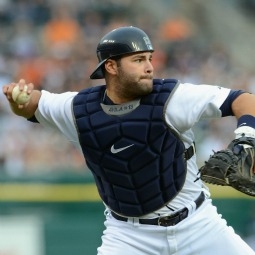
Jim Leyland said this week that 11 of the 13 spots on his roster for position players are all but locked up. Which, in turn, means that there are only two spots left for a number of candidates.
If we assume that the 11 spots belong to Avila, Pena, Martinez, Fielder, Infante, Peralta, Cabrera, Jackson, Hunter, Dirks, and Santiago then the remaining two spots will go to Brennan Boesch, Quintin Berry, Avi Garcia, Danny Worth, Don Kelly, or Jeff Kobernus. Of course someone else could have an insane spring and get into the conversation, but these six are the likely contenders.
So how should the Tigers allocate their remaining roster space?
I think it’s unlikely that Garcia makes the Opening Day roster as a reserve outfielder because the Tiger are committed to developing him and he’ll gain more from 600 minor league at bats than 250 big league ones.
From there, we should probably look to positional considerations. Worth and Kobernus can both play infield, but Worth is a better glove and based on his minor league numbers I don’t see Kobernus as offering anything extra at the plate. An important consideration, however, is that Kobernus can also play the outfield and was a rule five pick, which could push him into a Don Kelly 25th man type role from the right side of the plate. If the Tigers were going to do that, they might as well go with Kelly who is even more versatile.
The Boesch versus Berry decision depends on a number of factors. First, who is playing better? Both players have shown flashes of a skill set that can help in the majors and they both hit left handed, so whoever is swinging a hot bat will have a leg up. Boesch provides an element of power and Berry brings speed to the table but neither get on a base at a high rate and both are defensive liabilities.
If the Tigers are committed to keeping Garcia in the minors, then Boesch is the only one on this list who can bring any sort of power off the bench, but he’s also the least flexible player. He can only play corner outfield and doesn’t do it well. Berry can play center and Kobernus, Kelly, and Worth can all play three or more spots.
Given the strength of the Tigers starting group and relatively weak infield defense, I would argue on behalf of Danny Worth for spot number 12 on the roster. He plays good defense and runs well enough to pinch run late in games for Peralta, Avila, or Fielder if the time is right. He doesn’t have Berry’s game changing speed, but he runs the bases well and catches the baseball.
For spot 13, I would go with Boesch. His skill set is limited, but the Tigers won’t ask him to do more than start once a week or so. If he gets rolling, his offensive ceiling is the highest and he could provide some solid value. If he doesn’t do anything, then at least they tried and they can shift to Berry or Kelly or Kobernus who will give a move certain performance, but likely with a lower potential breakout.
I’m a big Kelly supporter because I like all of the things he can do and he’s one of the nicest people on Earth, but the Tigers need to see if they can get anything else out of Brennan Boesch before they decide to call it quits. If the Boesch experiment fails, Kelly can jump right in and play the role he’s had for the last couple seasons.
What we have to remember here is that neither of these last two players is going to see a lot of the field, so the impact of each choice is very small. Worth seems like a smart call for me because of his defensive skill and I’d go with Boesch because you might get a few weeks of greatness.
There is still plenty of camp left for this to sort itself out, but for now, I’d tell Jim Leyland to put Worth and Boesch on his list to head north and see how it goes.
2013 Preseason Power Rankings: 10-1
Over the last two days, SABR Toothed Tigers has released our 2013 MLB Preseason Power Rankings 30-21 and 20-11. Today, we complete the series and take you all the way through number one.
Remember, this list is designed to represent the expected performance of each team in 2013, but not necessarily the win totals of each team. For example, I project the Red Sox to be a better team than the Pirates but I expect the Pirates to win more games as a function of their league, division, and better relationship with an almighty deity than the team from Boston. Check back tomorrow for my Preseason Standings Prediction.
10. St. Louis Cardinals
The Cardinals are a very deep team with talent at about every position. The middle infield is a bit iffy going forward but those are two of the less important offensive positions and the rest of their lineup more than makes up for it. The rotation is a good mix of veterans and talented youngsters and the bullpen has a lot of exciting pieces. Nothing about the Cardinals makes me say “wow!” but everything about them makes me think they’re a very good team. I also can’t ignore the incredible comebacks/magic/voodoo/etc of the last two seasons. It’s usually not right to expect weird things to keep happening like that, but I’m not really looking to tempt fate.
9. Los Angeles Angels
The Angels are an interesting team because I can talk myself into a lot of different places on this list for them. Probably more so than any other team expect the Dodgers. They added Josh Hamilton, but lost Torii Hunter who was worth more than Hamilton in 2012. They’ll have an everyday role for Peter Bourjos who is among the very best defensive players walking the Earth and Albert Pujols likely won’t struggle as much as he did last April in any month of 2013. In just looking at the offense and defense, I would imagine the Angels should be about as good in 2013 as they were in 2012. But the pitching looks a lot worse. Jered Weaver should be the same as always and CJ Wilson likely won’t improve upon his 2012 numbers because he simply isn’t that good. After them, instead of Greinke or Haren, you have Joe Blanton, Tommy Hanson, and stuff. This rotation is pretty good if you want to win 80 games, but I think it’s awful if you want to win 95 like the Angels do. This team has the best player in the league (Trout), the best player of his era (Pujols), and a player with an impossibly high ceiling (Hamilton), but I just can’t bring myself to bet any higher on them with such a suspect pitching staff.
8. Toronto Blue Jays
The Blue Jays did excellent work this offseason adding Melky Cabrera, Jose Reyes, Josh Johnson, Mark Buehrle, RA Dickey, and others. They are a much better team than they were in 2012 and could also get a full season from Jose Bautista. Even with expected regression from Edwin Encarnacion, this should be a team that scores runs and pitches well. I think they’ll be right in the thick of the AL East race and should also contend for a wild card. My reservations about placing them higher deal with a lot of injury question marks. Bautista is recovering from a wrist injury and hand and wrist injuries tend to have a negative effect on power. I’m not saying he’ll have a down season, but I think it’s more likely than it was before he got hurt. Additionally, while I think Josh Johnson is fantastic, he is also very fragile. Who knows what Melky Cabrera can do without the help of PEDs? Brandon Morrow missed significant time last season. Something was obviously wrong with Ricky Romero, right? So while on paper this is a talented team with a great chance at October baseball, there are concerns large enough to keep them at number eight.
7. San Francisco Giants
The Giants return an excellent pitching staff and good defensive club. A full season of Scutaro and Pence should be a marginal improvement, but losing the great “wind-aided” performance of Melky Cabrera will hurt with no clear replacement lined up. If Pablo Sandoval is healthy and Brandon Belt is allowed to do his thing without interference from a silly manager, this team should be on par with last year’s division winning club. It’s a good bullpen and the park tends to work in favor of the team’s design, so I’m willing to bet the Buster Posey led Giants are making another deep run into the postseason.
6. Cincinnati Reds
The Reds should have no trouble winning the NL Central if they are able to remain as healthy as their counterparts. They have the amazing Joey Votto at first and an average to above average player pretty much everywhere. They rotation remained perfectly intact last year and Aroldis Chapman is coming to help them out even more in 2013. With the addition of Choo, the maturing of Cozart and Fraizer, and the continued success of Bruce and Phillips, I can’t really see a glaring whole other than defense in centerfield. This is an all-around good club.
5. Texas Rangers
A lot of people are down on the 2013 Rangers because they didn’t sign or trade for any of their big offseason targets, but I think that means they’re very underrated. If we look at the 2012 Rangers as a pretty true 93 win club who had a bad week at the end, when we compare them to the 2013 version, they hold up great. The pitching should be essentially the same with perhaps a better performance by the adapting Darvish. On offense, they dropped Michael Young’s negative WAR at DH for Lance Berkman and will return everyone else except Josh Hamilton and Mike Napoli. Top prospects Jurickson Profar and Mike Olt can easily combine with Craig Gentry and Leonys Martin to approximate the ~4WAR season of Josh Hamilton and AJ Pierzynski steps in to replace Napoli who had a down year on a team that won 93 games. While it can be said that the Rangers missed out on getting a lot better, they also failed to really get worse. This is the overlooked team of the year if you’re into making those types of wagers.
4. Atlanta Braves
The Braves added a lot this offseason (see: Uptons, all) but they also lost a good amount in Chipper Jones and Martin Prado. I like Andrelton Simmons and Freddie Freeman to breakout in compliment with Jason Heyward and the Upton brothers. The starting pitching is deep and the bullpen is second to none. The Braves aren’t the most exciting team in the league to me, but I think they have the highest floor. It’s hard for me to imagine them having much worse than an upper 80s win season.
3. Tampa Bay Rays
I’m higher on the Rays than most because I’ve seen them over-perform too many times not to believe. Their starting pitching is in the top five and their bullpen always works. They’ve added Kelly Johnson and Yunel Escobar on offense and are hoping for a full season of Evan Longoria to go with the soon to be called up Wil Myers. Top to bottom, the Rays are probably in the 6-10 range as far as talent goes, but they are so well run from top to bottom, that they will get more out of that talent than the other teams on this list.
2. Detroit Tigers
The 2012 Tigers underperformed and won 88 games. In 2013, they will add Victor Martinez and Torii Hunter and a full season of Omar Infante and Anibal Sanchez. They lost nothing of substance from the roster should get at least modest bounce back seasons from Jhonny Peralta and Alex Avila. That is all by way of saying, it’s hard to see how they aren’t one of the surest bets in the league for 2013. 90 wins should be safe and 95-100 is a real possibility given the level of competition they face. They own baseball’s best rotation 1-5 and their only weaknesses are infield defense questions and bullpen uncertainty. And almost everyone has bullpen uncertainty so I can’t really hold that against them. Looking at the Tigers on paper, it’s hard to see how the defending AL champs won’t get a shot to play in October once more.
1. Washington Nationals
The Nationals earn this spot through logic similar to that which put the Tigers at number two. They added Denard Span, Rafael Soriano, and Dan Haren and lost only Edwin Jackson. With an unlimited Stephen Strasburg and a more experienced Bryce Harper, there isn’t an argument to be made that the Nats got worse for 2013. Granted, any team can collapse and underperform, but there is no reason to think the Nationals are any more likely to do so than any other team on this list. If the Nationals stay as healthy as their competitors in 2013, they should once again be baseball’s best team.
Tell us what you thought of the 2013 Preseason Power Rankings series in the comments, on Twitter, on Facebook, or via the United States Postal Service. Check back tomorrow for STT’s projected standings.
The Book on Prince Fielder
What Other People Think:
No one would question Prince Fielder as an offensive force. He hits for power, has excellent plate discipline, and has improved his ability to limit strikeouts over the last couple seasons. He’s a top flight slugger. He tends to get downgraded for his below average defense and often comical running of the bases, but at the plate, there is little disagreement about his ability.
To the general populace, Fielder is a top five first basemen and usually only trails the great Joey Votto and Albert Pujols. He’s an all-star level player who is better defense short of the MVP conversation.
But he is working on it. Someone I know who was down in Lakeland last spring reported that Fielder spent extra time with Tom Brookens working on his glovework and the same person told me that Fielder was not only hard at work, but was extremely receptive to Brookens’ teaching. Fielder might never be a good defensive player, but I like that he’s trying to improve his defense to go along with a bat that everyone respects.
What the Numbers Say:
Prince is more or less a model of consistency. He’s never played fewer than 157 games since his first full season and is a virtual lock for .270 or better with 30 or more homeruns. Fielder has never walked less than league average and is often near the top of the leaderboard in that category.
By looking at his stat page, it is clear that Fielder is a power hitting force with great plate discipline and an improving hit tool. The baserunning and defensive numbers are discouraging, but they are not so terrible that one would demand he become a DH.
What My Eyes Tell Me:
Over Fielder’s first six seasons I watched him from afar and generally knew no more about him than I did any other non-Tigers player. I saw him during interleague play and on highlight reels in addition to the occasional random game during a Tigers off day, but I never got the chance to watch him day in and day out.
Let me tell you, it was eye opening. I knew he could hit for power, but I never realized how talented he was as a pure hitter. While he does swing and miss on occasion, he is not a power hitting whiffer like Adam Dunn or Mark Reynolds. Fielder has exceptional hand eye coordination and is actually a very good contact hitter despite a body type that says otherwise.
About that body type. Everyone seems to think he’s going to break down and age poorly because of his size, but in seven years, he’s never missed more than five games in a season. He moves pretty well for someone of that size and absolutely never dogs it on the field. He’s giving max effort 162 games a year and doesn’t get hurt. I’m not going to worry about his size until he gives me a reason to.
Fielder’s glove is a bit of a liability, but I know that he is working on it. He’s never going to be a star on defense and we should all accept it. On the bases, he’s a bit of a wild card. He’s always hustling, which I appreciate, but he can sometimes run into outs and get hosed due to his limited horsepower.
That said, the offensive performance is fantastic and I value his leadership and personality in the clubhouse. Fielder is definitely a well-adjusted, relaxed guy who doesn’t take plays and games off. He isn’t the perfect player, but we can’t all be Mike Trout. I really like what Fielder brings to the table and was surprised to see how much of a complete hitter he was when he joined the Tigers last season.
The Dotted Line:
Let’s see. Year two of a nine year, $214 million deal. As long as no one runs out of checks, Fielder’s contract isn’t much of a story. He’ll be with the club for years to come.
Fantasyland:
Fielder is a player who is worth more to the fantasy owner than he is to the real one because Fielder’s iffy defense won’t hurt you in a standard league. He provides great value at every category except steals which should make him a top two or three round guy. Grab him if you can.
The Lead:
Prince Fielder is an excellent hitter who mixes power, contact, and plate discipline in a very effective manner. Despite his poor defense and questionable baserunning, he’s a perennial all-star type player who appears to have a positive effect on the clubhouse and the city. He’s as durable a player as there is in the game today, and if he keeps that up, he’ll be a centerpiece of every Tigers team for the next decade.
King Felix Cashes In, Justin Verlander Comes Next
Felix Hernandez is a starting pitcher for the Seattle Mariners baseball club. He is now, also, the owner of the largest contract every given to a starting pitcher. The details of the deal are 7 years, $175 million. This contract will replace the final two years of his current deal and will carry through the 2019 season, paying out at $25 million per season.
So while this is the biggest contract in history for a pitcher, it absolutely should be. He’s one of the best four or five pitchers in the league and is entering his age 27 season. If every pitcher signed a one year deal before 2013, Felix would certainly be among the top handful by dollar amount and his relative youth compared to most free agent starting pitchers means a seven year commitment doesn’t take you very far into his decline years, as does a contract that a player signs at 30 or 31.
Felix is among the game’s best and most durable starting pitchers, having never been on the DL and throwing over 230 IP in each of the last four season to go along with four straight 5+WAR seasons. The Mariners want him anchoring their rotation for years to come.
Any big contract for a pitcher is a risk, but if you’re going to offer them, you want the deal to be going to a player on the right side of thirty with no injury history and a consistent and high level of performance. Felix meets all of those criteria and is the unquestioned face of the Mariners. This is the deal you sign when all of those things are going in your favor.
Let’s ponder briefly what this means for Justin Verlander who is on the same free agent clock. Verlander is three years older, but has been better over the last four seasons than Felix and has been no less durable. It’s probably safe to say that Felix and JV are the too safest bets as far as durability and sustained performance are concerned.
Verlander’s age will be a factor, but he also plays for a higher spending club and is at least marginally better than Felix. He will also sign his deal after Felix and could do so a year closer to free agency or while on the free agent market. Even if you think Felix is a better bet from a cost benefit standpoint over the next seven seasons, Verlander is the type of player who will attract more money because he’s a more dynamic and recognizable player and his ceiling is likely higher in the opinion of most baseball people.
Both players are Hall of Fame caliber players if they maintain their career paths and if the Tigers want to make JV a Tiger for life or some other team wants to pry him from the Tigers hands, it’s going to take a lot of cash.
Right or wrong, he’ll end up with more than Felix. Here are my estimates:
Signs before Opening Day 2013: 8 years, $210 million
Signs before Opening Day 2014: 7 years, $210 million
Signs as Free Agent after 2014 season: 6 years, $200 million.
As it appears, I’m confident that barring a serious injury, Verlander will be baseball’s first $200 million arm.
Porcello, Smyly, and Never Having Too Much of a Good Thing
An issue of some contention this offseason has been what to do about the Tigers surplus of starting pitchers. You see, the Tigers have six of them and only five slots in the rotation. Many fans and commentators have characterized this as a problem, but it really shouldn’t be thought of in this way. Seriously, when is having too many good players a problem?
Following said belief about having too many starters, these same people have often advocated for trading Rick Porcello. The reasons for dealing Porcello are straightforward. First, his contract is heavier than Drew Smyly’s, so the team could reallocate more cash if they deal Porcello instead of Smyly. Second, fans perceive Porcello as an inferior pitcher to Smyly or at least less valuable because he doesn’t throw with his left hand.
I, however, am here to discuss this situation in a different way. The Tigers should keep both Rick Porcello and Drew Smyly.
Let’s first lay out the possible options:
A) Keep both
1) Porcello starts, Smyly relieves
2) Smyly starts, Porcello relieves
3) Porcello starts, Smyly starts in AAA
B) Trade one
4) Trade Porcello
5) Trade Smyly
When we look at it with all of the options in front of us, it’s much easier to see which make the most sense. I would argue that Option 3 is the ideal one for three primary reasons.
Reason 1: The Tigers gain little by trading either player. There is no one on the trading block right now who they could get for either pitcher that would improve the 2013 club. The Tigers could add a prospect or add depth at another position, but they can’t get better in the short run given the options. The team wants to win now. Why should they trade their pitching depth, which is lacking after Smyly and Porcello, when they will likely need it at some point in 2013?
Reason 2: Smyly should start so that he can continue to develop. If the team moves him to the pen, they are likely stunting his growth for the long term.
Reason 3: I think Porcello is better than Smyly for 2013. Porcello has four 2-3 WAR seasons already and has never missed a start due to injury. His strikeout numbers have trended up each season with his walk numbers coming down. His FIP has dropped every season of his career. He’s also still just 24 years old – at least 2-3 years before the average pitcher peaks. Porcello could easily be a 3+WAR pitcher in 2013 and has shown no reason to think he will break down and every reason to think 2013 will be his best season so far.
Smyly, on the other hand, is not nearly so well defined. He’s only a year younger and has less than twenty major league starts and less than fifty professional starts. His rate stats are quite good and he easily looks to be a promising young player, but he hasn’t pitched enough to know these things. Smyly has an injury history and less experience. I’m not sure which pitcher will be better in for their career, but Porcello has a big head start and is a much more certain quantity. There are always things that you don’t see coming, but I’d rather be predicting off four years of data than less than one.
If we merge those reasons together, we’re left with Option 3. This gives the Tigers depth should one of their pitchers get injured and it allows Smyly to develop for the day that he is called upon to be full time starter. The Tigers lose nothing in keeping both pitchers for the start of the 2013 season except the opportunity cost of the trade they could make right now – but none of those trades look that great.
The Tigers should keep Porcello and Smyly for 2013 and start with Porcello in the rotation and Smyly leading the Mud Hens staff. They can always adjust from their throughout the season, but you can’t untrade Rick Porcello if Max Scherzer blows out his elbow in May.
Does Andy Dirks Need a Platoon Partner?
What often happens when a team has relatively few holes to address during an offseason is a lot of attention gets placed on minor needs. One of these needs in Detroit, has been a right handed hitting outfielder to match with Andy Dirks in a platoon situation.
The feeling among many is that this is one way the Tigers could improve their club heading into 2013, and it is also a way to improve the club that most perceive as possible. Finding a right handed hitter to man the weak side of a platoon is easier, for example, than finding a shortstop that is both available and an upgrade over Peralta.
So we’ve spent a good bit of the winter wondering who the Tigers could target to compliment Dirks. Scott Hairston was a logical fit, but he ended up signing with the Cubs for two years because they could offer him more in terms of playing time than the Tigers could.
But I think we’ve gotten a little too caught up in finding a dance partner for Dirks that we’ve overlooked the fact that he probably doesn’t need one. We’ve been looking for a match for him because there’s nothing else we even remotely need on offense, but we actually probably don’t need this either. The only place the Tigers really have room to upgrade is the bullpen and that only relates to Dirks in that he will be standing in front of it when he man’s left field.
Why is it that I say we don’t need a platoon partner for Dirks? Well, it’s because he can hit lefties just fine. Let’s explore the numbers.
Dirks has played 166 games in his career spawning 579 plate appearances. We’re working with about a full season of information that has covered parts of three seasons. Unfortunately, I can’t get splits data from his minor league career, just total numbers, so that can’t be included right now.
But let’s look at his big league breakdown:

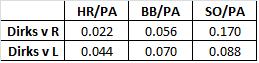
So if we look at that, Dirks is pretty much just as good against righties and lefties. He gets on base a little more versus lefties and hits with a little more extra base power against righties. But he hits more homeruns on average against lefties, walks more against lefties, and strikes out less against lefties.
According to Baseball-Reference’s tOPS which weighs each side, he scores 100 against righties and 99 against lefties, meaning that he is a one percent better hitter against righties. That doesn’t sound like a big platoon split to me. In fact, one would hardly consider that a platoon split at all. What are the odds both sides are perfectly identical.
From both sides, Dirks appears to be a capable major leaguer. But even if you don’t buy into Dirks yet and worry about the sample size, that should affect your opinion of him against all pitchers, not just one side of them. Dirks shows no discernible platoon split during his big league career.
So while we’re dying to find Dirks a buddy to play with out in left field, he doesn’t need one. Dirks can handle that position all on his own.
I generally think we overvalue platoon advantages. Don’t get me wrong, a lot of hitters weight to one side or the other, but I don’t think we should accept it as a given that hitters hit worse against their same side pitcher. I think that hitters who aren’t top flight prospects are often pigeonholed into a role that assumes they can’t hit one side before they actually display evidence of this shortcoming, and that pigeonholing puts them in a position in which they get fewer at bats against their “weaker” side, which means they actually develop a weakness because of a belief that may have not been true.
I’m not sure how to demonstrate evidence of this, but I think it’s happening. At any rate, I can and did show evidence that Dirks does not appear to be weaker against lefties. So in this case, at least, Dirks doesn’t need a dance partner and the Tigers can stop looking.
The Book on Miguel Cabrera
What People Think
So this should be pretty easy. The prevailing opinion on Cabrera is that he is among the best hitters in baseball. It is, in fact, that simple. Cabrera is no magician with the glove and he’s not fleet of foot, but he is a supremely talented hitter who does an adequate job at third base for someone who is better suited to play first.
What the Numbers Say
The numbers tell a story about Miguel Cabrera, and boy is it a doozy. I think the best way to demonstrate what his numbers say about him is this:
Here are three stat lines.
1) 37HR, 85R, 127RBI, .292/.349/.537
2) 33HR, 101R, 118RBI, .318/.395/.561
3) 44HR, 109R, 139RBI, .330/.393/.606
The first line is a representation of his worst big league season. The second is his average career line. The third was 2012. So what the numbers tell you is that Miguel Cabrera is at worst, an all-star caliber player, on average an MVP level player, and at best, a Hall of Fame type player.
What My Eyes Tell Me
I don’t think there’s any question that Cabrera is among the best hitters in the game. You can tell that by watching him or looking at his numbers or listening to anyone who knows anything.
What I see in Cabrera is an extraordinary talent driven by brute strength and exceptional hand eye coordination. Cabrera hits baseballs as hard and as purely as anyone I think I’ve ever seen in person. Everyone knows about his light-tower type power, but I’m more amazed by his ability to put force behind difficult pitches and shoot them between fielders for base hits. He seems capable of recognizing pitches a fraction of a second earlier than most anyone and he uses that to his advantage. Obviously he guesses wrong sometimes, but he’s among the best in the game at pitch recognition and reaction to said recognition. It shows.
On the bases, I actually think he’s pretty good at taking extra bases for someone who is as slow as he is. He knows what he’s doing, even if he can’t always capitalize on it. In the field, his arm is superb and his hands are good enough to play for me at third. His range is iffy, but I think his shortcomings are somewhat overstated. He’s not great, but I don’t think he’s terrible. In fact, I thought he was on his way to becoming a very good first baseman before the position change, so I can’t give him too much grief about not being an elite defender.
The Dotted Line
Cabrera’s contract runs through the 2015 season and will pay him $21M in 2013 and $22M in 2014-15. He’s certainly earning the 8 year, $153 deal he signed before 2008 considering the cost of a long term deal these days. The Tigers should be in no hurry to extend him as he is signed through his age 32 season, three years away. If he performs at a similar level for the next couple seasons, he could easily break the bank, but it’s too early to go there.
He’s a perennial MVP contender on a team dedicated to winning, and could easily be on his way to a Hall of Fame career. Those are generally the players who try to keep in your uniform for their entire careers, but the time for that discussion is later.
Hypothetically, if he was a free agent right now, I don’t think 10 years, $280M+ would be out of the question at all. If the Tigers were looking to extend him, say another five years, the price would easily be in the $150M+ range.
Fantasyland
If you play fantasy baseball, draft him in the top five. He does everything at an elite level expect steal bases and is among the game’s most consistent performers. Draft him.
The Lead
Miguel Cabrera is one of the game’s best hitters and remains in his prime. We’re probably in for several more elite seasons and potentially a Hall of Fame plaque. He’s not the game’s best defender and he has a history of off the field issues (that we hope are over), but in spite of all of that, he’s probably one of the most valuable players in the game today.
2012 Season in Review: American League Central
The AL Central produced the MVP, pennant winner, and Cy Young runner up in 2012, but other than that, it wasn’t the most exciting year for baseball’s most made fun of division. Sure the Tigers boast a lot of stars and Phil Humber threw a perfect game, but that didn’t earn them a lot of respect.
Here’s how the final standings shook out:
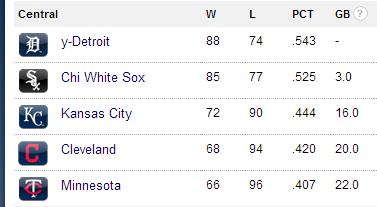
And this is how it played out over time:
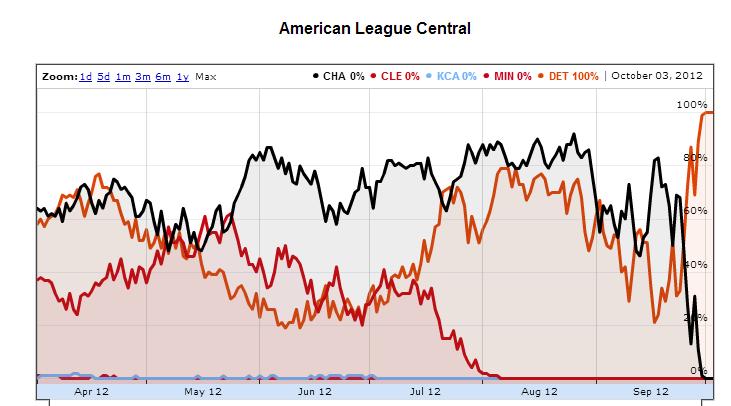
Followed by my 2013 projections:

And a final look at my 2012 grades:

AL Central MVP: Miguel Cabrera
AL Central Cy Young: Justin Verlander
2012 Season in Review: Detroit Tigers
88-74, 1st in the AL Central
Lost in the World Series to the Giants
It was a banner year for the Tigers, the hometown team of this website. There was a great deal of fan angst about the club’s performance for much of the summer which fans felt was lackluster (the performance, not the summer). However, the team won the division and the AL pennant and produced the AL MVP and Cy Young runner up. Could the team have played better? Sure, every team could. But the Tigers had a great season on the backs of great performances.
Miguel Cabrera won the MVP and Triple Crown in 2012 and posted an excellent (7.1) WAR. Despite the media narrative, he didn’t carry the team on his own. Austin Jackson, who missed time with an injury, tallied 5.5 WAR as well. Prince Fielder (4.9), Jhonny Peralta (2.6), Alex Avila (2.6 in 116 games), and Andy Dirks (1.6 in 88 games) all did their part too. The Tigers were among the best offenses in baseball by any measure even with two of baseball’s worst regulars, Delmon Young and Brennan Boesch getting lots of at bats.
If the offense was good, the pitching was awesome. Led as always by all-universe ace Justin Verlander (6.8), the Tigers staff dominated. Max Scherzer (4.6) broke out and Doug Fister (3.6 in 26 starts) followed up his ridiculous final two months of 2011. Rick Porcello (2.9), despite fan opinion, was among the game’s best backend starters. Drew Smyly (1.7 in 18 starts) was also very good as a rookie fifth starter when he was healthy. For the last two months of the season, Anibal Sanchez (1.4 in 12 starts) wore the Old English D as well and contributed greatly.
The bullpen was volatile. Dotel did his job most nights and Villarreal and Benoit went through very hot and very cold streaks. Valverde had a typical high save, low value season. It wasn’t a lockdown pen, but it was certainly good enough.
The Tigers shot out of the gate in early April before stumbling heavily in May. By the All-Star break they were back near the front of the division, but couldn’t quite take control. It looked like the White Sox were going to hold them off until a late September surge pushed them over the edge. A five game series win against the A’s in the ALDS preceded a quick four game sweep of the Yankees in the ALCS. The World Series didn’t go well, but the Tigers outlasted 28 other teams in 2012.
Some big names had big years while some supporting players had down years off their 2011 highs. In general, the Tigers underperformed their regular season expectations as a whole, but they stood atop the AL when it was over.
The cavalry is coming in 2013, too. A full season of Anibal Sanchez will improve the club and subbing in Torii Hunter for Brennan Boesch is certainly a few win swing as well. Victor Martinez should be back at full strength to replace the Delmon Young shaped whole in the Tigers batting order. Infante spend a full year at second in lieu of a mix and match. It’s also not unreasonable to expect a bit of a bounce back from Avila and Peralta, probably not to their 2011 highs, but somewhere about 2013.
Put that all together, and the Tigers could easily be 10-15 wins better. That would be a huge improvement and certain return to the postseason. But that of course, assumes no one will get hurt and no one will regress from 2012. It’s certainly reasonable to assume a 5-7 win bump for the team in 2013.
So after two straight postseason berths and an AL pennant, the Tigers will enter 2013 with a chance to win the big prize.
2012 Grade: A
Early 2013 Projection: 92-70
 New English D