King Felix Cashes In, Justin Verlander Comes Next
Felix Hernandez is a starting pitcher for the Seattle Mariners baseball club. He is now, also, the owner of the largest contract every given to a starting pitcher. The details of the deal are 7 years, $175 million. This contract will replace the final two years of his current deal and will carry through the 2019 season, paying out at $25 million per season.
So while this is the biggest contract in history for a pitcher, it absolutely should be. He’s one of the best four or five pitchers in the league and is entering his age 27 season. If every pitcher signed a one year deal before 2013, Felix would certainly be among the top handful by dollar amount and his relative youth compared to most free agent starting pitchers means a seven year commitment doesn’t take you very far into his decline years, as does a contract that a player signs at 30 or 31.
Felix is among the game’s best and most durable starting pitchers, having never been on the DL and throwing over 230 IP in each of the last four season to go along with four straight 5+WAR seasons. The Mariners want him anchoring their rotation for years to come.
Any big contract for a pitcher is a risk, but if you’re going to offer them, you want the deal to be going to a player on the right side of thirty with no injury history and a consistent and high level of performance. Felix meets all of those criteria and is the unquestioned face of the Mariners. This is the deal you sign when all of those things are going in your favor.
Let’s ponder briefly what this means for Justin Verlander who is on the same free agent clock. Verlander is three years older, but has been better over the last four seasons than Felix and has been no less durable. It’s probably safe to say that Felix and JV are the too safest bets as far as durability and sustained performance are concerned.
Verlander’s age will be a factor, but he also plays for a higher spending club and is at least marginally better than Felix. He will also sign his deal after Felix and could do so a year closer to free agency or while on the free agent market. Even if you think Felix is a better bet from a cost benefit standpoint over the next seven seasons, Verlander is the type of player who will attract more money because he’s a more dynamic and recognizable player and his ceiling is likely higher in the opinion of most baseball people.
Both players are Hall of Fame caliber players if they maintain their career paths and if the Tigers want to make JV a Tiger for life or some other team wants to pry him from the Tigers hands, it’s going to take a lot of cash.
Right or wrong, he’ll end up with more than Felix. Here are my estimates:
Signs before Opening Day 2013: 8 years, $210 million
Signs before Opening Day 2014: 7 years, $210 million
Signs as Free Agent after 2014 season: 6 years, $200 million.
As it appears, I’m confident that barring a serious injury, Verlander will be baseball’s first $200 million arm.
2012 Season in Review: American League West
The West was won on the final day of the season. Mike Trout unleashed greatness. Other things happened. But mostly the first two. Here are some final info-graphs about baseball out west.
Final Standings: 
Playoff Odds:

Early 2013 Projection:

Final 2012 Grades:
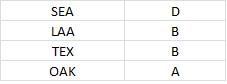
AL West MVP: Mike Trout
AL West Cy Young: Felix Hernandez
Porcello, Smyly, and Never Having Too Much of a Good Thing
An issue of some contention this offseason has been what to do about the Tigers surplus of starting pitchers. You see, the Tigers have six of them and only five slots in the rotation. Many fans and commentators have characterized this as a problem, but it really shouldn’t be thought of in this way. Seriously, when is having too many good players a problem?
Following said belief about having too many starters, these same people have often advocated for trading Rick Porcello. The reasons for dealing Porcello are straightforward. First, his contract is heavier than Drew Smyly’s, so the team could reallocate more cash if they deal Porcello instead of Smyly. Second, fans perceive Porcello as an inferior pitcher to Smyly or at least less valuable because he doesn’t throw with his left hand.
I, however, am here to discuss this situation in a different way. The Tigers should keep both Rick Porcello and Drew Smyly.
Let’s first lay out the possible options:
A) Keep both
1) Porcello starts, Smyly relieves
2) Smyly starts, Porcello relieves
3) Porcello starts, Smyly starts in AAA
B) Trade one
4) Trade Porcello
5) Trade Smyly
When we look at it with all of the options in front of us, it’s much easier to see which make the most sense. I would argue that Option 3 is the ideal one for three primary reasons.
Reason 1: The Tigers gain little by trading either player. There is no one on the trading block right now who they could get for either pitcher that would improve the 2013 club. The Tigers could add a prospect or add depth at another position, but they can’t get better in the short run given the options. The team wants to win now. Why should they trade their pitching depth, which is lacking after Smyly and Porcello, when they will likely need it at some point in 2013?
Reason 2: Smyly should start so that he can continue to develop. If the team moves him to the pen, they are likely stunting his growth for the long term.
Reason 3: I think Porcello is better than Smyly for 2013. Porcello has four 2-3 WAR seasons already and has never missed a start due to injury. His strikeout numbers have trended up each season with his walk numbers coming down. His FIP has dropped every season of his career. He’s also still just 24 years old – at least 2-3 years before the average pitcher peaks. Porcello could easily be a 3+WAR pitcher in 2013 and has shown no reason to think he will break down and every reason to think 2013 will be his best season so far.
Smyly, on the other hand, is not nearly so well defined. He’s only a year younger and has less than twenty major league starts and less than fifty professional starts. His rate stats are quite good and he easily looks to be a promising young player, but he hasn’t pitched enough to know these things. Smyly has an injury history and less experience. I’m not sure which pitcher will be better in for their career, but Porcello has a big head start and is a much more certain quantity. There are always things that you don’t see coming, but I’d rather be predicting off four years of data than less than one.
If we merge those reasons together, we’re left with Option 3. This gives the Tigers depth should one of their pitchers get injured and it allows Smyly to develop for the day that he is called upon to be full time starter. The Tigers lose nothing in keeping both pitchers for the start of the 2013 season except the opportunity cost of the trade they could make right now – but none of those trades look that great.
The Tigers should keep Porcello and Smyly for 2013 and start with Porcello in the rotation and Smyly leading the Mud Hens staff. They can always adjust from their throughout the season, but you can’t untrade Rick Porcello if Max Scherzer blows out his elbow in May.
2012 Season in Review: Oakland Athletics
94-68, 1st in the AL West
Lost in the ALDS to the Tigers
So this is the final team-based Season in Review for 2012 and normally I recited the WARs of the top players and talk about the club’s big story lines. This one will be different, because it deserves it. If you want to check out the stat leaders for the 2012 A’s, here is the link.
When 2012 started, everyone had Oakland pegged as a cellar dweller. Everyone. Me too. When August started, we all agreed they were playing better and we should have been nicer to them. Fair?
Then everything went bonkers. Absolutely bonkers. The made up 13 games on Texas and caught them on, you guessed it, the final day of the season. The final day of the season.
This would be an appropriate time to hear the radio announcer from Moneyball say “WHAT IS HAPPENING IN OAKLAND?!”
What was happening in Oakland was that the geniuses out there got scrap heap platoon split guys and threw them in a blender. Then they got a bunch of young pitchers and told them to pitch well. Lather, rinse, repeat. Pray.
And it worked. Lots of people made the Orioles the Cinderella story of 2012, but the Oakland A’s were the ones to talk about. This was the story of baseball in 2012. There was Mike Trout and perfect games and lots of great stuff going on, but gosh darn it, the Oakland A’s came from nowhere and won the division on the final day of the season.
That was magical.
Tied with Texas going into the final day, the winner was going to real playoffs and the loser was going to a coin flip. I remember watching the final inning on my phone while my wife drove me home from a night class. Watching those guys celebrate winning that division was what sports are all about.
No one saw this coming. How much fun was that?
2012 Grade: A
Early 2013 Projection: 87-75
Short Answers to Pressing Questions (Feb. 6, 2013)
1) Where are Michael Bourn and Kyle Lohse going to sign?
On Bourn, I leaned toward the White Sox in my post a couple weeks ago with the Mets as a close second. The Mets are certainly the team getting the most attention right now, so the odds are probably in their favor. His problem is there aren’t a lot of teams that a) have the money he wants b) need a center fielder c) are willing to lose their first round pick in order to sign him. Only the “a” is negotiable, so it’s going to be tough to predict this.
Lohse, on the other hand, has a lot of teams interested, but no one extremely interested given his price. With Carpenter going down for the season, St. Louis might get involved, but they have a ton of depth and don’t need to commit this kind of money to him. If I had to wager on Lohse, the Angels make a ton of sense to me, but I’m not sure they will spend the cash, so I’ll go with the Brewers from out of nowhere.
2) How bad are the Astros going to be?
I’ve struggled with this one because it could go a couple of ways for me. I want to believe that they actually won’t be as bad as everyone thinks because it is extremely rare for a team like this not to defy expectations even a little bit. But then I look at their roster and don’t see much of anything. Now that Lowrie is gone, I’m not sure I can even find a two win player on the entire team. That can’t bode well. I pegged them at 65 wins for the Early 2013 Projection of the AL West due out on Friday, but since I wrote that I’ve walked them back toward 60 wins. It could get really ugly, but something about them tells me they’re going to be just a touch better than the conventional wisdom. Just a touch!
3) People seem to be in disagreement over who had the better offseason, Washington or Atlanta. Who should I believe?
Glad you asked! The answer to this question is probably Washington. Span, Soriano, and Haren are good additions if healthy and retaining LaRoche while not losing anyone who would have otherwise had a key roster spot seems to take it for me. Atlanta added both Uptons, but they lost Bourn, Prado, and Chipper. The Nats added marginally and lost nothing. The Braves added a lot and lost a lot. I think the Nats are the better team and did better this offseason.
4) So, like, what should we think about all of this PED stuff?
You should think many things, but the important things are these. First, don’t jump to conclusions until we have all of the facts. That doesn’t do you any good. If A-Rod or anyone else is guilty of using banned substances, the investigations and testing procedures will catch them. Association and rumor should not cause you to form a definite opinion. Let everything play out and then decide.
Second, I think we need to accept that PED use will always be an issue in all sports. Athletes are hyper-competitive people with lots of money on the line. Good penalties and testing has stifled drug use, but it’s never going to eliminate it. These players are rule breakers, but I don’t think they are fundamentally different that players who do other questionable things to gain advantages like stealing signs or putting pine tar on their caps. People will always try to get an edge and I don’t like some of the self-righteous attacks from members of the media who seem to pick and choose who a target is. We have system in place to police the game, let it work and relax. Cheaters are bad, but there will always be cheaters.
5) ESPN is arguing over the best division in baseball. Which one is it?
Good question! Assuming they’re talking about 2013, I think we have a three tiered system. Tier 1 is the AL East, AL West, and NL East. Tier 2 is the NL West. Tier 3 is the AL and NL Centrals.
The AL East has five teams capable of .500 or better seasons and four who could probably win 90 or more games. I don’t think it’s the best at the top, but it is the deepest. The AL West has three very good teams (90+ win potential) and two bleh teams (<80 win teams). The NL East is excellent at the top with two of the best teams in the entire league, followed by two average type teams and one really bad one. If you had to make me chose, I’d go with the NL East by a hair.
However, this could easily change as certain teams settle into their over and under performing paradigms for the season. Here at STT, we’ll be rolling out Power Ranking and prediction pieces starting next week and running into March so you’ll get a good sense of what is ahead this year.
Now let’s have five more questions with even shorter answers!
6) Does my team need a proven closer to make the playoffs or be successful in the playoffs?
No.
7) Which player would you rather have, one who hits .250 but walks a lot or one who hits .320 but rarely takes a free pass?
The one who walks. Batting average is overrated, plate discipline is not.
8) Who will be the most obscure player to throw a no-hitter in 2013?
Fun one. I don’t know how obscure he is, but Jon Niese sounds right now that Mets players are allowed to throw no-hitters.
9) Shin Soo Choo had a -17.0 UZR in RF for the Indians in 2012. That can’t be good for his prospects in CF this year in Cincinnati.
Well, it isn’t a good sign, but you can’t put too much stock into one season of defense numbers. He’s been between -2.0 and +6.0 in every other year of his career with a similar pattern for DRS. I would tend to think last year is an outlier and he won’t be that bad again because such a dramatic drop off seems artificial. But if you’re asking him to play a tougher position, it won’t be good. It could actually be quite bad!
10) Not one player who qualified for the batting titled avoided grounding into a double play last season. De Aza did it once and he was closest. Who was the last player to avoid a GIDP all season?
This is incredible. Craig Biggio, 1997. He had 744 PA, .309/.415/.501. Stole 47 bases and had a 9.7 WAR to lead the league. Tell me again why he isn’t in the Hall of Fame?
This actually gets more amazing. From 1998-2012, every player who qualified hit into at least one double play. Biggio didn’t in 1997, but in 1994, three players hit into zero double plays. Otis Nixon, Ray Lankford, and Rickey Henderson. It gets better though. Since 1990, the only other player on this list:
Rob Deer, 1990.
Baseball is amazing.
Send in questions via the comments section, Twitter @NeilWeinberg44, or on Facebook for the next edition of Short Answers to Pressing Questions.
2012 Season in Review: Texas Rangers
93-69, 2nd in the AL West, 1st Wild Card
Lost in the Play-in Game
These are things to know about the Rangers. They ran away with the division and then tripped over September and found themselves losing it on the final day of the season. At which point, they played in the inaugural play-in game and lost. So it was all over pretty quickly. Josh Hamilton started fast and cratered. So everyone is kind of thinking the Rangers time has passed, but I’m not so sure it’s over.
Adrian Beltre (6.5) led the way and Josh Hamilton (4.4), Elvis Andrus (4.2), David Murphy (4.0), Ian Kinsler (3.2), Craig Gentry (2.9), and Mike Napoli (2.0) had his back. Texas is a good place to hit, but we should also not confuse that fact with the fact that they employ very good hitters.
Yu Darvish (5.1) and Matt Harrison (3.8) combined for one of the more interesting two headed rotation monsters, but it worked pretty well. Scott Feldman (2.3) and Colby Lewis (2.0) weren’t slouches either. Derek Holland at 1.7 WAR, was a bit of a slouch though. The bullpen was pretty solid too.
Overall, this was a good team who lost it at the worst possible time. They won 93 games, they just probably should have won one more. There isn’t much to say other than that.
Going into next year, I like them as an overlooked club. They lost Hamilton, but they have a good enough platoon in center to keep them only a couple wins worse and I like what Mike Olt and Jurickson Profar can add in. Not to mention Lance Berkman. This is still a deep team. The Angels are the sexy pick and the Athletics are still a menace, but I like the Rangers to bounce back.
2012 Grade: B
Early 2013 Projection : 91-71
2012 Season in Review: Los Angeles Angels
89-73, 3rd in the AL West
Let’s talk about the Angels. In order to perform better, they signed Albert Pujols and CJ Wilson to big contracts of different degrees before the 2012 season. Wilson didn’t pitch that well. Pujols struggled early and eventually ended up having a good for most people kind of season. They probably should have been a playoff type team, but instead came in third in their own division. Oh, and there was this Mike Trout fellow too. It was a busy year.
Seven players topped 2.0 WAR and helped the offense get the team on track led by Mike Trout (10.0) and backed up by Torii Hunter (5.3), Albert Pujols (3.9), Erick Aybar (3.4), Howie Kendrick (2.8), Alberto Callaspo (2.7), and Mark Trumbo (2.4). It was a good offense, especially in the sense that they didn’t give a lot of at-bats to any player who was really bad. That might seem easy to do, but the lots of clubs gave 300 plus at bats to replacement level guys.
On the mound, the Angels disappointed. Jered Weaver (3.0) an CJ Wilson (2.5) were the only guys to top 2.0, but the Zach Greinke (1.8 in 13 starts) trade did help. What didn’t help, was Ervin Santana (-0.9). Yup, that’s a minus sign. He made 30 starts.
This was a team that should have pitched better and pitched them into the playoffs. That didn’t happen and they ended up missing by four games. They started slow and never recovered.
But there was Mike Trout. He was baseball’s best player in 2012 and it was hard not to enjoy that. He’ll have company in 2013 because the Angels added Josh Hamilton on a big contract and revamped their pitching staff. They didn’t necessarily do it well, but they gave it a shot.
But they lost Hunter and Greinke and Haren. So that might be a wash. At any rate, this is a good team, but I’m not sure it’s a great one.
2012 Grade: B
Early 2013 Projection: 89-73
Does Andy Dirks Need a Platoon Partner?
What often happens when a team has relatively few holes to address during an offseason is a lot of attention gets placed on minor needs. One of these needs in Detroit, has been a right handed hitting outfielder to match with Andy Dirks in a platoon situation.
The feeling among many is that this is one way the Tigers could improve their club heading into 2013, and it is also a way to improve the club that most perceive as possible. Finding a right handed hitter to man the weak side of a platoon is easier, for example, than finding a shortstop that is both available and an upgrade over Peralta.
So we’ve spent a good bit of the winter wondering who the Tigers could target to compliment Dirks. Scott Hairston was a logical fit, but he ended up signing with the Cubs for two years because they could offer him more in terms of playing time than the Tigers could.
But I think we’ve gotten a little too caught up in finding a dance partner for Dirks that we’ve overlooked the fact that he probably doesn’t need one. We’ve been looking for a match for him because there’s nothing else we even remotely need on offense, but we actually probably don’t need this either. The only place the Tigers really have room to upgrade is the bullpen and that only relates to Dirks in that he will be standing in front of it when he man’s left field.
Why is it that I say we don’t need a platoon partner for Dirks? Well, it’s because he can hit lefties just fine. Let’s explore the numbers.
Dirks has played 166 games in his career spawning 579 plate appearances. We’re working with about a full season of information that has covered parts of three seasons. Unfortunately, I can’t get splits data from his minor league career, just total numbers, so that can’t be included right now.
But let’s look at his big league breakdown:

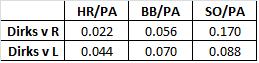
So if we look at that, Dirks is pretty much just as good against righties and lefties. He gets on base a little more versus lefties and hits with a little more extra base power against righties. But he hits more homeruns on average against lefties, walks more against lefties, and strikes out less against lefties.
According to Baseball-Reference’s tOPS which weighs each side, he scores 100 against righties and 99 against lefties, meaning that he is a one percent better hitter against righties. That doesn’t sound like a big platoon split to me. In fact, one would hardly consider that a platoon split at all. What are the odds both sides are perfectly identical.
From both sides, Dirks appears to be a capable major leaguer. But even if you don’t buy into Dirks yet and worry about the sample size, that should affect your opinion of him against all pitchers, not just one side of them. Dirks shows no discernible platoon split during his big league career.
So while we’re dying to find Dirks a buddy to play with out in left field, he doesn’t need one. Dirks can handle that position all on his own.
I generally think we overvalue platoon advantages. Don’t get me wrong, a lot of hitters weight to one side or the other, but I don’t think we should accept it as a given that hitters hit worse against their same side pitcher. I think that hitters who aren’t top flight prospects are often pigeonholed into a role that assumes they can’t hit one side before they actually display evidence of this shortcoming, and that pigeonholing puts them in a position in which they get fewer at bats against their “weaker” side, which means they actually develop a weakness because of a belief that may have not been true.
I’m not sure how to demonstrate evidence of this, but I think it’s happening. At any rate, I can and did show evidence that Dirks does not appear to be weaker against lefties. So in this case, at least, Dirks doesn’t need a dance partner and the Tigers can stop looking.
2012 Season in Review: Seattle Mariners
75-87, 4th in the AL West
Welp, Mariners. There is one great player on this team who had an amazing year and threw a perfect game. The rest of the team was pretty meh, and while the farm system is interesting, the future still isn’t now.
Just three position players topped 2.0 WAR, Kyle Seager (3.6), John Jaso (2.7), and Michael Saunders (2.3), for the 2012 Mariners and none of them were star level good. Brendan Ryan should also be acknowledged for being awesome on defense at shortstop, because well, he’s pretty freaking good.
Kevin Millwood (2.0) was one of two pitchers on the club to hit the magic 2.0 threshold. I don’t really want to talk about him or the ones who didn’t measure up, I want to talk about the one who exceed that number by a lot. Felix Hernandez (6.1) was awesome. He threw a perfect game and he pitched in near Verlander level fashion. Wow. Worth the price of admission.
Top to bottom this isn’t a great club. But I like some of their pieces. With some exciting prospects on their way and some slugging low risk players coming off other teams’ scrap heaps, 2013 could be better, but at least it shouldn’t be worse.
Ultimately, this is a team with a window to win coming, but they aren’t there yet. When they get going in that direction a little faster, their Season Recap will be more exciting.
2012 Grade: D
Early 2013 Projection: 76-86
The Book on Miguel Cabrera
What People Think
So this should be pretty easy. The prevailing opinion on Cabrera is that he is among the best hitters in baseball. It is, in fact, that simple. Cabrera is no magician with the glove and he’s not fleet of foot, but he is a supremely talented hitter who does an adequate job at third base for someone who is better suited to play first.
What the Numbers Say
The numbers tell a story about Miguel Cabrera, and boy is it a doozy. I think the best way to demonstrate what his numbers say about him is this:
Here are three stat lines.
1) 37HR, 85R, 127RBI, .292/.349/.537
2) 33HR, 101R, 118RBI, .318/.395/.561
3) 44HR, 109R, 139RBI, .330/.393/.606
The first line is a representation of his worst big league season. The second is his average career line. The third was 2012. So what the numbers tell you is that Miguel Cabrera is at worst, an all-star caliber player, on average an MVP level player, and at best, a Hall of Fame type player.
What My Eyes Tell Me
I don’t think there’s any question that Cabrera is among the best hitters in the game. You can tell that by watching him or looking at his numbers or listening to anyone who knows anything.
What I see in Cabrera is an extraordinary talent driven by brute strength and exceptional hand eye coordination. Cabrera hits baseballs as hard and as purely as anyone I think I’ve ever seen in person. Everyone knows about his light-tower type power, but I’m more amazed by his ability to put force behind difficult pitches and shoot them between fielders for base hits. He seems capable of recognizing pitches a fraction of a second earlier than most anyone and he uses that to his advantage. Obviously he guesses wrong sometimes, but he’s among the best in the game at pitch recognition and reaction to said recognition. It shows.
On the bases, I actually think he’s pretty good at taking extra bases for someone who is as slow as he is. He knows what he’s doing, even if he can’t always capitalize on it. In the field, his arm is superb and his hands are good enough to play for me at third. His range is iffy, but I think his shortcomings are somewhat overstated. He’s not great, but I don’t think he’s terrible. In fact, I thought he was on his way to becoming a very good first baseman before the position change, so I can’t give him too much grief about not being an elite defender.
The Dotted Line
Cabrera’s contract runs through the 2015 season and will pay him $21M in 2013 and $22M in 2014-15. He’s certainly earning the 8 year, $153 deal he signed before 2008 considering the cost of a long term deal these days. The Tigers should be in no hurry to extend him as he is signed through his age 32 season, three years away. If he performs at a similar level for the next couple seasons, he could easily break the bank, but it’s too early to go there.
He’s a perennial MVP contender on a team dedicated to winning, and could easily be on his way to a Hall of Fame career. Those are generally the players who try to keep in your uniform for their entire careers, but the time for that discussion is later.
Hypothetically, if he was a free agent right now, I don’t think 10 years, $280M+ would be out of the question at all. If the Tigers were looking to extend him, say another five years, the price would easily be in the $150M+ range.
Fantasyland
If you play fantasy baseball, draft him in the top five. He does everything at an elite level expect steal bases and is among the game’s most consistent performers. Draft him.
The Lead
Miguel Cabrera is one of the game’s best hitters and remains in his prime. We’re probably in for several more elite seasons and potentially a Hall of Fame plaque. He’s not the game’s best defender and he has a history of off the field issues (that we hope are over), but in spite of all of that, he’s probably one of the most valuable players in the game today.
 New English D