Scouting the Tigers Pitchers…At the Plate

With a three game series beginning tonight against the Mets in New York, the Tigers pitchers will be asked to bat for just the third time all season (they’ll get one more shot in the season’s final series). Through some amazing quirk of scheduling, Fister and Sanchez pitched in the two game stints in Washington and Pittsburgh, so we’ve only see them at the dish this year. We know, through science, that Justin Verlander is likely the worst hitter currently in the major leagues and he won’t get a shot to redeem himself this time around, but we will get a look at Scherzer and Porcello in addition to Fister. The question that you’re likely asking, along with the Mets’ pitchers (especially Harvey) is clear. How in the world can we pitch to these guys?
Let’s start with some basic offensive numbers for these pitchers in their careers. For what it’s worth to you, I’ll include Fister’s 2013 numbers separately as well:
| Player | PA | AVG | OBP | SLG | K% | wRC+ |
| Scherzer | 86 | 0.162 | 0.205 | 0.189 | 25.6 | -3 |
| Porcello | 16 | 0.214 | 0.214 | 0.214 | 37.5 | -3 |
| Fister | 15 | 0.308 | 0.308 | 0.385 | 26.7 | 111 |
| Fister ’13 | 4 | 0.667 | 0.667 | 0.667 | 0 | 286 |
Max Scherzer
Scherzer’s numbers aren’t good, but he’s the only one of the group to take a walk and he limits the strikeouts compared to the group as well. He’s definitely the Tigers pitcher who works counts the best and he does have a BABIP that’s a good deal below average (.231). I’m not saying he’s going to break out, but he hits a lot of ground balls and doesn’t chase bad pitches too often. Some of those hits should start to fall in.
You can see that he works the middle of the field nicely and doesn’t get pull happy:

The real key to getting Scherzer out is to avoid his hot spots up and out over the plate. If you put one there, he’s likely to smack it to right for a hit. You need to come middle in or low and away to get him to roll over one to the SS.

Rick Porcello
Porcello burst onto the scene in his rookie year, but has really gone down hill at the dish since then. He doesn’t take his walks and he strikes out too much to have a ton of value at the plate. Just check out his year to year wOBA so far:
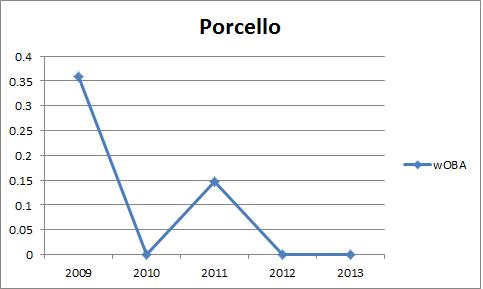
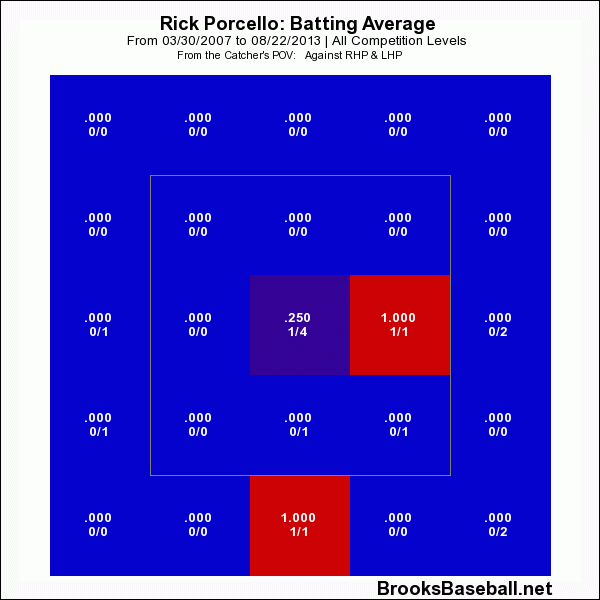
Porcello has shown the ability to use the whole field, but he doesn’t make enough contact for the bat control to play up.

Really the key to Porcello is to pitch him inside. You don’t want to miss away because he will make you pay.
Doug Fister
Fister is a much different story. Fister can really hit, even if he doesn’t have a patient approach, and he seems to be getting better with age. In 2011 he had a wRC+ of 133 and this year it’s 286. He’s made the leap from top 30 hitter to all-time great. He’s Babe Ruth and then some!
To get Fister out, you have to make him put the ball on the ground because if he gets it in the air, he’s going to get on base.
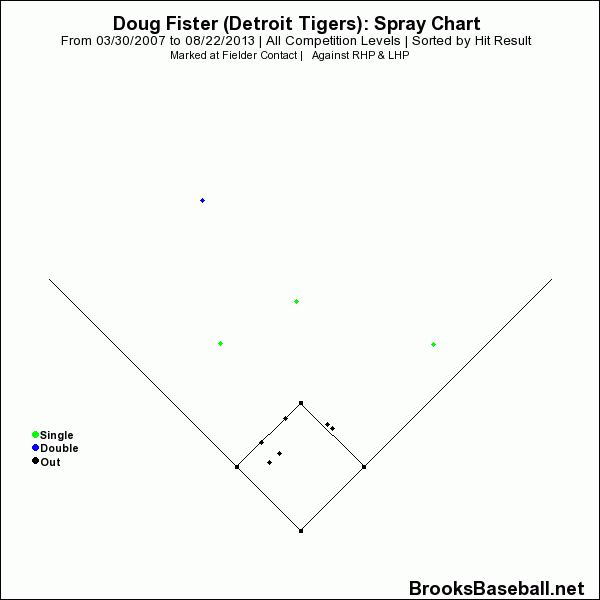
And you really don’t want to miss low and over the plate, because that is where Fister eats.

You have to make sure you go up and in or get the ball away from him. Remember, Fister bats left-handed. In fact, Fister seems to have some really nice opposite field gap power based on that spray chart. Take a look at this great swing from 2011. Hey, look who’s pitching!

Fister got an 0-2 fastball down and away from Anibal Sanchez and drove up the gap. Here’s an approximate shot of the ball splitting the fielders.

Fister has become more of a singles hitter as he’s aged, but he’s shown this type of power in the past so you have to be careful.
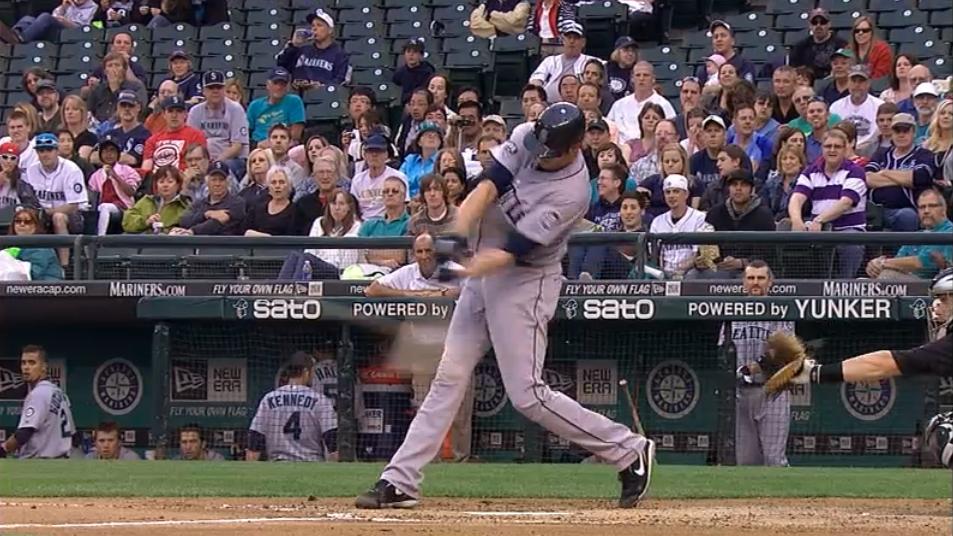
Scherzer and Porcello are pitchable, but you have to be careful with the big slugging lefty. If you miss to Fister, he’ll make you pay. For a pitcher who is 9 feet tall, this is pretty good form. Notice how he has his head on the ball and isn’t off balance at the point of contact:
Followed by an important discussion:
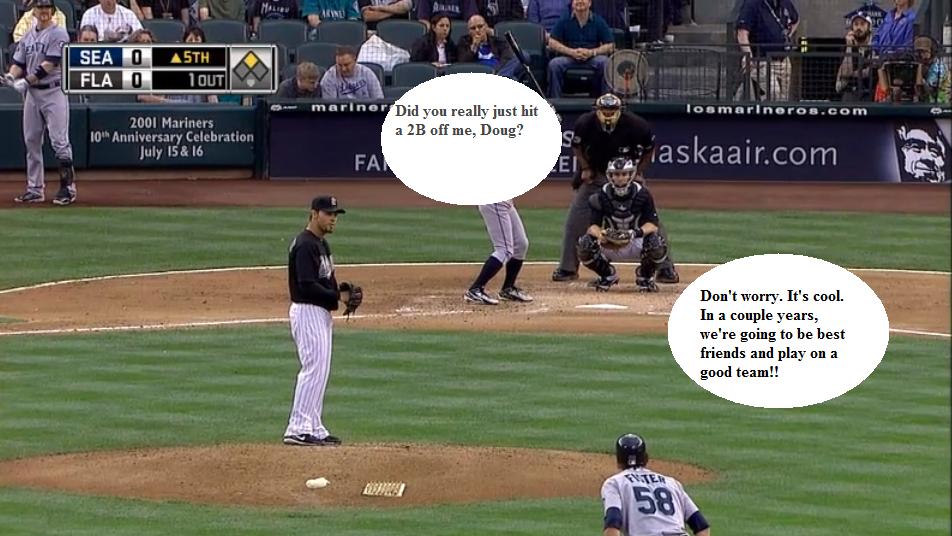
Next came an interview with Fister about why he bats left-handed. “I’m kind of screwed up in a lot of ways,” is the direct quote.

Then Sanchez gave up a hit to Ichiro and Brendan Ryan to score Fister. Fister had a better day than Sanchez, but we’re getting off track. This isn’t a Marlins and Marines game recap.
The key here is that Fister is the Cabrera of the Tigers pitchers and is the one to watch for. Matt Harvey is probably really happy he won’t have to face him on Saturday because Fister has shown the ability to hit the best arms in the game.
How Was The Game? (August 22, 2013)
Not quite long enough.
Twins 7, Tigers 6
Justin Verlander (27 GS, 173.2 IP, 3.68 ERA, 3.46 FIP, 3.7 WAR) was better than the stat line, really only making one very costly mistake to Doumit. He went 7 and allowed 6, but 3 came on one swing with two outs. He wasn’t vintage Verlander, but had some strong stretches and if he hadn’t hung one to Doumit would have been looking at a 7 IP, 3 ER start. Bryan Holaday got the Tigers scoring going with a solo shot, but the key offensive attack came in the 6th when Infante reached on an infield hit, Iglesias doubled, Holaday beat out an infield hit, and then Jackson sent one to the seats to tie it. Unfortunately, the Tigers gave one back in the 8th on a fly ball that really spun away from Jackson allowing a runner to score. The Tigers put two on in the 9th, but Martinez bounced into the game ending double play. The Tigers will hop a plane to the Big Apple and the pitchers will get ready to swing the bat against the Mets. Doug Fister (25 GS, 161.1 IP, 3.63 ERA, 3.28 FIP, 3.5 WAR) will take the ball for game one.
The Moment: Bryan Holaday slugs his first big league homerun, gets the silent treatment.
How Was The Game? (August 21, 2013)
The bats came late, but were worth the wait.
Tigers 7, Twins 1
Anibal Sanchez (22 GS, 139.2 IP, 2.45 ERA, 2.34 FIP, 4.8 WAR) did his job with the usual magnificence as he gave the Tigers 6.2 innings of 1 run baseball featuring 8 strikeouts and 2 walks. He pitched in a bit of traffic early but escaped with ease and then got rolling in the middle innings before handing it off to the capable hands of Drew Smyly. Trailing 1-0 entering the bottom of the 7th, the Tigers bats got rolling and chased Correia after scoring two runs and placing two more on base. Then, of course, Fielder swung and missed at strike three but got to first on the passed ball while Hunter scored. Get all that? Martinez doubled to add another and then the Tigers piled on in the 8th when Cabrera cleared the bases. The Tigers will do their best to take the series Thursday afternoon with the resurgent Justin Verlander (26 GS, 166.2 IP, 3.51 ERA, 3.42 FIP, 3.6 WAR) on the hill.
The Moment: Hunter puts one up the gap to drive in the tying and go-ahead run.
Can Phil Coke Be Fixed?

After failing to get the lefty he was called in to face, Jim Leyland took the ball from Phil Coke. He had seen enough. Coke, who struggles mightily against RHH, has to be able to get lefties out or he doesn’t have a whole lot of on field value. He’s always a good interview, but they pay you to perform on the field and not for the cameras. After last night, the Tigers had seen enough and sent Coke to Toledo to work on his issues while the big club calls on the services of Jose Alvarez to be the second lefty out of the pen.
Coke has had a bit of an up and down career with the Tigers. He’s been worth 3.8 WAR (what’s WAR?) over his four seasons with the club which included 14 starts in 2011. He’s generally had a FIP (what’s FIP?) between 3.20 and 3.80, but his ERA has consistently been worse, topping out at 5.00 in 2013. In the bullpen, Coke has consistently hovered around 7.3-7.5 K/9 and somewhere between 3.0-4.0 BB/9 with a high-ish BABIP and no real issue with the long ball.
That isn’t a stud reliever, but it’s definitely a big league reliever, especially if you throw with your left hand. Worse pitchers have survived longer with worse numbers. Coke has always had issues with RHH however and this year is no different. Let’s just talk about wOBA (What’s wOBA?) against to get a basic idea of the problem.
| Season | wOBA v L | wOBA v R |
| 2010 | 0.309 | 0.315 |
| 2011 | 0.267 | 0.351 |
| 2012 | 0.298 | 0.441 |
| 2013 | 0.298 | 0.345 |
Coke did fine work against RHH in 2010 and has never had trouble with lefties. He’s not a lockdown arm, but he’s solid. This year, he’s actually back on pace with his 2011 numbers. He’s better against RHH this year but the overall results are worse. The strikeout and walk numbers tell the same story. His batted ball profile isn’t that different. His pitch mix is a bit interesting. He’s throwing more changeups this season and fewer breaking balls. His velocity is also not a problem.
One thing that stands out to me is that batters aren’t chasing pitches out of the zone against him nearly as much (down almost 6%) and they are swinging more often at his strikes (up 5%), according to BIS data on FanGraphs. What is interesting about those numbers is that Pitch F/X, which doesn’t include the human corrections from BIS show much smaller year to year differences. To me, that says hitters are swinging at a lot of pitches on the edges of the zone. The people reading the data don’t think these are strikes, but the system does.
If you look at his zone profile, you should be able to see a difference from last year.
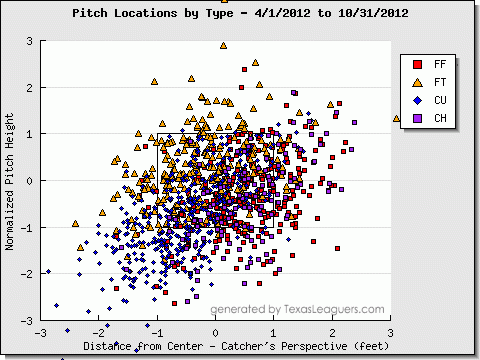

When he leaves the strikezone, he’s leaving by a lot less. He chase pitches are too close. This is a location problem. The actual pitches don’t look much different. Velocity is fine. His release point has moved ever so slightly toward the center of the diamond. He’s getting the same bite on his pitches and they are moving at the same speed. He’s just not putting them in the right spot.
And that’s much easier to fix. He’s healthy and isn’t losing his stuff. He’s just missing his spots. If anything, his slider looks better, he’s just not putting it in the right place and for a reliever, a few bad misses is all you need to go from very good to very bad.
So yes, I think Phil Coke can be fixed and I don’t think it will be that hard. He’s a hard working guy and open to instruction. It shouldn’t be long before he’s back in the big leagues sprinting out of the pen and pointing at anything that moves.
How Was The Game? (August 20, 2013)
Nothing worth writing home about.
Twins 6, Tigers 3
Rick Porcello (23 GS, 135.1 IP, 4.52 ERA, 3.46 FIP, 2.5 WAR) did some good things on Tuesday, but three infield hits and two poorly timed pitches cost him 5 runs in 4.1 innings despite 6 strikeouts and only 2 walks. Those things will happen when you induce a lot of ground balls and while you don’t love the result – especially Coke’s inability to get a lefty out – the process was mostly solid for Porcello who continues to be head and shoulders about baseball’s other #5 starters. The bats were able to score on a Fielder bomb and pushed across two other runs but failed to cash in with the tying run at the plate in the 8th inning. They had another shot in the 9th, with Cabrera at the dish no less but couldn’t make it happen. The Tigers have two more chances to get to the Twins this week and will turn around and give the ball to Anibal Sanchez (21 GS, 133 IP, 2.50 ERA, 2.39 FIP, 4.5 WAR) on Wednesday.
The Moment: Prince hits one a mile.
The Cy Young Case For and Against Max Scherzer

Let’s get the basics out of the way early. We love Max Scherzer. He’s one of our favorites. We like his stuff and his work ethic and his intelligence. He’s one of us and his eyes are different colors. We’re rooting for him to help the Tigers win and for him to be individually successful. He’s awesome. In fact, we’ve written of his awesomeness quite often:
- Three Reasons He Dominated
- Two Reasons He Got Better
- On Becoming an Ace
- On Falling in Love with Max
- And Why You Can Believe in Him (via Gammons Daily)
But here are New English D, we don’t put a lot of stock in wins and losses for pitchers. In fact, we put exactly zero stock in them, so the fact that Max is 18-1 means nothing to us in terms of postseason awards. I’m glad the Tigers win a lot in Max’s starts and it’s nice that he gets credit, but it’s a useless statistic when it comes to actually evaluating individual performance. Which means we need to consider more accurate stats when considering who the Cy Young should be in the AL. Let’s start with the candidates. To do so, I’m going to use Wins Above Replacement (what’s WAR?) as a starting point. I’m going to look at WAR only to determine who should be in the conversation.
Eight AL pitchers currently have 3.5 WAR or higher while the leader has 5.3. WAR isn’t precise, but I don’t believe there is a case to be made that it’s more than win off the mark. Like I always do on the site, those numbers come from FanGraphs WAR because I think it is a better reflection of performance than something like Baseball-Reference’s WAR (rWAR) or a basic runs allowed WAR (RA9-WAR). Remember, I’m only using WAR to draw the boundaries, not to make a decision.
The candidates are:
| Name | Team | WAR |
| Felix Hernandez | Mariners | 5.3 |
| Max Scherzer | Tigers | 5.3 |
| Derek Holland | Rangers | 4.8 |
| Chris Sale | White Sox | 4.6 |
| Anibal Sanchez | Tigers | 4.5 |
| Yu Darvish | Rangers | 4.3 |
| Hiroki Kuroda | Yankees | 3.8 |
| Justin Verlander | Tigers | 3.6 |
It’s worth noting that each starter has a different number of starts and innings based on their current spot in the rotation and how many games their team has played, in addition to any injuries. I will not penalize a pitcher because of his team’s schedule, but they will lose credit for injury time. Let’s see starts, innings, innings per start, and WAR per 200 innings:
| Name | Team | GS | IP | IP/GS | WAR/200IP |
| Anibal Sanchez | Tigers | 21 | 133 | 6.33 | 6.77 |
| Max Scherzer | Tigers | 25 | 172.1 | 6.89 | 6.15 |
| Felix Hernandez | Mariners | 26 | 178.2 | 6.86 | 5.94 |
| Derek Holland | Rangers | 25 | 168 | 6.72 | 5.71 |
| Chris Sale | White Sox | 23 | 165.1 | 7.19 | 5.56 |
| Yu Darvish | Rangers | 24 | 161 | 6.71 | 5.34 |
| Hiroki Kuroda | Yankees | 25 | 160.1 | 6.41 | 4.74 |
| Justin Verlander | Tigers | 26 | 166.2 | 6.40 | 4.33 |
Sanchez is clearly the best pitcher inning for inning by WAR and Sale is easily going the deepest into games. Scherzer and Felix are currently tied in WAR despite Scherzer being a start behind based on his team’s schedule and Scherzer leads in WAR/200 IP while having nearly identical IP/GS. WAR gives us these 8 candidates, and the early returns look good for Scherzer. Let’s go deeper.
Here are their ERA, FIP, and xFIP (what’s FIP and xFIP?):
| Name | Team | ERA | FIP | xFIP |
| Hiroki Kuroda | Yankees | 2.41 | 3.17 | 3.47 |
| Felix Hernandez | Mariners | 2.47 | 2.55 | 2.72 |
| Anibal Sanchez | Tigers | 2.50 | 2.39 | 2.95 |
| Yu Darvish | Rangers | 2.68 | 3.05 | 2.67 |
| Chris Sale | White Sox | 2.78 | 2.86 | 2.91 |
| Max Scherzer | Tigers | 2.82 | 2.67 | 3.08 |
| Derek Holland | Rangers | 2.95 | 2.99 | 3.49 |
| Justin Verlander | Tigers | 3.51 | 3.43 | 3.73 |
Kuroda, Felix, and Sanchez are all basically allowing the same number of earned runs per nine innings. Sanchez, Felix, and Max are clear the leaders in FIP. Darvish and Felix are your leaders in xFIP. But as you all know, park adjustments are really important. So let’s check out ERA/FIP/xFIP- stats that adjust for ballpark. Remember that 100 is average and everything below that is a percent better than average (ex. 85 ERA- is 15% better than average):
| Name | Team | ERA- | FIP- | xFIP- |
| Anibal Sanchez | Tigers | 61 | 59 | 74 |
| Felix Hernandez | Mariners | 62 | 65 | 68 |
| Max Scherzer | Tigers | 69 | 66 | 77 |
| Chris Sale | White Sox | 66 | 69 | 73 |
| Derek Holland | Rangers | 69 | 70 | 87 |
| Yu Darvish | Rangers | 63 | 72 | 67 |
| Hiroki Kuroda | Yankees | 59 | 77 | 87 |
| Justin Verlander | Tigers | 86 | 84 | 93 |
With park adjustments, we have a whole lot of guys between 59 and 70 for ERA-. Remember, this doesn’t even factor in defense. Only Verlander is outside of this window. By FIP-, we have Darvish and Kuroda falling back. By xFIP-, Darvish, Felix, Anibal, and Sale are your leaders.
Let’s now take a look at K and BB%, just for some added context:
| Name | Team | K% | BB% |
| Yu Darvish | Rangers | 33.20% | 8.50% |
| Max Scherzer | Tigers | 28.10% | 5.80% |
| Anibal Sanchez | Tigers | 26.60% | 7.20% |
| Chris Sale | White Sox | 26.20% | 5.40% |
| Felix Hernandez | Mariners | 25.70% | 5.40% |
| Derek Holland | Rangers | 22.60% | 7.10% |
| Justin Verlander | Tigers | 22.50% | 8.30% |
| Hiroki Kuroda | Yankees | 18.20% | 4.60% |
And I won’t take the time to break these stats down, but if you care about Win Probability Added and Run Expectancy 24, here you go:
| Name | Team | WPA | RE24 |
| Hiroki Kuroda | Yankees | 4.19 | 34.56 |
| Chris Sale | White Sox | 2.87 | 29.45 |
| Max Scherzer | Tigers | 2.84 | 26.63 |
| Derek Holland | Rangers | 2.81 | 29.75 |
| Yu Darvish | Rangers | 2.69 | 34.62 |
| Felix Hernandez | Mariners | 2.36 | 20.61 |
| Anibal Sanchez | Tigers | 0.83 | 23.83 |
| Justin Verlander | Tigers | 0.28 | 11.89 |
So let’s make first cuts. It’s obvious we can get rid of Verlander. I’m also getting rid of Holland because he isn’t a leader in anything. That leaves us with six choices. All of which could win the award based on the final month and a half, but who is in the lead right now? That depends on what you value in a pitcher. Since this is a Tigers site, we’re going to look at this through the prism of #37.
The Case for Scherzer
Pitchers can only control certain aspects of the game. They can’t control their defense. They can’t control their run support. They have some control over where the ball is hit, but only in broad terms. They can induce ground balls, but they can’t decide if it’s directly at a player or ten feet to his right. They control strikeouts, walks, and homeruns. Their ballpark matters.
Scherzer is tied for the league lead in fWAR which is based on FIP. Adjusting for park and league average, based on Scherzer’s Ks, BBs, HRs, and innings, he’s tied with Felix for the best WAR in the AL. If we assume that they would both pitch at this level over the course of an entire season, Scherzer is on a better pace, as seen through WAR/200 IP. Only Sale goes deeper into games than Scherzer. Max and Felix are essentially tied in FIP- and Scherzer throws more innings per start just barely. Only Sanchez is above them in FIP- and he missed starts due to injury, so he takes that hit. Looking at which pitchers induce the fewest hard hit balls, Scherzer and Sale are the two leaders among AL starters on this list at about 13%.
If you care about what a pitcher can actually control, the award belongs to Scherzer. He has a higher K% and is only a touch behind in BB%. His WPA and RE24 are higher as well. Batters hit fewer balls hard against him. Right now, the worst you could say about Scherzer is that he and Felix are basically even when it comes to the FIP side of things. In my mind, it’s razor thin, but I’m voting for Scherzer if I’m voting based on what a pitcher can control.
The Case Against Scherzer
Five pitchers on this list have lower ERAs. Including Felix, and including the leader, Kuroda. We should at least adjust for park using ERA-, but the message is the same. Scherzer allows more earned runs. Let’s take that a step further, because if we’re talking about earned runs, let’s just talk about all runs. If you’re arguing that a pitcher is responsible for his earned runs, then they are responsible for their unearned runs as well. The argument for FIP is the argument that defense and batted balls are fluky. If you don’t buy that, you have to accept errors too. Let’s see Runs Allowed Per 9 and then let’s convert it to a WAR number based on innings and park.
| Name | Team | RAA |
| Hiroki Kuroda | Yankees | 2.58 |
| Anibal Sanchez | Tigers | 2.77 |
| Yu Darvish | Rangers | 2.80 |
| Felix Hernandez | Mariners | 2.82 |
| Max Scherzer | Tigers | 2.92 |
| Chris Sale | White Sox | 3.16 |
| Derek Holland | Rangers | 3.27 |
| Justin Verlander | Tigers | 3.94 |
| Name | Team | RA9-WAR |
| Hiroki Kuroda | Yankees | 5.7 |
| Felix Hernandez | Mariners | 5.5 |
| Yu Darvish | Rangers | 5.5 |
| Max Scherzer | Tigers | 5.3 |
| Derek Holland | Rangers | 4.7 |
| Chris Sale | White Sox | 4.7 |
| Anibal Sanchez | Tigers | 4.3 |
| Justin Verlander | Tigers | 2.9 |
| Name | Team | RA9-WAR/200 IP |
| Hiroki Kuroda | Yankees | 7.1 |
| Yu Darvish | Rangers | 6.8 |
| Anibal Sanchez | Tigers | 6.5 |
| Felix Hernandez | Mariners | 6.2 |
| Max Scherzer | Tigers | 6.2 |
| Chris Sale | White Sox | 5.7 |
| Derek Holland | Rangers | 5.6 |
| Justin Verlander | Tigers | 3.5 |
So if you care about runs allowed, other numbers be damned, the case for Kuroda gets pretty strong. Darvish shows up too. Max and Felix are still in the conversation, but a step down. If you just care about the outcomes and not the process, Kuroda has a solid case.
My Vote
I’m not saying this because I’m a Tigers fan, but at this moment, Scherzer has my vote over Felix by an eyelash. You can’t go wrong with either. Everything you’ve seen at this site supports a FIP style approach that factors out defense and luck. We only care about what a pitcher controls and those two guys are the class of the AL based on that. Sanchez falls out because he missed time with an injury, otherwise he’d likely be the guy. The case against Max is also a case against Felix. If you are going to talk about his ERA or RAA, you have to then credit Kuroda. The argument for Max is that he’s limited walks and homeruns while striking out a lot of guys across a lot of innings and going deep in games. He’s allowing more runs, but runs are a team stat. The pitcher takes some responsibility, but not all of it. Some is luck, some is defense.
Today, I would vote for Scherzer, but with 7-8 starts left, lots of these guys have a shot. Max is going to win because he’s 18-1, but I couldn’t care less. His record doesn’t tell you anything of value. He’s the Cy Young for me in spite of his record, not because of it.
Justin Verlander’s Billy Butler Problem
It’s become so predictable that it’s something of a running joke among Tigers fans and followers: Justin Verlander can’t get Billy Butler out. He just can’t do it. Every time Verlander faces the Royals, we accept it as a forgone conclusion that Butler will reach base at least twice against the Tigers’ star pitcher.
To open, Verlander is an excellent starting pitcher despite a somewhat down season, posting an MLB best 31.9 WAR (what’s WAR?) since the start of 2009. In the same period, he has a 3.04 ERA and 3.00 FIP in 161 starts. Even if he’s handed his title of best pitcher alive over to Clayton Kershaw, no one can argue that across the last several seasons, Verlander has been one of baseball’s best.
Butler isn’t a bad hitter, so it’s not like JV is getting owned by some scrub, AAAA player, but it’s not like Verlander routinely has trouble with the game’s best hitters. Butler’s ownership of Verlander is unique to Butler and not to good hitters. Since 2009, Butler has turned in a very impressive 128 wRC+ (what’s wRC+?), good for 34th among qualifying hitters. He’s mostly a DH and this post is about hitting, so we really don’t care about anything else Butler does.
Since 2007, Verlander and Butler have squared off quite a few times thanks to intradivisional play at things don’t look good for Verlander at all. In 71 PA, Butler is hitting a robust .435/.507/.597, good for a 1.104 OPS. To give you an idea, Miguel Cabrera currently has a 1.141 OPS. When you put Butler in front of Verlander, Butler turns into the best hitter in the league. That’s hilarious and strange.
Here are all 71 PA. Scroll down to get a sense of what we’re dealing with:
| PA | Play Description |
| 1 | Double to RF (Ground Ball) |
| 2 | Lineout: 1B (2B-1B) |
| 3 | Single to CF (Line Drive) |
| 4 | Single to CF (Line Drive to Short CF); DeJesus Scores |
| 5 | Groundout: 3B-1B (Weak SS) |
| 6 | Walk |
| 7 | Home Run (Line Drive to Deep LF) |
| 8 | Flyball: LF |
| 9 | Lineout: CF (Deep CF) |
| 10 | Lineout: RF (Deep RF) |
| 11 | Single to LF (Ground Ball thru Weak 3B); Gordon to 2B |
| 12 | Flyball: CF (Deep CF) |
| 13 | Single to RF (Line Drive to CF-RF) |
| 14 | Flyball: LF (LF-CF) |
| 15 | Lineout: 3B (Weak 3B) |
| 16 | Groundout: 2B-1B |
| 17 | Flyball: CF |
| 18 | Single to LF (Line Drive to LF-CF); Guillen to 2B |
| 19 | Flyball: LF (Deep LF-CF) |
| 20 | Single to CF (Line Drive) |
| 21 | Flyball: RF (Deep CF-RF) |
| 22 | Double to RF (Line Drive to RF Line) |
| 23 | Flyball: LF (Deep LF) |
| 24 | Home Run (Line Drive to Deep LF-CF) |
| 25 | Strikeout Swinging |
| 26 | Double to RF (Line Drive to Deep RF Line) |
| 27 | Groundout: 3B-1B (Weak SS); Maier to 2B |
| 28 | Groundout: 3B-1B (Weak 3B) |
| 29 | Groundout: SS-1B (Weak SS) |
| 30 | Single to RF (Line Drive); Getz Scores; DeJesus Scores; Podsednik to 3B |
| 31 | Flyball: CF (Deep CF) |
| 32 | Groundout: 3B-1B (Weak 3B) |
| 33 | Double to LF (Ground Ball) |
| 34 | Walk |
| 35 | Groundout: SS-1B (Weak SS) |
| 36 | Walk |
| 37 | Single to LF (Line Drive to LF-CF) |
| 38 | Flyball: CF (Deep CF) |
| 39 | Strikeout Looking |
| 40 | Strikeout Looking |
| 41 | Flyball: CF (Deep CF-RF) |
| 42 | Groundout: P-1B (Front of Home) |
| 43 | Single to RF (Fly Ball to Deep 1B); Gordon Scores; Hosmer to 2B |
| 44 | Groundout: 2B-1B |
| 45 | Flyball: RF (Deep RF Line) |
| 46 | Single to LF (Line Drive) |
| 47 | Strikeout Swinging |
| 48 | Groundout: 3B-1B (Weak 3B); Gordon to 2B |
| 49 | Hit By Pitch; Gordon to 2B |
| 50 | Strikeout Looking |
| 51 | Single to CF (Ground Ball thru SS-2B); Gordon Scores |
| 52 | Single to CF (Ground Ball thru SS-2B); Gordon Scores |
| 53 | Strikeout Swinging |
| 54 | Intentional Walk |
| 55 | Single to LF (Line Drive to Deep LF Line) |
| 56 | Strikeout Swinging |
| 57 | Single to LF (Ground Ball thru Weak SS) |
| 58 | Single to CF (Ground Ball thru SS-2B); Escobar Scores |
| 59 | Walk |
| 60 | Single to RF (Line Drive to Short RF); Escobar Scores |
| 61 | Single to LF (Line Drive to LF Line) |
| 62 | Single to SS (Ground Ball) |
| 63 | Walk |
| 64 | Strikeout Swinging |
| 65 | Single to LF (Line Drive to Short LF-CF); Gordon to 3B |
| 66 | Walk |
| 67 | Groundout: 3B unassisted/Forceout at 3B; Hosmer to 2B |
| 68 | Single to LF (Line Drive to Deep LF-CF) |
| 69 | Lineout: RF (Deep RF) |
| 70 | Single to LF (Line Drive to Deep LF-CF) |
| 71 | Walk |
By my count, Verlander retired Butler in more than 3 consecutive plate appearances just one time out of 71. We’re talking about a pitcher who, over the last 5 seasons, typically allows less than three out of every ten hitters he faces to reach. Since 2009, he’s allowed a .225/.281/.345 batting line. Butler has a higher batting average against Verlander than the rest of the league does slugging percentage. Even if we go all the back to Verlander and Butler’s first meeting in 2007, Verlander’s line against is .230/.293/.351. If we include his poor 2008 season, it’s still great. MLB hitters get on base less than 30% of the time against JV and slug around .350. Butler gets on base 50% of the time and slugs about .600.
He owns Verlander. It has to be something about Butler’s approach that allows him to get to JV. Verlander puts most hitters away pretty easily, but not Butler. What does Butler do that most hitters don’t?
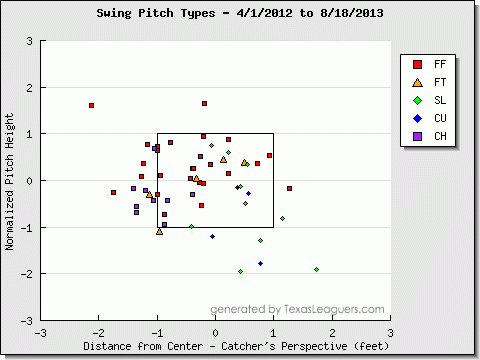
Since the start of 2012, they’ve met 29 times and Butler has reached base in 18 of those PA, good for a Bondsian .620 OBP. You might say small sample size, but the pattern has held across 71 PA for the most part and I don’t want to overload the analysis. What you see in the data is that Butler lays off Verlander’s stuff outside and looks to swing at pitches on the inside part of the plate:

And you’ll also see evidence of this in the spray chart:
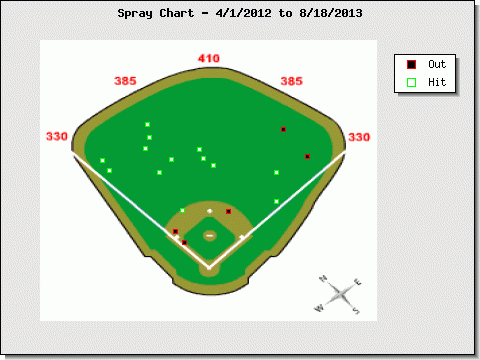
Butler ignores most pitches unless they are inside fastballs and when he gets one, he pulls it to left for a hit. The pattern is the same dating back to 2008 (when Pitch F/X data became available), but it’s a less clear visual. In fact, Verlander throws Butler fastballs about 60% of the time overall despite obvious evidence that Butler can handle it. Verlander has relied less on his fastball as he’s matured overall, but he still seems to be throwing it a lot to Butler and Butler doesn’t mind.
Everyone seems to have their Kryptonite and Verlander’s just happens to be the Royals’ DH. He can’t seem to get him out. It’s not getting better, it’s not influenced by a cluster of data points, and it doesn’t seem like something that will get better. Butler knows Verlander’s plan and Verlander hasn’t adapted despite lots of evidence that his current mindset isn’t working.
Luckily for Tigers’ fans, Butler only shows up in the other box for 18 games a season and Verlander can’t pitch in more than six of those games because when Butler steps into the box, Verlander doesn’t seen Billy Butler, he sees Miguel Cabrera. And that’s a terrifying sight.
How Was The Game? (August 18, 2013)
As comfortable as the weather.
Tigers 6, Royals 3
After splitting the first four games in the long, five game set with the Royals, the Tigers took the final game to ensure that they sent the Royals packing without gaining any ground on the division leaders. Max Scherzer (25 GS, 172,1 IP, 2.82 ERA, 2.66 FIP, 5.3 WAR) gave the Tigers 8 strong innings of 2 run ball featuring 4 strikeouts and no walks while Miguel Cabrera provided all the offense he would need including a no doubt, first pitch bomb in the first to go along with an RBI single that came later. The Tigers added runs in the 5th and 6th innings as well to pad the lead and likely would have been looking at more if not for some excellent defensive play by Alex Gordon and Eric Hosmer. The Tigers continue to put distance between themselves and the rest of the division as the summer winds down and will look to fatten up on the Twins for three games starting Tuesday at Comerica Park with Rick Porcello (22 IP, 131 IP, 4.33 ERA, 3.42 FIP, 2.5 WAR) on the mound to start it off.
The Moment: Cabrera hits a no doubt blast on the first pitch he saw.
How Was The Game? (August 17, 2013)
Just another feather in his cap.
Tigers 6, Royals 5
Doug Fister (25 GS, 161.1 IP, 3.63 ERA, 3.28 FIP, 3.5 WAR) didn’t dominate during his 6.1 innings, but he held the Royals to 3 runs with 6 strikeouts and 2 walks and pitched around one of the worst calls you’ll see this year by the entire umpiring crew. With Getz on first, Escobar clearly fouled a pitch off – so clearly that Pena made no effort to go pick it up – but the umpire made no such call and allowed Getz to advance to third before Fister retrieved the baseball. Needless to say, Jim Leyland got himself kicked out, but less needless to say, so did the mild mannered Pena. Fister turned the game over to Smyly who allowed an equalizer to Perez, but was quickly bailed out by a Fielder bomb that punctuated his big night. Calling on Veras for the 8th proved problematic, as he allowed the tying run to score before escaping a big jam thanks to Fielder putting a delicate part of his body in the path of the baseball. In the 9th, Aaron Crow had to face Miguel Cabrera. I’m pretty sure you can imagine how that went for Crow, as he hung his head as he strolled into the dugout after giving up the walkoff bomb. The win takes the Tigers 21 games over the .500 mark and sets them up to take the series on Sunday behind Max Scherzer (24 GS, 164.1 IP, 2.85 ERA, 2.69 FIP, 4.9 WAR).
The Moment: Miguel Cabrera sends everybody home.
How Was The Game? (August 16, 2013 – Game Two)
Nothing you’d worry about if it hadn’t happened twice today.
Royals 3, Tigers 0
The Tigers got another solid outing from their starter in the nightcap, but the offense failed to deliver again, this time for Jose Alvarez (5 GS, 25.1 IP, 4.62 ERA, 5.91 FIP, -0.1 WAR) who gave the Tigers 5.2 innings of 2 run baseball and kept pressure off the bullpen. He won’t win a Cy Young for the performance but he did a nice job keeping the Royals off balance and gave his team a shot to win. Unfortunately, the Tigers could get very little going against James Shields and they fell for the second time in just a few hours thanks to some tremendous defense by the Royals. The Tigers will have a chance to repair the damage as they’ll get the Royals two more times before the weekend is out starting with Doug Fister (24 GS, 155 IP, 3.60 ERA, 3.33 FIP, 3.3 WAR) on the hill on Saturday night.
The Moment: Iglesias charges and flips a ball backhanded to Cabrera to escape a jam.
 New English D