2012 Season in Review: Minnesota Twins
66-96, 5th in the AL Central
It was another dark year for the Minnesota Twins after spending much of the 2000s as the cost effective kings of the AL Central. They nearly missed losing 100 games and could easily be considered the worst team in the American League.
Joe Mauer did his part (5.0 WAR) and players like Josh Willingham (3.9), Denard Span (3.9), Ben Revere (3.4), and Jamey Carroll (2.4) helped along the way. The rest of the lineup was uninspiring, but serviceable for a non-contender.
But good gracious, the pitching was awful. Scott Diamond’s 2.6 was the only WAR above 1.3 for the entire staff. He was also the only pitcher to throw more than 110 innings. By WAR and FIP they were the worst collective staff in all of baseball. Starters and relievers alike were simply terrible.
The Twins are working on a makeover as they traded Span and Revere for prospects and have signed just about every scrap heap innings eater they can find to serve as stopgaps for 2013. They have some interesting position players coming through the system, but the pitching isn’t terribly exciting.
They should have a bit more reliability in the rotation in 2013 with Worley and his compatriots, but I can’t say they’ll be much better. This is a long road for the Twins to travel back to contention.
With the Tigers improving this offseason and the Royals and Indians making modest upgrades in the short term, it seems unlikely that the Twins will improve upon their 2012 showing.
2012 Grade: F
Early 2013 Projection: 65-97
The Nine Best Baseball Websites

Since this is 1) a website and 2) a website about baseball, it makes sense to consider the rest of the online baseball world. Below is a list of what I believe are The Nine Best Baseball websites going right now. There are more than nine good baseball sites, but these are the best in my book for a variety of reasons.
This list was originally crafted in January of 2013, but it’s been updated several times and you’re reading the version as of March 2017. Please don’t be offended if I didn’t mention a site you really like or work for, I’m not trying to throw shade.
9. MLB Trade Rumors
http://www.mlbtraderumors.com/
This is the site you need to bookmark if you care about transactions. Trades and signings. The staff at MLBTR does a great job synthesizing the news of the day and they do it quickly. I happen to follow a million baseball writers on Twitter and keep tabs on almost everything, but if you don’t have quite that much time, MLB TR does it for you. When roster moves happen, they’re always there for you.
8. MLB.com/Team Website
Not much to explain here except to say that MLB and most teams have done a great job taking their product online with products like Gameday, At-Bat, MLB.TV, the team stores, etc. Having access to video, audio, and box score archives is a huge plus.
7. Cot’s Baseball Contracts
http://www.baseballprospectus.com/compensation/cots/
They’re so great that BP bought them. Every contract for every play erand spreadsheets of team payroll data. Want to know how long a contract is and how much it’s worth in each year? They have that. It’s incredible. A one-stop shop.
6. Baseball Savant
https://baseballsavant.mlb.com/
Savant is Daren Willman’s creation and houses all of the public Statcast data, as well as PITCHf/x data previous years. If you’re into that type of thing, it’s an excellent resource to go deep into the weeds. But it’s more than that considering the amount of work Daren has put in over the last year. Graphics, comparisons, catcher data, you name it. Plus, he is willing to add features on request. Hugely vital for the baseball researcher.
5. Baseball Prospectus
http://www.baseballprospectus.com/
There are two hesitations on BP, the firs being that most of their content is behind a paywall. That’s certainly their right, but one should judge a site based on its quality to cost ratio. The other hesitations is user interface. They have lots of statistics, but the quality of presentation trails Baseball-Reference and FanGraphs (even if they do keep some good esoteric ones), and the overall visual appeal of the site is lacking. That said, I’m telling you why they’re 5th instead of 2nd. They have a huge range of content, great set of podcasts, and overall excellent product that mixes MLB, fantasy, and prospect level coverage.
4. Brooks Baseball
http://www.brooksbaseball.net/
Brooks Baseball is a top nine website for its Pitch F/X tool. You can select a date, game, and pitcher and within minutes, be looking at everything he threw that day, where it went, and how much it broke. Those graphics you see on MLB Gameday and MLB At-Bat with all of this data are compiled here and stored in a very accessible way. They’ve also added data on hitters and have dramatically improved the functionality of the site since this list was originally published. If you want to study PITCHf/x data without doing a lot of work yourself, Brooks is the place to do it.
3. Twitter
This may seem like a cop out, and it kind of is, but Twitter is an extraordinarily useful tool for following baseball. Breaking news, live analysis, and other content is at your fingertips no matter where you are and the speed and brevity make a good match. You can follow along on the couch or in the stands if you’re just looking for some commentary, or stay up to date if you aren’t able to follow the game. Plus, it’s a great way to connect with other fans and talk about the game as it happens.
2. Baseball-Reference
http://www.baseball-reference.com/
The amount of information on this site is staggering. Statistics, draft info, random trivia. It’s a clearinghouse for everything you need to know and the exceptionally cool Play Index allows you to go looking for quirky events on top of the regular things you find on any given page. Serious, get the Play Index.
1. Fangraphs
By far my favorite baseball site. They have a ton of statistical data and sabermetric information, but they also have excellent analysis from a group of very good writers. They do daily live chats and podcasts and are great about giving the people what they want. You can find a section that explains every sabermetric statistic and they do a fantastic job improving the functionality of the site and provide readers with much more user friendly leaderboards than B-Ref. If you want stats, this is the best place to get them. If you want smart analysis, this is also the best place to get it. (Full disclosure: I am employed by FanGraphs, although the site has been ranked #1 on this list since before that. Also, if you think I could financially benefit from this ranking you might not understand how blogging on the internet works).
Introducing ‘The Nine’
Something I’ve learned over the course of my life is that people love lists and rankings. They can’t get enough of them. If you write a paragraph about a group of good shortstops it will be less popular than a list of the five best shortstops even if the information is identical. Call it a quirk of humanity.
That said, the most highly read piece on this site was my list of the nine best baseball books, so I have some evidence to back this up besides the success of the otherwise useless Bleacher Report. People like lists and people like rankings.
So you’re going to get them. SABR Toothed Tigers is proud to introduce The Nine, a series of rankings, lists, and other things that can be grouped that relate to baseball’s most usable number, 9.
Nine positions, nine innings, nine things on our lists.
This will be a regular Saturday feature for us at STT and we’d love to hear any suggestions you might have about what you’d like to see discussed in our rankings. As I noted above, The Nine Best Baseball Books are already available on this site. Look for The Nine Best Baseball Websites this weekend and notice the new tab on the homepage with links to all of STT’s The Nine‘s
Enjoy!
2012 Season in Review: National League West
It was a big year for the National League West as the the World Series champion and the newest baseball juggernaut called the left coast home. The Dodgers spent a lot of the season as a surprise contender and then big time spender while the steady as she goes Giants took home the ultimate prize.
Here’s how the division finished up:
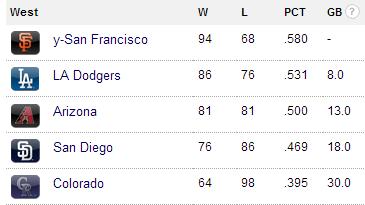
And for those of you tracking how it played out, here are the playoff odds from April to October

My early projection for next season looks like this:

And finally, I look back at my 2012 grades for each club.
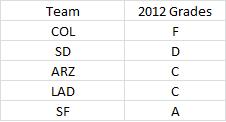
The NL West Cy Young is Clayton Kershaw’s in a runaway, and Buster Posey takes the NL West MVP over Chase Headley.
2012 Season in Review: San Francisco Giants
94-68, 1st in the NL West
Won World Series
The Giants won the World Series in 2012, so this is a pretty academic review. They won 94 games in the regular season and had two great series comebacks in the playoffs before stomping on the Tigers on their way to the second title in three years.
Buster Posey’s MVP season (8.0 WAR) led the way for Angel Pagan (4.8), Melky Cabrera (4.6 in 113 games), Pablo Sandoval (2.8), Gregor Blanco (2.4), Brandon Crawford (2.0), and Marco Scutaro (1.8 in 61 games). AT&T Park suppresses offense, so some of the traditional numbers might not look great, but I assure you the Giants position players were good.
When you think Giants, you think pitching. Cain (3.8), Bumgarner (3.4), and Vogelsong (2.6) did their jobs despite a terrible season from Tim Lincecum (1.5). The bullpen was great again and it helped carry them through the postseason.
Cain tossed a perfect game and the team came back from big deficits in the NLDS and NLCS to set up their sweep over the Tigers.
The Giants will keep most of the 2012 crew together going into next season and will likely get a better performance out of Lincecum. They’ll lose the wins from Melky but should get a little more from Scutaro and Sandoval.
2013 will likely look a lot like 2012 for them in regular season and they’re set up for another deep playoff run. The Dodgers look stronger out west, but they’re not a lock for anything.
The Giants won the World Series in 2012 for the second time in three seasons and the party will continue until Opening Day.
2012 Grade: A
Early 2013 Projection: 92-70
No One Gets Elected to the Hall of Fame
The BBWAA elected no one to the Hall of Fame today despite a rather deep ballot in light of steroid era concerns. You can read my views on electing suspected users from last year, here.
If I had a vote for the Hall of Fame and was limited, like the voters, to ten votes per ballot, my list would look like this:
Bagwell
Raines
Martinez
Bonds
Clemens
Piazza
Schilling
Biggio
McGwire
Sosa
2012 Season in Review: Arizona Diamondbacks
81-81, 3rd in the NL West
After a somewhat surprising and excellent 2011, the Diamondbacks took a step back in 2012 due to some regression to the mean and regression to the disabled list. The club won half its games, so it wasn’t a disaster, but expectations were moderately high, so it feels like a step back.
Four Dbacks outfielders played 100 games or more and posted starter or better WARs. Chris Young (2.8), Justin Upton (2.5), Gerado Parra (2.0), and Jason Kubel (1.8 so almost) made up a good outfielder, but it looks disappointing because Upton played so far below his ability. Second basemen Aaron Hill (6.2) had a monster year and hit two cycles, so you can’t complain about that. Paul Goldschmidt (3.7) played a good first base and Miguel Montero (5.0) had another great year behind the dish. Really, the left side of the infield is the only really area in need of upgrade on offense.
The starting pitching wasn’t bad either, even if Ian Kennedy (3.1) wasn’t a top line guy again and Daniel Hudson got hurt. Wade Miley (4.6) stepped in nicely and Trevor Cahill (3.4) fit in well. The other two spots in the rotation were trouble as the Snakes mixed and matched with some veterans and youngsters. The bullpen did well enough to keep them relevant.
A .500 team isn’t a great team, but this one has the makings of one. They traded Chris Young and signed Cody Ross. They have Adam Eaton waiting for an outfield spot too. They added some middle infield depth and bullpen reclamation projects this offseason. They dealt top prospect Trevor Bauer in the process, but added fragile yet very good Brandon McCarthy to fill the void not to mention a lot of good starting pitching working its way up the farm system.
The Dbacks didn’t turn heads in 2012, but with some retooling and a couple bounce back seasons, they have a shot to improve in 2013. Unfortunately, there are a number of NL teams on the rise, so that might not be so easy.
2012 Grade: C
Early 2013 Projection: 80-82
2012 Season in Review: Colorado Rockies
64-98, 5th in the NL West
The Rockies were really bad in 2012. Usually I make an attempt at wit in the opening lines of a recap, but that’s all there is to be said. The Rockies were bad.
Their best hitter, Dexter Fowler, posted a 2.9 WAR and Carlos Gonzalez (2.7) and Tyler Colvin (2.7) are the only others above the 2.0 threshold. Granted their best player, Troy Tulowitzki, only played 47 games, so he likely would have made a run at something like a good season. The Rockies get help at home to make their traditional offensive numbers look good, but their batting average dropped from first in baseball at home to 26th in baseball when they went on the road.
Their staff as a whole was 23rd in baseball by WAR, but they were first in embarrassing attempts to limit pitch counts and use an ill-advised four man rotation! Let’s put it this way, their best pitcher by WAR in 2012 was a reliever. Matt Belisle, who was actually good, made 80 relief appearances on his way to a 2.1 WAR. None of their starters topped 1.8.
Yes, it was that bad. They went with a 75 pitch limit for starters no matter what and down to four starters to adjust for how bad they were and of course that made it worse.
Health will improve the Rockies going forward but the team isn’t built very well. With full seasons from their stars, I think the offense is good enough to contend in the NL West, but the pitching is simply too terrible for it to even matter.
It is very hard to get free agent pitchers to go to Colorado and drafting pitching is difficult as well. It only takes a few good luck seasons to get back into contention, but right now, this is easily the worst team in a division that includes the Padres.
It was a dark 2012 for the Rockies and 2013 doesn’t look a lot better. Tulo should be back and I don’t imagine the pitching can get worse, but their also up against some teams on the rise out west who will counteract those gains.
2012 Grade: F
Early 2013 Projection: 64-98
Lineup Protection: Fact or Fiction?
Among members of the traditional baseball community, lineup protection is a well-accepted truth. Among many members of the sabermetric community, lineup protection is a myth. Both can’t be right, but I’m sure not sure we know which side is.
First off, let’s define the term. Lineup protection is the idea that the hitter who hits behind you impacts how you perform based on a pitcher’s willingness to attack the zone against you versus pitching around you to face the next hitter. Let’s go a little further.
1) Protection assumes that it is better for Hitter 1 to see pitches in the strikezone because those pitches are easier to hit, therefore, protection increases your offensive numbers that do not include walks.
2) Protection assumes that a pitcher has some ability to control whether or not they throw you strikes versus balls in an at bat.
3) If you are “protected” you will see fewer pitches outside the strikezone, thus giving you a better chance to produce offensive numbers.
Now the sabermetric community points to evidence that says protection is myth because it hasn’t been shown to matter in any of the cases in which it could be tested. But a reasonable person would point out that to conduct a valid test, we would have to control for factors that we cannot control for in real life. We can’t randomly assign pitchers. We can’t hold the quality of the Hitter 1 constant. Even if you try to do that in a statistical sense, the sample size gets too small to have findings of any real significance.
The sabr crowd will tell you that the absence of evidence for protection means the burden of proof is place on those supporting it, and that’s a fine request in the abstract, but my aim isn’t to litigate an argument, it’s to see if protection is a thing or not.
More specifically, I want to see if protection should exist. In other words, should the hitter behind you impact how you get pitched?
I argue that it should and I’ll lay out my reasoning here. I can’t present an argument that protection does happen because it would be impossible to show that it does while maintaining a valid design, but I can present the argument that protection should exist using the 2012 Detroit Tigers.
Our Hitter 1 in this design is Miguel Cabrera. In 2012, Prince Fielder hit behind him and “protected” him. I will use their 2012 stats to craft their abilities, but these numbers could be adjusted if you prefer to track likelihoods by career numbers, monthly numbers, etc. Does Fielder’s presence behind Cabrera change the way a pitcher should attack Cabrera? I argue that it should.
Let’s look at this in the simplest terms possible. No one on, no one out. Cabrera leads off the inning, Fielder due up second.
In this scenario, Miguel Cabrera will get a base hit 33% of the time if the pitcher does not walk him (assuming Cabrera doesn’t know the pitcher will choose not to walk him). Fielder will get a base hit 31.3% of the time under the same conditions.
But not all base hits are the same. A walk and a single in this scenario have the same outcome for Cabrera, but doubles, triples, and homeruns are more damaging. Here, the pitcher would choose to walk Cabrera in all cases in which he would get a hit that wasn’t a single.
.33(batting average)*.41(% of hits that are for extra bases) = .1353
Regardless of who hits behind Cabrera, 13.5% of the time it is a better choice to walk Cabrera instead of pitching to him. If you don’t walk Cabrera, he will get an extra base hit 13.5% of the time, so you should walk him in those cases, but the other 86.5% of the time he will make an out (better) or single (equal).
So now let’s introduce his protector. Fielder gets a hit 31.3% of the time and 35% of his hits are for extra bases. This is important here because if Fielder gets an extra base hit, it is irrelevant what Cabrera did. If Cabrera gets a hit and then Fielder doubles, triples, or homers, Cabrera will score regardless of what base he occupied.
What we care about is how often Cabrera will get an extra base hit minus how often Fielder gets an extra base hit. We want to know how often we should walk Cabrera, so we need to see how often a Cabrera extra base hit will be followed by a Fielder single or out because a Fielder extra base hit would score a Cabrera walk.
Piece this all together and we discover that with none on and none out with Cabrera leading off and inning with Prince protecting him, walking Cabrera is the preferred choice 2.5% of the time.
This tells us that when Cabrera leads off an inning, 97.5% of the time, pitching to Cabrera will be the same or better than walking him with Fielder behind him. Obviously you can’t predict which 2.5% it will be, so you play the odds and always pitch to him when he leads off an inning.
How does this help us solve the problem? Should lineup protection matter?
It helps because if we insert the 2012 version of Delmon Young into this methodology, we should walk Cabrera 5.5% of the time. This still doesn’t tell us to walk Cabrera when he leads off an inning, but it tells us that we should walk him more to lead off an inning with Young behind him than if Fielder is.
This tells us that protection should matter. The hitter who bats behind you should impact the pitches you see. In practice, the likelihood of a walk being a smarter play with Young behind Cabrera means a pitcher should be more willing to pitch around Cabrera than if Fielder was behind him.
This becomes more evident when you add in baserunners and outs. I’m not going to walk through all the math in each of the 24 possible arrangements except to say that the more baserunners there are, the more valuable a walk can be over a hit. If a runner is on 2nd base, a walk is better than a single in the pitcher’s eyes, so the percentages slide in favor of a walk. However, you’re making a trade off because you are saying you like a 31.3% chance of a hit to a 33% of a hit when it comes to scoring the runner from second, but you are risking the chance that Fielder drives in Cabrera too.
The point of this entire piece is that the hitter behind Cabrera should matter. A pitcher should be more willing to pitch around Cabrera based on who hits behind him. That is hard to ignore, even if the percentages favor pitching to him in all scenarios. The important take away, however, is that it should also be a matter of degree.
Fielder and Young are dramatically different hitters. A very good hitter like Fielder matters over someone like Young, but would Fielder matter of Victor Martinez? Glad you asked.
Victor behind Cabrera means you should walk Cabrera 3.9% of the time in our scenario. So Prince is a better protector because he hits for extra bases more than Martinez does. But the difference is smaller than when Young is involved.
So, protection should matter, it’s a question of how much. A better hitter should protect you more than a lesser one and one who hits for more power should protect you more than one who hits more singles. It’s a sliding scale, so an overall difference would not be that evident unless the two potential protectors are significantly different both in reality and in the minds of the pitchers.
So while I cannot prove that protection exists, it absolutely should exists and should favor hitters with higher averages who get a lot of extra base hits. Additionally, since most baseball people believe it exists, that should reinforce its effect.
It should have a larger effect when pitchers and managers believe it exists. If they change their approach based on who hits behind someone because they believe it matters, then it will matter. Since it also should matter in a formal, logical sense as shown above, there is no other belief except to posit that lineup protection is a real thing, even if we can’t prove it.
The sabermetric response to this finding would likely be that even if it varies based on who hits behind you, the percentages always favor pitching to Cabrera over walking him. In other words, we never break 50.0%. This is true, but it misses something important. If 95% of the time you should pitch to Cabrera (and this is the extreme end), 1 out of 20 times, you should have walked him. This should impact you approach as a pitcher or you are being irrational. You should be more willing to walk Cabrera with Young behind him than Fielder even if your preference is to never walk him.
Protection should and probably does exist, even if the results are relatively small. Cabrera will not have a dramatically different season with Fielder or Young behind him, but we should observe differences, which means protection is likely a real phenomenon.
Alan Trammell and What We Want the Hall of Fame to Look Like
I was six when Alan Trammell played his final game. I can’t say I remember seeing much of him with my own eyes. But I come from a family of Tigers fans, so much so that my parents had a dog before I was born named, you guessed it, Trammell.
So the issue of Alan Trammell’s Hall of Fame candidacy is of some importance to me, my family, and the majority of the state of Michigan. Trammell is a beloved figure from the ’84 World Series team and a less beloved figure from a less than perfect managerial stint prior to Jim Leyland’s (he’s found a better home as Kirk Gibson’s bench coach in Arizona).
But is he a Hall of Famer? He’s a great Tiger, but does he make the cut for baseball’s highest honor?
First, I guess I should make clear that the Hall of Fame voting and the BBWAA in general are a joke. Stubborn, self-righteous writers won’t vote for suspected steroid users despite no proof and some refuse to vote for anyone on the first ballot simply because Babe Ruth didn’t make it in unanimously on the first ballot, so no one should. Lots of things about the voting are silly, but let’s leave that aside and ask if Trammell should be in the Hall of Fame assuming the Hall of Fame is actually a good measure of real baseball value.
For a long time, I thought no. And so have most of the voters. 36.8% of the 2012 voters put Trammell on their ballots, which is a far cry from the necessary 75% needed for induction. But in recent years I’ve become a more sophisticated fan, especially in the area of comparing eras and positions.
Trammell doesn’t have any universally accepted counting stat thresholds like 3000 hits or 500 homeruns to rest his candidacy upon, but those marks aren’t necessary for induction, they are merely sufficient. Let’s examine Trammell’s candidacy.
Over 20 big league seasons, he played 2293 games, hit 185 homeruns, drove in 1003, scored 1231, and stole 236 bases. He hit .285/.352/.415, good for a .343 wOBA and 111 wRC+. With good defense, Fangraphs puts his WAR at a healthy 69.5 (Baseball Reference says 67.1).
I’m not going to go through the arguments for or against Trammell made by others, but rather I’m going to construct a case based solely on the evidence.
Let’s start my putting Trammell in the context of major league shortstops. In the simplest terms, Trammell in 16th in career WAR for a shortstop. Every retired player on the list ahead of him is in the Hall. Some behind him are in. Based on the players already in the Hall at short, it seems like Trammell has a strong case. But past decisions aren’t necessarily right, so we can’t just say Trammell should make it because other undeserving players have made it.
By all of the main counting stats, Trammell is somewhere between 14th and 21st all time for shortstops with no controls for era. He’s outside the top 30 in all of the rate stats, however. Again, we’re not controlling for era here. This is the crux of the problem with Trammell’s candidacy. If you look at his numbers, it looks like he played for 20 years and accumulated a lot of counting stats without ever rising to the to the rate levels of the other past greats.
But like I said, this ignores context. Offense shot up right as Trammell’s career was ending and only in the last few years has it headed back down. Let’s look at Trammell’s contemporaries. Shortstops who played from 1970 to 2000 (adding five years on each end). These are arbitrary end points, but during that 30 year span, only Cal Ripkin, Ozzie Smith, and Robin Yount have higher WARs.
Trammell’s case rests on being a very good shortstop at a time of lower offense. He wasn’t the best of his era and he isn’t the best at anything. He played well over a long career and had a peak that looked like a Hall of Fame peak. Trammell’s best seasons are Hall of Fame worthy, but some of his worst seasons drag down the overall resume. Trammell is a good study in what you think the Hall of Fame should be.
I’ve always been a “story of the game” guy. The Hall of Fame to me is a museum to the game’s history and it should include the players who are vital to understanding the game. For this reason, I’m for admitting the suspected steroid users. But where does that leave Trammell?
By counting stats, he should be in. By rate stats, he’s probably not good enough. But that’s before you factor in the context of his position and his era. If the threshold for induction is that you have to be better than the worst player who is in, Trammell makes the cut. If there is a more ideal definition I think his case is less clear.
Trammell is vital to the story of the Tigers, but I don’t know how much he matters to the game as a whole. The fourth best shortstop of his era and a top 20 or 30 shortstop all time. If you like a big Hall of Fame, there is room for him. If you’re an exclusivity fan, he’s probably on the outside looking in.
Despite the quirks of voting, the Hall is still sacred ground. It does matter who gets in and who doesn’t. I’m left wavering on Trammell because I’m a story of the game guy and an exclusivity hawk. I want to induct players who were great and players that mattered. Greg Maddux is going in the Hall soon because he was great (and mattered), but I’m also more favorable toward Jack Morris because of his role in one of the great pitching classics of all time (Game 7, 1991 World Series) even if his raw numbers don’t warrant an inclusion in my book.
By my own standards, if I was redrawing the Hall of Fame, I think I would leave Trammell out. He doesn’t meet my own internal standards for the Hall, but he does mean the standards of the Hall as it currently stands.
Like I said, the Hall is a quirky place. Tim Raines isn’t in, but Jim Rice is. That doesn’t really add up. Hell, Pete Rose isn’t in the Hall. Voters have a lot of weird traditions and unwritten rules that don’t make sense. Certain voters see themselves as privileged gatekeepers to the point of ridiculousness. Bonds won’t make it because maybe he used steroids, but racists and wife beaters are just fine with them. The voters are the morality police without the moral compass.
As a Tigers fan, I want Trammell to get in. If I was designing my own Hall of Fame, I’d probably leave him out. But he belongs in this one. He has four years left of eligibility and he might get lost in the other battles raging over the Hall.
Given the criteria and the boundaries drawn by voters past and present, Alan Trammell belongs in the Hall of Fame.
 New English D