The Morning Edition (June 25, 2013)

From Last Night:
- The Blue Jays finally lost after winning 11 straight
- There were four games, you don’t need me for this. Here are all the scores and boxes.
What I’m Watching Today:
- Darvish versus Kuroda at Yankees Stadium (7p Eastern)
- One of the only reasons to watch the Marlins, Jose Fernandez takes the hill (7p Eastern)
- Wheeler faces Sale (8p Eastern)
- The surprisingly impressive Jeff Locke faces the Mariners (10p Eastern)
The Big Question:
- So, are the Jays back in this?
A week ago, I questioned if the Blue Jays were buried despite recent success and they didn’t lose from that point until yesterday. They are back in it. Which gave me a new threshold for determining whether or not a team is or is not out of it. I heard someone else spout this idea, so I’m not taking credit for it, I’m merely buying into it. If a team is a good two week stretch away from being in contention, they aren’t out of it. I think this is a good barometer for teams thinking about selling at the deadline and that kind of thing. If we play our best baseball right now for two weeks, would we be in this race? That’s how I’m going to start thinking about the standings. Although, I make it a rule not to spend much time looking at the standings until after the break. But hey, that’s soon.
Evaluating Defense: Web Gems or Advanced Metrics
I’m a huge believer in the value of defense in baseball and I’m also someone who believes in advanced statistics in baseball. You might already know that if you’re a regular reader. Some of the typical advanced stats regarding defense are Defensive Runs Saved (DRS), Ultimate Zone Rating (UZR), and UZR’s close cousin UZR/150 which scales that number based on a full season of games.
Critics and proponents alike will tell you these numbers aren’t perfect and do not always predict true skill in small samples, but they are reasonably good compared to any other defensive statistic we have and they are created by people watching baseball, not a computer algorithm. So they’re the best measure of defense we have even if there are flaws.
But another measure of defense is the number of spectacular, eye-popping plays. This measure is called the Web Gem and is brought to you by the people at Baseball Tonight.
Mark Simon, an ESPN Stats and Info researcher, often posts Web Gem data on Twitter and I’ve been wondering about Web Gems and advanced stats for a while. Today I stopped wondering and started doing. Here’s Simon’s most recent tweet regarding team level Web Gems:
Now if you’re a real scientist who knows about probability and stuff, you know there are a couple flaws in what I am about to do. Let me get them out of the way quickly:
- Web Gems are conditional what happens on a given day, the 6th best play (not a gem) on Monday might have been 1st on Tuesday (a gem) but due to the random distribution of gems, it doesn’t qualify even though it should.
- Terrible defensive plays don’t count against you in Gems, but do in DRS/UZR
- Team numbers aren’t best, but it’s all I have. A team’s defensive quality can vary, so if one play accumulates all of your gems they can still only account for a fraction of your DRS/UZR
So recognize that these are issues, but also ignore them for now because this is supposed to be fun and merely to satisfy my curiosity.
How well do Web Gems predict defense? Does a small number of great plays predict overall defensive value? The short answer, no. Not at all. Here is Web Gems plotted against DRS, UZR, and UZR/150.
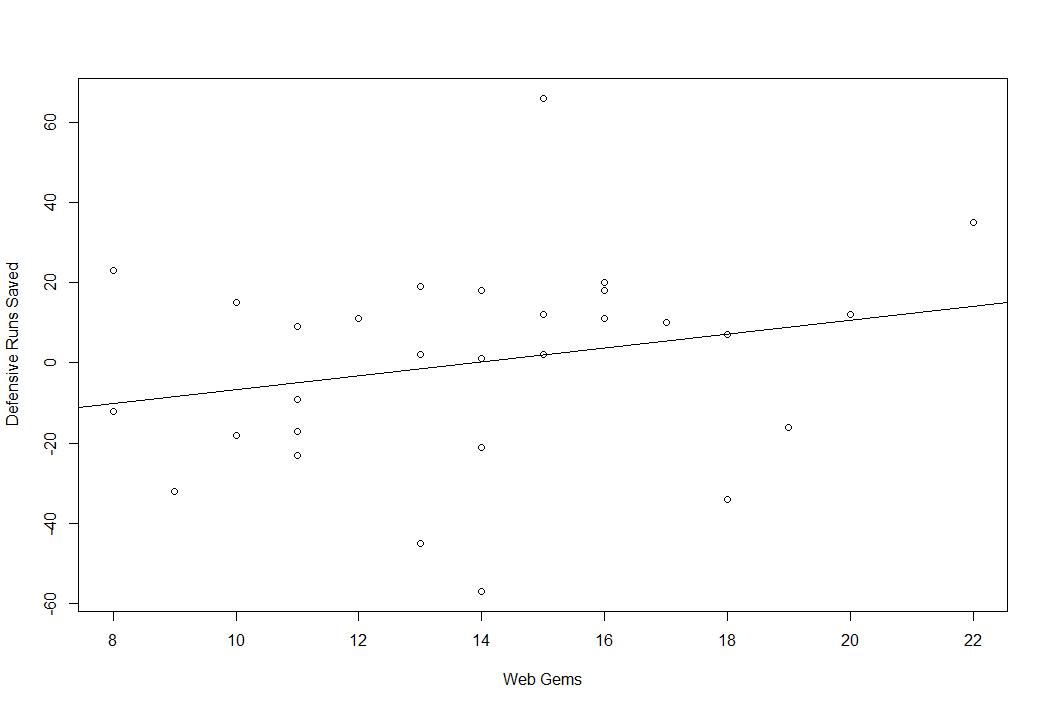
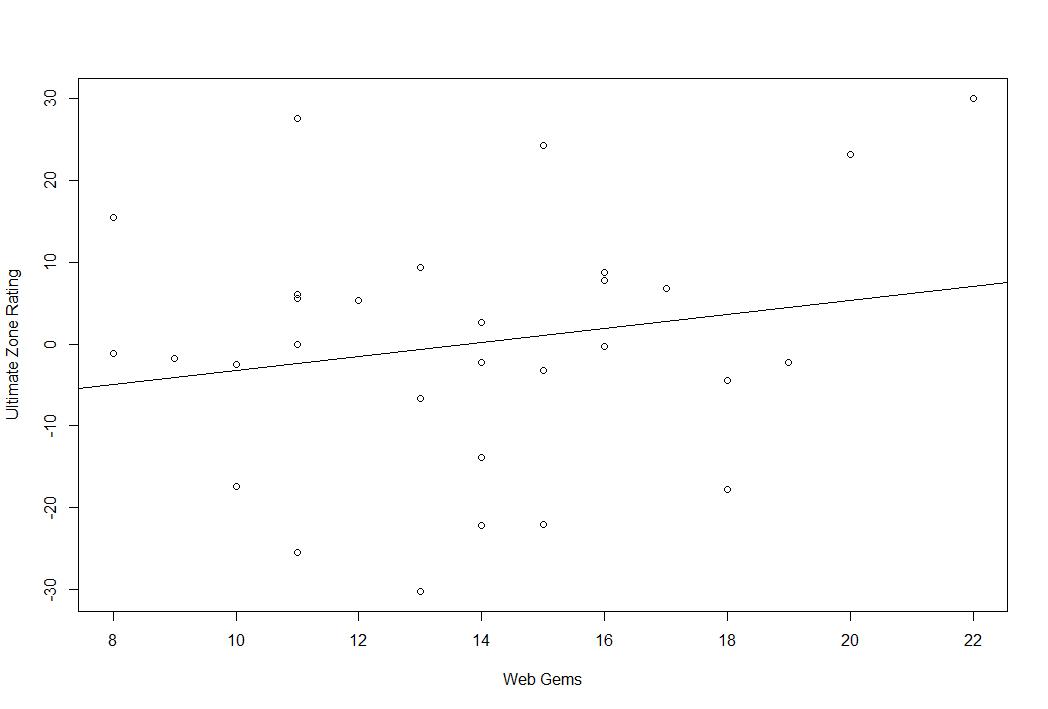
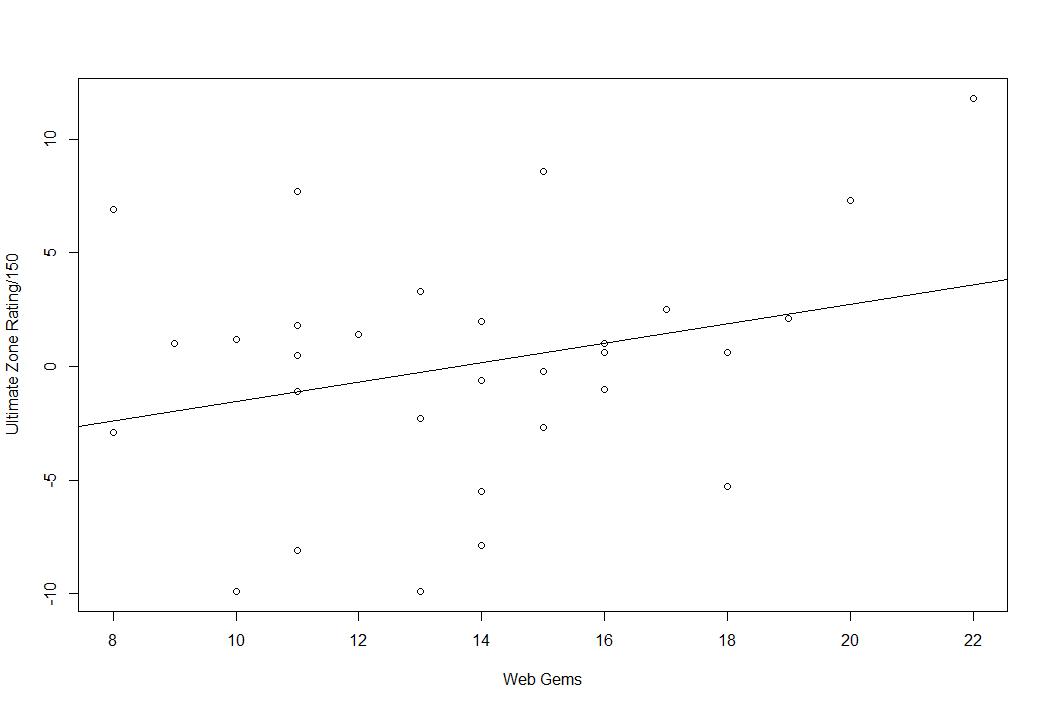
You may notice the line slops upward in each graph, meaning that as Web Gems increase, so too do the various metrics, but a positive slop doesn’t mean it’s a real effect. That’s just the line of best fit. In reality, these lines are not statistically significant. In fact, they are almost as insignificant as something can be (I know that’s bad statistical theory, it’s poetic license).
Here are the slope coefficients, standard errors, and adjusted r squares:
| WEB GEMS | DRS | UZR | UZR/150 |
| Parameter Estimate | 1.70 | 0.86 | 0.43 |
| Standard Error | 1.30 | 0.80 | 0.27 |
| Adjusted R squared | 0.03 | 0.00 | 0.05 |
As you can see, the adjusted r squares for each of these are remarkable tiny. In layman’s terms, what you are seeing here is this. More Web Gems, on average, mean higher DRS/UZR, but this is almost surely due to random chance. Web Gems also explain less than 10% of the overall variation in the defensive stats.
Basically, the takeaway here is that overall team defense is not related to a team’s overall number of Web Gems. That might not interest you, but I was curious. I’d like to do it with every player in the league, but I don’t have complete individual Web Gem data and I think the very high number of zeroes would probably make it a giant mess. I’m not sure.
But my curiosity has been satisfied and I feel better knowing that the ability to make ridiculous plays is not strongly related to the overall ability prevent runs.
The Morning Edition (June 24, 2013)
From Last Night:
- The Pirates get 3 in the 9th to tie, 4 in the 10th to take the lead and almost give it back as they outlast the Angels
- Morales walks off on the A’s in 10
- The Mets get 8 as Harvey goes 6 scoreless
- Cashner is brilliant, but Street blows it in the 9th
- Latos K’s 13 Dbacks and the Reds survive a rough inning from Chapman
- Toronto slugs their way to 11 straight wins
What I’m Watching Today:
- Cliff Lee visits Petco (10p Eastern)
- Bumgarner faces Ryu (10p Eastern)
The Big Question:
- How can MLB only schedule four games for today?
Clayton Kershaw has thrown 113.1 IP, 8.8 K/9, 2.5 BB/9, 2.06 ERA, 2.16 FIP, and 2.9 WAR.
Mat Latos has thrown 103.1 IP, 8.7 K/9, 2.44 BB/9, 3.05 ERA, 3.02 FIP, and 2.3 WAR.
They aren’t dramatically different, but Kershaw is pretty much better across the board. Kershaw is 5-5 and Latos is 7-1. It’s time to stop caring about pitcher won loss record, it simply isn’t an indicator of individual pitcher performance.
Revisiting The Nine Best Catchers for 2013
In the weeks leading up to the 2013 season, I unveiled my predictions for The Nine best players at each position. Some of the lists look good, some look terrible at this point, but that’s all part of the fun. Over the next two weeks leading up to the All-Star Game I will be revisiting these lists to see how things are going so far, around the halfway mark.
Obviously, the early evaluations will feature fewer than half a season and the later lists will feature a bit more, but try to think of these as the state of the position at the halfway mark. I’ll be using Wins Above Replacement (WAR) to generate the rankings because it is the number that best captures the entire value of a player. It isn’t perfect, so don’t take the precise values too seriously, but it’s certainly the best way to make any type of holistic list. WAR values offense, defense, baserunning, and playing time, so it represents exactly what I was trying to capture when I made the rankings during Spring Training.
Here’s how this will work. Below, you’ll see all nine players I ranked in the preseason and any player who currently ranks in the top 9 at that position. The current ranking drives the order and the preseason ranking and their current WAR is noted. Hit, miss, and push distinctions are based on where their first half places them going forward. For example, I can miss on a player even if I expect them to play much better in the second half if their first half was so poor that it is impossible to make up the ground overall.
Let’s start with catchers! Here’s the original post for you to refer to: The Nine Best Catchers for 2013. (Numbers reflect start of play on June 22).
57. Ryan Hanigan, Reds (Preseason Rank: 9, 2013 WAR: 0.0 WAR)
Hanigan made my original list largely based on his excellent defensive work and his ability to get on base. The defense has been strong as usual, but his .278 OBP has been horrible, especially compared to his .365 mark a year ago. As a result of his poor offense, he’s receiving much less playing time than I expected and isn’t accumulating much value. I don’t think he’ll be replacement level the entire year, but it’s likely too late for him to make any sort of run at a top nine spot. MISS
51. Carlos Ruiz, Phillies (Preseason Rank: 7, 2013 WAR: 0.1 WAR)
Ruiz missed the first 25 games with a suspension, which I knew about going into the season, so I anticipated his value would be backloaded. However, he also got hurt and has only appeared in 19 games to date with 67 PA. He hasn’t played well in that span, but that’s such a small sample that it’s really too hard to tell how he’ll play for the whole season now that he has come off the DL. Even if he matches his career year pace the rest of the way, I think it will be pretty hard for him to crack the top 9, much less be number 7. I expect him to play like a top 10-12 catcher for the rest of the season, but this is an accumulation list and that doesn’t do me much good. MISS
49. Miguel Montero, Diamondbacks (Preseason Rank: 4, 2013 WAR: 0.1)
Montero was a pretty safe pick coming into the season, but while his walk rate is still very good the batting average and power have vanished. He’s actually making more contact, but it is, evidently, weaker contact. He’s hitting more balls on the ground than he used to, but the line drive rate is pretty consistent. I’m optimistic that he’ll break out of this, especially because of his home ballpark, but it’s pretty unlikely he can make it to #4 on the list under any circumstances. He’s not this bad, but he’s not as good as I said either. MISS
19. Matt Wieters, Orioles (Preseason Rank: 6, 2013 WAR: 0.9 WAR)
Wieters looked like he was on track to finally become the star player he was billed as coming up in Baltimore, but pretty much every part of his offensive game has taken a big step back this year. The average is down, the walk rate is down, and so is the power. His defense is still excellent, but a .288 OBP isn’t something you can wash away with a nice UZR. From the right side of the plate, he’s been very good, but he spends most of his time hitting left-handed. It might be time to think about bagging the switch hitter thing if this keeps up. MISS
18. Brian McCann, Braves (Preseason Rank: 8, 2013 WAR: 0.9)
McCann’s numbers are in line with what I expected from him. No longer a star player, but still a better than league average hitter who players catcher and does so reasonably well. He missed time to start the season, but appears to be back and healthy now. If he keeps up this pace, he’ll be right around where I figured he’d be. I’m not ready to call this a hit, but it’s certainly not a miss. PUSH
11. Salvador Perez, Royals (Preseason Rank: 5, 2013 WAR: 1.2)
All of Perez’s numbers are very good, especially for a 23 year old, except for his walk rate, which is under 3%. The average is good, the power is good, the defense is excellent. I banked on him developing his approach to some degree this year, but that doesn’t seem to be happening. He’s a very good player (I bet Harold Reynolds loves him because he thinks walks are outs in disguise), but he’s not a top 5 catcher until he learns some patience. I’m going to call this a push, because he’s less than a win away from the spot I pegged him for and some of those guys are overachieving. We’ll revisit this after the season is over. PUSH
9. Jarrod Saltalamacchia, Red Sox (Preseason Rank: N/A, 2013 WAR: 1.3)
Salty was part of a couple of high profile trades and it’s taken him a while to grown into a solid big leaguer, but the power is real even if he has a problem with strikeouts. His OBP is better this year than in the past and that’s probably going to regress a bit, but it is possible he is starting to figure it out. I don’t think he’s going to be a top 10 catcher the rest of the way, but he’s certainly lined up for a respectable season. PUSH
8. A.J. Ellis, Dodgers (Preseason Rank: N/A, 2013 WAR: 1.6)
Ellis broke out last year and is reproducing his excellent approach at the plate, which puts him in line for a great OBP. His defense is looking better but the power has ticked down a bit so he’s probably not going much higher than this. I had him just outside the top nine, so I’m feeling very good about this one. HIT
7. Jason Castro, Astros (Preseason Rank: N/A, 2013 WAR: 1.8)
Castro has always had a fairly good approach, and the batting average has trended up every season, but this year the power has broken out and it is certainly his carrying tool. He’s never had 300 PA at the MLB level, so it’s a bit of an unknown on a bad team, but I think he’s certainly better than I thought at the beginning of the season. I think he’s going to be an average catcher and I’d have put him around the middle entering the season. PUSH
6. Carlos Santana, Indians (Preseason Rank: N/A, 2013 WAR: 1.8)
I had Santana literally right outside the top 9 going into the season and agonized between him and Hanigan, who I love on defense. Santana has a great approach and great power and can be counted on for above average power and OBP, but he has stepped from a 120 wRC+ guy to a 140 wRC+ guy this year which is enough to take his iffy defense from 10th best catcher to top 6 catcher so far. I’m banking on him falling back on this list, just slightly, such that he’ll be right around the 8-10 range. HIT
5. Evan Gattis, Braves (Preseason Rank: N/A, 2013 WAR: 1.9)
Gattis doesn’t give you a great OBP and scouts say he is likely overperforming in that regard, but the power is absolutely incredible and he mashes lefties. Gattis has already provided more value than I had him pegged for entering the year, so it’s an obvious miss, but I’m not so sure he can provide more than another 1-1.5 wins the rest of the way. MISS
4. Russell Martin, Pirates (Preseason Rank: N/A, 2013 WAR: 2.4)
Yeah, so Martin has always been a good defender and had a nice approach, but his strikeouts were trending up and his average was trending down over the last several years and the power had been inconsistent. But it’s all coming back. This calls for a graph:

I hope you can forgive me for not seeing this Russell Martin coming. Nice sign by the Bucs. MISS
3. Buster Posey, Giants (Preseason Rank: 1, 2013 WAR: 2.8)
Posey is a great player having an excellent season. He’s not 2012 Buster Posey, but that’s a career season. He’s striking out less and is still above average to great at everything except running. HIT
2. Joe Mauer, Twins (Preseason Rank: 3, 2013 WAR: 3.1)
Mauer, too, is a great player having a great season. His major question mark lately has been health and that hasn’t been an issue so far. High average, excellent approach, and the power has even bounced back to go along with his nice defense and excellent game calling. It’s not his fault no one else on his team is any good. HIT
1. Yadier Molina, Cardinals (Preseason Rank: 3, 2013 WAR: 3.6)
Molina has always been an unquestionable great defensive player who could probably hit .150 and still be worth rostering, but over the last few years he has made the leap to MVP by turning himself into a great hitter too. Catcher defense is not fully appreciated with UZR and DRS, but even without giving him enough credit for his defense he’s still a top player in baseball this year thanks to this offensive adjustment:

Not bad. HIT
Check back for more The Nine updates featuring the other positions. How will these lists look come October? Sounds off in the comments section.
The Morning Edition (June 23, 2013)
From Last Night:
- The Rangers knock Miller around, win 4-2
- Kluber unimpressive, Walters very-not-impressive, as Indians win 8-7
- Greinke goes 8, gives up 1 ER, keeps Quentin off the bases in first meeting with SD since brawl
- Corbin and Leake were brilliant, but Bell and Chapman blow saves as the Dbacks win
- Papelbon blows the game, gets a W as his Frandsen bails him out
- Turner and Zito are both sharp, Giants win in 11
- Myers hits a GS off Sabathia, but the Rays pen gives it away
What I’m Watching Today:
- Matt Harvey day in Philly (1p Eastern)
- James Shields’ hilarious W/L record on display (2p Eastern)
- Cain tries to stay hot (4p Eastern)
- Parker and Bonderman (4p Eastern)
- Wainwright on Sunday night (8p Eastern)
The Big Question:
- How long until we stop idolizing closers?
I wrote earlier in the week that “proven closers” are a myth and that you can very easily invent a 9th inning save-getter with almost no effort. That should be easily on display as many “proven” guys melted down on Saturday. Let’s rethink bullpen usage. This is how I’d allocate the spots:
- Relief ace (pitches in highest leverage situations)
- High leverage righty (can get out both lefties and righties)
- High leverage lefty (can get out both lefties and righties)
- Right Handed Specialist
- Left Handed Specialist
- Long Reliever
- Long Reliever
I want bullpens to be used so that the situation and matchup dictates who comes into the game, not the inning on the scoreboard or whether or not something is a “Save.” If you carry two long men, you can also let them eat up two and three innings at a time so that on nights where there are big leads or deficits, you just don’t go to anyone else after your starter. Most teams barely have one good long man, when they should probably have two. If readers are interested, I’d be happy to expand on how this would work. Last year starters averaged 6 innings per start. Managers should be thinking about how to get 6-12 outs a night from 7 relievers, rather than getting to the 9th inning and their closer.
The Nine Most Valuable Powerless Seasons of the Last Decade
Power hitters get all the headlines. And all the cash. People love homeruns. I get it, homeruns are good. But homeruns aren’t everything. Getting on base matters more than hitting for extra bases and defense and baserunning are important aspects of the game. ESPN has a homerun tracker, but they don’t have a leadoff single tracker. It’s a cultural thing.
So here, I’m going to pay homage to the powerless players who sometimes get overlooked. This is The Nine Most Valuable Powerless Seasons of the Last Decade. The rules are simple. These are the players who posted the highest Wins Above Replacement (WAR) values while having a slugging percentage that was below league average from 2004-2013.
For starters, here is league average slugging by season:

9. Russel Martin, 2008 Yankees (.396 SLG, 4.8 WAR)
8. B.J. Upton, 2008 Rays (.401 SLG, 4.8 WAR)
7. Brett Gardner, 2011 Yankees (.369 SLG, 4.9 WAR)
6. Nyjer Morgan, 2009 Pirates and Nationals (.388 SLG, 5.0 WAR)
5. Ichiro Suzuki, 2006 Mariners (.416 SLG, 5.3 WAR)
4. Jose Reyes, 2007 Mets (.421 SLG, 5.3 WAR)
3. Brett Gardner, 2010 Yankees (.379 SLG, 6.0 WAR)
2. Michael Bourn, 2012 Braves (.391 SLG, 6.1 WAR)
1. Chone Figgins, 2009 Angels (.393 SLG, 6.6 WAR)
Obviously, Figgins parlayed this season into a big deal and Upton, Bourn, Reyes, and Ichiro all did just fine for themselves too. So this group isn’t entirely underpaid, just under appreciated. Seriously, Michael Bourn finished 18th in the NL MVP vote last year despite having the 7th highest WAR among all NL players.
In 2013, Jacoby Ellsbury’s .391 SLG and 2.1 WAR lead the way.
The Morning Edition (June 22, 2013)
From Last Night:
- The Jays tie it in the 7th and win in the 9th to bail out Dickey
- Kazmir dominates the Twins
- Strasburg gives up 1 ER in 7, Ks 9, walks none to beat the Rockies
- Garza goes 8 to beat the Astros
What I’m Watching Today:
- Jacob Turner heads to AT&T (4p Eastern)
- Leake and Corbin in Arizona (7p Eastern)
- Greinke and Volquez in the who knows what will happen game (7p Eastern)
- NERD darling Kluber (7p Eastern)
- Actual darling Shelby Miller (7p Eastern)
The Big Question:
- Are you ready for Trout/Cabrera 2.0?
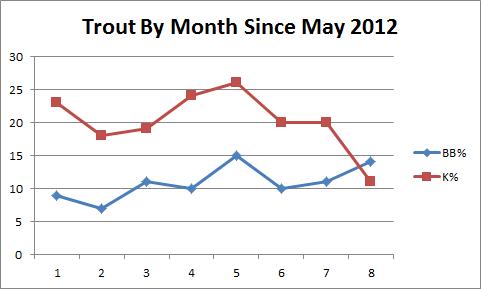
As I write this, the Angels are in the 4th inning, so the exact numbers might be different when you read this, but Cabrera and Trout are 1 and 2 in WAR right now. Cabrera stands at 4.8 and Trout at 4.3. Dave Cameron wrote a nice piece yesterday regarding Trout’s place among the best age 21 seasons in history after having the best age 20 season ever last year. He’s felt the dreaded regression monster, all the way from 166 wRC+ to 161 this year. We all know what Cabrera is doing:
But Trout is doing his thing as well. .315/.393/.553 plus excellent baserunning (but just average defense so far by the advanced metrics). Read Cameron’s piece for a full picture, but his K% and BB% numbers are trending in a ridiculous direction.
The Morning Edition (June 21, 2013)
From Last Night:
- Wright homers twice, but the Mets lose Niese in win against the Braves
- Longoria’s 2 HR lift the Rays over the Yanks
- Zimmermann dominates the Rockies, but Oswalt gets 11 K of his own as Nats win 5-1
- Pena walks off on the Crew in 10
- Another Puig HR
What I’m Watching Today:
- Strasburg looks to build on a solid first start back (7p Eastern)
- Cole goes to LA to face Weaver (10p Eastern)
- Clayton Kershaw faces similarly named Clayton Richard (10p Eastern)
- Colon and Iwakuma (10p Eastern)
The Big Question:
- Who would you honor with the NL All-Star start?
There are a number of good candidates depending on what statistics you value:
WAR:
Wainwright, Harvey, Lee, and Kershaw
FIP:
Harvey, Wainwright, Miller, Kershaw, Lee
ERA:
Kershaw, Locke (!), Miller, Harvey, Corbin, Wainwright, Zimmermann
K/9:
Miller, Burnett, Samardjiza, Harvey, Lynn
Wins (LOL!):
Wainwright, Lee, Corbin, Zimmermann, Lynn, and Marquis
Wainwright is probably having the best season, but I’d be completely happy with Harvey given that the game is at Citi Field and he’s one of the game’s brightest young stars. Kershaw, Lee, and Miller are all very deserving as well. Right now, I’d go with Waino or Harvey. You?
Yes, You Can Invent a Closer
I’ve written extensively on bullpen usage and the closer role. To catch you up, here are the three big pieces:
I encourage you all to read those piece to catch up, but I’m going to move forward even if you haven’t. I’m going to make a claim and then seek to back it up with real evidence. The claim is this:
Closer experience doesn’t matter. If you put a good reliever into the closer role, he will succeed.
I would prefer managers not use closers at all (see link #3 above), but let’s say managers want to have a closer who comes in during save situations for a single inning. If that is the case, I am here to tell you that you do not need closer experience to be a closer.
I took the 30 pitchers with the most save opportunities from 2012 to test this theory. The group average was 35 save chances from 2012 and none had fewer than 20. Only the Athletics had two players on the list who played for only one team and four players on the list played for two or more teams in 2012. Combined, they averaged 30.3 saves and 910 saves in total.
These are 30 undisputed closers. The took on the closer role in 2012 and accumulated saves. Jim Leyland, who is my target audience right now, would look at their save totals and save percentage and consider them closers.
You with me so far? Good.
Only 10 of them had more than 17 save opportunities in 2011. Only a third of 2012’s best closers would have made the list from 2011. Certainly there were injuries, but Joe Nathan is the only one who was a legitimate closer before 2011 other than Rafael Soriano, who backed up Mariano Rivera in 2011. Maybe I’ll give you Jonathan Broxton, but he had lost his closer tag, so we’ll see. Despite all of this, at most we could say that half of 2012’s best closers had closer experience. Just half.
Half of them had fewer than 10 save chances in 2011 and five had zero save chances in 2011. Half of the best closers of 2012 weren’t even closers the year before.
I’ll cut the group in half and say anyone under 10 save chances in 2011 is non-proven and anyone over 10 chances is proven. I’m being generous.
The non-proven closers averaged 27 saves in 2012 and the provens averaged 33. But they averaged an 87 and 86% save percentage, respectively. The non-proven closers averaged 7 fewer opportunities in 2012, but they converted essentially the same percentage as the proven closers.

These are facts. I’ll go a step further. The five closers who had zero save chances in 2011 converted 84% of their save chance in 2012. There is literally no discernible difference between pitchers with closing experience as it pertains to saves. None. None. None.
It gets better. The proven closers had an ERA of 3.11 in 2012. The non-proven closers had an ERA of 2.73.
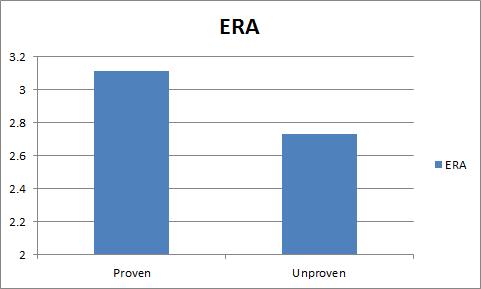
So basically, this is the argument I’m making. Closing experience does not predict future success in that role. The 30 best closers from 2012 prove that pretty nicely. The 15 proven guys were no more successful at converting saves and had a worse ERA than the non-proven closers. If anything the unproven closers pitched better.
Jim Leyland and the Tigers have placed an extremely high value on closing experience. They signed a reliever who was past his ability to pitch in MLB because he had saved games before and they won’t turn to better pitchers because they “can’t close.” Leyland has been clear on this. I have never heard a clear explanation about what makes the 9th inning different, but I can tell you very clearly that pitchers have been placed in the closer’s role as recently as last season and had absolutely no problem handling it.
No problem at all. So while I don’t advocate using a closer at all, if managers insist on defined roles with specific limits can we at least accept the fact that you can put anyone who is reasonable competent into the closer’s role?
Leyland doesn’t want to use Smyly or Benoit in the closer’s role and has repeated said the “9th inning is a little bit different,” but there is just no evidence that is true.
You can create a closer by putting a good reliever into the role. The Tigers have good relievers and should just put one of them into the role if Leyland insists on having a closer. It really is that simple. You can invent a closer. Fifteen teams did it last season.
I’ve included an Excel File (Closers) with the the data I used. The stats to the right of the yellow divider are from 2012 and the left side is from 2011.
The Morning Edition (June 20, 2013)
From Last Night:
- Bruce ties it in the 9th and Phillips wins it in the 13th as the Reds beat the Bucs 2-1
- Myers drives in his first two to lead the Rays over the Sox
- Medlen shuts down the Mets
- Papelbon allows the Nats to tie it in the 9th, Suzuki delivers a GS in the 11th
- Yanks and Dodgers split a DH
What I’m Watching Today:
- Oswalt returns to the bigs with the Rockies against Zimmermann (7p Eastern)
- Moore and Pettitte at Yankees stadium (7p Eastern)
- Felix Hernandez faces the Angels (10p Eastern)
The Big Question:
- After 8 straight wins, are the Blue Jays getting back in this?
I’m doubtful despite the hot streak. Despite 8 straight wins, they are still 7.5 games back of first place and 4.5 back of the second wild card. That isn’t a number too big to overcome, but the problem is how many teams are between them and their goal. To make up the terrible start, they would have to outplay at least two other teams the rest of the way plus the distance they are already back. I’m not sure they are good enough. Fangraphs’ own standings projection is equally skeptical of the Jays, figuring them for 82 wins. New English D has them at 83 wins, and I feel pretty good about that. One week in June isn’t enough to convince me the first 10 weeks didn’t happen.
 New English D