Dynamic Standings Projection (May 8, 2013)
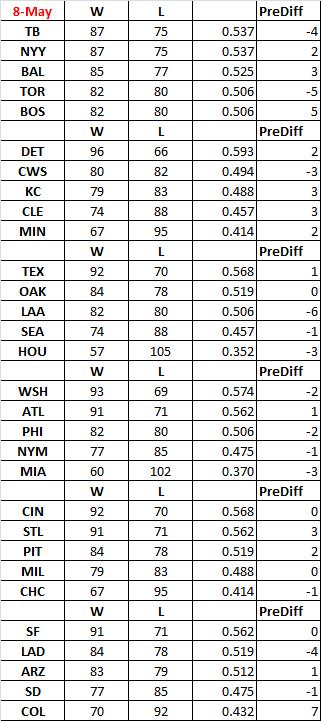
In case you missed it, last month we launched our Dynamic Standings Projection feature on New English D. A full explanation of the methodology can be found here or by clicking the tab at the top of the page. This project seeks to provide a reasoned and cautious approach to updating our beliefs about the baseball future. You can find a summarization of the original projections here. You’ll notice a column on the far right that indicates the difference in projected wins from the preseason prediction. Positive numbers mean teams are now projected to win more games and negative numbers mean a team is now projected to win fewer games.
This Dynamic Standings Projection is updated through the May 7 games.
The Morning Edition (May 8, 2013)

From Last Night:
- Matt Harvey takes a perfect game into the 7th, loses it on an infield single, and winds up striking out 12, walking none over 9 innings – but the Mets needed 10 innings to beat the White Sox 1-0
- J.A. Happ takes a line drive off the side of his head, taken off the field on a stretcher (condition unknown at press time)
- The Reds get two homers in the 9th to walk off on Kimbrel
What I’m Watching Today:
- Felix Hernandez is on the hill in Pittsburgh, but so is the quite frontman AJ Burnett (1230p Eastern)
- Matt Moore faces the Jays (7p Eastern)
- Clayton Kershaw welcomes the Dbacks to Chavez Ravine (10p Eastern)
The Big Question:
- Is Happ going to be alright?
Matt Harvey (4-0. 49.1 IP, 1.28 ERA, 1.92 FIP, 1.9 WAR) did it again. You may remember he made the inaugural Appointment Television rankings and he showed why on Tuesday. He retired the first 20 hitters he faced, until he allowed a two out infield hit in the 7th inning, and then went right back to dominating and finished the night with 12 strikeouts, 0 walks, 1 hit, and 0 runs in 9 innings of work. His team couldn’t muster a run until the 10th, so he didn’t get a win, but he was eye-popping fantastic. Granted, he faced the league’s second worst offense in the White Sox, but that kind of domination is difficult in any setting. I’ve been buying Harvey for a while, as regular readers will note, but this is just getting out of hand. In 17 ML starts, he’s allowed 3 or more earned runs just three time. He’s allowed more than 5 hits just four times. The 24 year old righty is certainly must watch TV, but he’s closing in on bona fide ace status. Here are the names he shares the top 9 of the pitcher WAR leaderboard with: Sanchez, Buchholz, Verlander, Darvish, Wainwright, Hernandez, Scherzer, Shields. That’s the company he’s keeping.
Swinging 3-0: Rod Allen’s Go To Topic
Tonight’s Tigers game has been postponed until Thursday on account of rain in D.C., so I thought I’d take this opportunity to consider one of Rod Allen’s favorite topics of conversation: swinging on a 3-0 pitch. This is a topic of interest for me because it exists at the intersection of two things I think are really important in baseball: plate discipline and strategy.
Let’s set the stage for a moment. Generally speaking in baseball, when a hitter gets himself into a 3 balls, 0 strikes count, the manager gives him a “red light” indicating that he is instructed not to swing at the next pitch because the pitcher has recently had trouble finding the zone and the batter should accept a free pass if the pitcher is offering it. If you take a strike on 3-0, you still have two pitches to choose from while the pitcher still has no margin for error. It’s a good percentage play. A quality major league player will recognize the value in accepting a free pass and will take the pitch.
But 3-0 pitches are very often fastballs right down the middle because pitchers are trying not to walk you and that pitch is presumably the easiest to throw for a guaranteed strike. That makes sense, except that it makes no sense at all. If the pitcher had the ability to control his pitches that well, he shouldn’t have gotten behind 3-0 in the first place and even if he grooves one on 3-0, he’s going to go back to nibbling at the strike zone on the next pitch. Either the pitcher shouldn’t have gotten into a 3-0 count or he shouldn’t care about issuing a four pitch walk if he is just going to issue a five pitch walk twenty five seconds later.
It’s a pretty standard paradigm. If you get behind a hitter 3-0, you usually groove a fastball. If a hitter is ahead 3-0, he usually takes. Except when he doesn’t.
Rod Allen, the Tigers TV color man, has made a lot of this during the first few weeks of the season because he thinks really good hitters should attack the 3-0 pitch more often because it’s usually such a good pitch. His logic makes sense. If you know a straight fastball is coming, you can probably do significant damage that might be better than a walk. There is a risk in swinging, in that you might make an out, but if you get exactly what you are expecting, it could be beneficial to swing. Rod tells us Cabrera and Fielder have the green light 3-0, but don’t like to swing too often when they get it. Which makes sense given the risk while also knowing if they get ahead 3-0, they’re probably getting walked soon anyway.
But maybe we have this wrong. I’m a huge proponent of plate discipline and taking the base on balls, but maybe hitters should be more aggressive on 3-0 pitches. After all, so many of them are batting practice fastballs waiting to get crushed. Is there an inefficiency here that hitters can exploit?
Let’s start with some basic data. Tigers hitters have been in 65 3-0 counts so far this season and 39 have ended in walks. Of those 65 plate appearances, 28 ended after the fourth pitch. 25 of those were walks. What this indicates is that Tigers hitters have put the ball in play just three times in a 3-0 count. I don’t have access to the data, but I think we can probably assume the Tigers haven’t swung an missed at a 3-0 pitch this year, but there may be a foul ball in there somewhere and we have to ignore those away.
In those 3 plate appearances in which the Tigers went for it 3-0, here are the numbers. Obviously, they are gaudy: .667 batting average, 1.667 slugging percentage (.964 OBP when you leave the walks in). A three run homerun by Cabrera, a single by Peralta, and an out by Prince.
Notice the pitch sequence during the HR at bat to Cabrera (I mean, what do you expect here?):

But let’s take this a little further and go back to the 65 3-0 counts in general. If they walked 25 times on 4 pitches and put the ball in play on 3 others, then there are 37 at bats that got to 3-0 and then went at least 5 pitches. So 37 times, the Tigers took a 3-0 pitch for a strike. What happened after they did that?
After the Tigers got to 3-0 and took the fourth pitch for a strike, they went on to hit .391/.595/.609. Not bad at all. It’s not better than when they swing on 3-0, but obviously a sample size of 3 in the first analysis isn’t that predictive. What I think is interesting is the on base percentage. If you get to a 3-0 count, your odds of getting on base at any time during the at bat are .769. If you take the next pitch for a strike, it drops to .595. In other words, if you take a 3-0 strike, you’re sacrificing a ~17% change of getting on base to avoid the risk that you’ll make an out. That’s an interesting trade off to make given that you have a .667 batting average swinging 3-0 so far this year. (If you take out the intentional walks, which you obvious aren’t swinging at, the point holds)
So this means we should think about swinging on 3-0 more often because taking a 3-0 strike, which should be easy to hit, reduces your chance of getting on base pretty substantially, right?
Well, not exactly. This could be a small sample illusion. Last year, the Tigers hit .250 swinging on 3-0 and .192 in at bats that started 3-0. In 2011, it was .250, .232. What’s going on there?
I’m not really sure. The Tigers put 3-0 pitches in play just 4 times in 2012 and 8 in 2011, so it’s not like the sample size is much different than this season. The number of ABs that got that far is much bigger in the two complete seasons however. But the on base pattern does hold in larger samples. It’s around .700 when you get to 3-0, but it drops down substantially when you take a strike.
Essentially, if you get into a 3-0 count, taking a strike substantially changes your odds of getting on base. If you see a strike on 3-0, maybe you should swing. If you’re looking for exactly what you get. There is a chance to out fox your opponent. Pitchers expect you to take, so they groove it. If you swing, there is an above average change you will get a base hit because you know it’s a fastball, but there is also a good chance it will give pitchers pause when throwing you 3-0 pitches in the future because they don’t want to throw a meatball if you’re swinging. Which means in the future, they won’t do that so much and you’ll get more walks 3-0 and won’t have to continue the at bat into counts in which you have worse odds.
It’s kind of fun to think about. There is an optimal rate at which you should swing 3-0 and I don’t think we’re there. You can’t swing too much or you’ll end up on base less overall, but swinging too little also huts you because your odds of reaching base 3-1 are much worse than 3-0 and you’ve also sacrificed a chance at a 3-0 hit.
So next time Rod talks about Cabrera or Fielder swinging 3-0, think about it a little more carefully. There is probably good reason to swing 3-0 at a higher rate. Of course, no one wants to make an out on a 3-0 pitch, so hitters probably won’t be doing this any time soon.
The Morning Edition (May 7, 2013)
From Last Night:
- The Indians homer their way to a win over the A’s
- Shields throws 8 scoreless, but his offense fails him as the the White Sox win in 11
- Simmons homers twice as the Braves beat the Reds 7-4
What I’m Watching Today:
- Medlen and Bailey bring identical 3.38 ERAs to GABP (7p Eastern)
- Matt Harvey faces baseball’s second worse offense, the White Sox, at Citi (7p Eastern)
- McCarthy and Beckett face off in a battle of erstwhile stars (10p Eastern)
- And don’t forget Sanchez vs Zimmermann in DC! (7p Eastern)
The Big Question:
- How will Harvey respond coming off his first short outing?
Don’t look now, but 20 year old 3B Manny Machado is doing a Trout and Harper impression and has placed himself 4th on the WAR leaderboard (1.7). Machado is hitting .309/.352/.522 for a 135 wRC+ to go with his sterling 6.9 UZR/6 DRS. He’s playing gold glove defense at third and he’s hitting like a star. We’ve talked a lot about how Harper and Trout are generational talents and they’ve spoiled us for other young players, but Mr. Machado isn’t so sure he’s ready to give up so soon. As I write this, just one AL position player has a higher WAR. Perhaps you’ve heard of him: Miguel Cabrera.
The Morning Edition (May 6, 2013)
From Last Night:
- Darvish K’s 14 Red Sox as the Rangers win in the bottom of the 9th
- The Marlins shell Halladay and get a clean outing from Slowey in a 14-2 win
- Garcia goes 8 and allows 1 run in front of a huge offensive outburst for the Cards
- Gordon’s walk-off single leads the Royals over the White Sox
What I’m Watching Today:
- Sale and Shields duel in KC (2p Eastern)
- Buchholz welcomes the Twins to town in search of his 7th win (7p Eastern)
- Lefties Lee and Bumgarner face off on the left coast (10p Eastern)
The Big Question:
- Is this the end for Doc?
When the season began, I left Roy Halladay off my list of The Nine best NL starters for 2013, but did so with great reservations. Sure Halladay was coming of a rough, injury plagued 2012, but the guy was easily the best and most consistent pitcher of the previous ten seasons, so I didn’t want to write him off too quickly. He opened the season with two rough outings against the Braves and Mets, but then got back on track for three against the Marlins, Cardinals, and Pirates before blowing a gasket against the Indians and Marlins. After the most recent start, he finally admitted to shoulder pain and will see Dr. Yocum this week. He’s likely headed for the DL and will likely never be the brilliant ace he once was. From 2002-2011, Halladay was the best pitcher in the sport and it wasn’t close. Not even a little bit. His 60.9 WAR during the time frame was first ahead of Sabathia by 9.6 WAR despite making 19 fewer starts. Only one starter with more than 1000 IP in the same time frame had a lower ERA: Johan Santana and he threw 400 fewer innings. As of now, he’s 33rd all time in pitcher WAR. He doesn’t have some of the counting stats one likes to see to make the Hall of Fame, but his peak is extremely solid. He has my vote if he never throws another pitch, and it’s not entirely certain that he ever will.
The Morning Edition (May 5, 2013)
From Last Night:
- Lorenzo Cain drives in 2 in the first to back Guthrie’s CGSO against the White Sox
- Jose Fernandez allows 1 hit in 7 innings while striking out 9 Phillies in his first ML win
- Strasburg gives up 2 homeruns in 7 innings, but the Nats score 1 in the top of the 9th to outlast the Bucs
- Wainwright struggles for the first time (5 ER in 5.1 IP), but the Cards deliver in the 9th to win
- Dickey gets lit up by the Mariners, Blue Jays fall 8-1
- Hughes throws 8 scoreless as the Yanks top the A’s
What I’m Watching Today:
- Hudson tries to an encore to his 200th win against Niese and the Mets (1p Eastern)
- Halladay looks to straighten out again against the Marlins (230p Eastern)
- Jon Lester. Yu Darvish. Arlington, Texas. (3p Eastern)
- Alex Cobb takes his hot start to Coors Field (4p Eastern)
- Strikeout happy Ryu gets struggling ace Matt Cain at AT&T (8p Eastern)
The Big Question:
- On a day in which Strasburg and Wainwright were on the mound, how did Guthrie, Fernandez, and Hughes headline the night? (Well, Scherzer did his part!)
R.A. Dickey…what’s going on? I certainly expected some regression from the 2012 peak in moving to the AL and a hitter friendly park, but this is pretty serious so far. We’re not deep enough into the season to totally dismiss a small sample size issue, but it’s getting to the point where it just doesn’t look like he’s going to pitch at or around ace levels for the foreseeable future. He’s 2-5 in 7 starts over 42 IP with a 7.07 K/9 and 3.64 BB/9 to go with a 5.36 ERA and 5.19 FIP. Granted, FIP isn’t a great judge of knuckleballers, but the other numbers don’t exactly hearten Blue Jays fans or Dickey fantasy owners (the present author included). If you go back to the much more reasonable 2010-2011 seasons, Dickey’s numbers this year don’t match those either. His strikeouts are up, but his walks are too. His ERA is way up, but his groundball rate is down considerably. That’s the item on the list that catches my attention the most. I haven’t watch Dickey enough to know, but I’m curious if this is the league figuring him out. Maybe he’s not much different and hitters are just getting smarter. I’m not sure, and I know there is some injury talk, but either way, the Mets are starting to look like even better for the offseason deal. The Jays can still turn it around if Dickey finds his groove, but I’m starting to wonder if he will.
The Nine Most Average Hitters of the Last Decade
Have you ever sat back and thought about being typical? Average? Middle of the road? Chances are you haven’t, but don’t worry, that’s where I come in. I answer questions you never knew you had and I’m about to do it again.
Have you ever wondered who the most average players are? We talk a lot about league average when we talk about statistics, but we don’t often provide illustrative examples. So let’s do that.
Below are a list of the most average MLB players over the last decade (2004-present) as defined by wRC+. There were 10-20 players who have posted a 100 wRC+ during that time period, so to make The Nine list, you have to have a 100 wRC+ since 2004 and then you have to have the most plate appearances doing so (as of 5/3/2013).
9. Ian Desmond (1964 PA)
8. Mike Jacobs (2140)
7. Marcus Giles (2190)
6. Brad Wilkerson (2412)
5. Xavier Nady (2794)
4. Mark Loretta (2885)
3. Coco Crisp (4397)
2. Aaron Hill (4494)
1. Alex Rios (5449)
Normally I write a blurb about each of the items on our The Nine lists, but I’d like to consider this one as a group because it’s more interesting to me. Notice the groupings. Players ranked 5-9 all have between 3 and 5 seasons of plate appearances during this window. They were league average over a span of 3-5 years during a sample of about 10. Crisp and Hill have 7 seasons. Rios has 9. So while these guys are all average by our best single offensive metric, Alex Rios is super average in that he produced average offense over a really long period of time. Let’s look at his career a little bit.

While Rios has been average on average, he has actually never been average in any one season. His most average season was 2008 in which he posted a 108 wRC+. What is kind of amazing is that none of the other guys on this list display a pattern much different from Rios. They vary in the degree to which they deviate from the 100 wRC+ line, but they all deviate a great deal. I haven’t taken the time to go searching for baseball’s most consistently average player, but I will someday. For now, Rios gets the title of baseball’s most average hitter over the last decade, but man, he’s done it in atypical fashion.
The Morning Edition (May 4, 2013)
From Last Night:
- Holliday and Beltran homer behind a smooth performance by Shelby Miller
- Derek Holland dominates the Red Sox enroute to a 7-0 win
- David Wright homers off Kimbrel to send it to extras where the Mets win 7-5
- Felix Hernandez throws 8 shutout innings in Toronto
- AJ Burnett sharp again in 3-2 win over the Nats
- Kershaw flirts with a no-hitter, but loses it in the 6th ahead of a Posey walk-off
What I’m Watching Today:
- Adam Wainwright takes the Cardinals north to face the Crew (4p Eastern)
- Strasburg faces the Pirates in his first start since experiencing forearm tightness (4p Eastern)
- Patrick Corbin and his 1.91 ERA head to SD to face the Padres (830p Eastern)
The Big Question:
- Which pitching performance did you most enjoy on Friday?
It probably wouldn’t surprise the astute fan that Carlos Santana is crushing the baseball right now. His .383/.468/.679 line produces a 215 wRC+. That’s pretty awesome. To give you a sense of how good that is, Babe Ruth only had a wRC+ higher than 215 four times and his career wRC+ is 197. Probably not sustainable, but damn impressive as he is a 130 wRC+ career hitter. Man, the Indians can hit. They’d be good if their rotation wasn’t terrible.
The Morning Edition (May 3, 2013)
From Last Night:
- Haren cruises through 8 to lead the Nats over the Braves 3-1
- Brewers try to rally back from a 6-0 deficit and come up short against the Cards
- Kendrick stays solid to push the Phils past the Fish
What I’m Watching Today:
- Felix faces the Jays (7p Eastern)
- Shelby Miller and Kyle Lohse do battle in the beer city (8p Eastern)
- Clayton Kershaw on the hill against the Giants (10p Eastern)
The Big Question:
- Can you believe who leads the league in WAR?
The answer is Carlos Gomez who is trying to sustain a breakout campaign with a .372/.427/.638 line, good for 198 wRC+ and 2.0 WAR thanks to a 3.2 UZR. A good amount of the success is BABIP driven, but it’s still pretty impressive. How impressive? He’s only ever posted more than 2.0 WAR in a full season twice. It took him 26 games to do it in 2013.
Appointment Television: Baseball’s Must Watch Starting Pitchers
The following post is something I’ve been toying with in one form or another for a long time and finally got around to crystallizing this afternoon. I’ve often made reference to pitchers being “Appointment Television” in various Morning Edition and other posts and I thought I’d take that a little further and outline exactly who I’m talking about.
The methodology is simple but also subjective. To be classified as Appointment TV you have to have a high likelihood of pitching a gem. There is no set definition of gem or likelihood, but the idea is that to make this list, you have to be likely enough to throw a game worth clearing your schedule for. I think a number of pitchers qualify. Most are high strikeout guys, but that isn’t a requirement. If you are good enough to dominate on a semi-regular basis you’re in. If on your day to pitch, I make sure I’m aware of the start time so that I can check in, you’re Appointment TV.
This is a rolling list and pitchers will be added and subtracted throughout the season and it will be updated as necessary. There is no order other than that pitchers lower on the list in italics are recent additions, so if you’re wondering if Jordan Zimmermann really qualifies, know that he’s earned his way onto the list in his last few starts. Remember, this is a list of pitchers who on this date are can’t miss TV. These are not necessarily the best pitchers and plenty of good pitchers aren’t on the list.
Appointment Television Starting Pitchers:
- Justin Verlander
- Adam Wainwright
- Clayton Kershaw
- Felix Hernandez
- Yu Darvish
- Stephen Strasburg
- Matt Harvey
- Cliff Lee
- Matt Moore
- Clay Buchholz
- Max Scherzer
- Jordan Zimmermann
- Anibal Sanchez
- Jon Lester
Feel free to make a case for other starting pitchers who are must watch guys and we’ll consider adding them to the list.
 New English D