2013 Season Preview: American League Central

While certain national baseball writers seem to think Kansas City and Cleveland adding five or six wins to their 2012 totals will somehow help them unseat a Tigers team that added four or five wins of their own this offseason, the overwhelming evidence points to a third straight Tigers division title.
Things can go wrong, but the Tigers are far and away the safest bet to win any division in baseball again this season.
Here’s how STT sees it. [Division Rank. Team (2013 W/L Prediction, 2013 Preseason Power Ranking)]
5. Minnesota Twins (65-97, 27)
The Twins are looking down the road at a crop of exciting position prospects who are a few years away. They traded away both of their center fielders and signed scrap heap pitching. The plan is to wait it out, and that’s what they are doing. The Twins might not be baseball’s worst team, but on paper, they are certainly the worst in the AL Central.
4. Cleveland Indians (71-91, 26)
To be clear, I locked in these rankings and projections days before the Indians signed Michael Bourn, so this reflects a lower opinion of the Indians that is appropriate. The numbers reflect my views in the days before Spring Training, so for consistency’s sake, I’ll stand by them. The Indians added Bourn, Swisher, Stubbs, and Reynolds on offense and Myers, Bauer, and Dice-K in the rotation this offseason and should be better in 2013 for it. I kind of like their positions players and would like them more if they had one elite bat to put in the middle. But the pitching just can’t cut it. They have plenty of guys I like at the back end of a rotation, but no one I like for the top in 2013.
3. Kansas City Royals (76-86, 23)
Listen, the Royals didn’t get that much better. They added Ervin Santana who was terrible last year. They added Jeremy Guthrie who is okay. They added Wade Davis who could be solid and James Shields who is very good. At most, they added ten wins to their 2012 total. At most. That’s if Santana and Guthrie and Davis all contribute like legitimate major leaguers and if they all stay healthy. Don’t get me wrong, Hosmer should be better and Perez should hopefully stay healthy, but man is that a lot of qualifications. The Royals are no one’s whipping boy anymore, but let’s cool it with the excitement from national writers who somehow think adding James Shields changes everything. Guys, Wil Myers would have been just as big an upgrade over Jeff Francoeur.
2. Chicago White Sox (83-79, 16)
The White Sox didn’t do much to improve upon the 2012 roster and that team was the picture of average. So they shall be again. They over performed my expectations last year because I bet on certain players to continue washing up instead of returning to form. This team is a 78-85 win team at its finest and can certainly hang around if the Tigers let them.
1. Detroit Tigers (94-68, 2)
The Tigers return the same team that made it to the World Series in 2012 after underperforming all season, but they also add Victor Martinez, Torii Hunter, and full seasons of Omar Infante and Anibal Sanchez. They do so without losing anything of substance. If the Tigers remain as healthy as their opponents, they should win the division easily in 2013. Their pitching staff is head and shoulders above the Twins, Royals, and Indians while remaining significantly better than the White Sox and are serious contenders for the title of baseball’s best staff. Certainly things can go wrong, but they would have to go a lot more wrong for the Tigers than for every other team for this to be much of a race.
AL Central Cy Young: Justin Verlander (snooze)
AL Central MVP: Justin Verlander
Most Potentially Pivotal Player: Eric Hosmer
Storyline that Will Surprise Us: The Tigers won’t stumble out of the gate or down the stretch and will make it easy on their fans.
Boldest of the Bold: Joe Mauer will find his power again and hit 20 HRs.
2013 Season Preview: American League East
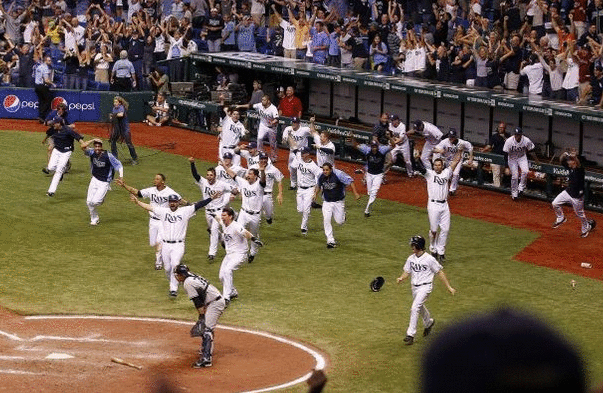
The East is kind of a mess. Boston is coming off a terrible year and a payroll reset. The Orioles had a magical 2012 and did nothing to bolster their club. The Yankees are dropping like flies. The Rays retooled. The Blue Jays got a makeover. Everything is different, but everything also looks kind of similar.
Like, I mean, could any of these teams win 90 and any of them win 75? I think so.
As always, here is how STT sees it. [Division Rank. Team (2013 W/L Prediction, 2013 Preseason Power Ranking)]
5. Boston Red Sox (77-85, 20)
If everything goes right for the Sox, I can totally see them making a run at a wild card spot, I just don’t feel as confident that they can put it all together as I do about the other teams in the division. They added a lot of players who could provide value, but they didn’t add a lot in terms of difference makers. Dempster and Victorino and Napoli will make the team better, but there are a lot of injury question marks and starting pitchers who I just don’t know how to project. The Sox have talent, I’m just not sure how it’s going to manifest. They won’t be an embarrassment but I don’t expect them in the playoffs.
4. Baltimore Orioles (82-80, 17)
The O’s had a great run in 2012 but 93 wins is a tough act to follow and some modest regression is bound to happen. They also failed to do anything to upgrade the roster that might have given them a shot to repeat last season. This is an average club in a deep division.
3. New York Yankees (85-77, 12)
The Yankees are pinching pennies ahead of the 2014 luxury tax threshold and it’s showing on their 2013 roster. They got outbid by the Pirates on a catcher and can probably only count on superstar performance from Robinson Cano. But that doesn’t mean they don’t have good players like Jeter, Teixeira, and Sabathia or good supporting pieces like Ichiro and Brett Gardner. The Yankees aren’t what they once were, but they’re still a very good team.
2. Toronto Blue Jays (87-75, 8)
The Jays added a ton of talent this offseason including Melky Cabrera, Jose Reyes, Josh Johnson, Mark Buehrle, and R.A. Dickey. That’s a lot of wins added to the roster in addition to hopefully an additional half season from Jose Bautista and a bounce back from Rickey Romero. If everything goes right, the Jays could be one of the best teams in the AL. But I’m a bit more conservative on my prediction for them because they added a lot of talent, but it isn’t without question marks. If they play to their potential and stay healthy, they’re a force, but there is fragility among these players. The Jays should be contenders, but I’m not buying them as favorites.
1. Tampa Bay Rays (91-71, 3)
The Rays have insane pitching depth, the best manager and front office in the game, and have a history of replacing players who have become too expensive. I see no reason why that won’t work out for them again in 2013 as they ride one of the game’s best five staffs to a division title and a playoff berth.
AL East Cy Young: Matt Moore
AL East MVP: Evan Longoria
Most Potentially Pivotal Player: Josh Johnson
Storyline that Will Surprise Us: Ichiro will return to form
Boldest of the Bold: The Yankees will seriously listen to trade offers for either Cano or Granderson in July.
2013 Season Preview: American League West
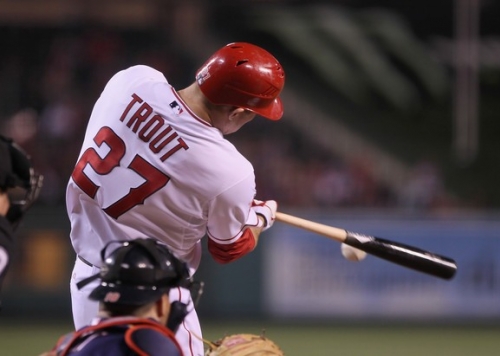
In an awesome and surprising turn of events, the Oakland A’s won the West in 2012 after the Angels spent a ton of money and the Rangers led wire to wire. It was the kind of thing Hollywood would laugh at for being unrealistic, but it happened.
This year, the hapless Houston Astros join the party. They won’t be hapless forever, but this year looks likely to be a mess in the space city. The West was arguably the best division in 2012 and should be good again in 2013 despite a potential 100 loss team living in the cellar.
As always, here is how STT sizes up the AL West. [Division Rank. Team (2013 W/L Prediction, 2013 Preseason Power Ranking)]
5. Houston Astros (60-102, 30)
As I’ve said on many occasions, I like the way the Astros are rebuilding, they just aren’t going to be anywhere near good enough to compete in 2013. It’s a process. That said, something makes me think they’ll be a little better in 2013 than most people think because a large group of people making similar predictions often shift toward extremity. This is a team that might not have a single 2 win player in 2013, but it’s hard to lose a lot more than 100 games period. The bar is low.
4. Seattle Mariners (75-87, 24)
Locking up Felix Hernandez was a good move and they would have added Justin Upton if not for the player vetoing the move and winding up with the Braves. They bought low on a lot of washed up sluggers and one or two are bound to provide some value in 2013. The Mariners didn’t make any really bad moves, but they failed to make great ones in order to dramatically improve for the upcoming season. I like the young pitching they have coming up from the farm, but it’s not quite ready. 2014 and beyond looks brighter in Seattle, but it’s hard to make a case that the Mariners are serious contenders this year. Any team can over perform and win the second wild card, but that’s the ceiling for Seattle.
3. Oakland Athletics (84-78, 14)
The A’s made some good moves in the offseason adding Chris Young and Jed Lowrie to go with a club that won 94 games last season, but some of those 94 games are going to vanish due to simple regression to the mean. Bob Melvin and the A’s front office are excellent at getting the most out of their players, but I can’t really see this team striking gold twice in a row. It would require none of the young pitching to take a step back and all of their platoon guys to stay locked in, which is asking too much. The A’s are a good team, I just don’t think they’re quite good enough to make the playoffs.
2. Los Angeles Angels (88-74, 9)
The Angels added Josh Hamilton in the offseason to an already stellar lineup that featured the best player from 2012, Mike Trout, and the best player of the last decade, Albert Pujols. But their pitching staff is now short Zach Greinke, Dan Haren, and Ervin Santana and full of Tommy Hanson and Joe Blanton. The offense is great, but the pitching, by contender standards, is terrible. When you’re counting on C.J. Wilson, Tommy Hanson, Joe Blanton, and Garrett Williams to be 4/5 of your rotation, something isn’t quite right with the preseason predictions that put your among the game’s best.
1. Texas Rangers (91-71, 5)
If you’re a betting man/woman, the Rangers are the buy low team of the season. Everyone and their mother seem to be down on the Rangers right now because they lost Josh Hamilton and Mike Napoli and failed to add an Upton or a Greinke. But this is a Rangers team that won 93 games last season and added A.J. Pierzynski and Lance Berkman, not to mention top prospects Jurickson Profar and Mike Olt. Darvish has a full season under his belt in the U.S. Why is everyone jumping off the Rangers bandwagon so quickly? This is a team that should be no worse in 2013 than in 2012, which should give you pause when you’re writing their eulogy.
AL West Cy Young: Felix Hernandez
AL West MVP: Mike Trout
Most Potentially Pivotal Player: Lance Berkman
Storyline that Will Surprise Us: Texas won’t regret their quiet offseason.
Boldest of the Bold: Houston will win the season series against one divisional opponent.
The Nine Best Center Fielders for 2013

As we do every week here at STT, we present lists of things ordered by the nines and on this Saturday, it’s a list of The Nine Best Center Fielders for 2013.
On this list, you’ll find a couple of center fielders have gone missing as they no longer play the position. If you’re looking for Mike Trout and Bryce Harper, for example, try the left field list. Beyond that, I found this list to be a bit convoluted and had a difficult time doing the rankings. A lot of players are left off who could easily be in the 7-9 range and lots of players who are on the list could easily end up somewhere else on the board.
Apologies to: Justin Ruggiano, Dexter Fowler, Brett Gardner, Jacoby Ellsbury.
9. Adam Jones (Orioles)
Jones hits for power and average and has decent speed, but his plate discipline is suspect. He’s also less than stellar on defense according to the metrics, but coaches seem to like him as they gave him a gold glove last year over the great Mike Trout. He’s a good player, but he’s not a complete player.
8. John Jay (Cardinals)
You could probably attack this choice more any other because Jay doesn’t hit for power and doesn’t have one eye popping skill. But Jay hits for average, runs the bases pretty well, and plays solid defense. It’s more of gut feeling here than anything, but I like Jay to break out this year. Entering his prime years on a great team, I’m buying.
7. B.J. Upton (Braves)
Upton will play between his brother and Jason Heyward on a good all-around team. He’s a solid defender who hits for power and runs well to mix with a good approach at the plate. He has a swing and miss problem and a lowish batting average, but he’s a good bet for 3 to 5 WAR.
6. Peter Bourjos (Angels)
The speedy, defensive star put up a 4.5 WAR season when he got a full season as a starter in 2011 and has two 2+WAR season in a backup role in 2010 and 2012. He doesn’t light up a lot of the traditional stats, but he plays amazing defense and runs as well as anyone. He’s worth the price of admission on defense alone and could easily be a top five centerfielder if he has a moderately good offensive year.
5. Denard Span (Nationals)
Span is a great defender who doesn’t strikeout much and gets on base better than average for a centerfielder and runs well. If he can stay healthy, he’ll be great at the top of the Nationals lineup and between Werth and Harper. With his concussion history hopefully behind him, he should be in for a big year.
4. Michael Bourn (Indians)
Bourn may be aging, but he’s coming off four very good seasons and is a top tier defensive player. He’s a top flight runner and gets on base well. Four years from now, the Indians might not want to pay him $12 million a season, but for 2013, he’s still one of the very best centerfielders money can buy.
3. Matt Kemp (Dodgers)
Kemp’s 2011 season was one for the ages and his 2012 started off on the same pace but was cut down by injuries. That’s the only reason Kemp isn’t #1 on this list. I’m just not sure he’ll play a full season. His defense could use some work, but on offense, a healthy Kemp is as good as they come. If he was coming off a less serious set of injuries I would be more likely to brush them off, but I’m doubtful Kemp can play 150 games for a team with big expectations in 2013.
2. Andrew McCutchen (Pirates)
McCutchen is one of baseball’s best players. He mixes speed, power, and plate discipline and was one of baseball’s most valuable players in 2012. He has four very good seasons under his belt and is only held back by averageish defense. There is some debate about his skills in center, but all in all there isn’t much bad to say about the Pirates’ star.

1. Austin Jackson (Tigers)
Now before I’m accused of bias in favor of my favorite team, go back and look at Jackson’s 2012 season. He was better than Bourn in every major category excepts steals and defense, but he also missed 25 games with an injury. He cut down on his strikeouts, walked more, and hit for more power. He’s a great defender and is a year younger than McCutchen. Despite missing time with an injury that has completely healed, Jackson was third in centerfield WAR among players who still play the position and less than 2 WAR behind McCutchen. I’m buying another step forward for Jackson in 2013 toward something like a 6-6.5 WAR player and modest regression by McCutchen. This isn’t to say Cutch is in decline, but rather that 2012 was simply his career year. It will be hard to reproduce that peak, so Jackson might catch him in 2013. This might be a bit bold, but I’ll stick to it. Jackson is my pick for the best centerfielder in baseball for 2013.
Sound off in the comments and online about the merits of this list. Should you want your money back because it was terrible, try to remember this site is free, unlike ESPN Insider, which charges you to read mostly terrible commentary.
What if MLB Teams Played Fantasy Baseball?
I’ve had this question for a long time and it wasn’t until today, for some reason, that I realized how easy it would be to answer. A buddy of mine and I used to wonder who would win in a fantasy baseball league in which you drafted only players from your favorite teams. Extending that question further, which MLB team would win if they played in a Roto Fantasy Baseball league?
Here’s how it worked. I took each team’s totals in the standard 10 categories (R, HR, SB, RBI, AVG, W, SV, K, ERA, WHIP) and ranked each team and gave them a point total 1-30 in each category with 30 points for the best in the league at each category (Ties split points). I then summed the point totals and ranked each team by total point value.
Next I scaled the fantasy points total into the equivalent value of real wins, which turned out to be much more widely distributed than I was hoping for which led me to simply rank each by fantasy wins and real wins and then take the difference between the two. Teams with negative differences do worse in fantasy baseball and teams with positive differences do better in fantasy baseball.
Here are the results:

I’ll call your attention to the values in red. 27 teams had fantasy win ranks within six places of their real win rankings. The exceptions are the Brewers who would much rather play fantasy baseball and the Reds and Athletics who are very glad that they do not have to. This speaks to the Brewers as a very traditional stat heavy team and the Reds and A’s as teams who accumulate their wins through things like defense, walks, etc.
I’m not sure if we can take too much from this, but if you were wondering how your team would stack up if you drafted them all, this is how it would look. Yes, Tim Jennings, I would have won.
2013 Season Preview: National League Central

The National League Central isn’t a division you think about when you think about powerhouses, but it features a couple really good teams who made it into the playoffs last season.
It wasn’t a big offseason in the Central except for the loss of the Astros. Man, they’re gonna miss those guys!
2013 should be much like 2012, but hey, what do we know. Here’s how STT sees the NL Central shaking out.
[Division Rank. Team (2013 W/L Prediction, 2013 Preseason Power Ranking]
5. Chicago Cubs (68-94, 25)
The Cubs are on the right track and their pitching staff isn’t half bad. They’re a year or two away and they have some players worth watching on the north side of Chicago, notably one of my favorites, Anthony Rizzo at first base. With Theo Epstein and Jed Hoyer at the helm, the Cubs are heading back to prominence, but it won’t be this year.
4. Milwaukee Brewers (79-83, 19)
The Brewers are a lot of people’s pick to surprise in 2013. They have a pretty good offense, but I can’t get behind their pitching depth and man, the bullpen looks pretty weak. They have one of the game’s best players in Ryan Braun and some other players who could make the Central interestiof the game’y one of my favorites, Anthong if they can produce at career levels. The Brew Crew won’t be embarrassing by any stretch, but I don’t see them contending in a meaningful way.
3. Pittsburgh Pirates (82-80, 21)
This is the year! The Pirates are going to finish above .500. They will. Don’t get me wrong, this is a team with a lot of upside, but not a lot of players who are sure to produce. If they can get some life shot into them from the farm system, the Pirates should be good enough to hang on the peripheries of the playoff race before falling off down the stretch again.
2. St. Louis Cardinals
The Cards are a really good team with a lot of pitching depth and a well-rounded offense. They also have some sort of deal with a higher power given the way the last two postseasons have gone for them. Even without Chris Carpenter in the fray, they’re still a great team with a lot of good players.
1. Cincinnati Reds (92-70, 6)
If the Cardinals are really good, the Reds are great. They’re average or better everywhere on the field and their rotation was excellent last season and has Aroldis Chapman coming to make it even better. You wonder about the outfield defense with Choo in center, but other than that, this is a team that looks like it could only be stopped by injuries. Plus, have you guys seen Joey Votto. That dude is incredible.
NL Central Cy Young: Adam Wainwright
NL Central MVP: Joey Votto
Most Potentially Pivotal Player: Rickie Weeks
Storyline that Will Surprise Us: Choo will survive center.
Boldest of the Bold: Anthony Rizzo will finish in the top ten of the MVP race.
2013 Season Preview: National League East

On Monday, STT previewed the NL West. Today, the Eastern division in the Senior Circuit is on tap.
Last season the Nationals surprised many (but not me, they were my pick to win the division) by accumulating the most wins in baseball, while the Braves made the fake playoffs and lost a coin flip game that featured garbage being thrown on the field. The Phillies disappointed and the Mets made a pretty good first half run. The Marlins stumbled and then blew up their franchise in a way only the Marlins could.
The Nationals and Braves both had big offseasons while the Phillies did weird stuff like signing Delmon Young to play defense. The Mets dealt Dickey for a good haul and extended David Wright. The Marlins traded everyone who isn’t Giancarlo Stanton, and he’ll be gone inside twelve months two I’m sure.
Here’s how the 2013 NL East looks according to STT. [Division Rank. Team (2013 W/L prediction, 2013 Preseason MLB Power Ranking]
5. Miami Marlins (63-99, 29)
I’ve made no secret of my disgust with the Marlins fire sale over the last several months and won’t rehash it at length here. They have but one player on their entire projected opening day roster that is a lock to have a 2 WAR or better season if healthy. Only Giancarlo Stanton is anything more than a bench type player going into 2013. They will no doubt have some surprises and I’m excited to see former Tigers Jacob Turner and Rob Brantly get a shot at the big leagues, but this team is so devoid of talent it borders on the criminal.
4. New York Mets (78-84, 18)
I’m actually kind of bullish on the Mets. I think their rotation of Santana, Niese, Harvey, Gee, and eventually Wheeler could be very good and they’ve made some good bullpen signings. David Wright is a centerpiece and they have some good supporting pieces in guys like Ike Davis and Daniel Murphy. The Mets need an outfield. I think they’re one great player and one pretty good player away from being a legitimate contender and maybe only one good player away from making noise. Even if they don’t make a playoff run, I’m excited to watch the Mets rotation in 2013.
3. Philadelphia Phillies (84-78, 13)
The Phillies rotation is too amazing at the top for them to be any lower on this list even if the rest of the team is questionable. Up the middle, the Phillies can play with anyone with the likes of Carlos Ruiz, Chase Utley, Jimmy Rollins, and Ben Revere to match Halladay, Lee, and Hamels. The problem is that the corners are potential black holes of terrible. Michael and Delmon Young are written in as starters for 2013 and they were literally among the five worst starters in baseball last season costing their teams more than two wins combined. Ryan Howard has been a bit of problem at first given his lack of four tools. Each of these players could have bounce back years, but I’m not betting on it. The pitching and the middle will hold the Phillies up, but they won’t make it to the top.
2. Atlanta Braves (90-72, 4)
The Braves added Uptons for 2013 but lost Chipper Jones and Martin Prado, which makes me think they’ll be about as good in 2013 as they were in 2012. Which was good. The Braves have a great outfield and infielders who have the potential to really contribute. Their starters are solid and their bullpen is second to none. The Braves are a well-balanced club with no glaring holes. Other than Dan Uggla’s defense.
1. Washington Nationals (95-67, 1)
I’ve also made no secret of my belief in the Nationals on these pages and this is merely a formality. They were baseball’s best team last season and got better by any definition. Even if you expect regression by some, you should probably anticipate improvement by others. Their pitching staff is only challenged by the Tigers and Rays for the best in baseball and the Nats have a good bullpen and well-rounded offense. It’s hard to imagine a scenario without disproportionate injuries that doesn’t have the Nationals among the best teams in baseball for 2013.
NL East Cy Young: Stephen Strasburg
NL East MVP: Jason Heyward
Most Potentially Pivotal Player: Justin Upton
Division Storyline that Will Surprise Us: Chase Utley stays healthy and has a big year.
Boldest of the Bold: Freddie Freeman will make the All-Star team.
2013 Season Preview: National League West
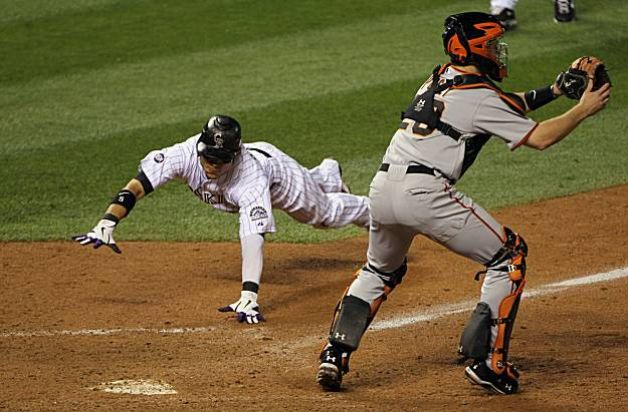
If we knew nothing else than who won the World Series every year, the National League West would look as if it was doing pretty well for itself as it is home to two of the last three world champions. Both of those teams are the San Francisco Giants, however, so it’s probably better for everyone if we had a little more information.
The division features those defending champion Giants and baseball’s newest quarter billion dollar payroll, the Dodgers. Both clubs have their sights set on a playoff run and they will have company.
The Diamondbacks made a lot of roster juggling, win now type deals this year and the Padres had a good run to end 2012. Only the Rockies can be said to have no realistic playoff hopes for 2013.
The division features big ballparks and could be a growing challenge to baseball’s previously elite divisions in the years to come. For now, it remains a bit off the pace in my book. Here’s how SABR Toothed Tigers sizes up the NL West for 2013.
[Division Rank. Team (Predicted 2013 Record, Preseason Power Ranking)]
5. Colorado Rockies (63-99, 28)
The Rockies had a bad season in 2012 and didn’t do a whole lot to make their team better for 2013. The offense, with a healthy Tulowitzki, is formidable enough to contend, but they cannot do it alone. The starting rotation and bullpen, even with generous adjustments for the tough home ballpark, are abysmal. The Rockies have a number of guys I would feel comfortable placing at the back end of my rotation, but none who belong at the front. If the Rockies won more than 75 games in 2013, I would be absolutely shocked. As you can see by my preseason ranking, I think the Rockies will be among the worst five teams in baseball this year.
4. San Diego Padres (78-84, 22)
The Padres played much better in the second of half of 2012 and actually looked like a team that could contend in 2013 with a few upgrades. Unfortunately, they didn’t make any big upgrades. They took some chances on previously injured starters who could certainly provide good value, but no one who will be a bona fide difference maker. With some good fortune, the Padres should spend a few months kicking dirt around the second wild card, but the talent just isn’t there without a couple more acquisitions.
3. Arizona Diamondbacks (82-80, 15)
The Diamondbacks have a talented roster, but also made some strange moves this offseason. They traded Chris Young, Justin Upton, and Trevor Bauer for a return of Martin Prado, Didi Gregorius, Heath Bell, and Randall Delgado. There are a few more pieces as well, but these are the ones who look to make an impact this year. They signed Cody Ross and Eric Chavez and have good pitching depth coming from the system to go along with centerfielder in waiting Adam Eaton. On the whole, this is a talented club, but they seemed to get the worse end of every move they made. That doesn’t mean they’ll have a bad season, but it does make you wonder how well the team is run. I wouldn’t be surprised by a playoff push from the Dbacks, but it will require another big year from Aaron Hill and Paul Golschmidt in addition to solid seasons from a lot of lesser pieces. The key will be how well a deep but inexperienced pitching staff can navigate through a full season. This is a good team, but not a great team and their record will reflect that.
2. Los Angeles Dodgers (88-74, 11)
I’ve written on several occasions that I don’t think the Dodgers have successfully spent their way into a playoff berth, but rather have merely allowed themselves to get into the discussion. Their top two starters, Clayton Kershaw and Zach Greinke, are phenomenal, but the rotation is uncertain after that despite a number of options. Carl Crawford claims he’ll be ready by Opening Day, but I’m doubtful we’ll ever see him regain his Tampa Bay form. Matt Kemp is coming off an injury plagued season and Andre Either’s and Adrian Gonzalez’s best days are behind them as far as I’m concerned. This isn’t a bad team, but this is not the best team $250 million can buy. The Dodgers should be in the playoff chase right down to the wire, but they’re not going to make into October.
1. San Francisco Giants (91-71, 7)
The Giants have earned this spot in part due to history and in part due to reason. As far as history is concerned, they’ve won two World Series in three years and are due some deference for that. Rationally though, they won the division last year and return the same team minus a half season of Melky Cabrera and plus full ones from Hunter Pence and Marco Scutaro. The Dodgers may be better than last year, but they also had an unusually lucky first two months last year, so that might balance out. It’s also hard to imagine Tim Lincecum doing any worse than he did in 2012 and could reasonably do much, much better. The Giants aren’t the most talented team in baseball for 2013, but they have shown the ability to exceed our expectations of them. This is a team that plays good defense and pitches well, but they are also a better offensive club than they were in 2010 when they played “torture baseball.” Buster Posey will lead the way, but he won’t be on his own. The Giants aren’t my pick for the World Series, but they are my pick to represent the NL West in the postseason.
Awards and Miscellaneous Predictions:
NL West Cy Young: Clayton Kershaw
NL West MVP: Troy Tulowitzki
Most Potentially Pivotal Player: Hanley Ramirez
Division Storyline That Will Surprise Us: The Dodgers will be desperate for pitching by June.
Boldest of the Bold: Carl Crawford will be a platoon player by August.
The Nine Best Left Fielders for 2013
Compiling a list of The Nine best left fielders proved interesting this season because so many of the players on this list were not full time left fielders last season. By my count, three or four of the top nine spent time at a different position in 2012 and as of this publication, they are not all 100% locks to play left field. If you’re reading this during the season and are like, “Hey, #1 plays centerfield!” you might be right. Please take the positionality of the outfielders with a grain of salt.
That said, this was a very deep list. Apologies to many who didn’t make the cut. Prove me wrong and end up on next year’s list.
9. Curtis Granderson/Brett Gardner (Yankees)
Now it may seem strange to have the ninth spot go to two players, but I’m just not sure which Yankee is going to be in left field this season and either one would fit right here on my list, so it’s both of them. Whichever plays there, lands here. Granderson hits for power, but Gardner is much better at getting on base and plays a much better defense. Both players have great aspects of their games and both have weaknesses.
8. Yoenis Cespedes (Athletics)
Cespedes hit nicely in 2012, but missed 33 games and played below average defense. It’s hard to be sure about those flaws because we don’t have any great data from his time playing in Cuba, but he has all the necessary tools to excel in the majors. My hesitation with him is merely that I don’t have nearly as much information about him as I do for everyone else on the list. If he repeats his 2012, he’ll move up the list quickly.
7. Carlos Gonzalez (Rockies)
CarGo’s place on this list is really a testament to his contemporaries rather than a knock on him. He’s on base a lot and hits for power to go along with some good baserunning chops. His defense is something of an open question because certain people love it and certain people hate it. Gonzalez gets help from his park to some degree, so that will cost him just a spot or so on the list. Great player, but not a top five left fielder for 2013.
6. Justin Upton (Braves)
Upton still has his prime ahead of him and is moving to the Braves and left field to play with his brother, but he also had a rough season in 2012 compared to a great 2011. Most people see the talent and expect great things, but he also seems to have developed the reputation as an underperformer. The change of scenery should be good for him because his coaching staff and front office won’t be looking to trade him every day. A good season for Upton is ahead, but not a great one.
5. Matt Holliday (Cardinals)
Holliday is a great and consistent offensive performer and is just starting to slow down defensively at 33. He’s the centerpiece of a great lineup and hasn’t been worth fewer than 4 WAR since 2006. The ceiling might be lower than Upton, but the floor is higher.
4. Alex Gordon (Royals)
Gordon took a while to arrive relative to expectations, but he finally did in 2011 and followed it with a great 2012. He’s a gold glove defender in left and does everything well. Power, speed, and discipline mix nicely in Gordon and for my money, after Ben Zobrist, is probably baseball’s most underrated player. The Royals might not have enough to contend this year, but they have a star in left.
3. Bryce Harper (Nationals)
Harper is another player moving to left this season, and he’s doing it on baseball’s best team. He had a great season for a teenager at 19 and another year under his belt should only make him better. Harper is often referred to as a generational talent, but even if he isn’t Mantle or Mays, a single step forward from last season should be enough to put him near the top of this list. Harper does everything well and should be at the top of this list for years to come.
2. Ryan Braun (Brewers)
Ryan Braun is arguably baseball’s best all-around player. He is an MVP at the plate, runs the bases well, and is consistently improving his defense in left. He’s entering his prime despite having a collection of elite seasons already under his belt and has never missed more than twelve games in a season in five and a half big league seasons. The fact that Braun is second on this list despite that resume tells you something about the man ahead of him.
1. Mike Trout (Angels)
Mike Trout had an all-time great season at 20. The guys who do that, tend to be all-time greats. He hit for power and average, ran the bases as well as anyone in the game, and was among the very best defensive centerfielders in the sport. He was, by far, the best player in the league in 2012. That performance is not something you can easily duplicate, but even 75% of what he was last season would be enough to challenge Braun for first on this list. If Trout was half as good as he was last season, he would still be a perennial all-star. Mike Trout might not be the best player in the league for years to come, but it’s hard not to dream on his talent and get caught up in his 2012 season. Lost in this love letter to Trout is that there is a player on the Angels who is good enough on defense that he is pushing Trout to left in 2013; Peter Bourjos. Trout is the best left fielder for 2013 only because there is someone on his team who is a better defensive centerfielder than he is. Pretty amazing.
Like this list? Hate this list? Have a more nuanced feeling about this list? Join the discussion in the comments section or on Facebook and Twitter.
Thinking Aloud About Grading Managers
Last Friday, MLB Network completed their Top Ten Right Now series with a look at baseball’s best ten managers. The series was informed heavily by Clubhouse Confidential’s “shredder” which uses an objective formula to determine player value much like Wins Above Replacement. But this gets sticky, as they admit, when it comes to managers because it’s very hard to determine what managers should get credit for and for what they should get blamed.
So I started thinking about what it would look like to quantify manager value. We have a great set of offensive and pitching statistics that quantify player performance and an increasingly good group of stats to measure defense, but what do we have that measures what a manager does? Let’s first ask the question, what is it that managers do?
Managers Lead and Motivate Men
This is definitely the hardest piece to measure. How do we quantify that which we cannot observe? And even if we did observe it by being inside meetings and next to the skipper in the dugout, how much does this leadership matter?
It’s conventional wisdom that this aspect of the job matters a great deal and that players often improve and weaken their performance based on how well a manager motivates and leads. A good number of people in the analytic community scoff at this notion because world class, competitive athletes are already so far to the right on the distribution of talent that this type of leadership shouldn’t be terribly effective at making a noticeable difference in performance.
I tend to see a big role for leadership and motivation because this also includes communicating with players about their roles and what is expected of them. In general, this aspect of managing is important, but very hard to measure. Let’s leave this aside except to say that managers who are good leaders will get outcomes no worse than those who are bad leaders.
Managers Make Personnel Decisions
This should be much easier. Putting the right people in the right spot in the lineup and calling on the right players to pitch at the right time is a very important aspect of the job. Hitting your best hitter in the right spot is a better choice that hitting them ninth. Most in the statistical community would argue for putting your best hitter second, but we’ll setting for third until we win that war. You can also add value here by platooning the right players and giving players appropriate days off too.
On the mound, knowing when to pull your starter and knowing which reliever to use when is perhaps the place a manager can do the most good or harm.
I’d be curious to see how much an optimal lineup could improve a team over worst case lineup. But on the other hand, no manager would actually use the worst possible lineup. How many wins can be gained between optimization and ordinary? That’s the question we have to answer.
The pitching side would be tricky, but it is possible in theory. What we need is to gather leverage indexes of every plate appearances and then somehow compare those indexes to the outcomes in cases when the manager makes a move and when they don’t. This could be problematic, because managers can only make a move if they have the right personnel on the roster, but we could find a way to compare these moves to each based on the roster they have. I don’t have a formula in mind, but I think evaluating each pitching change and non-pitching change and the outcome on the next series of at bats would be the proper way to look at this if we created some sort of constant that accounted for the best a manager could do with the team he has.
Neither of these ideas are fully formed, but it should help us understand managers just by thinking about what it would look like to measure them.
In-Game Strategy
Strip out the personnel choices and managers have moves to make like calling bunts, hits-and-runs, and stolen bases. Two problems emerge. The first is obvious and unavoidable, sometimes players do these things on their own. Can’t do anything about that. Let’s move on.
The second issue is game theory. How is it that we can judge a manager based on incomplete information? If a manager thinks a stolen base is a good idea, he is weighing the likelihood of success given what he anticipates the other manager will do (pitch out, pickoff, nothing). The problem here is that if Manager A calls for a steal and it works, it might work in spite of the fact that he made a bad choice. Manager B may have called for a pitchout, but the catcher may have dropped the pitch. In this case, Manager A made the wrong call, but got the right result. How do we account for that? It’s tough.
You’re starting to see why this is so hard.
Putting it Together
So managers are leaders, make personnel choices, and make in-game strategic decisions. The first hard to measure. The second is easier, but requires a lot of complicated math. The third is pretty easy, but requires us to control for what the other manager does, which is theoretically quite problematic.
But just in thinking about these aspects, it gives us a more formal understanding of what we are looking for and allows us to better evaluate managers using the tools we do have.
Like our eyes.
I know that’s a really lame answer, but it’s a good one. Two issues emerge. The first is that I can’t watch every manager enough. I can watch my team’s manager very closely and judge him well, but I can’t watch all thirty. The second issue is objectivity. Your eyes aren’t as objective as a more math-y approach, but a math-y approach isn’t without bias.
The best way to evaluate managers, for now at least, is to think very formally about what managers do and then judge them with your eyes. We want to see managers bringing in relievers at the right times. This requires us to decide before every hitter whether or not we think he should go to the pen. We can’t judge him by saying, “I knew it!” We have to say, “he should pull his guy now,” and then see how often we are right and how often he is. We have to manage alongside him, not in retrospect.
We also need to understand strategy better by looking at Run Expectancy Matrices and considering how likely a given outcome will be and how often the managers play the high probability moves.
None of this is easy, and it is very subjective, but as my Game Theory professor says, formalizing allows us to isolate that which we are debating and allows us to have specific conversations about the items of interest to us. In English, when we decide what we are looking for before we go looking for it, we can measure our expectations against the outcomes to see if managers are getting the most out of their players.
While we probably won’t ever have a WAR for managers, this discussion will hopefully help you better judge your team’s manager. Try it out and let me know what you think. For reference, I’d say Jim Leyland is top notch at leading men, pretty good at offensive personnel, good at deciding when to pull the starter, shaky when it comes to using his bullpen, and average when it comes to in-game strategy.
Tell us what you think about grading managers by typing it on your “Hand Computers.” Bonus Points if you know from where that reference originates.
 New English D