How To Pitch To Miguel Cabrera

A simple Google search of the above headline leads you to about 7 million pages, none of which appear terribly helpful. Some pose the question if one should pitch to Cabrera and some discuss recent attempts to pitch near Miguel Cabrera’s head. Others still just show you .gifs of Cabrera hitting homeruns, which seems pretty similar to just telling you that it’s tough to get this guy out.
In fact, he is the hardest hitter in baseball to get out, posting a league best .454 OBP. He makes the fewest outs in baseball and also does a considerable amount of damage, posting a .670 SLG, .470 wOBA, .306 ISO, and 202 wRC+, depending on which statistics you like to use to measure how much a player crushes a baseball. Heck, I’ll even cite the 26 HR and 85 RBI just because. Here’s the point, he’s hard to get out and when you don’t get him out, he makes you pay.
Which returns us to the original inquiry, how should you pitch to him?
Let’s start with some quick assumptions:
- You can’t walk him because at this point in the game it would be bad strategy.
- You are a RHP
- You are a reasonably competent, average starter with a full repertoire
From here, we’re going to breakdown the approach using Cabrera’s plate appearance data against RHP from 2013 because he’s presumably adapted throughout his career, so we shouldn’t try to get the 2009 version of him out. Let’s go for it.
First, let’s take a look at where in the strikezone Cabrera will swing and miss:
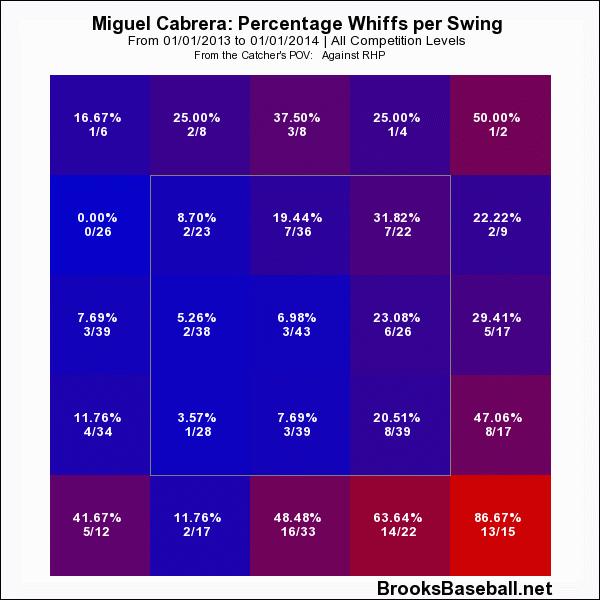
So overall, you can get Cabrera to swing and miss if you go low and away or if you elevated the pitch out over the plate. This stands to reason as his batting average zone plot looks like this:
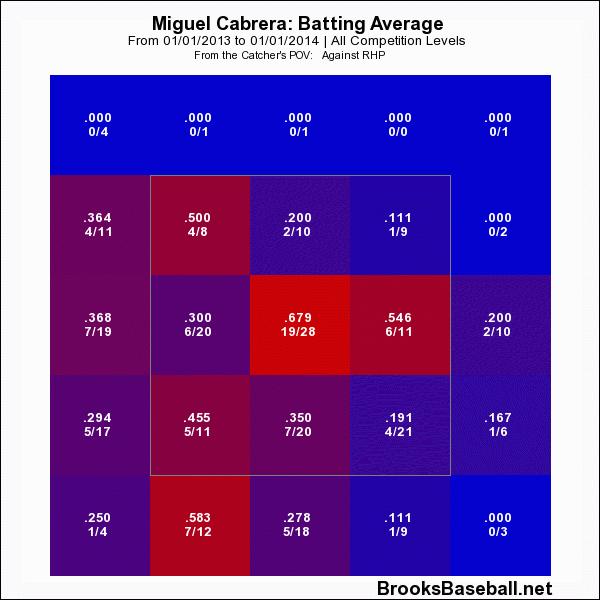
Generally, this shows us that you have to go down and away or up above the zone if you’re trying to limit contact. If you’re trying to limit the damage, as seen by his slugging percentage by location, the same holds true.

So we have a general idea about where to pitch Cabrera based on his 2013 performance. For reference, the same pattern holds true for the last few seasons. He’ll chase down and away and above the zone, and those are the two places he’ll get the fewest hits and the fewest extra base hits.
Let’s now break it down a little by pitch type. If you throw him hard stuff (various fastballs), you want to keep it away from him. This is his slugging percentage against hard stuff:

And again, whiffs per swing against fastball type pitches:
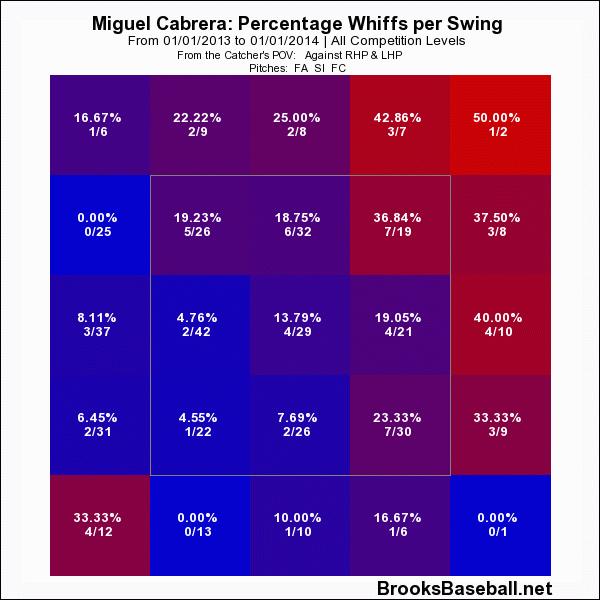
So we have a little more information now. We know that if we’re a right handed pitcher, when we go with the fastball we want to go up and away, and avoid the inside part of the plate at all costs. Let’s turn to breaking balls and offspeed pitches. Here’s the whiff per swing rate on soft stuff:
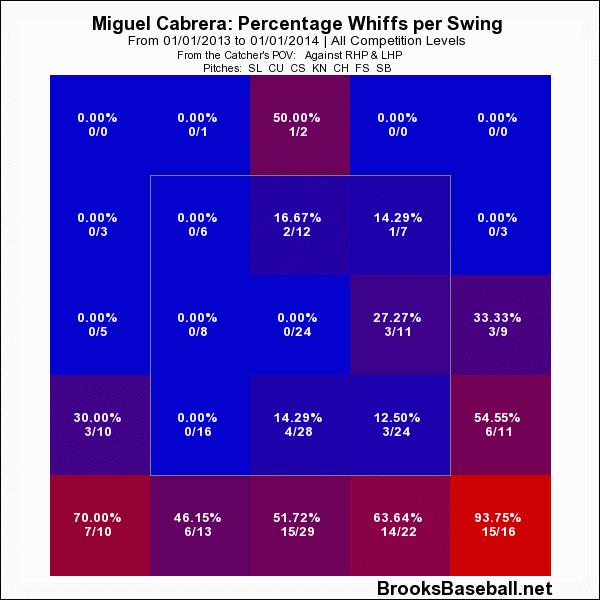
Now let’s take the slugging percentage against breaking balls and offspeed:

You can see here that Cabrera isn’t likely to swing at offspeed pitches inside and outside, but he will swing if they are over the plate and will crush them if they are in the zone.
So what have we learned? First, throw the fastball up and away and the changeup and breaking ball low and over the plate. Those are pretty much the only places to get Cabrera to chase and get himself out. We could break this all down by count, but that would get extremely long and messy. There are 12 possible counts to breakdown and that’s a lot of charts, so let’s just stop here with the zone breakdowns.
If we look by pitch type more generally, you can see there are pitches that work better.

He’s more vulnerable to sliders and splitters, and you can get him out with the cuvreball, but there is a big risk involved if you miss with that pitch because he may crush it.
Cabrera is baseball’s hardest out and he’s also one of the game’s most feared power hitters. There isn’t an easy way to get him out, but the way to do it is to work the fastball up and away and the breaking ball down and over the plate. That is, however, no guarantee. Because sometimes he does this (click to play if it isn’t running on your screen):

How Was The Game? (July 3, 2013)

A little heated.
Tigers 6, Jays 2
The actual baseball part of Wednesday’s game went quite well for the Tigers as Max Scherzer (13-0, 116.2 IP, 3.09 ERA, 2.63 FIP, 3.7 WAR) made another fine start, going 6.1 innings, allowing just 2 runs, while walking 1 and striking out 8. He was supported (no way?!) by 6 runs, 3 coming on an Avila homer, 2 from Martinez on a single and a homer, and one from Peralta AND a ridiculous catch by Austin Jackson in centerfield. Things got quite heated, however, when Colby Rasmus injured Omar Infante on a dirty slide and then Jays pitcher Todd Redmond came up and in on Torii Hunter in the very next inning. The benches cleared, but Prince Fielder and company helped keep the peace. Scherzer gave way to Rondon, Smyly, and Benoit who held the lead and guaranteed the Tigers no worse than a split during their only trip north of the border. They’ll call on Justin Verlander (8-5, 105 IP, 3.77 ERA, 3.05 FIP, 2.8 WAR) to go for the outright series win on Thursday, and hopefully Jim Leyland won’t get him suspended like he did with Porcello.
The Moment: Jackson makes a leaping catch to rob the Jays of extra bases.

How Was The Game? (July 2, 2013)
One with a solid ending.
Tigers 7, Jays 6
The first inning of this one was a mess for Doug Fister (6-5, 109 IP, 3.80 ERA, 2.93 FIP, 2.9 WAR) who couldn’t pitch around several defensive miscues and ended up down 4 runs after his first three outs. But his teammates picked him up right away, as they haven’t done all season, and threw 6 runs on the Jays in the 2nd thanks in part to a 2 run double by Avila and a 3 run HR by Cabrera. Fister would allow two more on a homerun, but would lock in after that and ended up going 6 innings despite the early problems and finished with 4 K, 1 BB, and of course 1 hit batter. The game stayed knotted at 6 until the Tigers pushed across a run in the 8th inning on a Hunter infield hit, giving way to Smyly and Benoit to shut the door. It was a much needed win for the team and they’ll have a shot to earn a split as early as Wednesday behind standout starter, Max Scherzer (12-0, 110.1 IP, 3.10 ERA, 2.68 FIP, 3.4 WAR) looking to make his final case to start the All-Star Game before Leyland has to make a call.
The Moment: Cabrera goes yard in the 2nd to give the Tigers a 6-4 lead after giving up 4 runs in the 1st.
Omar Infante Becomes a Complete Player
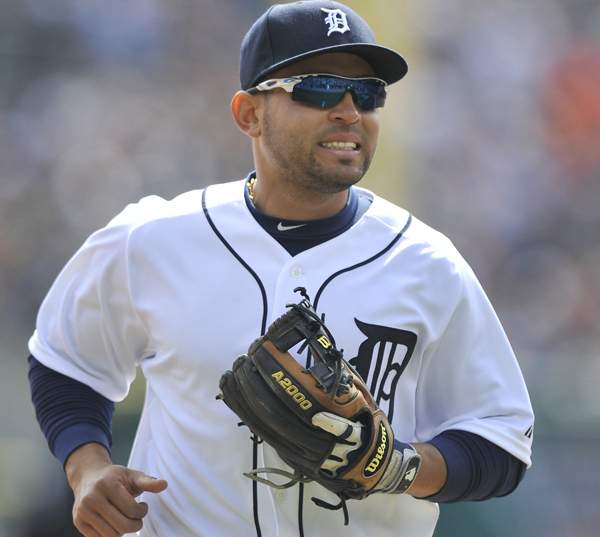
The big focus of last season’s trade with the Marlins was Anibal Sanchez, and rightfully so. He was the best player in the deal and had the biggest impact on the Tigers down the stretch. They re-signed him for a lot of money and before the injury, he was having a Cy Young type season. But the Tigers also got Omar Infante back from the Marlins, and Omar Infante has made one of the more interesting transformations in baseball since we last knew him as a Tiger.
Infante came to the major leagues very young, at age 20, and from 2002 to 2008 only played about one solid major league season. Here are his WAR totals for those seasons, understanding that his PA varied.
| Season | Team | PA | WAR |
| 2002 | Tigers | 75 | 0.6 |
| 2003 | Tigers | 244 | -0.5 |
| 2004 | Tigers | 556 | 1.7 |
| 2005 | Tigers | 434 | -0.1 |
| 2006 | Tigers | 245 | 0.7 |
| 2007 | Tigers | 178 | -0.2 |
| 2008 | Braves | 348 | 0.6 |
Infante had a reasonably good season in 2004 (2.0 WAR is generally considered starter level), but in every other season he either performed near replacement level or didn’t get enough at bats to provide much value because he wasn’t playing well. Omar looked poised for a career as a backup or up and down guy despite making it to the show so young. Then something funny happened. Here are his WAR numbers for 2009-2013:
| Season | Team | PA | WAR |
| 2009 | Braves | 229 | 1.1 |
| 2010 | Braves | 506 | 2.1 |
| 2011 | Marlins | 640 | 2.1 |
| 2012 | 2 Teams | 588 | 3 |
| 2013 | Tigers | 303 | 2.4 |
Infante went from borderline AAA player to solid major league regular. He peaked in 2004 in the first group and slowly lost playing time as his production dropped. But he rebuilt his value in 2009 as a backup and became a full on regular every year since and has added more than 2.0 WAR in each of the last four seasons. Here it is in graphical form, keep in mind that 2013 is only half over:

He’s becoming more and more valuable each season. That’s pretty clear and it’s not so crazy to see it given that he is essentially doing it during the peak years of baseball performance (27-31), but it is a big out of the ordinary how exactly Infante is doing it.
Let’s look at his offensive production over time using wRC+ which compares a player to a league average hitter (100). I’ve dropped out his first season because he only played about 20 games:

So Infante has become a better hitter, but he hasn’t really become that much better over the last few seasons compare to the previous ones. By 2008, he was locked into a 90-110 wRC+ pocket. That number has fluctuated but he also achieved it in 2004 and 2006. He’s become a more consistent offensive performer but he isn’t a great hitter and has had two below average seasons during his recent breakout. He’s a better hitter than he used to be, but that isn’t what’s really driving his transformation.
Infante has become a solid major leaguer over the last few seasons because he’s become a complete baseball player. The offense has stabilize, but it’s his glove and baserunning that have pushed him over the top. Check this out. Here are Infante’s defensive and baserunning numbers from his career. NOTE: I’ve dropped 2002 because of how few games he played and I have extrapolated his 2013 numbers so that you can see how much better he is playing this season. To be clear, the 2013 numbers are projections because these are not rate stats:

Infante has become a much better defender and a noticeably better baserunner over the last three seasons and it’s helping him become one of the more valuable second basemen in the game. He’s currently on pace for a 4-5 WAR season, and even if that won’t keep up completely, he looks poised to turn in his best season yet. He’s doing it with defense and baserunning which are parts of a player’s game that are supposed to peak early. You’re supposed to become a better hitter as time goes on and you’re supposed to watch your other skills fade early.
Infante won’t hear of that. He’s becoming a good all-around player as he ages, which is making him very valuable. Here are the runs above replacement from his defense and baserunnining added together over his career. Remember, 10 runs equals 1 WAR:

But here are his run values on offense:
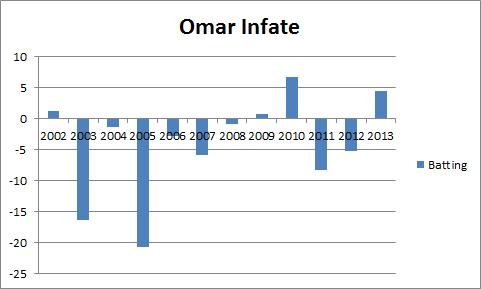
Yes his offense is getting better, but the value is coming from turning himself into a good defender and baserunner. Replacement level and positional adjustments are added to these to get WAR, but you can see clearly that Infante is taking an unusual path toward mid career success.
He’s getting better in the field and on the bases and it’s working for him and the Tigers.
How Was The Game? (July 1, 2013)
About what you might expect.
Jays 8, Tigers 3
When the other team calls on their ace and you throw your number 7 starter, you don’t typically expect to win. Jose Alvarez (1-2, 19.2 IP, 5.03 ERA, 6.00 FIP, -0.1 WAR) didn’t give the Tigers much and left after surrendering 5 runs (4 earned) in 3 innings and gave way to Putkonen, who gave the Tigers length, but allowed the deficit to balloon. The Tigers got runs on a Fielder bomb and Infante double and homer and had a nice throw from Dirks cut down and additional run early in the game, but they would fail to mount any serious threats to Dickey and the Jays on Canada Day. The Tigers will get the odds back in their favor Tuesday night as they call on Doug Fister (6-5. 103 IP, 3.50 ERA, 2.82 FIP, 2.9 WAR) to get things straightened out.
The Moment: Rod asks Mario if he has stopped following him on Twitter.
How Was The Month? Detroit Tigers June Report
Not too bad.
14-13 (43-37 Overall)
The month of June caused some consternation among Tigers fans, but the overall numbers look pretty good. They easily could have won a few extra games, but in general it’s hard to be too upset with the second best offense in baseball during the month (118 wRC+) and the 4th best pitching staff (3.9 WAR), placing their season ranks at 2nd (112 wRC+) and 1st (16.6 WAR). The Tigers might not have a record that perfectly lines up with the overall performance, but those things will catch up as the season wears on.
Miguel Cabrera led the way and pulls his full season totals to .373/.461/.680, 207 wRC+, 5.6 WAR after a fantastic month. Austin Jackson came back and played 15 phenomenal games while the team also had big contributions from Peralta and Infante. Additionally, the Tigers were lifted by 29 excellent PA from Don Kelly who hit .347/.379/.500 during the month
Despite struggles over the last two weeks, the pitching staff still stacks up across the full season as the Tigers feature 4 starters with 2.8 WAR or better, not to mention Porcello’s (1.5), Smyly’s (1.3), and Benoit’s (1.0) strong performances. Verlander wasn’t his usual self during June and Sanchez only threw 10 innings due to injury, but Scherzer, Fister, and Porcello all offered sub 3.30 FIPs and Smyly and Benoit were lights out. If you can block out Valverde’s 9.45 ERA and 9.81 FIP during the month, you’d probably have a much nicer record.
A lot of fans have taken the last few days to jump off the bandwagon, but there are really no signs that is warranted. The Tigers remain one of the best hitting teams in the league and have the best staff in the game and didn’t perform much off that pace in June. Fans tend to only watch their own team very closely and tend to make a big deal out of what they perceive as flaws, when in reality those “deficiencies” are typical features of baseball.
Relax, everyone. Baseball is fun and this is an excellent team.
The Moment: Victor Martinez makes a potential play of the year against the Sox at first base on June 23rd.
How Was The Game (June 30, 2013)
A missed opportunity.
Rays 3, Tigers 1
While we didn’t see the Rick Porcello (4-6, 86.1 IP, 5.21 ERA, 3.65 FIP, 1.5 WAR) who dominated hitters from May to mid June, we saw an effective Porcello who went 6 innings and gave the Tigers a chance to win. He allowed 3 runs, but only a couple of well hit balls to go with 2 BB and 3 K. Miguel Cabrera crushed a 4th inning HR into the Ray Tank, but the Tigers wouldn’t get any more despite loading the bases with no outs in the 7th. After taking the opener so cleanly on Friday, losing the last two so closely stings, but probably not as much as Ben Zobrist’s right shoulder after Leyland ordered Porcello to hit him in the first inning because Jim Leyland thinks baseball needs more violence. Hopefully, MLB will suspend Leyland, but the odds of that seem quite slim because MLB tends to support this kind of childish behavior. It’ll be a quick turnaround after the flight to Toronto as the Tigers will face the Jays Monday at 1pm with Jose Alvarez (1-1, 16.2 IP, 3.78 ERA, 5.70 FIP, -0.1 WAR) hopefully making his last start for a while with Sanchez’s return looming.
The Moment: Cabrera sends one into the Rays Tank in RCF, just the second player to ever do so.
How Was The Game? (June 29, 2013)
Another extra inning loss.
Rays 4, Tigers 3 (10 innings)
After a great all-around win on Friday, the Tigers sent Justin Verlander (8-5, 105 IP, 3.77 ERA, 3.05 FIP, 2.8 WAR) to the hill and while he wasn’t at his best, there were good signs regarding his stuff and his efficiency. He allowed 3 runs (2 earned), but pitched 8 innings for the first time this season to go with 4 BB and 4 K. It wasn’t vintage Verlander, but it was a much more effective version than he’s been the last few times out. The bats offered three runs in the 3rd on a Jackson homerun and a 2 RBI single from Peralta, but the Rays clawed back and tied it in the 8th leaving it up to the bullpens to hammer out a resolution in the 9th inning and beyond. After a lights out 9th from Smyly, the Tigers handed it over to Rondon in the 10th who allowed two baserunners between a flyout and a strikeout, but allowed the game winning hit to Escobar. Should you care to peruse his velocity, here is a handy tweet:
The Tigers will saddle back up Sunday behind Rick Porcello (4-5, 80.1 IP, 5.27 ERA, 3.66 FIP, 1.3 WAR) who will look to lead the Tigers to a series victory.
The Moment: Verlander gets through 8 for the first time this season.
How Was The Game? (June 28, 2013)
A powerful display.
Tigers 6, Rays 3
Parallel tracks usually take you to the same location and that’s the story of this game. Max Scherzer (12-0, 110.1 IP, 3.10 ERA, 2.67 FIP, 3.3 WAR) had another fine outing, keeping the Rays to just 3 runs in 7 innings while striking out 9 and pitched in almost no traffic, allowing 2 of the 3 runs on solo homers. But the other track was no less impressive as Miguel Cabrera led the way with 2 HR, a single, and a double, moving his season numbers up to 209 wRC+ and 5.4 WAR, both of which are easily MLB bests. But it was Prince Fielder who sealed the deal with a majestic homerun that hit the catwalk in RF, perhaps as it was still traveling upward. The bullpen shut the game down in the final two innings and put the Tigers in position to take the serious to take the series Saturday behind Justin Verlander (8-5, 97 IP, 3.90 ERA, 2.86 FIP, 2.8 WAR).
The Moment: Fielder hits the catwalk on a 2 run HR in the 7th.
New English D Audio (Episode 3)
On this edition of the podcast, I cover why you shouldn’t panic about the 2013 Tigers, why it’s time to see what Bruce Rondon can do, how Cabrera’s 2013 season is better than anything he’s ever done, our new reliever statistic SOEFA, and why RBI and Wins aren’t good statistics for measuring individual performance. The author wishes to point out that he misspoke near the 8:00 mark when he said Dirks is having one of the best offensive seasons in the league. He obviously meant defense. Dirks is good at defense.
Feel free to send questions for future editions of the podcast to @NeilWeinberg44 on Twitter or to NewEnglishD@gmail.com.
Download (Approx 33 mins)
 New English D