Prince Fielder’s Streaky Season

Prince Fielder isn’t having a great season compared to the bar he’s set for himself. I covered the issues a couple of months ago and chalked it up to a whole host of things. Primarily he wasn’t making as much contact as the previous two seasons and he wasn’t hitting for the same kind of power he had during the seasons prior to that. In other words, as he matured into a more well-rounded hitter he started to rely more on contact and his contact numbers were down. Mix that with some BABIP luck and you’re stuck with a graph that looks like this (From the original post):

Since I wrote the post he had a a rough couple weeks and then snapped out of it. His wRC+ is only up to 126 for the season, but he’s hit a lot better since early August and is putting up the kind of numbers you would expect from him over his last 39 games. Let’s take a look at his season in four parts:
| Date | Games | PA | AVG | OBP | SLG |
| 4/1 – 5/10 | 33 | 154 | 0.298 | 0.422 | 0.573 |
| 5/11 – 6/21 | 39 | 171 | 0.263 | 0.339 | 0.395 |
| 6/22 – 8/6 | 39 | 169 | 0.219 | 0.302 | 0.351 |
| 8/7 – 9/16 | 39 | 170 | 0.344 | 0.400 | 0.539 |
The cutoffs are arbitrary to some extent, but every cutoff is arbitrary if you really think about it. Fielder started hot, slumped, slumped hard, and then caught fire. These are four roughly equal collections.
In the first act, Fielder was excellent as he hit for high average, walked plenty, and hit for power. That’s the Prince Fielder who signed a $200 million contract! Act two is a drop in batting average and a drop in power. Act three is a loss of average but no drop in power. To demonstrate, he are his ISOs from the four acts (ISO = SLG – AVG):
| Date | ISO |
| 4/1 – 5/10 | 0.275 |
| 5/11 – 6/21 | 0.132 |
| 6/22 – 8/6 | 0.132 |
| 8/7 – 9/16 | 0.195 |
You can see quite clearly that when Fielder got a hit in the third act, the odds it was for extra bases was pretty consistent with act two, he just got many fewer hits period. But then his season started to turn around and while he hasn’t recovered his power from April, he’s hitting for more power, and a way higher average since August 7th.
It’s actually kind of remarkable if you separate it out by hard, breaking, and offspeed pitches. Let’s look at batting average and slugging percentage for each.
HARD
| Date | BA | SLG |
| 4/1 – 5/10 | 0.297 | 0.676 |
| 5/11 – 6/21 | 0.225 | 0.348 |
| 6/22 – 8/6 | 0.200 | 0.278 |
| 8/7 – 9/16 | 0.364 | 0.560 |
BREAKING
| Date | BA | SLG |
| 4/1 – 5/10 | 0.353 | 0.500 |
| 5/11 – 6/21 | 0.343 | 0.600 |
| 6/22 – 8/6 | 0.293 | 0.659 |
| 8/7 – 9/16 | 0.349 | 0.698 |
OFFSPEED
| Date | BA | SLG |
| 4/1 – 5/10 | 0.188 | 0.250 |
| 5/11 – 6/21 | 0.296 | 0.296 |
| 6/22 – 8/6 | 0.200 | 0.200 |
| 8/7 – 9/16 | 0.192 | 0.308 |
If the pattern doesn’t jump out to you, allow me to demonstrate. He was still hitting breaking balls well and he was pretty consistent against offspeed pitches. Look at the fastballs, my god, look a the fastballs. His batting average and slugging percentage against fastballs plummeted between act one and two and the average dropped off a little more into act three. Now he’s back in business, but man, that thing cratered.
Fielder couldn’t get around on a fastball to save his life for about 80 games and now he’s doing it again. I’m not going to make any connections between issues he’s having in his personal life and his performance. There could have been an injury or a mechanical adjustment that needed to be worked out. But the evidence is pretty clear and pretty stark.
Prince Fielder couldn’t hit fastballs. He didn’t slump the same way against the other pitches and obviously batters see more fastballs than anything else so it’s going to drive a lot of their performance. There’s certainly a game theory/sequencing thing about what pitches are used when that we can’t really untangle right now, but it certainly appears as if Fielder just went through a period of time – for whatever reason – in which he couldn’t catch up with a fastball. That stretch has been over now for 39 games and 170 PA. He’s crushing the baseball since August 7th and the Tigers are reaping the rewards.
There’s no reason to thing this problem will reoccur, so there’s no reason to thing Fielder won’t continue to mash heading into October. Whatever was going on from May 11th to August 6th is behind him and the guy who cleans up after Miguel Cabrera appears to be back.
How Was The Game? (September 16, 2013)

Another Porcello gem.
Tigers 4, Mariners 2 (Magic # = 8)
The Tigers grabbed an early run and then added on in the 6th inning, which would be plenty for Rick Porcello (28 GS, 168 IP, 4.45 ERA, 3.69 FIP, 2.7 WAR) who was fantastic again across 6 innings at Comerica Park. Porcello allowed a solo homerun and two walks, but was aces otherwise as he struck out 10 and breezed through the rest of the ballgame. The big strikeout total lifts his 2013 K% to 18.5%, which is nearly 5% higher than his previous career high (13.7%) as he makes a run at a career high in WAR (2.7 in 2013, 2.9 career best). The win is the Tigers’ 87th on the season and drops their magic number to 8 with another game against the M’s coming Tuesday as Anibal Sanchez (26 GS, 165.2 IP, 2.50 ERA, 2.47 FIP, 5.5 WAR) takes the hill.
The Moment: Porcello punches out 10, marking his second straight excellent start.
Alex Avila Returns To Form
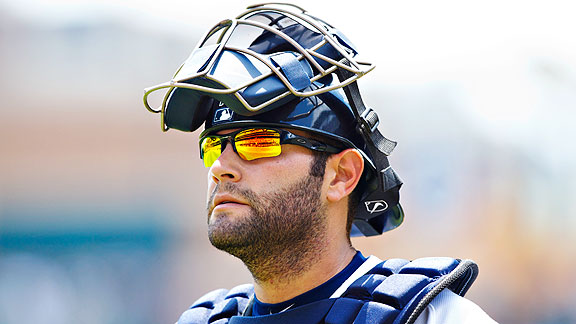
There was a time earlier this year when I advocated sending Alex Avila down to Toledo. He was lost. He was hitting .166/.265/.280. He showed the occasional flash, but it was mostly one of those horrible stretches in which a player is stuck in between and can’t find his way out. But very shortly after that he took one on the wrist and jumped on the DL. It was June 16th and he had a .560 OPS.
But Avila has been himself since the injury and even better if you put the cutoff at the All-Star Game, hitting .284/.360/.485 since the wrist injury and .313/.376/.545 since the break. He’s been the Avila we saw in 2011 as he’s posted a 153 wRC+ since the break compared to 141 wRC+ over all of 2011. It’s probably wrong to think he’s going to be that player consistently, but it’s not wrong to be optimistic that the worst is behind him.
The statistics tell a convincing story. If we drop the cutoff before and after his two week break due to injury or at the ASG, Avila looks much more like the player we thought he would be. Granted, sample sizes can always cloud your vision when it comes to statistics, but the actual swing mechanics have looked so much better ever since he got back. The flashpoint for me was the go-ahead homerun in Cleveland on August 5th where he cleared the high wall in LCF.
I’ve always though Avila was at his best when he took a short path to the ball and drove pitches to left center and he’s doing that again in a big way. Let’s draw the line at the wrist injury which puts about 190 PA on one side and 150 on the other. Neither is huge, but they aren’t way out of proportion.
First the spray charts:
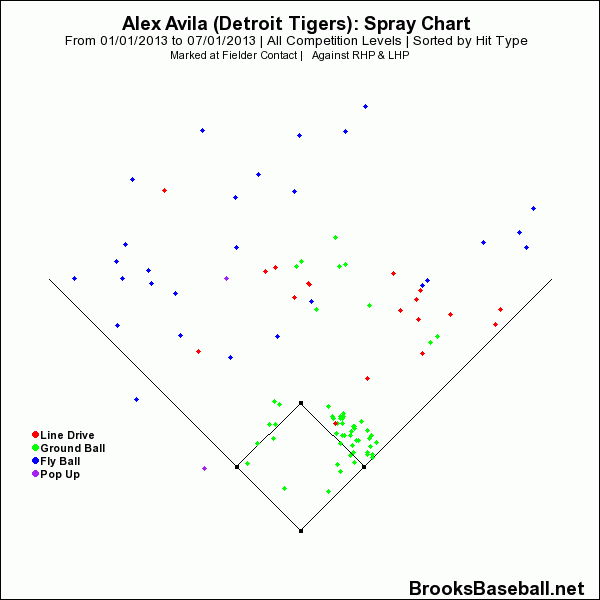

Not only is he less pull happy overall, but when he goes the other way he’s now hitting the ball on a line much more often.
His batting average and slugging percentage are up against almost every type of pitch (only slugging against sinkers is down). Let’s simplify that and take a look at hard, breaking, and offspeed pitches:

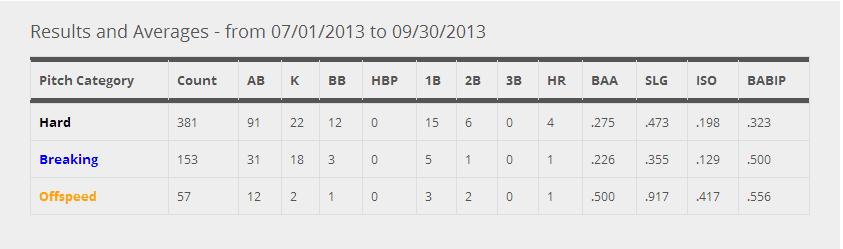
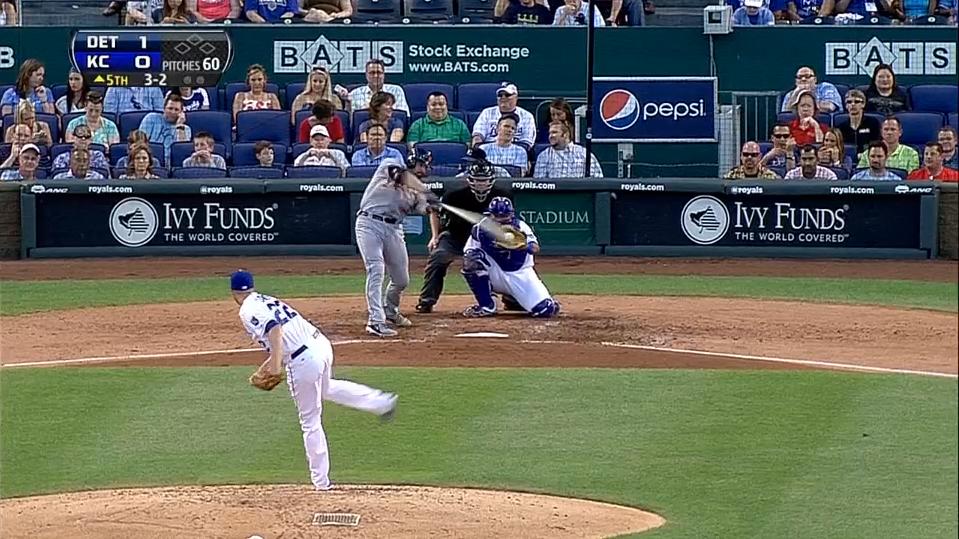
So Avila is driving the ball to the left center field gap and he’s doing much better against breaking balls and offspeed pitches. This probably isn’t surprising information considering how much his numbers have picked up. The swing is a lot shorter to the ball and it’s been a huge improvement. I wish I was adept at GIF-making, because a visual illustration would be great. Below are two screenshots from pitches at nearly identical locations at very similar speeds. He misses the first and hits the second for a game winning homerun. I think you can see the slightly more compact swing in the second, but if you can’t, that’s more my visualization abilities than anything else.
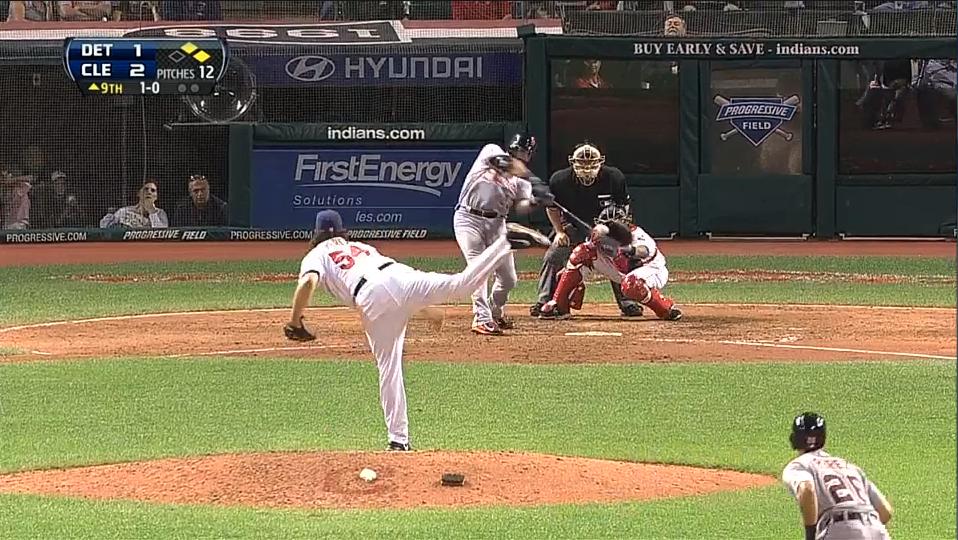
Also, one of Avila’s big problems during the slump was his awful numbers against lefties. Granted, he’s still not tearing it up against southpaws and neither is a big sample, but the comparison is striking. In 26 AB against lefties before the injury he hit .038/.100/.038. In 45 AB since, he’s .222/.314/.378. Add that to his ability to mash righties lately (Since the injury, 315/.384/.539 against RHP) and you’re in business.
He’s improved against lefties and he’s gotten better overall, but you don’t just see it in the numbers. The spray chart tells the same story and the video does as well. It’s all looking up for Avila who has been worth a full win above replacement since the break and has himself up to 90 wRC+ for the season despite the terrible start. It’s not going to be a Silver Slugger year for the Tigers backstop, but ending the season like this is a very good sign for the future. He’s never going to be the most durable player and it’s probably wrong to expect him to be a 5 win player like he was in 2011, but there’s no reason we shouldn’t expect him to be an above average catcher for the next couple of seasons.
The swing is back and he has the number to prove it. And really, if he delivers in October and helps the Tigers win a World Series, is anyone going to care how he hit in May?
How Was The Game? (September 15, 2013)
A feather in Max’s award season cap.
Tigers 3, Royals 2 (Magic # = 9)
When Max Scherzer (30 GS, 201.1 IP, 2.95 ERA, 2.68 FIP, 6.2 WAR) takes the mound you can usually count on the Tigers to score a lot of runs, but on this afternoon that wouldn’t be the case. Despite plenty of chances the Tigers only scored on Alex Avila’s 2 run homer in the second inning and that would be all Max would need (sort of!). Aside from a solo homerun to Gordon he dazzled across 7 innings in which he allowed 5 hits, 1 walk, and struck out 12 Kansas City Royals, including 5 straight at one point. It was vintage Max after he struggled in two of his past three outings and he sent the Tigers on the path to their 86th win of the season that would be interrupted by a run scoring wild pitch in the 8th inning that tied the game at 2 until Avila stepped in to untie it again with a bomb in the 8th. They’ll welcome the Mariners to Comerica Park for the first time this season on Monday with Rick Porcello (27 GS, 162 IP, 4.56 ERA, 3.73 FIP, 2.5 WAR) lined up for game one.
The Moment: Avila blasts a go-ahead homerun in the 8th – his second of the day.
Jim Leyland and Knowing When To Break Your Rules
I’ve long since come to terms with the fact that Jim Leyland is not a very good on-field tactician. He routinely misuses his relievers and bunts at weird times. On Saturday night, he made a very critical mistake that cost his team a chance to win. It wasn’t a mistake because of the result, it was a mistake because of the process. Let’s walk through it.
The Tigers entered the 9th inning down 1-0 with Greg Holland on the mound. Prince Fielder led off the inning with a walk. The tying run is on first base in the 9th inning and it’s Prince Fielder who is a below average runner. I love Prince, but he’s not a good baserunner. I know that, you know that, he probably knows that, and his manager knows that.
But Leyland didn’t pinch run. Martinez flied out and Dirks struck out to set up Infante. Prince Fielder stood on first while Hernan Perez and Danny Worth stood on the bench. Infante doubled and Prince was gunned down by a great relay by a step or two. The difference in this game was Leyland failing to run for Fielder. It’s obvious to see that this decision was costly, but it was a mistake long before it actually came to fruition.
Here’s the logic behind the mistake. First, Leyland has long said he won’t run for Fielder or (healthy) Cabrera. The basic premise is right. You shouldn’t pull your best hitters for pinch runners in most situations because the potential value of their later at bats is very high. However, this situation is the exact situation in which you must run for your slugger.
Down one in the 9th inning at home, you have to score at least once or you lose the game. That run is everything. You have to do everything you can to score that run and you worry about what might happen later, later. You have to maximize your odds of winning and you do that by putting the much faster Perez on first base. Whether or not Infante gets the hit doesn’t matter, it’s the right decision 10 times out of 10.
If it was a tie game, you leave Fielder in because you know you’re getting another at bat, but down a run you have to pinch run. The problem here isn’t this particular mistake it’s that an MLB manager should be ready for this situation. He’s clearly thought about the merits of pinch running for Fielder, but somehow he didn’t come to the conclusion that there is a single, glaring exception to the rule. You pinch run if that run is the difference between playing on and the game ending.
Leyland’s response to the postgame question was that he doesn’t pinch run for Fielder. (Note: I will update if one of the reporters posts more detailed comments,but so far I haven’t seen him display regret). The absolute nature of that statement is very concerning because while that rule is right most of the time, it isn’t right in this particular situation. Leyland should have been prepared for this. We aren’t talking about him deciding he liked a particular pinch hitter matchup that might involve intuition. This is pure, rational logic. There isn’t a case to be made for not pinch running, especially once we got to two outs and the chance at the two run inning was much smaller.
I don’t know how to properly weigh tactical skills and leadership skills in managerial evaluation, but this kind of mistake isn’t acceptable. And this isn’t the only mistake he’s made this year because he’s unwilling to break his rules. On multiple occasions he’s refused to go to Benoit in a tie game on the road because it wasn’t a save situation and the Tigers have been worse off for it.
The Tigers are still going to make the playoffs, but two weeks from now, the value of individual games is going to sky rocket and Jim Leyland’s poor decisions are going to be much more costly. Maybe his personal skills in the clubhouse make up for it, but that doesn’t excuse it. This isn’t a personal criticism. I have loads of affection for Leyland, but he needs to be better prepared for these situations or the Tigers are going to be disadvantaged in October. The occasional mistake is easy to overlook, but this is a pattern and it doesn’t appear as if he understands where he went wrong.
It’s not his fault the Tigers didn’t score in the first 8 innings, but when he was a given a chance to help the team win, he didn’t do it. Managers don’t often have a chance to make a big difference and you can’t let those opportunities slip away because you don’t know when to break the rules.
Updated 10:40pm: Via Matthew Mowery, Leyland had this to say:
“I’m not taking Prince Fielder out of the game. I’m not going to do it. It’s just the way it is. I’m not going to run for him….That’s the way I do it.”
So, that confirms that he doesn’t see the issue and the bad outcome tonight did not cause him to reflect on why this situation calls for him to break his rule.
How Was The Game? (September 14, 2013)
Brisk, but without success.
Royals 1, Tigers 0 (Magic # = 10)
To no one’s surprise, Doug Fister (30 GS, 193.2 IP, 3.67 ERA, 3.30 FIP, 4.2 WAR) and Ervin Santana hooked up for a pitchers’ duel tonight featuring very little offense and a pretty quick pace. Fister allowed a run on two hits in the first but was stingy the rest of the way giving the Tigers 7.2 innings of 1 run baseball featuring 6 K an 3 BB. The Tigers bats couldn’t do much against Santana and his pen despite an Infante double with a man on first in the 9th. The Tigers failed to score, however, as Leyland elected not to run for Fielder – who was on first – and it was the difference in the game as he was thrown out at home by about a step – a step that a pinch runner would have had on Fielder. It’s hard to quantify the effect managers have on games, but this was a clear time in which Leyland is squarely to blame. It makes sense not to lose Fielder in a tie game in the 9th or any time earlier, but if you don’t score the tying run in the 9th, the game ends. You have to pinch run. It’s bad strategy, pure and simple, and it’s a situation an MLB manager should be ready for from the first day of the season. Especially with expanded rosters. The Tigers will look to take the series Sunday afternoon with Max Scherzer (29 GS, 194.1 IP, 3.01 ERA, 2.71 FIP, 5.9 WAR) on the hill.
The Moment: Hunter guns down Getz at third in the 7th inning.
How Was The Game? (September 13, 2013)
The reckoning of Bruce Chen.
Tigers 6, Royals 3 (Magic # = 10)
The top of the order gave Justin Verlander (31 GS, 199.2 IP, 3.66 ERA, 3.41 FIP, 4.6 WAR) plenty of runs to work with thanks to good nights from Jackson, Hunter, Cabrera, and Fielder against the Bruce Chen. Verlander didn’t dazzle in any sort of Cy Young caliber way, but he gave the Tigers 6.2 solid innings of 3 run baseball featuring 7 strikeouts and no walks and continues to have the best “down year” anybody has probably ever had. The story of this one was the bullpen as Smyly came on and got the final out of the 7th and the first in the 8th before giving way to Veras who got one out but added two baserunners. It was Benoit who entered with four outs left, defying all logic. Somehow, a closer managed to finagle his way into a game earlier than the 9th inning out of Jim Leyland’s bullpen – and somehow – he didn’t blow it! He K’d Lough and then went through the 9th to close it out. The Tigers will try to take the series behind the vertically gifted Doug Fister (29 GS, 186 IP, 3.77 ERA, 3.31 FIP, 4.0 WAR).
The Moment: Benoit comes in with the bases loaded and two outs in the eighth inning and strikes out David Lough.
Austin Jackson’s Southpaw Problem

Austin Jackson is a pretty great baseball player. He’s not Miguel Cabrera or Mike Trout great, but he does a lot of things well. He’s averaged 3.4 WAR (what’s WAR?) per 600 plate appearances and has been as high as 5.2 in a season and never lower than 2.4. He plays excellent center field, runs the bases well and is something better than league average at the plate before you consider his position.
But unless you’re Austin Jackson’s mother or his dog, you don’t think he’s perfect. He used to strikeout a lot and he improved in that department and now just strikes out a bit more than average. If you look across the stat line, he’s a pretty good all-around player. If you look inside the numbers, there’s a very strange split developing this season. Let’s take a look:
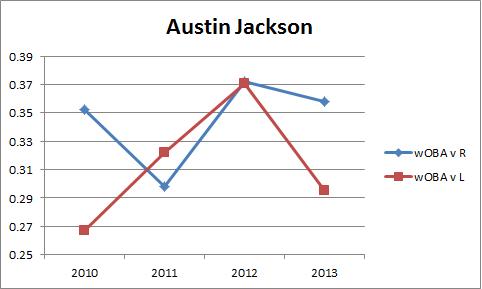
Remember that Austin Jackson hits right-handed. In his rookie season, he displayed a dramatic reverse platoon split. In 2011, it was a small and normal split. In 2012, it didn’t exist. In 2013, it’s back to being a crazy-big reverse platoon split. What’s going on here?
Let’s forget that 2010 happened, not because it didn’t, but because four years is a long time and it’s pretty likely that Jackson has grown as a player and isn’t the same hitter he was back then. Let’s just look at 2012 and 2013 in order to look for differences. What moved Jackson to struggle so much against southpaws this year?
First some basics:
| Split | PA |
| 2012 v R | 432 |
| 2012 v L | 185 |
| 2013 v R | 375 |
| 2013 v L | 167 |
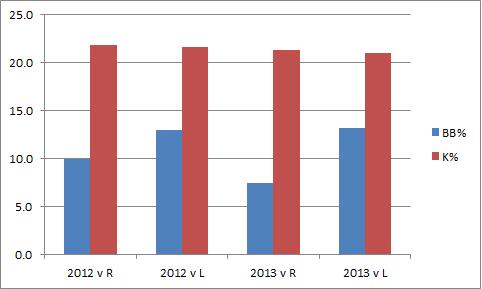

So first, the plate appearance distribution isn’t funky and he’s walking less against righties this year. Strikeouts are remarkably consistent. When you drop down to the second figure you can see how similar his production was across the board in 2012 and how different it is in 2013. If you notice the purple column, you’ll recognize that this issue is BABIP driven. So now the question is if this is luck or a problem?


You’ll notice a fairly even split in batted ball data in 2012 and in 2013 we see a drop off in line drives against lefties in favor of fly balls. So, Austin Jackson is hitting the ball in the air more often in against lefties in 2013 – and hitting fly balls instead of line drives will drop your BABIP. And a lower BABIP will hurt your production. Therefore, this is a real thing. What’s behind it?
If we hop over to Brooks Baseball, we can derive an interesting lesson. I won’t present all of the numbers because there are too many, but I’ll pull out the relevant data. First, he’s hitting fastballs and sinkers in the air more often this year against lefties and he’s putting a lot fewer sliders in play. And when he puts those sliders in play, they are all on the ground. He also hasn’t hit a single homerun on a fourseam, sinker, or slider against lefties this year.
So he’s putting more fastballs in play and he’s putting them in the air without leaving the yard and he’s putting fewer sliders in play and they’re all on the ground. That’s not a good combination.
To me, it says his timing is off and he’s out in front. If you’re out in front on a fastball, you’ll hit it in the air. If you’re out in front on a slider breaking toward you’re more likely to hit it into the ground. If you run a query for LHP throwing sliders to Austin Jackson that he hit on the ground – most are down and in. I’m not a master of GIFs, so I can’t show you clips or anything, but it will be something I’m looking for as the season winds down.
Jackson famously lost his big leg kick last year so it’s not outrageous to think some little mechanical issue could be messing with his ability to turn fastballs around rather than hit them in the air and the same mechanical issue could be getting him to roll over some sliders and swing through others. Hitting is about timing and pitching is about interrupting timing.
Jackson doesn’t seem to be having much of an issue with righties and it should be easier to pick up pitchers from lefites, so it seems logical that there’s something about lefties this year that he’s miss-timing. When you’re dealing with fewer than 200 PA against southpaws, you only need a few fly balls to turn into line drive hits for this to even out. Jackson needs to be better against lefties, but there’s also no reason to think he can’t be better against them.
He hit them last year with no problem and if he had a serious problem with his health or swing it would show up against righties. I’m not worried about him long term. This looks like a short term issue that he will have the ability to correct with a little bit of work. He’s having a good season overall and has hit well over the last 30 days (.311/.393/.443) so this isn’t some terribly detrimental problem that’s ruining the Tigers. It just catches your eye because it’s surprising that a player this good would have such a funky platoon split, but he does. Now why have some understanding of why that might be the case.
How Was The Game? (September 11, 2013)
Another great one from Sanchez.
Tigers 1, White Sox 0 (Magic # = 11)
Anibal Sanchez (26 GS, 165.2 IP, 2.50 ERA, 2.47 FIP, 5.6 WAR) followed Rick Porcello’s lead and gave the Tigers 7.1 great innings of shutout baseball featuring 10 strikeouts and 3 walks as he continued to roll passed AL offenses and into the back end of the Cy Young race with a couple of starts left. The Tigers bats had some chances in this one but it took them 8 innings to push across their first and only run thanks to an Infante RBI single that plated Prince Fielder. Veras, Smyly, and Benoit held serve in the 8th and 9th and the Tigers jumped back up to 6.5 ahead of the Cleveland Indians with Justin Verlander (30 GS, 192.2 IP, 3.64 ERA, 3.49 FIP, 4.1 WAR) getting the ball to start the final homestand on Friday.
The Moment: Infante pushes across the Tigers only run with a single through the left side.
How Was The Game? (September 10, 2013)
Finally a chance for Porcello to finish what he started.
Tigers 9, White Sox 1
After a disappointing game on Monday, the Tigers struck back and struck back hard with a great performance by Rick Porcello (27 GS, 162 IP, 4.56 ERA, 3.72 FIP, 2.5 WAR) and some big hits that capitalized on some horrible White Sox defense. Fielder was on base four times and Avila made it to first five times while eight different Tigers touched home plate en route to the big win than included three errors from Conor Gillaspie and one more from Paul Konerko for good measure. But the story on this night was the man on the mound. Porcello gave the Tigers 9, 1 run innings with one walk and 4 strikeouts while retiring the final 17 he faced as he notched his first career complete game in his 147th career start. It was just the third for the Tigers this year, courtesy of Jim Leyland’s personal vendetta against allowing a starter to pitch the ninth inning. Win number 83 leaves the Tigers 5.5 games up in the AL Central with 17 to play and Anibal Sanchez (25 GS, 158.1 IP, 2.61 ERA, 2.49 FIP, 5.2 WAR) on the mound trying to take the series on Wednesday.
The Moment: Rick Porcello gets a chance to go the distance and doesn’t disappoint.
 New English D