How Was The Game? (June 1, 2013)

A nice correction.
Tigers 10, Orioles 3
After last night’s Valverde meltdown and the offensive struggles of the last few games, Saturday adjusted the averages back to normal as the Tigers crushed the Orioles and finally won their 30th game after five tries. Justin Verlander (6/7-4, 73 IP, 3.70 ERA, 2.60 FIP, 2.5 WAR) was solid, even if he was unimpressive, over 7 innings, allowing 3 runs while striking out 5 and walking 1. But the story of the day, no doubt, was the Tigers massive 8 run 4th inning. It started with a Martinez homerun. Then a Peralta homer. Then Avila joined the party with a bomb of his own. It was at this point that Hammel put one in Tuiasosopo’s ear and was ejected from the game to the disappointment of Tigers hitters, who didn’t mind his replacement. Garcia singled. Infante doubled. Dirks walked. And then Miguel Cabrera walked to the plate and whacked a 3-2 pitch into the left field seats to complete the rally. Fielder would add a solo shot later, but it was over when Cabrera fired off the grand slam. The Tigers are now 30-24 on the year and will look to take the series Sunday behind Rick Porcello (2-2, 51 IP, 5.29 ERA, 3.92 FIP, 0.7 WAR) who will look to build on his fantastic outing last time out and continue his breakout season.
The Moment: The Tigers deliver four HR in the 4th.
How Was The Month? Detroit Tigers May Report
Excellent, until the very end.
14-14 (29-24 overall)
The Tigers entered May on a hot streak and ended it on a cold streak losing four in a row, even if most of the month was very strong.
They end May fourth in MLB offensively with a 108 wRC+ after hitting 110 wRC+ during the month of May. On the bump, the Tigers are far and away the best staff in baseball with a 13.4 WAR overall thanks to a 6.5 WAR month of May in which they struck out 9.9 batters per 9 and walked just 2.44 per 9, good for a 2.92 FIP and 2.99 xFIP.
To no one’s surprise, Miguel Cabrera led the way during May with 2.1 WAR thanks to an otherworldly 224 wRC+ and .379/.455/.767 line during the month to go with his 12 HR, but Jhonny Peralta stood out as well. Peralta put up 1.3 WAR in the month and hit .362/.413/.543 good for 160 wRC+. The Tigers also had decent months from Dirks (0.7 WAR in May), Infante (0.5), Pena (0.4), and Kelly (0.4). Hunter, Avila, Fielder, and Martinez combined to cost the Tigers -1.0 WAR in May.
The pitching ERAs belie how good the staff was during the month thanks to about one poor start each, but the other numbers are great. Sanchez (1.4 WAR, 2.26 FIP), Fister (1.3 WAR, 2.08 FIP), Scherzer (1.2 WAR, 2.95 FIP), Verlander (0.9 WAR, 2.42 FIP), and Porcello (0.7 WAR, 3.25 FIP) all had strong months thanks to big strikeout totals, low walk rates, and a limitation of the longball. Three of the seven best pitchers in baseball during May and four of the top ten overall this season play for the Tigers.
Of MLB pitchers with 50 or more innings so far this year, the Tigers 5 starters rank 2, 5, 6, 12, and 13 in xFIP, which is FIP adjusted for park, league average, and HR/FB%.
It’s hard not to like what the Tigers are doing, as they lead MLB in WAR at the end of May and are in first place despite finishing the month with four straight losses. Fans sometimes have a tendency to focus on your team’s struggles without realizing that your team is one of the best teams in the league because you don’t watch every other team day in and day, thus failing to notice their flaws. The Tigers are very, very good. Their starters are on another level and their offense is also deadly. Teams will go through poor stretches throughout a 162 games schedule and will not play at the exact same pace for an entire year. There will be variation, and you have to be able to see the forest rather than the trees.
The Moment: Sanchez nearly no-hits the Twins, coming within two outs, on May 24th.
The Nine Worst Tigers Teams Ever
Last week, as the Tigers honored the 1968 World Series team, I took a look at the The Nine Best Tigers Teams Ever. Today, I’ll do the opposite and will give you the worst Tigers teams ever. The methodology is the same. I’m ranking the teams by Wins Above Replacement (WAR), not because that’s the best way, but because it’s easy to take a look at win totals and this requires a little more legwork. WAR is a good choice for a list like this because it compares the team to its environment, which is good because the level of competition varies and we’d like to control for context when making a list like this.
Also of note, which you can see in the original post, is the WAR and Wins correlate extremely well over samples of this size.
9. 1994 Tigers (18.0 WAR, 53 Wins)
8. 1918 Tigers (17.7 WAR, 55 Wins)
7. 1904 Tigers (15.4 WAR, 62 Wins)
6. 1989 Tigers (14.2 WAR, 59 Wins)
5. 1975 Tigers (13.8 WAR, 57 Wins)
4. 2002 Tigers (12 WAR, 55 Wins)
3. 1995 Tigers (9.9 WAR, 60 Wins)
2. 1996 Tigers (2.2 WAR, 53 Wins)
1. 2003 Tigers (1.7 WAR, 43 Wins)
A few things are worth noting about this list that I think are interesting and/or important. First, the 1994 Tigers are somewhat unfairly listed here because that was a strike shortened season. If you’re curious the 2001 Tigers are the first team out at 18.2 WAR and 66 Wins. Additionally, the 2003 Tigers are not just the worst Tigers team ever, but likely one of the worst teams ever, period. By this same measure, they are the 4th worst team ever, trailing only the ’54 Athletics, ’63 Mets, and ’79 Athletics (also the ’13 Marlins and Astros, but they will presumably add a couple more WAR before the end of the season). I wrote about the 2003 Tigers more extensively here.
What’s also pretty fun is that the 2013 Tigers were not excluded from consideration and are already better than 15 Tigers teams just 52 games into the season. That’s got to be a good sign.
Helping the cause, the worst Tigers seasons ever by a qualifying player and pitcher belong to Jerry Morales in 1979 (-2.5 WAR) and John Hiller in 1979 (-1.6 WAR). Surprisingly, the 1979 Tigers won 84 games and are only the 46th worst Tigers team in history.
How Was The Game? (May 31, 2013)
A return to hitting, and a return to the other thing…
Orioles 7, Tigers 5
After struggling to score over the previous three games, they Tigers returned to form against the Orioles on Friday and matched it with another good start from Max Scherzer (7-0, 76.1 IP, 3.42 ERA, 2.45 FIP, 2.7 WAR). Scherzer gave the Tigers 7 strong innings of 3 run baseball featuring 2 walks and 10 strikeouts, while retiring the final 16 he faced. It wasn’t quite as dominant as his previous two outings, but it was certainly very good and it was against a very strong offense. The Tigers offense came from Cabrera and Garcia HRs and Garcia and Martinez RBI hits and the Tigers almost got their 30th win, if not for the horrendous pitching of Jose Valverde. He entered the game in the 9th up 2 runs and allowed a homerun, a single, a single, a popup, a popup, and then a 3 run HR complete his meltdown. They’ll look to get back on track Saturday afternoon behind HR Derby hopeful, Justin Verlander (6-4, 66 IP, 3.68 ERA, 2.26 FIP, 2.5 WAR), who thankfully, will likely stick to pitching.
The Moment: Cabrera starts the game off right with a 2 run HR.
How Was The Game? (May 30, 2013)
Another pitchers’ duel that needed a run.
Pirates 1, Tigers 0
This game was many things. It featured good pitching led by Doug Fister’s (5-2, 68.2 IP, 3.28 ERA, 2.64 FIP, 2.3 WAR) 7 strong innings of 4 H, 0 R, 1 BB, 1 HBP, and 12 K baseball and it also featured a play in which Travis Snider made two outs and was called for neither (On a popout to 2B, Snider, running from first, passed 2B, didn’t retouch, and was tagged out returning to first). This game was also the first one in which Jhonny Peralta was ejected from play in his 1,300+ career games. His offense was disagreeing with a called third strike and apparently gesturing slightly with his hand while walking to shortstop. Additionally, this game featured Doug Fister hitting a batter, but also walking one, updating his HBP and BB totals to 12 and 11, respectively. As you may recall, no one has ever hit more than they have walked in a full season:

But this game was also another 0-0 extra inning affair that ended in the 11th inning with a Pirates run. With the loss, the Tigers fall to 29-23 and lose the four game set with the Pirates. They will head to Baltimore for three starting on Friday and will be led by Max Scherzer (7-0, 68.1 IP, 3.42 ERA, 2.39 FIP, 2.4 WAR) who is looking to build on a couple of excellent starts (see here, and also here). Fister’s great start also gives the Tigers 4 of the top 8 pitchers in MLB by WAR and 4 of the top 6 in the AL. Also of interest to Tigers fans might be yesterday’s post on the team’s increase use of the changeup over the last few seasons.
The Moment: Fister makes a diving stop in the 6th.
A Changeup in the Tigers Pitching Approach
Fastball velocity catches your attention. Knee-buckling breaking balls demand respect. But the changeup is not usually a pitch that grabs headlines, but here I am, writing about it. I’ve mentioned it briefly in these electronic pages and Rod Allen has touched on it as well: the Tigers are throwing more changeups and it’s working.
Now I’m not sure if this change is coming from Jeff Jones, the Tigers pitching coach, or Jim Leyland. Maybe it’s coming from Alex Avila. Perhaps the starters are doing it themselves and learning from one another. Heck, the front office could be putting useful information about the pitch in front of the players. I don’t know the answer, but I know it’s happening and I know it’s yielding some good results.
First, let’s check out the Tigers starting pitching as a whole over the last five seasons:
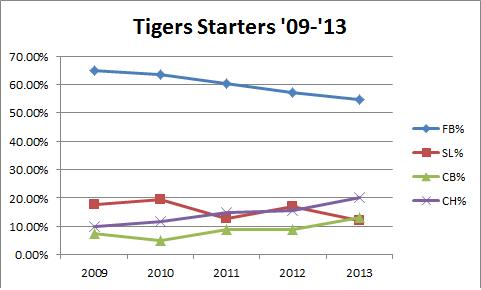
The trend is pretty clear, even if we can’t identify the cause. The Tigers are trading fastballs and sliders for curveballs and changeups. Now the slider versus curveball transformation could be many things, but those are both breaking balls and they are moving together. The changeup is a distinct pitch. Let’s look at the same chart but with sliders and curveballs combined:

This allows you to see the trend a little better. Fastballs down, changeups up. Breaking balls mostly constant (splitters, cutters, knucklers all excluded due to very low numbers).
So is this an overall trend that reflects a difference in organizational approach, or is one pitcher getting changeup happy and obscuring the results. (The size of the scale on the vertical axis makes these changes look minor, but we are talking about noticeable changes).
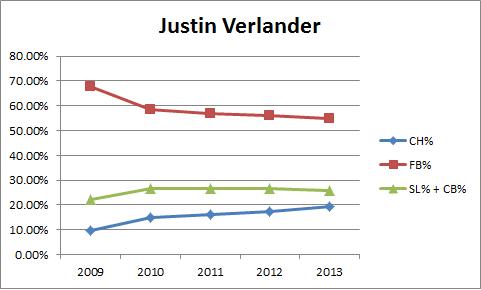
Justin Verlander
Verlander, as you can see below, matches the overall trend perfectly. He’s changed the breaking ball he throws, but he hasn’t really changed the percentage of breaking balls. He has, however, traded fastballs for changeups:

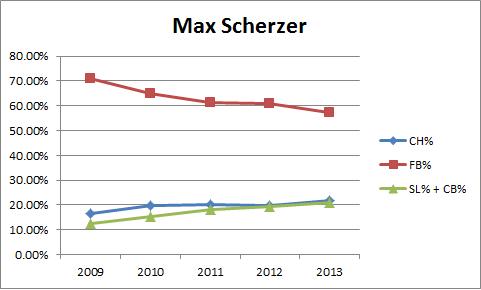
Max Scherzer
The pattern fits Scherzer (joined the Tigers in 2010) a bit less cleanly, as he is using more breaking balls and changeups instead of the fastball. You can see here:

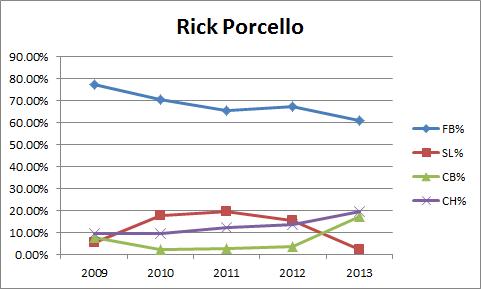
Rick Porcello
I’ve made a ton of Rick Porcello’s breakout campaign this season, and looking at his pitch type, he fits the mold perfectly:

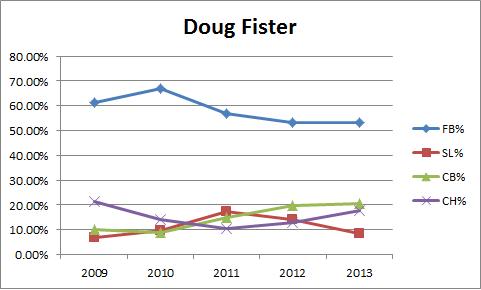
Doug Fister
Fister, too, fits the mold especially if you look at his change from 2011 (when he joined the Tigers):

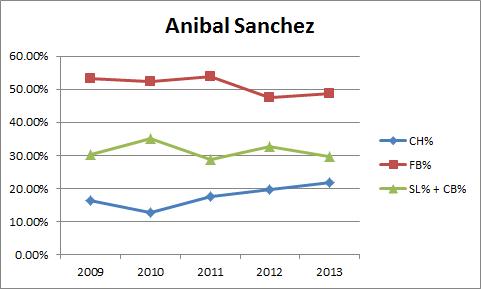
Anibal Sanchez
Sanchez also fits the mold, especially since joining the Tigers last year, but he is trading breaking balls for changeups more so than fastballs in recent years:

Twelve graphs later, what have we learned? Well we can see that the Tigers starters are collectively and individually moving toward changeups at the expense of the fastball, while also shifting which types of breaking balls they throw. I’m not sure if this change in approach is coming from the pitching coach, the catcher, or the pitchers themselves, but the trend exists and it’s hard to argue with the staff that has 4 of the top 12 pitchers by WAR so far in 2013 and leads the league by more than 3 full wins as an entire pitching staff.
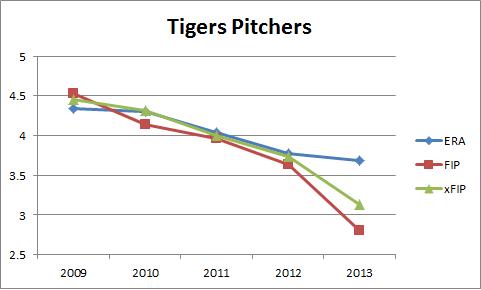
You can see how the results are getting better, even if not all five guys were on the staff each year. Compare this to the top charts. I’m not making the case that the changeups are making the Tigers staff this much better, but rather that the change in pitch type as an organization is a noticeable trend that is tracking with success:
And the last question you should be asking, also has an answer. This is not a league-wide trend:

The Tigers are throwing more changeups. I’m not sure whose idea it was, but it’s working and it isn’t happening in all 30 major league cities. Changeups aren’t usually thought about as a “stuff” pitch, but it might be time to rethink that approach. I know there are some advocates for the pitch, like Dave Cameron at Fangraphs, who like me, thinks great changeups are vastly underappreciated, but on the whole, we overlook the changeup. Maybe we shouldn’t.
The Morning Edition (May 30, 2013)
From Last Night:
- Baltimore’s 6 run 7th tops Zimmerman’s 3 HR night
- The Mets beat the Yanks with 5 in the first, but Nova delivers an immaculate inning
- Navarro homers 3 times as the Cubs beat the White Sox
What I’m Watching Today:
- Felix goes at Petco (330p Eastern)
- Moore faces the Marlins (7p Eastern)
- Michael Wacha makes his MLB debut for the Cards
The Big Question:
- Has the Cardinals draft team been tested for PEDs?
I spend some time checking into various baserunning numbers and threw several tweets out regarding those numbers (you can read them if you look to the right of this page) and I made this handy graph comparing how often a team scores from second base on a single:

You can see 60% is about average and the Mets lead the way with 79%, but look at those Astros. My, my those Astros. 39%.
How Was The Game? (May 29, 2013)
Very good, and then it totally unraveled.
Pirates 5, Tigers 3
This game can be thought of as a two act play. The first act got rave reviews as the Tigers jumped out to a 3-1 lead thanks to a three run 5th and a great start by Anibal Sanchez (5-5, 71 IP, 2.79 ERA, 1.87 FIP, 3.1 WAR). But in the bottom of the 7th, this would be the start of act two, the Pirates jumped on Sanchez so quickly he didn’t know what hit him.

They got 4 runs on 5 hits and a walk in the inning to chase Sanchez with a final line of 6.2 IP, 7 H, 5 R, 1 BB, and 9 K. Now trailing by two the Tigers made a run at a comeback, but ultimately came up short and will need to win tomorrow behind Doug Fister (5-2, 61.2 IP, 3.65 ERA, 2.89 FIP, 1.8 WAR) to split the four game, home and home series, with the Pirates.
The Moment: Cabrera smacks an opposite field bomb in the 5th.
The Morning Edition (May 29, 2013)
From Last Night:
- Harvey and Kuroda deliver a classic duel in NY
- Lee dominates the Red Sox, wins 3-1
- Rays walk off against the Marlins
- McCann homers in the 10th to lift the Braves over the Jays
What I’m Watching Today:
- Zimmermann faces the Orioles in Baltimore (7p Eastern)
- McCarthy looks to stay hot against the Rangers (8p Eastern)
- Weaver returns to action against the Dodgers (10p Eastern)
The Big Question:
- How do you like some of these home and home series in MLB?
Cliff Lee in 2013: 7.03 K/9, 1.45 BB/9, 0.56 HR/9, 39.1 GB% 2.34 ERA, 2.84 FIP, 3.63 xFIP, 2.0 WAR
Rick Porcello in 2013: 7.06 K/9, 1.76 BB/9, 1.24 HR/9, 55.7 GB%, 5.29 ERA, 3.93 ERA, 3.15 xFIP, 0.7 WAR
Once their HR/FB rates normalize (5.5% to 19.4%), they’re basically the same pitcher with Porcello getting the ball on the ground more often. I’m not saying Porcello is going to be Cliff Lee, but so far, it’s not such a crazy thought. (Innings aside)
How Was The Game? (May 28, 2013)
Baseball as it should be, with an unfortunate ending.
Pirates 1, Tigers 0
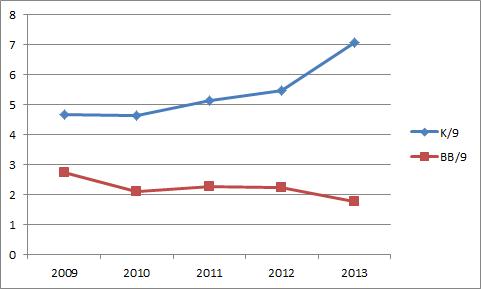
I’ve been banging the Rick Porcello (2-2, 51 IP, 5.29 ERA, 3.93 FIP, 0.7 WAR) drum pretty hard for a long time, and as recently as two weeks ago, and it was so much fun to watch him walk out onto the mound after a rain delay tonight and deliver the best performance of his career. He was brilliant from the start and finished with 8 innings, 3 hits, 0 runs, 1 BB, and 11 K. Only two balls were hit in the air against him all night, both of which were caught. The three hits were groundball singles up the middle. Nothing else of any substance came off the bats of the Pirates hitters and Porcello (as you can see below) continued his march toward his breakout year.

For their part, the Tigers offense made him sweat and didn’t deliver anything, even into the 11th inning, when Neil Walker’s solo HR gave the Pirates a 1-0 lead that would hold.The loss gives the Tigers a 4-2 homestand and a 29-21 record so far on the year as they pack up and head to Pittsburgh to play the second half of the home and home series. Anibal Sanchez (5-4, 64.1 IP, 2.38 ERA, 1.78 FIP, 2.8 WAR) will start game one Wednesday looking to continue his great season and keep his near no-hitter stuff going.
The Moment: Porcello strikes out his 11th batter to set a new career best.
 New English D