The Nine Worst Wins of 2013

If you’re here, you’ve likely been exposed to our series on pitcher wins and why we want to kill them. It’s become a pretty big topic of conversation around baseball and some people are calling for a cease fire because the win has been repeatedly slaughtered to the point that we’ve probably violated the Geneva Convention. So, I’ll make sure to avoid overdoing it because apparently #KillTheWin is sabr-bullying. If you’re new to the cause, check out the groundwork for why wins are a terrible statistic and then enjoy The Nine Worst Wins from 2013 (as of Sept 13th).
- You Can Have A Great Season and Not Win
- You Can Have A Bad Season and Win A Lot
- Wins Don’t Even Out in Big Samples
- A Case Study in Wins
- 12 Assorted Facts About Wins from 2013
- Dissecting the Case for Wins
- A Replacement for Wins
So the methodology is quite simple. Below are the pitchers in 2013 who have earned a “win” sorted by the lowest Win Probability Added (WPA). What WPA does is measure how much the team’s likelihood of winning changed as a result of every play and assigns that value to the pitcher and batter who took part. It’s not a perfect stat for measuring a player’s performance but it works for our purposes here for a simple reason. If a pitcher’s team scores 10 runs in the first inning, that pitcher can pitch poorly and get a win, but most of the pro-win alliance thinks that’s okay. They believe in something called “pitching to the score” which has been shown to be fiction. So in order to make the point clearly, I’ll use WPA which is entirely dependent on context. If you’re up 10, you’re allowed to give up 5. If you’re up 1, you better not give up two.
There are other ways to do this, but I think this is the most valuable way to do it given the audience still in need of persuasion.
| Rk | Player | Date | Tm | Opp | Rslt | App,Dec |
| 9 | Randall Delgado | 2-Aug | ARI | BOS | W 7-6 | GS-6 ,W |
| 8 | Brandon League | 31-May | LAD | COL | W 7-5 | 9-9 ,BW |
| 7 | CC Sabathia | 18-Aug | NYY | BOS | W 9-6 | GS-6 ,W |
| 6 | Alfredo Simon | 22-Apr | CIN | CHC | W 5-4 | 13-13f,W |
| 5 | Rafael Soriano | 17-May | WSN | SDP | W 6-5 | 9-9 ,BW |
| 4 | Matt Belisle | 28-Jul | COL | MIL | W 6-5 | 8-8 ,BW |
| 3 | Joe Smith | 26-Jun | CLE | BAL | W 4-3 | 8-8 ,BW |
| 2 | Michael Wacha | 19-Aug | STL | MIL | W 8-5 | 7-7 ,BW |
| 1 | Kyuji Fujikawa | 12-Apr | CHC | SFG | W 4-3 | 9-9f ,BW |
| Rk | Player | IP | H | R | ER | BB | SO | HR | Pit |
| 9 | Randall Delgado | 6 | 6 | 6 | 4 | 1 | 7 | 2 | 97 |
| 8 | Brandon League | 1 | 2 | 2 | 2 | 0 | 1 | 1 | 26 |
| 7 | CC Sabathia | 5.1 | 7 | 6 | 6 | 5 | 5 | 1 | 103 |
| 6 | Alfredo Simon | 1 | 1 | 2 | 1 | 0 | 1 | 1 | 15 |
| 5 | Rafael Soriano | 1 | 4 | 2 | 2 | 0 | 0 | 0 | 19 |
| 4 | Matt Belisle | 1 | 2 | 2 | 2 | 0 | 2 | 1 | 23 |
| 3 | Joe Smith | 1 | 3 | 2 | 2 | 1 | 0 | 0 | 21 |
| 2 | Michael Wacha | 1 | 4 | 3 | 3 | 0 | 1 | 1 | 30 |
| 1 | Kyuji Fujikawa | 1 | 3 | 3 | 3 | 0 | 0 | 0 | 30 |
| Rk | Player | ERA | RE24 | WPA |
| 9 | Randall Delgado | 6.00 | -2.939 | -0.392 |
| 8 | Brandon League | 18.00 | -1.479 | -0.404 |
| 7 | CC Sabathia | 10.12 | -3.472 | -0.410 |
| 6 | Alfredo Simon | 9.00 | -1.537 | -0.417 |
| 5 | Rafael Soriano | 18.00 | -1.594 | -0.430 |
| 4 | Matt Belisle | 18.00 | -1.479 | -0.431 |
| 3 | Joe Smith | 18.00 | -1.490 | -0.528 |
| 2 | Michael Wacha | 27.00 | -2.537 | -0.557 |
| 1 | Kyuji Fujikawa | 27.00 | -2.537 | -0.745 |
To date, there have been 282 wins in which the pitcher had a negative WPA in 2013. Above you’ve seen the nine worst including Fujikawa having just about the worst performance I could imagine in a win using this method. In fact, as far back as we have WPA data, it’s the 14th worst such win.
It looked like this! That’s pretty bad.

This is all by way of saying that wins aren’t a useful statistic and that even if we allow for the idea of pitching to the score, we still have a ton of ridiculous wins every season. If every win was handed out perfectly the rest of the season, we would still have seen 11.6% of the wins in 2013 go to pitchers who hurt their team’s chance to win.
#KillTheWinButDoItWithoutBeingSoDramatic
How Was The Game? (September 13, 2013)
The reckoning of Bruce Chen.
Tigers 6, Royals 3 (Magic # = 10)
The top of the order gave Justin Verlander (31 GS, 199.2 IP, 3.66 ERA, 3.41 FIP, 4.6 WAR) plenty of runs to work with thanks to good nights from Jackson, Hunter, Cabrera, and Fielder against the Bruce Chen. Verlander didn’t dazzle in any sort of Cy Young caliber way, but he gave the Tigers 6.2 solid innings of 3 run baseball featuring 7 strikeouts and no walks and continues to have the best “down year” anybody has probably ever had. The story of this one was the bullpen as Smyly came on and got the final out of the 7th and the first in the 8th before giving way to Veras who got one out but added two baserunners. It was Benoit who entered with four outs left, defying all logic. Somehow, a closer managed to finagle his way into a game earlier than the 9th inning out of Jim Leyland’s bullpen – and somehow – he didn’t blow it! He K’d Lough and then went through the 9th to close it out. The Tigers will try to take the series behind the vertically gifted Doug Fister (29 GS, 186 IP, 3.77 ERA, 3.31 FIP, 4.0 WAR).
The Moment: Benoit comes in with the bases loaded and two outs in the eighth inning and strikes out David Lough.
Austin Jackson’s Southpaw Problem

Austin Jackson is a pretty great baseball player. He’s not Miguel Cabrera or Mike Trout great, but he does a lot of things well. He’s averaged 3.4 WAR (what’s WAR?) per 600 plate appearances and has been as high as 5.2 in a season and never lower than 2.4. He plays excellent center field, runs the bases well and is something better than league average at the plate before you consider his position.
But unless you’re Austin Jackson’s mother or his dog, you don’t think he’s perfect. He used to strikeout a lot and he improved in that department and now just strikes out a bit more than average. If you look across the stat line, he’s a pretty good all-around player. If you look inside the numbers, there’s a very strange split developing this season. Let’s take a look:
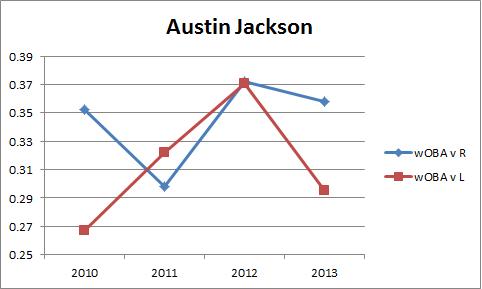
Remember that Austin Jackson hits right-handed. In his rookie season, he displayed a dramatic reverse platoon split. In 2011, it was a small and normal split. In 2012, it didn’t exist. In 2013, it’s back to being a crazy-big reverse platoon split. What’s going on here?
Let’s forget that 2010 happened, not because it didn’t, but because four years is a long time and it’s pretty likely that Jackson has grown as a player and isn’t the same hitter he was back then. Let’s just look at 2012 and 2013 in order to look for differences. What moved Jackson to struggle so much against southpaws this year?
First some basics:
| Split | PA |
| 2012 v R | 432 |
| 2012 v L | 185 |
| 2013 v R | 375 |
| 2013 v L | 167 |
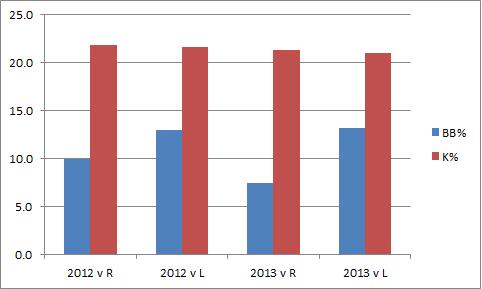

So first, the plate appearance distribution isn’t funky and he’s walking less against righties this year. Strikeouts are remarkably consistent. When you drop down to the second figure you can see how similar his production was across the board in 2012 and how different it is in 2013. If you notice the purple column, you’ll recognize that this issue is BABIP driven. So now the question is if this is luck or a problem?


You’ll notice a fairly even split in batted ball data in 2012 and in 2013 we see a drop off in line drives against lefties in favor of fly balls. So, Austin Jackson is hitting the ball in the air more often in against lefties in 2013 – and hitting fly balls instead of line drives will drop your BABIP. And a lower BABIP will hurt your production. Therefore, this is a real thing. What’s behind it?
If we hop over to Brooks Baseball, we can derive an interesting lesson. I won’t present all of the numbers because there are too many, but I’ll pull out the relevant data. First, he’s hitting fastballs and sinkers in the air more often this year against lefties and he’s putting a lot fewer sliders in play. And when he puts those sliders in play, they are all on the ground. He also hasn’t hit a single homerun on a fourseam, sinker, or slider against lefties this year.
So he’s putting more fastballs in play and he’s putting them in the air without leaving the yard and he’s putting fewer sliders in play and they’re all on the ground. That’s not a good combination.
To me, it says his timing is off and he’s out in front. If you’re out in front on a fastball, you’ll hit it in the air. If you’re out in front on a slider breaking toward you’re more likely to hit it into the ground. If you run a query for LHP throwing sliders to Austin Jackson that he hit on the ground – most are down and in. I’m not a master of GIFs, so I can’t show you clips or anything, but it will be something I’m looking for as the season winds down.
Jackson famously lost his big leg kick last year so it’s not outrageous to think some little mechanical issue could be messing with his ability to turn fastballs around rather than hit them in the air and the same mechanical issue could be getting him to roll over some sliders and swing through others. Hitting is about timing and pitching is about interrupting timing.
Jackson doesn’t seem to be having much of an issue with righties and it should be easier to pick up pitchers from lefites, so it seems logical that there’s something about lefties this year that he’s miss-timing. When you’re dealing with fewer than 200 PA against southpaws, you only need a few fly balls to turn into line drive hits for this to even out. Jackson needs to be better against lefties, but there’s also no reason to think he can’t be better against them.
He hit them last year with no problem and if he had a serious problem with his health or swing it would show up against righties. I’m not worried about him long term. This looks like a short term issue that he will have the ability to correct with a little bit of work. He’s having a good season overall and has hit well over the last 30 days (.311/.393/.443) so this isn’t some terribly detrimental problem that’s ruining the Tigers. It just catches your eye because it’s surprising that a player this good would have such a funky platoon split, but he does. Now why have some understanding of why that might be the case.
Dynamic Standings Projection (September 12, 2013)
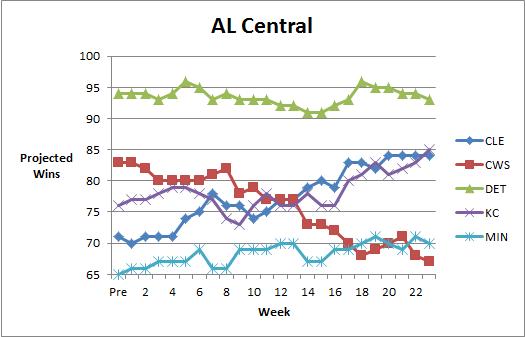
In case you missed it, in April we launched our Dynamic Standings Projection feature on New English D. A full explanation of the methodology can be found here or by clicking the tab at the top of the page. This project seeks to provide a reasoned and cautious approach to updating our beliefs about the baseball future. You can find a summarization of the original projections here. You’ll notice a column on the far right that indicates the difference in projected wins from the preseason prediction. Positive numbers mean teams are now projected to win more games and negative numbers mean a team is now projected to win fewer games. You’ll notice a series of graphs below the standings section that track how the projections have evolved over the course of the year.
This Dynamic Standings Projection is updated through the September 11th games. Note that DSP posts have been moved to Thursday accommodate something that won’t interest you.
| 12-Sep | W | L | PreDiff | |
| BOS | 96 | 66 | 0.593 | 19 |
| TB | 88 | 74 | 0.543 | -3 |
| NYY | 86 | 76 | 0.531 | 1 |
| BAL | 86 | 76 | 0.531 | 4 |
| TOR | 76 | 86 | 0.469 | -11 |
| W | L | PreDiff | ||
| DET | 93 | 69 | 0.574 | -1 |
| KC | 85 | 77 | 0.525 | 9 |
| CLE | 84 | 78 | 0.519 | 13 |
| MIN | 70 | 92 | 0.432 | 5 |
| CWS | 67 | 95 | 0.414 | -16 |
| W | L | PreDiff | ||
| OAK | 93 | 69 | 0.574 | 9 |
| TEX | 91 | 71 | 0.562 | 0 |
| LAA | 78 | 84 | 0.481 | -10 |
| SEA | 72 | 90 | 0.444 | -3 |
| HOU | 56 | 106 | 0.346 | -4 |
| W | L | PreDiff | ||
| ATL | 96 | 66 | 0.593 | 6 |
| WSH | 86 | 76 | 0.531 | -9 |
| PHI | 76 | 86 | 0.469 | -8 |
| NYM | 73 | 89 | 0.451 | -5 |
| MIA | 61 | 101 | 0.377 | -2 |
| W | L | PreDiff | ||
| STL | 94 | 68 | 0.580 | 6 |
| PIT | 93 | 69 | 0.574 | 11 |
| CIN | 92 | 70 | 0.568 | 0 |
| MIL | 71 | 91 | 0.438 | -8 |
| CHC | 69 | 93 | 0.426 | 1 |
| W | L | PreDiff | ||
| LAD | 94 | 68 | 0.580 | 6 |
| ARZ | 82 | 80 | 0.506 | 0 |
| SF | 75 | 87 | 0.463 | -16 |
| SD | 75 | 87 | 0.463 | -3 |
| COL | 73 | 89 | 0.451 | 10 |



How Was The Game? (September 11, 2013)
Another great one from Sanchez.
Tigers 1, White Sox 0 (Magic # = 11)
Anibal Sanchez (26 GS, 165.2 IP, 2.50 ERA, 2.47 FIP, 5.6 WAR) followed Rick Porcello’s lead and gave the Tigers 7.1 great innings of shutout baseball featuring 10 strikeouts and 3 walks as he continued to roll passed AL offenses and into the back end of the Cy Young race with a couple of starts left. The Tigers bats had some chances in this one but it took them 8 innings to push across their first and only run thanks to an Infante RBI single that plated Prince Fielder. Veras, Smyly, and Benoit held serve in the 8th and 9th and the Tigers jumped back up to 6.5 ahead of the Cleveland Indians with Justin Verlander (30 GS, 192.2 IP, 3.64 ERA, 3.49 FIP, 4.1 WAR) getting the ball to start the final homestand on Friday.
The Moment: Infante pushes across the Tigers only run with a single through the left side.
How Was The Game? (September 10, 2013)
Finally a chance for Porcello to finish what he started.
Tigers 9, White Sox 1
After a disappointing game on Monday, the Tigers struck back and struck back hard with a great performance by Rick Porcello (27 GS, 162 IP, 4.56 ERA, 3.72 FIP, 2.5 WAR) and some big hits that capitalized on some horrible White Sox defense. Fielder was on base four times and Avila made it to first five times while eight different Tigers touched home plate en route to the big win than included three errors from Conor Gillaspie and one more from Paul Konerko for good measure. But the story on this night was the man on the mound. Porcello gave the Tigers 9, 1 run innings with one walk and 4 strikeouts while retiring the final 17 he faced as he notched his first career complete game in his 147th career start. It was just the third for the Tigers this year, courtesy of Jim Leyland’s personal vendetta against allowing a starter to pitch the ninth inning. Win number 83 leaves the Tigers 5.5 games up in the AL Central with 17 to play and Anibal Sanchez (25 GS, 158.1 IP, 2.61 ERA, 2.49 FIP, 5.2 WAR) on the mound trying to take the series on Wednesday.
The Moment: Rick Porcello gets a chance to go the distance and doesn’t disappoint.
Who Should Start Game One For The Tigers?
As the season starts to wind down, we continue to think about what comes after. For the Tigers, barring something horrific, they’ll open the postseason five days after their final regular season game in Miami in finished. Which means they’ll be able to choose any starting pitcher they want to start the first game of the ALDS – and therefore have the option to bring him back for game five. Who should that be?
It’s pretty safe to say that Rick Porcello isn’t the guy. Despite New English D’s undying love for the right-hander, we clearly recognize he isn’t the Tigers best starting pitcher and he certainly doesn’t have the kind of stamina that the others can offer. He’s likely heading to the bullpen for the playoff run, but even if he gets a start, he won’t get the most important one.
The other four starters are all elite guys. The worst of the four is 14th in MLB in WAR at 4.0. Twenty teams don’t have a pitcher with a higher WAR than the Tigers 4th best guy this year, so the options are very good. Doug Fister (4.0 WAR, 3.77 ERA, 3.30 FIP) is extremely efficient and gets a ton of ground balls. This could be quite useful in the first and last game of a series because you can usually count on him to work deep into games and get out of jams. I’d feel pretty good about Fister in game one, but considering the other options, he doesn’t really have a strong case. He has the worst K% and ERA of the bunch and the 3rd best FIP.
Anibal Sanchez has an extremely strong case because when you consider performance purely on an inning by inning basis rather than an accumulation of value, he’s been the best starter this year. He leads the team in ERA, FIP, and xFIP. He pitches deep into games and the only concern is the time he missed due to injury which appears behind him given the strong velocity he’s demonstrated lately. Playing the numbers, Sanchez has given the Tigers the best average start this year.
Of course, there’s Max Scherzer who is likely going to carry his very good season and fluky-wonderful W/L record to a Cy Young award. He’s been extremely consistent this year, having just a couple of blowup games. He’s had a lesser year than Sanchez inning for inning, but he’s been pretty close to Sanchez while being a touch more consistent. Max has accumulated more value thanks to more innings, but that’s the kind of thing that counts for awards but not for one game. It’s a tossup as to which has better stuff, Sanchez or Scherzer, based on the day. When Sanchez has all his pitchers working, he’s been better than Max, but Max has had all of his pitches working more often.
But the elephant in the room still lurks. Justin. Verlander. Certainly he doesn’t have the one year credentials of Sanchez or Scherzer and he’s had several more blowup starts than either. But the more you weigh past performance the more Verlander is the obvious choice. Since 2009, he’s been the best pitcher in the game even after a “shaky” 2013. And it isn’t close. The track record is Verlander’s case. And the fact that on his best day, he’s still got the best stuff.
It comes down to how you want to make the call. Sanchez has been the best this year, but Scherzer has been extremely consistent without trading much overall value. Verlander remains the one feared most by other teams because of what he could unleash. We haven’t seen vintage Verlander than much this year, but if you knew you were going to get everyone’s best, he’s the obvious choice.
Two weeks ago, I’d have felt really good about choosing Scherzer. But he’s struggled a bit. It’s probably just some random variation, but it could be fatigue. Or new scouting reports against him. Or just basic regression to the mean. Scherzer is great, but when you have so many good options, you wonder which you should choose. Sanchez has been quietly brilliant this year and seems fully healthy. But there’s still Verlander and he’s the guy who planted the seeds of this season.
Maybe he’s slowing down for good, but it’s hard to believe that when the velocity has been good on many occasions. I’m not sure I trust him the way I used to, but I still trust him a whole lot. It comes down to this for me. If the team the Tigers face leans more to the left, I want Sanchez and his changeup. If it’s a right-leaning team, I’ll take Scherzer. But that’s all up for grabs if Verlander shows me he can be JUSTIN VERLANDER over the final few weeks. It’s hard to leave that club in your bag, even if it has seen better days.
The last couple weeks will determine it, and I’m guessing Leyland will take Scherzer, but I’m open to Verlander and thinking about playing matchups when the time comes.
How Was The Game? (September 9, 2013)
Bad at the start and didn’t get much better.
White Sox 5, Tigers 1
Max Scherzer (29 GS, 194.1 IP, 3.01 ERA, 2.71 FIP, 5.9 WAR) just didn’t have his best stuff tonight, giving up 5 runs in 4 innings in part thanks to some poor defense on his part, but it wouldn’t have mattered too much as the bats couldn’t get it going against the excellent Chris Sale. The story of this one came in the 1st inning when Miguel Cabrera was ejected by the HP umpire after being hit by a pitch. The umpire ruled he swung (which was a borderline call) and didn’t honor Cabrera’s request to check with the first base umpire. Cabrera jawed at him, but not menacingly so and was thrown from the game because the umpire wanted to be on television (probably?). Leyland got his money’s worth and, wouldn’t you know it, Santiago had the same thing happen to him a few innings later! Although he didn’t get ejected. The Tigers will try to get back on track Tuesday against the Sox with Rick Porcello (26 GS, 153 IP, 4.76 ERA, 3.81 FIP, 2.2 WAR) getting the ball.
The Moment: Miguel Cabrera gets ejected for getting hit by a pitch!
Should The Tigers Bring Peralta Back for The Playoffs?

Very shortly, the Tigers are going to have to decide whether or not they’ll bring Jhonny Peralta back for the postseason. We’re three weeks from the end of the season and Peralta will presumably require some time to get himself back into game shape. The conversations are happening now, I would imagine, and we should know in the near future. Let’s assess the arguments for and against.
THE CASE AGAINST
There are two primary arguments against bringing Peralta back for the playoff run. First, Peralta’s skills might have atrophied over the course of the fifty game suspension such that he won’t be able to contribute above what a player like Ramon Santiago could. This is entirely possible, but it would require some sort of evaluation in order to believe. Peralta was crushing the ball before the suspension and there is no reason to think the 2013 season was PED aided, so the case would have to be made that he is out of game shape and the only way that case could be made would be to test him with baseball activities and simulated games. If Peralta was on the DL and not suspended, the Tigers would make every effort to get him ready for October even if he missed the same number of games.
The other argument against Peralta coming back is personal. It’s possible that the team is angry with him and wouldn’t be receptive to his presence in the clubhouse. Other than Scherzer, most of the Tigers kept their heads down about Biogenesis and Scherzer tempered his reaction once the full story on Peralta came to light. On top of that, the word is that Peralta was extremely well liked within the organization. I’m open to the idea that his presence could negatively affect the team, but the reactions to his suspension suggests that won’t be the case. The Tigers are a practical and forgiving organization.
So the case against Peralta hinges on two issues. Can he still contribute and would his presence create a hostile environment? We’ll revisit those questions shortly.
THE CASE FOR
Assuming the Peralta wouldn’t shake up the clubhouse, the case to bring him back is based on how well he can play. Entering the suspension, Peralta had what is still the second highest WAR (what’s WAR?) on the team at 3.6. He hit .305/.361/.461. Among the full time guys, only Cabrera has a higher OBP and SLG. Peralta has also been an above average defender for three years running now, although he is clearly no Iglesias in that regard. His value is predicated on his ability to hit and entering the suspension he was one of the best hitting shortstops in baseball. The league average shortstop hits 15% worse than league average and Peralta hit 25% better in 2013.
The argument isn’t really whether or not Peralta will be better than Iglesias in the postseason, the questions is if he is one of the 14 best position players in the organization. It’s hard to make the case that even after 50 games off he wouldn’t at least be better than Santiago or Tuiasosopo. If you leave Iglesias at short and Dirks in left, you have five bench spots to use. One is for Pena, obviously, and you need at least one backup outfielder, but it’s hard to make the case that there are three other Tigers you’d rather have on your bench.
In reality, he’s probably better than Iglesias, but that is still up for debate considering defense and time off, but he’s certainly better than Santiago, Tui, Kelly, and company. No doubt, no question.
THE VERDICT
So it comes down to this. If the Tigers players view Peralta as a clubhouse cancer, then it’s reasonable to say thanks but no thanks when it’s time to set the playoff roster. But short of that, the Tigers must include him. The Tigers don’t owe it to Peralta – who dug this hole himself – they owe it to everyone else. The players worked too hard and the fans have given too much not to put the best 25 guys on the roster.
It’s perfectly reasonable to say that after this break Peralta won’t be as productive as Iglesias overall, but when the opposing manager brings in a left-handed reliever to face Andy Dirks in the 7th inning of a 2 run game, do you want to go with Tuiasosopo or Jhonny Peralta? In the World Series, when you need to pinch hit for the pitcher, do you want to call on Avila or do you want Jhonny Peralta?
Even a lesser version of Peralta is a better bat off the bench than most of the options the Tigers have. Even if the time off has hurt his skills, it certainly didn’t diminish them to the point that he can’t be a productive postseason pinch hitter. This isn’t a fringe player, this is a guy who was and still is the Tigers second best player in 2013. If you’re going to go all in like the Tigers have for a title, you can’t leave this weapon in the shed.
This isn’t the time to make a stand on morality – a stand the Tigers didn’t make when Miguel Cabrera was arrested during the final weekend of the 2009 season. Peralta will have served his time and the Tigers are lined up for their best chance at a parade since 1984. You have to use him even if you don’t start him. If Iglesias or Infante or Cabrera get hurt in October, surely you would want him then. And you can’t ask him to be ready out of nowhere on October 9th, you have to start now. The practical thing to do is to get him working back into game shape and bring him along as a reserve.
How Was The Game? (September 8, 2013)
The standard Chen-experience.
Royals 5, Tigers 2
Doug Fister (29 GS, 186 IP, 3.77 ERA, 3.31 FIP, 4.0 WAR) did nice work today except for a three batter stretch that would prove decisive in the 5th inning. Gordon reached on an infield hit that Martinez knocked down and then Bonifacio knocked a single to right field to bring Hosmer to the plate with 2 on and 2 out. Fister got behind 2-0 but worked back even before leaving a fastball over the plate that Hosmer belted out to dead center. Aside from that Fister did his job, allowing 5 total runs in 6.1 innings while striking out 4 and walking just one. You don’t get extra credit for bunching up the damage, but Fister looked good other than a very poorly timed mistake pitch. The fault belongs with the offense who couldn’t score against Chen and the ‘pen aside from the Iglesias homerun in the 3rd and the Tigers dropped the series. They’ll pack up and head to Chicago to meetup with the White Sox for three starting Monday behind Max Scherzer (28 GS, 190.1 IP, 2.88 ERA, 2.73 FIP, 5.7 WAR).
The Moment: Iglesias turns on one against Bruce Chen in the 3rd.
 New English D