ESPN Cancels Baseball Today Podcast, No One Wins
On Monday, ESPN completed their journey toward becoming the network with the worst baseball coverage. While the quality had been deteriorating for a long time, it finally went over the edge when the powers that be cancelled ESPN’s Baseball Today podcast and replaced it with ESPN’s Baseball Tonight podcast.
Now the name change might not seem like something getting worked up about if you weren’t a regular listener, but I assure you the entire nature of the program was altered into something perfectly ESPN, which means it is perfectly terrible.
Baseball Today had been “on the air” for the last five years, but existed with its current roster for the last two and a half. The show was hosted by ESPN Fantasy Baseball writer Eric Karabell and co-hosted by ESPN Stats and Info researcher Mark Simon (Monday and Friday) and ESPN senior baseball/prospect analyst Keith Law (Tuesday-Thursday).
The show featured smart, analytical discussions about baseball that covered the entire league (read: not just the Yankees and Red Sox) and embraced sabermetrics and statistical analysis in addition to Law’s scouting chops. It was an excellent program for baseball fans of all stripes because it blended all kinds of baseball discussion ranging from The Ridiculous Question of the Day to analysis of market inefficiencies.
It also helped that the personalities meshed well together and were all genuine fans of the sport. They didn’t grow up as journalists, they grew up loving the sport.
Naturally, ESPN ruined it. My general complaint with ESPN’s sports coverage is that they spend too much energy focusing on uncovering “scoops” through “sources” so that they can bring you sports news first. When it comes time for analysis, they product is pretty awful. For the most part, the people they pay to comment on sports either speak only in clichés or know nothing about the thing about which they are paid to speak.
Does this sound familiar? “Player X just knows how to win. He’s one of the best players in the game, and I tell you what, in (insert league), that’s a really valuable thing.”
That’s pretty much every analyst on ESPN. There are occasional exceptions, but almost all of their coverage is reporting, speculation, and this type of analysis. And it’s just not interesting.
And this is generally what the Baseball Tonight podcast is. Buster Olney is now the host and he has his fellow BBTN colleagues on like Jayson Stark, Tim Kurkjian, and John Kruk. Don’t get me wrong, there is a big difference in buffoonery across that spectrum, but the entire show has become a “scoops” based show. It’s basically just a new forum for Olney to say, “I talked with someone at Yankees camp today and they told me this,” or “A source tells me…”
It’s not analysis, it’s just Olney reporting on stuff he hears. And then he asks people what they think about something and you get the same tired clichés you hear on BBTN.
So the podcast went from interesting analysis like Law breaking down a pitcher’s mechanical problems or Simon providing a very interesting observation about how a player performs against a certain type of pitch in a certain location to more driveling nonsense about contracts and whether or not A-Rod is a distraction.
While my distaste for this type of content is likely clear by now, I think it is important to ask a follow up question. Why did ESPN make this change when they had so much content like this already? Olney has a blog. They have the TV version of BBTN, there are countless other ESPN reporters doing TV spots with the same type of coverage. The Baseball Today podcast was the one place for the baseball fan who actually cared about smart, savvy baseball analysis and they got rid of it.
Mind you, they didn’t just add a new podcast for Olney, they cancelled the old one too. Someone at ESPN decided that it would be a better move for the network to cancel Baseball Today and replace it. I don’t get it.
Why is everyone so obsessed with sports and entertainment “scoops?” Is it so important to know all of this inside information and speculation? What do we gain from Olney having an entire podcast in addition to his writing and TV work to tell us random things people in front offices tell him?
We’d be so much better off hearing from smart people like Karabell, Law, and Simon who talk about interesting aspects of the game.
So I’m upset about this, you can tell. I wanted to write about it to criticize ESPN for being the worst network on Earth, but I also wanted to do it to let the Baseball Today cast know they put on a good show and should still be on the air. We, your listeners, will miss you.
But additionally, I have to share my thoughts about why ESPN made this move. I know they favor scoops and such over analysis, they have for a long time. But I also kind of think this was a subtle statement and punishment from the ESPN bigwigs.
A punishment for what you ask? I think this is a backlash against the Baseball Today crew for going too far into sabermetrics and supporting Trout over Cabrera in the MVP race in 2012. That may seem silly to you, given that a billion network couldn’t possibly care about something so small, but I think they did.
I think they saw their fan base get really upset at people who didn’t buy into the Triple Crown as a narrative in support of Cabrera. ESPN is a hype machine and their baseball podcast was going against the hype. They were a voice for the rational and analytical rather than the good story. I don’t think ESPN liked that at all. I think ESPN thought these guys weren’t company men because they were outside of the ESPN way of thinking, which is to develop inside access and get us scoops, and after that, follow the story we’re selling.
Now I don’t think it was so nefarious in the sense that the people who made this decision actually calculated this all out, but I think it subtlety informed their opinion of the Baseball Today podcast. This was a group of men talking about sports in a way that was very un-ESPN.
And they had to be stopped.
So they were. And Baseball Today is dead. The Bias Cat has been slaughtered for the final time and ESPN has completed its fall.
I listened to the new podcast for a week and probably won’t go back. I might try it out once games start to see if it changes at all, but it’s really mindless news headlines read aloud by ESPN’s top reporter.
And that’s the thing. Olney isn’t a bad reporter at all, it’s that a reporter shouldn’t be hosting a baseball podcast. Those of us who listen to this type of thing do it for commentary, not for news. We want to be entertained during boring points in our day (I listen on the ride home from work and while I’m at the gym). News comes in other fashion and the podcast plays on our iPods hours after its recorded, so we’ve already heard most of what Olney is reporting on through other means.
Maybe, I’m overreacting. Well, I know I am given that this is 1,300 words about a podcast, but I think the point holds up.
ESPN ruined a good thing for no reason. They could have kept the old one and launched the new one. They’re still paying all of the previous contributors to work on other things, so it’s not like this was a cost cutting move. This was a programming choice and a bad one.
Maybe this says more about how I’ve changed than it does about how they’ve changed, but I don’t think it does. Five or six years ago, almost all of my (non-live game) sports content came from ESPN. After the Baseball Today podcast died last week, exactly zero will.
Other than live games that can’t be watched anywhere else, I will not consume any ESPN content or products.
This was the network that changed everything thirty years ago, now it is utterly unwatchable.
How to Prepare for a Fantasy Baseball Draft
Around this time of year, serious and casual fantasy baseball players are getting ready for their preseason drafts. Fantasy sports as a whole are a billion dollar industry and one of the more popular topics of conversation for sports fans young and old. While I’m not a fantasy baseball nut, I’m a baseball fanatic and have a pretty good knowledge of what it takes to win your league.
Here are a few tips to help you prepare for your upcoming draft.
Skim the Rankings
As you’re no doubt aware, every website in the world publishes fantasy baseball rankings and many publish more than one set. I can think of as least ten non-fantasy projection systems that could also be used in a fantasy baseball context. Needless to say, there is a lot of information out there regarding how other people think players are going to perform in a given season.
But don’t pay too much attention to these rankings. For one, there is a lot of uncertainty in predicting a baseball season, so saying a player is going to be number 6 at their position is really like saying that player is most likely to be somewhere between 10th and 2nd. No ranking system, human or computer, can make precise choices for you.
Yet the rankings are great for giving you a sense of how players are most likely to perform. You want to see that the conventional wisdom is that a group of players is expected to be about equal to each other and better than a second group of players.
Use the rankings for broad decision making, but don’t get bogged down in the details, it’s a waste.
Depth Charts
There are a lot of sites that keep depth charts (MLB Depth Charts is my favorite) and you should review them. Playing time is often one of the most overlooked aspects of fantasy baseball. One of the best ways to get ahead from the beginning is to use late round draft picks on players who you think will play more than everyone else does. For example, going into 2012, Andy Dirks looked like he was going to be a part time player. But if you knew better and saw how terrible Young would be in LF defensively and how terrible Boesch would be overall, you would have known that Dirks was a buy low candidate who was going to be a big producer for the Tigers once May rolled around.
This is especially true with relief pitchers and closers. Know the players who are first in line for saves after a team’s closer. Those are great guys to target in the period immediately after a draft and early in the season. If you’re well informed about who is waiting the wings, you’ll be ready to pick them up before your opponents.
Think about Context
On this site and on many other sabermetric sites, we try to provide context neutral analysis. For example, Buster Posey was about as good as Ryan Braun last season on offense if we try to remove context factors like ballpark. However, that is the opposite of what you want to do in fantasy baseball. In real baseball analysis, we talk about how certain players are helped or hurt by ballpark and teammates. In fantasy baseball, you want to use those factors to your advantage.
In real life, Miguel Cabrera gets a lot of RBI because Austin Jackson and Andy Dirks got on base a lot and he shouldn’t get extra credit for driving in a lot of runs because he had a lot of guys on base, but in fantasy baseball you want guys like that. You want to snatch up players who are in ideal environments. Players who play in ballparks that favor their skills or who hit in a good spot in the lineup are good targets. Think about the defense behind your pitchers.
All of these context factors can help you win. Don’t pay big for Buster Posey because he’s awesome, avoid him because most people perceive him to be the best catcher in baseball even if it doesn’t translate to fantasy baseball style numbers because he plays at AT&T Park.
Have a Plan for Injuries
The best advice I can give you is to be ready for injuries. They are a simple fact of life for the fantasy sports player, but you can be ready for them. Never leave yourself without options. On the pitching side of things, this doesn’t matter much because you’re going to have many players who play the same position, but on offense, it does.
After you fill in your starting lineup, grab players who fill in according to how much it would hurt to lose your starter at that position. Grab a fourth outfielder right away because that one player can back up three spots. Try to pick up a player with multiple eligibility to back up on the corners or catcher like Mike Napoli. You don’t want to have your best player get hurt in April and have to fill that spot from the waiver wire. What you want to do is fill the void with a bench bat and have waiver player fill in on your bench.
Have a Plan, Period
The best way to have a good draft is to know what you’re going to do and know which players you like. If you get to the draft room and you’re picking first, be ready for that. Same for if you’re in the middle or if you’re at the end. Know how you want to draft based on your position. Are you going for the best player available no matter what or do you like to have a position based strategy? Do you want to grab two elite players at the same position and use them as trade bait later? Know the kind of player you are and be ready for it.
Information
Finally, the best thing you can do is know more about baseball than everyone else in the room. It may sound simple, but it will help. For example, if you know which top prospects are going to see a lot of playing time in 2013 and your opponents don’t, you have big advantage. Imagine if you had drafter Trout last year in the 14th round when most of your buddies were looking to grab him at the very end.
Any time you can know more about a player or a team, do it.
In general, prepare for your draft by being informed widely without focusing too much on fantasy baseball coverage itself. You win your league by drafting players who will over perform the expectations of the group either by playing better or by playing more than everyone else thought. Be ready for contingencies and good luck.
Feel free to post questions in the comments section unless you’re in my league, in which case, I recommend drafting Justin Masterson.
The Nine Best Third Basemen for 2013
Over the last number of Saturdays we have released our lists of The Nine best players at each position and this Saturday will be no different. Today, we unveil our list of the cream of the crop at the hot corner.
This list was actually quite easy compared to some of the others because there were seven obvious choices, leaving just two spots up for grabs. The order in the middle of the list is a bit fluid in my opinion, so don’t take it too seriously if you’re upset that your favorite player is sixth instead of fifth.
Third base is very good at the top, decent in the middle, but really falls off once we get passed the just missed portion of the list.
Apologies to: David Freese, Kyle Seager, Pedro Alvarez, Todd Frazier, Jeff Keppinger, and Pablo Sandoval.
9. Mike Moustakas (Royals)
Moustakas enters his age 24 season in 2013 and has shown himself to be a very good defensive player who can hit for power. His average could be higher, but it’s not terrible for such a young player. His key flaw is relatively weak plate discipline, but I expect that to improve to some degree as he ages. Moustakas is a former top prospect who could really make a leap this season and is coming off of a 3.5 WAR season in 2012, which was, you guessed it, 9th best in all of baseball.
8. Brett Lawrie (Blue Jays)
Lawrie was off the charts incredible in his 43 games stint in the big leagues in 2011, but took a bit of a step back in an injury shortened 2012. Lawrie was a good player last year, but he wasn’t a great player. I think he can be a great player this season given that he’s shown all of the necessary tools – power, speed, defense – at some point in the last eighteen months and is only 23 years old. If he plays like he did in 2011, he’ll be in the top three on this list, but even just a little better than his performance from 2012 should put him right about here on the list.
7. Aramis Ramirez (Brewers)
Even if you don’t believe that Ramirez improved his defense last season, a .300/.360/.540 slash line is impossible to ignore. He’s put together a couple of really nice seasons in 2011 and 2012 after a two year stretch where it looked like his once promising career would be over. He’s the oldest one on this list – already 34 – but he should have a place on it for at least one more season.
6. Ryan Zimmerman (Nationals)
When Ryan Zimmerman is healthy, he is an excellent baseball player. In seven major league seasons, he’s played a full season five times posting between a 4.4 and 7.5 WAR. In his two injury shortened years, he’s been a 2.5 WAR player. He played phenomenal defense early in his career but the injuries might be slowing that down, but injuries haven’t slowed his plate discipline and power. A fully healthy 28 year old Zimmerman could have an MVP type season, but he sits at sixth on this list because it’s getting difficult to believe he’ll be healthy all season.
5. Chase Headley (Padres)
Chase Headley is four seasons into his big league career and has seemingly improved his average and power over the last couple seasons. He is a switch hitter with good plate discipline while playing solid defense at third. The homerun numbers shot up in 2012 and with the fences coming in at Petco, he might have a shot to do it again. If last year didn’t happen, Headley would near the bottom of the list, but it did. I don’t want to put too much weight on one amazing season, but we also can’t ignore it.
4. David Wright (Mets)
Wright has an excellent season in 2012 and has had other excellent seasons in his career. My only concern with Wright is that in the three seasons prior to 2012, his defensive numbers were much worse that they were last season. I’m not sure Wright is a 7 WAR player going forward for that reason and imagine him more as a 5 WAR player for 2013. There’s nothing wrong with David Wright, but there is even less wrong with the next three on this list.
3. Adrian Beltre (Rangers)
Beltre is a great defender and hits for power in a big way. His only wart is that he doesn’t walk nearly enough. He’ll be 34 this season, but three of his best four seasons have come beyond thirty, so I’m not too worried about him falling off out of nowhere. If you want a slugger who can play defense, Beltre is a good way to go.
2. Evan Longoria (Rays)
Longoria’s career WAR/600 PA is 6.5. The only negative thing you can say about Longoria is that he’s only played two full seasons, two other seasons of 120-135 games, and one half season. He’s an elite defender who hits for power and has a great eye at the plate. Oh, and he’s 27. So there’s prime left in his career and has signed two of the most team friendly deals in MLB history. If you can’t tell, I’m a big fan of what he does.
1. Miguel Cabrera (Tigers)
If offense was the only thing that mattered here, Cabrera would be the only one near the top of this list. He’s easily the top offensive third baseman in baseball and has been remarkably consistent entering his age 30 season. On defense, he’s no star, but he proved last year he could handle the position well enough to make it work. His best three seasons have been his last three and boasts a career line of .318/.395/.561. That’s probably all that needs to be said.
Sound off in the comments section or to call into your local sports talk radio station and scream at them. Not about this list, but just in general.
2013 Preseason Standings Projection
Predicting an entire season’s worth of baseball games accurately – that is 2,430 baseball games – is essentially impossible. We can make guesses, run computer simulations, watch spring training, and analyze offseason activity all we want, but the amount of uncertainty, randomness, and divine intervention is so great that you’re lucky to even get the order right in each division.
But we try because something about us makes us hungry from prediction. We want to know what is going to happen and we want to get angry about it and debate it and tell each other we’re terrible people because we disagree on how many wins the Orioles will have. It might be a terrible thing about humanity or it might be one of our endearing quirks. I’ll leave that up to you.
So without further delay, here is the official SABR Toothed Tigers Preseason Standings Projection. The methodology is simple. This is what I think based what I’ve read and seen about each team and it is informed at the margins by various statistical models of prediction.
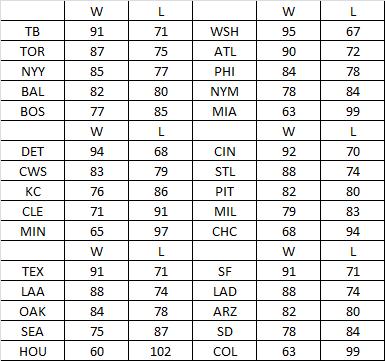
These standings should not come as any surprise to those who have read our Power Rankings series this week, but there are some interesting deviations worth looking into.
Throughout the offseason I listed “Early 2013 Projections” with the Season in Review series and these are updated based on trades, signings, injuries, and a little adjustment because I originally had ten too many wins. I’ll have a post next month that predicts a postseason based on these standings and I’ll keep tabs on these projections throughout the season so we can see how well STT does. Feel free to sound off in the comments sections about what you believe to be the particular strengths and weaknesses of this projection.
2013 Preseason Power Rankings: 10-1
Over the last two days, SABR Toothed Tigers has released our 2013 MLB Preseason Power Rankings 30-21 and 20-11. Today, we complete the series and take you all the way through number one.
Remember, this list is designed to represent the expected performance of each team in 2013, but not necessarily the win totals of each team. For example, I project the Red Sox to be a better team than the Pirates but I expect the Pirates to win more games as a function of their league, division, and better relationship with an almighty deity than the team from Boston. Check back tomorrow for my Preseason Standings Prediction.
10. St. Louis Cardinals
The Cardinals are a very deep team with talent at about every position. The middle infield is a bit iffy going forward but those are two of the less important offensive positions and the rest of their lineup more than makes up for it. The rotation is a good mix of veterans and talented youngsters and the bullpen has a lot of exciting pieces. Nothing about the Cardinals makes me say “wow!” but everything about them makes me think they’re a very good team. I also can’t ignore the incredible comebacks/magic/voodoo/etc of the last two seasons. It’s usually not right to expect weird things to keep happening like that, but I’m not really looking to tempt fate.
9. Los Angeles Angels
The Angels are an interesting team because I can talk myself into a lot of different places on this list for them. Probably more so than any other team expect the Dodgers. They added Josh Hamilton, but lost Torii Hunter who was worth more than Hamilton in 2012. They’ll have an everyday role for Peter Bourjos who is among the very best defensive players walking the Earth and Albert Pujols likely won’t struggle as much as he did last April in any month of 2013. In just looking at the offense and defense, I would imagine the Angels should be about as good in 2013 as they were in 2012. But the pitching looks a lot worse. Jered Weaver should be the same as always and CJ Wilson likely won’t improve upon his 2012 numbers because he simply isn’t that good. After them, instead of Greinke or Haren, you have Joe Blanton, Tommy Hanson, and stuff. This rotation is pretty good if you want to win 80 games, but I think it’s awful if you want to win 95 like the Angels do. This team has the best player in the league (Trout), the best player of his era (Pujols), and a player with an impossibly high ceiling (Hamilton), but I just can’t bring myself to bet any higher on them with such a suspect pitching staff.
8. Toronto Blue Jays
The Blue Jays did excellent work this offseason adding Melky Cabrera, Jose Reyes, Josh Johnson, Mark Buehrle, RA Dickey, and others. They are a much better team than they were in 2012 and could also get a full season from Jose Bautista. Even with expected regression from Edwin Encarnacion, this should be a team that scores runs and pitches well. I think they’ll be right in the thick of the AL East race and should also contend for a wild card. My reservations about placing them higher deal with a lot of injury question marks. Bautista is recovering from a wrist injury and hand and wrist injuries tend to have a negative effect on power. I’m not saying he’ll have a down season, but I think it’s more likely than it was before he got hurt. Additionally, while I think Josh Johnson is fantastic, he is also very fragile. Who knows what Melky Cabrera can do without the help of PEDs? Brandon Morrow missed significant time last season. Something was obviously wrong with Ricky Romero, right? So while on paper this is a talented team with a great chance at October baseball, there are concerns large enough to keep them at number eight.
7. San Francisco Giants
The Giants return an excellent pitching staff and good defensive club. A full season of Scutaro and Pence should be a marginal improvement, but losing the great “wind-aided” performance of Melky Cabrera will hurt with no clear replacement lined up. If Pablo Sandoval is healthy and Brandon Belt is allowed to do his thing without interference from a silly manager, this team should be on par with last year’s division winning club. It’s a good bullpen and the park tends to work in favor of the team’s design, so I’m willing to bet the Buster Posey led Giants are making another deep run into the postseason.
6. Cincinnati Reds
The Reds should have no trouble winning the NL Central if they are able to remain as healthy as their counterparts. They have the amazing Joey Votto at first and an average to above average player pretty much everywhere. They rotation remained perfectly intact last year and Aroldis Chapman is coming to help them out even more in 2013. With the addition of Choo, the maturing of Cozart and Fraizer, and the continued success of Bruce and Phillips, I can’t really see a glaring whole other than defense in centerfield. This is an all-around good club.
5. Texas Rangers
A lot of people are down on the 2013 Rangers because they didn’t sign or trade for any of their big offseason targets, but I think that means they’re very underrated. If we look at the 2012 Rangers as a pretty true 93 win club who had a bad week at the end, when we compare them to the 2013 version, they hold up great. The pitching should be essentially the same with perhaps a better performance by the adapting Darvish. On offense, they dropped Michael Young’s negative WAR at DH for Lance Berkman and will return everyone else except Josh Hamilton and Mike Napoli. Top prospects Jurickson Profar and Mike Olt can easily combine with Craig Gentry and Leonys Martin to approximate the ~4WAR season of Josh Hamilton and AJ Pierzynski steps in to replace Napoli who had a down year on a team that won 93 games. While it can be said that the Rangers missed out on getting a lot better, they also failed to really get worse. This is the overlooked team of the year if you’re into making those types of wagers.
4. Atlanta Braves
The Braves added a lot this offseason (see: Uptons, all) but they also lost a good amount in Chipper Jones and Martin Prado. I like Andrelton Simmons and Freddie Freeman to breakout in compliment with Jason Heyward and the Upton brothers. The starting pitching is deep and the bullpen is second to none. The Braves aren’t the most exciting team in the league to me, but I think they have the highest floor. It’s hard for me to imagine them having much worse than an upper 80s win season.
3. Tampa Bay Rays
I’m higher on the Rays than most because I’ve seen them over-perform too many times not to believe. Their starting pitching is in the top five and their bullpen always works. They’ve added Kelly Johnson and Yunel Escobar on offense and are hoping for a full season of Evan Longoria to go with the soon to be called up Wil Myers. Top to bottom, the Rays are probably in the 6-10 range as far as talent goes, but they are so well run from top to bottom, that they will get more out of that talent than the other teams on this list.
2. Detroit Tigers
The 2012 Tigers underperformed and won 88 games. In 2013, they will add Victor Martinez and Torii Hunter and a full season of Omar Infante and Anibal Sanchez. They lost nothing of substance from the roster should get at least modest bounce back seasons from Jhonny Peralta and Alex Avila. That is all by way of saying, it’s hard to see how they aren’t one of the surest bets in the league for 2013. 90 wins should be safe and 95-100 is a real possibility given the level of competition they face. They own baseball’s best rotation 1-5 and their only weaknesses are infield defense questions and bullpen uncertainty. And almost everyone has bullpen uncertainty so I can’t really hold that against them. Looking at the Tigers on paper, it’s hard to see how the defending AL champs won’t get a shot to play in October once more.
1. Washington Nationals
The Nationals earn this spot through logic similar to that which put the Tigers at number two. They added Denard Span, Rafael Soriano, and Dan Haren and lost only Edwin Jackson. With an unlimited Stephen Strasburg and a more experienced Bryce Harper, there isn’t an argument to be made that the Nats got worse for 2013. Granted, any team can collapse and underperform, but there is no reason to think the Nationals are any more likely to do so than any other team on this list. If the Nationals stay as healthy as their competitors in 2013, they should once again be baseball’s best team.
Tell us what you thought of the 2013 Preseason Power Rankings series in the comments, on Twitter, on Facebook, or via the United States Postal Service. Check back tomorrow for STT’s projected standings.
2013 Preseason Power Rankings: 20-11
Yesterday I gave you the bottom third of my 2013 Preseason Rankings and today I present you with the middle third. Remember, this is how I view the quality of each team for 2013 and not how many wins I believe each team will accumulated. For example, I have the #21 Pirates winning more games than the team ahead of them because I expect them to have an easier time in their own division and think they’ll benefit from more good fortune as well.
20. Boston Red Sox
It’s been a rough 18 months for the Red Sox, but they enter 2013 without the weight of big contracts or expectations. They shed payroll thanks to the big spending Dodgers and made smaller commitments to free agents this offseason like Shane Victorino, Mike Napoli, Stephen Drew, David Ross, Johnny Gomes, and Ryan Dempster. The Sox have a pitching staff that should bounce back to some degree in 2013 and adding Joel Hanrahan should thicken up the back end of the pen. I think the Sox will be respectable this season, but I couldn’t make a case for them in the top half of the teams in the league and felt more comfortable calling them the 20th best team for 2013.
19. Milwaukee Brewers
The Brewers are a pretty good offensive team led by Ryan Braun and Aramis Ramirez, but their pitching is somewhat suspect. Without any serious moves to improve their rotation or bullpen, I couldn’t do much to move them up this list. Expect the Crew to hit well, but I can’t see them preventing enough runs to make a postseason run.
18. New York Mets
I think the Mets are one elite outfielder and one pretty good outfielder away from being a legitimate playoff contender. They have a franchise player in David Wright and some nice supporting pieces on offense, but that usually won’t be enough to knock on the door of 90 wins. I’m a huge fan of the Mets rotation, even without Dickey in 2013 and think the bullpen should be better than it was a season ago. I don’t think this is the year for the Mets, but I also think they are a lot better than people think.
17. Baltimore Orioles
The Orioles had a great 2012 season, but that greatness came on the backs of a lot of good fortune. I find it hard to believe they’ll be as lucky in extra inning and one run games again in 2013 and they also didn’t make any upgrades to the roster. A full season of Manny Machado will help and Dylan Bundy may get a chance to make an impact, but I’m expecting a low to mid 80s win total rather than a mid 90s one.
16. Chicago White Sox
The White Sox are just a really average team. They have some frontline arms, but not much depth in the rotation or the pen for my taste. A lot of their bats have breakout potential, but they’re also very inconsistent. We saw last season, with much of the same roster, that a team like this can have a few good months, but they almost never hold up over a full season. This is an 80-85 win team in its purest form.
15. Arizona Diamondbacks
The Dbacks made a lot of moves this offseason. They dealt Justin Upton, Chris Young, and Trevor Bauer, but got back Martin Prado, and many prospects and depth pieces. I think their pitching depth is phenomenal, but I think their top tier is lacking. On offense they have a lot of players I really like, but also have holes and question marks. This is a pretty good team and their ranking is more a function of how I feel about other teams than how I feel about them. While I told you I couldn’t put the Red Sox higher than 15th, I should probably say I can’t imagine putting the Dbacks any lower than this.
14. Oakland Athletics
Oakland is going to need some good luck to get back to 94 wins this season, but Billy Beane and they A’s had a nice offseason. They added some low cost high upside pieces that I think will pay off, but if last year’s formula is going to work, a lot of players are going to have to repeat career best type performances. I’m not sure they can do that, but I’d look for them to remain relevant into September.
13. Philadelphia Phillies
The Phillies have an incredible top three in their rotation and one of baseball’s best relievers anchoring their pen. They also have a great middle infield and an up and coming centerfielder. I worry deeply about everything else. They are a mess in the corners and their catcher is out for the first twenty five games of the season. This team has the ability to be very good, but I think their floor is also pretty low as well. I like them enough to put them in the top 13, but they could easily fall back if some of their gambles start to turn sour quickly.
12. New York Yankees
The Yankees are aging, but they’re still a talented team even if they aren’t the best team in the league anymore. The top of the rotation is good, but it lacks depth and offensive side is deep even if their star power is waning. A playoff berth wouldn’t surprise me for the Yanks, but I think they’ll be just on the outside this year.
11. Los Angeles Dodgers
They spent a ton of money via free agency and trades, but I’m still not sold on the Dodgers as a great team. They’re weak at 3B, 2B and potentially in the corner outfield spots depending on health. They have an excellent top two in the rotation, but I don’t love it south of there. The Dodgers are a good team, but paying Crawford and Gonzalez $40 million a season doesn’t scream playoff berth. You know how I know that? The Red Sox have already tried it twice.
Check back tomorrow for spots 10-1.
2013 Preseason Power Rankings: 30-21
Spring Training begins this week in Florida and Arizona as all thirty MLB teams do their best to prepare themselves for another season. That preparation will be critical to their respective successes and failures, but before anyone gets hurt or anyone has a breakout season, this is how SABR Toothed Tigers thinks the league stacks up.
30. Houston Astros
There isn’t a whole lot to say about the Astros other than that they are a very bad team. The new front office has worked well over the last year to restock the farm system and get them on a path to rebuilding but that has come at the expense of the clubs won-loss record for 2013. The Opening Day payroll will be south of $30 million and the Astros could easily lose another 100 games. The future looks much better for the Astros, but the now is just terrible.
29. Miami Marlins
Entering the 2012 season the Marlins had a new stadium and a revamped club. The ownership committed to higher payrolls and more competitive clubs, but after a rocky start to the season, the Marlins began selling off pieces and completed the process with a full on fire sale in the offseason. Almost nothing remains. The Marlins ownership didn’t like the less than stellar attendance and they decided they weren’t going to pay for a team that didn’t sell tickets. The 2013 Marlins are Giancarlo Stanton and players who are either too young to make any money or two broken to get other offers.
28. Colorado Rockies
Last season was a disaster for the Rockies. They lost Tulowitzki for most of the season and their pitching staff was terrible. A healthy Tulo will help the team and the offense should be okay, but the pitching staff isn’t much of anything. They didn’t do anything to improve the club during the offseason and the return of Tulowitzki can only do so much. With other teams in the NL West adding to their arsenals, the Rockies won’t find room to improve.
27. Minnesota Twins
The Twins pursued two offseason strategies this winter. First, they traded all of their centerfielders. Span to the Nationals and Revere to the Phillies. Second, they signed every pitcher they could find that is coming off an injury hoping for the best. On the face of it, those moves won’t do much for the 2013 team, which could easily lose 95 or more games, but these moves have helped stock an already interesting farm system. The Twins are a couple years away from getting back into things, but they have enough pieces that we shouldn’t expect them to be terrible in an unwatchable sort of way.
26. Cleveland Indians
The Tribe added Nick Swisher and others in free agency and picked up Drew Stubbs and Trevor Bauer via trade during the offseason to plug up holes in their team, but their main issue is starting pitching and they didn’t do enough to turn themselves into contenders. The Indians have some exciting young position players, but when you’re counting on Swisher to be your top offensive player you’re probably too short on offense and when Justin Masterson is your ace, you’re definitely short on pitching. Editors Note: This ranking was determined as of Saturday Feb. 9th, prior to the beginning of Spring Training. The signing of Michael Bourn is not reflected here.
25. Chicago Cubs
The Cubs are moving in the right direction with Theo Epstein and Jed Hoyer now at the helm and I like their starting pitching for 2013 and beyond. The offense isn’t much to look at and the bullpen isn’t really anything. If you’re hoping for an end to the curse, you should probably shift your hopes until next season.
24. Seattle Mariners
The Mariners have Felix Hernandez and a lot of young starting pitching coming, but 2013 won’t be their year. They tried to improve their lineup with a bunch of broken pieces, but it’s going to be a rough offensive season even with shorter fences at Safeco. This is a team that can prevent runs but not one that can score them.
23. Kansas City Royals
The Royals place on this list might seem low, but there are still a lot of problems with this team despite adding James Shields. They probably added a few wins with pitching upgrades, but the offense didn’t improve much other than counting on bounce back seasons. The Royals will probably have more wins than other teams ahead of them on this list, but that will be a function of playing two teams on this list ranked 26th or lower 19 times each. The Royals probably won’t be embarrassing, but I don’t think they’ll be good either.
22. San Diego Padres
The Padres have some good young players in their system and the fences are coming in at Petco Park, but they didn’t do much to improve their team. In a tough division, it’s hard to see them being much better than they were in 2012 especially with their starting catcher spending 50 games on suspension for PED use.
21. Pittsburgh Pirates
In my 2012 Season in Review series I told you I thought the Pirates would finally break the under .500 curse and turn into a winning team for the first time in two decades, but I’ve been talking myself out of it ever since. I think they might still win over 81 games this year, but I think that will be a function of luck and timing rather than true talent. I think the Pirates are the 21st best MLB team, but they might still finish with a record above average.
Come back tomorrow and Thursday for 2013 Preseason Power Rankings 20-11 and 10-1.ets.
What Pitchers and Catchers Means

There is a moment that comes right before the climax. One that precedes the grand finale. It arrives just before the moment everyone is waiting for, and while you don’t often expect to be so moved by it, it usually sticks in your mind.
When you picture your wedding day, you’re likely imagining the vows or the first kiss, maybe the first dance or when the doors close on the honeymoon suite. But, I’m here to tell you, the moment you’ll remember most is the one just before all of that. When the chapel doors open and you see the bride (or groom) for the first time that day; that’s the moment you’ll remember most.
The moment when you turn in your last high school exam is better than the one when you walk across the stage.
That moment is the day pitchers and catcher report for Spring Training. You’ve been dying for baseball season and the first pitch of Opening Day, but when pitchers and catchers report for Spring Training, that’s the chapel doors and the final exam. It’s the moment before the moment.
It’s the last crack of thunder before the storm breaks. The drive to the office before your big interview. The opening credits of the summer blockbuster.
That, is Pitchers and Catchers.
You haven’t been waiting for this moment in particular, but this moment is the one that tells you the big one is coming.
So as the planes land in Florida and Arizona and players unpack their belongings over the next few days, we’re all arriving at the moment before the moment. Our long offseason journey is nearly over. It’s not over, but almost.
We’ve made it, fellow baseball fans, to the first step in recovering from the long terrible winter. Baseball is almost back. The first day of the rest of your life is today.
Happy Pitchers and Catchers, everyone. We missed you, baseball.
King Felix Cashes In, Justin Verlander Comes Next
Felix Hernandez is a starting pitcher for the Seattle Mariners baseball club. He is now, also, the owner of the largest contract every given to a starting pitcher. The details of the deal are 7 years, $175 million. This contract will replace the final two years of his current deal and will carry through the 2019 season, paying out at $25 million per season.
So while this is the biggest contract in history for a pitcher, it absolutely should be. He’s one of the best four or five pitchers in the league and is entering his age 27 season. If every pitcher signed a one year deal before 2013, Felix would certainly be among the top handful by dollar amount and his relative youth compared to most free agent starting pitchers means a seven year commitment doesn’t take you very far into his decline years, as does a contract that a player signs at 30 or 31.
Felix is among the game’s best and most durable starting pitchers, having never been on the DL and throwing over 230 IP in each of the last four season to go along with four straight 5+WAR seasons. The Mariners want him anchoring their rotation for years to come.
Any big contract for a pitcher is a risk, but if you’re going to offer them, you want the deal to be going to a player on the right side of thirty with no injury history and a consistent and high level of performance. Felix meets all of those criteria and is the unquestioned face of the Mariners. This is the deal you sign when all of those things are going in your favor.
Let’s ponder briefly what this means for Justin Verlander who is on the same free agent clock. Verlander is three years older, but has been better over the last four seasons than Felix and has been no less durable. It’s probably safe to say that Felix and JV are the too safest bets as far as durability and sustained performance are concerned.
Verlander’s age will be a factor, but he also plays for a higher spending club and is at least marginally better than Felix. He will also sign his deal after Felix and could do so a year closer to free agency or while on the free agent market. Even if you think Felix is a better bet from a cost benefit standpoint over the next seven seasons, Verlander is the type of player who will attract more money because he’s a more dynamic and recognizable player and his ceiling is likely higher in the opinion of most baseball people.
Both players are Hall of Fame caliber players if they maintain their career paths and if the Tigers want to make JV a Tiger for life or some other team wants to pry him from the Tigers hands, it’s going to take a lot of cash.
Right or wrong, he’ll end up with more than Felix. Here are my estimates:
Signs before Opening Day 2013: 8 years, $210 million
Signs before Opening Day 2014: 7 years, $210 million
Signs as Free Agent after 2014 season: 6 years, $200 million.
As it appears, I’m confident that barring a serious injury, Verlander will be baseball’s first $200 million arm.
 New English D