Victor Martinez Returns Despite Never Leaving
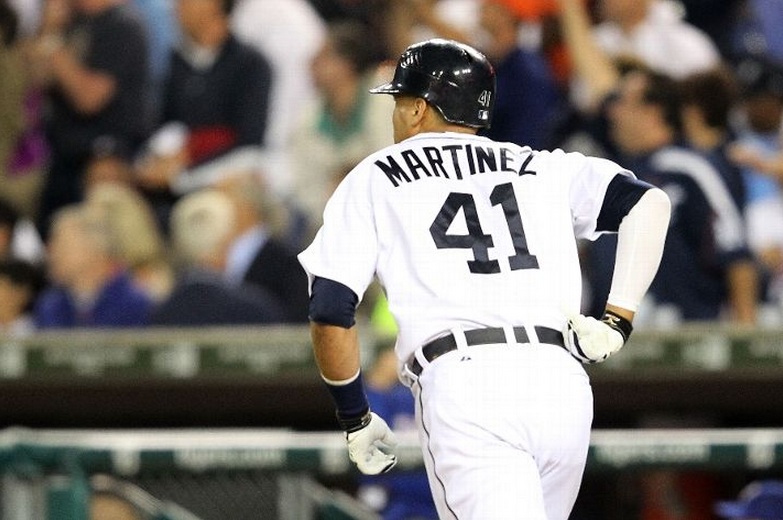
Victor Martinez’s early season statistics weren’t good. Most were pretty bad. He wasn’t getting on base, he wasn’t hitting for power, and because he plays a position that doesn’t utilize a glove, he wasn’t adding value on defense in the way Andy Dirks has done during his own offensive struggles.
But seemingly all of a sudden, Martinez is crushing the baseball. In the last 30 days, Martinez has a very respectable 112 wRC+ (what’s wRC+?). In the last 14 days he has a 170 wRC+. In the last 7 days, it’s 209. That is what the average person would describe as a trend, or perhaps a hot streak. Regardless of the cause or the sustainability of this performance, anyone can look at his numbers and recognize that Martinez’s performance is getting better.
I wrote earlier this year that Victor Martinez was having a particularly extreme case of terrible luck on hard hit balls. He was among the top handful of players in the game at making hard contact, but his batting average and power numbers didn’t reflect that. In fact, he was the only one near the top of the list who wasn’t hitting well above league average.
It made no logical sense that Martinez would make so much hard contact and not reap the rewards. It wasn’t really happening to any other hitter and it doesn’t really happen all that often in general. Hard contact is very highly correlated, and likely the cause of success in the batter’s box. But it wasn’t happening for Martinez?
Why?
The answer is actually so simple that it’s hard to grasp. Nothing was happening. Victor Martinez was doing nothing wrong. He wasn’t chasing bad pitches, he wasn’t hitting a dramatic number of popups or anything. Victor Martinez was the victim, if you can call it that, of something we statisticians call random variation.
Think of it this way. If a player’s true talent level is a .300 batting average, that means that over the course of the season, he’ll get 3 hits for every 10 at bats. But it doesn’t mean that he’ll get 3 hits in EVERY 10 at bats (that would mean performance uniformly distributed). Sometimes he’ll get 2, sometimes he’ll get 4. Sometimes he’ll get 8 and sometimes he’ll go 0 for 15.
Statistics are excellent and wonderful and we love to use them to measure things, but they have to be used properly. You have to understand what they mean. When Martinez was hitting .210, it meant to date he had gotten about 2 hits in every 10, but it didn’t mean that was his true talent level. He’s a .300 hitter in his career, this window was just a low point. A period of “bad luck” if you want to call it that.
Random variation means, in a simple sense and nontechnical sense, that the smaller a sample you look at the higher the likelihood is that you’re observing something that doesn’t reflect reality. Miguel Cabrera gets a hit around 33% of the time in his career, but if you look at any 3 at bats, you’re likely to see him have 0, 2, or 3 hits. That’s how sample size works.
This relates to Martinez because the underlying information about Martinez went unchanged during the slump. He wasn’t chasing pitches and he was making hard contact. The walk and strikeout rate looked fine. Good swings were turning into outs way more frequently than they usually do for him or for anyone.
And then all of a sudden it stopped. Somewhere in the last four to five weeks, Martinez just started getting those swings to turn into hits and he’s climbed all the way up to a .254/.311/.367 line after a .221/.290/.274 line in April. He’s not a different player, he’s just getting his hits to drop now and he wasn’t then. He’s taken two and half months of bad stats and is slowly erasing them.
His numbers were awful. Now they are amazing. Only two things can be responsible for that. One is a change in skill, health, or approach – none of which are evident. The other is a change in fortune – which appears likely. Victor Martinez is the poster child for a concept called “regression to the mean.”
Regression to the mean is an idea that suggests, in baseball, that when a player does something much better or worse than his previous career average it’s likely that he’s going to regress toward the previous average more often than he moves further into the extremes. You can think of regression to the mean as the correction in random variation over large samples.
In a small sample, anything can happen, but if you give something enough time, it will show its true colors. I’m boiling down a complex statistical concept, so well-versed statisticians shouldn’t analyze the wording too literally, but the amazing tear Martinez is on is essentially like the universe balancing out the really unlucky stretch he had.
It really is that simple. Take a look at his monthly performance:
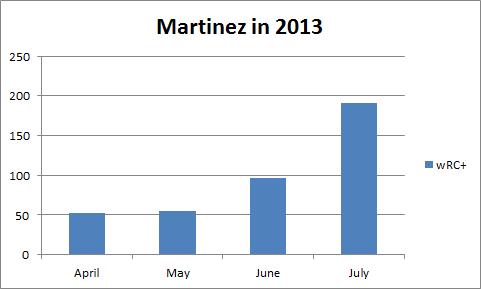
It’s getting much better, sure. But there is something in the batted ball data I want you to see. This is a bit cluttered, but take a look.
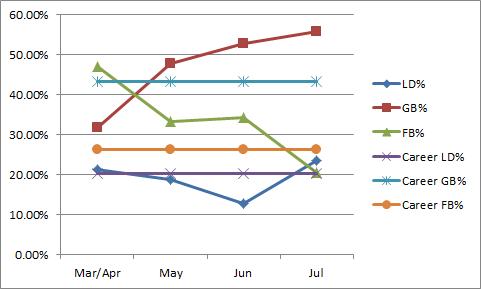
He was hitting fewer groundballs than normal in April, and now he is hitting more to compensate. He was hitting fewer than normal line drives for the first three months, now his is hitting more. He was hitting way more flyballs that normal to start the year, now he’s hitting fewer. Everything is correcting itself. It’s not that he is now hitting like the career averages he set for himself, it’s that he’s now playing at the other extreme to balance out what happened before. The process for Martinez was good, but the results we all out of whack. Now the process is the same and the results are good.
This is a simple case of regression to the mean. There wasn’t anything wrong with Martinez that time couldn’t fix. The Tigers did just fine while he was “struggling” and now they’re getting the hot-hitting version of him as the race gets going.
In general, this should be a lesson to you that surface statistics can be deceiving. If you thought Martinez was a good hitter entering the season, you shouldn’t change your opinion so quickly when he has a low batting average for six or eight weeks. Almost always, unless a player is hurt (he never looked hurt), he will regress to the mean. He may not ever have the season he had in 2011, as that was likely his career year as a hitter, but he will look very much the player you expected. He’s been a 120 or so wRC+ hitter for most of his career and there is no reason not to expect something around 110 now that he is entering the downswing of his career.
Enjoy Victor’s hitting streak and power explosion now because you certainly earned it while he wasn’t getting hits. It’s often hard to take a step back and see the world with a wide angle lens, but it’s something we should do a lot more often.
How Was The Game? (July 10, 2013)

A nice response.
Tigers 8, White Sox 5
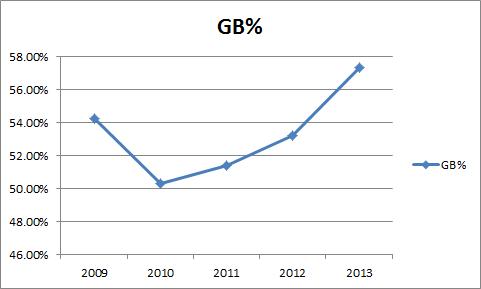
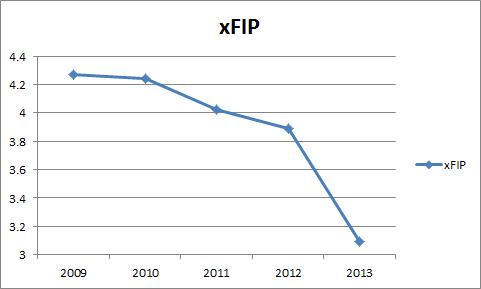
After Tuesday’s disastrous final two innings, the Tigers put together a much better game on all fronts. They got a solid outing from Rick Porcello (6-6, 99.1 IP, 4.80 ERA, 3.53 FIP, 1.8 WAR) who allowed 3 runs in 6 innings while striking out six batters and walking none to make his season long transformation look even better by the numbers we’ve been tracking here at New English D. Here’s currently 7th among MLB starters in xFIP (learn about xFIP) and is joined only by Felix Hernandez and John Lackey as starters with more than 7 K/9, fewer than 2 BB/9 and a GB% higher than 50%.:

But it wasn’t just Porcello who carried the Tigers. They also got tons of production from the middle of the order as Jackson, Hunter, Cabrera, Fielder, and Martinez all had multi hit games that helped the Tigers score in 4 separate innings. It was an all-around solid attack save for an iffy inning from Rondon who somehow managed to produce an inning with a K, BB, 1B, 2B, HR, GO (2), and WP (2). That’s almost everything that can happen!
Rondon’s inning wouldn’t be too costly as he held the Sox to two runs and Drew Smyly came in for the 8th inning and made very quick work of the three batters he faced, giving way to Benoit who handled the 9th. It was a nice game all-around and gives the Tigers their 50th win and a shot to take the series behind Anibal Sanchez (7-5, 86.2 IP, 2.70 ERA, 2.11 FIP, 3.4 WAR) on Thursday afternoon.
The Moment: Porcello freezes Gillaspie on a curveball for his final strikeout.
How Was The Game? (July 9, 2013)
Good, until it got weird.
White Sox 11, Tigers 4
After a forty minute rain delay, the Tigers got under way and the first 7 innings were a nice, breezy pitchers’ duel between Justin Verlander (9-6, 119 IP, 3.71 ERA, 3.22 FIP, 2.9 WAR) and Jose Quintana, but the 8th inning wasn’t. The Sox would send 13 men to the plate, chasing Verlander after the first 5 and obscuring what looked to be a very solid start. He finished with 7 IP, 12 H, 5 R, 1 BB, and 3 K, but it easily could have been much cleaner if not for the 8th. The Tigers put up 2 more of their own in the 8th on a Cabrera homerun to left center and a Kelly homerun in the 9th, and made it a little closer, but the cats couldn’t claw all the way back against the solid White Sox staff and then watched the Sox scratch across a few more in the 9th. It’s not a surprise that the Sox limited the Tigers offense, it’s a surprise that they scored themselves (they’re the AL’s worst offense). Not to fear, as the Tigers send Rick Porcello (5-6, 93.1 IP, 4.82 ERA, 3.55 FIP, 1.7 WAR) to the mound on Wednesday to even the series.
The Moment: The Tigers double up De Aza on a popup…in foul territory.
How Was The Game? (July 8, 2013)
A win, even if it wasn’t a pitcher win.
Tigers 4, Indians 2
Max Scherzer (13-0, 123.2 IP, 3.06 ERA, 2.62 FIP, 4.0 WAR) was only marginally affected by the adverse weather conditions and brief rain delay, allowing 2 runs and 3 walks in addition to punching out 7 Indians across 7 wet innings. He allowed both runs on a single immediately after the rain delay and didn’t allow another. The Tigers got one in the 2nd on a Peralta double and solo homerun from Tuiasosopo in the 4th. Other than that, both teams threatened but didn’t score until we headed into extra innings. The Tigers made the Indians pay for back to back walks to Cabrera and Fielder when Martinez smashed a two run double off the wall in centerfield to give the Tigers a two run lead, which would be all Benoit (#BackBenoit) would need. The win gives the Tigers 49 on the season, 3 in the series, and 7 out of 11 on the road trip. They’ll return home to meet the White Sox for the first time on Tuesday with Justin Verlander (9-5, 112 IP, 3.54 ERA, 3.02 FIP, 3.0 WAR) on the mound.
The Moment: Pena lets a Swisher dribbler roll fair while Swisher stood in the box, tags him with giant grin on his face.
On Max Scherzer and Falling in Love

Sometimes it’s instantaneous. Like the first time I saw Porcello’s two-seam fastball break across the plate or the intial glimpse of Doug Fister jumping off the mound to field his position with such enthusiasm and grace. Seeing Inge gun down a baserunner at old Ned Skeldon Stadium on Key Street.
Other times it’s slower. Quieter. It builds over time. Such is the case with Max Scherzer. It was never that I didn’t like him, but rather that he came to us in such a painful way. He cost the Tigers Curtis Granderson in what looked a lot like a salary dump, but proved to be much shrewder. At the time it was hard to totally accept him. He was talented, but it was also maddening to watch someone which such amazing stuff fall just short of putting it all together so frequently. He was always one little mechanical adjustment from being a star and he teased us over and over.
But things changed, as they often do. I started to think about it 383 days ago, before this website even existed, when I was checking my phone for the last time before going to bed, only to come across a rumor that Max’s brother had taken his own life. That little part of me that couldn’t fully get my arms around Scherzer seemed so small when a member of the team I love faced such an awful personal tragedy.
I almost wrote this post 261 days ago. Scherzer had just won the series clincher against the Yankees and propelled the Tigers into the World Series. I’m serious when I tell you I haven’t cried since my dog passed away 8 years ago, but I almost did that night. Not because the Tigers won, but because of what Dave Dombrowski said when he was accepting the AL pennant:
“As I look to my right, today’s winning pitcher, with his family which had an extremely difficult time, I can’t think of a better feeling for their family and his parents.”
Four months after one of the worst things any of us will probably ever experience, Scherzer and his family were celebrating a 10 strikeout, pennant-clinching performance. Not only had he finally mastered his command, but he had done so with such a heavy heart. At this point, I couldn’t imagine caring about who we traded to get him.
I almost wrote this post 92 days ago, when ESPN published a heartbreaking feature on the Scherzer family and Max’s relationship with his brother. Seriously, if you haven’t read it, stop reading this and go read that instead. I won’t even try to tell you how sad and sweet and meaningful it is.
I almost wrote this post 81 days ago, in the wee hours of April 18th, after Scherzer had twirled a gem against the Mariners on my birthday in a four and a half hour, 14 inning affair that ended with Brayan Pena getting clobbered by Justin Smoak and managing to hold onto the ball. I actually started to write this post that day, but I couldn’t put the pieces together. Not quite yet.
Any early coolness I felt toward Max had long since vanished and he was becoming one of my favorite players to watch and to cheer for. Anyone who knows me will tell you I’m one of the most loyal people you’ll meet. If you endear yourself to me, you’ll have my undying support, pretty much forever. I’ll stand by Inge, Raburn, and Kelly despite their flaws until they put me in the ground, and Scherzer had made the leap to that level. He was one of ours. Through everything. Always a Tiger.
But I’m glad I didn’t write it then, not because Max had anything left to prove to me but because he was about to prove so much to everyone else. As the first half of 2013 winds down, Scherzer currently leads qualifying American League starters in Wins Above Replacement (WAR), Fielding Independent Pitching (FIP), is 3rd in xFIP, 9th in ERA, 2nd in K/9, 14th in BB/9, and 9th in innings pitched despite being a start behind because of where he pitches in the rotation. He is also, as you may have seen in publications that care about such things, 13-0.
He’s going to his first All-Star Game, and he’s likely to start given how much stock most people still place in wins and losses for pitchers. Scherzer deserves it, but it’s not as obvious as some people think. Others are having great seasons too.
He is finally putting it all together on the field, and so I’m glad I waited until now to finally write this. It’s nice to know that I probably would have fallen in love just as much had he not been touched by tragedy. He’s achieving his potential as a starter after overcoming so much as a person. It’s hard not to love Max Scherzer.
But it’s more than that because you learn things along the way. I’ve always known that Scherzer has heterochromia (or two different colored eyes), but now I know that so do Jack Bauer and Mila Kunis. That’s a good list to be on. Max is also something of genius. He’s always presented himself as an intelligent guy, but I learned this year he got a 35 on the ACT and that he discussed complex world politics with his brother.
Of course, too, there’s his interest in sabermetrics. His brother, an econ major, actually got him into it a couple of years ago and he’s run with it ever since. He’s used advanced stats to understand the game and his approach better and it’s certainly working, even if Verlander sometimes mocks him for it on national television.
Scherzer isn’t just a great starter with a compelling personal story that makes you want to root for him, he’s also a really smart guy who takes a very intellectual approach to the game of baseball. The only thing missing is a strong connection to charity work or maybe bringing a Golden Retriever to the mound. He’s got the first one covered.
Max was all of these things, likely, before he came to the Tigers. He’s always been this guy, but his growth as a pitcher has been remarkable and fun to watch while the tragedy in his life has made me relate to him on a personal level. Not only is he a great Tiger, he’s a person I’m really pulling for.
His brother lost a fight with mental illness, and that’s something that’s pretty close to home for me. I don’t know if it’s because I feel like I understand how much he must be hurting or because I just feel so terrible that the Scherzer’s had to watch someone they love suffer, look like he was getting better, and then suddenly slip away. That has to be harder than almost anything.
It’s really important to me that the athletes I love earn admiration for what they do outside the lines. Becoming an elite athlete takes hard work, but it’s also a lot of genetic luck. The real measure of a man is who they are everywhere else and Scherzer is one of the good guys. He’s a force on the mound, but he also puts the “thinking man” in the thinking man’s game.
There’s an ineffable depth to Scherzer that’s pretty uncommon in the world of sports. Few seem to understand their craft and their world as well as he does. It’s impossible to know how much of who I think Scherzer is reflects reality, but I think it does.
Sports are about a lot of things. Competition, teamwork, hustle. But they’re also, for my money, about the fans. To be a fan is to be a member of a community. A family. People who share a common purpose, a common goal, and common interests. Sports are fun and they’re a place where really different people can come together.
The relationship I have with the Tigers is a more meaningful and rewarding relationship than almost any one I have with another person. They’re my team. My family. I don’t know if that makes me pathetic or awesome, but I don’t really care. It makes me feel good and it’s something I love.
My connection is to the Tigers as a team, as an idea even, but through that connection I bond with the players. Sometimes it happens quickly, sometimes it takes longer, but I always come around. They’re my team, no matter what. That sounds like family to me, even if the relationship is a tad asymmetric.
So I don’t get angry when the team struggles or underperforms like many bangwagon fans do because they’re my team in sickness and in health, for richer or poorer, in good times and in bad. They don’t have to win for me to love them, they just have to keep showing up and giving it their best and in return, they have my everlasting affection.
That’s one of the reasons that what happened to the Scherzer family touched me so much. They were hurting, so I hurt too. Solidarity among friends. One of the Tigers went through a terrible time and I was there, every fifth day on my couch, supporting him.
I have a story like this, although not quite so deep, for every player. Baseball is important to me and it’s a big part of who I am. The team is like my wife and the players are like my family. That’s how I experience sports, on an emotional level. This is an analytically focused site, but sabermetricians are people too.
We fall in love and experience joy and heartbreak like everyone else. Max Scherzer is one of us. He’s a Tiger and smart dude, and he knows about the quiet suffering of a loved one with mental illness. I can’t imagine someone I rather root for than him, even if it took me a while to see it.
How Was The Game? (July 7, 2013)
Up and Down
Indians 9, Tigers 6
After Miguel Cabrera put the Tigers ahead with a homer in the first, Doug Fister (6-5, 115 IP, 4.07 ERA, 3.31 FIP, 2.5 WAR) had a rough first inning, allowing four runs after a pair of two out walks that put the Tigers behind 4-1. Fister pitched well during his remaining innings, allowing just two solo homeruns in five innings, but he left the game with things looking less that peachy. However, the offense unloaded in the 7th and 8th innings, capped by a game tying 3 run homer by Torii Hunter in the 8th. Yet it wasn’t going to be that easy for the Tigers as Michael Brantly, who had quite the day, tagged Alburquerque for a 2 run HR in the 8th and put the Tigers behind again rather quickly. Despite the comeback effort, the Tigers fell to the Tribe for the first time in 8 games and lost their first game since Monday overall. They’ll still have a shot to take 3 of 4 from the Indians tomorrow behind Max Scherzer (13-0, 116.2 IP, 3.09 ERA, 2.63 FIP, 3.7 WAR), who will be making his final case to be chosen to start the All-Star Game.
The Moment: Hunter ties it with a bomb in the 8th.
How Was The Game? (July 6, 2013)
Another big win.
Tigers 9, Indians 4
On the day the All-Star Rosters were announced, the Tigers played like a team with 6 of them, but were lead by a great player left off the roster, returning starter Anibal Sanchez (7-5, 86.2 IP, 2.70 ERA, 2.11 FIP, 3.4 WAR). Sanchez was on a pitch count, but turned in 5 great innings of 3 hit, 1 walk, 1 run, and 4 K baseball before turning it over to the bullpen. He was consistently in the mid 90s with his fastball and looked fully healthy, which is great news for the Tigers. The bats didn’t stay quiet either as the Tigers got 4 in the 3rd, 3 in the 4th, and 2 in the 6th thanks to back to back homeruns from Cabrera and Fielder, Torii Hunter coming a single short of the cycle, and two hits from the other All-Star, Jhonny Peralta. The win gets the Tigers 10 games above the .500 mark and have clinched no worse than a split in Cleveland this weekend after registering their 5th straight win. Scherzer and Verlander will watch their non-All-Star teammate, who certainly was deserving, Doug Fister (6-5, 109 IP, 3.80 ERA, 2.95 FIP, 2.9 WAR) take the baseball Sunday as the Tigers go for the series victory.
The Moment: Cabrera and Fielder go back to back.
How Was The Game? (July 5, 2013)
Another fantastic game.
Tigers 7, Indians 0
Coming off three straight wins the Tigers rolled into Cleveland and had no trouble putting them away. The bats scored early and often, crossing the plate in four separate innings totally 7 runs with Dirks and Martinez in the center of the attack, but Rick Porcello (5-6, 93.1 IP, 4.82 ERA, 3.55 FIP, 1.7 WAR) was the story as he turned in 7 shutout innings of 5 hit, 2 walk, 6 strikeout baseball and pitched in almost no traffic all night long. He gave up a little bit of hard contact, but those turned into outs quickly and he didn’t let one baserunner turn into four baserunners as he sometimes does when he’s off his game. He had all his pitches working and went to the breaking ball and offspeed stuff very effectively, making him look more like the dominate, potential front-line starter he was during May and early June (a breakdown here). He is 8th in major league baseball in park adjusted xFIP-. Here’s are important graphs on the subject, first regarding his strikeout and walks rates and second regarding his varying fastball and excellent curve:


Everything went well for the Tigers, as it has for the last four nights running, moving them to 47-38 as they give the ball to Anibal Sanchez (6-5, 81.2 IP, 2.76 ERA, 2.07 FIP, 3.2 WAR) who comes off the DL looking to jump back on his Cy Young track on Saturday.
The Moment: Porcello strikes out 6 on his way to 7 scoreless innings.
How Was The Game? (July 4, 2013)
A great one all-around.
Tigers 11, Jays 1
After losing the last two in Tampa and the first one in Toronto, many fans started to stir with consternation, but the Tigers have since railroaded the Jays in three straight nights with the series finale placed in the capable hands of Justin Verlander (9-5, 112 P, 3.54 ERA, 3.01 FIP, 3.0 WAR), who retired the first 11 he faced and went 7 scoreless innings in which he allowed just 3 hits, 2 walks, and struck out 5. It was vintage Verlander for the first time in a few weeks as he cruised to victory in dominating fashion. The offense gave him plenty of room too, as they grabbed 2 in the 1st, 2 in 3rd, 3 in the 6th, 2 in the 8th, and 2 in the 9th thanks to standout games from Jackson, Hunter, Fielder, and Kelly. It was an excellent series win for the Tigers who move back to 46-38 with a four game set against the second place Indians at Progressive Field looming this weekend. They turn the ball over to Rick Porcello (4-6, 86.1 IP, 5.21 ERA, 3.65 FIP, 1.4 WAR) for game one on Friday.
The Moment: Verlander dominates for the first time in a while.
How To Pitch To Miguel Cabrera

A simple Google search of the above headline leads you to about 7 million pages, none of which appear terribly helpful. Some pose the question if one should pitch to Cabrera and some discuss recent attempts to pitch near Miguel Cabrera’s head. Others still just show you .gifs of Cabrera hitting homeruns, which seems pretty similar to just telling you that it’s tough to get this guy out.
In fact, he is the hardest hitter in baseball to get out, posting a league best .454 OBP. He makes the fewest outs in baseball and also does a considerable amount of damage, posting a .670 SLG, .470 wOBA, .306 ISO, and 202 wRC+, depending on which statistics you like to use to measure how much a player crushes a baseball. Heck, I’ll even cite the 26 HR and 85 RBI just because. Here’s the point, he’s hard to get out and when you don’t get him out, he makes you pay.
Which returns us to the original inquiry, how should you pitch to him?
Let’s start with some quick assumptions:
- You can’t walk him because at this point in the game it would be bad strategy.
- You are a RHP
- You are a reasonably competent, average starter with a full repertoire
From here, we’re going to breakdown the approach using Cabrera’s plate appearance data against RHP from 2013 because he’s presumably adapted throughout his career, so we shouldn’t try to get the 2009 version of him out. Let’s go for it.
First, let’s take a look at where in the strikezone Cabrera will swing and miss:
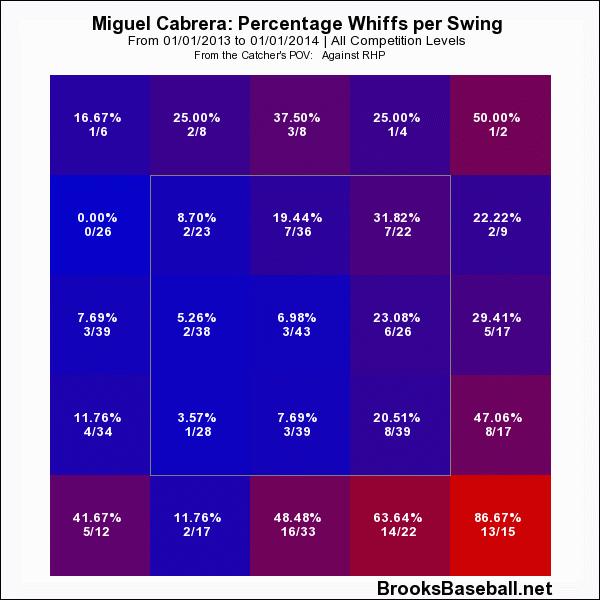
So overall, you can get Cabrera to swing and miss if you go low and away or if you elevated the pitch out over the plate. This stands to reason as his batting average zone plot looks like this:
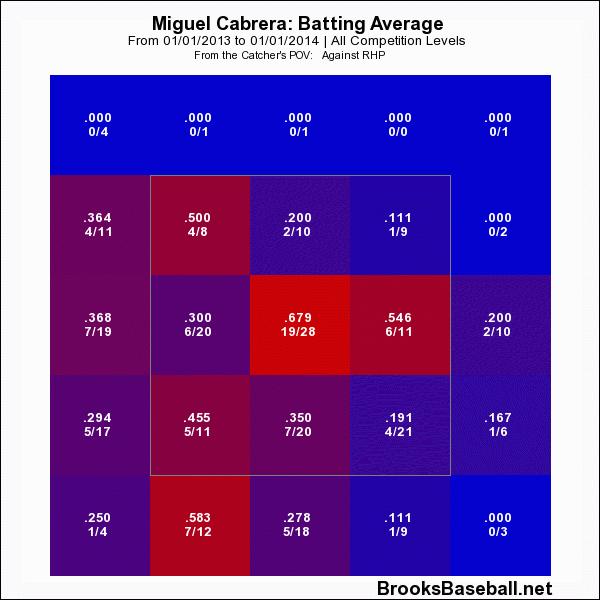
Generally, this shows us that you have to go down and away or up above the zone if you’re trying to limit contact. If you’re trying to limit the damage, as seen by his slugging percentage by location, the same holds true.

So we have a general idea about where to pitch Cabrera based on his 2013 performance. For reference, the same pattern holds true for the last few seasons. He’ll chase down and away and above the zone, and those are the two places he’ll get the fewest hits and the fewest extra base hits.
Let’s now break it down a little by pitch type. If you throw him hard stuff (various fastballs), you want to keep it away from him. This is his slugging percentage against hard stuff:

And again, whiffs per swing against fastball type pitches:
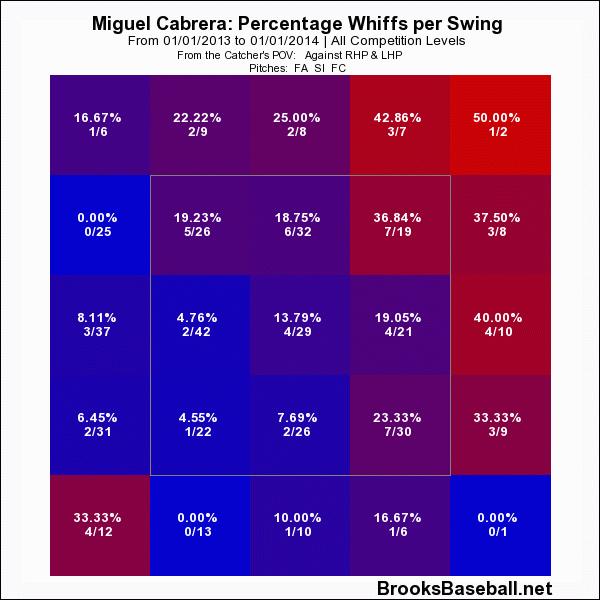
So we have a little more information now. We know that if we’re a right handed pitcher, when we go with the fastball we want to go up and away, and avoid the inside part of the plate at all costs. Let’s turn to breaking balls and offspeed pitches. Here’s the whiff per swing rate on soft stuff:
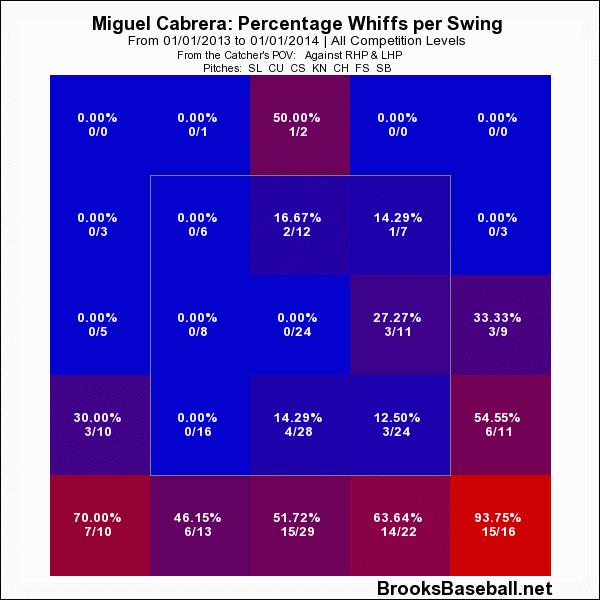
Now let’s take the slugging percentage against breaking balls and offspeed:

You can see here that Cabrera isn’t likely to swing at offspeed pitches inside and outside, but he will swing if they are over the plate and will crush them if they are in the zone.
So what have we learned? First, throw the fastball up and away and the changeup and breaking ball low and over the plate. Those are pretty much the only places to get Cabrera to chase and get himself out. We could break this all down by count, but that would get extremely long and messy. There are 12 possible counts to breakdown and that’s a lot of charts, so let’s just stop here with the zone breakdowns.
If we look by pitch type more generally, you can see there are pitches that work better.

He’s more vulnerable to sliders and splitters, and you can get him out with the cuvreball, but there is a big risk involved if you miss with that pitch because he may crush it.
Cabrera is baseball’s hardest out and he’s also one of the game’s most feared power hitters. There isn’t an easy way to get him out, but the way to do it is to work the fastball up and away and the breaking ball down and over the plate. That is, however, no guarantee. Because sometimes he does this (click to play if it isn’t running on your screen):

 New English D