How Was The Game? (June 14, 2013)

Another big night for Porcello.
Tigers 4, Twins 0
Earlier in the day, I wrote a very detailed piece about how Rick Porcello (4-3, 70 IP, 4.37 ERA, 3.46 FIP, 1.3 WAR) is becoming one of the game’s best starting pitchers and he took the stage tonight and delivered another stellar outing (seriously click the link, Porcello is awesome). It was brilliant. I audibly cheered in my own home as he pumped fastballs that crossed at the knees and changeups and curves that hitters couldn’t touch. His final line was 7 innings, 3 hits, 0 runs, 0 walks, and 5 strikeouts, to improve on his already impressive season.
The Tigers struggled to get the offense going until the sixth inning when Jackson walked and the Twins gave Cabrera an intentional pass that set up a Fielder two run double, which set up Martinez and Peralta RBI doubles to give the Tigers a 4-0 lead. They wouldn’t need anything else as Porcello cruised to victory, the bullpen did the job, and got the Tigers to 37-28 on the year. They’ll look to take the series tomorrow with Anibal Sanchez (6-5, 78 IP, 2.65 ERA, 1.78 FIP, 3.3 WAR) taking the hill after missing his last start.
The Moment: Porcello dominates.
Rick Porcello’s Rising Star

Twenty seven days ago, I wrote a piece entitled “Rick Porcello is Breaking Out” in which I said the following:
Put this together and we have this story: Rick Porcello is striking out more batters than ever, walking fewer batters than ever, getting more groundballs than ever, and is allowing more homeruns per flyball than we would generally expect. All of this points toward the 24 year old having his best season to date.
Since then, all Porcello has done is prove me right. I don’t mean for this to be about me or my predictive success, I mean it to be a validation of how Porcello was showing signs that he was having his breakout campaign. Now it’s clear that he is.
Let’s take a quick look at his numbers over the last 30 days.
2-1, 30 IP, 9.68 K/9, 1.76 BB/9, 2.93 ERA, 2.77 FIP, 2.14 xFIP, 0.8 WAR.
Those are great numbers. All-Star, Cy Young type numbers. Over the last 30 days, Porcello’s 2.14 xFIP is the best in major league baseball and his xFIP this season is 7th best in MLB despite his rough April. This is no longer the Rick Porcello who is a really good #5 starter, this is Rick Porcello the really good starter.
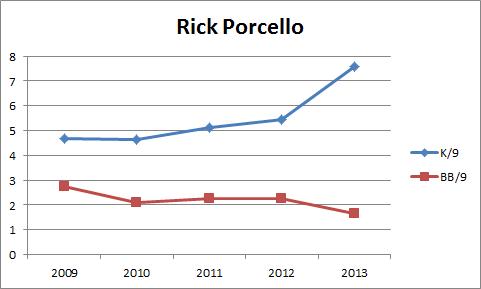
Let’s update where Porcello stands. His K/9 is far and away the best of his career as is his BB/9.

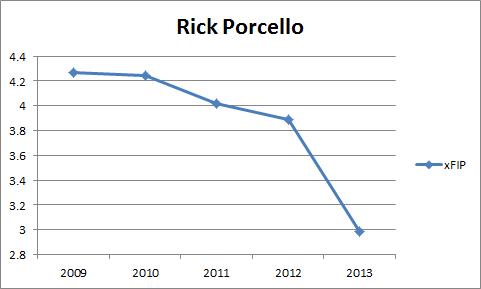
When you translate his numbers into FIP and xFIP, it looks like this:

But it isn’t just the strikeouts and the walks, it’s also the groundballs. Rick Porcello isn’t trading groundballs for strikeouts, he’s actually getting more of both.
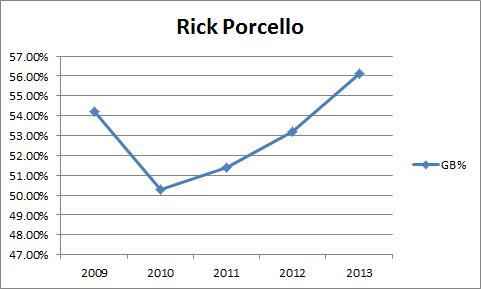
Everything is trending in the right direction for Porcello. More strikeouts, fewer walks, more groundballs. He’s gone from very good #5 starter with some upside to a one of the game’s best starters over the last month and a half. In fact, his particular combination of strikeouts, walks, and groundballs is quite rare and extraordinary.
He’s striking out more than 7 batters per 9, walking fewer than 2 batters per 9 and has a groundball rate above 50%. From 2000-2012, here is the list of pitchers who have finished a season with that mix: Halladay (4x), Carpenter (3x), and Hamels (1x). In 2013, the pitchers on that list are Felix Hernandez, Doug Fister, and Rick Porcello. That is some excellent company.
If we push the limits farther, to 7.5 K/9, 2.0 BB/9 and 55% GB (which Porcello has) the list of pitchers since 2000 to accomplish that feat drops to zero. Nobody. We don’t have groundball data from before the early 2000s, so I can’t tell you how rare this is in MLB history, but since the data became available, it’s never been done.
Porcello is mixing strikeouts, command of the zone, and groundball induction in a way that has never been done before. You may look at his ERA or even more foolishly his W/L record and think he’s the same old guy, but he’s actually nothing close to it. He’s turned himself into a star.
And this isn’t some fluke stretch that happens to him everyone once in a while. This is his K/9 by month for every month of his career:
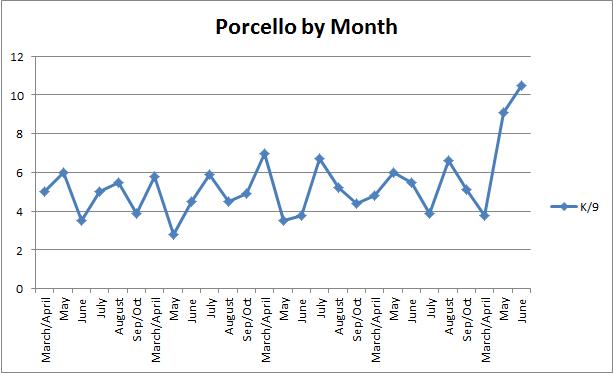
Porcello is a noticeably different pitcher. And he’s doing it by dropping the slider, cutting back on the fastballs and using curveball and changeup more often.

It’s all working. You can see the change in his approach is coming from a changeup and curveball that are moving more and have bigger separation from the fastball by velocity.
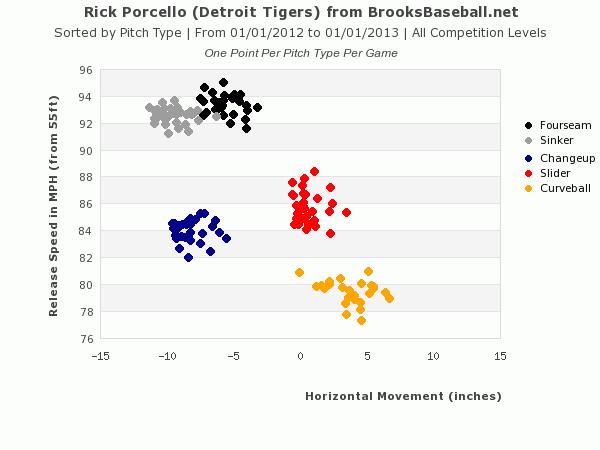
 This is all by way of saying that Rick Porcello is getting much better results over the last two months than he ever has before and that it is the result of real change in his approach to pitching. I’ve always believed this breakout would come. It’s true, you can ask friends who suffered through my lectures on him. Everyone looked at Porcello in 2009 and saw a young kid with big time prospect status. But he didn’t develop that fast and he started to get tagged as a bust. But the mistake those critics made was that Porcello got to the major leagues so early that they didn’t realize he was still developing. His training for big league baseball was all on the job training.
Consider this. Rick Porcello is in his 5th year in MLB and has made 131 starts (120 entering 2013). When each of these pitchers turned 24, they had this many starts: Doug Fister (0), Anibal Sanchez (23), Justin Verlander (32), Max Scherzer (3). Rick Porcello has more starts before his 24th birthday than all four of his rotation-mates combined. Doug Fister, Max Scherzer, Anibal Sanchez, and Justin Verlander have all played the vast majority of their major league careers over the age of 24. Porcello has played almost the whole thing below 24. Think about how much those pitchers have grown since they turned 24.
If Rick Porcello can develop at a rate even remotely close to that which his teammates have, he could be one of the best pitchers in the baseball across the late 2010s. Heck, over the last two months he already is.
An Unimpressive, But Important Verlander GIF
You’ve all seen the fancy Yu Darvish gif by Blackbelt Gifologist Drew Shepherd, and a lot of you have probably seen other MLB players get the same treatment. My editing skills are not nearly that good, but I would like to provide you with a GIF to illustrated that Justin Verlander is back on track.
Below you can see his velocity and movement from the terrible start in Texas and also his velocity and movement from his very good start yesterday in KC. As you can seen, the separation between the pitches is much better, but so is the movement. He’s good.

New English D Audio: Episode 1 Featuring Cameron Bonk
On the first ever edition of New English D Audio I talk with Cameron Bonk of The Guy Show and The Farm Club about the state of the Tigers, specifically their bullpen, and about the difference between being a fan of one or multiple sports. I also hit Cam with some lightening round questions, including which Tigers player he would most trust to date his sister. The author apologizes for the slight inconsistency in volume, as he has just recently learned to create audio files. He promises future editions will not have this issue.
Enjoy and please direct any podcast related questions to NewEnglishD@gmail.com or @NeilWeinberg44 on Twitter.
Download (Approx 22 mins)
How Was The Game? (June 12, 2013)
Pretty much exactly what you’d have expected.
Royals 3, Tigers 2
Earlier this year I decried the performances of Justin Verlander and Yu Darvish in what was supposed to be a great duel, but Verlander and Shields lined up against each other today and gave the people what they wanted. The Tigers got single runs in the 1st and 5th and that would be it on the scoring as Verlander (8-4, 87 IP, 3.41 ERA, 2.49 FIP, 3.0 WAR) gave the Tigers 7 innings of shutout baseball that featured just 3 hits, 2 walks, and 8 strikeouts and Shields offered 7 2-run innings himself. After some struggles in May, Verlander looks like he’s back on track and pitching like the $200 million man. Unfortunately, Jose Valverde is pitching exactly like himself as well, which means he isn’t pitching well. Leyland went to him after Smyly allowed a baserunner in the 9th and Valverde gave up a game tying homerun two batters later. At this point, you can’t be mad at Valverde because he simply isn’t good enough to pitch in close games. This falls squarely on Leyland and Dombrowski’s shoulders. I just feel bad for him now. I don’t support the use of a closer at all, but if you’re going to use one, they can’t be this bad. Coke came on in relief of Valverde and gave up a run in the 10th to end it. The Tigers have still won 6 of their last 9 and are eight games over the .500 mark at 36-28. They’ll take Thursday off in preparation for a three game set with the Twins this weekend. Rick Porcello (3-3, 63 IP, 4.86 ERA, 3.67 FIP, 1.0 WAR) and his rising star (and amazing 2.96 xFIP) will take the mound in game one and may have Austin Jackson behind him depending on how he feels after today’s rehab game.
The Moment: Lough makes a diving grab to rob Cabrera of an RBI double.
How Was The Game? (June 11, 2013)
A close one, but a good one.
Tigers 3, Royals 2
Looking to stop the Royals winning streak, the Tigers sent Max Scherzer (9-0, 93.1 IP, 3.19 ERA, 2.49 FIP, 3.0 WAR) to the mound looking to deliver another great performance and after struggling with command in the first inning, he turned in another fine outing by providing 7 innings of 3 hit, 2 run, 2 walk, and 6 strikeout baseball despite having issues deciding on an outfit:
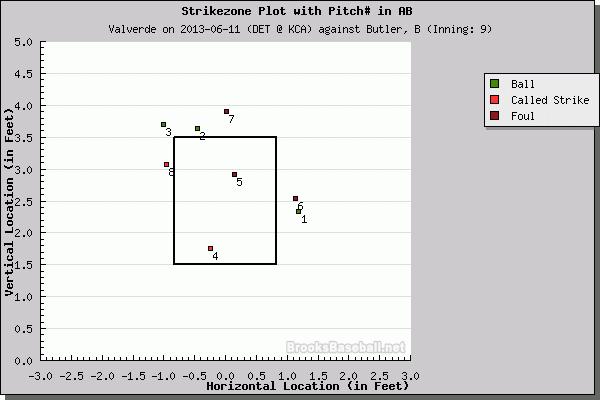
The 8 and 9 hitters did most of the heavy lifting as Infante went 3-4 and Kelly and Garcia combined to go 3-4. The Tigers got out to an early lead, but wouldn’t score the winning run until the 8th inning on a Martinez sac fly. Valverde made it interesting, but escaped the 9th thanks in part to a generous call by the HP umpire that wasn’t good, but wasn’t as bad as Butler thought:
The win pushes the Tigers to 36-27 and they will go for the series victory behind Justin Verlander (8-4, 80 IP, 3.71 ERA, 2.57 FIP, 2.7 WAR) tomorrow in KC. In Verlander’s last start against the Royals this season, he went 7 innings and allowed 1 ER in an extra inning loss.
The Moment: Cabrera scores on a Martinez sac fly in the 8th.
Max Scherzer the Ace: The Key to His Transformation

I don’t need to tell you that Max Scherzer is an excellent MLB starting pitcher or that he’s having his best season to date. For one, I’ve already done so on a couple of occasions (Two Game Breakdowns: here and here). Also, you have eyes. You’ve watched him pitch and you’ve checked out his numbers.
But let me hit on some relevant points. Max Scherzer has the lowest walk rate of his career. He has the lowest homerun rate of his career. He has the lowest ERA, FIP, and xFIP of his career. He’s on pace for his highest WAR and might get there by August. He’s added a curveball and is using it along side his changeup to give hitters more frequent offspeed looks. He’s getting more groundballs than last year at the expense of line drives.
I’ve already laid out in the links above how well he’s avoiding the top of the strike zone. Heck, he’s throwing more strikes period. The worst things you can say about Scherzer this year is that his strikeout rate was about .25 K/9 higher last year and that his BABIP is a bit lower than we should probably expect it. That’s it. He’s due for a little regression to the mean, but almost all of his numbers look stable. This is the best we’ve seen from Scherzer. But you knew that.
You knew he’s 6th among pitchers in WAR, 4th in FIP, 5th in xFIP, and 3rd in K/9. You’ve seen it all. He’s finally putting it all together. That’s established.
So the next question is what’s different? Well I already mentioned the new pitch and the additional use of offspeed pitches. He’s throwing more strikes, but he’s not really inducing more swings and misses or more chases outside the zone. I’ve routinely talked about Scherzer’s need to rein in his wild delivery if he wanted to really have a great season. He’s doing that.
Let’s take a look at the pitches themselves. First we have single game averages from 2011:

Now here’s 2013:
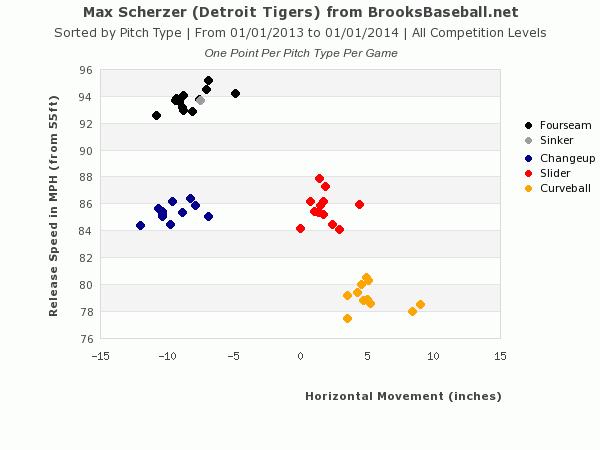
The scales are essentially identical, and while the sample size is 1/3 the size in the lower chart, you can see how much more consistent the velocity and movement are on his pitches these days. To me, that’s because he’s repeating his delivery much more so than he used to. The stuff was always good, but now he’s getting more consistent results because his release point is more consistent. Here are 2011 and 2013:

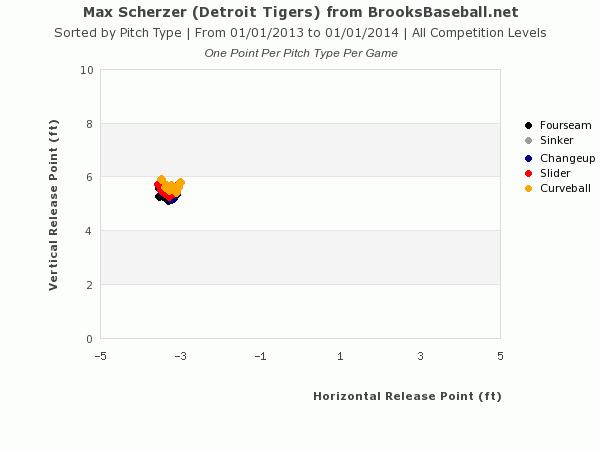
So let’s consider the facts. Max Scherzer has always had great stuff and his inconsistency held him back. Over the last the last couple seasons, he’s worked on it and has found a way to repeat his delivery such that the results are lining up with the scouting report. He’s having his best season yet and it looks like he’s finally climbed his Everest and figured out his delivery.
As he looks to make start #13 tonight, one has to ask if Max Scherzer is now officially an ace. I consider the top 15 or so starters to be aces and Scherzer is certainly one of those this year by every available measure and was just on the edge of that last season. But Scherzer also has the requisite dominant stuff that aces need and is capable of twirling a lights-out-10+K performance on almost any occasion.
Scherzer is finally getting results in line with his skills and he’s done so by going to his offspeed stuff more often and doing whatever he needed to do to get his mechanics in order so that he could command his brilliant stuff well. Max Scherzer has spent the last three years in Justin Verlander’s shadow. At times in Anibal Sanchez’s and Doug Fister’s shadow. But Max Scherzer is no man’s understudy. Max Scherzer is an ace all on his own. He’s making a case to start the All-Star Game in July and is very much in the discussion for AL Cy Young.
If you liked this, check out New English D on Porcello’s Breakout Campaign, Anibal Sanchez’s Cy Young Leap, The Tigers Approach to Pitching, and Why They Have the Best Rotation Ever.
How Was The Game? (June 10, 2013)
A little unfair to Fister.
Royals 3, Tigers 2
In the interest of tidy box scores, both clubs limited their scoring to the 3rd inning today as Miguel Cabrera delivered a 2 run HR in the top of the inning and the Tigers defense helped the Royals respond with 3 in the bottom half. Doug Fister (5-4, 85 IP, 3.28 ERA, 2.60 FIP, 2.8 WAR) was characteristically fantastic and only allowed runs in one inning that featured 2 infield hits, a regular hit, and a triple that should have been kept to a single if not for a poor play by Garcia and Hunter. Fister would end the day with a CG, 3 run affair with 0 walks and 3 K in the losing effort that also pushed his GB rate to 57.5% which is second best among MLB starters.
After four straight wins, it’s hard to complain, but Doug Fister deserves better and I would like to request that the Tigers spread their poor offensive games around and don’t use them all up with Fister on the mound. Max Scherzer (8-0, 83.1 IP, 3.24 ERA, 2.36 FIP, 2.9 WAR) will take the hill tomorrow looking to even the series and improve his own All-Star and Cy Young profile.
The Moment: After a strike-em-out-throw-em-out to end the 4th inning, all 9 Tigers thought there were only two outs and didn’t leave the field.
Understanding the Tigers Bullpen
If you follow me on Twitter or have spent a lot of time on this site (here, also here) you know that I’m not a fan of how most managers use their bullpens. Primarily, I think “saves” are worthless and utilizing a one inning-saves only closer, even if that closer is excellent, is not the right way to use your bullpen.
This idea is simple and it’s explained in the links above, but I’ll summarize. You should use your best relievers when the game is most on the line. That does not always happen in the 9th inning. Your relief ace should pitch when he is needed, not when he can accumulate saves. The 9th inning is not “a different animal” that requires special skills. Many pitchers have moved into the 9th inning role without any problem and a high number of saves does not mean you have pitched well.
In general, I’m a fan of rethinking bullpen usage so that the best pitchers pitch in key situations. I’ve routinely mentioned that Jose Valverde is not a good MLB reliever anymore, but even if he was, the Tigers are using him incorrectly. Let’s explore.
Fangraphs furnishes a statistic that measure the average leverage index each pitcher enters the game during. Leverage index measures how much the game is “on the line” at every moment, so this captures exactly what we’re after. On average, how critical is the moment that Leyland brings in each reliever:
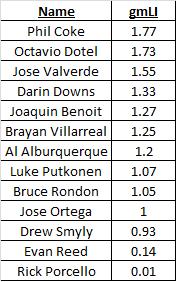
Obvious, some of these guys have fewer appearance than others, but you’ll note that Phil Coke, Jose Valverde, and Darin Downs have been called on during the most critical moments with Joaquin Benoit coming in 4th among pitchers who have a decent chunk of innings. What you should also notice is that Drew Smyly is effectively dead last because Reed and Porcello have hardly pitched at all.
Yet it’s Benoit and Smyly who are actually the team’s best relievers. If we look at Win Probability Added (WPA) which measures the the change in win expectancy from a pitcher’s entry into the game until their removal, Smyly and Benoit are the best the Tigers have:

And if you’d rather consider WPA in conjunction with LI:

What we see here is that Smyly and Benoit are the pitchers who are performing the best out of the Tigers bullpen but they aren’t getting place in the high leverage situations. Leyland is going to Coke, Valverde, and Downs more than Benoit and Smyly when the game is on the line even though those guys are worse.
We can look to other numbers like FIP and ERA, among Tigers relievers with more than 8 IP, Smyly and Benoit reign:

Put very clearly, Smyly (who is 8th in MLB in reliever WAR) and Benoit are the Tigers best two relievers by pretty much every objective measure, yet they are not getting the call when the games count most. Until yesterday (June 9th), Smyly had pitched to just 15 batters in the previous 2 weeks despite being the team’s best reliever. That just isn’t acceptable.
The way to fix this is simple. First, managers need to stop valuing “proven closers” and should not be afraid to go to closer by committee. Jose Valverde leads the Tigers in “Saves,” but by every other measure, he’s nowhere close to the team’s best pitcher. Second, managers need to accept that the most important time in the game is not always the 9th inning and should bring in their best reliever to face the other team’s best hitters or when the other team is threatening. If you go to your best guy with the bases empty against the 6-7-8 hitters, you’re wasting them.
The flaws were on display in Baltimore (5/31) when Jose Valverde came into the game in the 9th inning up by 2 against the Orioles’ best hitters and blew the game, but on the next day, Leyland went to Smyly for two innings up by 7 runs. The opposite should have happened. Valverde should not pitch when the game is on the line and Smyly shouldn’t pitch in garbage time. You need to align your best relievers with the most important moments in the game.
Now certainly you can’t see the future and I won’t begrudge someone for going to Smyly in a tight spot only to find the game gets tighter in a future inning. But when Leyland doesn’t use Smyly for days at a time and then gets him work during a blowout, it’s maddening.
People complain about the Tigers’ bullpen, but it’s actually 7th in MLB in WAR, 9th in FIP, and 4th in K/9. It’s not elite, but it’s reasonably good. The problem is not the individual pitchers but rather how they are used. If Leyland was willing to think differently and go to his best guys in the tightest spots, the Tigers wouldn’t have these late inning issues.
The Tigers have far and away the league’s best staff and one of the best couple of offenses. Their only weaknesses are defense and the bullpen, but the bullpen isn’t really a weakness, it’s an inefficiency. And it’s one that can be fixed.
How Was The Game? (June 9, 2013)
A nice, clean sweep.
Tigers 4, Indians 1
It’s rare that everything goes right during a baseball game, but that seemed to happen today. Jose Alvarez (1-0, 6 IP, 1.50 ERA, 3.40 FIP, 0.1 WAR) was stellar in his MLB debut, delivering 6 innings of 3 hit, 1 run, 1 walk, and 7 strikeout baseball in place of Anibal Sanchez and left the game with the score tied 1-1 thanks to an Avila sac fly and a Raburn homerun. In the bottom of the 6th inning, as Alvarez was basking in his debut, Miguel Cabrera and Prince Fielder got themselves on base ahead of the imposing Don Kelly who turned on a pitch low and in and sent it into the seats to give the Tigers a 4-1 lead. And then something even more amazing happened. Jim Leyland actually called on his best relievers and brought Smyly into the game for 2 innings before turning it over to Benoit who added a scoreless 9th. The win completes the sweep and moves the Tigers 5.5 games ahead in the AL Central thanks to a 5-1 homestand. They’ll hop a plane to KC and will have Doug Fister (5-3, 77 IP, 3.27 ERA, 2.63 FIP, 2.4 WAR) on the mound for game one of the series on Monday.
The Moment: Don Kelly breaks the tie with a 3 run homer in the 6th.

 New English D