How Was The Game? (July 27, 2013)

A good old fashioned laugher.
Tigers 10, Phillies 0
Despite the 40 minute rain delay, the Tigers didn’t have any trouble getting off to a good start on Saturday as they annihilated the Phillies without much trouble. Max Scherzer (21 GS, 143.2 IP, 3.01 ERA, 2.72 FIP, 4.3 WAR) put the Phillies away easily in the 1st and allowed just one baserunner across his 6 innings of work to go with 7 strikeouts. Leyland pulled him after just 75 pitches to save some bullets because the Tigers offense unloaded early and often. They got 5 runs in the first on a Cabrera HR, Peralta single, and Tuiasosopo HR to the shrubs in dead center. They added 3 in the 2nd, and single runs in the 4th and 5th to run the score up to 10-0 before the Phillies knew what hit them and every Tigers starter had reached base at least once before the night was over. The Tigers went to Alburquerque for 2 innings and Reed for one to finish out the ballgame and coast to their 58th win. They’ll turn around and go for the sweep on Sunday behind Rick Porcello (18 GS, 106.1 IP, 4.49 ERA, 3.55 FIP, 1.9 WAR) who looks to keep his strong season going.
The Moment: Tuiasosopo crushes a 3 run HR to dead center to put this one away early.
How Was The Game? (July 26, 2013)
A thing of beauty.
Tigers 2, Phillies 1
In life, it’s so rare that something lives up to the hype but I’m confident in saying this duel between Cole Hamels and Doug Fister (21 GS, 135 IP, 3.67 ERA, 3.31 FIP, 2.9 WAR) did. Hamels’ only blemish was a 2 run double he allowed to Avila in the 5th and Fister allowed just a single unearned run in the 3rd. Fister gave the Tigers a brilliant effort, going 8 innings and allowing just 3 hits and 1 walk to go with his 6 strikeouts. It was everything a great Fister start should be. He was efficient, he got ground balls, and he made hitters look silly with tons of movement on the fastball and a curve about which you could write poetry. After today’s start, Fister is now 3rd in MLB in ground ball percentage and 7th in the league in walk percentage. Both teams also treated us to some great defense to put the cherry on top of the sundae that was this game, including some solid work by Santiago and a doozy of a grab by Nix in RF for the Phils. The win pushes the Tigers to 57-45 and they will avoid Cliff Lee on Saturday due to an injury. The Tigers will send Max Scherzer (20 GS, 137.2 IP, 3.14 ERA, 2.81 FIP, 4.0 WAR) to the mound to face his replacement.
The Moment: Fister gets a standing ovation after retiring 13 of the final 14 batters he faced.
Prince Fielder’s Missing Value

Prince Fielder isn’t having a bad season, he just isn’t having a great one. He’s been worth just 1.0 wins above replacement (what’s WAR?) in 101 games despite being worth close to 5 WAR in each of the last two seasons. The defensive and baserunning metrics always put Fielder clearly below average, costing his team 1-2 wins per season on average, but they are not currently out of line with his career numbers. Fielder’s missing value is entirely on the offensive side of things.
Again, this is not to say Fielder has been bad, but rather that he hasn’t been a great hitter like he normally is. These kind of seasons have happened before for Fielder. Let’s take a look at his single season wRC+ (what’s wRC+?) over his career. This is simply an offensive rate stat that measures how he compares to league average, which is set to 100.

You can see he has had down seasons in his career. In his first full season he was only at 110. In 2008 it was 125 and in 2010 it was just 136. None of those are bad numbers, but they aren’t like the 4 seasons of better than 50% better than league average that he put up in 2007, 2009, 2011, and 2012. This year he’s all the way down at 122. He’s just 22% better than the league average hitter this season when we expected to see him around 40% better. What’s going on?
Well he’s walking less and striking out more than last season, but he’s still significantly above average in both departments. He’s also been successful when he’s had a higher K%. I’m not saying these aren’t factors, but I don’t think they are the main factors. I think it’s more about the at bats in which he makes contact.
You’ll notice his overall production dips in conjunction with lower batting average and OBP, obviously, but you’ll notice the 2011 and 2012 average spike wasn’t met with an OBP spike. He traded walks for hits. This year he’s essentially walking at the same rate but isn’t getting the hits. It’s as if he changed his approach in the last few years to be more of a contact hitter, and this year the contact isn’t paying off:
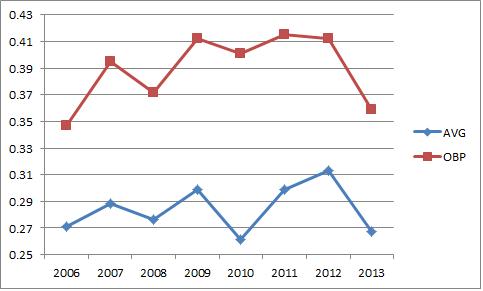
You can see the contact spike very clearly in the following graph:

2011 and 2012 look like the anomalies. He saw a huge spike in his contact rate, which helped elevate the batting average. He wasn’t hitting for as much power, but plate appearance that used to be walks were now hits, which helped his offensive value because they occasionally went for extra bases as well. Let’s take a look at BB, 1B, 2B, and HR (PA numbers are all very close):
| Season | 1B | 2B | BB | HR |
| 2006 | 90 | 35 | 59 | 28 |
| 2007 | 78 | 35 | 90 | 50 |
| 2008 | 96 | 30 | 84 | 34 |
| 2009 | 93 | 35 | 110 | 46 |
| 2010 | 94 | 25 | 114 | 32 |
| 2011 | 95 | 36 | 107 | 38 |
| 2012 | 118 | 33 | 85 | 30 |
| 2013 | 66 | 21 | 52 | 17 |
He’s always had a very consistent number of singles until 2012 when that number spiked. In 2010, he walked a lot but it cost him his extra base power. 2011 was essentially the best of everything. Lots of singles, career higher 2B, 107 BB, and 38 HR. He parlayed that into a nice contract, actually. In 2012, he hit fewer homers and doubles and walked less, but had a ton more singles to make up for it. Instead of a high walking slugger, he was a solid walking well balanced hitter.
You can see in 2013 that the HR, BB, and 2B pace is down only slightly from last season. The difference between Fielder in 2012 (when he was great) and Fielder in 2013 (when he is just pretty good) is that what used to be singles are now outs. Some of that is a tick up in K% and a decrease in contact% but some of it is about batted balls.
If we look at his BABIP (what’s BABIP?) we can see that the years in which he “struggles” are the years in which he has a low batting average on balls in play.
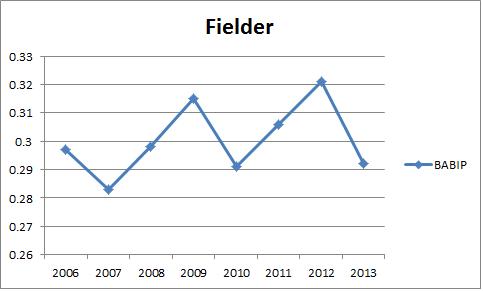
Notice first that 2007 doesn’t seem to fit the patter because he was great but has a low BABIP – but remember that he hit 50 HR that season, which aren’t in play. If we bounce 2007 up and say he had a low BABIP for a positive reason, we can see that the down years of his career are the ones with the lower BABIP.
Low BABIP can be about a hitter’s skill, approach, or quality of contact, but it can also be about luck and the quality of the other defense. Let’s see if their is a Fielder explanation in his batted ball data:

What we can see is that Fielder has been trending toward more line drives lately at the expense of fly balls, which makes perfect sense with our theory that he’s trading big power for more contact and singles. But you’ll also notice that his line drive percentage this year is actually better than his very good 2011 season. He’s also hitting a lot more fly balls this year that he did in the last two seasons, but he has previously been successful hitting that many fly balls. Fielder’s approach is definitely different that in used to be in this respect, but it doesn’t appear to be detrimentally different.
He’s hitting more balls in the air, but they aren’t leaving the park like they should. He is HR/FB%:
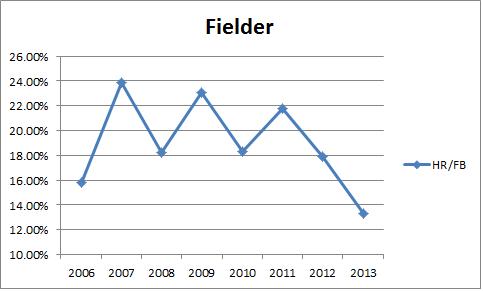
You’ll notice that it has fluctuated in his career, as we would expect given the fluky nature of HR/FB%, but his number in 2013 is noticeably lower than the typical fluctuation. In his best years he’s hitting 22% or better, but in his down years we expect it around 18%. Let’s imagine a scenario in which Fielder’s HR/FB% was 18% this season. That would be 23 HR instead of 17. Five additional homeruns is a meaningful difference.
His current 2013 wOBA (what’s wOBA?) is .352, which is good but not amazing. If we trade 5 outs for HR, what happens? It goes up to .377. That’s not in line with his great seasons, but it’s much better. That calculates out to a wRAA (what’s wRAA?) of 22.5, which is good for about 2.4 WAR offensively. He’s currently offering an offensive WAR of around 1.3. These 5 HR account for an entire win above replacement in value and something like 1.6 WAR extrapolated out over an entire season. He’s a 3.9 WAR offensive player if he hits exactly like this the rest of the season if he bring his HR/FB% in line with his previous lows. That’s much better. His defense and running will still cost him 1-2 wins before he positional and replacement level adjustment.
So we have to ask ourselves if the HR/FB rate is Fielder’s fault or just bad luck? And also, if he’s generally been unlucky on balls in play turning into outs. If it’s just bad luck, we don’t have to worry and we can easily expect him to regress to the mean and play better the rest of the way.
If we take a look at this Hard Hit Average leaderboard, Prince Fielder still ranks extremely well (H/T Mark Simon and ESPN Stats and Info):

If you can’t read it, he’s 14th in baseball with a hard hit average better than guys like Chris Davis, David Wright, and Paul Goldschmidt. It seems like he’s making hard contact at a high rate, but he’s simply not getting those balls to drop. The same thing happened to Victor Martinez earlier this season and everything corrected itself for him. If we believe that hard hit balls are predictive of good performance, and I do, then it looks like Fielder is just getting unlucky and everything should be fine. His hard hit average is down this year, but it’s still way above the MLB average of .170. When you hit the ball hard this often, the results are usually very good.
| Hard Hit Average | |
| 2010 | 0.244 |
| 2011 | 0.290 |
| 2012 | 0.269 |
| 2013 | 0.234 |
He’s getting fewer hits on balls in play, but he’s not hitting the ball weakly, he’s hitting it in the wrong place. Combine that with a fluky low HR/FB% and you can wash away Fielder’s offensive problems. The results matter for the team, but there doesn’t appear to be anything wrong with the process. And process is more predictive than results going forward and going forward is what we care about. Even if he’s lost a touch of power behind his swing, it’s still going to produce results better than this going forward.
Prince Fielder is having a down season in the second season of a huge contract, but it doesn’t look like this is the sign of an early decline. It’s mostly just some bad luck, and luck often turns.
How Was The Game? (July 25, 2013)
Another rocky one for JV.
White Sox 7, Tigers 4
The Tigers couldn’t cash in on a sweep in Chicago today as Justin Verlander (22 GS, 137.2 IP, 3.99 ERA, 3.41 FIP, 3.0 WAR) struggled again, allowing 7 runs in 6 innings on 11 hits, 2 walks, and 4 K. Verlander again struggled to get both breaking balls working and couldn’t get enough sink on his fastball when he wanted to thanks to a problem with his release point that we chronicled yesterday. The Tigers didn’t go quietly, however, as they got runs on Hunter, Martinez, and Pena homeruns against Peavy but couldn’t complete the comeback despite getting the tying run to the plate in the 9th. The loss drops the Tigers to 56-45 as they head home to face the Phillies on Friday and will call on Doug Fister (20 GS, 127 IP, 3.90 ERA, 3.40 FIP, 2.6 WAR) to lead them to victory.
The Moment: Pena swats a homerun in the 8th and sprints around the bases.
How Was The Game? (July 24, 2013)
Another clean win.
Tigers 6, White Sox 2
The Tigers picked up their four consecutive win on Wednesday thanks in part to a solid outing from Anibal Sanchez (17 GS, 104 IP, 2.68 ERA, 2.39 FIP, 3.5 WAR ) who turned in 6 shutout innings, allowing 6 hits, 1 BB, and 5 K. The bats got going early as the Tigers got three homeruns – one from Prince, one from Jackson, and one from Hunter – to take an early and commanding 5-0 lead. Avila added an RBI single to give the Tigers their 6th run before Rondon allowed 1 back in his one inning of work. A 3 K 8th from Smyly and a cleanup job by Benoit in the 9th after Putkonen and Coke struggled took the Tigers the rest of the way and improved their record to 56-44.
They’ll carry their 3.5 game lead in the Central into Thursday’s matinee looking to sweep the set with the Sox. They’ll call on Justin Verlander (21 GS, 131.2 IP, 3.69 ERA, 3.35 FIP, 3.0 WAR) to get the job done. If you missed it yesterday, New English D broke down exactly what has been troubling Verlander this year.
The Moment: Prince puts the Tigers ahead early, and for good.
What’s Going On With Verlander?
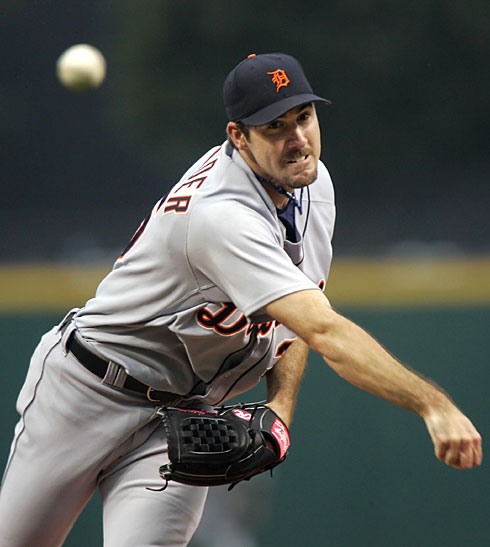
Justin Verlander was baseball’s best pitcher over the last four seasons, but this year Verlander has regressed all the way down to being, like, baseball’s 10th best pitcher. We’ve overblown his struggles because we’re used to him never struggling. He’s not 2009-2012 Justin Verlander, but he’s still better than almost anyone else in baseball.
That said, despite a respectable 3.69 ERA, 3.35 FIP (what’s FIP?), and 3.0 WAR (what’s WAR?), there are some signs of trouble. He has the lowest K/9 and highest BB/9 since his 2008 struggles:

The strikeout drop isn’t dramatic, but the walk differential is a bit concerning. He’s allowing a higher batting average against and a higher BABIP (what’s BABIP?) so some of this could be luck, but it could also be because he’s easier to hit. His line drive, fly ball, and ground ball rates are almost identical to his 2012 numbers .
The key for JV is a little bit of batted ball luck, but mostly it’s a strikeout to walk ratio problem. Try this on for size, in 2012, 32% of Verlander’s total batters faced ended in a walk, HBP, or strikeout. In 2013, it’s exactly the same. He’s allowing the same percentage of balls to be put in play as last season and he’s allowed the exact same line drive, fly ball, and ground ball mix. Exactly the same.
The difference for Verlander in 2013, we can say, is that he’s walking batters during at bats in which he used to strike them out. This is evident when you consider opposing hitters are chasing pitches outside the zone against Verlander less often and he’s getting fewer swinging strikes. Basically, batters aren’t chasing Verlander’s pitches and he isn’t inducing as many swings and misses as he did last season. As a result, instead of striking out a batter chasing on 3-2, he’s walking them which extends innings and makes the hits he does allow more costly in terms of run prevention.
He’s not allowing more balls in play as a percentage of batters faced, but he is allowing more overall because walks are extending his innings and giving other teams more chances to cash in. In 2012 he faced 3.7 batters per inning on average. In 2013 it’s 4.3. The problem with Verlander is that he’s doesn’t put hitters away with a strikeout and instead grants a walk. Everything else unravels from there.
What’s behind all of this?
I have two basic answers with one common cause. None of it has anything to do with his velocity. We’ve seen Verlander pitch effectively with lower velocity before and he’s been successful this season when he didn’t have a good fastball and he’s been bad this season when he has had the 95+mph.
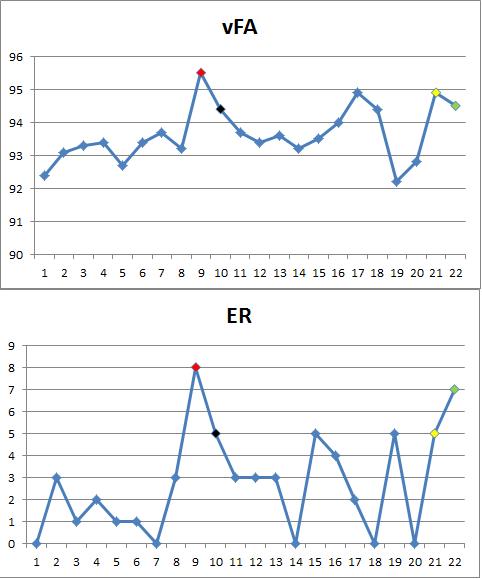
This is something different. It’s something fixable. It’s not something we should worry too much about. Let’s break it down.
1. Movement on His Breaking Balls
Last season his curveball averaged 6.3 inches of horizontal movement and 8.5 inches of vertical movement (these are Pitch F/X numbers and are based on where the ball would be expected to finish based on a baseball that wasn’t rotating). This year, he’s at 5.2 and 7.7 inches respectively. It’s easier to see graphically (All graphs from catcher’s perspective. H/T to Brooks and FanGraphs):
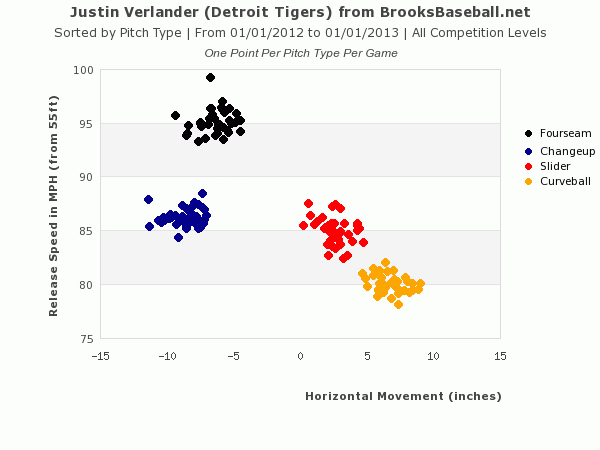

Notice how his curveball has as much horizontal break as his slider this season when it used to have more in the past. Now let’s look at horizontal and vertical movement together.


You can see the problem in his slider too a little bit, actually. The curveball isn’t breaking horizontally enough and the slider doesn’t have enough vertical depth. Both pitches are blending into a hanging breaking ball. The slider is faster, but it lacks the vertical depth needed to get hitters (especially lefties) out. The curveball is essentially just a slower version of the slider with some vertical depth. Neither is what it was in 2012. In order for Verlander to use these pitches effectively, they need to have different properties. The curveball is a slower pitch with more break and the slider is faster with less. They need to be different in all three dimensions – velocity, horizontal, and vertical – and they need to both break more in general than they are this season.
As a result, hitters are laying off the sliders that they used to swing through and more of those sliders are getting called as balls. The curveball has still been an effective weapon at times, but he’s throwing it less often because it isn’t moving the way he wants it to.
This is a bit convoluted so I’lll try to make it clearer. His curveball is getting more swings than it used to and the contact against on it is up because it isn’t moving the way it used to. The slider is less effective because hitters are swinging less and it’s not landing in the zone. The curveball is more hittable and the slider is less enticing. This is problem number one.
2. Fastball…Movement
In the charts above, you could see the breaking ball problems if you looked at overall averages from each game. They are clear as day. But the fastball doesn’t look much different other than a bit of a drop in average velocity. But as I pointed out earlier, two of his rockiest starts have come when he had his best fastball. The success isn’t about velocity. It’s above vertical movement on his fastball and you can’t see the problem if you don’t look at every pitch.
The horizontal problem with the curveball and vertical issue with the slider are evident overall because they are a consistent problem. But the fastball issue is only some of the time, take a look at 2012 and then 2013:

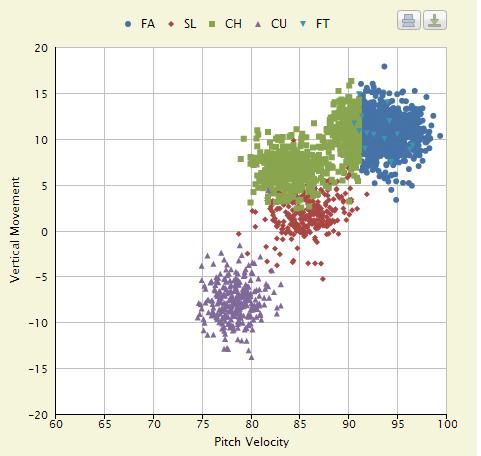
Notice that missing cluster of fastballs in the 0-5 vertical movement section? Those are gone. He’s missing a subset of his fastballs that drop significantly on their way to the plate. You can see it in the horizontal and vertical plots too, 2012 and then 2013:


A cluster of fastballs (and changeups because of some Pitch F/X confusion) is missing that are just down and to the left of center. They are gone. It’s not like there are fewer or they aren’t moving as much, they are totally absent. And this isn’t a classification issue because we’re not talking about these being fastballs OR changeups, there simply are no pitches thrown in that location on the chart.
His fastballs all have the same general horizontal and vertical movement as each other this season when Verlander used to be able to go to a fastball that had more sink on it in 2012. Not having that pitch in his arsenal is likely the cause of a nearly 3% drop in his fastball swing and miss rate from 2012 to 2013. Verlander used to get more whiffs on the fastball and now he isn’t anymore and when they do make contact they do so for more line drives. They’re squaring up his fastball more because there is less variation in its movement.
So now that we’ve established the problem and the connection to the results, we have to ask what is responsible for this? Everyone wants to talk velocity, but two of his worst starts were two of his “best” fastball days. No friends, this is something much more technical.
Release Point
Let’s take a look at his release points form 2012 and 2013:
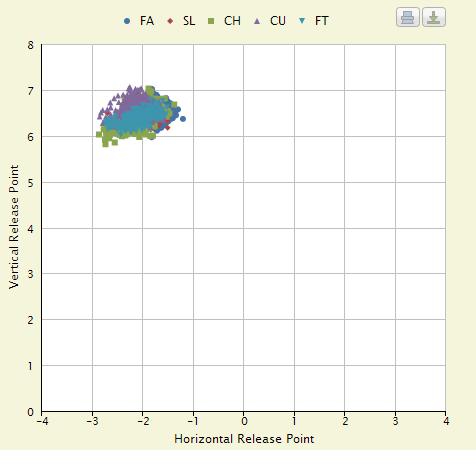
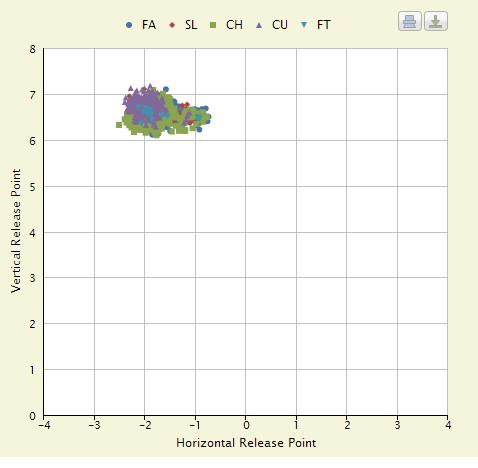
That looks awfully different. Terrifyingly different, one might say if they were prone to hyperbole. Let’s take a look at just curveballs and sliders first:


That’s a big difference. The scale is in feet. We’re talking about release the ball 6-12 inches different from normal in some cases, and at the very least it’s a more inconsistent release point that we saw in 2012. Let’s try fastballs and changeups:

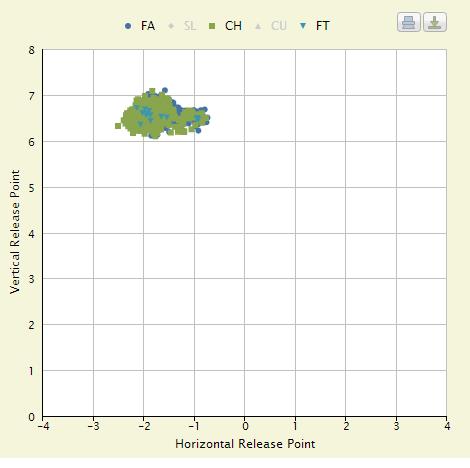
Again, this is a big difference. I don’t even need to describe it to you. He’s releasing the ball closer to first base on his breaking balls and on his fastballs and changeups. This is the difference. It’s a mechanical issue that he needs to correct. I’m not a master of .gifs and screenshots, but I’ve seen the tape from 2012 and 2013 and can tell you he’s falling off to the first base side more in 2013 than he used to. His body is taking him away from the plate and it’s preventing him from getting on top of his pitches – which makes sense that he can’t get the vertical movement on some of his fastballs but the horizontal movement is just fine. It also explains the problem with his breaking balls. Less depth on the slider and less horizontal break on the curveball.
I’m not a pitching coach and I didn’t pitch growing up (I caught, so I can diagnose the problem even if I can’t fix it), but I can clearly see the problem. I don’t know if Verlander is out of whack in his timing or if he’s favoring a lower body injury, but this is what’s going on.
The problem with his pitches lines up with the problems in results and this release point problem explains it all very nicely. Something else could be wrong, but this definitely is. It’s right there in front of you.
This is good news for Tigers fans because it’s really easy to fix compared to an injury. Verlander can just straighten out and get back to being himself. He just signed a huge contract, so it’s good to see this might not be him wearing down but rather him just being out of sync. That’s actually the explanation he’s given the press. It seems to be true.
It also explains why he’s shown flashes of himself. Sometimes he does throw the ball from the right spot and those pitches do their thing. The problem is when he gets out of sync and he loses it, things can turn quickly. Have you noticed how it’s tended to blow up in some innings but rarely across entire games. This is Verlander fighting his delivery, not fighting his body.
And he can fix it. Heck, Scherzer has a way more complicated motion and he’s repeated that like a champ so far this season. It’s going to be okay Tigers fans, the ace isn’t fading, he’s just going through a bit of a rough patch. And he can find a way to fix it. (Here’s a post from August 6th, showing improvement!)
Appreciating Norm Cash and The Summer of ’61
My Dad and I have a running joke about the Fox Sports Detroit trivia question that goes something like this: If the question is about the last Tigers player to do (any statistic relating to hitters) in a single season, the answers is always, unquestionably, don’t even bother looking it up…Norm Cash 1961. It’s time to fully appreciate that season.
Cash spent 15 of his 17 MLB season in Detroit and accumulated 54.2 WAR (what’s WAR?) in a Tigers’ uniform and 54.6 WAR overall. He was a very good player in every way. He was a solid defender who hit .271/.374/.488 with a .382 wOBA (what’s wOBA?) and 139 wRC+ (what’s wRC+?) in his career. Overall, that offensive line is nearly 40% better than league average in his era. That’s a great, just missed the Hall of Fame career. In fact, there’s a reasonable case he should be in the Hall based on who is in and the insulting fact that he spent just one season on the ballot. I can accept that he isn’t a Hall of Fame, but he deserved more than 1.6% of the vote in his only year.
But let’s leave that aside. Cash had a very good career and is one of the top 10 Tigers position players of all time. What I’d like to highlight is what Cash did in 1961. Because it was ridiculous. Ridiculous. One more because it was that good, ridiculous.
To start, let’s lay out the particulars. Cash hit .361/.487/.662 with a 41 HR, a .488 wOBA and 193 wRC+ along with solid defense to lead to 10.1 WAR. What’s even more amazing about this is that Cash didn’t win the MVP. He didn’t even finish 2nd. Or 3rd. He finished 4th in the 1961 AL MVP vote despite this amazing season.
Now don’t get me wrong, it wasn’t highway robbery that Cash didn’t win. The problem was who he lost to. Roger Maris happened to hit 61 HR that season, so the voters gave the award to him and his league leading 142 RBI despite a .269/.372/.620 line to go with his .424 wOBA and 163 wRC+. Maris had an excellent season, but the fact that he beat out Cash is silly. Maris also beat out Mickey Mantle’s .317/.448/.687 season (.478 wOBA, 197 wRC+, 10.4 WAR) and Jim Gentile’s .302/.423/.646 campaign and .453 wOBA and 180 wRC+.
Norm Cash and Mickey Mantle were substantially better players than Maris in 1961 but the HR/RBI totals were all the voters chose to care about. You can’t even say it was a carried his team thing because Mantle wore the same uniform and the Tigers also won over 100 games.
But let’s leave that aside and discuss Cash’s season. Take a look at how his numbers compare to MLB league average (for non-pitchers) in 1961:
| Season | BB% | K% | AVG | OBP | SLG | wOBA | wRC+ |
| Non P League Average | 9.40% | 12.30% | 0.267 | 0.338 | 0.415 | 0.334 | 99 |
| Norm Cash | 18.50% | 12.60% | 0.361 | 0.487 | 0.662 | 0.488 | 193 |
Cash walked twice as much as the rest of the league and got on base in about 15% more of his trips to the plate while slugging and impressive 154 points above average. Put together, Cash hit 94% better than league average. 94% better than league average is something that has only happened only about 50 times in since 1901. Ty Cobb is the only other Tiger to ever do it (although there’s a guy in 2013 making a run…).
It was an impressive season compared to most others in MLB history and in Tigers history, but it also stands out above anything else Norm Cash ever did. I gave you his career line earlier, and while it’s great, it’s not anything like this. Take a look at his wOBA, wRC+, and WAR season by season. It’s nuts.


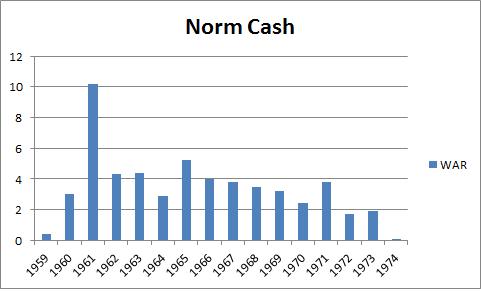
Most of the guys with all time elite seasons like Cash in ’61 usually do it again. By my count, 23 different players have posted a wRC+ of 193 or better in a single season since 1901. Only Norm Cash and Arky Vaughan never posted another season of 168 wRC+ of better. Almost every player who has ever had an offensive season like Cash did in 1961 has done it more than once. Cash had many very good seasons in his career, but 1961 is his unquestioned, absolute peak.
Cash was 26 years old in the summer of 1961 while Roger Maris made a run at Ruth’s HR record and while Mickey Mantle was running through his insane peak. Cash is often overlooked because he was more of a fringe All-Star type player than an MVP candidate most seasons, but his ’61 season is among the very best baseball has to offer.
Among Tigers, few have rivaled it. Five of the top six seasons in Tigers history by WAR belong to Ty Cobb. The other is Cash in ’61. Offensively, Ty Cobb is first and second among Tigers in terms of single seasons. Norm Cash is 4th. The guy in 3rd place hasn’t complete his season yet, so it isn’t in the official record.
Miguel Cabrera is hitting better in 2013 than Norm Cash did in 1961. That’s amazing, and Fox Sports Detroit might have to revamp the trivia questions to say, “other than Miguel Cabrera, who was the last Tiger to….”
The answer is always Norm Cash in 1961.
How Was The Game? (July 23, 2013)
The best case scenario.
Tigers 6, White Sox 2
For a team that was missing its biggest offensive threat, the Tigers didn’t show any signs of trouble. Rick Porcello (18 GS, 106.1 IP, 4.49 ERA, 3.54 FIP, 1.9 WAR) didn’t rack up strikeouts but he mowed down the Sox bats across 7 shutout innings in which he walked a season high 3, but also only allowed 4 hits – three of which didn’t make it out of the infield. Porcello trusted his sinker and got ground ball after ground ball and handed the game over to the pen for the final two. The offense didn’t miss Cabrera as they got 3 runs in the 4th and 3 in the 6th thanks to plenty of offensive from the bottom of the order. Peralta, Avila, Kelly, and Perez were all on base at least twice and once they broke through in the 4th, the game was never really in doubt. The win assures the Tigers of no worse than a split and they will try to take game three and the series Wednesday night behind Anibal Sanchez (16 GS, 98 IP, 2.85 ERA, 2.42 FIP, 3.3 WAR).
The Moment: Hernan Perez scores on his own swing – but only gets credit for a 3B and advancing on an error in the 6th.
Introducing Tigers Starters Watchability Scores (WATCH)
Among the things we love at New English D are the Detroit Tigers, starting pitching, math, and nonsensical rankings. This post will combine all three in glorious fashion. I’ve often thought about doing something like this because I’ve always had my own rankings of which starters I enjoyed watching the most. If you’re familiar with this site, I’m not just a fan of great pitching, I’m a fan of certain kinds of pitching. The rankings below reflect that. This is meant to be fun.
Among the factors considered here are how deep a pitcher pitches into games, strikeouts, walks, ground balls, first pitch strikes, and how quickly they work. Each number is compared to the team average (not league average) and added together with all six categories weighted equally. Hat tip to Carson Cistulli of Fangraphs for inspiring the idea with his NERD scores.
As July 23, the 2013 Tigers WATCH List looks like this:
5. Justin Verlander
4. Anibal Sanchez
3. Rick Porcello
2. Max Scherzer
1. Doug Fister
If you’re interested, here are the monthly ranks to date:
| Rank | April | May | June | July |
| 5 | Porcello | Verlander | Sanchez | Sanchez |
| 4 | Verlander | Scherzer | Verlander | Verlander |
| 3 | Sanchez | Sanchez | Porcello | Fister |
| 2 | Fister | Fister | Fister | Scherzer |
| 1 | Scherzer | Porcello | Scherzer | Porcello |
Should you be curious about full league WATCH scores, here are the best 10 and worst 10:
| Rank | Name |
| 1 | Adam Wainwright |
| 2 | Matt Harvey |
| 3 | Cliff Lee |
| 4 | Chris Sale |
| 5 | Felix Hernandez |
| 6 | Jordan Zimmermann |
| 7 | Max Scherzer |
| 8 | Hisashi Iwakuma |
| 9 | Doug Fister |
| 10 | Clayton Kershaw |
| Rank | Name |
| 80 | Dylan Axelrod |
| 81 | Ryan Dempster |
| 82 | Jeff Locke |
| 83 | Wade Davis |
| 84 | Edinson Volquez |
| 85 | Matt Moore |
| 86 | Ubaldo Jimenez |
| 87 | Lucas Harrell |
| 88 | Barry Zito |
| 89 | Jason Marquis |
Enjoy watching baseball!
How Was The Game? (July 22, 2013)
Smooth sailing.
Tigers 7, White Sox 3
Max Scherzer (14-1, 137.1 IP, 3.14 ERA, 2.81 FIP, 4.0 WAR) was Max Scherzer on Monday night, turning in a sparkling 8 innings in which he allowed just 4 hits, struck out 5 and allowed just two runs, both on solo homers. He was in command early, as he retired the first 12 he faced and guided the Tigers comfortably to the 9th inning. His offense backed him up with a run in the 3rd, 2 in the 5th, and 1 in the 7th courtesy of a Fielder single, VMart single, and Hunter longball and then three bonus runs in the 9th on some weird White Sox defense and the subsequent consequences thereof. The Tigers took care of business start to finish, but got a bit of a scare as Miguel Cabrera left the game with a sore hip flexor and will be reevaluated Tuesday. The team will send Rick Porcello (6-6, 99.1 IP, 4.80 ERA, 3.51 FIP, 1.8 WAR) to the mound for game two as he looks to build on his strong first half.
The Moment: Martinez cashes in two with a two out single in the 5th.
 New English D