New English D Audio (Episode 2): Bullpen, Castellanos, and Jhonny Peralta’s Value

On this edition of New English D Audio I discuss how the Tigers should handle the bullpen and Jose Valverde, Nick Castellanos’ breakout at Triple A, and how we should value Jhonny Peralta given his big offensive season and somewhat controversial defense. The conversation features material regarding how one can invent a closer, the great season of Darin Downs, Nick Castellanos’ big season, and various statistics surround offensive value such as wRC+, wRAA, and wOBA in addition to WAR.
Please feel free to send questions or comments to NewEnglishD@gmail.com or to me on Twitter @NeilWeinberg44.
Download (Approx 22 mins)
The Morning Edition (June 21, 2013)
From Last Night:
- Wright homers twice, but the Mets lose Niese in win against the Braves
- Longoria’s 2 HR lift the Rays over the Yanks
- Zimmermann dominates the Rockies, but Oswalt gets 11 K of his own as Nats win 5-1
- Pena walks off on the Crew in 10
- Another Puig HR
What I’m Watching Today:
- Strasburg looks to build on a solid first start back (7p Eastern)
- Cole goes to LA to face Weaver (10p Eastern)
- Clayton Kershaw faces similarly named Clayton Richard (10p Eastern)
- Colon and Iwakuma (10p Eastern)
The Big Question:
- Who would you honor with the NL All-Star start?
There are a number of good candidates depending on what statistics you value:
WAR:
Wainwright, Harvey, Lee, and Kershaw
FIP:
Harvey, Wainwright, Miller, Kershaw, Lee
ERA:
Kershaw, Locke (!), Miller, Harvey, Corbin, Wainwright, Zimmermann
K/9:
Miller, Burnett, Samardjiza, Harvey, Lynn
Wins (LOL!):
Wainwright, Lee, Corbin, Zimmermann, Lynn, and Marquis
Wainwright is probably having the best season, but I’d be completely happy with Harvey given that the game is at Citi Field and he’s one of the game’s brightest young stars. Kershaw, Lee, and Miller are all very deserving as well. Right now, I’d go with Waino or Harvey. You?
How Was The Game? (June 20, 2013)
Not a bad ending.
Tigers 4, Red Sox 3
The buzz around the Tigers today was about the bullpen situation, but despite Leyland giving Coke the ball when it should have gone to Smyly, it wasn’t the Tigers bullpen that would be the story. Jose Alvarez (1-0, 11 IP, 2.45 ERA, 4.69 FIP, 0.1 WAR) did solid work across 5 innings of 2 run baseball against a very strong offense and Putkonen, Coke, and Smyly combined to allow just one additional run. The bats were unable to get more than two runs in the first 8 innings, however, as a Torii Hunter 2 run single was the only scoring the Tigers could muster against Lackey and company until Martinez walked to start the 9th inning against Bailey and then Jhonny Peralta stepped to the plate and lined a slider into the Tigers bullpen to end the game. I know it doesn’t matter, but I said to my wife before the inning started that Martinez was going to walk and Jhonny was going to walk off. It felt good as the Tigers delivered their first walk off win of the season. If you’re going to lose one in this series, it certainly should be the Alvarez game but the Tigers survived it and can now turn to Fister, Scherzer, and Verlander the rest of the way, who are among the best dozen starting pitchers in baseball so far this season. It will be Doug Fister (6-4, 92.2 IP, 3.21 ERA, 2.67 FIP, 2.8 WAR) who will get the ball Friday night at Comerica Park.
The Moment: Jhonny Perlata walks off into the Tigers bullpen.

Yes, You Can Invent a Closer
I’ve written extensively on bullpen usage and the closer role. To catch you up, here are the three big pieces:
I encourage you all to read those piece to catch up, but I’m going to move forward even if you haven’t. I’m going to make a claim and then seek to back it up with real evidence. The claim is this:
Closer experience doesn’t matter. If you put a good reliever into the closer role, he will succeed.
I would prefer managers not use closers at all (see link #3 above), but let’s say managers want to have a closer who comes in during save situations for a single inning. If that is the case, I am here to tell you that you do not need closer experience to be a closer.
I took the 30 pitchers with the most save opportunities from 2012 to test this theory. The group average was 35 save chances from 2012 and none had fewer than 20. Only the Athletics had two players on the list who played for only one team and four players on the list played for two or more teams in 2012. Combined, they averaged 30.3 saves and 910 saves in total.
These are 30 undisputed closers. The took on the closer role in 2012 and accumulated saves. Jim Leyland, who is my target audience right now, would look at their save totals and save percentage and consider them closers.
You with me so far? Good.
Only 10 of them had more than 17 save opportunities in 2011. Only a third of 2012’s best closers would have made the list from 2011. Certainly there were injuries, but Joe Nathan is the only one who was a legitimate closer before 2011 other than Rafael Soriano, who backed up Mariano Rivera in 2011. Maybe I’ll give you Jonathan Broxton, but he had lost his closer tag, so we’ll see. Despite all of this, at most we could say that half of 2012’s best closers had closer experience. Just half.
Half of them had fewer than 10 save chances in 2011 and five had zero save chances in 2011. Half of the best closers of 2012 weren’t even closers the year before.
I’ll cut the group in half and say anyone under 10 save chances in 2011 is non-proven and anyone over 10 chances is proven. I’m being generous.
The non-proven closers averaged 27 saves in 2012 and the provens averaged 33. But they averaged an 87 and 86% save percentage, respectively. The non-proven closers averaged 7 fewer opportunities in 2012, but they converted essentially the same percentage as the proven closers.

These are facts. I’ll go a step further. The five closers who had zero save chances in 2011 converted 84% of their save chance in 2012. There is literally no discernible difference between pitchers with closing experience as it pertains to saves. None. None. None.
It gets better. The proven closers had an ERA of 3.11 in 2012. The non-proven closers had an ERA of 2.73.
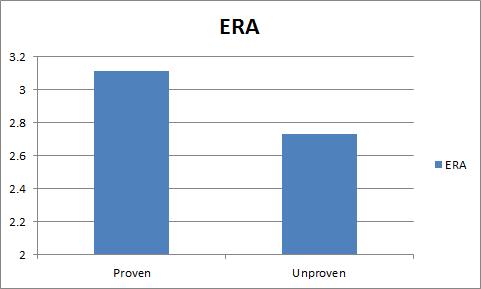
So basically, this is the argument I’m making. Closing experience does not predict future success in that role. The 30 best closers from 2012 prove that pretty nicely. The 15 proven guys were no more successful at converting saves and had a worse ERA than the non-proven closers. If anything the unproven closers pitched better.
Jim Leyland and the Tigers have placed an extremely high value on closing experience. They signed a reliever who was past his ability to pitch in MLB because he had saved games before and they won’t turn to better pitchers because they “can’t close.” Leyland has been clear on this. I have never heard a clear explanation about what makes the 9th inning different, but I can tell you very clearly that pitchers have been placed in the closer’s role as recently as last season and had absolutely no problem handling it.
No problem at all. So while I don’t advocate using a closer at all, if managers insist on defined roles with specific limits can we at least accept the fact that you can put anyone who is reasonable competent into the closer’s role?
Leyland doesn’t want to use Smyly or Benoit in the closer’s role and has repeated said the “9th inning is a little bit different,” but there is just no evidence that is true.
You can create a closer by putting a good reliever into the role. The Tigers have good relievers and should just put one of them into the role if Leyland insists on having a closer. It really is that simple. You can invent a closer. Fifteen teams did it last season.
I’ve included an Excel File (Closers) with the the data I used. The stats to the right of the yellow divider are from 2012 and the left side is from 2011.
Nick Castellanos is Forcing the Issue

I’m the last person in the world you’ll hear clamoring for the Tigers to make roster moves to replace players who are having a bad two weeks and I’m never someone who advocates rushing prospects because you have a need at the major league level. This is not that kind of post.
In fact, it’s the opposite. Andy Dirks is slumping at the plate, although his defense has been very good, but Matt Tuiasosopo is more than capable of stepping in to be the Tigers everyday left fielder for now. The Tigers had the league’s best offense entering the day (112 wRC+) and we all know they have the best pitching staff in baseball quite comfortably. I’m not worried about the Tigers one bit. They are a great team who will win the Central, barring significant injuries, quite easily.
But Nick Castellanos, the Tigers top prospect, is sitting in AAA Toledo and he’s starting to make some noise. A lot of it actually. No player under 24 had a higher wRC+ than Castellanos in AAA except for the recently promoted super-prospect Wil Myers. Nick is now the best young hitter at his level and he may be outgrowing it.
The book on Castellanos is a great hit tool with the expectation that the power will develop. His approach has needed work and his defense is still coming along. The club moved him to the OF after the Fielder signing, but he was originally a 3B. He’s 21 years old, in Triple A, and he’s forcing the issue.
Since I no longer live in Toledo, I haven’t seen Castellanos play defense, but I haven’t heard any horror stories, even if he isn’t great. But I can follow the numbers he’s putting up at the plate from 600 miles away and it’s starting to get good.
Here is how Castellanos’ numbers have looked over the course of the season (OBP, SLG, K%, and BB% at the end of each game):
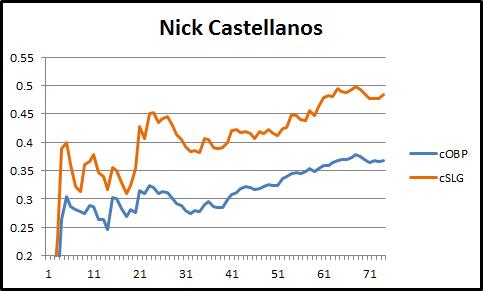
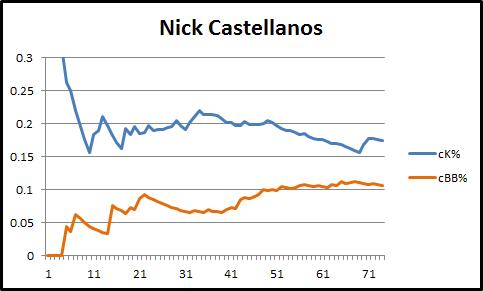
His OBP is now over .350 and his SLG is up near .500 and both numbers have been trending upward. He’s mashing lefties (1.016 OPS) and isn’t having trouble with righties either (.805 OPS). The walks are way up from last year and the strikeouts have come down. And these numbers are coming from one of the lowest BABIP’s of his career (.332 entering Wednesday) against the best competition he’s ever faced.
In half a season at Triple A, he’s put up big numbers and the biggest of those are coming more recently. The plate discipline appears to be getting better and the power is coming. I’m sure he could benefit from more seasoning and his defense probably still needs work, but it’s getting close to that time.
The Tigers don’t need him, but he’s getting close to the point where it might be time for him to come up anyway. You shouldn’t rush a prospect because your team needs him, but you also shouldn’t stash him in the minors just because you don’t. The Tigers shouldn’t be worried about his service time when they’re in their championship window. There are times to worry about an arbitration clock and there are times to play your best 25. This is the latter.
I’m not a professional scout and won’t pretend to be and I haven’t seen Castellanos live this year, but if I’m following the numbers it’s starting to look like he’s ready. This is the Tigers’ blue chip, top prospect. The Tigers are built to win now with or without him, but if he’s ready, then it’s time to call him up.
The timetable has always been late 2013 for Nick and he’s walking around Fifth Third Field in Toledo like he won’t be there much longer. I’m not saying it should be tomorrow or even this month, but I think it’s time for Nick to come north.
Two years ago, people wanted to call him up to play 2B because the Tigers didn’t have a 2B. That was silly because he wasn’t ready and he wasn’t a 2B. But it’s two years later I’m starting to think he’s ready to hit big league pitching and I’m starting to wonder if he’s one of the best OF bats the Tigers have to offer.
I think we’ll see Tuiasosopo get a few more at bats in the next couple weeks and if he hits, maybe the Tigers let Nick work on his glove. But if Tuiasosopo isn’t mashing the ball and Castellanos stays hot, our deadline deal might be with the Toledo Mud Hens, when we recall a potential franchise cornerstone.
Stat of the Week: Weighted Runs Above Average (wRAA)
When we talk about offensive statistics, the ones we usually talk about on New English D are wOBA and wRC+ which take the actual value of each offensive action and weight them properly, which OBP and SLG do not do. I encourage you to clink the links and read about those statistics if you have not already done so. However, those two statistics are rate stats and not counting stats. Rate stats tell you how well a player has performed while they’ve been on the field, but counting stats are also good for telling you how much value a player has actually added to his team.
If you have a 150 wRC+, but only have half the plate appearances of someone with a 120 wRC+, you’re not as valuable. You need to be both a good performer and a player who stays healthy and on the field. With that, I’ll introduce Weighted Runs Above Average (wRAA) to do just that. Weighted Runs Created (notice the absence of the plus sign) is a similar statistic, but it is just scaled differently. The concept is the same, but let’s stick with wRAA.
wRAA is the offensive component of Wins Above Replacement (WAR) and is based on wOBA and is rather simple to calculate if you have all of the necessary numbers.
((wOBA – League Average wOBA)/wOBA scale) * (PA)
A player’s wOBA and PA are pretty obvious and the league average and wOBA scale be found for each season quite easily here. The idea behind this statistic is how many runs a player is worth to his team above average and ten runs is equivalent to one WAR. Here is the full explanation from Fangraphs but the idea is pretty simple. How many runs above average has a player been worth to his team. Average, therefore, is 0 and anything above 10 is good and above 20 is great. It is also a counting stat, so players accumulate them throughout the season as opposed to wRC+ and wOBA which are rate stats.
I generally like rate stats better, but counting stats are an important comparison. Here’s a quick example:
Miguel Cabrera has a 193 wRC+ and .456 wOBA in 325 PA while Matt Tuiasosopo has a 186 wRC+ and .446 wOBA in 88 PA. Cabrera and Tuiasosopo have very similar rate stats, but you can distinguish their value based on how many PA they have using wRAA. Cabrera has 36.9 and Tuiasosopo has 9.3.
I wouldn’t tell you to use wRAA over wRC+ or wOBA, but it is nice to use in tandem if you’re trying to compare which players have been more valuable to their team, but stick with the rate stats if you care about determining who is actually the better player.
The Morning Edition (June 20, 2013)
From Last Night:
- Bruce ties it in the 9th and Phillips wins it in the 13th as the Reds beat the Bucs 2-1
- Myers drives in his first two to lead the Rays over the Sox
- Medlen shuts down the Mets
- Papelbon allows the Nats to tie it in the 9th, Suzuki delivers a GS in the 11th
- Yanks and Dodgers split a DH
What I’m Watching Today:
- Oswalt returns to the bigs with the Rockies against Zimmermann (7p Eastern)
- Moore and Pettitte at Yankees stadium (7p Eastern)
- Felix Hernandez faces the Angels (10p Eastern)
The Big Question:
- After 8 straight wins, are the Blue Jays getting back in this?
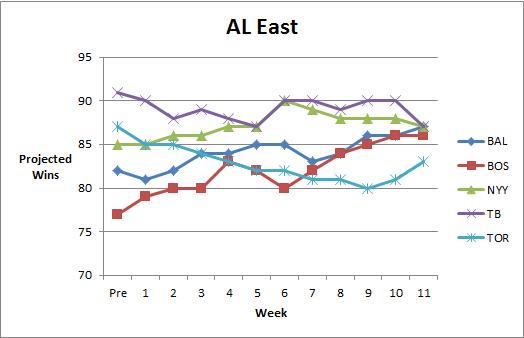
I’m doubtful despite the hot streak. Despite 8 straight wins, they are still 7.5 games back of first place and 4.5 back of the second wild card. That isn’t a number too big to overcome, but the problem is how many teams are between them and their goal. To make up the terrible start, they would have to outplay at least two other teams the rest of the way plus the distance they are already back. I’m not sure they are good enough. Fangraphs’ own standings projection is equally skeptical of the Jays, figuring them for 82 wins. New English D has them at 83 wins, and I feel pretty good about that. One week in June isn’t enough to convince me the first 10 weeks didn’t happen.
How Was The Game? (June 19, 2013)
An ambush.
Orioles 13, Tigers 3
Everything went reasonably well for the Tigers today except the top half of the 4th inning in which the Orioles hit Rick Porcello (4-4, 76 IP, 4.74 ERA, 3.66 FIP, 1.2 WAR) hard and then, of course, the 9th inning. It was a peculiar 4th inning given that Porcello was dominant in the other 5 innings, 3 of which came before and 2 of which came after. He finished with 6 innings, 9 hits, 6 runs, 0 walks, and 4 K, but all six runs and six of the nine hits happened in the span of 11 batters before he got himself straightened out. I’m not concerned given how well he’s performed this season with career best 7.46 K/9, 1.54 BB/9, 3.66 FIP, and 2.98 xFIP even after today’s game. The offense made some noise, but only turned it into 3 runs, two of which came on a Tuiasosopo pinch hit double before the bullpen allowed 3 runs to give the Orioles sufficient cushion who then put up a 4 spot on Valverde in the 9th, who simply cannot get MLB hitters out at this point and needs to be released before Jim Leyland can use him again. The Tigers dropped their second series of the season to the Orioles, but still stand at 39-31 on the season, and thankfully never have to play the Orioles again this season. I say that because MLB doesn’t allow people in North Carolina (where I live) to watch the Baltimore Orioles* under any circumstances, so I’ve spend the last three days listening on the radio like a caveman. Things will get back to normal as the Red Sox come to town for four starting Thursday with Jose Alvarez (1-0 6 IP, 1.50 ERA, 3.39 FIP, 0.1 WAR) making his second start of the year in place of Sanchez.
The Moment: Tuiasosopo doubles in a pair to make it a game.
*Or the Washington Nationals
Dynamic Standings Projection (June 19, 2013)
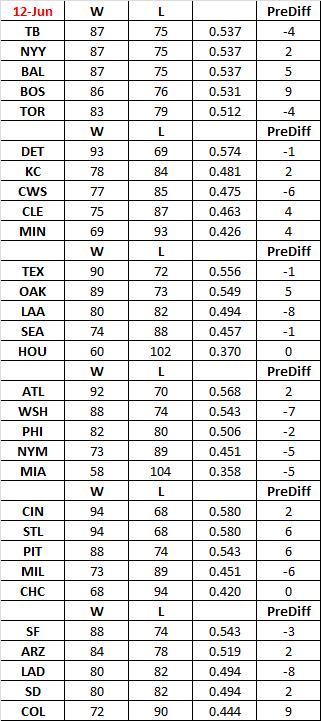
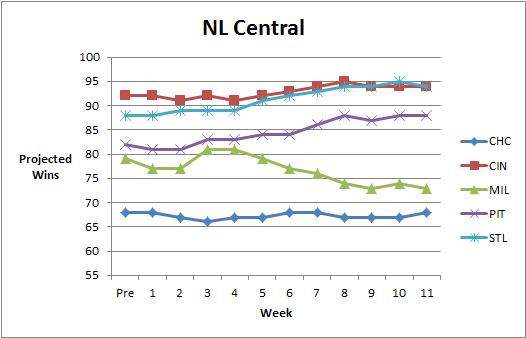
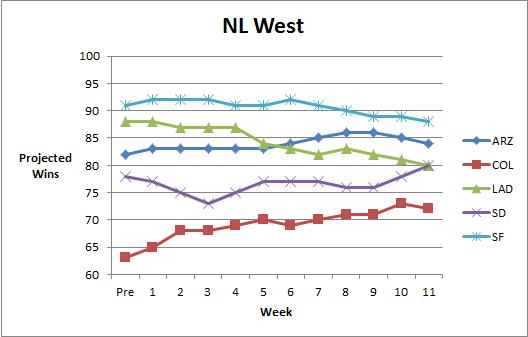
In case you missed it, in April we launched our Dynamic Standings Projection feature on New English D. A full explanation of the methodology can be found here or by clicking the tab at the top of the page. This project seeks to provide a reasoned and cautious approach to updating our beliefs about the baseball future. You can find a summarization of the original projections here. You’ll notice a column on the far right that indicates the difference in projected wins from the preseason prediction. Positive numbers mean teams are now projected to win more games and negative numbers mean a team is now projected to win fewer games. You’ll notice a series of graphs below the standings section that track how the projections have evolved over the course of the year.
This Dynamic Standings Projection is updated through the June 18 games.


The Morning Edition (June 19, 2013)
From Last Night:
- Harvey flirts with a no-no, Ks 13 and Wheeler goes 6 scoreless to sweep the DH
- The Sox sweep the Rays in a DH as Gomes walks off
- Goldy walks off in the desert
- Sweeney and Ranson homer to beat Wainwright
- Parker out does Darvish, despite 10 K
- Lee dazzles again
What I’m Watching Today:
- Ryu and Kuroda in NY (1p Eastern)
- Fernandez faces Cahill at Chase Field (330p Eastern)
- Chris Sale gets the Twins after the hardest of luck losses last time (8p Eastern)
The Big Question:
- What Tuesday a glimpse into the Mets future?
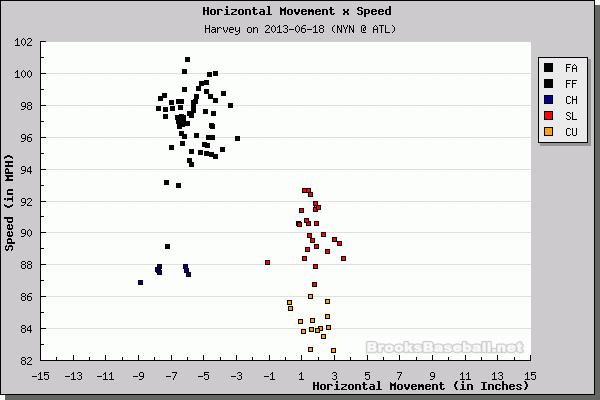
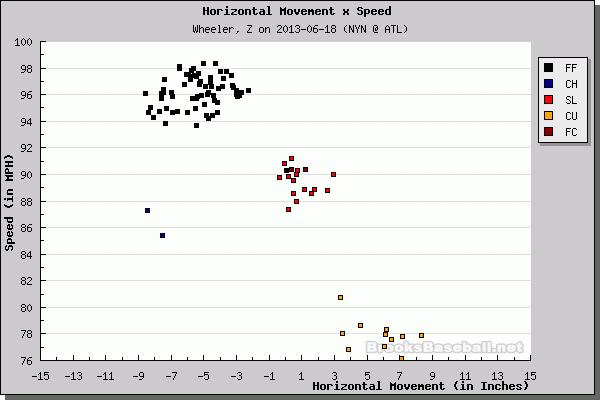
Matt Harvey pulled into a WAR tie with league leader Adam Wainwright after their starts on Tuesday at 3.8 after a great start featuring 13 K. He has a 2.04 FIP and a nearly 5:1 K:BB ratio. I don’t like to make big proclamations like this, but he’s probably the under 25 pitcher to watch if we’re thinking about who are going to be the game’s best in the next four or five seasons. But his rotation mate was strong too, as far as strikeouts and run prevention go. The walks were a bit of an issue, but Wheeler is young and should improve. I like the Mets rotation, now only if they could play OF on their off days. And if you’re like me and enjoy this kind of thing, here’s what they did on Tuesday:
 New English D