How Was The Game? (June 18, 2013)

Surprising.
Orioles 5, Tigers 2
One characterizes this game as surprising, partially because Justin Verlander (8-5, 92 IP, 3.72 ERA, 2.82 FIP, 2.8 WAR) pitched poorly despite some very good signs early and partially because Miguel Cabrera and Prince Fielder both popped out representing the tying run in the 7th inning and then Cabrera grounded into a double play to end the game. Verlander only went 5 innings, allowing 7 hits, 5 runs, and 4 walks while striking out 5. He gave up two homeruns, one to Hardy and one to Jones, that delivered all of the runs, but 11 baserunners in 5 innings is too many for Verlander regardless of how the runs were clustered. Britton kept the Tigers at bay, but started to open the door before being pulled. Tuiasosopo homered in the 5th and Jackson drove in a run in the 7th but the Tigers would get no closer. Downs, who is having a strong season, and Putkonen did nice work in relief, but the damage had been done. The Tigers will still have a change to take the series against a very good team behind Rick Porcello (4-3, 70 IP, 4.37 ERA, 3.46 FIP, 1.3 WAR) who is having his breakout season, as described here.
The Moment: Tuiasosopo homers the other way in the 5th.
Darin Downs, Very Capable Reliever

A great deal has been said and written about the Tigers and their bullpen struggles. I’ve taken part, offering criticism of signing Valverde, discussing why closers don’t matter, and explaining how I would use a bullpen. And I think we’re probably all on board with the idea that Smyly and Benoit are the Tigers best relief pitchers, even if we don’t agree on how a team should use their best relievers.
Yet in all the madness, we’ve overlooked a very good reliever in the Tigers bullpen, likely because Jim Leyland doesn’t use him very much. I said this on June 15th when Downs came on to pitch:
Some of that comes from the Tigers having an incredible rotation and not needing much relief help, but the idea that Leyland didn’t use Downs for nearly two weeks when he was running Valverde out six times is a bit of an issue. Why? Because Darin Downs has actually pitched really, really well.
In 19 games, Downs has 25.1 IP and sports a 11.09 K/9, 2.49 BB.9, and 1.07 HR/9 rate which equates to a 3.22 FIP and 3.23 xFIP along with his 3.91 ERA and 0.4 WAR. Two things jump out about that line. First, his K and BB rates are very good (29.3% and 6.6% if you prefer) but also that his performance looks entirely sustainable in the sense that his peripherals are in line with his results. He’s faced only 106 batters, so maybe this is just the best stretch of his career, but if it is, the Tigers should at least be riding the streak.
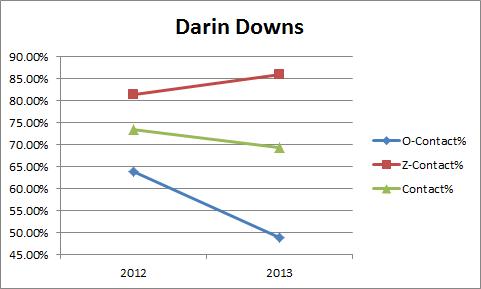
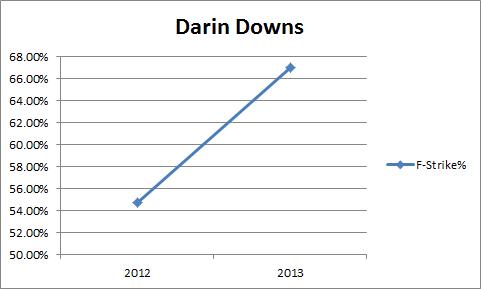
Last year, he was good also, if not quite this good (3.48 ERA, 3.24 FIP, 3.82 xFIP in 20.2 IP). So this isn’t totally out of nowhere. He leads all Tigers pitchers in O-Swing% (getting hitters to swing at pitchers out of the zone) at 37.9% and only Alburquerque has allowed less contact. Only Evan Reed has thrown more first pitch strikes.
I’m fully aware that I’m walking on small sample size thin ice, but I’m going to press on because I think this gets interesting if you’re willing to stay with me.
Here are his K/9 and BB/9 over the last two seasons (K% and BB% look the same):

And he’s inducing more swings on pitchers outside the zone and fewer inside the zone:
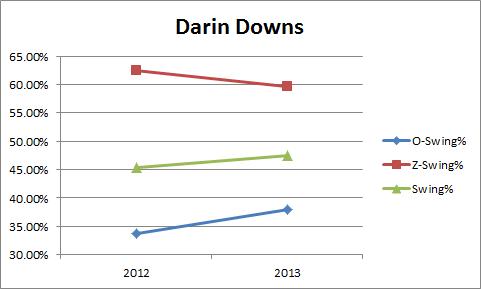
Downs is getting hitters to chase more outside the zone and take more inside the zone, which goes nicely with the fact that hitters are making less contact outside the zone and more inside the zone this year:
And in a very boring visual, he’s also throwing more first pitch strikes than last year:
So if we’re willing to accept our hands are tied with small samples any time we analyze relievers, Downs looks good. He’s improved from last year to this year and his numbers are quite good this season. If we’re going to look at statistics for relievers at all, the statistics tell a good story regarding Downs. He’s good and he’s getting better.
So what’s different? It could be simple variation, but there is something else I want to highlight. It’s not just the results that are better, the pitches are better too. Let’s start with his pitches from 2012:

And here is Downs this season:

Notice how the changeup and fastball is moving more this season and notice how there is more separation between the fastball and the changeup. His pitchers are moving more and the separation has gotten a bit better. That’s generally a good formula for success. And I think Downs has figured it out. Here’s how he’s mixing his pitches:
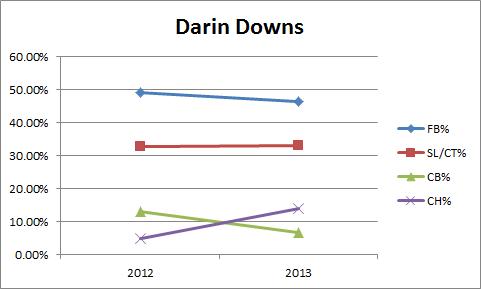
He’s going to the changeup instead of the curveball more often, just like so many Tigers pitchers, and it’s becoming a better pitch for him. He’s throwing the changeup more and he’s getting more swings and misses on it, and also with the curveball, possibly because hitters now have to worry about a good changeup and can’t read the offspeed pitch as well:

And no, Darin Downs does not have a platoon split this season. In fact, he’s both faced more righties (58 vs 48) and done better work against them this season. Hey, aren’t changeups used to get opposite handed hitters out?!

So the story with Downs is this. He’s having a good season and by all accounts he has gotten better since last season, and that improvement is based on some actual differences in his pitches and pitch usage. When we dive into reliever stats, we can often get lost in small samples, but if we’re going to evaluate relievers, and clearly we are, everything is going in the right direction for Downs.
It’s about time he gets the recognition he deserves and maybe even some high leverage appearances.
Miguel Cabrera and Chris Davis Own 2013


Miguel Cabrera came into 2013 having recently won an MVP and the first Triple Crown in decades. No one would bat an eye if you mentioned his name among the greatest hitters in baseball history whether the listener was a believer in batting average and RBI or wOBA and WAR. His off field issues might cause some whispers, but his name is essentially synonymous with great hitting.
Chris Davis had a well-established reputation of being a slugging hacker. Lots of power, not much of an approach at the plate. The Orioles got a solid season out of him in 2012, but it was a 2.0 WAR kind of season, not a Miguel Cabrera kind of season. He was 27 years old in need of a strong season to avoid being labeled a platoon player.
But that was two and a half months ago. Cabrera’s story isn’t much different. He’s having his best season, but that doesn’t surprise you very much. He’s always been a star. But Davis’ story is much different. Chris Davis was closer to Crash Davis that he was to Miguel Cabrera a year ago, but now he and Cabrera are sharing the leaderboards and a lot of sentences about the game’s best hitters right now.
This isn’t a post about who Cabrera and Davis were before or who they are going to be after. This is Miguel Cabrera and Chris Davis in the summer of 2013.
(All statistics reflect the season to date as of 6/17, before the start of the Tigers-Orioles series at Comerica Park)
Cabrera is hitting for a higher average and is getting on base more frequently, but Davis is making up for it with a higher slugging percentage. Balance those differences out and their wOBA are nearly identical.
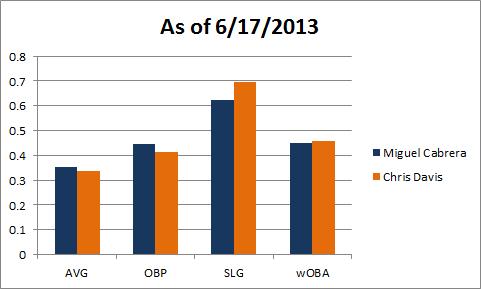
Once we control for park and league average, Chris Davis tops Cabrera in wRC+ narrowly 194 to 189. In terms of overall offensive value, they have essentially been the same player thus far. Remember, this post isn’t about what to expect in the future, it’s about what they’ve done to this point.
Breaking down the SLG, you can see the hit distribution gives Davis more extra base hits, but Cabrera has more hits period.

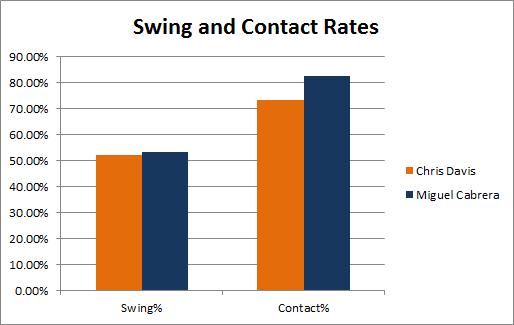
Having read this far, I probably don’t have to tell you that Miguel Cabrera’s approach at the plate has been better:

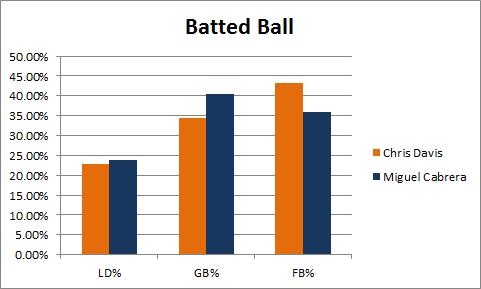
And Davis hits more fly balls in place of the ground balls hit by Cabrera:
In 2013, Cabrera and Davis have been about equally valuable on offense when you break it down. Davis is slugging it a little more so than Cabrera, who is focusing more on getting on base, but neither is bad at either. They both have the HR and RBI if you’re looking for Triple Crown narratives. Davis is 1st in HR, Cabrera 2nd. Cabrera leads in RBI, Davis is 2nd. Cabrera leads in average, Davis is second.
It’s a draw, with a slight edge to Davis. Cabrera has the track record and will certainly have the better career, but right now at this moment, they are essentially the same.
That’s amazing and wonderful and weird. Think of it like this. A year ago, Miguel Cabrera was crafting the first half of an MVP season. Chris Davis was the position player the Orioles called on to pitch in a marathon game with the Red Sox on May 6th.

I didn’t have to look up the date, I remember it pretty well. I read about in a hotel room on my wedding night. A year ago, Chris Davis was so expendable to the Orioles that they let him pitch. Now he is, for all intents and purposes, Miguel Cabrera.
That’s pretty freaking cool. Baseball is often predictable, but there are plenty of exceptions to prove the rule. Davis is having quite the exceptional year. I’ll be glad once he leaves town and does his Cabrera impression against other clubs.
How Was The Game? (June 17, 2013)
Another gem, this time from Scherzer.
Tigers 5, Orioles 1
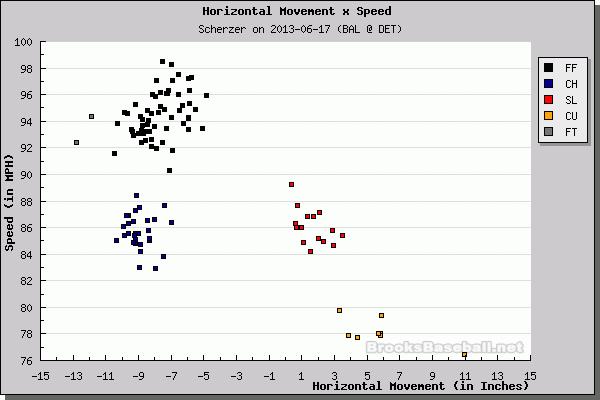
We’re at the point, where it is hardly news now when a Tigers starting pitcher throws a brilliant game. It was Max Scherzer (10-0, 96.1 IP, 3.08 ERA, 2.51 FIP, 3.1 WAR) who did it tonight, delivering a 6 inning, 1 R, 2 BB, and 10 K line with the only blemish being a homerun to Chris Davis. The Tigers rotation is on pace to be the best rotation in MLB history and Scherzer is now the 2nd best pitcher in the AL by WAR, trailing only King Felix, who has made an additional start. The Tigers offense came from a 2 run bomb from Cabrera in the 1st, a Jackson single in the 2nd, a Martinez sac fly in the 5th, and a Peralta single in the next at bat. Leyland even brought Smyly in at the right time to get 9 outs! But the moment of the night, no doubt, was Scherzer striking out Davis with the bases loaded to end the 5th inning. Here’s how he got him, with exceptional control and terrific velocity:

I mean, what do you do against a guy who can offer this mix:
The win finally pushes the Tigers 10 games over .500 to 39-29 as they send Justin Verlander (8-4, 87 IP, 3.41 ERA, 2.49 FIP, 3.0 WAR) to the hill tomorrow looking to take the series.
The Moment: Scherzer gets Davis to strikeout with the bases loaded to end the 5th.
The 2013 Tigers Are The Best Rotation…Ever (So Far)
Regular readers will not be surprised to hear me say the Tigers rotation is exceptional and many of you have probably seen Dave Cameron’s take from a few weeks ago on the same subject. His point, which is the one I’ll pick up here, is that when we adjust Fielding Independent Pitching (FIP) for ballpark effects and league average, the Tigers have the best rotation ever, no hyperbole added.
Those adjustments will look like this: League average FIP- is 100 and every point above or below average is a percent better. Pitchers want the lowest FIP- possible.
The current record for FIP- belongs to the 1971 White Sox at 77 with a handful of other clubs packing around 77-79. The 2013 Tigers are setting the pace, however, at 64. Consider what that means. The best rotation of all time was 23% better than league average. The Tigers rotation is 36% better than league average.
Certainly, the season isn’t even half over and there is time for the Tigers to cough this up, but they have a pretty big cushion. They’re getting contributions from all five starters who all have a FIP below 3.50 and all have xFIPs at 3.20 or below. More amazingly, the strikeout rate is off the charts. We have to acknowledge that this is a high strikeout era, but the Tigers current K/9 from the starting rotation is 9.51. The MLB record is 8.62 from the 2003 Cubs. The Tigers have a K:BB ratio of 4.46. The MLB record is 4.22 from the 2011 Phillies.
The Tigers rotation leads baseball in K/9 by a ton, is 3rd in BB/9, and 2nd in HR/9. They’re essentially dominating hitters in a way that we’ve never seen before. Currently, they’ve accumulated 13.2 WAR, which is 3.3 wins more than the 2nd place Cardinals and they are nearly halfway to the record set by the 1970 Cubs (29.4).
It’s a rotation on an historic pace. If we plot FIP- and ERA- (which is the same principle comparing to league average) it just looks silly. This is every starting rotation in MLB history, including the other 2013 rotations who are already regressing to the mean.

One would except the Tigers to regress toward the line that obvious runs through this plot, but it’s not entirely clear in which direction they will move. FIP and xFIP are more predictive than ERA, so you would expect that they would move left on the graph before they moved up, but that seems equally ridiculous given a subpar defense and the fact that an ERA- that low would also be silly.
I’ve written before about how the Tigers as a team are throwing more changeups and how Scherzer, Porcello, and Sanchez have all made leaps into the upper echelons of MLB starters. This is a truly remarkable rotation that Dave Dombrowski has assembled. Most teams would kill for their worst starter. Their fourth best starter would be the ace on almost every team this season. They have the 4th, 6th, 8th, and 11th best pitchers by WAR this season. They have the 2nd, 7th, 8th, and 12th best starters by FIP and the five Tigers starters are 4th, 6th, 7th, 8th, and 16th best pitchers by xFIP in MLB right now.
If you sort AL starters by xFIP all five Tigers starters are in the top 10. Three of the top four AL starters in K/9 are Tigers. Justin Verlander has the Tigers worst BB/9. Justin Verlander.
This is, perhaps, the most incredible rotation we’ve ever seen. If you look at the individuals starters and how they compare to their peers you certainly have to wonder where the Tigers rank all-time. As it turns out, they rank quite well. By strikeouts, walks, and homeruns allowed, the three categories that build FIP, pitchers have complete control over, and generally predict future performance, the 2013 Tigers are not just the best rotation we’ve ever seen, it’s not really even that close.
With 95 games to play, the Tigers staff is working on a season for the ages.
How Was The Game? (June 16, 2013)
Another gem for Fister.
Tigers 5, Twins 2
Doug Fister (6-4, 92.2 IP, 3.21 ERA, 2.68 FIP, 2.8 WAR) came into Sunday’s game having pitched phenomenally over the last several outings, and really the entire season, but had very little to show for it in the win column thanks to almost no run support (50 runs entering the day). But he got early support from Torii Hunter’s 300th career homerun and later from a very impressive Austin Jackson bomb.
Fister would handle the rest, retiring the first 11 batters he faced before allowing a walk and 15 of the first 16 before allowing a homerun to Dozier that broke up his no-hit bid (Dozier had both hits against Fister). He finished the day with a fantastic 7.2 inning, 2 H, 2 R, 2 BB, 7 K performance. It was classic, no drama, fast working Doug Fister. Hunter tacked on another with a 12 pitch AB that ended in an RBI double to help pad the lead for Benoit, who was called on to get the final four outs (!).
The win sends the Tigers to 38-29 as they head home from a .500 road trip to face the Orioles. Max Scherzer (9-0, 90.1 IP, 3.19 ERA, 2.49 FIP, 2.9 WAR) will get the ball in game one on Monday, looking to build on his excellent 2013 campaign.
The Moment: Jackson smashes a 2-run HR in the 4th.
The Time Has Probably Come for Avila
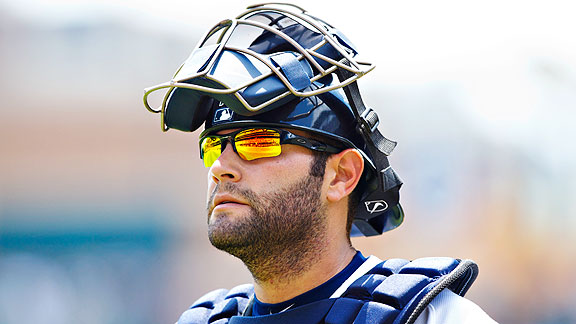
I’m going to be honest up front. I love Alex Avila. He’s one of my favorite players. I caught all the way up through high school and always thought the best catchers were one part strategist, one part shrink, and one part over-protective mother. I think he’s the perfect mix. I love his demeanor and his class. He’s a strong defender and a good teammate. He calls a very good game. And in 2011, he was an elite hitter. In 2012, he was a solid MLB regular. But this year he looks lost. I don’t have the answers, I just have questions.
I’m always an advocate to give struggling hitters time. There’s random variation in outcomes and performance. I wrote about that with Victor Martinez recently. Sometimes players need time to figure things out. But we’re approaching the halfway point of the 2013 season and Alex Avila hasn’t figured it out. Granted, it’s not getting worse, but it’s not getting better.
I dove into the numbers and my conclusions are descriptive, not causal. I know what the problems are, but I can’t figure out what’s causing them. Entering 2013, Avila had a 115 wRC+ in his career with a very nice .261/.359/.432 line. He had 8.0 WAR in about 3 seasons worth of PA. This year (entering 6/15), he’s at 52 wRC+, .166/.265/.280, and -0.3 WAR.
Going deeper, he’s walking at a good rate, but the strikeouts are up and the BABIP is down. Unlike with Martinez, Avila isn’t making a ton of hard hit outs. He’s had some, but not so many that you could chalk this thing up to luck. He’s hitting fewer line drives and more groundballs. He’s swinging less at pitches outside the zone and more at pitches in the zone, and just a little bit more (1%) overall. But the contact rate is down both in and outside the zone.
He’s making contact less, the contact is weaker, and the balls that are in play are going into the ground more often. If you look at his platoon splits, it’s actually so gruesome that you have to look away. He hits.191/.299/.328 against RHP (75 wRC+, 131 PA), but just a dreadful .038/.074/.113 against LHP (-80 wRC+, 27 PA). That’s not big sample size, so the error bars around the left side should be pretty big, but I’m not quite sure I’ve ever seen a line look that bad even in just 30 PA.
But then I went looking at his performance by count, and things got confusing:
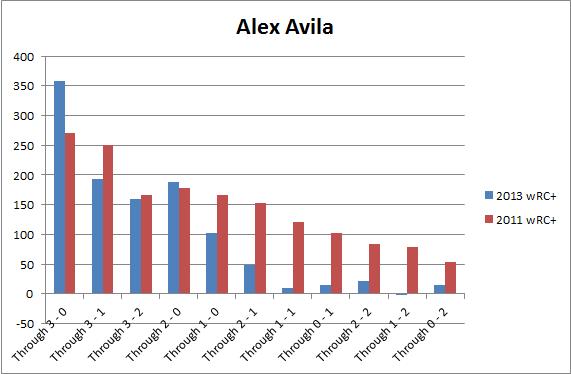
I’m looking at that graph comparing his 2013 and 2011 wRC+ by count and it looks pretty comparable for the hitter’s counts and pretty uneven when he’s behind in the count. And that kind of throws a wrench in this whole thing. I thought I was looking at Avila and seeing some sort of problem with his swing. Maybe something hurts, maybe he’s out of whack. But when he gets ahead in the count, he can hit. If his swing was messed up, he couldn’t hit in 2-0 counts.
So this has to be between his ears. It seemingly has to be. He says he’s healthy and I believe him. So it’s something happening with his approach, which is weird because his walk rate is good. Above average, even. What we’re looking at is kind of baffling. Clearly Avila isn’t performing at the plate, but the best explanation I can come up with is that it’s about his approach, not his health or mechanics. But he’s walking and chasing fewer pitches, so how can his approach be messed up?
Like I said guys, I don’t have answers, just questions. The contact isn’t good and the power is gone. He’s shown flashes of it, but it’s mostly not there. So I think it’s probably time to send him down to Toledo to figure this out. I generally have three conditions for sending an established player down to the minors:
- The team has to have a replacement plan that is better.
- Staying in the majors isn’t helping the player solve the problem
- The player has been given sufficient time to solve the problem at the MLB level
I think we’re at the point where all three conditions have been met. We’re closing in on the halfway point and Avila isn’t turning the corner. It’s clearly not helping him to get at bats in Detroit right now and the Tigers can offer Pena and a minor league compliment who can produce at a better level than Avila can.
It’s time. I would consider myself among the most patient people for these kinds of things, but I think it’s time to send Avila to Toledo to work on whatever it is that has gone wrong. He’s shown us he has the ability to be a star player, but he just can’t get anything going at the plate right now and there is no indication it’s just bad luck. The Tigers need to get Avila going and I think he needs to head to AAA to get going.
I’m a huge fan of Avila and I’m pulling for him to snap out of it on every pitch. But I think the time has come for the Tigers to make the move and outsource his recovery to Phil Nevin and Bull Durham down I-75 in Toledo. I don’t want to see it happen and I won’t stop wearing my Alex Avila #13 shirt, but it’s not helping anyone to keep him in Detroit and in the lineup.
The Tigers are easily one of the top teams in the league right now despite Avila’s struggles. Imagine what they could be if he was hitting the ball like we know he can. Two or three weeks in AAA should help, and if it doesn’t, then at least we know where we stand. The team knows the player better than I do, but I think it’s time and I’m not an easy person to push to this conclusion.
It’s time for the Tigers to send Alex Avila down so that they can recall the good Alex Avila as soon as possible.
How Was The Game? (June 15, 2013)
Not what you want to see.
Twins 6, Tigers 3
The Tigers were outscored by the Twins on Saturday, leading to a loss, but that isn’t the part of the game that is most concerning. That event was Anibal Sanchez (6-5, 81.2 IP, 2.76 ERA, 2.07 FIP, 3.1 WAR) being removed in the fourth inning, potentially with further shoulder issues. As I write this, it isn’t clear if he was hurt or just out of whack, but he only went 3.2 IP, and had an uncharacteristic 3 K and 4 BB. Hopefully we’ll know more soon, but you hope it’s good news because he has turned himself into one of the game’s best starters. The Tigers got two in the fourth on a Peralta single and one in the 8th on a Fielder ROE, but the Tigers allowed 3 in the 6th and never really seemed in it after that. They’ll try to shake it off and go for the series win Sunday behind the very excellent Doug Fister (5-4, 85 IP, 3.28 ERA, 2.59 FIP, 2.7 WAR).
The Moment: Peralta singles in two on a broken bat grounder.
Anibal Sanchez Masters His Changeup and AL Batters

Earlier this season, I wrote about how the Tigers starters were utilizing the changeup more often this season and that it was working to their advantage. Yesterday, I took on Rick Porcello’s rising star and how his use of offspeed pitches were helping him become a bona fide star. Well it’s working for another one of the Tigers pitchers, too.
Anibal Sanchez has been a solid MLB starter for several seasons, so his breakout might be a little less surprising to you, but it’s not less impressive than what Porcello is doing. Here are Sanchez’s strikeouts and walks per 9 since 2009:
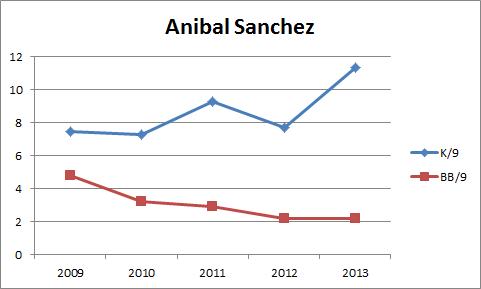
He was always a 7-9 K/9 pitcher and his control has been improving each year. But something happened this year. His strikeouts shot way up and that is directly responsible for his career best ERA, FIP, and xFIP and his on pace to be best career WAR. Here are those rates since 2009:

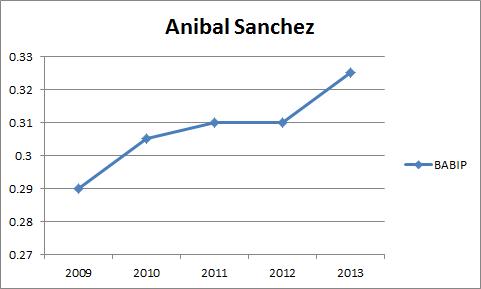
Any quick look at Sanchez’s numbers will tell you he’s striking out more batters and walking fewer, but the walk rate decline has been happening for years. But the strikeout spike is new and it’s correlated with the huge improvement in run prevention. That alone isn’t enough to tell you anything, but consider this. Sanchez is actually getting hit harder when he gets hit. He’s giving up more hits on balls in play (probably because of his defense, but that counts toward his ERA)
And the batted ball data actually makes him look worse as he is giving up more line drives at the expense of groundballs, which we would usually consider to be harder hit and more likely to result in baserunners:

So let’s review. He’s preventing runs better than ever before with more strikeouts and fewer walks. He’s giving up more hits on balls in play and they are likely coming on harder hit balls because he’s giving up line drives. If anything, he’s been unlucky on balls in play. His HR/FB rate will regress up, but that is accounted for in xFIP so we’ve essentially controlled for that explanation. The only explanation that makes sense for why he’s gotten so much better this season is the strikeouts.
But about those strikeouts. He’s not getting hitters to swing more than they used to. And he’s not getting them to swing at worse pitches. Batters are essentially swinging the same amount as they have the last two seasons against him both in and out of the zone:

So they’re swinging the same, but they are making much less contact:

Let’s revisit how he’s adjusted his pitch selection now to get a sense for what might be causing this:

Basically, the key change in Sanchez’s approach is his increased use of the changeup. If we sum this up, we get this story. Sanchez is preventing runs better this year because he’s getting more strikeouts. He’s getting more strikeouts because he’s getting hitters to swing and miss more often, but not based on the location of the pitch. So it has to be about the pitches themselves. And he’s using the change up more. So it’s probably the changeup, or at least the threat of a better changeup.
In fact, if we track his swing and miss percentage on each pitch over the last five seasons, you can see that while he’s doing well with the fastball and slider this year, it’s the changeup that is really driving this breakout over time. He’s gotten swings and misses on his fastball and slider at this rate before, but the changeup swing and miss rate is at an all time high.
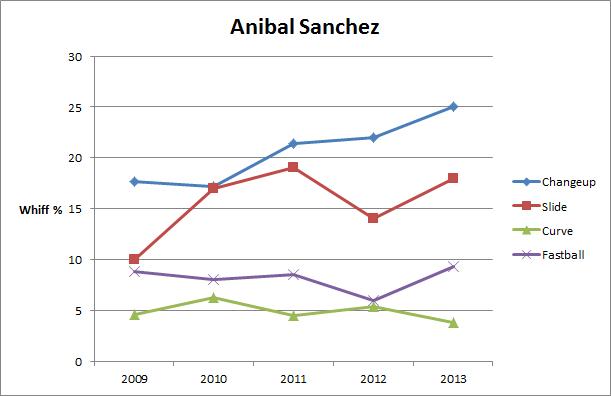
In my other life, I’m a social scientist, so I’m not going to sit here and tell you a better and more effective changeup is the only reason Sanchez is better this year, but the evidence certainly points in that direction. He’s getting better results based on an increase in strikeouts. Those strikeouts are the product of more swings and misses, but batters are swinging at the same rate and they are swinging in the same locations. At this point, it looks like the changeup is drawing the most whiffs, and therefore, more of the credit for the uptick in strikeouts.
Sanchez was great down the stretch for the Tigers in 2012, but some people worried about giving a good but not great starter such a big contract. It doesn’t appear as if those concerns were warranted as Sanchez has turned himself in the AL’s best pitcher by FIP, xFIP, and WAR so far this season thanks to better use of his changeup. This is something all of the Tigers starters seem to be doing, but Sanchez is doing it exceptionally well. I’m not sure if it’s Jeff Jones, Alex Avila, or the starters themselves, but the Tigers are striking batters out at a crazy rate and it’s likely thanks to the changeup.
Anibal Sanchez has the changeup to thank for what could be a Cy Young season.
The Morning Edition (June 15, 2013)
From Last Night:
- Chris Sale went 8 innings, allowed 0 ER, and struck out 14. Against the Astros. He lost.
- Buehrle looks good, blanks the Rangers over 7
- Bumgarner is brilliant against the Braves, 10K
- Fernandez K’s 10 to beat the Cards
- Dusty Baker actually used Chapman in a non-save situation, helping Jay Bruce homer the Reds to victory
- Moore struggles in loss to the Royals (about to lose Appointment TV status)
- The Indians walk off the Nats, Masterson K’s 10
What I’m Watching Today:
- Kershaw pitches at PNC (4p Eastern)
- Cobb faces the Royals (4p Eastern)
- Felix tries to slow the A’s (7p Eastern)
- Zimmermann vs Kazmir (7p Eastern)
The Big Question:
- Are we still even keeping track of wins after what happened to Sale tonight?
Chris Sale went the distance, gave up no earned runs, and struck out 14 Astros and lost. Basically, you can give up 7 ER in 7 IP and get a win and give up 0 ER in 8 innings and lose. So these make sense. But much more notably, MLB handed down suspensions for the Dbacks and Dodgers brawl today and kept it pretty toothless. Belesario threw punches and got one game. Ian Kennedy got 10 games, but he’s only going to miss one start. The managers only got one game. It doesn’t look like MLB wants to curb this behavior, even thought it’s essentially felonious. Other than that, I just have to plug Rick Porcello again, because he’s turning into a star.
 New English D