There’s Miguel Cabrera and Then There’s Everyone Else

Earlier today, Fangraphs’ resident GIF expert posted this beauty that demonstrates Cabrera’s ability to hit for power no matter where a pitch is located. And a large number of other people whose job it is to say things about baseball have flooded the internet with statistics and observations about Cabrera’s torrid start.
I’m not going to rehash everything because most of you can read and it’s pretty easy to call up numbers with a quick Google search. But I would like to point a few things out about Miguel Cabrera with respect to his peers at this moment.
First, Cabrera leads MLB in WAR (3.2) by 0.3 over Evan Longoria (2.9), but Miguel Cabrera is currently rated as the 8th worst defensive player who qualifies by Fangraphs. In other words, Cabrera is hitting so much better than everyone else that he is still the most valuable player even though he is among the worst glovemen going. Let’s look at it:

And now, just for reference:

Miguel Cabrera has been baesball’s most valuable player so far despite being one of it’s worst defenders. That’s how much better he is than everyone else at the plate. You can see from the first graph that the quality of your offense and the quality of your defense aren’t that strongly related (on average a 1 unit increase in wRC+ decreases your defensive score by .007, but the results aren’t statistically significant and the R squared hardly registers.). But on the other hand, Fld and WAR are related (on average, a one unit increase in Fld will increase your WAR by .08 with the results being statistically significant and the R squared at least somewhat reasonable).
In other words, defense and hitting aren’t really related, but defense and WAR are (obviously). That rule just doesn’t apply to Cabrera because he’s outhitting everyone by so much.

He’s out there by himself. If you’d rather break it down by AVG, OBP, and SLG it’s just as impressive.


Miguel Cabrera, through 45 games, is simply outhitting everyone. This is the peak of one of the best hitters we’ve seen in our lifetimes, so enjoy it.
The Morning Edition (May 24, 2013)

From Last Night:
- The Angels get 4 HR off former teammate Santana to beat the Royals
- The Indians take out their Tigers frustration on the Red Sox, win 12-3
- Gausman doesn’t impress with results in his debut, falls to the Jays
- The Pirates get to Jackson, win 4-2
What I’m Watching Today:
- Zimmermann faces the Phils (7p Eastern)
- Masterson looks to stay hot against the Red Sox (7p Eastern)
- Danks makes his season debut against the Marlins (8p Eastern)
- Burnett heads to Milwaukee (8p Eastern)
- McCarthy looks to back up two good starts against the Friars (930p)
The Big Question:
- Who would you guess is the worst defensive team in the league?
I’d have said the Astros before I looked it up, but it’s the Angels. The Angels! They’re -37 DRS, -16.1 UZR, -10.3 UZR/150 which are all 30th best in the league. That seems really crazy to me given some of the great defenders they have, but with their overall struggles, some must be leaking into the defensive side. Let’s look. I set the minimum innings to 30 at a position and looked at the leaderboard. Here it is:
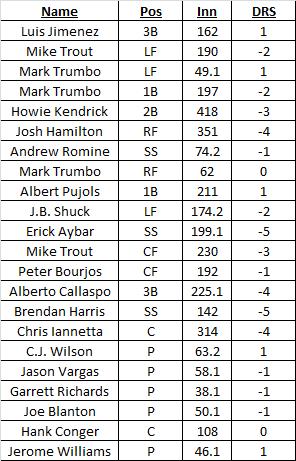
I know defensive numbers don’t stabilize this early, but that’s just not what you want to see for a team that should be pretty good on defense.
How Was The Game? (May 23, 2013)
A team effort.
Tigers 7, Twins 6
You might take a look at Rick Porcello’s (2-2, 43 IP, 6.28 ERA, 4.50 FIP, 0.3 WAR) 4 run 3rd inning and dismiss his performance as poor, but his defense botched a couple of plays and made the whole thing look worse than it was. The gopherball to Willingham is the only pitch he’ll lose sleep over, but he shouldn’t lose too much as his offense came to his rescue in spades. Cabrera homered in the 1st and drove in a third run with an infield hit in the 5th, while the whole team got involved in a 3 run 7th that erased Porcello’s 5 runs and Downs’ 1. In the 8th, Infante reached, Hunter bunted him to second, and Cabrera was IBB’d to set up a Prince Fielder RBI single to give the Tigers a 7-6 lead which would hold up to the scrutiny of the 9th inning. With the win the Tigers move to 26-19 and will turn to Anibal Sanchez (4-4, 55.1 IP, 2.77 ERA, 1.80 FIP, 2.4 WAR) tomorrow night looking for their 4th straight win.
The Moment: Peralta drives in Fielder with a double to left to tie the game.
On Defense and Unearned Runs: ERA Isn’t the Answer
Last night, Justin Verlander was not at his best, but his overall line looked worse than it was because Torii Hunter made two poor plays in right that cost Verlander two runs, but neither was ruled an error. So Verlander’s ERA goes up because of poor defense even though conventional wisdom is that the “earned” part of ERA factors out your defense making mistakes behind you.
It does and it doesn’t. You don’t get charged for runs that come from errors but you do get penalized when the official scorer makes a mistake (as we saw last night) and when your defensive players do not make a play they should have even though it does not qualify as an error. Sabermetricians have devised other metrics like FIP, xFIP, SIERA, and others to stand in for ERA with a focus on elements of the game that pitchers can control because they have no control of what happens once contact is made. (Read my explanation of FIP for more specific information)
Today, I’d like to offer a little concrete evidence for why ERA doesn’t capture a pitcher’s value. Let’s take an independent measure of defense (Fangraph’s aggregate Fld score) and compare it to the number of unearned runs a team allows (or the percentage of a team’s runs that are unearned).
I haven’t looked back into history, but for 2013 the relationship is nonexistent. For the raw number of unearned runs, the results are not statistically significant and are substantively small. On average a team needs to increase its Fld score (range -21 to 18 so far) by about 7 to eliminate a single unearned run on average (range 5 to 25 so far). On average, from worst to first in Fld you can move only 20% of the range of unearned runs. This tells us that the strength of one’s defense does not predict the number of unearned runs allowed. The results are the same if we control for the total number of runs a team has allowed.
Here it is in graphical form:

As you can see, the number of unearned runs has almost no relationship with Fld and if you squint hard enough can only come up with the slightest negative tilt. Basically, what this is showing you is that the difference between your runs allowed and the runs you get shoved into your ERA do not depend on the quality of your defense, it depends on the official scorer and it depends on a lot of other things that have nothing to do with a pitcher’s skill or performance.
This is all by way of saying that ERA is not a good measure of a pitcher’s true skill level. It’s not a bad place to start, but if you look at the Won-Loss Record and ERA, you’re getting very little useful information. Expand your horizon to K/9, BB/9, HR/FB, FIP, xFIP, and other statistics and metrics that enrich the game.
ERA attempts to capture the pitcher’s performance in isolation but it doesn’t. The defense and the official scorer play huge roles in determining that number. If you want to judge a pitcher by themselves, you need to look deeper.
If you’re interested in learning more, I encourage you to visit the Fangraphs Glossary or to post questions in the comment section. I’d be happy to explain or interpret any and all statistics about which you are curious.
The Morning Edition (May 23, 2013)
From Last Night:
- Cliff Lee delivers the CGSO against the Marlins
- Wilson strong as the Angels thump the Mariners
- Granderson comes up a 3B short of the cycle, but Kuroda leaves early as the Yanks fall
- Liriano out duels Sharky at PNC
- Bautista homers twice and then hits a walk off extra inning single
- Gio and Bumgarner duel but the bullpens decide it in favor of the Nats
- The Reds make Harvey look human, win in the 9th
What I’m Watching Today:
- Only four games on the schedule that don’t involve the Tigers, here are your matchups: Jackson/Gomez, Gausman/Morrow, McAllister/Dempster, Blanton/Santana
- I’d tell you I was watching Gausman, but I can’t because I live in NC and we aren’t legally allowed to watch the Orioles or Nationals play under any circumstances
The Big Question:
- How do you spend rain delays? (I stare off into space until there is something worth watching again.)
I’ve written a good deal about guys near the top of the WAR leaderboard, but I’m going for it again because I noticed something as of this moment: four of the top six players on the list are the guys I consider to be the four best in the game. Longoria (1), Cabrera (2), Votto (3), Trout (6). Trout and Longoria are elite two way players while Cabrera and Votto are the best hitters in their respective leagues. It’s not often that your expectations line up with reality so well, but here we are.
How Was The Game? (May 22, 2013)
All over the place.
Tigers 11, Indians 7
The Tigers jumped out to a first inning 2-0 lead and then Justin Verlander (4/5-4, 59 IP, 3.66 ERA, 2.47 FIP, 2.1 WAR) gave a run back in each of the first two innings with some help from terrible “non-error” defense from Torii Hunter. But then the Tigers offense came alive with 4 in the 3rd and Verlander looked like he figured something out and shut the Indians down in the 3rd and 4th. In the 5th, the Tigers added 3 more runs and Verlander came out for the bottom half and gave up three more runs. And then the rain came and the game was halted before the inning could be completed. After a 62 minute delay, Verlander came back out to finish the 5th and qualify for a win. Then relief ace Smyly gave up 2 in the 6th to make it 9-7. After a scoreless 7th, the rain came again and we waited another 50 minutes for the 8th inning in which Miguel Cabrera hit a ball to the warning track that Michael Bourn knocked over the fence for a two run homer. The game was exactly as head-shakingly chaotic as the first several sentences of this post and I wrote it that way so you could feel the game in my words. It was one of those baseball games that just wore you down even though your team led the entire way. The win improves the Tigers to 25-19 and gives them a short, two game sweep of the Indians and sends them home to face the Twins behind Rick Porcello (2-2, 38 IP, 5.92 ERA, 4.38 FIP, 0.4 WAR) whom I argue is on his way to a breakout year. It’s unclear for certain what caused Verlander’s odd start, but there are some rumblings of sign stealing, which I can’t really dispute give that nothing else seems to be wrong with him. We’ll have to wait and see where things go from here, but the Tigers got the win and that’s good enough for me on this night. Also, if you missed it, here’s my piece from earlier on Max Scherzer’s dominate performance from Tuesday.
The Moment: Don Kelly scores on a double steal in the 5th.
Three Reasons Max Scherzer Dominated the Indians

Max Scherzer pitches for the Tigers and is also known for having two different colored eyes. Some Tigers fans like to joke that when Scherzer is pitching poorly he is pitching from the brown eye and when he is pitching well he is pitching from the blue eye. I’m not sure if that’s a real medical condition, but if it is, Max Scherzer was all blue eye on Tuesday.
He threw 8 innings, allowed 2 H, 1 R, 1 BB, and 7 K and retired the last 22 batters he faced in order. It wasn’t his highest strikeout performance, but it was superb in every way. Here are three reasons he toasted the Indians.
1. Everything Was Down
 Look at this. Scherzer threw just four of his 118 pitches in the top 1/4 of the zone and none of them were put in play. He didn’t hang breaking balls and he didn’t lose his delivery and start missing his spots.
2. His Fast Ball Was On
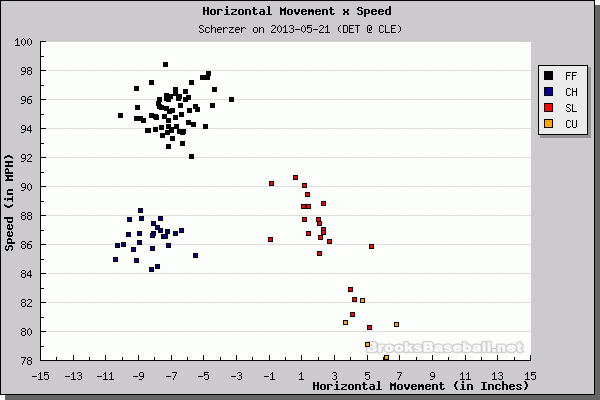
Not only did Scherzer have all four pitches working, but his fastball was particularly potent. The graph above shows the separation between his pitches by velocity and horizontal movement, but it’s also of note that his average fastball last night was an entire MPH faster (94.4 according to Pitch F/X, 95.8 according to BrooksBaseball) than his best average fastball so far this season (93.4 and 94.2 respectively). [Graph reflects Pitch F/X)
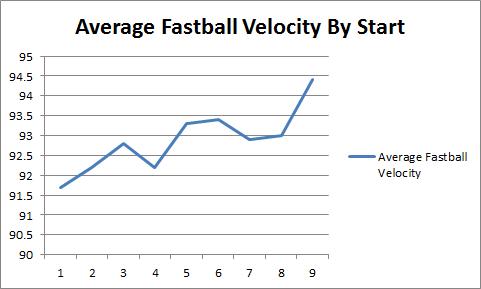
3. He Verlandered Them
Not only was Scherzer commanding his pitches and throwing harder, but he also got better as the game went on. His last pitch was his hardest fastball of the night, topping out at 98 MPH. You can see that he threw harder on average as the game went on as well with some of his best fastballs coming at the end of the game.

So while you didn’t need me to show you that Max Scherzer was great against the Indians on Tuesday, now you know why. He commanded his pitches well, his fastball was better than in previous starts, and he got better as the game went on. Scherzer is 4th in baseball in pitcher WAR with 2.3 so far and had his best start of the year last night.
Dynamic Standings Projection (May 22, 2013)
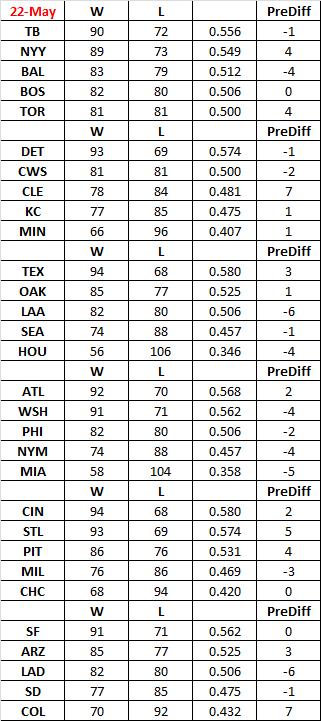
In case you missed it, last month we launched our Dynamic Standings Projection feature on New English D. A full explanation of the methodology can be found here or by clicking the tab at the top of the page. This project seeks to provide a reasoned and cautious approach to updating our beliefs about the baseball future. You can find a summarization of the original projections here. You’ll notice a column on the far right that indicates the difference in projected wins from the preseason prediction. Positive numbers mean teams are now projected to win more games and negative numbers mean a team is now projected to win fewer games.
This Dynamic Standings Projection is updated through the May 21 games.
The Morning Edition (May 22, 2013)
From Last Night:
- Mike Trout hits for the cycle
- Leake strong as the Reds beat the Mets 4-0
- McClouth walks off against the Yanks
- Garza sharp in his season debut, but Snider slams the Cubs pen to give the Bucs the W
- Greinke gets roughed up over 4 innings in Milwaukee
What I’m Watching Today:
- Harvey versus Latos at Citi (1p Eastern)
- Gio and Bumgarner throw from the left side in SF (330p Eastern)
- Cliff Lee faces the Marlins (7p Eastern)
- Buchholz gets the White Sox (8p Eastern)
The Big Question:
- Is a 4th AL 3B trying to get involved in this race?
Last week I talked about how Miguel Cabrera, Evan Longoria, and Manny Machado led the AL in WAR, but a new AL 3B has moved into the #4 spot: Josh Donaldson. As I write this, he’s hitting .315/.391/.530 with a 152 wRC+ an 2.1 WAR, which is 9th in MLB. He’s flashed solid potential before, but nothing quite like this. In 300+ previous big league at bats he was a below average walker and above average strikeout guy who didn’t hit for average of power. In the minors he had some reasonable success, but it wasn’t anything spectacular. Now in 2013, he’s crushing. His BABIP (.353) is elevated, but he’s shown a higher BABIP in various minor league stints so it’s not like it is guaranteed to regress dramatically. I left him out of my top 9 3B to start the year and I think I’m sticking with that, but for now, the best 3 players in the AL play 3B and one of them is Josh Donaldson.
How Was The Game? (May 21, 2013)
A masterpiece.
Tigers 5, Indians 1
The Tigers began the night trailing the Indians in AL Central and gave the ball to Max Scherzer (6-0, 62.1 IP, 3.61 ERA, 2.34 FIP, 2.3 WAR) to quiet the sizzling Tribe and to straighten out the Tigers staff. He did both with a brilliant performance in which he went 8 innings with 2 hits, 1 R, 1 BB, and 7 K including a string of 22 straight batters retired to end the night. It was the top of the Tigers lineup that did the trick in the 6th with a solo homerun from Dirks (and an RBI single in the 9th!) and a 2 run shot for the scorching hot Miguel Cabrera. It was everything the Tigers needed after a taxing, slugfest of a series in Arlington over the weekend. Scherzer was at his absolute best after the first inning and put the Indians down in order in every inning thereafter. They’ll look to sweep the short series tomorrow night behind Justin Verlander (4-4, 54 IP, 3.17 ERA, 2.46 FIP, 1.9 WAR) who will be in search of a bounce back start after struggling in Texas.
The Moment: Scherzer strikes out Stubbs to end the 8th and finish a string of 22 straight batters retired.
 New English D