How Was The Game? (June 16, 2013)

Another gem for Fister.
Tigers 5, Twins 2
Doug Fister (6-4, 92.2 IP, 3.21 ERA, 2.68 FIP, 2.8 WAR) came into Sunday’s game having pitched phenomenally over the last several outings, and really the entire season, but had very little to show for it in the win column thanks to almost no run support (50 runs entering the day). But he got early support from Torii Hunter’s 300th career homerun and later from a very impressive Austin Jackson bomb.
Fister would handle the rest, retiring the first 11 batters he faced before allowing a walk and 15 of the first 16 before allowing a homerun to Dozier that broke up his no-hit bid (Dozier had both hits against Fister). He finished the day with a fantastic 7.2 inning, 2 H, 2 R, 2 BB, 7 K performance. It was classic, no drama, fast working Doug Fister. Hunter tacked on another with a 12 pitch AB that ended in an RBI double to help pad the lead for Benoit, who was called on to get the final four outs (!).
The win sends the Tigers to 38-29 as they head home from a .500 road trip to face the Orioles. Max Scherzer (9-0, 90.1 IP, 3.19 ERA, 2.49 FIP, 2.9 WAR) will get the ball in game one on Monday, looking to build on his excellent 2013 campaign.
The Moment: Jackson smashes a 2-run HR in the 4th.
The Time Has Probably Come for Avila
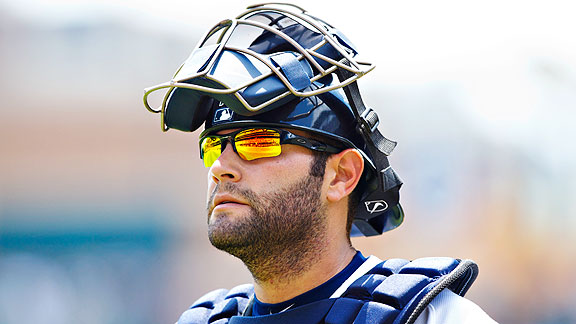
I’m going to be honest up front. I love Alex Avila. He’s one of my favorite players. I caught all the way up through high school and always thought the best catchers were one part strategist, one part shrink, and one part over-protective mother. I think he’s the perfect mix. I love his demeanor and his class. He’s a strong defender and a good teammate. He calls a very good game. And in 2011, he was an elite hitter. In 2012, he was a solid MLB regular. But this year he looks lost. I don’t have the answers, I just have questions.
I’m always an advocate to give struggling hitters time. There’s random variation in outcomes and performance. I wrote about that with Victor Martinez recently. Sometimes players need time to figure things out. But we’re approaching the halfway point of the 2013 season and Alex Avila hasn’t figured it out. Granted, it’s not getting worse, but it’s not getting better.
I dove into the numbers and my conclusions are descriptive, not causal. I know what the problems are, but I can’t figure out what’s causing them. Entering 2013, Avila had a 115 wRC+ in his career with a very nice .261/.359/.432 line. He had 8.0 WAR in about 3 seasons worth of PA. This year (entering 6/15), he’s at 52 wRC+, .166/.265/.280, and -0.3 WAR.
Going deeper, he’s walking at a good rate, but the strikeouts are up and the BABIP is down. Unlike with Martinez, Avila isn’t making a ton of hard hit outs. He’s had some, but not so many that you could chalk this thing up to luck. He’s hitting fewer line drives and more groundballs. He’s swinging less at pitches outside the zone and more at pitches in the zone, and just a little bit more (1%) overall. But the contact rate is down both in and outside the zone.
He’s making contact less, the contact is weaker, and the balls that are in play are going into the ground more often. If you look at his platoon splits, it’s actually so gruesome that you have to look away. He hits.191/.299/.328 against RHP (75 wRC+, 131 PA), but just a dreadful .038/.074/.113 against LHP (-80 wRC+, 27 PA). That’s not big sample size, so the error bars around the left side should be pretty big, but I’m not quite sure I’ve ever seen a line look that bad even in just 30 PA.
But then I went looking at his performance by count, and things got confusing:
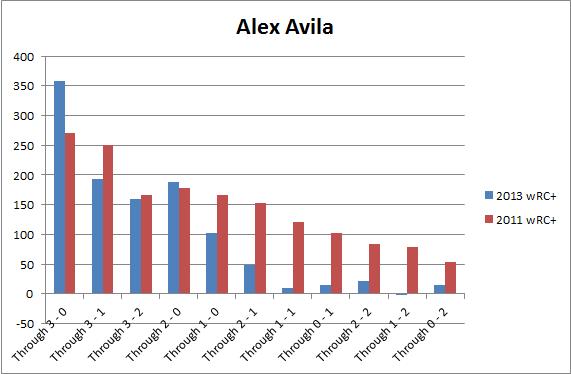
I’m looking at that graph comparing his 2013 and 2011 wRC+ by count and it looks pretty comparable for the hitter’s counts and pretty uneven when he’s behind in the count. And that kind of throws a wrench in this whole thing. I thought I was looking at Avila and seeing some sort of problem with his swing. Maybe something hurts, maybe he’s out of whack. But when he gets ahead in the count, he can hit. If his swing was messed up, he couldn’t hit in 2-0 counts.
So this has to be between his ears. It seemingly has to be. He says he’s healthy and I believe him. So it’s something happening with his approach, which is weird because his walk rate is good. Above average, even. What we’re looking at is kind of baffling. Clearly Avila isn’t performing at the plate, but the best explanation I can come up with is that it’s about his approach, not his health or mechanics. But he’s walking and chasing fewer pitches, so how can his approach be messed up?
Like I said guys, I don’t have answers, just questions. The contact isn’t good and the power is gone. He’s shown flashes of it, but it’s mostly not there. So I think it’s probably time to send him down to Toledo to figure this out. I generally have three conditions for sending an established player down to the minors:
- The team has to have a replacement plan that is better.
- Staying in the majors isn’t helping the player solve the problem
- The player has been given sufficient time to solve the problem at the MLB level
I think we’re at the point where all three conditions have been met. We’re closing in on the halfway point and Avila isn’t turning the corner. It’s clearly not helping him to get at bats in Detroit right now and the Tigers can offer Pena and a minor league compliment who can produce at a better level than Avila can.
It’s time. I would consider myself among the most patient people for these kinds of things, but I think it’s time to send Avila to Toledo to work on whatever it is that has gone wrong. He’s shown us he has the ability to be a star player, but he just can’t get anything going at the plate right now and there is no indication it’s just bad luck. The Tigers need to get Avila going and I think he needs to head to AAA to get going.
I’m a huge fan of Avila and I’m pulling for him to snap out of it on every pitch. But I think the time has come for the Tigers to make the move and outsource his recovery to Phil Nevin and Bull Durham down I-75 in Toledo. I don’t want to see it happen and I won’t stop wearing my Alex Avila #13 shirt, but it’s not helping anyone to keep him in Detroit and in the lineup.
The Tigers are easily one of the top teams in the league right now despite Avila’s struggles. Imagine what they could be if he was hitting the ball like we know he can. Two or three weeks in AAA should help, and if it doesn’t, then at least we know where we stand. The team knows the player better than I do, but I think it’s time and I’m not an easy person to push to this conclusion.
It’s time for the Tigers to send Alex Avila down so that they can recall the good Alex Avila as soon as possible.
The Morning Edition (June 16, 2013)
From Last Night:
- Felix throws 7 shutout innings to blank the A’s
- Lance Lynn gives up 7 runs in 5 innings to the Marlins, gets a W
- Cobb is struck in the head with a line drive, Rays win
- Freeman walks off on the Giants
- The bullpen coughs up a Kershaw gem, but wins in extras
What I’m Watching Today:
- Strasburg comes off the DL to face NERD darling Corey Kluber (1p Eastern)
- Lester tries to get back on track versus the O’s (130p Eastern)
- Greinke against Cole in Pittsburgh (130p Eastern)
- CC and Weaver face off in LA (330p Eastern)
- Iwakuma and Colon in Oakland (4p Eastern)
- Ian Kennedy tries to go an entire game without committing a felony (4p Eastern)
The Big Question:
- Do we live in a world where Iwakuma and Colon is the most intriguing pitching matchup?
So I’m pretty up and up on which players are having the best seasons and wasn’t expecting to be surprised, but here we are, with Hunter Pence at #12 among position players with a 3.0 WAR. Now Pence isn’t a bad player, but he’s generally been a 2-4 win player in his career with a high water mark of 4.4 in 2011. He’s already 2/3 of the way there in just 67 games. He’s had this type of offensive season before (139 wRC+) but he’s never hit this well during a good defensive season and he’s never run the bases this well according to the advanced metrics. If he keeps this up, he’ll get a nice lump of money from an organization that doesn’t care about a below average walk rate. And…the Phillies have already signed him to a 5 year deal…
How Was The Game? (June 15, 2013)
Not what you want to see.
Twins 6, Tigers 3
The Tigers were outscored by the Twins on Saturday, leading to a loss, but that isn’t the part of the game that is most concerning. That event was Anibal Sanchez (6-5, 81.2 IP, 2.76 ERA, 2.07 FIP, 3.1 WAR) being removed in the fourth inning, potentially with further shoulder issues. As I write this, it isn’t clear if he was hurt or just out of whack, but he only went 3.2 IP, and had an uncharacteristic 3 K and 4 BB. Hopefully we’ll know more soon, but you hope it’s good news because he has turned himself into one of the game’s best starters. The Tigers got two in the fourth on a Peralta single and one in the 8th on a Fielder ROE, but the Tigers allowed 3 in the 6th and never really seemed in it after that. They’ll try to shake it off and go for the series win Sunday behind the very excellent Doug Fister (5-4, 85 IP, 3.28 ERA, 2.59 FIP, 2.7 WAR).
The Moment: Peralta singles in two on a broken bat grounder.
Anibal Sanchez Masters His Changeup and AL Batters

Earlier this season, I wrote about how the Tigers starters were utilizing the changeup more often this season and that it was working to their advantage. Yesterday, I took on Rick Porcello’s rising star and how his use of offspeed pitches were helping him become a bona fide star. Well it’s working for another one of the Tigers pitchers, too.
Anibal Sanchez has been a solid MLB starter for several seasons, so his breakout might be a little less surprising to you, but it’s not less impressive than what Porcello is doing. Here are Sanchez’s strikeouts and walks per 9 since 2009:
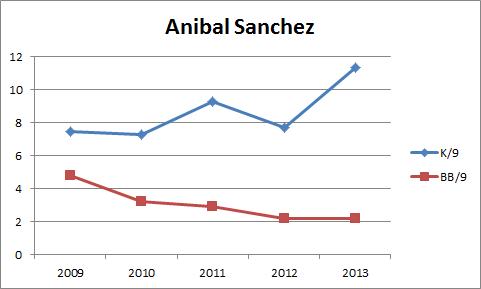
He was always a 7-9 K/9 pitcher and his control has been improving each year. But something happened this year. His strikeouts shot way up and that is directly responsible for his career best ERA, FIP, and xFIP and his on pace to be best career WAR. Here are those rates since 2009:

Any quick look at Sanchez’s numbers will tell you he’s striking out more batters and walking fewer, but the walk rate decline has been happening for years. But the strikeout spike is new and it’s correlated with the huge improvement in run prevention. That alone isn’t enough to tell you anything, but consider this. Sanchez is actually getting hit harder when he gets hit. He’s giving up more hits on balls in play (probably because of his defense, but that counts toward his ERA)
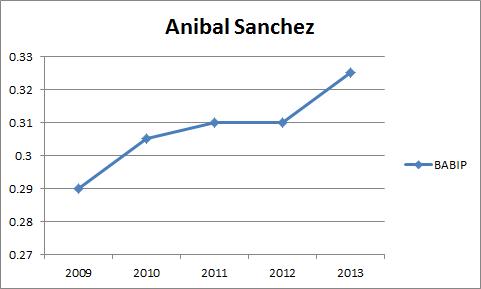
And the batted ball data actually makes him look worse as he is giving up more line drives at the expense of groundballs, which we would usually consider to be harder hit and more likely to result in baserunners:

So let’s review. He’s preventing runs better than ever before with more strikeouts and fewer walks. He’s giving up more hits on balls in play and they are likely coming on harder hit balls because he’s giving up line drives. If anything, he’s been unlucky on balls in play. His HR/FB rate will regress up, but that is accounted for in xFIP so we’ve essentially controlled for that explanation. The only explanation that makes sense for why he’s gotten so much better this season is the strikeouts.
But about those strikeouts. He’s not getting hitters to swing more than they used to. And he’s not getting them to swing at worse pitches. Batters are essentially swinging the same amount as they have the last two seasons against him both in and out of the zone:

So they’re swinging the same, but they are making much less contact:

Let’s revisit how he’s adjusted his pitch selection now to get a sense for what might be causing this:

Basically, the key change in Sanchez’s approach is his increased use of the changeup. If we sum this up, we get this story. Sanchez is preventing runs better this year because he’s getting more strikeouts. He’s getting more strikeouts because he’s getting hitters to swing and miss more often, but not based on the location of the pitch. So it has to be about the pitches themselves. And he’s using the change up more. So it’s probably the changeup, or at least the threat of a better changeup.
In fact, if we track his swing and miss percentage on each pitch over the last five seasons, you can see that while he’s doing well with the fastball and slider this year, it’s the changeup that is really driving this breakout over time. He’s gotten swings and misses on his fastball and slider at this rate before, but the changeup swing and miss rate is at an all time high.
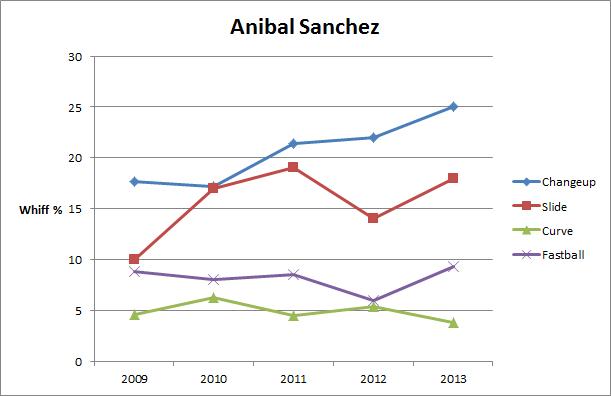
In my other life, I’m a social scientist, so I’m not going to sit here and tell you a better and more effective changeup is the only reason Sanchez is better this year, but the evidence certainly points in that direction. He’s getting better results based on an increase in strikeouts. Those strikeouts are the product of more swings and misses, but batters are swinging at the same rate and they are swinging in the same locations. At this point, it looks like the changeup is drawing the most whiffs, and therefore, more of the credit for the uptick in strikeouts.
Sanchez was great down the stretch for the Tigers in 2012, but some people worried about giving a good but not great starter such a big contract. It doesn’t appear as if those concerns were warranted as Sanchez has turned himself in the AL’s best pitcher by FIP, xFIP, and WAR so far this season thanks to better use of his changeup. This is something all of the Tigers starters seem to be doing, but Sanchez is doing it exceptionally well. I’m not sure if it’s Jeff Jones, Alex Avila, or the starters themselves, but the Tigers are striking batters out at a crazy rate and it’s likely thanks to the changeup.
Anibal Sanchez has the changeup to thank for what could be a Cy Young season.
The Nine Worst Seasons by “Closers”
At New English D we do not approve of the way modern bullpens are managed. We don’t appreciate the way managers chase “saves” and only go to proven closers in perfectly aligned save situations. We believe this to be an inefficient and illogical use of resources. If you’d like to catch up on the theory behind these views, here are three pieces we’ve publish this year on the subject that tell a pretty complete story:
But for now, as an exercise in the ridiculousness of closers and an exercise in fun baseball history, I present to you, The Nine Worst Seasons by Closers.
The rules are simple. Since “Saves” became an official statistic in 1969, there have been 5088 individual qualifying reliever seasons and among those there have been 557 relievers to get 30 or more save opportunities in a given season. Full disclosure, “Blown Saves” are not recorded in the first few years of the sample, so it’s possible I’m missing a few relievers who had 30 save opportunities because I added saves and blown saves to get save opps. The rankings below are determined by Fielding Independent Pitching (FIP) because I believe that to be the best measure of pitcher performance because it takes into account strikeouts, walks, and homeruns without punishing anyone for bad defense or rewarding anyone who allows inherited runners to score. xFIP isn’t available for all of the years in question and WAR is a counting stat, so it would be misleading when comparing pitchers who threw a considerably different number of innings. (FYI: The average number of blown saves among pitchers who had at least 30 SVO in a season is 6. The average SV% in the sample is 85%.) You can find full stats for the relievers below here (Worst Closers).
9. Bobby Thigpen (1991 White Sox)
30 for 39 in SVO, 3.49 ERA, 5.18 FIP
8. Jorge Julio (2003 Orioles)
36 for 44 in SVO, 4.38 ERA, 5.20 FIP
7. Rocky Biddle (2003 Expos)
34 for 41 in SVO, 4.65 ERA, 5.26 FIP
6. Brad Lidge (2009 Phillies)
31 for 42 in SVO, 7.21 ERA, 5.45 FIP
5. Jeff Montgomery (1996 Royals)
24 for 34 in SVO, 4.26 ERA, 5.67 FIP
4. Jason Isringhausen (2006 Cardinals won World Series)
33 for 43 in SVO, 3.55 ERA, 5.70 FIP
3. Ambiorix Burgos (2006 Royals)
18 for 30 in SVO, 5.60 ERA, 5.89 FIP
2. Jose Mesa (1999 Mariners)
33 for 38 in SVO, 4.98 ERA, 5.92 FIP
1. Shawn Chacon (2004 Rockies)
35 for 44 in SVO, 7.11 ERA, 6.57 FIP
I’m fully aware that a list of the worst people to ever do something doesn’t prove much, but it’s interesting nonetheless. Seven of the nine worst closers in baseball history got 30 saves during their worst season. That has to tell you something about how easy it is to accumulate saves.
Also of note: The worst closer on this list who only blew one save is Fernando Rodney of the 2009 Tigers. He was 37/38 despite a 4.40 ERA and 4.56 FIP. Ah, the good old days.
The Morning Edition (June 15, 2013)
From Last Night:
- Chris Sale went 8 innings, allowed 0 ER, and struck out 14. Against the Astros. He lost.
- Buehrle looks good, blanks the Rangers over 7
- Bumgarner is brilliant against the Braves, 10K
- Fernandez K’s 10 to beat the Cards
- Dusty Baker actually used Chapman in a non-save situation, helping Jay Bruce homer the Reds to victory
- Moore struggles in loss to the Royals (about to lose Appointment TV status)
- The Indians walk off the Nats, Masterson K’s 10
What I’m Watching Today:
- Kershaw pitches at PNC (4p Eastern)
- Cobb faces the Royals (4p Eastern)
- Felix tries to slow the A’s (7p Eastern)
- Zimmermann vs Kazmir (7p Eastern)
The Big Question:
- Are we still even keeping track of wins after what happened to Sale tonight?
Chris Sale went the distance, gave up no earned runs, and struck out 14 Astros and lost. Basically, you can give up 7 ER in 7 IP and get a win and give up 0 ER in 8 innings and lose. So these make sense. But much more notably, MLB handed down suspensions for the Dbacks and Dodgers brawl today and kept it pretty toothless. Belesario threw punches and got one game. Ian Kennedy got 10 games, but he’s only going to miss one start. The managers only got one game. It doesn’t look like MLB wants to curb this behavior, even thought it’s essentially felonious. Other than that, I just have to plug Rick Porcello again, because he’s turning into a star.
How Was The Game? (June 14, 2013)
Another big night for Porcello.
Tigers 4, Twins 0
Earlier in the day, I wrote a very detailed piece about how Rick Porcello (4-3, 70 IP, 4.37 ERA, 3.46 FIP, 1.3 WAR) is becoming one of the game’s best starting pitchers and he took the stage tonight and delivered another stellar outing (seriously click the link, Porcello is awesome). It was brilliant. I audibly cheered in my own home as he pumped fastballs that crossed at the knees and changeups and curves that hitters couldn’t touch. His final line was 7 innings, 3 hits, 0 runs, 0 walks, and 5 strikeouts, to improve on his already impressive season.
The Tigers struggled to get the offense going until the sixth inning when Jackson walked and the Twins gave Cabrera an intentional pass that set up a Fielder two run double, which set up Martinez and Peralta RBI doubles to give the Tigers a 4-0 lead. They wouldn’t need anything else as Porcello cruised to victory, the bullpen did the job, and got the Tigers to 37-28 on the year. They’ll look to take the series tomorrow with Anibal Sanchez (6-5, 78 IP, 2.65 ERA, 1.78 FIP, 3.3 WAR) taking the hill after missing his last start.
The Moment: Porcello dominates.
The Harold Reynolds Problem

I don’t need to tell anyone that Harold Reynolds is a controversial figure in baseball coverage. He’s become the face of the anti-sabermetric movement and has taken it upon himself to attack the new way of thinking about baseball at every turn. I’m not going to chide Reynolds for disagreeing with me and the sabermetric community. It’s fine that he disagrees and it’s fine that he plays it up for the cameras. I imagine it’s good for his career as a TV pundit. That’s fine.
But Reynolds actually represents the most serious problem in sports analysis today. Harold Reynolds makes claims without relying on evidence. Again, this isn’t Harold saying Player X is the best player in baseball because of what he sees with his eyes, I’m talking about Reynolds making claims that are factually incorrect because he simply doesn’t want to or know how to find the answer.
I’ve been trying to stay away from this, but the guys over at @HeardonMLBT pushed me into it and HR finally said something so foolish on Thursday night I couldn’t resist. In case you’re wondering, Heard on MLB Tonight tweets silly things said on air by their commentators and it’s a must follow.
But last night, Harold Reynolds blamed Starlin Castro’s terrible 2013 season on the Cubs Front Office and their “Moneyball” tendencies. Basically, HR said that the Cubs got in his head about taking pitches and working counts and it got him away from his style of play which allowed him to get 200+ hits every year.
I don’t agree with Reynolds’ anaylsis because I’m a fan of walking and a good approach at the plate, but I’ll play along. Let’s say batting average is all that matters and OBP is worthless. Here is Castro’s AVG over his career:
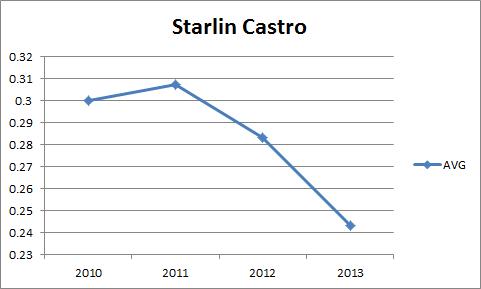
So we can all agree that Castro had a very good average in his first three seasons and it has fallen off in a big way in 2013. Reynolds says it’s because the Cubs want him to work counts. But Castro is walking less than ever. Even if we ignore that and say that the new approach is putting him in a bad position to hit and walk, we can go deeper.

Starlin Castro isn’t swinging less and he’s not swinging at worse pitches. In fact, he’s getting himself into almost the same counts he did in 2011. Here are the percentage of PA that got to each count.
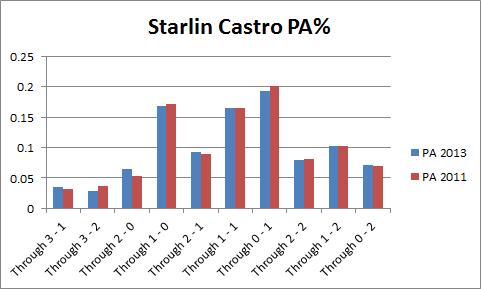
So Harold Reynolds is not only wrong about valuing average over on base, but he’s just fundamentally wrong about the facts. Castro’s approach at the player hasn’t changed at all. The facts are right here. He’s not getting deeper into counts. He’s not swinging less. He’s not swinging at different pitches.
I don’t mind that HR is wrong about what leads to wins and losses and I don’t mind that he likes to pick on sabermetrics. But if he’s going to do both, he at least needs to avoid saying things that are so provably false. This isn’t just Harold Reynolds, it’s a lot of people. But he’s made himself the face of the movement.
Like I said, I don’t mind his old school skepticism, I mind that when presented with facts that directly contradict his point, he doesn’t acquiesce. Right here, he made a case that Castro’s approach was changed by the Cubs which has lead to his batting average decline. But if HR made any attempt to look at the facts, that is just so obviously not true.
This is just one example, but there are many cases of the same. I mean, on Thursday, he said the Phillies shouldn’t trade Papelbon for Castellanos and Smyly, but should only deal him for Prince Fielder. That’s not great analysis, but he’s charismatic and certain swaths of people like him. I used to like him because he was always excited about baseball, but now he’s complaining about every new thing in baseball. He hates walks. He hates strikeouts. He hates valuing defense in WAR when it says the Triple Crown winner isn’t the MVP, but loves it when it helps his case about OPS being misleading. He hates new thinking. And he turns everything into a chance to bash on new ideas.
So Harold Reynolds has made himself the poster-boy of terrible analysis and it’s getting worse because he’s fighting a battle against progress. The game is changing and his job is to analyze baseball, but it appears as if he doesn’t even understand the new statistics. It’s not that he disagrees, it’s that he hasn’t even done the work to learn about them. It’s lazy, it’s obnoxious, and it makes him the butt of many jokes.
Dude, Starlin Castro’s approach hasn’t changed at all. It took me less than 30 seconds to look up the evidence to prove you wrong. Maybe you need some help.
Rick Porcello’s Rising Star

Twenty seven days ago, I wrote a piece entitled “Rick Porcello is Breaking Out” in which I said the following:
Put this together and we have this story: Rick Porcello is striking out more batters than ever, walking fewer batters than ever, getting more groundballs than ever, and is allowing more homeruns per flyball than we would generally expect. All of this points toward the 24 year old having his best season to date.
Since then, all Porcello has done is prove me right. I don’t mean for this to be about me or my predictive success, I mean it to be a validation of how Porcello was showing signs that he was having his breakout campaign. Now it’s clear that he is.
Let’s take a quick look at his numbers over the last 30 days.
2-1, 30 IP, 9.68 K/9, 1.76 BB/9, 2.93 ERA, 2.77 FIP, 2.14 xFIP, 0.8 WAR.
Those are great numbers. All-Star, Cy Young type numbers. Over the last 30 days, Porcello’s 2.14 xFIP is the best in major league baseball and his xFIP this season is 7th best in MLB despite his rough April. This is no longer the Rick Porcello who is a really good #5 starter, this is Rick Porcello the really good starter.
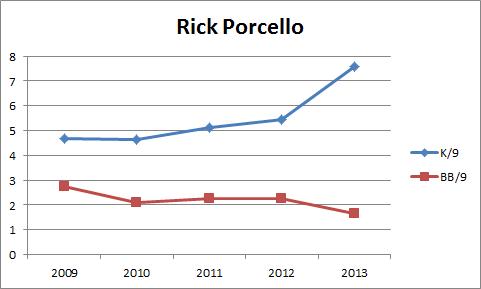
Let’s update where Porcello stands. His K/9 is far and away the best of his career as is his BB/9.

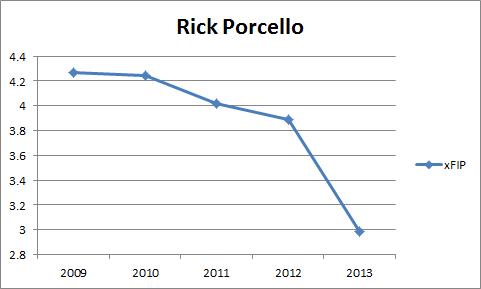
When you translate his numbers into FIP and xFIP, it looks like this:

But it isn’t just the strikeouts and the walks, it’s also the groundballs. Rick Porcello isn’t trading groundballs for strikeouts, he’s actually getting more of both.
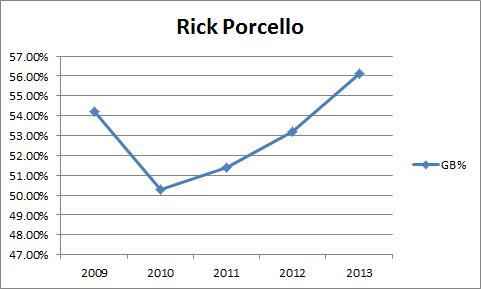
Everything is trending in the right direction for Porcello. More strikeouts, fewer walks, more groundballs. He’s gone from very good #5 starter with some upside to a one of the game’s best starters over the last month and a half. In fact, his particular combination of strikeouts, walks, and groundballs is quite rare and extraordinary.
He’s striking out more than 7 batters per 9, walking fewer than 2 batters per 9 and has a groundball rate above 50%. From 2000-2012, here is the list of pitchers who have finished a season with that mix: Halladay (4x), Carpenter (3x), and Hamels (1x). In 2013, the pitchers on that list are Felix Hernandez, Doug Fister, and Rick Porcello. That is some excellent company.
If we push the limits farther, to 7.5 K/9, 2.0 BB/9 and 55% GB (which Porcello has) the list of pitchers since 2000 to accomplish that feat drops to zero. Nobody. We don’t have groundball data from before the early 2000s, so I can’t tell you how rare this is in MLB history, but since the data became available, it’s never been done.
Porcello is mixing strikeouts, command of the zone, and groundball induction in a way that has never been done before. You may look at his ERA or even more foolishly his W/L record and think he’s the same old guy, but he’s actually nothing close to it. He’s turned himself into a star.
And this isn’t some fluke stretch that happens to him everyone once in a while. This is his K/9 by month for every month of his career:
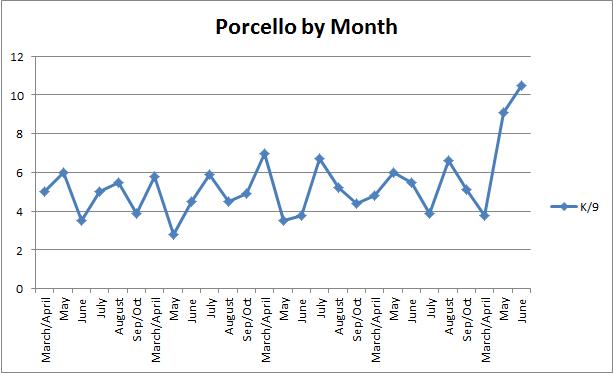
Porcello is a noticeably different pitcher. And he’s doing it by dropping the slider, cutting back on the fastballs and using curveball and changeup more often.

It’s all working. You can see the change in his approach is coming from a changeup and curveball that are moving more and have bigger separation from the fastball by velocity.
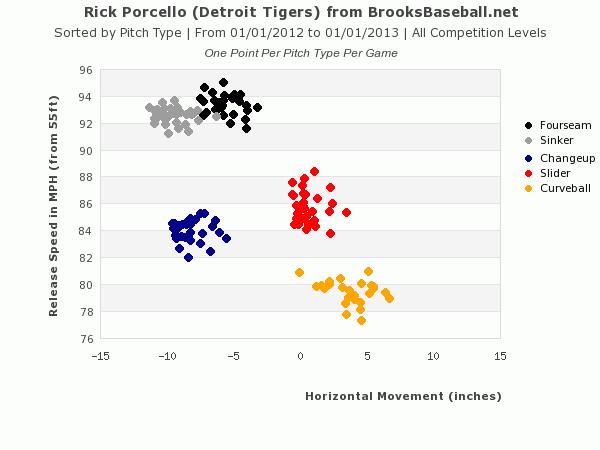
 This is all by way of saying that Rick Porcello is getting much better results over the last two months than he ever has before and that it is the result of real change in his approach to pitching. I’ve always believed this breakout would come. It’s true, you can ask friends who suffered through my lectures on him. Everyone looked at Porcello in 2009 and saw a young kid with big time prospect status. But he didn’t develop that fast and he started to get tagged as a bust. But the mistake those critics made was that Porcello got to the major leagues so early that they didn’t realize he was still developing. His training for big league baseball was all on the job training.
Consider this. Rick Porcello is in his 5th year in MLB and has made 131 starts (120 entering 2013). When each of these pitchers turned 24, they had this many starts: Doug Fister (0), Anibal Sanchez (23), Justin Verlander (32), Max Scherzer (3). Rick Porcello has more starts before his 24th birthday than all four of his rotation-mates combined. Doug Fister, Max Scherzer, Anibal Sanchez, and Justin Verlander have all played the vast majority of their major league careers over the age of 24. Porcello has played almost the whole thing below 24. Think about how much those pitchers have grown since they turned 24.
If Rick Porcello can develop at a rate even remotely close to that which his teammates have, he could be one of the best pitchers in the baseball across the late 2010s. Heck, over the last two months he already is.
 New English D