Ballpark Review: PNC Park

Home of the Pittsburgh Pirates
Pittsburgh, PA
It’s been three and a half months since I’ve reviewed a ballpark for this series, but having been to only 7 active MLB parks, I didn’t want to rush through this series faster than I could see new venues. But yesterday, I finally got around to something I’ve been thinking about for a while: I built a database of every MLB and MiLB stadium to help track my progress as I make my quest to visit them all. This rekindled my interest in this series, and here we are.
PNC Park is an incredible stadium. Setting aside Comerica Park for personal attachment reasons, PNC my favorite park by far. It is scenic without being too ornate as to distract from the actual game and has solid dining options.
The view of the river, bridges, and Pittsburgh skyline is excellent and foul territory is scare enough that you’re very close to the action even when your seats aren’t great. I’ve been to three games there and sat in the upper deck twice and lower deck once. From behind the plate in the upper deck, you were still right in the action and had almost every inch of the field in view. From the lower deck, you have good angles pretty much anywhere you sit. Not only is left field an interesting size, but the right field wall is a throwback to the old school scoreboard and the tantalizing hope of seeing a ball fly into the river keeps fans coming back.
Ticket and food prices are generally pretty reasonable and the food and beverage selection is diverse and tasty. I’ve had standard hot dogs, fries, and chicken strips, all of which were above average for ballpark food.
Another thing I like about PNC is its location. It’s on the north side of the river near a couple museum, casino tourist attraction type places along with some very nice hotels, but it’s only a short walk from the more typical Pittsburgh downtown area. Not only is the park a fun place to be, but it’s generally a nice area to hang out in before they open the gates and after the final out.
I consider PNC the standard by which all other parks are compared as it has the view and amenities of a big city park with the close to play feel of a minor league stadium. It’s simply an excellent place to enjoy a game and is a must visit for all serious fans. I’ve previously rated Nationals’ Park, giving it a 7 out of 10 relative to its contemporaries (minor league parks and MLB parks are only compared to other parks at their levels) and PNC clearly sets the curve at 10. The only complaint you can have about PNC is that the Pirates play there, and even they have turned themselves into a watchable club.
Stadium Rater (scale 1-10): 10
The Morning Edition (June 7, 2013)

From Last Night:
- The first night of the MLB Draft features some surprises, Appel, Bryant, Gray go 1-2-3
- Rosales’ 10th inning HR beats the White Sox
- Four run 8th gets the Royals past the Twins
- Miller, after being named to my Appointment TV list, Ks 9 in 6 innings and homers as the Cards beat the Dbacks
- Ortiz walks off as Holland and Lester both meander through 6
What I’m Watching Today:
- Middle rounds of the MLB Draft (1p Eastern)
- Harvey and Hernandez face off in New York (7p Eastern)
- Wainwright faces the Reds (7p Eastern)
- Lee heads to Milwaukee (8p Eastern)
- Cain versus Corbin in Arizona (930p Eastern)
- Kuroda gets Bonderman’s 2nd start (10p Eastern)
The Big Question:
- Which clubs will look back on last night as a building block en route to a title?
I’m not the world’s best guy for draft analysis, but I’ll give you my brief thoughts. First of all, if you’re looking for who went where, I can direct you here, among other places. The reason I’m not the best guy for draft analysis is not because I don’t know anything about amateur baseball, but rather because I don’t like to give analysis that isn’t based on my own observation. Almost everyone who was and will be drafted this weekend are guys I haven’t seen myself, so I’d rather direct you to guys like Keith Law or Jonathan Mayo or Baseball America. I could give you reports about guys based on things I’ve read, but you can read. I’m much more useful to you as someone who analyzes baseball players I’ve seen in person and on TV and in the box score. I have, however, seen Colin Moran, who went 6th overall to the Marlins. He’s a 3B with a great approach and a very good hit tool. Some question if the power will come and if he can stick at third, but I’m bullish there. I don’t think he’ll be a star, but a good approach can play for me. Here are some picks I liked from the first day:
Plenty of teams got good players, but those stand out to me as teams who made good choices when presented with a lot of options.
More on VMart’s Bad Luck
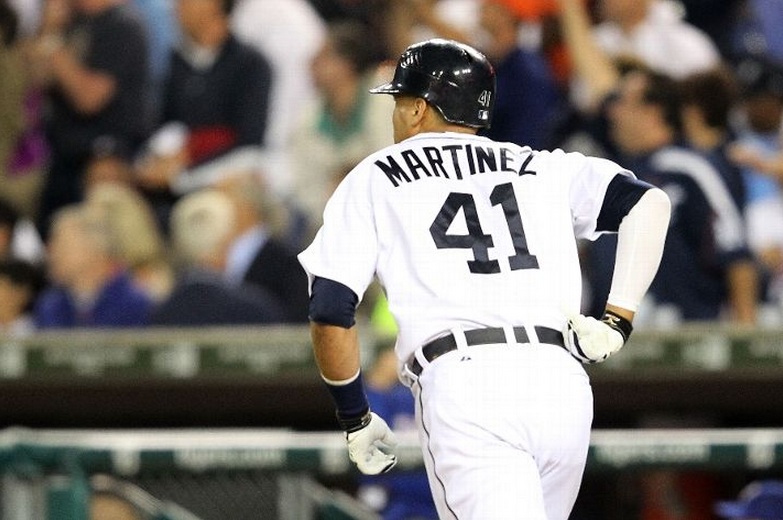
Early this week, I wrote about Victor Martinez’s tough luck on hard hit balls this season and showed that his Hard Hit Average is all out of whack with his on field results. I’d like to offer a little more data to illustrate the point as Martinez made some post game comments today regarding the hard hit problem:
I took a look at Martinez’s wRC+ this season relative to league average, his 2011 season, and his career average entering the day and broke it down by groundballs, flyballs, and line drives. I think you’ll find it interesting.
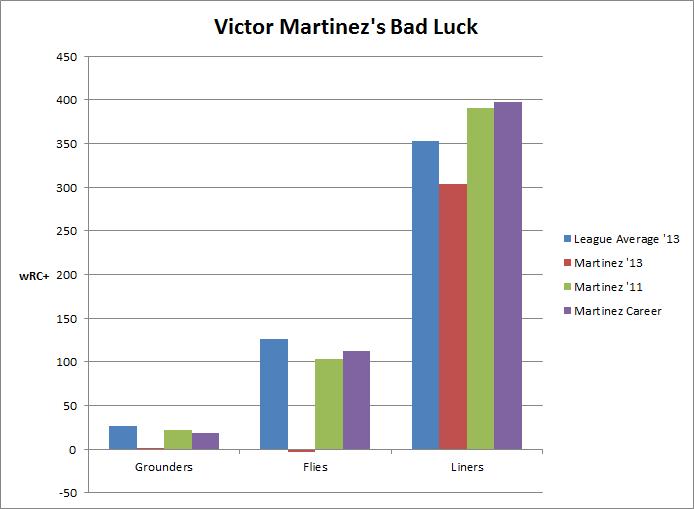
Notice how Martinez is a little below where we would expect him to be historically on line drives, but not so far off that we would think anything more than some aging at work. But look at the other numbers. My goodness, look at them. On groundballs, he has a 1 wRC+ which is about 20% lower than we’d expect. On flyballs it’s even worse. He’s at -3 despite a general expectation he’d be north of 100. I’m not saying Martinez isn’t declining or having a down year, I’m providing evidence that he’s been unlucky. It might not be everything, but it’s something.
I showed you earlier this week that Martinez is hitting the ball hard, and now I’m showing you how exactly that bad luck is playing out in his results by batted ball type. The great thing here is that the odds are in his favor. There’s no way this keeps up, and it might already be turning around. Don’t look now, but the hits might just be starting to fall.
Appointment Television: Baseball’s Must Watch Starting Pitchers (June 2013 Update)
Last month, I rolled out our list of Appointment Television starting pitchers, or pitchers who were worth planning your baseball viewing (and life) schedule around. Today, I’d like to update that list and talk about the changes. The original list can be found here, which also includes a little more detail on the origin of the project. Recall that the order is tiered into stable and non stable (italics), but each ranking is meaningless.
Here is the gist from the original:
The methodology is simple but also subjective. To be classified as Appointment TV you have to have a high likelihood of pitching a gem. There is no set definition of gem or likelihood, but the idea is that to make this list, you have to be likely enough to throw a game worth clearing your schedule for. I think a number of pitchers qualify. Most are high strikeout guys, but that isn’t a requirement. If you are good enough to dominate on a semi-regular basis you’re in. If on your day to pitch, I make sure I’m aware of the start time so that I can check in, you’re Appointment TV.
This is a rolling list and pitchers will be added and subtracted throughout the season and it will be updated as necessary. There is no order other than that pitchers lower on the list in italics are recent additions, so if you’re wondering if Jordan Zimmermann really qualifies, know that he’s earned his way onto the list in his last few starts. Remember, this is a list of pitchers who on this date are can’t miss TV. These are not necessarily the best pitchers and plenty of good pitchers aren’t on the list.
Appointment Television Starting Pitchers:
- Justin Verlander
- Adam Wainwright
- Clayton Kershaw
- Felix Hernandez
- Yu Darvish
- Matt Harvey
- Cliff Lee
- Clay Buchholz
- Max Scherzer
- Jordan Zimmermann
- Anibal Sanchez
- Jon Lester
- Matt Moore
- Shelby Miller
- Doug Fister
Stephen Strasburg(placed on DL 6/5)
Since the original list came out in early May, we’ve made a few changes. First, Stephen Strasburg is off the list because he’s on the DL, which is an arbitrary rule built into the system. He’ll return to the list once he’s activated. After that, you’ll notice all of May’s borderline candidates have made the leap into the stable portion of the list with the exception of Matt Moore. I love Moore’s stuff, but despite the good record, strikeouts, and ERA, a guy who walks 4.78 batters per 9 just isn’t a sure bet for this list. He remains in italics.
The other borderline guys from May, Buchholz, Scherzer, Zimmermann, Sanchez, and Lester have all clearly demonstrated their staying power. Buchholz, Scherzer, and Sanchez are contending with Felix for the AL Cy Young right now and Zimmermann and Lester are both showing that they are top 15 starters again, even if they aren’t quite dominating like they did in April.
Two pitchers join the list, as well, in the form of Doug Fister and Shelby Miller. Now I’ve personally always been a giant Fister fan thanks to his great control and supreme efficiency, but he’s shown over the last two years that he is a legitimate leading man. As I write this he’s 9th in MLB in pitcher WAR (2.5) and has one of the league’s lowest walk rates (1.4 per 9) and is coming off a string of 3 straight gems/near gems.
Miller was another guy I was watching when I made the initial list, but he needed to do a little more to make the cut because he had so little big league experience. That’s no longer a problem for the 15th best pitcher by WAR this year (1.9) who has yet to allow more than 3 runs in a start this season. His ERA and FIP are sparkling and even when his HR/FB regresses, he’ll still be a very good starter thanks to excellent strikeout and walk numbers.
Feel free to make a case for other starting pitchers who are must watch guys and we’ll consider adding them to the list.
How Was The Game? (June 6, 2013)
A cleaner affair.
Tigers 5, Rays 2
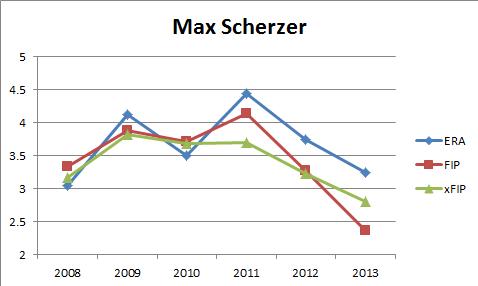
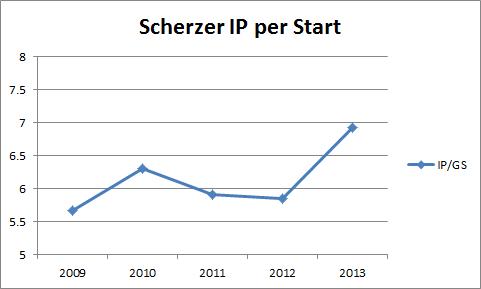
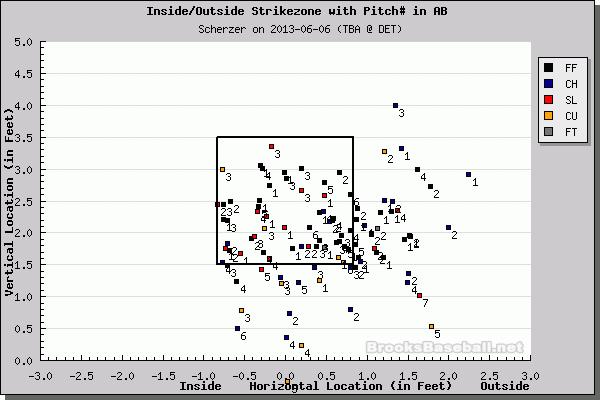
After struggling on the last trip, the Tigers looked poised for a good homestand after a big win against the Rays on Tuesday, but yesterday’s loss dampened those hopes for some. Max Scherzer (8-0, 77 IP, 3.24 ERA, 2.36 FIP, 3.0 WAR) was undeterred, however, and mowed down the Rays hitters across 7 innings, allowing 4 hits and 1 run while getting 9 K and 2 BB to make the angles on these graphs even steeper:
But also of note is this graph, which shows that Max Scherzer did not miss the strikezone inside once during this start. Not once:
The bats stayed quiet early, but awoke in the later innings, scoring in the 4th, 5th, 6th, and 7th innings led by big days from the 3-6 hitters, especially Victor Martinez, who drove in 3 runs on a single and a bomb. Benoit and Valverde meandered through the 8th and 9th innings, allowing a run, and gave the Tigers their first series victory since they beat the Twins on the last homestand. The Indians come to town for a weekend series and the Tigers will look to add some separation in the standings with Justin Verlander (7-4, 73 IP, 3.70 ERA, 2.60 FIP, 2.4 WAR) on the bump for game one.
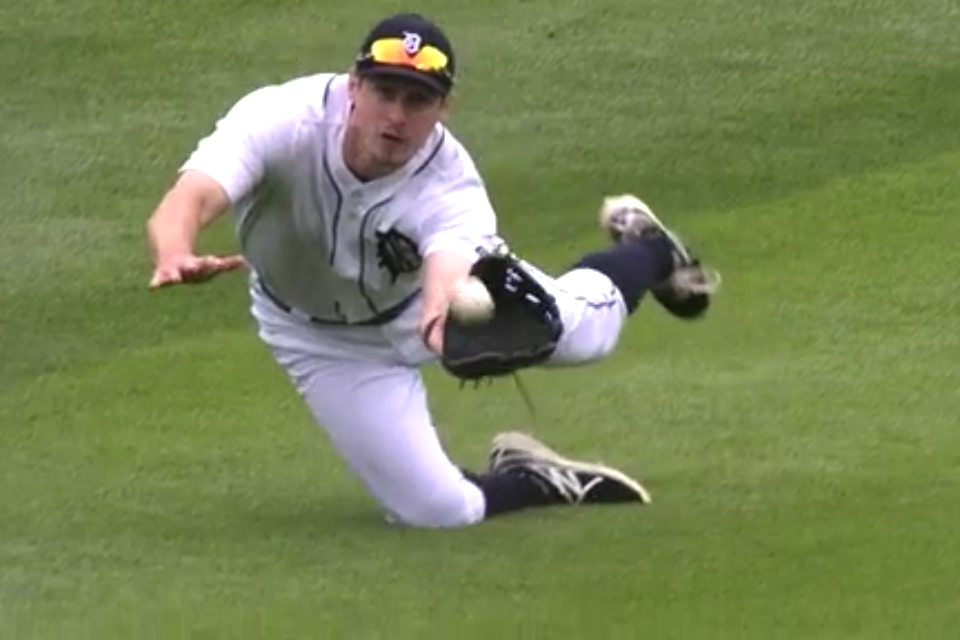
The Moment: Don Kelly makes a diving catch in the 4th (see below)
The Morning Edition (June 6, 2013)
From Last Night:
- The Mariners and White Sox take a 0-0 game into the 14th, each score 5, but the Sox win it in 16
- CarGo hits 3 HR and Tulo hits 2 HR as the Rockies smash the Reds
- Byrd homers twice to back a solid outing by Gee over the Nats
- Dickey helps his own cause at the plate and nearly misses a CGSO
- Hamels finally looks like Hamels, striking out 11 Marlins
- Sabathia gives up 4, but gets the CG win against the Indians
- Teheran nearly no-hits the Pirates
What I’m Watching Today:
- Lester and Holland duel in Boston (7p Eastern)
- Shelby Miller faces the Dbacks, looks to earn Appointment Television title in the process (8p Eastern)
- Greinke tries to straighten out against the Braves (10p Eastern)
The Big Question:
- Who will populate the top picks in today’s draft?
While there is plenty of exciting baseball on today, the MLB Draft will take center stage for most die hard fans. Unlike the NFL Draft, the MLB version doesn’t turn itself into an entire season in and of itself, but rather calls attention to itself in more subtle and sophisticated ways. Only a handful of mock drafts are done and only the first two rounds get airtime. A few names to know for the first pick are Mark Appel, Jonathan Gray, Kris Bryant, and Colin Moran, but it still remains unclear as to who the Astros will take first overall. I’m hoping for the Tar Heel, Moran, not because he’s the best, but because I’m a grad student at UNC and am hoping he drops several hundred dollars on his way back from signing the contract. If you’re new to the process, the key difference between the MLB Draft and others is that MLB teams are always drafting the best player available and do not focus on their current positional needs. NFL picks are expected to contribute right away, but MLB picks go through a seasoning process. For example, the Tigers will take a 3B with their pick if he’s the best player left even though they have a big of a logjam at the position. If you’re looking for a primer on the top picks, I suggest Mark Anderson’s work at BPN:
Stat of the Week: Expected Fielding Independent Pitching (xFIP)
Generally, I’ve been a little light on “weekly” updates to this feature, but I generally write at least one statistically informative post a week, even if it doesn’t actually follow the mold I’ve laid out. Today, I’ll try to write that wrong with an introduction to the very useful Expected Fielding Independent Pitching (xFIP).
You may recall my introduction to Fielding Independent Pitching (FIP) some months ago and my frequent use of the metric on the site. You can read my introduction to FIP or Fangraphs’ primer to catch up, but I’ll outline the basic concept because it carries over.
We use FIP because ERA is not a reflection of a pitcher’s individual performance because he cannot control what his defense does once the ball is put in play. Two pitchers who are carbon copies of each other will perform differently if you put them in front of the Dbacks defense (currently the league’s best) and the Angels defense (one of the league’s worst so far) despite throwing identical pitches to identical hitters. ERA is a reflection of the team as a whole, not just the pitcher.
In steps FIP or a class of numbers coming from this idea, to measure a pitcher’s performance based only on what we know he can control. FIP takes strikeouts, walks, and homeruns and uses historic run values to calculate a number on the same scale as ERA so that you can see which pitchers are succeeding in the areas of the game they can control. Generally speaking, defense evens out over a long enough period and ERA, FIP, and our new friend xFIP will converge toward each other.
The FIP formula looks like this:
FIP = ((13*HR)+(3*(BB+HBP))-(2*K))/IP + constant
So what exactly is xFIP? xFIP, as you can read about on Fangraphs, takes this one more step. xFIP is the same as FIP except it normalizes HR/FB rate to give you a number that better predicts future performance.
It’s actually pretty simple, just stay with me. Generally speaking, we’ve found that the percentage of a pitcher’s flyballs that are hit for homeruns will converge toward about 10% and that large variations from that number are not sustainable. If you allow more flyballs, you’ll allow more homeruns, and that will cost you in FIP and xFIP, but if you’re allowing half of your flyballs to go for homeruns, it’s likely that won’t happen for very long.
So xFIP looks like this:
xFIP = ((13*(Flyballs * League-average HR/FB rate))+(3*(BB+HBP))-(2*K))/IP + constant
As you can see, it’s the same formula, but it takes your flyball rate and multiplies that by the league average HR/FB rate to get a more predictive version of your HR rate going forward. xFIP is one of the best indicators of future performance we have and it is very useful in evaluating which pitchers are getting lucky and which pitcher’s are actually performing in line with their skills.

If we scan the Tigers 2013 leaderboard right now (digits truncated), you can get a sense of how this works. As expected, all of the Tigers have better FIP than their ERA because they play in front of a poor defense, but all of their xFIP are slightly higher than their FIP (except for Porcello) because they are allowing a lower than average HR/FB rate. Porcello, on the other hand, has very unlucky 21% HR/FB rate, so his xFIP is better than his FIP. Again, xFIP correlates better with future performance than almost any other ERA estimator.
Personally, I like to look at FIP to see how a pitcher is doing and use xFIP to see how fluke-y his homerun rate is. They’re both good metrics and they are both better indicators of individual performance than ERA.
Want to learn about a statistic? Request one for the next edition in the comments section or on Twitter @NeilWeinberg44. If you’re looking to catch up on sabermetrics, check out New English D’s posts on FIP, WAR, wOBA, wRC+, and ISO.
How Was The Game? (June 5, 2013)
A gem, wasted.
Rays 3, Tigers 0
When Doug Fister (5-3, 77 IP, 3.27 ERA, 2.62 FIP, 2.5 WAR) takes the hill, you’re usually treated to a fast moving, efficient performance and today was an exceptional lesson in said qualities. Fister cruised through the first 7 innings in just 72 pitches causing the present author to remark:
and
Fister would finish the game with a marvelous 8.1 innings, 7 hits, 3 runs, 1 walks, and 4 strikeouts after surrendering all three runs on three hits, a sac fly, and a wild pitch in the 9th. That performance on most days will bring you an easy victory, but Mr. Fister had to sweat as his counterpart was also quite good. Cobb kept the Tigers at bay over 7.2 and got help from his bullpen to blank the Tigers. Fister succeeded with his usually excellent command and excellent separation among his four pitches, the latter is illustrated here:

With the loss, the Tigers fall to 31-26 and will try to take the series with the Rays tomorrow afternoon with Max Scherzer (7-0, 76.1 IP, 3.42 ERA, 2.45 FIP, 2.6 WAR) on the hill.
The Moment: Doug Fister doing anything.
The Morning Edition (June 5, 2013)
From Last Night:
- Boston beats Texas 17-5, but David Murphy (the OF) pitches a scoreless inning
- The Braves walk off in extras against the Pirates
- Zimmermann is sharp and the Nats rally in the 9th to win
- Mayberry Jr. walks off in grand style against the Fish
- Both Wacha and Skaggs struggle as the Cards and Dbacks go down to the wire
- The Mariners bounce Peavy early
What I’m Watching Today:
- Turner and Hamels at Citizens’ Bank (1p Eastern)
- Garza faces the Angels (7p Eastern)
- Kershaw gets the Padres at home (10p Eastern)
The Big Question:
- What should we make of last night’s steroid story?
The big story last night was that MLB has acquired the cooperation of fake doctor/steroid peddler Tony Bosch and will attempt to use his testimony to suspend up to 20 MLB players who appear on documents relating to Bosch’s Miami clinic, including Alex Rodriguez and Ryan Braun.
Now I’m not condoning cheating, but I do question the way this investigation is being handled. I think a failed test that holds up to the scrutiny of the review process should land players on the suspended list, but the evidence that is publicly available on this clinic is not very convincing. If MLB is going to base suspensions on Bosch’s word and some hand written notes, that isn’t okay. Most of these players haven’t failed a test and the ones who have failed a test have already served a suspension. I’m all for strict testing and harsh punishments, but I don’t think the evidence is very compelling. Additionally, this is not really news. MLB has been trying to suspend these guys from the start. The only new information is that Bosch is now cooperating, but the headlines focused on the desire to suspend. This is definitely a case of the media (ESPN in particular) making more out of a story than they should. A big steroid suspension is big news, but that isn’t what we got last night. We got “MLB is working to suspend them.” Sorry guys, wake me when something is happening. Let’s focus on the MLB draft and ASG and regular season until something actually happens.
Dynamic Standings Projection (June 5, 2013)
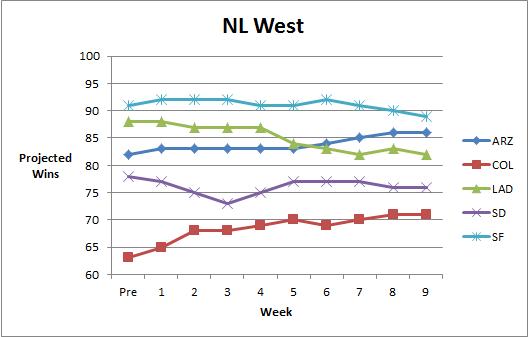
In case you missed it, in April we launched our Dynamic Standings Projection feature on New English D. A full explanation of the methodology can be found here or by clicking the tab at the top of the page. This project seeks to provide a reasoned and cautious approach to updating our beliefs about the baseball future. You can find a summarization of the original projections here. You’ll notice a column on the far right that indicates the difference in projected wins from the preseason prediction. Positive numbers mean teams are now projected to win more games and negative numbers mean a team is now projected to win fewer games. You’ll notice a series of graphs below the standings section that track how the projections have evolved over the course of the year.
This Dynamic Standings Projection is updated through the June 4 games.


 New English D