The State Of The Tigers Outfield

Last week, we looked back at the Tigers rotation from 2013 and ahead to what they might become in 2014. Today, we’ll do the same thing with the Tigers’ outfield. Thankfully, there aren’t many moving parts so we don’t have to dig into all sorts of complicated permutations. The Tigers 2014 outfield is going to look a whole lot like the outfield from 2013.
Austin Jackson
On the whole, Jackson had a very nice 2013 season. He hit .272/.337/.417 in 614 PA which factors out to a 107 wRC+. He ran the bases well (5.7 BsR), and even though his defensive metrics were a touch below the average centerfielder, he put together 3.1 fWAR over the course of the season. His production was up and down, but on the whole, it was a very strong year. It wasn’t on par with his excellent 2012 season, but he’s still young and could easily settle in as one of the best handful of centerfielders in the game.
The second link above takes you through some more detailed thoughts on 2014, but Steamer/Oliver/ZiPS all project him to be worth about three wins for the upcoming season. You have to prepare yourself for a two or three week DL stint due to a hamstring or oblique injury, but Jackson is a solid performer with a pretty nice ceiling.
Torii Hunter
The big question entering Hunter’s first year with the Tigers was if he could sustain his new found opposite field, line drive, high BABIP approach. Turns out that he can and it’s allowed for an offensive reinvention for the aging corner outfield. He didn’t shine in right field for the Tigers, but he was replacing Brennan Boesch, so it still looked pretty good. He hit 117 wRC+ and ran the bases at a league average rate, so playing iffy defense in a corner still produced 2.5 fWAR.
It’s probably safe to safe that his new approach is real and that we should expect a higher BABIP this year than his pre-2012 track record, but he’s also aging and has taken a turn defensively. Hunter probably isn’t going to get better in 2014, but he’s a solid player and figures to be right around league average in 2014. Steamer/Oliver/ZiPS have him at 1.9/1.3/1.3 for 2013, but I’m a touch more optimistic about his ability to sustain his above average bat than they are.
Andy Dirks
Dirks took a step back offensively in 2013, but he made up for it with some really nice defense out in left field. He’s a great example of how value is value no matter where you find it. He’s never had a big platoon issue, but for some reason he keeps find himself in platoon arrangements. He had Matt Tuiasosopo in 2013 and will have Rajai Davis in 2014, but Dirks remains a guy who can hit right around league average with nice defense in a corner. Pretty much the definition of a player who is under-appreciated.
Steamer/Oliver/ZiPS have him at 0.8/1.6/1.3 WAR for 2014, but they have very different PA assumptions 268/600/455. I’d bet more in the 1.5+ department if he stays healthy.
Matt Tuiasosopo/Don Kelly/Nick Castellanos/Avi Garcia
Tuiasosopo got most of the at bats that didn’t go to Dirks and he raked for the first couple of months. Then life caught up with him and he reverted back to the player who couldn’t keep a big league roster stop for most of his career. The overall body of work was pretty solid for a bench player, but it was a tale of two halves – and the next act ends with him in the Diamondbacks organization. Kelly played the normal Kelly role, Castellanos only had a handful of trips to the plate, and Garcia was sent out of town for Iglesias.
Kelly will continue to fill in for 2014 and Castellanos will primarily be at third, so we don’t really need to look forward with this group.
Rajai Davis
Davis joined the Tigers this offseason on a 2 year, $10 million to share time with Dirks and will play primarily against left-handed pitching. He can hit a lefty (112 wRC+ career) and is one of the very best baserunners in the game (9.5 BsR/600 PA), so he’ll be a nice compliment to the Tigers outfield going forward. He can’t bring the same kind of thump as Tuiasosopo, but he should be able to match his overall production.
There’s also a good sense that Davis is a well-known quantity. He’ll hit lefties well enough, he’ll run like crazy, and he’ll be okay defensively in left. You don’t have to worry about a huge variance in his performance, which is nice for a Tigers fan base that can often fret about performance fluctuations. Steamer/Oliver/ZiPS peg him for 0.3/1.6/0.3 WAR for 2014, but I think something right around 1.0 is a good bet, but it’s all going to depend on playing time for one of the newest Tigers.
—
All told, the Tigers outfield should provide very similar value to the 2013 iteration. Maybe a little better, maybe a little worse, but don’t expect a whole lot of difference.
Verlander Has Surgery, Nobody Panic
So today I started a new gig at the SB Nation MLB news desk. It’s just another part-time writing job to add to my ever building portfolio of part time writing gigs, but as serendipity would have it, my second assignment was to write about Justin Verlander’s surgery. WAIT, WHAT?!
Those are not words I knew could go together. Justin Verlander + Surgery? That doesn’t seem right, but here we are. It’s a core muscle tear, a lot like Cabrera’s and it requires about six weeks of rehab before being evaluated. Dombrowski expects Verlander to participate in Spring Training and they hope he’ll be ready to make his seventh Opening Day start.
Verlander has been crazy durable – seven straight 200+ inning seasons – and has never even thought about going to on the DL. I’m not sure he would even know what to do. Is it an actual list that he has to sign?
The tone from Verlander and the Tigers is positive, but anytime a player goes under the knife you worry and Verlander has 6 years and $160 million left on his contract, so it’s important that he comes back healthy. We’ll know more about how this will affect the team in a few weeks but the Tigers are now down to four healthy starters and Verlander. Six weeks ago they had six above average starters. Things change quickly.
It’s always the opinion of New English D not to panic, but this is a panicky type announcement. Also, why did he wait until now to have the surgery. Don’t think about it too much or you’ll start to panic. I told you not to panic.
The State Of The Tigers’ Rotation
Partly due to my own fascination with starting pitching and partly due to the fact that the Tigers had one of the best rotations in baseball history last year, New English D covered that quintet in great detail. We had a couple of posts on their record setting ways as a unit:
- The Best Rotation in MLB History (June 2013)
- Checking in On Their Record Pace (August 2013)
But we also analyzed each of the starters quite heavily. Here’s a quick summarization of the coverage of each starter and then a preview of what we should expect in 2014.
Justin Verlander
The story on Verlander was the tale of three seasons. He dominated in April for the first time in his career and looked poised for another Cy Young season but his April triumphs turned to struggles during the middle months as he fumbled with release point issues that affected his ability to utilize all of his pitches. But with the team coasting to a playoff berth, Verlander took his time to return to form and was absolutely lights out across his final 9 starts (including the postseason), leaving him with another 5 win season. Disappointing for Verlander? Sure. But not disappointing for almost anyone else.
Going into 2014 it reasonable to expect another great season from Verlander. He’ll be 31 this year, which is the back end of a starter’s peak, but he’s coming down from a HOF type peak, so there’s plenty of room to have good seasons as he ages. Steamer has him down for 3.9 WAR, Oliver at 5.7 WAR, and ZiPS at 6.1 WAR for the 2014 season with the Steamer number coming in part from projecting only 192 innings. We’ve probably seen the end of Verlander as the consensus #1 starter in the league, but all signs point to another ace level season in 2014.
Doug Fister
Fister, the erstwhile Tiger, had two major storylines in 2013. First, he had another quietly fantastic season (4.6 WAR, 3.26 FIP, 54.3 GB%) that would have made him the ace on 22 of 30 MLB teams even though he was the fourth best arm in the stocked Tigers arsenal. His ability to limit walks and induce ground balls made him an under 90 mph force to be reckoned with in his second full season in Detroit. Unfortunately for us, it was his last as he was dealt to the Nationals in December. The other Fister storyline was his incredible HBP number, which ended up only being 16, but those 16 came quite early and for a while he was actually hitting more batters than he was walking. Needless to say, no one had ever done that. We’ll miss you, Doug!
Rick Porcello
Porcello is really good. He’s a personal favorite of mine because his style of pitching (heavy grounders, low walk rate) is something I really enjoy but also because he’s an undervalued guy whom I’ve been trumpeting for a very long time. I encourage you to read the links above which chronicle a pitcher who added strikeouts, cut walks, and added ground balls over the last few seasons and turned himself into a really nice major league starter. He was easily the best #5 starter in the league and would have been a 2/3 on most clubs. And Porcello will only be 25 entering the 2014 season, which is still shy of the years in which a starter is usually at their best. I’m a huge Porcello believer, and with the addition of a curveball instead of a slider in 2013, he took another step forward. It also so happens that the middle link above was one of this site’s first big breakout articles, so there’s always going to be a connection between my success and his, which I think is pretty cool.
For 2014, he’ll be asked to shoulder a little more of the load with Fister in DC, but Porcello is more than equal to the task. He’s been a 3 win pitcher in each of the last two seasons and has shown consistent improvement over his entire career. He should be able to build on what he accomplished in 2013 as he heads into the new year and I would expect another very solid 3+ win season, and it will be a little more obvious now that he has some quality defenders behind him. (Steamer/Oliver/ZiPS WAR: 3.2/2.8/2.2)
Max Scherzer
- Transformation into an Ace
- Three Keys to Success
- Two Keys to Success
- The Cy Young Case For and Against Him (August)
Scherzer was all over the baseball world in 2013 as he had a breakout season and also lucked into a huge win total which caught the eye of less analytically minded. When push came to shove, I had him second on my Cy Young ballot (he won easily) to teammate Anibal Sanchez, but he was a very deserving candidate. Max added a curveball and continued his improved mechanics to the tune of more strikeouts, fewer walks, and fewer dingers. That’s a great formula for success as he posted career bests in ERA/FIP/xFIP and turned in 6.4 WAR. Max was great and it was great fun to watch him all season long.
Going into 2014, Scherzer’s contract status (FA after 2014) and potential trade rumors surrounding him have been the talk, but he looks poised for another very good season. He’s still in his peak years and the improvements he made in 2013 should carry over and help him produce this year. He’s almost certainly going to regress a little bit just because that’s how the world works, but there’s no reason to think he won’t have another season of ~5 WAR. (Steamer/Oliver/ZiPS WAR: 4.2/4.6/4.8)
Anibal Sanchez
I adored the rotation in its entirety, but I had already developed my affection for Verlander, Porcello, Fister, and Scherzer, so it was Anibal Sanchez who really caught my eye during the 2013 campaign. He made excellent use of his changeup (as did all of the Tigers pitchers this year) and dramatically improved his strikeout and homerun numbers in 2013 while posting career bests in ERA/FIP/xFIP and a 6.2 WAR season. He also earned my Cy vote as the only knock on his campaign was that he missed three starts early in the year with an injury. When I vote on Cy, I pay more attention to rate stats than innings totals, which is why he got my vote over Max. All in all, it was an amazing season.
It’s probably not fair to expect a repeat performance, but Sanchez is a very good starting pitcher who should be right in that class with Scherzer going forward. He’s got good command and a lot of weapons, but he also looked very healthy down the stretch as his velocity ticked upward. Sanchez is very good and should be again in 2014. (Steamer/Oliver/ZiPS WAR: 4.0/4.6/4.2)
Drew Smyly
Smyly is the wild card here because he was a reliever in 2013. He was a great one, but relieving and starting are different and it’s been a full season now since he’s made a start. He was very solid in his partial season in the rotation in 2012, but we can’t just look at his stat line and look for trends because we don’t know if the changes we saw were about his role or his ability. The question for Smyly will likely be durability as he’s been pretty effective during his career when he’s been healthy, but isn’t exactly a workhorse. A reasonable expectation is something like an average starter (~2 WAR) for the 2014 season, which is still just his age 25 season. That’s right, he and Porcello are the same age. You’re going to lose something from Fister to Smyly in 2014, but the Tigers should still have an excellent rotation given that their worst starter should still be pretty good. (Steamer/Oliver/ZiPS WAR: 2.0/1.5/2.2)*
*Oliver still has Smyly projected to relieve.
All told, the rotation was amazing in 2013 and still looks to be very good in 2014. There was absolutely a case to be made that the Tigers should trade some pitching depth for offense or prospects this offseason, the only complaint is how they went about doing so. The rotation will be worse in 2014, but it’s coming down from a season in which they were 9.3 fWAR better than the second best rotation in the sport. They were an entire Sandy Koufax better than the second best rotation in the league, so even if things get worse, things will still be pretty great.
The Best Tigers Moments of 2013 – #16
For the next several weeks we’ll be rolling out our list of the best The Moment’s of 2013. The list is the product of winnowing down 173 moments from April to October into the best twenty. They vary in their importance but all captivated us in an important way. A few are silly, a few are excellent plays, and a few will travel down in Tigers lore. I hope you enjoy it.
#16 – Anibal Sanchez Strikes Out 17 Atlanta Braves
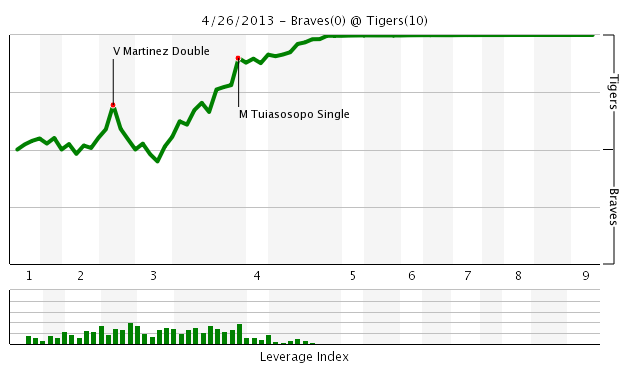
This one is pretty easy to recap. The video does the talking. The Tigers welcomed the Braves to Comerica Park for their first interleague series of the year and destroyed them. On this Friday night, the offense shelled Paul Maholm and the Braves by putting up ten runs in the first four innings, half of which were driven in by Matt Tuiasosopo (I’m going to miss saying Tuiasosopo). Anibal Sanchez did the rest as he twirled 8 magnificent innings in which he allowed 5 hits and 1 walk across 29 batters. 17 of them, or a whopping 59% of them went down on strikes. To give you some idea, Sanchez’s singled game FIP was -0.83. That’s a minus sign. You only get those when you’re really on. He threw 121 pitchers and batters swung and missed at 27. That’s a lot!
How Was The Game (April 26, 2013)
The Best Tigers Moments of 2013 – #17
For the next several weeks we’ll be rolling out our list of the best The Moment’s of 2013. The list is the product of winnowing down 173 moments from April to October into the best twenty. They vary in their importance but all captivated us in an important way. A few are silly, a few are excellent plays, and a few will travel down in Tigers lore. I hope you enjoy it.
#17 – Avila’s Game Winning Shot in Cleveland (video link)
Alex Avila had a really rough first half of the 2013 season. He had a 60 wRC+ before the All-Star Break and dealt with a wrist injury in addition to innumerable foul balls. In the second half, he was much, much, much better, posting an impressive 140 wRC+ along with far better swings at the plate. This swing, chronicled as our 17th best moment of the 2013 season was one of the big turning points in his season, not just in result, but in approach. This was a classic Avila blast to left-center.
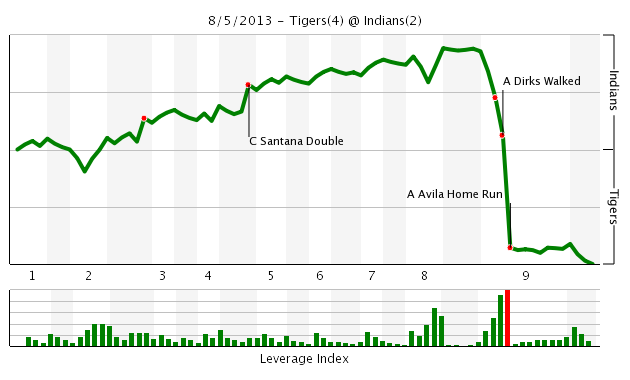
The stage was set quite nicely for the 26 year old backstop as his battery mate, Anibal Sanchez had tossed 7.2 very strong innings in which he scattered just two runs. Which brings us to the top of the ninth inning in Cleveland. At this point, the Tigers were three games up on Cleveland entering a four game series at Progressive Field. They were in control, but a bad series would make it a horse race and a good series could be a dagger. Losing the first game wouldn’t have been devastating, but snagging it from the jaws of defeat was a two game swing in a matter of minutes.
Fielder led off with a double to left. Martinez singled to left and scored Prince to make it a 2-1 game. Perez pinch ran and Dirks worked a walk. 2-1, no outs, top of the ninth. Alex Avila comes to the plate. The leverage index was over 5 meaning that it was a huge moment in the game (the average LI is 1) and Alex took the first pitch for a ball. 1-0 count, here’s the pitch from Perez.
Avila crushed it to left. Tigers take a 4-2 lead. The Tigers had a 15.5% chance of winning the game when the inning started and were now all the way up above 93%. Avila’s blast capped an assaulting rally that helped the Tigers bury the Indians for good. Obviously both teams would have done differently things down the stretch had this game played out differently, but the Tigers won the division by a single game. And this was a pretty dramatic way to do it.
I think my downstairs neighbor is still recovering from how loudly I jumped up and down when Avila hit this one out.
How Was The Game (August 5, 2013)
Should The Tigers Extend Miguel Cabrera?
Several days ago, in these pages, I discussed the the merits of a contract extension for Max Scherzer. When push came to shove, I advised against such a deal based on how rare it is for a pitcher to produce past age 33. The Tigers have a collection of decisions coming over the next couple of seasons, but the other big one concerns the future of Miguel Cabrera. Should the Tigers look to lock him up long term?
Let’s settle some particulars right off the bat. Cabrera is under control for the next two seasons at $22 million per season which covers his age 31 and age 32 season. Cabrera is an elite bat who rarely misses time, but offers very little value (and often negative value) on the bases or in the field. If he walked away from baseball today, he’d be a borderline Hall of Famer. The only knock would be longevity, so as long as he hangs around and is reasonably productive for another couple of years, you’re looking at one of the better players in the game’s history. Certainly one of the better hitters.
But Cabrera’s coming contract isn’t about who he was, it’s about who we think he’s going to be. Let’s approach this from two angles. We have to consider what Cabrera will ask for and what the Tigers should pay. The big question will be the length of the deal, which is a little hard to gauge this far out from free agency. Let’s assume that adding an extra six years onto the current deal will be a satisfying length. That would take Cabrera through age 38. Let’s also assume that Cabrera won’t take a pay cut. So at the very least, this extension will run 6 years, $132 million. But that’s a floor, not any sort of likely number. We have a sense that the price of a win is about $6-$7 million on the free agent market and that two years from now it will at least be as high as it is now. If we work from there, we can imagine Cabrera putting up something like 23 wins over six seasons if we’re aging him in a standard fashion. At that rate, we’re talking about $140 million to $161 million in terms of value. The bottom end is only $23M per season and the top end is closer to $27M. Let’s call it $28 million a season for 6 years. $170 million.
That’s less than Felix, Verlander, Pujols, A-Rod, and Cano – but that makes some sense. Pitcher contracts aren’t really comparable and he’ll be older than the pitchers at the time of the deal. The Pujols deal is a pretty good place to start. Pujols was 32 entering his 10/$240M deal. And Pujols had about 83 fWAR at the time. Cabrera will have something like 66 fWAR. Cabrera is great, but Cabrera isn’t Pujols. Cabrera will get a higher AAV at $28 million, but for fewer years because teams recognize that those really long deals are kind of silly. And remember, we’re talking about an extension. So the total value is 8 years and $214 million. Cano just got 10/240 as a free agent, while younger, and while being a far superior defender. Pujols got the same as a free agent, while the same age, and while being better in the preceding seasons. That makes some sense to me.
So 6/170 seems like a decent place to start. Maybe money keeps flowing and things accelerate. Maybe it’s 6/180. That would make him the highest paid player per season in baseball. I wouldn’t think he’ll continue to be a top five player that far into the future, but he’s right around that group at the moment, so we’re in the ballpark.
So, should the Tigers pay up? Let’s work backwards. A $180 million deal assumes something like 26 to 30 wins above replacement from 2016-2021 or ages 33-38. Let’s be generous and call it 25 wins, factoring in some inflation and various other nonsense. Can Cabrera be worth 25 wins over those six seasons? We’re pretty confident he’ll provide surplus value in 2014-2015, and that his first extension will be an excellent deal when all is said and done, but is it worth making a longer commitment to centerpiece of the Tigers current offense?
25 wins over six years assumes an average of about 4.2 per season. Let’s look at this a few different ways. First, how common is it for a position player to earn 25 WAR from ages 33-38? It’s happened 27 times in MLB history, which you can peruse here. But let’s get a little more specific. Let’s try since 1969. Nine names.
- Barry Bonds
- Mike Schmidt
- Edgar Martinez
- Pete Rose
- Ozzie Smith
- Chipper Jones
- Rafael Palmeiro
- Frank Robinson
- Mark McGwire
That’s a nice list, for sure, but Ozzie Smith’s value is all defense, so that’s a silly comp. Let’s be generous and call it 8 guys out of 209 to have 2000 PA since 1969 between ages 33-38. That total number is going to be a little off based on guys who are still inside the age window, but you get the idea. The odds of getting 2000 plate appearances is low. Then the odds of being great is lower still.
An important factor is Cabrera’s defensive value and how long before he can move to DH – but that isn’t really true. The difference in the positional adjustment is only five runs from 1B to DH, which means that unless Cabrera ends up being a very good defender at first, it’s probably not a huge difference. Let’s call it two years of 1B and four at DH. Let’s call him a league average defender at first, which is probably generous more than it’s underselling. We’re talking about something like -120 runs between position and defense. Let’s assume he keeps playing 140+ games or so and is an average baserunner (which is surely won’t be). That’s +60 runs before we get to offense. He needs to get to about 235 total for us to get to 25 wins. That’s 175 offensive runs over six years. That’s about 30 a year. That’s doable, but not easy.
If he averages about 650 PA, that means he’ll need to average roughly the 2013 equivalent of a .374 wOBA adjusted for changes in the future run environment. At his peak, that has been no problem. But in his mid-thirties, it’s up in the air.
Let’s try one more quick thing before getting to the point. Let’s try players since 1969 ages 28-30 with at least 1000 PA and let’s find some comparable players to Miguel Cabrera. He ranks 11th on that list in terms of fWAR. Of the top 30 on that list, let’s find those players with -20 runs or worse of positional and fielding value during the same period. It’s a short list. Cabrera, Giambi, and Helton. It’s rare for a player to be this good at ages 28-30 without much defensive value. In theory, we’d expect elite bat only players to fall harder because they can’t make up the value elsewhere. For what it’s worth, neither Giambi or Helton were worth even 10 WAR from 33-38.
It’s hard to find a good comparison for Cabrera in history. You can find his bat and you can find his glove, but you can’t find the whole package as one. If we think he ages well enough, he can earn a 6/180 deal, but you don’t love what history suggests about the odds. You’re betting on Cabrera being a bit of an outlier, which isn’t a terrible bet given his history to date, but that circles us back to the point I’ve made several times on Twitter and will leave you with here.
I can envision a world in which Cabrera is a fair value at 6 years and $180 million. It’s not a ridiculous idea. But I’m waiting to offer an extension for a simple reason. He’s not going to get better. 2013 was his peak. I’m confident about that, and that’s without worrying about his recent injuries and his body type. He’s never going to get better, only worse. I don’t think it’s going to happen super fast, but you can’t fight father time (legally!). A standard aging curve sets him up for 6/180 or so being a fine deal, but I’m going to bet he ages just a little bit worse. I’m going to wait and see if you can get him for cheaper in a year or two. Maybe in two years he’s still a superstar and you have no problem paying the extra few million because you waited. That’s the cost of doing business. But maybe Cabrera is just a run of the mill all-star at that point and you can save yourself several million. Or maybe you won’t want him at all. I think the risk of signing him now outweighs the discount you get from locking him up early.
Put it this way, I’m not in a rush. If Cabrera maintains his value over the next two seasons, you live with the consequences. If he doesn’t, you pocket the difference. I’m willing to make that bet when you already know that you have two more seasons of Cabrera at an excellent value. There’s no reason to roll the dice until you need to. Don’t panic and extend him, wait and see if you still want to when the hour is actually near. I can see a world in which extending him makes sense, but I’m also willing to wait before making the final decision.
How Much Can The Tigers Offer Tanaka?
News broke late Tuesday that Masahiro Tanaka is coming to major league baseball from the NPB via the new posting system. The way it works is very complicated, but easy enough to explain. Teams have to bid on the right to negotiate with him and the maximum bid is $20 million that will be paid to his NPB team if he decides to come to the states. Basically, every team will bid $20 million because there’s really no harm in it at all. If they bid $20 million and they only offer him the league minimum, he’ll sign somewhere else and there’s absolutely no cost to any team who doesn’t sign him.
Since this is a Tigers site, let’s explore the extent to which the team can offer Tanaka a contract beyond the $20 million fee. It’s unlikely that the Tigers can outbid the Yankees and Dodgers, but let’s just think about it quickly.
The Tigers payroll before arbitration and league minimum guys is about $120 million for 2014 and my rough estimation puts the final number at about $150 million if they don’t make any other significant moves. That leaves them almost no flexibility with this season’s payroll, but there is no reason to think they couldn’t backload a deal with Tanaka. Presumably he won’t care about when he gets paid.
If you factor in the post-2014 Scherzer savings in conjunction with Hunter and Martinez coming off the books, and then you take away the raise to Verlander and additional arbitration dollars, the Tigers can probably find $18 to $20 million in 2015 if they fill the rest of the holes cheaply. After 2015, they have Porcello, Cabrera, Nathan, Davis, Avila, etc coming off the books, so there are all kinds of options and could easily pay him whatever he wants in terms of payroll availability. Reports suggest he’ll get around 6 years, $120 million, but that’s an imprecise estimate. The Tigers could make that work, if they load it 5/15/25/25/25/25, but it would definitely affect their ability to lock up other players, so it’s a very clear trade-off.
I honestly don’t have a clear idea if he’s worth it. He’s been very successful in Japan – 1300+ innings, 2.30 ERA, 4.5 to 1 K/BB ratio, but that doesn’t always translate cleanly. Darvish has been great, Dice-K wasn’t. It’s hard to compare a guy against that competition when we’ve seen very few of his league-mates come over. That said, he just turned 25. Great players don’t reach free agency that young very often. If you’re going to give a guy a big deal, it should be for his late 20s and not his early 30s. I’d rather sign Tanaka long term than Scherzer, but I’m not sure that it’s a direct trade off. And I’d rather pay Fister than Tanaka, but that ship has sailed.
It’s very unlikely that the Tigers will sign Tanaka given the competition, but it’s worth thinking about given that the Tigers will at least be placing a bid. After that, who knows? A potential #2 starter hitting the market at 25 isn’t something you can ignore.
Should The Tigers Extend Max Scherzer?
With all of the big changes happening to the Tigers roster lately, it’s clearly a time to look forward in Detroit. The Tigers dumped Fister and Fielder and haven’t replaced them with shiny new upgrades, so in theory, it looks like the Tigers are loading up to sign extensions with some of their core pieces. Miguel Cabrera is due a new deal after 2015, along with several others, but Max Scherzer is the immediate concern, as he will become a free agent after the 2014 season. The question now is if the Tigers should look to lock him up.
I’ll start by saying that Scherzer is represented by Scott Boras, who almost never signs extensions, and especially doesn’t do it this close to free agency. This post isn’t really trying to determine if the Tigers will lock him up, it’s more a question if they should. Scherzer will hit the market entering his age 30 season and should enter as the best pitcher on the market as long as Kershaw signs a massive extension in LA. Should they sign a big deal with Max when he hits the market?
| Season | GS | IP | K/9 | BB/9 | HR/9 | ERA | FIP | xFIP | WAR |
| 2009 | 30 | 170.1 | 9.19 | 3.33 | 1.06 | 4.12 | 3.87 | 3.82 | 3.0 |
| 2010 | 31 | 195.2 | 8.46 | 3.22 | 0.92 | 3.50 | 3.71 | 3.68 | 3.8 |
| 2011 | 33 | 195 | 8.03 | 2.58 | 1.34 | 4.43 | 4.14 | 3.70 | 2.6 |
| 2012 | 32 | 187.2 | 11.08 | 2.88 | 1.10 | 3.74 | 3.27 | 3.23 | 4.6 |
| 2013 | 32 | 214.1 | 10.08 | 2.35 | 0.76 | 2.90 | 2.74 | 3.16 | 6.4 |
Here are his numbers in five seasons as a full time starter, four of which came with the Tigers. He’ll likely have another good season to his name in 2014 and should enter the free agent market as one of the best pitchers in the game. He’s been durable, but not a workhorse and is trending in the right direction across the board. His strikeouts are up, his walks are down. His ERA, FIP, and xFIP are down. He’s been worth more WAR in each of the last two seasons.
I’ve written extensively about Scherzer’s improved mechanics and new curveball that have allowed him to make the leap from solid starter into superstar. I’ve also written about how much I enjoy cheering for the heterochromatic and cerebral ace. Scherzer is great, you heard it here first.
The question remains, how much will it cost to keep him and should the Tigers pony up the dough?
Let’s assume he regresses a little bit to the mean and enters free agency after a solid 5 win season. He’ll have three or four great years and two or three solid ones to his name. He’ll be 30, looking for a 6 or 7 year deal. Zack Greinke got 6 years and $147 million. Greinke signed that deal entering his age 29 season and they aren’t perfect comparisons, but Greinke’s peak and Scherzer’s higher floor make the comparison useful. Cliff Lee was older, but with a higher peak and lower floor than Scherzer when he signed for 5/$120M entering the 2011 season.
With new money flowing into the game, it’s not hard to see basic inflation helping push Schezer’s deal upward. Anibal Sanchez got 5/$80M with a less impressive resume. Let’s call it six years for Scherzer’s deal, just because 7 year deals for pitchers are rare, and usually come as extensions rather than on the open market.
It seems like a $20 million AAV is the floor. At his cheapest, Max is looking like 6/$120, but he’ll be on the market, mostly on his own. Teams will have lots of cash and will be desperate for pitching. Something like 6/$150 seems more realistic, maybe even low depending on how things develop.
More than Greinke, because the market is better. Less than Verlander, Felix, and likely Kershaw, because he isn’t on a Hall of Fame track. That’s a whole lot of cash to spend on one player, especially when you have something like $40+ million tied up in Verlander and Sanchez for the next several seasons.
The Tigers can afford to pay Max from a business sense. They have the resources to run a $130+ million payroll, but the question is really if the Tigers could spend that money more effectively. You’d expect something like 20 wins from Scherzer over his age 30-35 seasons based on the basic aging models, and so somewhere between 15 and 25 is a safe bet. For 15 wins, you’re paying $10 million per win. For 25, you’re paying $6 million per win. One of those is an excellent wager, one is a bad one. The Tigers can spend $150 million more effectively if Scherzer is going to age poorly. The gamble we’re talking about is better on Max Scherzer to hold onto his value into his mid thirties.
I’m not sure that’s a gamble I want to make. Let’s look back over the last ten seasons. Here are the best ten qualifying starters at age 33, age 34, and age 35 during that time span.
Age 33
| Rank | Season | Name | IP | WAR |
| 1 | 2010 | Roy Halladay | 250.2 | 6.1 |
| 2 | 2005 | Pedro Martinez | 217 | 5.8 |
| 3 | 2005 | Andy Pettitte | 222.1 | 5.4 |
| 4 | 2012 | Cliff Lee | 211 | 4.9 |
| 5 | 2005 | Esteban Loaiza | 217 | 4.3 |
| 6 | 2006 | Derek Lowe | 218 | 4.1 |
| 7 | 2006 | Jason Schmidt | 213.1 | 3.9 |
| 8 | 2009 | Ted Lilly | 177 | 3.7 |
| 9 | 2009 | Carl Pavano | 199.1 | 3.7 |
| 10 | 2005 | Jose Contreras | 204.2 | 3.4 |
Age 34
| Rank | Season | Name | IP | WAR |
| 1 | 2011 | Roy Halladay | 233.2 | 8.1 |
| 2 | 2009 | Chris Carpenter | 192.2 | 5.2 |
| 3 | 2013 | Cliff Lee | 222.2 | 5.1 |
| 4 | 2006 | Jose Contreras | 196 | 4.2 |
| 5 | 2004 | Jon Lieber | 176.2 | 3.7 |
| 6 | 2005 | Paul Byrd | 204.1 | 3.6 |
| 7 | 2011 | Javier Vazquez | 192.2 | 3.2 |
| 8 | 2013 | John Lackey | 189.1 | 3.2 |
| 9 | 2006 | Andy Pettitte | 214.1 | 2.9 |
| 10 | 2010 | Carl Pavano | 221 | 2.9 |
Age 35
| Rank | Season | Name | IP | WAR |
| 1 | 2008 | Derek Lowe | 211 | 4.5 |
| 2 | 2007 | Andy Pettitte | 215.1 | 4.3 |
| 3 | 2010 | Hiroki Kuroda | 196.1 | 4.1 |
| 4 | 2010 | Chris Carpenter | 235 | 3.3 |
| 5 | 2011 | Tim Hudson | 215 | 3.3 |
| 6 | 2012 | Ryan Dempster | 173 | 3.1 |
| 7 | 2004 | Mike Mussina | 164.2 | 3.1 |
| 8 | 2012 | A.J. Burnett | 202.1 | 3 |
| 9 | 2010 | Livan Hernandez | 211.2 | 2.9 |
| 10 | 2005 | Jon Lieber | 218.1 | 2.8 |
The reality is that pitchers aged 33-35 have just six seasons of 5.0+ WAR or better over the last ten seasons. In order for Scherzer to hit the top end of our projection, he’s going to need at least two of them. That seems like a tall order. There have been 16 seasons of 4.0+ WAR in that time span. Scherzer would probably need three of them. That too, seems like a tall order for anyone, much less a player who has only recently controlled his wild mechanics.
I have faith that Scherzer can remain effective into his 30s, but I’m just not sure he’s going to be an ace for more than another year or two. What’s even more frightening about this data is that there were 36 qualifying seasons at age 33, 30 at age 34, and 2o at age 35. Staying on the mound gets harder and harder as you get older. In order to be worth a huge contract like this, Scherzer needs to remain great and remain healthy. I’m not sure that’s a bet I want to make. He’ll have surplus value in the early years, but I don’t think he’ll have that much surplus. It’s hard to imagine he ever has a better season than the one we just saw. he’s more of a 4-5 win pitcher than a 7-8 win pitcher like Verlander or Kershaw.
I love Scherzer and would be sad to see him go, but I think the right move is to go for it with Max in 2014 and then let him walk away. The Tigers have Verlander and Sanchez locked up. I think they should extend Porcello – who is both very good, and significantly younger (25 this season). Smyly is has four years left of control. Robbie Ray, presumably, should be ready to contribute at the back end in 2015. Scherzer is a great pitcher, but I don’t think he’ll be good enough for long enough for a huge deal to make sense. That money could be put to better use elsewhere on the team. Heck, they should have extended Fister for 60% of the price.
I supported the Tigers going all in for 2014. They’ve made some weird moves this offseason, but they’re still capable of winning the division and have a team capable of winning in October. They should make one last run with Scherzer and then they should let him walk. It’s been a fun ride, but you can’t let your heart get in the way of the right decision.
The Best Tigers Moments of 2013 – #18
For the next several weeks we’ll be rolling out our list of the best The Moment’s of 2013. The list is the product of winnowing down 173 moments from April to October into the best twenty. They vary in their importance but all captivated us in an important way. A few are silly, a few are excellent plays, and a few will travel down in Tigers lore. I hope you enjoy it.
#18 – Cabrera homers three times on Sunday Night Baseball in Texas
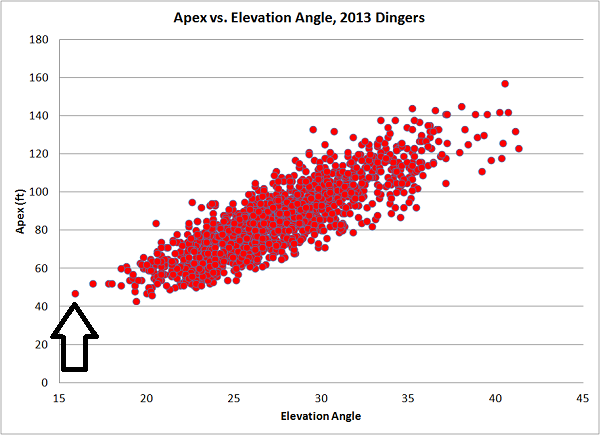
The game itself was actually pretty crazy considering all the run scoring as Fister and Holland were less than stellar after a couple of nights in which Anibal Sanchez and Justin Verlander struggled mightily. The nature of the game was interesting, but the moment(s) was/were clear. Cabrera had four hits (three HR) and a walk in five trips to the plate. Each was impressive, and it was one of those nights in which Cabrera just looked like he belonged in another league. The middle homerun was especially impressive considering that Holland actually ducks when Cabrera makes contact because the ball was actually hit on a very flat trajectory. Jeff Sullivan wrote about it as one of the more interesting homeruns of the year at the time.
Here is the GIF Sullivan made over at FanGraphs to show the duck more clearly:

Here, also, is Sullivan plotting the elevation angle and apex (peak height) of the homerun compared to all other homeruns through May 19th. Even when we look at the entire season, no non-inside the park homerun had a lower elevation angle and only fifteen have lower vertical peaks.
Miguel Cabrera is on this list quite a few times – already appearing at #19, and slotting in three more times before we’re all said and done.
How Was The Game? (May 19, 2013)

Is The Tigers Roster Set?
When Dave Dombrowski spoke with the media today, he made comments that suggested Joba Chamberlain will be the final significant acquisition the team makes this offseason. While Dave shouldn’t be trusted to always tell us the truth, it certainly does appear as if the vast majority of the roster is set.
Let’s take a quick peak at the 2014 Tigers:
Starters
C: Avila
1B: Cabrera
2B: Kinsler
SS: Iglesias
3B: Castellanos
LF: Dirks
CF: Jackson
RF: Hunter
DH: Martinez
Bench
Davis, Lombardozzi, Holaday, Kelly
Rotation
Verlander
Scherzer
Sanchez
Porcello
Smyly
Bullpen
Nathan
Krol
Rondon
Chamberlain
Alburquerque
Coke/Crosby/#2 Lefty
Long-man (Putkonen, etc)
—
So there are really only three possible ways the roster changes. The first would be grabbing a big time FA outfielder and shuffling the roles of Dirks and Davis. They could presumably also find another bench player and cut ties with Don Kelly, but that isn’t a significant change to the overall group.
The second change would be to add additional bullpen pieces. The Tigers could absolutely improve upon their bullpen and that would include signing a high quality lefty or righty and bumping anyone down a spot or two. This is reasonably likely, but the potential impact is small.
The third option is a ground-shaking trade. This isn’t to say that the Tigers intend to do this, but the only way to improve the position player group right now is to displace a solid starter in a trade. Only Choo remains on the free agent market as any kind of serious upgrade over what the Tigers have, so if you’re really going to improve, you’re going to have to make a big trade. Options here are limited as well. That’s the curse of being a good team, it’s really hard to get better. Not only do you have to find an available player on the market, but they have to be significantly better than the guy you have in there already. The Tigers can’t just go out and trade for a great centerfielder because teams don’t want to trade the really good ones and Jackson is already a 3-ish win player. The intersection of the Venn Diagram of “available” and “better than the current Tiger” is very small and very pricey.
So, it sort of looks like the Tigers are done. Maybe there will be some moves at the margins, but it’s hard to see a path to serious upgrade, and that’s disappointing. The 2014 roster as currently constructed is a lesser team than the one they put on the field in 2013. This looked like the perfect year to push all of their chips into the center of the table and go for it before it was time to break up the band. Instead, the Tigers are trying to to rebuild and go for it all at the same time. And it’s not working. They traded Fielder to free up money for other moves, but it turns out those moves are going to be extensions for Scherzer and/or Cabrera who will be past their primes for most of those deals. When they dealt Fister, not only did they get a weak return, they turned around and spent his salary on a relief pitcher who is 39. Nathan is still plenty good, but why would you spend money on an aging reliever if you’re also thinking about the future. Nathan only helps you in the short run, but if you care about the short run, Fister was more valuable to you than Nathan and the return you got for Fister.
My reading of the situation is that the Tigers are bumping up against an in-house spending limit and that Dombrowski was told to keep the 2014 payroll at a certain level. That doesn’t really explain his actions, but it explains why he didn’t spend more. The new coaching staff gave me high hopes, but I think the realistic expectation at this point is that the Tigers are heading into a shadow rebuild. They’re still the best team in the Central, but their ability to compete with the rest of the league is in jeopardy.
They’ll still be fun to watch, but it’s disappointing when you consider what they could have been.
 New English D