The Morning Edition (June 14, 2013)

From Last Night:
- Wainwright and Harvey don’t disappointed, combining for 14 IP, 9 H, 1 R, 3 BB, and 13 K as the Cards win 2-1
- The Cubs walk off the Reds in 14
- Parker and Kuroda pitch to a draw, the A’s win in 18
- Cain gives the Giants 6.2 scoreless as they beat the Pirates
- Tulo likely facing a “lengthy absence” after breaking rib
What I’m Watching Today:
- Matt Moore tries to avoid being dropped from the Appointment Television list against the Royals (7p Eastern)
- Westbrook comes of the DL to face Fernandez (7p Eastern)
- Bumgarner and Medlen in ATL (7p Eastern)
The Big Question:
- Can you believe our marquee matchup last night lived up to the hype?
After yesterday’s duel, Adam Wainwright (4.0) and Matt Harvey (3.3) are 1st and 3rd in pitcher WAR, only separated by Anibal Sanchez (3.4). In fact, Wainwright and Harvey are the only two pitchers in the top five who don’t play for the Tigers. It is perhaps worth noting that Wainwright and Harvey are excellent examples as to why the pitcher wins statistic is not useful for evaluating performance. Wainwright has a 2.18 ERA and 1.78 FIP. Harvey has a 2.04 ERA and 2.15 FIP. Harvey leads in K/9, Wainwright leads in BB/9 and HR/9, but both are great in each category. By all reasonable accounts, Wainwright and Harvey are two of the top few pitchers in the league. But Wainwright is 10-3 and Harvey is 5-1. Among the pitchers with more wins than Harvey is Jason Hammel, who features a 5.24 ERA, 5.09 FIP, and 0.4 WAR. Pitcher won-loss record is nonsense.
And now, because they’re awesome:

Stat of the Week: Run Expectancy
A point of contention among members of the baseball community is bunting. Most sabermetricians would tell you that the sacrifice bunt is overused because it gives away an out while a lot of on-field Dusty Baker/Harold Reynolds type people love bunting to move runners closer to the plate. I’m not here to argue for or against bunting, but rather to offer you a tool for determining the answer for yourself. This tool is a Run Expectancy Matrix.
The idea behind Run Expectancy is figuring out how many runs, on average, a team scores in a given situation (based on the number of outs and which bases are occupied). The values are based on long run averages and you can calculate them based on many years or a single year, but the ratios are generally going to be the same. Presented below is the matrix from 2012. What you see in the grid is the expected number of runs a team will score given the situation as presented by the top row and left column. You can use the RE Matrix to determine which strategic move is best for you.

So let’s use an example. Runner on 1st base, no outs. At this point, the team is expected to score .8577 runs this inning because, on average, teams have scored that many runs in the inning after those situations have occurred. If we were to sacrifice bunt in this situation, we would move to runner on 2nd, 1 out, which has an expected run value of .6551. That’s obviously less than .8577, so the sacrifice bunt in that situation is not the right play on average. You can play around with other situations on your own.
An important caveat is that this chart is context neutral and reflects averages. If the baserunner is Austin Jackson and the guy bunting is Miguel Cabrera, you’re hurting yourself more than if the runner is Victor Martinez and the bunter is Ramon Santiago. You should be more willing to give up an out to move a runner if the batter is more likely to make an out. However, that doesn’t mean it’s necessarily ever the right play to give up the out. A pitcher who hits .150 is almost definitely going to make an out, so you want him to move the runner up, but Miguel Cabrera is pretty likely going to get a hit relative to average, so you don’t want him intentionally making an out.
I don’t mean to suggest that you should take these numbers as gospel, but rather that you should be aware of which situations lead to the most runs and which situations you want to get yourself into if possible. The takeaway here is that we know how many runs a team is likely to score in a given situation and we can make some sort of educated prediction about what will happen if we do something else. Context matters, but this matters too.
I’m generally not a fan of the sacrifice bunt (or conversely the intentional walk), but there are occasional situations in which it makes sense. This RE Matrix should help you better understand which situations call for which moves.
As always, if you have questions about how this works or how to use it, feel free to comment or contact us. Also, please let us know if there is a statistic or sabermetric concept you’d like to learn about and we’d be happy to cover it.
An Unimpressive, But Important Verlander GIF
You’ve all seen the fancy Yu Darvish gif by Blackbelt Gifologist Drew Shepherd, and a lot of you have probably seen other MLB players get the same treatment. My editing skills are not nearly that good, but I would like to provide you with a GIF to illustrated that Justin Verlander is back on track.
Below you can see his velocity and movement from the terrible start in Texas and also his velocity and movement from his very good start yesterday in KC. As you can seen, the separation between the pitches is much better, but so is the movement. He’s good.

The Morning Edition (June 13, 2013)
From Last Night:
- Clete Thomas goes 4-4 as the Twins beat the Phils
- Miller K’s 10 but gives up 4 as the Cards fall to the Mets
- The Pirates outslug the Giants 12-8
- Frazier homers to lift Leake over Wood and the Cubs
- The Angels beat the O’s despite an 0-5 from Trout
What I’m Watching Today:
- WAINWRIGHT AND HARVEY. WAINWRIGHT AND HARVEY (1p Eastern)
- Guys, Wainwright and Harvey!
- Latos versus Sharky (1p Eastern)
- Darvish faces the Jays again (8p Eastern)
- Cliff Lee heads to Minnesota (8p Eastern)
The Big Question:
- Is Wainwright and Harvey a Cy Young battle?
That’s a bit of a misnomer, but it’s easily one of the top duels we’ve seen so far this season even if it won’t actually determine who wins the Cy Young. But it should inform who gets to start the All-Star Game. Verlander and Darvish was close as far as how each pitcher had performed up to that point, but not quite. Let’s look at the big one tomorrow:
Wainwright: 9-3, 93 IP, 2.34 ERA, 1.75 FIP, 3.8 WAR
Harvey: 5-0, 90 IP, 2.10 ERA, 2.20 FIP, 3.0 WAR
The two starters are 26th and 9th in K/9, 1st and 22nd in BB/9, 8th and 5th in ERA, 1st and 3rd in FIP, 2nd and 6th in xFIP, and 1st and 4th in WAR in MLB. So yeah, that’s pretty good. Watch it. And while you’re waiting for that one to start, check out New English D’s newest feature: New English D Audio.
New English D Audio: Episode 1 Featuring Cameron Bonk
On the first ever edition of New English D Audio I talk with Cameron Bonk of The Guy Show and The Farm Club about the state of the Tigers, specifically their bullpen, and about the difference between being a fan of one or multiple sports. I also hit Cam with some lightening round questions, including which Tigers player he would most trust to date his sister. The author apologizes for the slight inconsistency in volume, as he has just recently learned to create audio files. He promises future editions will not have this issue.
Enjoy and please direct any podcast related questions to NewEnglishD@gmail.com or @NeilWeinberg44 on Twitter.
Download (Approx 22 mins)
How Was The Game? (June 12, 2013)
Pretty much exactly what you’d have expected.
Royals 3, Tigers 2
Earlier this year I decried the performances of Justin Verlander and Yu Darvish in what was supposed to be a great duel, but Verlander and Shields lined up against each other today and gave the people what they wanted. The Tigers got single runs in the 1st and 5th and that would be it on the scoring as Verlander (8-4, 87 IP, 3.41 ERA, 2.49 FIP, 3.0 WAR) gave the Tigers 7 innings of shutout baseball that featured just 3 hits, 2 walks, and 8 strikeouts and Shields offered 7 2-run innings himself. After some struggles in May, Verlander looks like he’s back on track and pitching like the $200 million man. Unfortunately, Jose Valverde is pitching exactly like himself as well, which means he isn’t pitching well. Leyland went to him after Smyly allowed a baserunner in the 9th and Valverde gave up a game tying homerun two batters later. At this point, you can’t be mad at Valverde because he simply isn’t good enough to pitch in close games. This falls squarely on Leyland and Dombrowski’s shoulders. I just feel bad for him now. I don’t support the use of a closer at all, but if you’re going to use one, they can’t be this bad. Coke came on in relief of Valverde and gave up a run in the 10th to end it. The Tigers have still won 6 of their last 9 and are eight games over the .500 mark at 36-28. They’ll take Thursday off in preparation for a three game set with the Twins this weekend. Rick Porcello (3-3, 63 IP, 4.86 ERA, 3.67 FIP, 1.0 WAR) and his rising star (and amazing 2.96 xFIP) will take the mound in game one and may have Austin Jackson behind him depending on how he feels after today’s rehab game.
The Moment: Lough makes a diving grab to rob Cabrera of an RBI double.
The Morning Edition (June 12, 2013)
From Last Night:
- The Dbacks and Dodgers trade serious beanballs, brawl in LA, many suspensions to come
- Cole goes 6.1 in his MLB debut as the Pirates beat the Giants
- The Jays tie it in the 9th and win it in the 10th against the White Sox
- Kluber goes 8 to end the Indians’ skid
- Cingrani and the Reds unload on Garza and the Cubs
- Stanton homers in the 8th to avoid spoiling Turner’s strong outing
- Rays shell Lester
- Harang CGSO
What I’m Watching Today:
- Shelby Miller goes to Citi Field (7p Eastern)
- Corbin and Ryu in LA (10p Eastern)
- Bonderman gets the Astros in Seattle (10p Eastern)
The Big Question:
- So, no hard feelings between the Dodgers and Dbacks?
Hardly the case. Greinke hit Ross early in the game (not intentional at all), but things heated up when Kennedy hit Puig in the 6th and Greinke retaliated by hitting Montero in the 7th. Greinke came to the plate in the 7th and Kennedy hit him in the head, precipitating a massive bench clearing brawl that featured grown men tackling each other and punches being thrown. I’ve been pretty outspoken about the need to curtail this type of behavior in baseball. I wasn’t watching the game, so I don’t know which pitch was the one that started it, but everyone carries some blame for keeping it going. I hope MLB suspends everyone involved because there is just no place for this in the game. Intentional beaning is dangerous and childish, especially when it’s up around the head, but it’s even more ridiculous for adults to run onto the field and start fighting. I have no problem with certain members of the teams coming out to talk and yell about it, but it’s not appropriate to settle these things with violence. If this happened somewhere other than the field of play, there would be arrests. It reflects poorly on the sport, even if people enjoy it.
Dynamic Standings Projection (June 12, 2013)
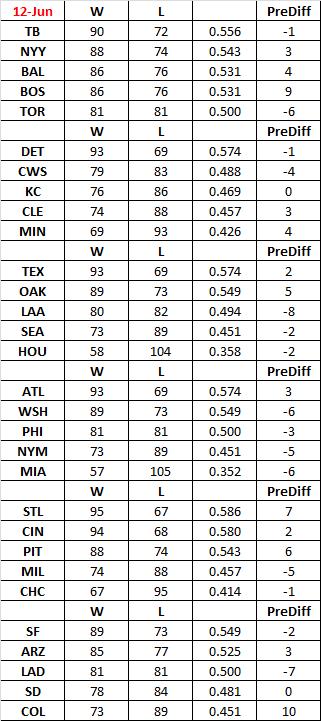
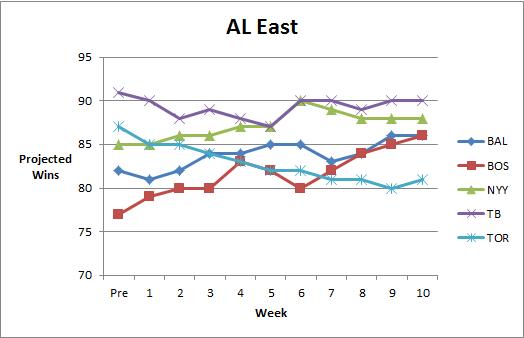
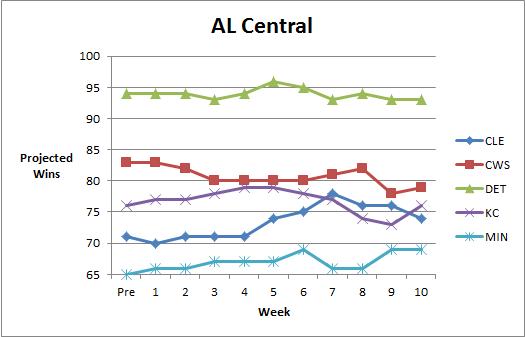
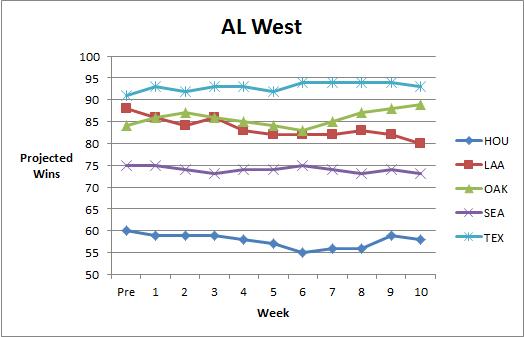
In case you missed it, in April we launched our Dynamic Standings Projection feature on New English D. A full explanation of the methodology can be found here or by clicking the tab at the top of the page. This project seeks to provide a reasoned and cautious approach to updating our beliefs about the baseball future. You can find a summarization of the original projections here. You’ll notice a column on the far right that indicates the difference in projected wins from the preseason prediction. Positive numbers mean teams are now projected to win more games and negative numbers mean a team is now projected to win fewer games. You’ll notice a series of graphs below the standings section that track how the projections have evolved over the course of the year.
This Dynamic Standings Projection is updated through the June 11 games.


How Was The Game? (June 11, 2013)
A close one, but a good one.
Tigers 3, Royals 2
Looking to stop the Royals winning streak, the Tigers sent Max Scherzer (9-0, 93.1 IP, 3.19 ERA, 2.49 FIP, 3.0 WAR) to the mound looking to deliver another great performance and after struggling with command in the first inning, he turned in another fine outing by providing 7 innings of 3 hit, 2 run, 2 walk, and 6 strikeout baseball despite having issues deciding on an outfit:
The 8 and 9 hitters did most of the heavy lifting as Infante went 3-4 and Kelly and Garcia combined to go 3-4. The Tigers got out to an early lead, but wouldn’t score the winning run until the 8th inning on a Martinez sac fly. Valverde made it interesting, but escaped the 9th thanks in part to a generous call by the HP umpire that wasn’t good, but wasn’t as bad as Butler thought:
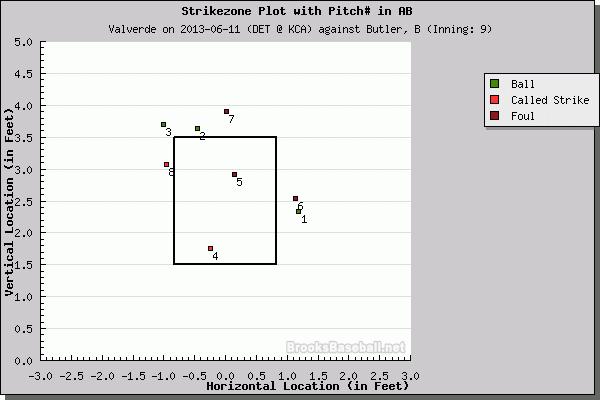
The win pushes the Tigers to 36-27 and they will go for the series victory behind Justin Verlander (8-4, 80 IP, 3.71 ERA, 2.57 FIP, 2.7 WAR) tomorrow in KC. In Verlander’s last start against the Royals this season, he went 7 innings and allowed 1 ER in an extra inning loss.
The Moment: Cabrera scores on a Martinez sac fly in the 8th.
Max Scherzer the Ace: The Key to His Transformation

I don’t need to tell you that Max Scherzer is an excellent MLB starting pitcher or that he’s having his best season to date. For one, I’ve already done so on a couple of occasions (Two Game Breakdowns: here and here). Also, you have eyes. You’ve watched him pitch and you’ve checked out his numbers.
But let me hit on some relevant points. Max Scherzer has the lowest walk rate of his career. He has the lowest homerun rate of his career. He has the lowest ERA, FIP, and xFIP of his career. He’s on pace for his highest WAR and might get there by August. He’s added a curveball and is using it along side his changeup to give hitters more frequent offspeed looks. He’s getting more groundballs than last year at the expense of line drives.
I’ve already laid out in the links above how well he’s avoiding the top of the strike zone. Heck, he’s throwing more strikes period. The worst things you can say about Scherzer this year is that his strikeout rate was about .25 K/9 higher last year and that his BABIP is a bit lower than we should probably expect it. That’s it. He’s due for a little regression to the mean, but almost all of his numbers look stable. This is the best we’ve seen from Scherzer. But you knew that.
You knew he’s 6th among pitchers in WAR, 4th in FIP, 5th in xFIP, and 3rd in K/9. You’ve seen it all. He’s finally putting it all together. That’s established.
So the next question is what’s different? Well I already mentioned the new pitch and the additional use of offspeed pitches. He’s throwing more strikes, but he’s not really inducing more swings and misses or more chases outside the zone. I’ve routinely talked about Scherzer’s need to rein in his wild delivery if he wanted to really have a great season. He’s doing that.
Let’s take a look at the pitches themselves. First we have single game averages from 2011:

Now here’s 2013:
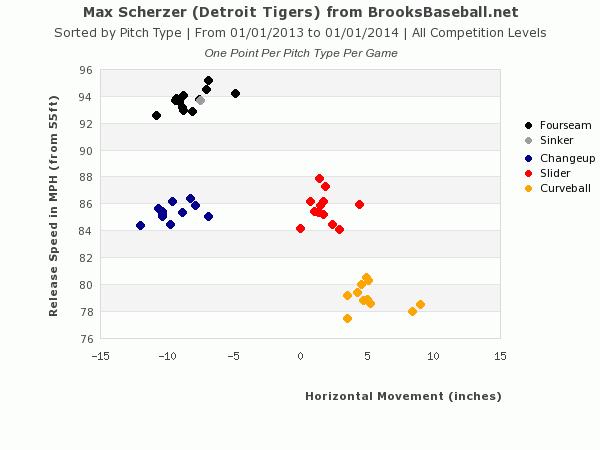
The scales are essentially identical, and while the sample size is 1/3 the size in the lower chart, you can see how much more consistent the velocity and movement are on his pitches these days. To me, that’s because he’s repeating his delivery much more so than he used to. The stuff was always good, but now he’s getting more consistent results because his release point is more consistent. Here are 2011 and 2013:

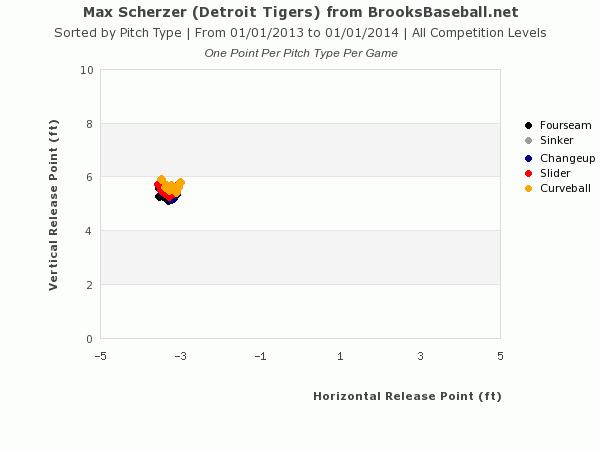
So let’s consider the facts. Max Scherzer has always had great stuff and his inconsistency held him back. Over the last the last couple seasons, he’s worked on it and has found a way to repeat his delivery such that the results are lining up with the scouting report. He’s having his best season yet and it looks like he’s finally climbed his Everest and figured out his delivery.
As he looks to make start #13 tonight, one has to ask if Max Scherzer is now officially an ace. I consider the top 15 or so starters to be aces and Scherzer is certainly one of those this year by every available measure and was just on the edge of that last season. But Scherzer also has the requisite dominant stuff that aces need and is capable of twirling a lights-out-10+K performance on almost any occasion.
Scherzer is finally getting results in line with his skills and he’s done so by going to his offspeed stuff more often and doing whatever he needed to do to get his mechanics in order so that he could command his brilliant stuff well. Max Scherzer has spent the last three years in Justin Verlander’s shadow. At times in Anibal Sanchez’s and Doug Fister’s shadow. But Max Scherzer is no man’s understudy. Max Scherzer is an ace all on his own. He’s making a case to start the All-Star Game in July and is very much in the discussion for AL Cy Young.
If you liked this, check out New English D on Porcello’s Breakout Campaign, Anibal Sanchez’s Cy Young Leap, The Tigers Approach to Pitching, and Why They Have the Best Rotation Ever.
 New English D