How Was The Game? (July 20, 2013)

A little sloppy all around.
Royals 6, Tigers 5
Justin Verlander (10-7, 131.2 IP, 3.62 ERA, 3.36 FIP, 3.0 WAR) didn’t have his best night, allowing 6 runs (5 earned) across 5.2 innings of work that included 8 hits and 4 walks to go with just 3 strikeouts. He did a nice job avoiding catastrophic damage and gave the Tigers a shot to claw back. He left the game with his team trailing 6-5 courtesy of 2 in the 1st, 1 in the 2nd, and 2 in the 5th thanks to solid production from the middle of the order and a big night for Avila. The Tigers had a great scoring chance in the 8th when the first two men reached, but Leyland gave away an out by having Jackson bunt and then Hunter and Cabrera grounded out before the Tigers could score and the Tigers were unable to knock in Hernan Perez in the 9th who pinch ran after a Martinez double. The Tigers will look to salvage one in the series on Sunday with Doug Fister (7-5, 121 IP, 4.02 ERA, 3.35 FIP, 2.6 WAR) set to take the hill
The Moment: Dirks beats out ground ball on a botched defensive play by Hosmer and Guthrie to set up two runs.
Torii Hunter Has Kept It Up

Aside from re-upping with Anibal Sanchez, the Tigers big offseason move was signing Torii Hunter to a two year deal to man RF at Comerica Park. He was coming off of a career year in which he posted a rather high Batting Average on Balls In Play (BABIP) which led most to believe he wouldn’t perform as well in 2013 as he did in 2012.
That’s a pretty simple belief and one that had a lot of merit. Players don’t often make dramatic changes to their offensive approach in their late 30s and have career renaissances. But after almost 100 games in 2013, it’s starting to look like Hunter’s change is real and sustainable and that he might just be the player he was last year.
Let’s start with a couple quick points. His defensive and baserunner numbers are way down this season. He’s playing around league average in the field and on the bases despite very good numbers in 2012. I can fully confirm the defensive issues as Hunter has made his share of bonehead plays in RF. In general, he’s not the great defender he once was, but he’s been perfectly serviceable out there and is a big step up from Brennan Boesch.
This post is about his offense because that’s the interesting thing. Let’s start with the basic career trends before we get into the last two seasons. If we just look at his basic offensive rate, he’s aged pretty well (what’s wRC+?)

But the key with Hunter was that he used to hit for more power with a lower on base. As he’s aged, those numbers have trended in opposite directions:

It’s not the easiest thing to see, but notice how his OBP has been picking up late in his career while his slugging is consistently much lower than it was from 2002-2009. This might make some sense if Torii was becoming a more selective hitter who drew more walks, but that’s not happening:
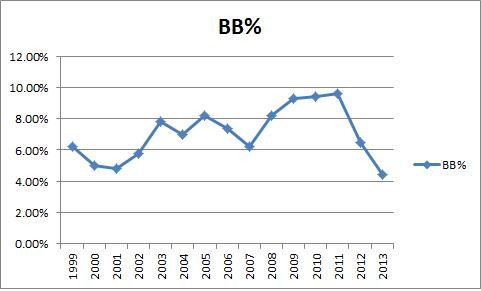
Um…what? Hunter is getting his offensive value from his new found OBP, but he’s walking substantially less that he used to. This is quite interesting. Obviously, you’ve figured out by now that the only way to do this is to substantially improve your batting average:

So this is a pretty clear story. Hunter is picking up his offensive value as he’s gotten older by getting on base via hits more often and hitting for less power than his younger self. In 2012 he posted a career high batting average and in 2013 is just ahead of that pace as I write this. Hunter is having another great offensive season relative to his career norm and age, and he’s doing it with fewer walks and long balls and more base hits.
He’s where the sustainability comes into play. As you can read about at the BABIP link above, you know that significant deviations from career BABIP norms are usually the kind of thing that won’t sustain themselves and players will revert back to normal. Here’s Hunter’s BABIP:
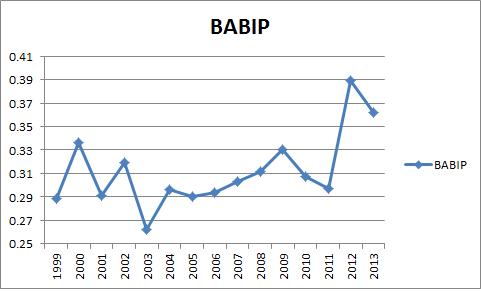
So that’s way different from anything he’s ever done. Early in his career he pushed .330 a couple times but he’s above .360 the last two seasons. What’s going on here? Well the reports are he has changed his approach as he’s aged in acknowledgement that he is no longer the power bat who hits for extra bases, but now it’s his job to get on for Pujols last year and Cabrera this year.
At the end of last season the word on Hunter was that he had a great year but a lot of it was luck driven by a high-unsustainable BABIP. Well he’s doing it again. We’re now at the point where Hunter has done this for almost 1,000 plate appearances, so it’s time to start believing. The Angels gave him Pujols in 2012 and then he moved to the Tigers in 2013 and got Cabrera, which instructed Hunter that his role would now be different and he would change his approach accordingly.
I’m now at the point where I think this is a real sustainable change. We’ve heard him talk about changing as he’s aged, but anyone can have a lucky year. We’re now to the point where it looks like this is for real. Take a look at his 2012 and 2013 numbers next to each other. Remember LA is a tougher park, but otherwise, this is crazy:
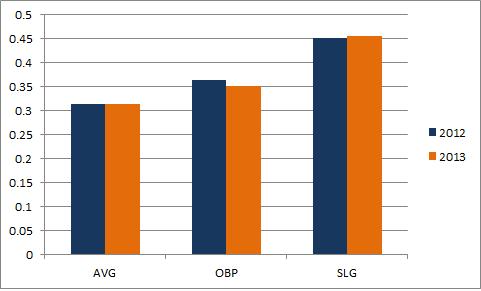
Hunter is doing pretty much the exact same thing he did last season. More hits, fewer walks, less power than his career numbers and a much higher BABIP. This is the new Torii Hunter and it’s real. It’s not luck. He’s different and it’s working. He may not be the defender or runner he once was, but he’s still league average in a corner and is something close to 20% better than league average at the plate. He’s gone from a power guy with a low on base like Adam Jones to a high OBP, lower power guy that’s just as valuable. That’s pretty good adaptation.
He’s posting the highest swing percentage and highest contact rates of his career. Here’s where it gets good. You can see it in other data. Check out his batted ball data, which only exists back to 2002:
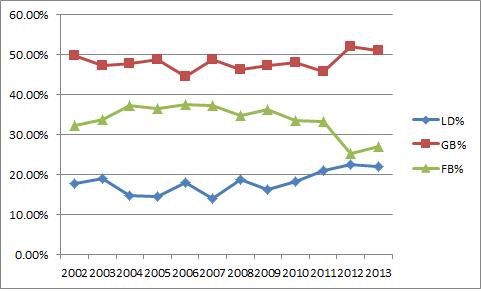
He’s cutting down on fly balls in exchange for more line drives and ground balls. He knows he doesn’t have the power he used to, so now he’s becoming a singles hitter who occasionally swings for the fences. It’s this type of change that leads me to believe the BABIP change is real and sustainable. Hunter is swinging more and making more contact while hitting the ball in the air less. That’s exactly what I’d tell someone to do if they were aging and trying to stay valuable without a great eye at the plate. Hunter has had some good walking years, but it’s never been his strong suit. Instead of adding discipline in his golden years, he’s adding singles. And it’s working.
Torii Hunter is on track for a 2.5-3.0 WAR season despite very pedestrian defensive and baserunning numbers. He’s doing a very nice job at the plate and there’s no reason to think it’s a fluke. The Tigers gambled on Hunter’s new approach being real and it’s working for them as much as it’s working for him.
The Nine Worst 100 RBI Seasons in MLB History
Yesterday we took a look at a case study in RBI to help explain why it’s a misleading statistic. The idea here is that RBI is very dependent on your team and the context you’re in. Two identical hitters will accumulate much different RBI totals depending on how many runners on base ahead of them and which bases those runners occupy. You can read all about it here.
Today, I’d like to start highlighting some broader evidence of the problems with RBI as a stat. You’ve already seen how a better season can result in fewer RBI depending on how the team around you performs, now let’s take a look at The Nine Worst 100 RBI Seasons in MLB History. This list is meant to show you that you can have a very poor season and still accumulate 100 RBI, which is often considered a magic number by people who value RBI. The phrase “100 RBI guy” is something you might here an analyst like John Kruk say when commenting on a player’s value. I’m here to show you that 100 RBI does not necessarily mean the player had a very good season.
Below, we have The Nine worst seasons by wRC+ since 1901 in which the player drove in 100 or more runs. wRC+ is a statistic that measures how a player stacks up to other players in the league and it factors in park effects. It’s easy to interpret the number. A wRC+ of 100 is league average and every point above 100 is a percent better than average a percent below average is a 99 wRC+. For example, an 85 wRC+ is a player who is 15% worse than a league average player. 115 wRC+ is 15% better than league average. You can read all about wRC+ here.
| Rank | Season | Name | Team | PA | RBI | AVG | OBP | SLG | wRC+ |
| 9 | 1927 | Glenn Wright | Pirates | 626 | 105 | 0.281 | 0.328 | 0.388 | 86 |
| 8 | 2006 | Jeff Francoeur | Braves | 686 | 103 | 0.260 | 0.293 | 0.449 | 84 |
| 7 | 1983 | Tony Armas | Red Sox | 613 | 107 | 0.218 | 0.254 | 0.453 | 84 |
| 6 | 1934 | Ray Pepper | Browns | 598 | 101 | 0.298 | 0.333 | 0.399 | 82 |
| 5 | 1990 | Joe Carter | Padres | 697 | 115 | 0.232 | 0.290 | 0.391 | 80 |
| 4 | 1993 | Ruben Sierra | Athletics | 692 | 101 | 0.233 | 0.288 | 0.390 | 79 |
| 3 | 1999 | Vinny Castilla | Rockies | 674 | 102 | 0.275 | 0.331 | 0.478 | 78 |
| 2 | 2004 | Tony Batista | Expos | 650 | 110 | 0.241 | 0.272 | 0.455 | 77 |
| 1 | 1997 | Joe Carter | Blue Jays | 668 | 102 | 0.234 | 0.284 | 0.399 | 72 |
What you have here is a list of players who are “100 RBI guys” who were substantially worse than league average. Perhaps some comparisons might be help. Let’s find a couple of current MLB players who slot in around 70-85 wRC+. Brendan Ryan has a career 72 wRC+. Jason Nix is at 72. Ramon Santiago is 75. Willie Bloomquist is 78. Ruben Tejada is 83. I’m not saying any of the guys on this list are bad players, I’m saying they all had bad seasons in which they still had 100 or more RBI. They guys had Ramon Santiago seasons at the plate and drove in over 100 runs.
Do you really want to place so much stock in a statistic that says a guy who hits like Brendan Ryan is among the league’s best hitters? I don’t. RBI is very much a team dependent statistic and we shouldn’t use it to value individual players. Players can’t control the situations you put them into, they can only control what they do in those situations. As seen here, even players who don’t do very well can still add RBI to their resumes if they are put into situations with many runners on base.
The Morning Edition (July 20, 2013)
From Last Night:
- Brandon Barnes hits for the cycle in a loss to the Mariners
- The Cards shell Marquis, but the Padres make it interesting
- Holland goes 8, but gives up 3 runs in a loss to the O’s
- The Phils pummel the Mets setting Kendrick up for a terrible start that still ends in a win
- The Rays win an 8 HR slugfest with the Jays
- Soriano coughs up a strong start for Strasburg
What I’m Watching Today:
- Hamles versus Wheeler at Citi (1p Eastern)
- Kuroda and Lackey (4p Eastern)
- Burnett takes on Latos (4p Eastern)
- Greinke goes against Gio (7p Eastern)
The Big Question:
- Where does the cycle rank among cool baseball achievements?
Obviously the cycle is awesome for it’s value (at least four times on base) and it’s cool factor (getting each type of hit) but where does it rank among other cool things. No-hitters, perfect games, 4 HR games, CGSO? Let’s take a look at the numbers since 1916:
- Perfect Games: 21
- No-hitters: 204
- Cycles: 240
- Cycles w/a walk: 39
- 4 HR: 14
- 15 or more K: 232
If you asked me I’d most prefer to attend a perfect game, no question, but all of them would be a lot of fun. I’ve been to about 3-4 near no-hitters and a 14 K game.
How Was The Game? (July 19, 2013)
Pretty quiet, but nice to have it back.
Royals 1, Tigers 0
The second half of the season got off to a bit of a slow start for the Tigers as they didn’t manage to provide any support for Anibal Sanchez (7-7, 98 IP, 2.85 ERA, 2.44 FIP, 3.3 WAR) who pitched in and out of traffic but avoided much damage, finishing with 6 innings of 1 run baseball, despite a hefty number of walks. The Tigers only put up 2 hits for their part and had quite a few balls die on the warning track. There’s not much else to say other than that the Tigers did a nice job preventing runs but couldn’t muster any of their own. They’ll be back at it on Saturday behind Justin Verlander (10-6, 126 IP, 3.50 ERA, 3.23 FIP, 3.0 WAR) who looks to build off an impressive first half finale.
The Moment: Fielder scolds Cain into tagging himself out on a weak ground ball.
Jason Marquis, Expectations, and Reality
 Should you be interested, I recently wrote a piece over in the Community Research section of Fangraphs breaking down the extreme difference between Jason Marquis’ very solid ERA and his all-time awful FIP. Not only is Marquis over-performing, he’s over-performing at an unprecedented level. I’ve mixed in some historical data and a comparison to a current MLB pitcher who has the same peripheral numbers but a much worse ERA. I hope you find the analysis interesting.
Check out the entire thing over at Fangraphs.
RBI Is A Misleading Statistic: A Case Study
One of our missions here at New English D is to help popularize sabermetric concepts and statistics and diminish the use of certain traditional stats that are very misleading. If you’re a return reader, you’ve no doubt seen our series about the pitcher win:
- The Nine Best Seasons Under 9 Wins
- The Nine Worst 20 Win Seasons
- Comparing Wins Over Entire Careers
- A Case Study from 2012 about Wins
- 12 Assorted Facts Regarding Wins
I encourage you to read those posts if you haven’t already, but I’m confident in the case I’ve laid out. Wins aren’t a good way to measure pitchers’ performance and I’ll let those five links stand on their own. Today, I’d like to move forward and pick up the mantle with another statistic that is very misleading based on how it is currently used: Runs Batted In (RBI).
I’ll have a series of posts on the subject, but I’m going to start with a case study in order to explain the theory. RBI are a bad statistic because they are a misleading measure of value. Most people consider RBI to be really important because “driving in runs” is critical to success, but RBI is very much dependent on the performance of the other players on your team. A very good hitter on a bad team will have fewer RBI than a good hitter on a good team because even if they perform in an identical manner, the first hitter will have fewer chances to drive in runners. Even if they have the same average, on base, and slugging percentages overall and with runners on and with runners in scoring position. The raw number RBI is a blunt tool to measure the ability to drive in runs.
Factors that determine how many RBI you have outside of your control are the number and position of runners on base for you, the number of outs when you come to the plate with men on base, and the quality of the baserunners. If you get a hit with runners in scoring position 40% of the time (a great number) but there are just 100 runners on base for you during a season, you will get no more than 40 RBI. If you get a hit 40% of the time and have 400 runners on base for you during a season, you could have 100 RBI. That’s a big difference even if you perform in the same way.
I’m not making the case here that RBI is completely meaningless and that hitting with runners on base is exactly the same as hitting with the bases empty, but simply that RBI as a counting stat is very misleading. Even if you think the best hitters are the guys who get timely hits and can turn it up in the clutch, you surely can appreciate that certain guys have different opportunities to drive in runs. RBI is very dependent on context and that means it’s not a very good way to measure individual players.
Allow me to demonstrate with a simple case study. Let’s start with comparing two seasons in which the following two players both played the same number of games.
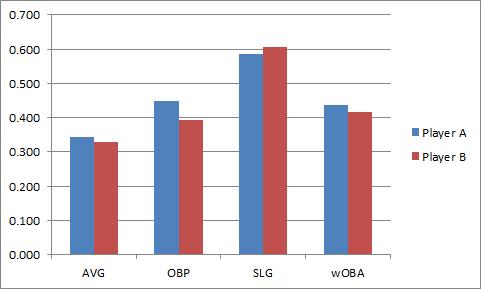
As you can see, Player A leads in average, OBP, and wOBA (what’s wOBA?) and is just a but behind in slugging. In wRC+, Player A leads 177 to 166 over Player B. If we take a look at BB% and K%, Player A looks much better.

All in all, Player A is the better player. We’ve looked at all of their rate stats and we’ve looked at wRC+ which controls for league average and park effect. It’s hard to argue that Player B is better. I couldn’t make a case to that effect.
Here’s the big reveal which some of you have probably figured out. Player A is Miguel Cabrera in 2011, Player B is Miguel Cabrera in 2012. This is the same player during two different seasons. In 2011, when Cabrera was clearly the better player, he had 105 RBI. In 2012, when he was worse, he drove in 139. Everything tells us he was better in 2011 except RBI. That should make use skeptical. It’s even more of a problem when you consider his situational hitting.
The graphs below are on identical scales:

Cabrera was better in 2011 in every situation and by each statistic except for his average (very close) and slugging percentage with no one on base. Which tells you nothing about how well he drives in runs. If you look at the HR distribution it tells you the same story.
| HRs | 2011 | 2012 |
| Bases Empty | 14 | 27 |
| Men on Base | 16 | 17 |
| Men in Scoring | 10 | 9 |
We can give him credit for those solo HR RBI from 2012, so let’s just lop 13 off the top. That still leaves 2012 Cabrera with 21 more RBI than 2011 Cabrera. Cabrera had a better season in 2011, but he had fewer RBI than in 2012. Most of this can simply be explained by the Tigers’ team OBP in the two seasons and where he hit in the lineup. If you subtract out Cabrera the Tigers got on base about 32% of the time in 2011 and 32.4% of the time in 2012 while Cabrera got to the plate a little less often because he hit 4th instead of 3rd. So there are more baserunners in general in 2012, but we can break this down even further.
In sum, Cabrera actually had more runners on base for him in 2011 than in 2012 but that doesn’t really tell the whole story. Let’s break it down by the number of baserunners on each base when he came to the plate:
| 2011 | 2012 | |
| Runner on 1B | 235 | 212 |
| Runner on 2B | 150 | 146 |
| Runner on 3B | 74 | 86 |
This should tell you the story even better. Cabrera had more baserunners in 2011, but the baserunners in 2012 were more heavily slanted toward scoring position. Cabrera had more runners closer to the plate so it’s easier to drive them in.
I intentionally chose Cabrera for this example because it strips away the idea that a given player just “has a knack” for driving in runs. Cabrera is an “RBI guy” if you subscribe to that idea. Miguel Cabrera had a better season in 2011 than 2012 when you break it down overall and in contextual situations. The only thing that helped 2012 Cabrera accumulate more RBI is that he had more runners on base closer to home when he got there. He played no role in getting those runners on base or closer to home, but he was able to more easily drive them and get credit in the RBI column. This is also isn’t as simple as converting RBI into a simple rate stat because where the baserunners are located and how many outs there are matter too, not just the number of situations.
This is the first step in a longer conversation but the takeaway point here is that RBI is stat that depends a lot on the team around you. Cabrera can’t control how many runners get on base and where they are on the bases when he comes to the plate. We shouldn’t judge a player for where he hits in the lineup and how the rest of the hitters on the team perform. It’s important to hit well with runners on base. I personally think we overvalue that skill over the ability to hit well in general, but I’ll leave that alone for now. Can we at least agree that a player who hits better with runners in scoring position and overall should be considered the better hitter? If that’s the case, then RBI is misleading you as an individual statistic. It’s that simple. I’m going to start laying out more evidence over the next couple weeks so stay tuned, but I’ll leave with this.
RBI is a descriptive statistic. It tells you who was at bat when a run scored and is critical to keeping track of a game in the box score. That’s why it was invented in the 1920s. You want to be able to scan a scorecard and recreate the game. RBI has a place in baseball, but only as a descriptive measure, not as a measure of value. Yet the RBI is still critical to MVP voting, arbitration salaries, and overall financial health of the players. They are judged by a statistic that doesn’t measure individual value and it is bad for their psyches. Players should focus on stats they can control and RBI isn’t one of those. It doesn’t measure individual value because as you can seen, in this very controlled example, RBI is misleading you.
The Morning Edition (July 19, 2013)
From Last Night:
- Sadness. There wasn’t baseball.
What I’m Watching Today:
- Strasburg faces the Dodgers (7p Eastern)
- Price looks to stay hot against the Jays (7p Eastern)
- Chen and Holland in Arlington (8p Eastern)
- Turner tries to keep it up in Milwaukee (8p Eastern)
The Big Question:
- Which team who’s out can make a run?
My own personal rule, and the rule of this site, is not to make anything about the standings until after the All-Star Break. You can discuss how individual teams have played, but you shouldn’t care about how they stack up until now. Every team is trying to win until now. At this point, teams take stock and think about buying and selling and whatnot. Now it’s okay to decide if you need some help or if it’s time to pack it in. There are currently 16 teams within 6 games of first place in their divisions, all of whom are at least in it for two more weeks. Some of those teams should sell because they’re not that good, but most of them are reasonably in it for now. Among those teams, the Nationals and Dodgers should be most on the radar as far as comebacks are concerned because the Dodgers are in a terrible division and the Nats have under performed. I bought the Nats in March and I’ll go down with the ship. This is a good team.
Tigers Second Half Preview and Top Moments of the First 94 Games
Let us begin to look forward first by looking back. During the first “half” of the 2013 season the Detroit Tigers were baseball’s best pitching staff with 17.1 WAR (what’s WAR?), a 3.26 FIP (what’s FIP?), and a 3.35 xFIP (what’s xFIP?). In fact, their starting rotation, when adjusting for park and league average, is the best starting staff in MLB history at 76 FIP-. The offense didn’t turn in an historic first half, but they were excellent, posting an MLB best 114 wRC+ (what’s wRC+?) and the fourth best position player WAR at 17.1.
There’s pretty much no case to be made that the Tigers aren’t one of baseball’s best teams so far, and there is no indication that will slow down in during the season’s final two months.
Some may fret that the Tigers are only on pace for 90 wins and that the Indians are hanging around their heels, but the Tigers have done this in each of the last two seasons and rode a strong final few weeks into the postseason. This is a veteran team that understands how to deal with the fatigue that comes in the dog days of August and should have no trouble coasting into the postseason.
They’ve had some bullpen issues, but with Valverde out of the mix Leyland is no longer intellectually trapped into using the wrong relief pitchers and is routinely turning to Smyly and Benoit in big situations. He has other talent down there and if Rondon can isolate his rough days, the Tigers should be able to hold together a reasonably good ‘pen with only a minor addition or two in late July.
The Tigers have obviously been lifted by an amazing season by Miguel Cabrera (205 wRC+) and more solid performances by Jhonny Peralta, Austin Jackson, and Omar Infate. Hunter and Fielder have had their issues, but have generally been contributing on offense well enough to make it work. Dirks hasn’t hit, but he’s played great defense and Tuiasosopo has given the Tigers 100 amazing PA out of nowhere. Avila has struggled, but has shown signs of life since coming off the DL.
The key to it all, likely is Victor Martinez, who was extremely unlucky on hard hit balls early in the season and has somehow managed to shake the curse over the last six weeks and has returned to form. If he keeps it up, the Tigers will be swatting away the competition with very little effort.
The Tigers have an all-time great starting rotation, the league’s best offense, and a bullpen that can do no worse than the did during the first half. The defense isn’t great, but the good pieces can carry the bad ones far enough. They should coast to an AL Central title barring any sort of significant injury, or ehem, suspensions. Since that seems too clear, let’s consider what the team has to do down the stretch to set themselves up for October success.
1. Manage the Outfield
One of the most interesting issues for the Tigers going forward will be how they handle left field. Currently, they are running a platoon with Dirks (who is a great defensive player this season) and Tuisasosopo (who is crushing like he’s Cabrera). It’s been a very effective tandem that has combined for a 9.0 UZR and .341 OBP while in LF. Alone, neither is a player worth blocking a top prospect for, but together they’ve been quite the weapon. Lurking, however, is Nick Castellanos who is offering a .281/.353/.455 line in Toledo and is probably MLB ready. How the Tigers work this situation will be key for their long term success. There is no sure way of knowing which move will give the Tigers the best shot at playing well for three weeks in October, but if they Tigers plan to test the Castellanos waters, they should probably see what they have sooner rather than later so they can correct any problems.
2. Find One More Arm
The Tiger bullpen gets a lot of grief, but Benoit and Smyly are two of the best couple relievers in baseball this season and the unit as a whole is respectable in most statistical categories. Without having to worry about Valverde blowing easy leads, the Tigers are actually in pretty good shape. They have a great pair for high leverage situations and have Rondon and Alburquerque who can shut hitters down with the best of them if you’re willing to accept the occasional meltdown. Phil Coke is better than he’s pitched, but even if he can simply get himself on track to shut down the occasional lefty, things should be fine for him. After that, you’re looking at a mix of Putkonen, Reed, and Downs (when healthy) to handle the lower leverage moments. I think all of those guys are solid options at the 6 and 7 spot in the pen and Downs has shown flashes that he could be something more. If the Tigers could just add one middle reliever who you can trust to give you consistent innings in 3-4 run games or to spell Benoit or Smyly in tight games, they should be all set. Dotel was supposed to be that guy, but he hasn’t thrown an inning since April and likely won’t be back any time soon. Jesse Crain would be a great addition, but the Tigers probably don’t even need someone that effective. Anyone reasonably competent without big platoon split will do.
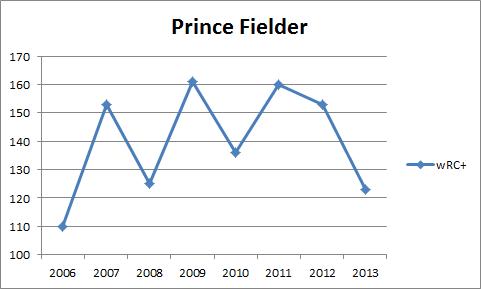
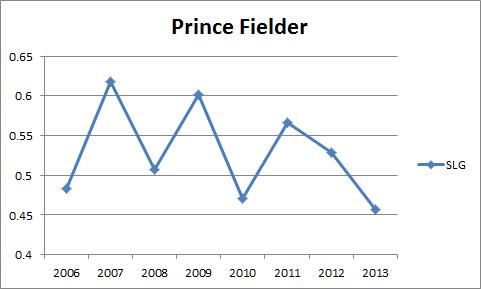
3. Get Prince Slugging
Prince Fielder (123 wRC+) isn’t having a bad season, but he’s not having a Prince Fielder season. He’s had ups and downs in his career and usually bounces back, but the Tigers are going to need a strong push from their slugging 1B if they’re going to be playing when the leaves turn brown.
 4. Don’t Touch Martinez
I’ve been pretty clear about Martinez being unlucky early in the season on hard hit balls and fully expecting things to even out. They are evening out right now. No one touch anything. Don’t tempt fate. Don’t even sneeze around VMart. He’s back to his old ways. Don’t be the one who screws it up.
5. Let Verlander Be Verlander
JV is having an excellent season by normal pitcher standards. He’s 9th in WAR for crying out loud. But by his standards he’s a little below where you’d like him to be. Accept that he’s getting older and won’t be as consistently brilliant all the time. Stop trying to get him to tinker and stop focusing on his issues. He’ll figure it out and even when he’s not “his normal self” he’s better than almost everyone.
6. Baby Steps with Avila
Avila was lost at the plate before going on the DL and has picked up a bit since coming back. You’re not going to get great production from Alex at C, just focus on good game calling and marginal offensive improvements. This is a great offense without him, just get him playing a little better and everything will be fine.
7. Keep Everyone Else Healthy
Peralta and Infante are having great seasons and Hunter is doing a serviceable job in RF. You don’t need these guys killing themselves out there every day to try and win 100 games. Give them plenty of rest and make sure they are performing at their best into October.
8. Just Get Out of Cabrera’s Way
This one’s easy. He’s the best hitter in the game, potentially on track for an all time great season. Just let the guy do his thing and enjoy.
9. Think About The Bench
The Tigers are in a tricky spot running their LF platoon because it gives them a bench that consists of the left fielder who isn’t playing and Kelly, Santiago, and Pena. Kelly is having a good season as a reserve (109 wRC+) and Pena is a necessity, but if the Tigers have to carry a middle infielder, you’re stuck with Santiago. This isn’t a problem for a long season, but they could use another bat off the bench in October and if Dirks isn’t swinging they are somewhat limited. You’d like a lefty power bat in place of a relief pitcher for the postseason, but the trick is where you find one. Lennerton is doing well in Toledo but doesn’t seem to have the attention of MLB minds and the Tigers don’t have anyone else in the system who fits the profile. You can pick a guy like that up in a deal, but to do that you have to have a roster spot that the team currently doesn’t have. It’s a bit tricky to make work with their current defensive game and it’s something worthy of consideration.
—
All in all, the Tigers are poised for a big second half and should have little trouble making the playoffs if everyone stays on the field. They have a great staff and offense and have been in this situation before. They need to prepare themselves for the grueling playoff push as they have hopes of winning four additional games and throwing a parade in early November.
It’s been a fun season and I’m looking forward to the last few months. If you’re new to the site, welcome. This is a place to both think analytically and to relax and enjoy. Baseball is fun. Go Tigers.
Here are the top 10 moments of 2013 so far (this was hard):
Apologies to: JV’s two no-hit tries, the Sale/Putkonen beanball affair, Fielder hitting the catwalk, Peralta’s walk off homerun, Porcello’s dominating outings, and the 4 HR inning Baltimore.
10. Brookens sends Martinez home and instead of being tagged out by 30 feet, Victor just turns toward the dugout.
9. Verlander heads to the other dugout entrance to avoid the Handshake of Doom.
8. Cabrera homers 3 times on Sunday Night Baseball in Texas.
7. Sanchez strikes out 17.
6. Sanchez takes a no-hitter into the 9th.
5. Victor Martinez makes a circus play against the Red Sox.
4. Brayan Pena tags out Nick Swisher on a ball Swisher thought was foul.
3. Alex Avila swats a 9th inning go-ahead bomb in Houston.
2. Max Scherzer strikes out Chris Davis with the bases loaded.
1. Brayan Pena absorbs a tackle from Justin Smoak to secure a 14 inning win in Seattle.
Revisiting The Nine Best Second Basemen for 2013
In the weeks leading up to the 2013 season, I unveiled my predictions for The Nine best players at each position. Some of the lists look good, some look terrible at this point, but that’s all part of the fun. Over the next two weeks leading up to the All-Star Game I will be revisiting these lists to see how things are going so far, around the halfway mark.
Obviously, the early evaluations will feature fewer than half a season and the later lists will feature a bit more, but try to think of these as the state of the position at the halfway mark. I’ll be using Wins Above Replacement (WAR) to generate the rankings because it is the number that best captures the entire value of a player. It isn’t perfect, so don’t take the precise values too seriously, but it’s certainly the best way to make any type of holistic list. WAR values offense, defense, baserunning, and playing time, so it represents exactly what I was trying to capture when I made the rankings during Spring Training.
Here’s how this will work. Below, you’ll see all nine players I ranked in the preseason and any player who currently ranks in the top 9 at that position. The current ranking drives the order and the preseason ranking and their current WAR is noted. Hit, miss, and push distinctions are based on where their first half places them going forward. For example, I can miss on a player even if I expect them to play much better in the second half if their first half was so poor that it is impossible to make up the ground overall.
We’ve already covered the catchers and first basemen, so let’s move on to first base. Here’s The Nine Best Second Basemen for 2013. Numbers are as of the All-Star Break.
81. Dustin Ackley, Mariners (Preseason Rank: 9, 2013 WAR: -0.6)
I would feel worse about Ackley if the rest of this list wasn’t as good as it is. I whiffed on this one. Ackley might have a future yet in MLB, but he’s not going to be a top 2B for 2013 unless something otherworldly happens. MISS
26. Aaron Hill, Dbacks (Preseason Rank: 4, 2013 WAR: 0.5)
Hill’s rate stats are great, he just got hurt and has only played 30 games after fracturing his hand. That’s not an “injury-prone” kind of injury, so it’s not like the kind of thing you should account for when considering a ranking because it could happen to anyone. This one is off, but for good reason. MISS
13. Ian Kinsler, Rangers (Preseason Rank: 5, 2013 WAR: 1.4)
Kinsler is much the same as Hill, as he missed time with an injury. The rate stats are good, but he hasn’t accumulated the value because he’s about 20-25 games short of his competitors. No sweat. PUSH
12. Neil Walker, Pirates (Preseason Rank: 7, 2013 WAR: 1.5)
Walker, too, is having a good season but missed a bit of time with an injury. He’s still pretty close to on track to finish 7th among 2B, so no issues here. HIT
10. Brandon Phillips, Reds (Preseason Rank: 6, 2013 WAR: 2.0)
Phillips is pretty much who I thought he’d be. A low on base, solid power guy who plays good defense. His precise ranking isn’t dead on, but it’s very close and there’s no reason to think he won’t be right around 6-8 when all is said and done. HIT
9. Marco Scutaro, Giants (Preseason Rank: N/A, 2013 WAR: 2.1)
Scutaro is a guy who has gotten better as he’s aged and is doing a nice job getting on base and limiting strikeouts. I had him out of the top 9, but not that far. I’ll call it a push and see how things go. He’d certainly have been 10-13th before the season. PUSH
8. Ben Zobrist, Rays (Preseason Rank: 2 among RF, 2013 WAR: 2.2)
Zobrist started the year in RF and I could only rank him in one place. I ranked him as the 2nd best RF in baseball. Nothing you can do about that. PUSH
7. Omar Infante, Tigers (Preseason Rank: N/A, 2013 WAR: 2.4)
Infante has done a very nice job improving his defensive and baserunning game, which has done a lot to improve his overall value. Infante was a middle of the pack guy for me, so I undershot him a little to this point. MISS
6. Howie Kendrick, Angels (Preseason Rank: N/A, 2013 WAR: 2.4)
Kendrick is another guy who I left just outside the list, and that’s on me. He’s having a strong year with the bat and it’s carrying him onto the list. MISS
5. Chase Utley, Phillies (Preseason Rank: 1, 2013 WAR: 2.6)
I’m a huge Utley fan and ranked him first as a bit of bold prediction that he’d stay healthy. He’s the best 2B in baseball in my book but he’s had trouble staying healthy, and despite missing about 25 games, he’s still 5th on this list. If he plays 65 games the rest of the way at the pace he’s on, we’re talking about a 5+ win player in 130 games. I’ll stand by him. He won’t finish first, but he’s definitely going to stick in the top five. HIT
4. Jason Kipnis, Indians (Preseason Rank: 8, 2013 WAR: 3.4)
Kipnis was one of those young players coming into the season who could easily have taken the leap or faded back. He’s done the former and has established himself as one of the game’s better power hitting second basemen with .514 SLG to go with his .383 OBP and good baserunning. Kipnis may not sustain this pace, but he’s a very good second baseman who I expect to finish in the 4-7 range this season. HIT
3. Dustin Pedroia, Red Sox (Preseason Rank: 3, 2013 WAR: 3.7)
Number 3, nailed it. Pedroia is just a great all-around player. I don’t think much else needs to be said about a guy who gets on base, hits for solid power, plays good defense, and runs the bases well. Pedroia is great. HIT
2. Robinson Cano, Yankees (Preseason Rank: 2, 2013 WAR: 3.8)
Another direct hit. Cano is a very good hitter, trailing only Kipnis and the guy who is 1st on the list in wRC+ and his defense and baserunning are about average. He’s been the only Yankees who can stay healthy and he’s setting himself up for a big payday. HIT
1. Matt Carpenter, Cardinals (Preseason Rank: N/A, 2013 WAR: 4.3)
I really like Carpenter as a player, I just had no idea he was going to turn into this guy. Pretty much everyone will tell you he’s turned himself into a much better player and when I wrote the original list he wasn’t even a lock to get the 2B job. He’s done a great job. He’s the best hitting 2B in baseball right now and is playing great defense. MISS
 New English D